Siddharth Malik’s success story in solar power for India

 How seven young entrepreneurs defied hurdles to develop clean renewable energy http://economictimes.indiatimes.com/news/emerging-businesses/entrepreneurs/how-seven-young-entrepreneurs-defied-hurdles-to-develop-clean-renewable-energy/ 4 AUG, 2012, SHREYA JAI,ET BUREAU articleshow/15347643.cms Renewable energy in India has always been a risky business, be it due to high input cost, unsteady market or lack of government support. But these seven young entrepreneurs defied all this and much more.
At a time when even big companies are reluctant to enter the renewable energy market due to the huge costs involved, they have come up with innovative solutions to develop clean energy, which brings down the costs and is accessible by the commons, even village folks, reports ET.
‘SWADES’ STORY IN REAL Siddharth Malik, 30 Megawatt Solutions, Delhi
AN engineering and management degree fromUniversity of Pennsylvania, a flourishing career with energy-focused companies in the US where the base package is a sinful $1,00,0000 per annum. What more can you ask for?
Well, Siddharth Malik had ideas. This passionate 30-year old left all this to come back to India and start his own renewable energy venture amalgamating high-performing solar-thermal systems with fossil fuels.
He started Megawatts Solutions in 2010, which provides concentrated solar-thermal solutions. “At least when sun is shining, fossils need not be fired,” says Malik, adding, “this simple idea creates long-term economic value for industry owners.” Its 0.5-mw pilot project in Guragon provides a hybrid solution by integrating solarthermal with fossil fuel that offers considerably higher value than stand-alone solar thermal plants.” It has resulted in up to 25% more efficient performance than competing technologies , which makes a drastic improvement in economics of solar,” adds Malik.
MS’ solutions are based on home-grown concentrated solar thermal technology and its role ranges from designing to manufacturing, installing and commissioning industrial-scale solar thermal projects. It has four projects in the pipeline including a 3 mw solar thermal heating project in Gujarat – the largest ever in India.
Decentralised solar power made poor Indian villagers the winners!
 Solar Power Helped Keep the Lights On in India By David Biello | August 1, 2012 Every day, at least 400 million Indians lack access to electricity. Another nearly 700 million Indians joined their fellows inenergy poverty over the course of the last few days, or roughly 10 percent of the world’s population.
Oddly enough, some of the formerly energy poor—rural villagers throughout the subcontinent—found themselves better off than their middle-class compatriots during the recent blackouts, thanks to village homes outfitted with photovoltaic panels. In fact, solar power helped keep some electric pumps supplying water for fields parched by an erratic monsoon this year.
That monsoon is partly to blame for the blackouts as well. A lack of rain has meant a reduction in power from India’s hydroelectric dams. Pair that with problems with the supply of coal to burn and the northern half of India found itself with not enough electricity supply to meet demand. One ironic anecdote illustrates this conundrum nicely: coal miners in northern India were trapped when their electric lifts failed as a result of the blackout exacerbated by a lack of coal….. http://blogs.scientificamerican.com/observations/2012/08/01/solar-power-kept-the-lights-on-in-india/
The secret, corrupt, and unaccountable face of India’s nuclear establishment
On account of the reluctance of the national media, print and electronic, to take up investigative journalism in the nuclear field , the Indian public has been deprived of a fair and full opportunity to know the true face of the Indian nuclear establishment.
Who Benefits From Nuclear Power Plants In India? By Buddhi Kota Subbarao. Ph.D. 02 August, 2012 Countercurrents.org The rest of the world is moving towards renewable energy and away from nuclear power. But India is pouring most of its energy budget into
establishing more and more nuclear power plants. It raises two compelling questions. Why is the present Union Government of India committing an enormous portion of its energy budget to imported nuclear power plants? Who benefits from these nuclear power plants?
The answers to these questions are not difficult to find. The secrecy that surrounds nuclear issues affords the Union Government to deal with vast sums of money in an easy way. Corrupt practices in the nuclear field do not get exposed as easily as in other fields. Big
money and political ambitions go hand in hand. This is one part of the answer. The other part is the way the Indian nuclear establishment functions.
Indian nuclear establishment has some unique features. Pursuit is more for administrative power and less for knowledge in science and technology. Consequently, pretence to knowledge grew over the years. Accountability is conspicuous by its absence. Mediocre results and at
times even nil results are proclaimed as outstanding achievements. The cleverness of the Indian nuclear establishment is from the way it can claim indigenous development and at the same time devise methods to import foreign technology. Continue reading
A new obstacle to Kudankulam nuclear plant
Kudankulam nuclear plant hits new hurdle, PM asks who will pay for mishap http://www.ndtv.com/article/india/pm-says-no-to-the-russians-in-the-kudankulam-project-250419 by Sunil Prabhu, Edited by Prasad Sanyal August 02, 2012 New Delhi: The Kudankulam nuclear power plant in Tamil Nadu has run up against new hurdles. This time, Prime Minister Manmohan Singh wants to know from the Department of Atomic Energy who will pay if there is a mishap at the power plant.
The PM, who is also the Minister for Atomic Energy, is questioning the department’s decision not to exercise the right to recourse – for units 3 and 4 of the project – in the event of a mishap at the plant. The plant is being built with Russian collaboration and the Russians have said they are keen that right to recourse should not apply to any part of this project. That would mean that the Russians will have no liability in case of an accident.
The PM has said that if such a waiver is granted to the Russian partners, other countries like the US and France, partnering India on such projects, will seek waiver too. Continue reading
Shoddy way that India’s government overrides anti nuclear villagrers
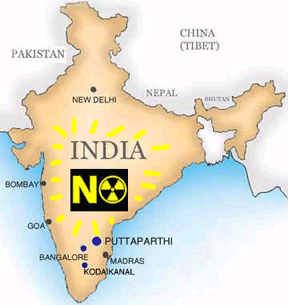
 Nuclear showdown in Delhi’s neighbourhood Rediff, 26 July 12, 2012 Gopal Krishna Plans to build India’s biggest indigenous nuclear power plant have failed to impress villagers in Haryana’s Fatehabad district, who fear a Fukushima-type disaster. The shoddy way in which the government agencies have handled the issue has not helped matters either. Gopal Krishna reports.
The angry protest by Haryana villagers against the proposed nuclear plant 210 km from Delhi on July 17 — a day after biggest rally in
Tokyo demanded an end to nuclear power — signifies the unity of the
struggle against nuclear power.
In Fatehabad, a big dharna and conference is planned on August 17, 2012 against the Gorakhpur nuclear power project. Continue reading
Nuclear showdown in Delhi’s neighbourhood Rediff, 26 July 12, July 26, 2012 Gopal Krishna “………. The three levels of conflict of interest that have been identified in
the EIA process for nuclear facilities are relevant for the EIA report of the proposed atomic power plant in Fatehabad.
First, the EIA is prepared by consultants who are retained to work on behalf of, and by implication act in the interests of, their client — the nuclear organization proposing the project.
Second, the organization that has been tasked with preparing the EIA to support its proposal for a project is the same which will benefit from the project.
The third conflict of interest is that the regulatory agency Atomic Energy Regulatory Authority is itself regulated by the nuclear power promoters, the Atomic Energy Commission, which is under the direct charge of Prime Minister Manmohan Singh.
The EIA report reveals that the water requirement for the project will be met from Fatehabad branch of the Bhakra canal. Unlike sea as a source of water in the case of Fukushima, in Fatehabad, canal water is the only source for water….” http://www.rediff.com/news/slide-show/slide-show-1-nuclear-showdown-in-delhi-s-neighbourhood-fatehabad/20120726.htm
Radiation exposure to over 40 Indian nuclear power plant workers
The first accident occurred on June 23 when 38 people were exposed during maintenance work on a coolant channel at the Rajasthan Atomic Power Station in Rawatbhata, senior plant manager Vinod Kumar told AFP.
Two of them received radiation doses equivalent to the annual permissible limit, he said, but all those involved have returned to work.
In a second incident last Thursday, another four maintenance workers at the plant were exposed to tritium radiation while they were repairing a faulty seal on a pipe.
India is on a nuclear power drive, with a host of plants based on Russian, Japanese, American and French technology under consideration or construction. … environmental watchdogs have expressed concerns about safety in India, where small-scale industrial accidents due to negligence or poor maintenance are commonplace and regulatory bodies are often under-staffed and under-funded…..
In May 2011, four labourers were exposed to low levels of radiation at the Kakrapur Atomic Power Station in eastern Gujarat state.
In November 2009, workers at a nuclear plant in southern Karnataka state fell ill after radioactive water contaminated their drinking water. … http://economictimes.indiatimes.com/news/politics/nation/40-india-nuclear-plant-workers-contaminated-firm/articleshow/15119386.cms
4 exposed to radiation at Rajasthan n-plant Express news service : Jaipur, Jul 24 2012 In the second such incident in a month, four workers at Rawatbhata Atomic Power Station in Rajasthan were exposed to harmful doses of leaked tritium radiationon July 19. Two persons were exposed to similar radiation on June 29.http://www.indianexpress.com/news/4-exposed-to-radiation-at-rajasthan-nplant/978569/
India’s farmers opposing nuclear power, and politicians taking up their fight
Nuclear power or not? Leaders fight it out (Haryana Newsletter) India Daily News, Chandigarh, July 20 — Leaders of all political hues in Haryana are fighting a nuclear war these days. The leaders have gone ballistic with their positioning over the issue of setting up a nuclear power plant in southwest Haryana. Continue reading
Delhi High Court considers radiation poisoning of university researcher
 “Strontium 90 is a toxic radioactive substance having a half life of about 28 years, a beta rays emitter and is one of the most hazardous products … Which if enters the human body, it accumulates within the bone marrow and over a period of time would cause certain type of cancers/tumors of the bone and of the blood cell….
they mixed the “hazardous and radioactive Strontium in a liquid form in cups of tea which the petitioner used to consume without knowing that those were contaminated.”
 Researcher Affected by Radiation: Centre’s Reply Sought http://news.outlookindia.com/items.aspx?artid=769120 PTI | NEW DELHI | JUL 17, 2012 The Delhi High Court today sought the Centre’s response to a plea by a researcher in a Haryana university accusing his guide and other staffers of making him drink tea, laced with radioactive element Strontium 90. Continue reading
Massive police presence does not stop public opposition to Gorakhpur nuclear power plan
Opposition demands scrapping of nuclear project, govt seeks to alley fears quoting scientists Deepender Deswal, TNN | Jul 17, 2012, ROHTAK: Haryana state committee of CPI (M) has demanded scrapping of the proposal for setting up a nuclear power plant at village Gorakhpur village in Fatehabad district in view of stiff opposition expressed by the villagers.
The farmers have been protesting against the proposed nuclear plant for many months and also registered their protest today during public hearing organized by the district administration. The party state secretary Inderjit Singh has claimed that the stand taken by CPI(M), opposition parties and other organizations has been vindicated by the open unwillingness of the people of the area.
He also criticized the massive deployment of police force at Gorakhpur and yet it could not deter the public from expressing their opposition to the nuclear plant. He also described the political stand of the ruling Congress leaders invoking the stand of former chief ministers
like late Devi Lal and Bhajan Lal regarding nuclear power as irrelevant stating that the situation had fundamentally changed in the aftermath of Fukusima accident in Japan.
“Congress leaders should see by themselves that there was a serious rethinking at global level in the matter of nuclear power”, he said…….
Gorakhpur farmers not impressed with pro nuclear speakers
Bishnoi, while addressing the farmers, said that as per rules, the locals should have been given the Environment Impact Assessment report one month before such a hearing, but it was not done.
Public hearing on nuke plant ends abruptly amid tension DNA, Jul 17, 2012, The public hearing on the proposed nuclear power project at Gorakhpur village here today ended abruptly amid tension triggered by the entry of political leaders at the venue.
The hearing was wound up within an hour after it started and efforts of nuclear scientists and Deputy Commissioner ML Kaushik to convince farmers went in vain as they were not ready to listen to them and raised slogans.
As Haryana Janhit Congress chief and Hisar MP Kuldip Bishnoi, and INLD leader Abhay Chautala entered the venue, the deputy commissioner stopped the proceedings and declared the hearing as “close and complete”. He abruptly wound up the discussion and left the place with the scientists and officers in a huff to avoid any ugly situation at the village where a huge police force was deployed. Continue reading
Secrecy and safety issues at troubled Kudankulam nuclear power plant
 An atom of doubt at the Kudankulam nuclear power plant Reuters, By Gokul Chandrasekar JULY 17, 2012 KUDANKULAM NUCLEAR POWER PLANT SAFETY ISSUES Opponents of the Kudankulam Nuclear Power Plant, under construction in Tamil Nadu, are raising fresh questions about the plant’s safety because of Indian government documents that they say reveal a problem in the design of one of the two reactors.
The reactor’s design differs from the plan that Russia and India came up with when they agreed to build the reactor in 1988, according to the documents published by India’s Atomic Energy Regulatory Board.
The design of the reactor pressure vessel, which contains the reactor coolant and core, was not supposed to have welds in its core region, the bulletin said. The vessel has two welds there, it said.
People who live near the Kudankulam plant and the People’s Movement Against Nuclear Energy called this deviation a “serious breach of contract” that exposes the plant to high failure risk and a higher possibility of offsite radiological contamination. Continue reading
Cancer and birth deformities toll, due to uranium radiation in Punjab groundwater
The effect of all this can be seen in the growing number of patients in the Malwa belt with cancer and other diseases and children being born with abnormalities. In fact, a train that connects Bathinda with Bikaner in neighbouring Rajasthan is known as the ‘Cancer Express’ as it ferries a large number of cancer patients from Punjab to Bikaner for treatment at a cancer hospital.
Groundwater contaminated, Punjab battles uranium curse Times of IndiaI Jul 13, 2012, CHANDIGARH, The high incidence of cancer and other diseases in Punjab’s Malwa belt has been highlighted over the last decade. Now, union Rural Development Minister Jairam Ramesh has confirmed the presence of uranium and other heavy metals in groundwater in the state, particularly the Malwa region, and serious efforts are afoot to control the damage. Continue reading
Nuclear capable missile tested by India
India tests nuclear-capable Agni-I missile South Asian News Agency (SANA) ⋅ July 13, 2012 ⋅ ALASORE, India on Friday successfully test-fired its indigenously developed nuclear capable Agni-I ballistic missile, with a strike range of 700 km, as part of the Army’s user trial from a test range at Wheeler Island off Odisha coast..
.. The trajectory of the missile, which has an operational strike range of 700 km, was tracked by sophisticated radars and electro-optic telemetry stations located along the sea coast and ships positioned near the impact point in the downrange area.
Weighing 12 tonnes, the 15-metre-long Agni-I, which can carry payloads up to 1000 kg, has already been inducted into the Indian Army. http://www.sananews.net/english/india-tests-nuclear-capable-agni-i-missile/
1 This Month
19 February – VIRTUAL EVENT-Decision Time: AI and Our Nuclear Arsenal
12:45 p.m. Central / 1:45 p.m. Eastern
To see nuclear-related stories in greater depth and intensity – go to https://nuclearinformation.wordpress.com

-
Archives
- February 2026 (161)
- January 2026 (308)
- December 2025 (358)
- November 2025 (359)
- October 2025 (376)
- September 2025 (258)
- August 2025 (319)
- July 2025 (230)
- June 2025 (348)
- May 2025 (261)
- April 2025 (305)
- March 2025 (319)
-
Categories
- 1
- 1 NUCLEAR ISSUES
- business and costs
- climate change
- culture and arts
- ENERGY
- environment
- health
- history
- indigenous issues
- Legal
- marketing of nuclear
- media
- opposition to nuclear
- PERSONAL STORIES
- politics
- politics international
- Religion and ethics
- safety
- secrets,lies and civil liberties
- spinbuster
- technology
- Uranium
- wastes
- weapons and war
- Women
- 2 WORLD
- ACTION
- AFRICA
- Atrocities
- AUSTRALIA
- Christina's notes
- Christina's themes
- culture and arts
- Events
- Fuk 2022
- Fuk 2023
- Fukushima 2017
- Fukushima 2018
- fukushima 2019
- Fukushima 2020
- Fukushima 2021
- general
- global warming
- Humour (God we need it)
- Nuclear
- RARE EARTHS
- Reference
- resources – print
- Resources -audiovicual
- Weekly Newsletter
- World
- World Nuclear
- YouTube
-
RSS
Entries RSS
Comments RSS
 nuclear-news