West Bengal government puts another fly in India-Russia’s nuclear ointment
The West Bengal government’s decision means that the hunt for a new site will begin afresh, at a time when anti-nuclear activists are protesting against nuclear power…
 Haripur site cancellation is one more wrinkle in India-Russia ties THE HINDU, 23 Oct 12 SANDEEP DIKSHIT Search on for another location for the proposed nuclear electricity park
There is another wrinkle in India-Russia relations, besides the known differences over Sistema’s telecom investments, the delays in the commissioning of aircraft carrier Admiral Gorshkov and the applicability of the nuclear liability legislation to units 3 and 4 of
the Kudankulam Nuclear Power Project.
India and Russia are scouting for another site for a nuclear electricity park after the West Bengal government decided to cancel the allotment of a site in Haripur. Continue reading
Russia’s Putin is put out about India’s Nuclear Liability Law
Kudankulam sparks ‘nuclear winter’, Putin defers visit Sachin Parashar, TNN | Oct 23, 201 NEW DELHI: In a sudden and unexpected move, Russian President Vladimir Putin decided to postpone his much-awaited summit meet with PM Manmohan Singh by close to two months. The meet, which was scheduled to take place on November 1 and for which groundwork had been completed during deputy prime minister Dmitry Rogozin’s visit to India last week, will now take place on December 24. .. TOI had learnt on Friday that since Moscow was not pleased with the outcome of Rogozin’s visit, Putin may decide to delay his India visit.
While the Russians had been maintaining that the cost of the reactors will go up substantially if suppliers are made accountable for compensation, they were still hoping that the two sides would be able to circumvent, if not override, the liability provisions through some arrangement that will acknowledge Moscow’s contribution to India’s nuclear power industry even during times of adversity. http://timesofindia.indiatimes.com/india/Kudankulam-sparks-nuclear-winter-Putin-defers-visit/articleshow/16920253.cms
Tamil Nadu – not a TOTAL disaster – solar energy policy
 TN Govt unveils solar energy policy http://www.thehindubusinessline.com/news/states/tn-govt-releases-solar-energy-policy/article4016264.ece R. BALAJI CHENNAI, OCT 20: Industrial and Commercial buildings connected to a high tension power load will have to use solar power to meet a portion of their power consumption , according to a solar energy policy announced by the Tamil Nadu Government on Saturday.
The policy offers incentives and mandates exploitation of solar energy in industrial, commercial and residential buildings. Continue reading
India and Australia both lying about nuclear weapons proliferation
The opening up of nuclear trade with India — first by the US in 2008 and most recently by Australia — has broader implications. It fundamentally changes the proliferation equation for other countries.
The most dangerous lie peddled by industry and by the Australian and Indian governments is that India has a strong track record of nuclear non-proliferation.
The Gillard government has no intention of seriously addressing any of the proliferation, safety, security and regulatory problems, nor does it care about the repression and murder of peaceful citizen protesters in India.
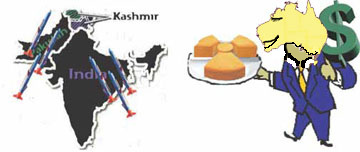
India’s Abysmal Nuclear Record, By Jim Green, New Matilda, 18/10/12 http://newmatilda.com/2012/10/18/indias-abysmal-nuclear-track-record
While the media focuses on Julia Gillard’s stumbles, India’s clunker of a nuclear industry stays unexamined. But hey, what’s a bit of nuclear proliferation between friends? Jim Green from Friends of the Earth on the South Asian nuclear arms race
According to Gemma Bailey, writing in the Australian Financial Review, Prime Minister Gillard has a cunning plan. She will ensure that Australia’s uranium supply treaty with India contains strict conditions on the safe use of the nuclear fuel. The plan, we’re told, “is intended to neutralise opponents who highlight that India has not signed the Nuclear Non-Proliferation Treaty.”
If only that were true. Here’s Gillard’s real plan: trot out tired old lines about strict conditions and hope that journalists will regurgitate them without question. For the most part, it works. …. At stake is the nuclear arms race in South Asia and broader, global nuclear proliferation concerns. As Ron Walker, a retired Australian diplomat and former Chair of the Board of the International Atomic Energy Agency (IAEA), said last year: “I am horrified that the media have not explained the enormity of this proposal.”
India is at least as culpable as its neighbours in fanning the nuclear arms race in South Asia. Continue reading
Australia’s hypocrisy in planning uranium exports to India
If we really want to assist Indian communities who currently lack access to electricity – and we should – it would be far more effective to prioritise exporting Australian expertise in regional renewable energy systems.
the admission this week from India’s own auditor that the country’s nuclear industry is “dangerously unsafe, disorganised and, in many cases, completely unregulated” – only compounds concerns.
When Australian uranium leaves our waters it effectively disappears from the radar. This is a profound concern for a fuel that can power either nuclear reactors or nuclear weapons. High-level Indian officials have stated that they need to source uranium from overseas in order to free up their own uranium for military purposes
No smooth passage to India for Australian uranium http://www.abc.net.au/environment/articles/2012/10/18/3612800.htm DAVE SWEENEY, ABC 18 OCT 2012 PRIME MINISTER JULIA GILLARD is in India this week and amid the staged handshakes and solemn exchanges of signed papers. The uranium sales plan is being heavily promoted. But there is growing concern both here and in India about the implications of the move and the fast-tracking of nuclear-armed India into the global atomic club.
No doubt Julia Gillard will be employing the age-old tactic of highlighting a problem that no reasonable person could ignore and then seeking to ‘own’ the solution. Proponents of the sales deal point to the estimated 200 million Indians who do not have reliable access to electricity as a rationale for the sales deal. But to link Australian yellowcake with lights and cookers in remote Indian villages is to draw a very long bow. Continue reading
Australian exports of uranium to India not likely to happen for years
India’s much trumpeted nuclear reactor construction binge has fizzled out… in the next five years we should not expect any shipments from Australia.
The India-US nuclear deal had one aspect of tacit proliferation built into its structure – the horizontal proliferation of knowledge from the civilian to the military
As a result while all kinds of water-tight restrictions were placed on the transfer of materials and power, none was placed on the movement of scientists. This of course was well known, the point was to acquire French reprocessing technology – ostensibly for civilian purposes but then to duplicate the same to improve India’s reportedly dismal weapons material reprocessing.
The scary state of Indian reactors, their safety and security has long been whispered about – but was blown apart by the CAG’s indictment a few months back.
Julia’s Nuclear Tango – Analysis http://www.eurasiareview.com/18102012-julias-nuclear-tango-analysis/
IPCS October 18, 2012 By Abhijit Iyer‐Mitra As expected, nuclear negotiations took centre stage during Australian
Prime Minister Julia Gillard’s visit to Delhi. Much talk of cultural links owing to the English language, cricket, a Westminster style parliament was bandied about. While Australia insists on a multifaceted engagement to build deep interdependencies, India sees only its one point agenda in all of this and has held ties hostage to the supply of Uranium. While opinions in Delhi seem optimistic many factors point to need for a hard reality check. Continue reading
Farce of Australia’s uranium deal, and award to Indian cricketer
Cricketism has brought India closer to Australia and nuclear grey deals brought them still closer and the announcement by a silly Australian PM to offer the nation’s prestigious awards to foreigners, especially in cricketism exercises. India needs Australian uranium for nuclear terror purposes
Mutual exchange of honorary degrees and awards are very common, like street robberies, in international politics for the promotion of trade in arms and nukes stuff.
Russians supply India nuclear stuff and Australians offer awards.
Why should the Indian regime of corporates and mafias kill people in Kudankulam?
India’s Archons bribes Australia for awards — Cricketism, The Canadian 18 OCTOBER 2012 BY DR. ABDUL RUFF ” …….Madam Gillard arrived in India after a surprise trip to Afghanistan had meetings with business leaders and their protector Singh in Delhi. Indian nuclear mafia abroad is doing well.
Australia’s ruling centre-left Labor party voted to overturn its ban on uranium sales to India last year after a long debate about nuclear weapons and reactor safety following Japan’s atomic crisis. Continue reading
India’s Supreme Court examines waiver of nuclear civil liability pact with Russia
Centre justifies waiver of nuclear civil liability pact with Russia THE HINDU, 19 Oct 12 J. VENKATESAN The Centre on Thursday justified in the Supreme Court waiver of the nuclear liability agreement with Russia for the Kudankulam plant in Tamil Nadu and said it was a policy decision taken at a time when no other country came forward to sustain India’s nuclear capabilities.
Making this submission before a Bench of Justices K.S. Radhakrishnan and Dipak Misra, Solicitor General Rohinton Nariman denied the allegation of Prashant Bhushan, counsel for petitioners, that the Government had signed the agreement to appease Russia…..
http://www.thehindu.com/news/national/centre-justifies-waiver-of-nuclear-civil-liability-pact-with-russia/article4010279.ece?homepage=true
Australian Prime Minister unwise to support India’s dodgy nuclear power program
India is pursuing an unreliable technology. The DAE’s plans involve constructing hundreds of fast breeder reactors.
there are reasons to be worried about the risk of severe accidents at Indian nuclear facilities.
 there are ongoing protests at all new sites selected for nuclear plants. The protracted and intense protests over commissioning of the Koodankulam reactors in Tamil Nadu is just the most spectacular of these.
India’s nuclear power failures warn against uranium exports, The Conversation, MV Ramana 16 October 2012, Selling Australian uranium is reportedly at the top of Prime Minister Julia Gillard’s priorities as she travels to India this week. Before she decides to do that, there are three facts she may want to consider. Continue reading
Nuclear power UNsafety in India
 India questions its own nuclear industry, SMH, October 15, 2012 ”…….India’s comptroller and auditor-general, Vinod Rai, has found the body that oversees nuclear safety in India, the Atomic Energy Regulatory Board, is ineffective, mired in bureaucracy and negligent in monitoring safety.
Sixty per cent of regulatory inspection reports for operating nuclear power plants in India were either delayed – up to 153 days late – or not undertaken at all. For power plants under construction, the number of regulatory inspections delayed or not done was 66 per cent.
Smaller radiation facilities operate throughout the country with no licences and no oversight at all. In many cases there are no rules for nuclear operators to follow. Despite an order from the government in 1983, the board has still not developed an overarching nuclear and radiation safety policy for India.
And even when laws do exist and are broken, the existing legislation gives the board almost no punitive power. In some cases, the fines for nuclear safety transgressions are as low as 500 rupees – less than $10.
India has had nuclear scares already. In 2010, a gamma irradiation machine containing Cobalt-60 was sold off by Delhi University for scrap. Pulled apart, it unleashed a massive dose of radiation, killing one person and putting another six in hospital.
The Indian government has legislation before parliament to replace the board with a new body, the proposed Nuclear Safety Regulatory Authority.
But Prabir Purkayastha from the Delhi Science Forum said: ”It is a very weak piece of legislation, that makes the regulator subservient to a group of ministers. It is a weakening of the current regulation.” http://www.smh.com.au/opinion/political-news/india-questions-its-own-nuclear-industry-20121014-27l0a.html#ixzz29Zt1gRpm
Extreme heat, police repression, nothing stops The People’s Movement Against Nuclear Energy (PMANE)
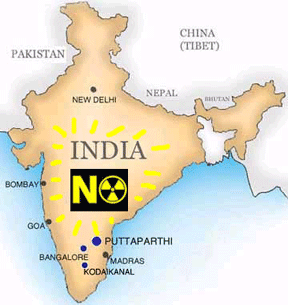 Anti-nuclear protesters lay seige to Kudankulam plant http://www.khaleejtimes.com/displayarticle.asp?xfile=data/international/2012/October/international_October252.xml§ion=international&col= 9 October 2012 The People’s Movement Against Nuclear Energy (PMANE) on Monday strengthened their 420-day agitation against Kudankulam atomic power plant in Tamil Nadu by laying siege of the plant.
Hundreds of fishermen and farmers from over 80 villages in Tirunelveli, Kanyakumari and Thoothukudi districts surrounded the sea 500 metres off the plant by placing their fibre boats and floating buoys. The protests passed off peacefully.
Defying the scorching heat, the protesters remained in the sea till evening demanding closure of the plant, 100kms from the Kerala capital of Trivandrum. The villagers also demanded withdrawal of police from the villages, release of those arrested and cancellation of false cases registered against them. Continue reading
Nuclear-capable Prithvi II ballistic missile test-fired http://articles.economictimes.indiatimes.com/2012-10-04/news/34260438_1_sleek-missile-strike-range-ballistic-missile Oct 4, 2012, BALASORE (Odisha): Sharpening its missile prowess, India today successfully test-fired its nuclear- capable Prithvi-II ballistic missile with a strike range of 350 km from a test range near here as part of a user trial by the army.
“The surface-to-surface missile was flight tested at around 0907 hrs from a mobile launcher from Integrated Test Range’s launch complex-3 at Chandipur,” defence sources said.
Death of democracy in India: anti nuclear heroes – “Enemies of the State”
 A non-governmental fact finding team that visited area found that police
  personnel had seriously injured many protestors, inflicted physical and verbal sexual abuse on several women, and at least two children had been stripped and tortured
serious criminal charges have been slapped against more than 150,000, mostly unnamed villagers…. at least 10,000 people are charged with sedition and waging war against the state..
India Clamps Down on Villagers’ Anti-Nuclear Protests, Earth Island Journal, BY NITYANANDJAYARAMAN – OCTOBER 4, 2012 In their eagerness to power the country’s growing economy, ndian authorities are treating opponents of nuclear energy as enemies of the state
If the chief minister of Tamil Nadu has her way, democracy would be dispensed with in the southern Indian state. On two separate occasions this year, chief minister J. Jayalalithaa let loose battalions of armed police on thousands of fisherfolk and farmers to crush their months-long non-violent protest against the unfinished nuclear power plants in Koodankulam and Idinthakrai, two coastal villages in the state.
In March, when she sent out security personnel to quell the protests, police squads blocked roads leading to villages and stopped essential supplies like milk and drinking water from reaching the area. (Read our earlier report on the conflict here.) Continue reading
Serious safety issues at Kudankulam nuclear plant – Supreme Court hears
 Kudankulam Nuclear Power Plant suffers from ‘serious issues’: Anti-nuclear activists tell Supreme Court
http://economictimes.indiatimes.com/news/politics/nation/kudankulam-nuclear-power-plant-suffers-from-serious-issues-anti-nuclear-activists-tell-supreme-court/articleshow/16670289.cms 4 OCT, 2012 NEW DELHI: Kudankulam nuclear power plant suffers from lack of safety measures and is plagued by several other “serious issues” and must not be commissioned till they are resolved, anti-nuclear activists told the Supreme Court today.
Appearing before a bench of justices K S Radhakrishanan and Deepak Misra, they submitted that the safety measures recommended by Atomic Energy Regulation Board (AERB) have not been put in place and government agencies have not determined till date the site for storing spent nuclear fuel.
“It is clear that KKNPP suffers from several serious issues that need to be resolved before the plant can be commissioned. Lakhs of people living in vicinity of the plant are bound to be apprehensive in such a situation.
“Instead of dealing with these issues and addressing the concerns in a meaningful way, the government has launched a wave of repression and has slapped 8000 sedition cases against peaceful protesters,” said advocate Prashant Bhushan, appearing for the petitioners. He said the government has not complied with the statutory guidelines framed by the National Disaster Management Authority (NDMA) regarding nuclear safety and pleaded with the apex court to restrain the Centre
from commissioning the plant. The bench, however, refused to pass any order and asked the petitioners to implead NDMA.
The petitioners’ counsel also questioned the Centre’s decision of exempting Russian reactor manufacturer firm from liability in case of accident due to defect in the reactor.
India: opponents of nuclear power treated as ‘pathological’
The way the Indian government has dealt with the opponents of the Koodankulam nuclear reactors being built in Tamil Nadu violates all three red lines.
The Department of Atomic Energy and its subsidiary Nuclear Power Corporation of India Ltd. see the opposition as a pathology to be cured by psychiatrists from the National Institute of Mental Health and Neurosciences.
Don’t impose K’kulam reactorshttp://www.thedailystar.net/newDesign/news-details.php?nid=252289, 3 Oct 12, Praful Bidwai Even zealous supporters of nuclear power should logically concede three things to their opponents. First, after Fukushima, it’s natural for people everywhere to be deeply sceptical of the claimed safety of nuclear power, and for governments to phase out atomic programmes, as is happening in Germany, Switzerland, Italy, and now Japan.
Second, nuclear power, like all projects, should only be promoted with the consent of local people, and with scrupulous regard for civil liberties. And third, safety must be paramount in reactor construction and operation, with strict compliance with rules laid down by an
independent safety authority. Continue reading
1 This Month
19 February – VIRTUAL EVENT-Decision Time: AI and Our Nuclear Arsenal
12:45 p.m. Central / 1:45 p.m. Eastern
To see nuclear-related stories in greater depth and intensity – go to https://nuclearinformation.wordpress.com

-
Archives
- February 2026 (161)
- January 2026 (308)
- December 2025 (358)
- November 2025 (359)
- October 2025 (376)
- September 2025 (258)
- August 2025 (319)
- July 2025 (230)
- June 2025 (348)
- May 2025 (261)
- April 2025 (305)
- March 2025 (319)
-
Categories
- 1
- 1 NUCLEAR ISSUES
- business and costs
- climate change
- culture and arts
- ENERGY
- environment
- health
- history
- indigenous issues
- Legal
- marketing of nuclear
- media
- opposition to nuclear
- PERSONAL STORIES
- politics
- politics international
- Religion and ethics
- safety
- secrets,lies and civil liberties
- spinbuster
- technology
- Uranium
- wastes
- weapons and war
- Women
- 2 WORLD
- ACTION
- AFRICA
- Atrocities
- AUSTRALIA
- Christina's notes
- Christina's themes
- culture and arts
- Events
- Fuk 2022
- Fuk 2023
- Fukushima 2017
- Fukushima 2018
- fukushima 2019
- Fukushima 2020
- Fukushima 2021
- general
- global warming
- Humour (God we need it)
- Nuclear
- RARE EARTHS
- Reference
- resources – print
- Resources -audiovicual
- Weekly Newsletter
- World
- World Nuclear
- YouTube
-
RSS
Entries RSS
Comments RSS
 nuclear-news