At Kolar Gold Fields, first cyanide dumps made people sick – now nuclear wastes
 Locals petrified of nuclear radiation in Karnataka http://timesofindia.indiatimes.com/city/bangalore/Locals-petrified-of-nuclear-radiation-in-Karnataka/articleshow/17331215.cms? By K RANGANATH, TNN | Nov 23, 2012 Having put their misfortunes behind them, residents of Kolar Gold Fields are now staring at the proposition of nuclear radiation in their neighbourhood.
The Union government’s unforeseen decision to dump nuclear waste in the now-defunct gold mines has come as a bolt from the blue. “We’ve had enough. Just as we thought it’s all over, this is a rude shock for us. Why does this country treat us like second-class citizens?” asked senior advocate P Raghavan, reflecting the town’s anger.
For residents, the downslide started with the closure of the Bharat Gold Mines Limited (BGML) in April 2000. The once buzzing township , given the name of ‘Little England’ , largely because of the presence of many Anglo-Indians , turned completely lifeless.
The township, with its population of 1.2 lakh, which till then depended on BGML for survival, found it hard to adapt to the harsh new reality.
The closure affected every aspect of life and the physical environment too. The local economy shrunk, and people started migrating to neighbouring cities in search of jobs. Former workers say they had no alternative means of earning a livelihood.
But this was just the beginning. The deadly silicosis disease struck the town, making the people’s lives even more miserable. The gold mining process at KGF generated about 32 million tonnes of tailings called cyanide dumps. Years of inhaling the gold dust aggravated the silicosis ailment among the former workers and their families living close to the site.
Since 2005, the disease, it is said, killed over 100 people in this town, the highest incidence reported in the state.
With their own lives a shambles, workers hoped their children, armed with an education they themselves did not get, would build new lives. They now see that dream being shattered, under the threat of nuclear waste dumping.
India: organisations join in protest movement against radioactive waste dumping
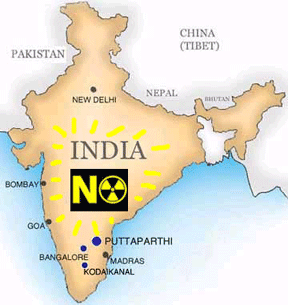 Protests against move to dump nuclear waste in KGF, KOLAR GOLD FIELDS, November 23, 2012 http://www.thehindu.com/news/states/karnataka/protests-against-move-to-dump-nuclear-waste-in-kgf/article4123795.ece?homepage=true
People in Kolar district are concerned over the likelihood of uranium waste generated at the Kudankulam nuclear power plant being dumped in the mine shafts of Kolar Gold Fields (KGF).
Reports that the Union government has filed an affidavit in the Supreme Court saying that nuclear waste from the Kudankulam plant will be stored in the disused shafts of Bharat Gold Mines Ltd. (BGML) in Kolar Gold Fields have stirred a hornet’s nest in the region with
people discussing the safety aspects of such a move.
Taken aback by the prospects of the gold mines turning into a dump yard for hazardous nuclear waste, a number of organisations irrespective of political affiliations staged a series of protests at KGF on Thursday. Continue reading
India’s Renewable Energy Scheme could still do well
it is vital for the government to ensure that RPO does not remain an
isolated initiative. Given the considerable renewable energy potential within India, a well-designed and workable RPO scheme, with the full support of state and Central policy makers, could result in promoting significant investment in this sector.
Renewed hope for alternative energy The mandate to buy electricity from renewable sources is not as stringent or unworkable as is commonly assumed ,Business Standard Ashwani Srivastava / Nov 23, 2012,
The Central government, in its post-policy-paralysis avatar, has been actively promoting the Renewable Purchase Obligation (RPO) scheme, which obligates electricity supply companies to ensure that a specified fraction of their electricity consumption comes from renewable sources.
The scheme was announced in April 2010, and, according to media reports, is currently facing “major hurdles”. Almost all state-owned electricity distribution companies (discoms),
and obligated entities have failed to meet their RPO obligation for 2011-12. This includes several large entities, including Reliance Industries and Steel Authority of India . Continue reading
The India Energy [R]evolution – jobs and energy security
The India Energy [R]evolution report jointly drafted by Greenpeace, the Global Wind Energy Council (GWEC) and the European Renewable Energy Council (EREC) focuses on the socio-economic impacts of renewable energy and proposes the pathway to ensure India’s energy security in the long run.
“With consistent and long term renewable energy policy frame work, India could build up a local renewable energy industry with an annual turnover of more than-INR 54,000 crore, creating more up to 24 lakh jobs by 2020.
 Renewable energy can create more jobs: Greenpeace, Electric Light and Power, New Delhi, Nov 17 (IBNS) Replacing fossil fuel with renewable energy can create more jobs and provide cheap electricity, said environmental organization Greenpeace.
Greenpeace has launched the second version of the Indian Energy [R]evolution – a roadmap to secure India’s growing energy needs without having to depend on the depleting and polluting fossil fuels.
The roadmap comes at a critical time when the country is facing massive power shortage due to the inability of fossil fuels to meet its economic aspirations.
Future of India’s growth lies with massive expansion and deployment of renewable energy technologies through key policy reforms and significant investments, without putting any negative impact on its pristine forest and dependent marginalised communities.
The India Energy [R]evolution report jointly drafted by Greenpeace, the Global Wind Energy Council (GWEC) and the European Renewable Energy Council (EREC) focuses on the socio-economic impacts of renewable energy and proposes the pathway to ensure India’s energy
security in the long run. Continue reading
India’s “democracy” – no right for Kudankulam public meeting about nuclear power
 Madras HC dismisses plea for holding public meetings in Kudankulam
http://www.dnaindia.com/india/report_madras-hc-dismisses-plea-for-holding-public-meetings-in-kudankulam_1765500, Nov 16, 2012,Chennai ANI The Madras High Court on Friday dismissed petitions which sought to declare the clamping of ban orders under Section 144 (1) of CrPC in Kudankulam as null and void.
It also refused to grant permission for conducting a public meeting to highlight demands against commissioning of the nuclear power plant. Continue reading
India’s Kudankulam nuclear power plant founded on illegalities
Kudankulam on shaky legal ground http://www.thehindu.com/opinion/op-ed/kudankulam-on-shaky-legal-ground/article4064951.ece D. NAGASAILA
V. SURESH 5 Nov Violations of Coastal Regulation Zone and Environmental Impact Assessment notifications make official claims questionable
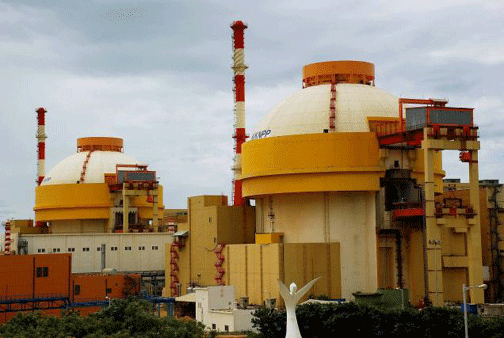
The debate over nuclear energy will go on, but the issue with the Kudankulam Nuclear Power Plant (KKNPP) is one of the several illegalities on which it is founded. Continue reading
Democracy eroding in India
ID please, keep it ready for all reserved rail trips after Dec 1 Hindu Business Line, MAMUNI DAS NEW DELHI, NOV 1: From December1, you require an original identity proof to travel in any reserved services of the Indian Railways. Those without identity proof will be treated as travelling without ticket and attract a penalty equivalent to the ticket fare….
http://www.thehindubusinessline.com/industry-and-economy/logistics/id-please-keep-it-ready-for-all-reserved-rail-trips-after-dec-1/article4054531.ece?homepage=true
A solar energy solution for India’s power needs
The solar-powered success of the Malankara Tea Plantation has national implications.
India’s most recent power outages demonstrate how important it is for the country and its peers to pursue the sustainable, onsite generation of renewable energy and move away from the fossil fuels and fragile power grids that left millions in the sweltering dark this summer.
Solar Energy Could Solve Developing Nations’ Infrastructure Problems Aol Energy , By Mark Cerasuolo November 1, 2012 The challenges with India’s public electricity grids last summer showed the world what happens when a country’s growth rapidly outpaces its energy delivery infrastructure and diversity of sources. When three of India’s electricity grids failed and more than half a billion people suffered two days of blackouts at the height of summer, the global media reminded us that even on the country’s best day, there is still an enormous portion of the population with no access to power. Solar energy is one way to solve this problem….
Today, India gets only one gigawatt of power from solar energy, a mere 0.5 percent of its total power consumption according to BusinessWeek . But the country’s solar capacity is growing, and the government is encouraging state utilities to tap into that capacity by offering companies the chance to trade renewable energy credits……
The Malankara Tea Plantation took advantage of the Indian government’s incentives on solar photovoltaic installations; it used capital subsidies of 90 rupees per watt up to a maximum of 30 percent of the project cost. It installed solar arrays and charge controllers that gave the company independence from the unreliable grid and made it one of India’s first net-zero energy buildings. The organization has also reduced its annual carbon emissions by 47 tons. Continue reading
India’s Attorney General not happy about waiving nuclear liability law for Russian nuclear reactors
 ‘Why nuclear liability waiver for Russian company’
 Dhananjay Mahapatra, TNN | Nov 1, 2012 NEW DELHI: Attorney general G E Vahanvati has reservations over the ministry of external affairs’ backing for grant of a nuclear liability law waiver to the Russian
manufacturer for Units 3 and 4 of Kudankulam nuclear power plant on the ground that while this could be legal under a 2008 inter-governmental agreement, it might not be prudent. Continue reading
Despite repression, 1000 anti nuclear protestors rally again at Kudankulam
 Protest erupts in Tamil Nadu over Kudankulam nuclear power plant, India Express, : Chennai, Oct 29 2012, Thousands of anti-nuclear activists thronged to the streets in Chennai on Monday in an attempt to lay siege to the state assembly as mark of protest against the Kudankulam nuclear power plant.
Protest against the power plant has only intensified over the past year, while nuclear fuel has already been loaded in the plant that is awaiting approval from the Atomic Energy Regulatory Board (AERB) for commissioning. Activists from various political groups and anti-nuclear bodies shouted slogans against the federal and state government, urging them to shutdown the plant permanently.
“Throughout Tamil Nadu, the state government has arrested hundreds and thousands of people to prevent them to come to Chennai to stage thisprogramme. In spite of that thousands of people have gathered here. We want that the Kudankulam nuclear plant should be closed, once and for all……
India: more arrests of peaceful protestors in Tamil nadu
We have information that 25 members of Tamizhaga Vazurimai Iyyakam from Salem (including the district secretary), 2 members of Dalit Viduthalai Katchi from Avinashi, and 1 member each from MDMK and Nam Tamilar Iyyakam from Tirupur are presently under preventive detention. The Police have maintained that they are only being detained and will not be arrested but the status remains unclear at the time of sending out this report.
Another 42 members of Pengal Munnani have been detained by the police at Kulithalai Railway Station and taken to Kulithalai police station. The police have said that they will get the signatures of the people and let them leave after 11 pm.
Kudankulam nuclear plant too close for Sri Lanka’s comfort
India’s nuclear fallout: Raise the bar to political level, The Sunday Times, 28 Oct 12 The Indian Government’s plans to expand its nuclear energy programme by establishing 48 new reactors throughout the sub-continent, more
than double of what it has, is already causing ripples within that country.
It will also be cause for concern for Sri Lanka whose population is less than 160 kms from India’s southern-most plant at Kudankulam and not too far away from the Kalpakkam plant. Continue reading
Nuclear lobby overrides democracy in India – ban on Australian filmmaker David Bradbury
 Australia’s best-known documentary film-maker, David Bradbury, was prevented by the Tamil Nadu Police from entering Idinthakarai.
The detention is likely to have international ramifications given the stature of Bradbury as a film-maker
Australian Film-Maker Stopped by Police in Koodankulam, Tamil Nadu By Sri Lanka Guardian October 26, 2012 Chennai, Amid conflicting reports about detention of Australian Film-maker David Bradbury in Koodankulam, we are posting below the updates as we receive them. After deportation of a German tourist and 3 Japanese activists, this is yet another move of stifling democracy by the Government which must be condemned in strongest terms. Continue reading
India stops Australian film maker entering Kudankulam anti nuclear protest area
Australian filmmaker prevented from entering Kudankulam 25 Oct 12http://www.dnaindia.com/india/report_australian-filmmaker-prevented-from-entering-kudankulam_1756187 , Oct 25, 2012, Three persons from Australia were today prevented from entering Idinthakarai, the epicentre of protests by People’s Movement Against Nuclear Energy leading the stir against Kudankulam Nuclear Power Plant in Tirunelveli district, police said.
Filmmaker David Bradbury along with his wife and son arrived in India on tourist visas and were about to enter Idinthankarai from Kanyakumari district this morning when police stopped them near Radhapuram police station, they said.
“After interrogations, the three were made to go back, since prohibitory orders were in place,” an officer said.
The PMANE has been leading protests against the plant for over a year citing safety concerns.
Commissioning of the first unit of the Indo-Russian project was originally scheduled for December last year, but has been delayed due to the protest.
While India’s nuclear dream languishes, solar energy up and running quickly
 The latest news is that Reliance is building Asia’s largest solar power plant in Jaisalmer district of Rajasthan. “The 250 MW plant being built with Areva of France would be ready by late 2014. The entire project would be ready by 2014”
Cheap nuclear energy is an illusion The Pioneer: Kumar Chellappan, 25 Oct 12 Nuclear energy is expensive and unsustainable, and takes more than a decade to be fully operational. It is also high on risks. Moreover, the 20 nuclear reactors spread across the country generate hardly 60 per cent of the total installed nuclear power
Hidden subsidies have helped the Nuclear Power Corporation of India Continue reading
1 This Month
19 February – VIRTUAL EVENT-Decision Time: AI and Our Nuclear Arsenal
12:45 p.m. Central / 1:45 p.m. Eastern
To see nuclear-related stories in greater depth and intensity – go to https://nuclearinformation.wordpress.com

-
Archives
- February 2026 (161)
- January 2026 (308)
- December 2025 (358)
- November 2025 (359)
- October 2025 (376)
- September 2025 (258)
- August 2025 (319)
- July 2025 (230)
- June 2025 (348)
- May 2025 (261)
- April 2025 (305)
- March 2025 (319)
-
Categories
- 1
- 1 NUCLEAR ISSUES
- business and costs
- climate change
- culture and arts
- ENERGY
- environment
- health
- history
- indigenous issues
- Legal
- marketing of nuclear
- media
- opposition to nuclear
- PERSONAL STORIES
- politics
- politics international
- Religion and ethics
- safety
- secrets,lies and civil liberties
- spinbuster
- technology
- Uranium
- wastes
- weapons and war
- Women
- 2 WORLD
- ACTION
- AFRICA
- Atrocities
- AUSTRALIA
- Christina's notes
- Christina's themes
- culture and arts
- Events
- Fuk 2022
- Fuk 2023
- Fukushima 2017
- Fukushima 2018
- fukushima 2019
- Fukushima 2020
- Fukushima 2021
- general
- global warming
- Humour (God we need it)
- Nuclear
- RARE EARTHS
- Reference
- resources – print
- Resources -audiovicual
- Weekly Newsletter
- World
- World Nuclear
- YouTube
-
RSS
Entries RSS
Comments RSS
 nuclear-news