Asdvanced nuclear missile being developed by India
India working on advanced nuclear missile Ft.com, By Victor Mallet in New Delhi 8 Feb 13, High quality global journalism requires investment. Please share this article with others using the link below, do not cut & paste the article. See our Ts&Cs and Copyright Policy for more detail. Email ftsales.support@ft.com to buy additional rights. http://www.ft.com/cms/s/0/3e1410e0-71e9-11e2-886e-00144feab49a.html#ixzz2KQm3xYXY
India is developing a new, long-range missile capable of delivering multiple nuclear warheads to different targets, a senior defence industry official said on Friday.
The missile, dubbed the Agni VI, would have a range of 5,500-6,000 kilometres, slightly farther than the already tested Agni V, but would also have so-called MIRV capability, according to defence analysts. Only a few countries have nuclear missiles with MIRV technology, which stands for Multiple Independently Targetable Re-entry Vehicle…… http://www.ft.com/intl/cms/s/0/3e1410e0-71e9-11e2-886e-00144feab49a.html#axzz2KQlwwnG5
Another nuclear capable missile test by India
India tests nuclear-capable missile
http://www.theaustralian.com.au/news/breaking-news/india-tests-nuclear-capable-missile/story-fn3dxix6-1226563126908
AAP January 28, 2013 AN Indian news report says India has
successfully tested a medium-range, nuclear-capable ballistic missile
fired from an underwater platform in the Bay of Bengal.
The Press Trust of India news agency says the missile would soon be
ready for deployment on platforms, including a nuclear submarine.
India’s Defence Ministry spokesman was not immediately available for comment.
Pallava Bagla, a defence expert, said Sunday’s test off the east coast
was 14th in the series with a range of 700 kilometres. It would
complete India’s nuclear triad – the capability to launch missiles
from land, air and below the sea.
India and its nuclear-armed rival Pakistan routinely test different
versions of their missiles. The countries have fought three wars since
they gained independence from Britain in 1947.
Tarapur Atomic Power Station (TAPS) – people’s lives in danger
The decommissioning cost of a nuclear reactor (about $300 million-5.6 billion) is more than the cost of construction and commissioning. That’s why TAPS hasn’t been decommissioned despite the American manufacturers’ advice to the government to do so in 1995
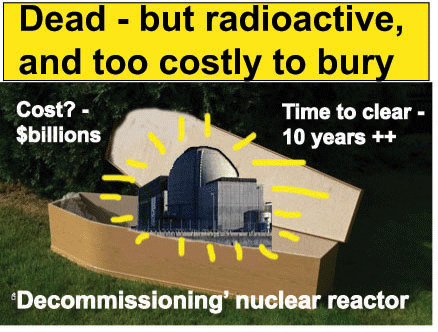
 When life is cheaper than nuclear power, Jan 7, 2013, By Dilnaz Boga | Place: Mumbai | Agency: DNA Poonam Hambire, a resident of Ghivali village, 12km from Boisar in Thane district, is at the forefront of the anti-nuclear agitation against the Tarapur Atomic Power Station (TAPS). “Women have to come forward as false cases are slapped against the male protesters in Tarapur,” she alleges.
Her village lies within the 1.6km radius around one the country’s oldest nuclear reactors built by General Electric in the 1960s. It’s the same model as Japan’s Fukushima reactor. The effects of radiation are obvious in every home not only in Ghivali but also in the neighbouring villages. Continue reading
Russia to make $squillions out of its nuclear sales to India
 India-Russia nuclear ambitions and mounting tensions in Sri Lanka,
Daily Mirror, by Dulip Jayawardena, 08 JANUARY 2013
KUNDANKULAM NUCLEAR POWER PLANT “……. the Russian President
Vladimir Putin paid a stand –alone visit to India on December 25 ,2012
for 15 hours to sign an agreement to collaborate to construct another
16 to 18 nuclear energy plants in India of 1000 MW each. At present
prices the total cost of these plants is a staggering US $ 45 billion! Continue reading
No evacuation plans for India’s dangerous Tarapur nuclear facility
 Nuclear troubles When life is cheaper than nuclear power, Jan 7, 2013, By Dilnaz Boga | Place: Mumbai | Agency: DNA
“……All nuclear-spent fuel from India is being brought to BARC, Tarapur, for reprocessing and later, cooling, storing and intermediate burial-storage, amounting to high concentration of nuclear activity material in Tarapur. Tandel explains that NPCIL has no evacuation routes for the villagers in case of emergency, or even any medical facilities, food or a shelter plan. Also, residents of Palghar and Dahanu are also at high risk. “Hence, we are opposing the expansion of the facility and the port that Jindal is going to build here,” says Tandel.
Every fortnight, the authorities take samples of soil and water for testing from the villages in the plant’s vicinity, but the results are never shared with the inhabitants…. “Labourers and contractuals are appointed from the roadside. There is no proper health procedure. They die on the roadside after their contracts are through…. Scientist Dr V Pugazhenthi, who had conducted a survey in Chinchani village, 8km from the plant two years ago, said cases of neuroblastoma can be attributed to radiation. “Even 40km away from the plant cases of unexplained anaemia, Down’s Syndrome, tumours, high rate of abortions and miscarriages and multiple myeloma are seen.” http://www.dnaindia.com/mumbai/report_when-life-is-cheaper-than-nuclear-power_1786292
India’s repression of anti nuclear protestors
 politicians, scientists, and bureaucrats have made every effort to crush agitation against the potentially lucrative KKNPP.
“We, the poor, are at the receiving end of all false promises given by the authorities,”
 police and intelligence agencies are stepping up their suppression of protestors.
269 persons have been arrested in connection with the agitation. Agitation leaders claim the number is much higher, with pending cases running into the thousands.
T. Peter, secretary of the National Fish Workers Forum, told IPS that many people have been taken into custody under the charge of sedition. He alleged that the establishment is trying to “sabotage” the protest movement and crush it with an iron fist.
Villagers Wail Against Nuclear Power, Independent European Daily Express, January 6, 2013 .“…..The Kudankulam Nuclear Power Plant (KKNPP), situated 24 kilometres from the world famous tourist town of Kanyakumari on the southern tip of the Indian peninsula, is likely to be commissioned this month.
Speaking to IPS, Mahalakshmi and dozens of women in Kudankulam, a village in the Tirunelveli district of the southern Indian state of Tamil Nadu, charged that the energy project would ruin their futures, homes and livelihoods. Continue reading
Thousands of anti nuclear protestors stopped by police, 2km from Jaitapur nuclear site
Indian protest movement spreads World Nuclear News, 03 January 2013
Mass public unease at nuclear power development has emerged at
Jaitapaur. Thousands of protestors were held by police today as they
attempted to surround the site of six planned reactors.
Groups representing villagers in the vicinity of the development in
western Maharastra state said they were angered by Nuclear Power
Corporation of India Ltd. (NPCIL’s) recent actions to move forward
with tenders towards the future power plant’s facilities. They said
tenders for a health clinic, fire station and security building showed
the national government had not given their concerns sufficient
attention and called for the project to be cancelled outright.
The march from surrounding towns to the plant attracted around 2000
people, according to a Business Standard report. Leaders had intended
to surround the 1000 hectare site and hand a letter to site managers,
but the crowd was stopped and held by police around two kilometres
from its destination…..
Five thousand villagers defy police in march and rally against Jaitapur nuclear power plant
 Villagers from Madhban-Mithgavane, Sakhrinate, Adiware, Dhaulwali,
Dhartale and other hamlets were taking part in the march Wednesday
despite prohibitory orders clamped by the local police to deter them.
Anti-nuclear plant protestors launch ‘jail-bharo’ in Maharashtra
http://india.nydailynews.com/business/2c7c1676293d2f93702509aa46ba49fd/anti-nuclear-plant-protestors-launch-jail-bharo-in-maharashtra
Jan 02, 2013 Ratnagiri — Thousands of villagers Wednesday launched a
‘jail bharo’ agitation demanding scrapping of the proposed 9,900-MW
Jaitapur Nuclear Power Project (JNPP) coming up here, an activist
said.
Nearly 5,000 residents from neighbouring villages and fishing hamlets
started a peaceful march to the JNPP site, some 400 km from Mumbai,
where they proposed to court arrest. Continue reading
New Year’s Eve anti nuclear protest against Kudankulam nuclear power plant
 Activists join anti-nuclear protesters on New Year’s Eve
http://timesofindia.indiatimes.com/india/Activists-join-anti-nuclear-protesters-on-New-Years-Eve/articleshow/17822395.cms
PTI | Dec 30, 2012 TIRUNELVELI: Several activists from various parts
of the country have arrived at Idinthakarai near Tirunelveli, the
epicentre of the over 500-day long agitation against the Kudankulam
nuclear power plant, to express their solidarity with the protesters
on the eve of New Year. Continue reading
Russia disappointed with India’s Nuclear Liability Law
 Still comrades after all these years, The Hindu KANWAL SIBAL, 28 Dec
12, “…….Russia’s disappointment with the delay in signing the
agreement on Kudankulam 3 and 4, despite the attractive financial
terms offered, is understandable. Having agreed to set up nuclear
plants in defiance of U.S.-led international restrictions on civilian
nuclear cooperation with India and supply nuclear fuel for Tarapur,
the Russians are resentful that India wants to treat them and the
Americans and the French alike with regard to our nuclear liability
law, especially as the inter-governmental agreement pertaining to
these reactors preceded our liability legislation.
However, with
Fukushima and the public agitation against Kudankulam 1 and 2, not to
mention the Supreme Court’s involvement in the matter, the issue has
become politically difficult for the government. The answer may lie in
increased cost of Russian reactors to cater for liability exposure. Continue reading
India standing firm against USA pressure to weaken its Nuclear Liability Law
 Won’t bow to US on nuclear liability law: Salman Khurshid Jayanth Jacob,Hindustan Times New Delhi, December 10, 2012 India has strongly rejected mounting US pressure to tweak its nuclear liability law — including suggestions that the legislation be interpreted by the International Atomic Energy Agency (IAEA) and revisited by Parliament.
Washington, DC, says the Indian law with stringent supplier international regimes on nuclear liability. If the IAEA says it is not compliant with the international system — as the Americans believe — they want India to “rework the law”, passed by Parliament. “The law (the Civil Liability for Nuclear Damage Act, 2010) has to be interpreted by our courts. Our courts are not subservient to any international organisation. They take into account our international obligations,” external affairs minister Salman Khurshid told HT in an exclusive interview……
The tough negotiations between India and the US also implies that commercial agreements for American companies to sell reactors to India are not likely any time soon, making operationalisation of the historic nuclear deal stuck in the last lap…..
http://www.hindustantimes.com/India-news/NewDelhi/Won-t-bow-to-US-on-nuclear-liability-law-Salman-Khurshid/Article1-970731.aspx
Renewable Energy – a job provider for millions of Indians
Indian Renewable Energy Sector to Create 2.4 Million Jobs by 2020 http://theenergycollective.com/energyjobline/147291/indian-renewable-energy-sector-create-24-million-jobs-2020 by C. Dominguez November 24, 2012 India’s renewable energy sector is to create up to 2.4 million jobs by 2020, according to a report jointly commissioned by environmental group Greenpeace, the Global Wind Energy Council and the European Renewable Energy Council.
To date, the sector employs 200,000 people, but this could jump 14 times by 2030 with the right policies and investments in place, stated India Energy [R]evolution report.
By 2050, about 92 percent of India’s energy infrastructure will be based on renewable energy sources. Renewables such as wind, solar thermal energy and photovoltaic, will comprise 74 percent of electricity generation. Continue reading
Kudankulam nuclear waste now a political issue in India
 “The people of Karnataka and the ruling BJP will not allow dumping of spent fuel from Kudankulam nuclear power plant in deep mines of KGF, as proposed by the Centre.”
BJP opposes nuclear waste dump at KGF The Pioneer, 25 NOVEMBER 2012 KESTUR VASUKI | BANGALORE The submission by the Nuclear Power Corporation of India Limited (NPCIL) to the Supreme Court to bury the spent fuel from Kudankulam nuclear power plant in Tamil Nadu at the now defunct Kolar Gold Fields (KGF), has become a major political issue. Continue reading
Understandably, Japan doesn’t like India’s Nuclear Liability Law
 Japan also sought some clarifications about India’s nuclear liability law that prevents suppliers from making themselves immune to compensation claims in the event of an accident.
PM revives nuclear energy talks with Japan By Sachin Parashar, TNN | Nov 26, 2012 NEW DELHI: PM Manmohan Singh sought to revive with Japan negotiations for peaceful use of nuclear energy, which has remained stalled since the Fukushima nuclear accident in March, 2011, in a meeting with his counterpart Yoshihiko Noda in Phnom Penh last week.
Sources said Singh expressed hope before Noda that Japan would soon share its nuclear technology and expertise with India. Continue reading
Underhand planning by Indian Government to dump nuclear wastes in Kolar Gold Mnes
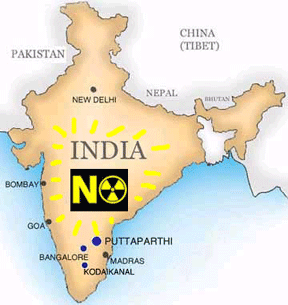 Kolar should not become nuclear dumpyard: Activists
http://www.newstrackindia.com/newsdetails/2012/11/23/379–Kolar-should-not-become-nuclear-dumpyard-Activists-, Chennai, Nov 23 (IANS) People’s Movement Against Nuclear Energy (PMANE) Friday said dumping spent nuclear fuel in Kolar gold mines could lead to disastrous health consequences.
“When all the national roads transport deadly nuclear cargo to Kolar (Kolar gold mines), millions and millions of our people in Karnataka, Andhra (Pradesh) and Tamil Nadu will be exposed to all kinds of threats and dangers. Nuclear waste management is much more expensive and dangerous than nuclear power plants and even most developed
countries such as the United States and Germany are not able to handle the waste effectively,” PMANE said in a statement.
“The Indian government should not go against the anti?nuclear trend of the world to promote the interests of the United States, Russia and France and expose the people of our country to nuclear dangers in Kudankulam, or Kolar or anywhere else,” the statement said. According to the PMANE, the Department of Atomic Energy (DAE) had not shared any basic information on storing the spent fuel of Kudankulam Nuclear Power Project (KNPP) at Kolar in Karnataka.
“The ad?hoc nature of the DAE’s decision?making and the short shrift given to science and public opinion are so glaring and, in fact, very disturbing,” PMANE said.
1 This Month
19 February – VIRTUAL EVENT-Decision Time: AI and Our Nuclear Arsenal
12:45 p.m. Central / 1:45 p.m. Eastern
To see nuclear-related stories in greater depth and intensity – go to https://nuclearinformation.wordpress.com

-
Archives
- February 2026 (161)
- January 2026 (308)
- December 2025 (358)
- November 2025 (359)
- October 2025 (376)
- September 2025 (258)
- August 2025 (319)
- July 2025 (230)
- June 2025 (348)
- May 2025 (261)
- April 2025 (305)
- March 2025 (319)
-
Categories
- 1
- 1 NUCLEAR ISSUES
- business and costs
- climate change
- culture and arts
- ENERGY
- environment
- health
- history
- indigenous issues
- Legal
- marketing of nuclear
- media
- opposition to nuclear
- PERSONAL STORIES
- politics
- politics international
- Religion and ethics
- safety
- secrets,lies and civil liberties
- spinbuster
- technology
- Uranium
- wastes
- weapons and war
- Women
- 2 WORLD
- ACTION
- AFRICA
- Atrocities
- AUSTRALIA
- Christina's notes
- Christina's themes
- culture and arts
- Events
- Fuk 2022
- Fuk 2023
- Fukushima 2017
- Fukushima 2018
- fukushima 2019
- Fukushima 2020
- Fukushima 2021
- general
- global warming
- Humour (God we need it)
- Nuclear
- RARE EARTHS
- Reference
- resources – print
- Resources -audiovicual
- Weekly Newsletter
- World
- World Nuclear
- YouTube
-
RSS
Entries RSS
Comments RSS
 nuclear-news