China joins the nuclear marketing frenzy to sell to India
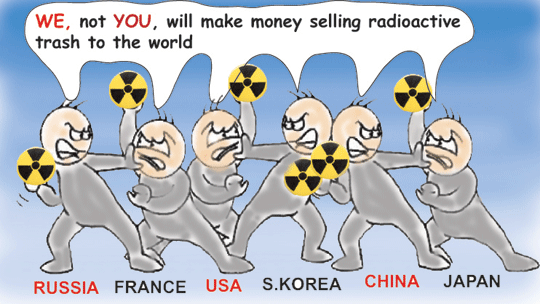 China joins nations eyeing India’s civil nuclear sector, Cold Air Currents, 21 Sept 14 Yahoo News UK: NEW DELHI (Reuters) – China became the latest nation to line up for a stake in India’s civil nuclear energy drive on Thursday, agreeing to open talks on cooperation in a sector that New Delhi sees as the solution to its chronic power problems.
...”I think the Chinese are looking basically at the commercial angle, since India is going to be giving contracts for nearly $150 billion in the next 10-15 years,” said Srikanth Kondapalli, a China watcher at Delhi’s Jawaharlal Nehru University.
The announcement, made after Xi met Prime Minister Narendra Modi in New Delhi, comes on the heels of a deal India struck earlier this month to buy uranium from Australia to increase its fuel supplies.
Days before that, Modi and Japanese Prime Minister Shinzo Abe agreed to accelerate talks on a nuclear energy pact……http://coldaircurrents.luftonline.net/2014/09/china-joins-nations-eyeing-indias-civil.html
India’s uranium legacy of birth defects
 India’s nuclear nightmare: The village of birth defects The Star.com By: Raveena Aulakh on Mon Sep 15 2014 Indian court trying to unravel mystery of sick and disabled children, miscarriages and fatal cancers around the country’s first uranium mine……..Now, an Indian court wants to unravel the mystery of what is happening in Jadugora, the hub of India’s uranium mining industry since the late 1960s……..
Today, nuclear power provides less than 5 per cent of India’s electricity. The aim is to make it 25 per cent by 2050. This month, Australia signed an agreement giving India access to its vast supplies of uranium.
But activists say Jadugora is paying the price for India’s nuclear dreams……….
Until a decade ago, miners took their uniforms home to be washed by their wives or daughters, says Xavier Dias, a political activist who has worked for decades with the indigenous people who made up the majority of the mine’s workforce.
“They never wore masks then … or boots. Or even gloves.”
The workers were free to take building materials from the mine and even waste material, which they used to build their homes, he says.
When people began to notice that young women were having miscarriages, witches and spirits were blamed. Prayers were said to ward off the “evil eye.” But people had lesions, children were born with deformities, hair loss was common. Cows couldn’t give birth, hens laid fewer eggs, fish had skin diseases.
“If you ask the tribals (as the indigenous people are known) who have lived there for decades, long before uranium was discovered, they will tell you that they lived healthy lives, drank from the rivers, ate fruits and vegetables … and they never saw the inside of a hospital,” says Dias……
In Jadugora, tailing ponds take up more than 65 hectares — and they are all uncovered with easy access for people and animals. A few homes stand fewer than 50 metres from the pond’s edge. There are some no-trespassing signs, but children still play cricket or hopscotch nearby. Another tailing pond a few kilometres away sits beside a busy street with pipes constantly delivering more sludge.
The tailing ponds tend to overflow, especially during monsoon season, say villagers. If that happens, radioactivity can seep out and contaminate the groundwater and rivers. River water is used for washing and bathing, sowing and irrigation — and sometimes for drinking.
Trucks filled with yellow cake or mine waste trundle day and night along the highway. The cakes are covered with flimsy plastic covers; sometimes bits of rubble fall off………
The Jharkhand High Court is also looking for answers.
In March, it sent a notice to UCILasking for an explanation for the deformities, cancers and miscarriages around the Jadugora mine. It based the notice on local media reports, which included shocking pictures of children who were sick or deformed. (The demand was made by the court unilaterally, without a filing by officials or victims, in what is known as a suo moto action.)
According to local reports, UCIL told the court that the radiation emitted through its mining is under permissible limits and contained within a safe zone. The court refused to accept the submissions because they were old.
In August, the court also asked that the company disclose the radiation levels and the presence of any heavy metals in soil and water in the cluster of villages around Jadugora. It also asked UCIL to explain how it ensures the safety of those who live near radioactive waste.
The answers are due in November……….
While families of children with deformities will tell their stories to reporters, the families of women who have been unable to get pregnant or who have had unexplained miscarriages often don’t.
Since Jadugora’s health problems made the local newspapers, few families receive marriage offers for their daughters. In a country where not being able to bear children is such a stigma that women are either thrown out by their in-laws or banished to their parents’ homes, Jadugora women are now tainted and unwanted……….http://www.thestar.com/news/world/2014/09/15/indias_nuclear_nightmare_the_village_of_birth_defects.html
Closure of uranium mines by State in East Singhbhum
Uranium Corporation stops mining at Jadugora after 47 years B Sridhar,TNN | Sep 8, 2014 JAMSHEDPUR: Uranium Corporation of India stopped all mining activities at Jadugora in East Singhbhum from Sunday after 47 years. following a ministry order in July.
The Centre, following a Supreme Court order in May on amendment of Mineral Concession Rules, 1960, issued a directive to all mineral-rich states on July 12 asking them to stop mining by corporate entities under deemed extension. The state then ordered closure of the decades-old uranium mines. “We have served the notice to UCIL (Uranium Corporation of India) informing the company about the directive of the state government,” said district mining officer Ratnesh Kumar Sinha…….http://timesofindia.indiatimes.com/city/ranchi/Uranium-Corp-stops-mining-at-Jadugora-after-47-years/articleshow/41970997.cms
The one big hurdle to the India-Japan nuclear deal
The hurdles to this deal emanate from Japan’s insistence that no reprocessing of spent fuel would be done in India, and that in the event of a nuclear test by India, the components supplied would be immediately returned to Japan.
The nuclear thorn in India-Japan ties http://www.thehindubusinessline.com/opinion/the-nuclear-thorn-in-indiajapan-ties/article6383865.ece?utm_source=RSS_Feed&utm_medium=RSS&utm_campaign=RSS_Syndication BHASKAR BALAKRISHNAN 5 SEPT 14 The recent visit to Japan by Prime Minister Narendra Modi has brought into focus the ongoing India-Japan negotiations on a civil nuclear agreement. This remains an item of unfinished business, though both sides have declared that it would be pursued with greater vigour. Exactly how important is this agreement in the context of India’s nuclear programme? What factors underlie the Japanese position? Continue reading
Why Australia should NOT sell uranium to India
Australian and Indian nuclear trade http://www.dailytimes.com.pk/opinion/29-Aug-2014/australian-and-indian-nuclear-trade Hasan Ehtisham 4 Sept 14 Adding Australian uranium into India’s energy mix would have serious fallouts on prevailing strained relations between India and its nuclear-armed neighbours Australia is expected to sign a civil nuclear agreement with India during the visit of Australian Prime Minister Tony Abbott early next month. Negotiations have been concluded to smooth the path for uranium imports from Australia.
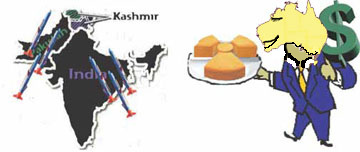
The news came out when hundreds of thousands of Indian men and women protested against the expanding nuclear industry. These protests have been a regular feature in Koodankulam (Tamil Nadu), Jaitapur (Maharashtra) and Gorakhpur (Haryana), and at least five activists have lost their lives since 2010 in their struggle against the Indian government’s decision without taking the affected parties on board. Radioactive waste from uranium mining in the country’s east is reportedly affecting adjacent communities. Thousands of Indians suffer from the effects of uranium mining related to poor technical and management practices.
Birth deformities and cancers in Indian villagers near uranium facilities
Independent studies of the health status of people who live near the uranium mines and mills have found both that there are physical deformities occurring at a much higher rate than controlled villages which are having similar population but are a little bit further away from the mines and mills, as well as lung diseases coming in at a much higher rate among those who work in the mines and mills.
Australia to sell uranium to India but at what cost to its people? Australian Broadcasting Corporation Broadcast: 03/09/2014 Reporter: Stephanie March
As Prime Minister Tony Abbott prepares to sign off on a deal to sell Australian uranium to India, critics are warning of the cost to the lives and safety of India’s most vulnerable.
Transcript
CHRIS UHLMANN, PRESENTER: “……. critics say India’s drive towards a nuclear future is coming at a cost – the lives and safety of the country’s most vulnerable.
South Asia correspondent Stephanie March reports.
STEPHANIE MARCH, REPORTER: This lush forest land in eastern India is home to the Adivasi, one of the country’s Indigenous tribes people. Here in the town of the Jaduguda, the Adivasi live simple lives, much the way they have for centuries.
But the locals feel something isn’t right with the world around them.
Mohammad Yusuf is just one child in the village deformed since birth.
MOHAMMAD MOIN (voiceover translation): We didn’t realise that there was anything wrong with him immediately, but four to five months after he was born, we realised that his legs and arms were not functioning properly.
STEPHANIE MARCH: The 14-year-old tries hard to be independent, but his wasted and stiff body makes it hard for him to move.
MOHAMMAD MOIN (voiceover translation): The doctor’s examined him. They said it wasn’t polio. They said that there was some damage that had taken place before he was born. His nerves were damaged or something like that.
STEPHANIE MARCH: A few doors down, Jobarani Acharya’s three-year-old son, Zariyadev (phonetic spelling), struggles to breathe and can’t sit without help. She doesn’t know what’s wrong with him and can’t afford to take him to hospital to find out.
JOBARANI ACHARYA (voiceover translation): I worry about what will happen when he grows older. What can we do for him? How do we cope with this situation?
STEPHANIE MARCH: Jobarani’s neighbour is a young boy named Gunda, born blind and mentally handicapped. In this hamlet of a few dozen houses there are at least three children with obvious physical deformities and locals believe they know the cause.
MOHAMMAD MOIN (voiceover translation): One of my other children, just six days old, died after dark patches erupted on its body all of a sudden. With Yusuf too, it seems that there was some poisoning or radiation that led to a birth defect.
STEPHANIE MARCH: The village where Mohammad Yusuf and Zariyadev were born is less than two kilometres from this tailing pond, attached to a uranium mine run by the Government-owned Uranium Corporation of India Limited, UCIL.
MOHAMMAD MOIN (voiceover translation): We feel that these are due to the affects of uranium. We’ve seen these kinds of incidents not just with humans, but also with the babies born to animals.
GHANSHYAM BIRULLE, JHARKHAND ORG. AGAINST RADIATION (voiceover translation): We cannot see any benefits. We have received only cancer and diseases. UCIL has given us nothing else.
STEPHANIE MARCH: Independent studies on the impact of the mining operation have been scathing. One survey by Indian Doctors for Peace and Development found that children born to families living near the mining operations were almost twice as likely to have congenital deformities than those born in villages 30 kilometres away and that those with deformities were five times more likely to die than those living in non-mining areas.
30-year-old Rapta Sadr has been physically disabled since birth and blames his problems on being born near the tailing ponds.
In addition, cancer rate are 50 per cent higher in the villages near the tailing ponds and people are 20 per cent less likely to reach the average life expectancy for the state.
M.V. RAMANA, NUCLEAR FUTURES LAB, PRINCETON UNI.: Independent studies of the health status of people who live near the uranium mines and mills have found both that there are physical deformities occurring at a much higher rate than controlled villages which are having similar population but are a little bit further away from the mines and mills, as well as lung diseases coming in at a much higher rate among those who work in the mines and mills.
STEPHANIE MARCH: M.V. Ramana is a nuclear physicist based at Princeton University who’s written extensively on the nuclear industry in India. He’s closely studied the situation in Jaduguda.
M.V. RAMANA: As far as I know, UCIL has offered no evidence that is has actually carried out any kind of detailed epidemiological studies. All it has done is make various assertions. These assertions start with denial, saying that there is no such problem, or claiming that these problems have to do with malnutrition – exactly the kind of thing epidemiological studies rule out……http://www.abc.net.au/7.30/content/2014/s4080503.htm
Indian Uranium Corporation ordered to probe birth deformities near mines
 The health issue came to the attention of the High Court earlier this year after pictures of Jadugora’s deformed children appeared in the Indian press. The court in February ordered Uranium Corp. to produce documents that might shed light on the health issues. The court noted then that children living near the mines in Jadugora are “born with swollen heads, blood disorders and skeletal distortions.”
India Court Orders Uranium Corp. to Probe Deformities Near Mines Bloomberg By Rakteem Katakey and Tom Lasseter Aug 20, 2014 India’s sole uranium mining company is being ordered by a regional court to disclose radiation levels and the presence of any heavy metals in soil and water in a cluster of villages with reports of unusual numbers of deformed and sick children.
The order by the Jharkhand High Court also mandates thatUranium Corp. of India Ltd.explain how it ensures the safety of nearby civilian populations who may be exposed to its 193-acre (78-hectare) radioactive waste dump near the village of Jadugora in eastern India.
The move comes about a month after a Bloomberg News story chronicled the plight of parents living near the Uranium Corp. mines who are seeking answers to what’s sickening and killing so many of their kids. The story also reported that local residents routinely wander the unfenced dump sites and fish and bathe in a river that receives water flowing from the dumps, known as tailings ponds. The Bloomberg article was submitted to the judges of the High Court by Ananda Sen, the lawyer appointed by the court to review the case.
Uranium Corp. has denied its mining operations have anything to do with village health issues. In 2007, a survey of more than 2,100 households by an Indian physicians group found mothers in villages 1.5 miles from the mines reported congenital deformities more than 80 percent higher than the rates just 20 miles (32 kilometers) away, with reported child death rates from such abnormalities more than five times as high.
Independent Experts
Serious flaws in India-Japan Nuclear Deal
Reasons to Oppose the India-Japan Nuclear Deal – Nuclear Free by 2045 ? Dennis Riches 14 Aug 14 In late July and early August, a leading member of India’s Coalition for Peace and Nuclear Disarmament, Kumar Sundaram, visited several Japanese cities in order to speak to the mass media and Japanese citizens about the proposed Japan-India nuclear energy agreement. He timed his visit to Japan to precede  that of Indian Prime Minister Narendra Modi at the end of August. Modi will meet with his Japanese counterpart in hopes of finalizing a deal to allow the purchase of vital components of nuclear power plants that are proposed or under construction
Uranium mining destroys lives
Yet another example of how mining companies destroy local peoples lives Papua New Guinea Mine Watch 14 Aug 14
“The government and the company don’t give a damn whether the tribal people live or die,” said Ghanshyam Birulee. “The government is treating us as guinea pigs to fulfill its greed for Uranium.”
India uranium mining fuels health crisis
Radioactive waste generated in three government owned mines spurs health fears in eastern Jharkhand state.
Sanjay Pandey | Al Jazeera “They took away my land,” 35-year-old Agnu Murmu told Al Jazeera, days before he died. “I begged them to give me a small truck… but they gifted me with cancer.”
Murmu, according to social activist Ghanshyam Birulee, was just the latest casualty of radiation pollution in Jadugoda, a tribal heartland in the eastern Indian state of Jharkhand.
His house sits dangerously close to a tailing pond, where the government-run Uranium Corporation of India Limited (UCIL) discharges waste from its mining operations. Murmu’s mother said the family knew nothing about radiation when mining began here about five decades ago.
“Like other unsuspecting parents, I would also allow my children to play near the tailing pond and catch fish from the canal that I know now is contaminated by radiation pollution,” said Rakhi Murmu, 52, with tears spilling down her creased cheeks.
“Uranium mines have ruined our lives. I know they won’t rest till they bury us all in those pits.”
Spontaneous abortions and miscarriages
Radioactive waste generated by three government owned mines – Narwapahar, Bhatin and Jadugoda – has spurred fears of a health crisis in the region.
Residents say they suffer from a number of diseases linked to radiation pollution, including congenital deformities, sterility, spontaneous abortions and cancer – yet mining continues unabated near these Indian villages, without proper security measures in place.
Dumping of radioactive waste by the roadside or near the villages may be putting even more people at risk………
radiation pollution
Several surveys conducted by independent agencies, including Japan’s Kyoto University and India’s Jadavpur University, have confirmed radiation pollution in the air, water and soil in Jadugoda.
Independent nuclear scientist Sanghmitra Gadekar, who conducted a survey on 9,000 villagers living in and around mines, has documented cases of congenital deformities, infertility, cancer, respiratory problems and miscarriages……..
Guinea pigs?
Nitish Priyadarshi, a geologist who has surveyed radioactivity in Jamshedpur and Ranchi, said while uranium particles cannot travel that far, “its sister elements like radon gas, which damages lungs and kidney, can travel to the city and take the already high radioactivity to alarming levels.”…….
whatever the government policy, Jadugoda’s 50,000 tribal residents continue to stand exposed to a danger which the activists say “nobody cares about”.
“The government and the company don’t give a damn whether the tribal people live or die,” said Ghanshyam Birulee. “The government is treating us as guinea pigs to fulfill its greed for Uranium.” http://ramumine.wordpress.com/2014/08/14/yet-another-example-of-how-mining-companies-destroy-local-peoples-lives/
India: Two big utilities investing in renewable energy
Tata, Reliance Power bet big on renewable energy, to spend Rs 1,500 crore each, Economic Times, By Shuchi Srivastava, ET Bureau | 9 Jul, 2014, MUMBAI: Two of the country’s largest power producers Tata PowerBSE -5.04 % and Reliance PowerBSE -7.70 % are betting big on renewable energy and will spend about Rs 1,500 crore each on clean energy projects this fiscal.
“Reliance Power is keen to be a part of the journey to position India as one of the world’s major solar power producers in the coming years. Given the exciting new opportunities such as the ultra mega solar PV projects and the shortfall in meeting the renewable purchase obligations by various state discoms,” said the company. http://economictimes.indiatimes.com/articleshow/38044771.cms?utm_source=contentofinterest&utm_medium=text&utm_campaign=cppst
World’s Largest Floating Solar Power Project planned for India
India Plans World’s Largest Floating Solar Power Project (50 MW) After canal-top solar power projects, India is planning to install the world’s largest floating solar power project.Clean Technica, 4 July 14
India’s leading hydro power generator National Hydro Power Corporation (NHPC) is planning to set up a 50 MW solar photovoltaic project over the water bodies in the southern state of Kerala. Renewable Energy College will provide assistance to the company for implementing the project…….http://cleantechnica.com/2014/07/02/india-plans-worlds-largest-floating-solar-power-project-50-mw/
India’s nuclear deal with USA, Russia and France is a very bad one
India – now nuclear and environmental dissent is a crime Ecologist, Kumar Sundaram 4th July 2014 “…….Nuclear power is the new must-have India made advance promises for reactor purchases from France’s Areva, Russia’s Atomsroy export and US giants like Westinghouse and GE in exchange for these countries’ support for an exemption for India at the Nuclear Suppliers’ Group (NSG) in 2008.
India was thus permitted to engage in international nuclear commerce despite its status as a nuclear weapons state outside the Nuclear Non-Proliferation Treaty.
It is under the pressure of the commitment to the international nuclear lobby that the Indian government has been bulldozing everything that stands in their way:
- undermining and diluting safety norms,
- pushing through environmental clearances at gun-point,,
- neglecting the adverse economics of these projects,
- crushing grassroots democratic dissent, and
- trying to exempt the nuclear suppliers from liability in the event of any accident….http://www.theecologist.org/News/news_analysis/2460076/india_now_nuclear_and_environmental_dissent_is_a_crime.htm
Nuclear Suppliers Group (NSG) has doubts about India becoming a member
Nuclear export group divided over ties with India – diplomats Yahoo 7 news July 2, 2014, By Fredrik Dahl VIENNA (Reuters) – An influential global body that controls atomic exports is divided over establishing closer ties with India, meaning the nuclear-armed Asian power may have to wait a while longer before joining.
Diplomatic sources said different opinions were voiced in a debate on relations with India – a non-signatory to the Non-Proliferation Treaty (NPT) – at an annual meeting of the 48-nation Nuclear Suppliers Group (NSG) last week in Buenos Aires.
The United States, Britain and other members have argued in favour of India joining the trade body, established in 1975 to ensure that civilian nuclear trade is not diverted for military aims……the country would be the only member of the suppliers’ group that has not signed up to the NPT, a 189-nation treaty set up four decades ago to prevent states from acquiring nuclear weapons.
This has caused some NSG states to raise doubts about India joining their club, which plays a pivotal role in countering nuclear threats and proliferation. Some also argue that it could erode the credibility of the NPT, a cornerstone of global nuclear disarmament efforts……..https://au.news.yahoo.com/world/a/24372928/nuclear-export-group-divided-over-ties-with-india-diplomats/
India’s frantic efforts to deal with problem of insuring nuclear power (the uninsurable)
‘Government working on providing insurance cover to nuclear plants‘ Economic Times Jun 28, 2014, HYDERABAD: The government is working with a group of experts and officials of Nuclear Power Corporation of India,Finance Ministry and insurance companies to work out the modalities of providing insurance cover to existing and new nuclear power plants, a senior official said here today.
R K Sinha, Secretary, Department of Atomic Energy and Chairman of Atomic Energy Commission told this to reporters after flagging off the world’s second largest gamma ray telescope to Ladakh, where it will be installed. According to him, government is working towards forming a nuclear insurance pool to cover the nuclear facilities, involving state-owned General Insurance Company and New India Insurance.
“We are on the way to find a solution (to liability law concerns). We will be putting in place a mechanism to cover the risk through insurance (for nuclear plants),” Sinha, told media persons, he said.
In order to address the liability issue that has held up deals with various countries, the central government earlier said it decided to form a Nuclear Insurance Pool that will have a number of stakeholders to meet the requirement of huge financial cover in case of a mishap.
Under the Liability Law, compensation of up to Rs 1,500 crore will have to be paid in case of a mishap involving a nuclear plant. At present, India has 20 nuclear plants and their number is expected to grow as the industry expands.
The Department of Atomic Energy has been pursuing the issue of bringing the nuclear plants under insurance cover, with the Ministry of Finance, NPCIL and insurance companies, he added…….http://articles.economictimes.indiatimes.com/2014-06-28/news/50929523_1_insurance-cover-nuclear-plants-nuclear-insurance-pool
France pushing as nuclear salesman to India
Defence, nuclear reactor deals on agenda for Fabius’ India visit http://www.thenewage.co.za/129938-1020-53-Defence_nuclear_reactor_deals_on_agenda_for_Fabius_India_visit A multi-billion-dollar deal for fighter jets and another for nuclear reactors are expected to be discussed between Indian leaders and French Foreign Minister Laurent Fabius, who arrives in New Delhi later on Sunday. The negotiations for six nuclear reactors from French company Areva for the state-run Nuclear Power Corporation’s power plant in Jaitapur in western India was initiated in 2010.
1 This Month
19 February – VIRTUAL EVENT-Decision Time: AI and Our Nuclear Arsenal
12:45 p.m. Central / 1:45 p.m. Eastern
To see nuclear-related stories in greater depth and intensity – go to https://nuclearinformation.wordpress.com
-
Archives
- February 2026 (141)
- January 2026 (308)
- December 2025 (358)
- November 2025 (359)
- October 2025 (376)
- September 2025 (258)
- August 2025 (319)
- July 2025 (230)
- June 2025 (348)
- May 2025 (261)
- April 2025 (305)
- March 2025 (319)
-
Categories
- 1
- 1 NUCLEAR ISSUES
- business and costs
- climate change
- culture and arts
- ENERGY
- environment
- health
- history
- indigenous issues
- Legal
- marketing of nuclear
- media
- opposition to nuclear
- PERSONAL STORIES
- politics
- politics international
- Religion and ethics
- safety
- secrets,lies and civil liberties
- spinbuster
- technology
- Uranium
- wastes
- weapons and war
- Women
- 2 WORLD
- ACTION
- AFRICA
- Atrocities
- AUSTRALIA
- Christina's notes
- Christina's themes
- culture and arts
- Events
- Fuk 2022
- Fuk 2023
- Fukushima 2017
- Fukushima 2018
- fukushima 2019
- Fukushima 2020
- Fukushima 2021
- general
- global warming
- Humour (God we need it)
- Nuclear
- RARE EARTHS
- Reference
- resources – print
- Resources -audiovicual
- Weekly Newsletter
- World
- World Nuclear
- YouTube
-
RSS
Entries RSS
Comments RSS
 nuclear-news