USA nuclear reactor corporations know that exports to India are nowhere near really happening
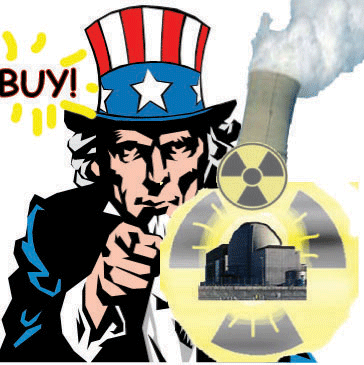 A year’s wait likely before commercial N-deals inked mydigitalFc.com By Subhash Narayan Jan 27 2015 The breakthrough in civil nuclear deal between India and US may be heads up for American equipment makers that plan to export eight unbuilt nuclear power reactors to India, but the companies will have to wait for up to a year before any commercial deal is inked with their Indian counterparts.
 department of atomic energy on the other would take a year to conclude before projects can commence on ground in Andhra Pradesh and Gujarat, a government official said……….
Toshiba’s Westinghouse Electric Company did not issue a statement but its chief executive officer Danny Roderick told Bloomberg that the company would look at commercial agreements with Indian only after studying the Indian government’s offer to create an insurance pool
“Let us understand that Indo-US civil nuclear deal is government-to-government agreement while the final deals have to reached between companies. There is sense that a lot still needs to be resolved,” said Debasish Mishra, partner at Deloitte Touche Tohmatsu……..
Under the umbrella agreement since the technology transfer will happen over a phased manner, nuclear reactor services companies are also likely to set up their shop in India through joint ventures with Indian entities.
The deal could also see increased exposure of Exim banks from US, Canada, Germany, France. Insurance companies from these countries are also likely to generate business.
Indo-US agreement provides for an insurance cover on liabilities to cover any disaster related liabilities.
Westinghouse has already been allotted a site in Modi’s home state of Gujarat to build a nuclear power station with total capacity of 2,500 MW and possibility of expansion in future. Similarly, two sites have also been identified for GE plants in Andhra Pradesh with an initial capacity of 3,200 MW………http://www.mydigitalfc.com/news/year%E2%80%99s-wait-likely-commercial-n-deals-inked-082
Many a slip twixt the much touted USA-India deal and commercial reality
Hurdles Remain in Nuclear Deal, Indian Express By B B Singh 30th January 2015 For almost two weeks prior to president Barack Obama’s visit to India, the negotiators from both the countries had been burning the midnight oil to operationalise Indo-US nuclear cooperation but hurdles seem to be emerging one after another. The first and the most talked about hurdle arose from Section 17 (b) of the Civil Liability for Nuclear Damage Act 2010, giving the right of recourse to the operator of the nuclear installation if nuclear incident resulted as a consequence of an act of the supplier or his employee which includes supply of equipment or material with patent or latent defects or sub-standard services.
This provision was introduced to ensure that the suppliers took utmost care since they would be liable even for “latent” defects that may exhibit their appearance in their equipment later on after extended exposure to nuclear related stresses. This problem seems to have been solved by India’s proposal for an insurance cover of `1500 crore out of which 50 per cent would be government contribution and the remaining from a pool of insurance companies which are public sector units.
Oddly, it would mean victims compensating victims.
The next conflict has arisen in respect of Section 46 of the Act which provides that its provisions shall be in addition to and not in derogation of any other law for the time being in force. It further provides that nothing contained in this Act shall exempt the operator from any proceeding which might, apart from this Act, be instituted against such operator or the suppliers directly or through the operator. The victims of nuclear incidents are thus entitled to file tort suits for unlimited damages and even criminal proceedings against the operator as well as suppliers. ………….
The story does not end here. There is still some more to come. Under the Hyde Act, the US president is further required to submit to an appropriate Congressional committee any significant changes in the nuclear activities of India including construction of nuclear facilities, production of nuclear weapons or changes in nature and amount of fissile material produced and the purpose and operational status of any unsafeguarded new nuclear facility.
Still further under the Hyde Act, the US president shall have to inform the Congress an estimate of the amount of uranium mined and milled in India and amount of such uranium that has likely been used or allocated for weapons; the rate of production of nuclear devices and the material used therein. Some procedure will have to be worked out in the administrative arrangements to achieve this objective and procure such information on India’s non-civilian nuclear activities for information to the US Congress. In view of these requirements, the Indian negotiators are likely to face still tougher uphill tasks ahead.http://www.newindianexpress.com/columns/Hurdles-Remain-in-Nuclear-Deal/2015/01/30/article2643619.ece
If it ever becomes a reality, USA-India nuclear deal a very bad one for Indian public
Financially, solar and wind energy are already becoming more attractive than nuclear. Electricity from these renewable sources cost Rs 8 and Rs 4.5 per unit respectively,according to a report by solar think-tank Bridge to India. Renewables are quicker to erect and are not as politically contentious as nuclear. In contrast, the Mithi Virdi project has run into serious opposition from local residents and farmers. If it is ever built, electricity from the Westinghouse reactors will cost Rs 12 per unit.
 The ‘breakthrough’ in Indo-US nuclear deal will bleed Indians every which way, Scroll In, The taxpayer will be made to pay to cover US companies’ untested technologies and the expensive electricity they generate. Nityanand Jayaraman, 29 Jan 15
India-USA nuclear deal very ‘up in the air’: no document signed
no specific document was signed
India is already generating more power from wind turbines alone than from nuclear power and has announced a solar target of 100 gigawatt by 2022. So it is perfectly coherent that the joint US-India declaration contains one paragraph on nuclear cooperation and eight on clean energy.
 Breakthrough in US-India civil nuclear deal ‘more symbolism than reality’, DW 29 Jan 15 The US and India announced a “breakthrough” in resolving a liability spat that has stalled the implementation of a civil nuclear deal. But Mycle Schneider tells DW this is more about geopolitics than industrial reality.
“…….Mycle Schneider, an independent international consultant on energy and nuclear policy, says in a DW interview that there is no real market for foreign nuclear companies in India, unless they bring their own funding, adding that the recent announcement is more about presenting both countries as equal partners than it is about the vision of a future blooming Indian nuclear export industry.
DW: What exactly does the new nuclear deal entail?
Mycle Schneider: Very little has so far been published about it. First of all, it is unclear whether there is even a “new nuclear deal.” Usually, when heads of state meet, the occasion is used to sign agreements. However, on this issue, the US-India joint statement only says President Obama and Prime Minister Modi welcomed the “understandings reached” on the issues of civil nuclear liability and “administrative arrangements for civil nuclear cooperation.”
Apparently, no specific document was signed. ………
Unlike all other aspirants for nuclear technology aid, India is not required anymore to put its entire fuel chain, facilities and materials, under comprehensive international control or so-called Full-Scope Safeguards. India has merely promised to separate its nuclear weapons related activities from the power sector……….
India law created liabilities for suppliers in the event of a nuclear accident. Are they not liable anymore?
The 2010 Civil Liability for Nuclear Damage Act has been voted by both houses of the Indian parliament. It remains in place as long as it has not been invalidated by a new vote. In that respect, absolutely nothing has changed from the situation prior to President Obama’s visit to India.
Considering the fact that the Act has not only been attacked by the nuclear industry side, but also from civil society representatives because it caps the liability of the nuclear operators to a ridiculously small sum of 240 million USD, reopening the parliamentary debate over this fragile compromise seems unlikely at this point. It also seems unlikely that the establishment of an insurance fund would fundamentally change the liability situation of nuclear suppliers.
What do India and the US expect to gain from this civil nuclear deal?
This is a typical example of announcement politics. Both governments are presenting the outcome of the US-India summit as a great success. But it is more an issue of symbolism and geopolitics than of industrial reality. The promise to continue to work together towards India’s “phased entry” into the Nuclear Suppliers Group as into three other international control regimes is more about presenting both countries as equal partners than it is about the vision of a future blooming Indian nuclear export industry.
Do you expect the Indian market to now become more appealing for US nuclear companies?
In reality, there is no real market for foreign nuclear companies in India, unless they bring their own funding. Under free market conditions it is not possible anymore to build a nuclear power plant anywhere in the world.
So if new reactors are built in India or elsewhere, the projects are highly subsidized, either by the government—the taxpayer—or the ratepayer. The Indian nuclear industry has painted a rosy picture of the nuclear future for decades and has delivered very little in comparison.
It is actually amazing to what extent overstretched projections of “hundreds of billions investment” are still being held up. Disconnected from reality, they are an effect of what Princeton University researcher M.V. Ramana has appropriately described as “The Power of Promise.”
India is already generating more power from wind turbines alone than from nuclear power and has announced a solar target of 100 gigawatt by 2022. So it is perfectly coherent that the joint US-India declaration contains one paragraph on nuclear cooperation and eight on clean energy.
Mycle Schneider is an independent international energy and nuclear policy consultant, based in Paris. He is the convening lead author of the annual World Nuclear Industry Status Report and a member of the Princeton University-based International Panel on Fissile Materials (IPFM). Schneider is a founding member and the spokesperson of the International Energy Advisory Council (IEAC).
The interview was conducted by Gabriel Domínguez. http://www.dw.de/breakthrough-in-us-india-civil-nuclear-deal-more-symbolism-than-reality/a-18221115
CPI objects to Indian tax-payers taking on nuclear company risks
 CPI asks govt to explain why it rushed into nuke agreement http://zeenews.india.com/news/india/cpi-asks-govt-to-explain-why-it-rushed-into-nuke-agreement_1537199.html January 27, 2015 New Delhi: The CPI on Tuesday asked Prime Minister Narendra Modi to explain why the government “rushed” into an agreement with the US on the nuclear liability issue, saying a proposed insurance pool to cover American nuclear firms would violate Indian law on the issue.
In a letter to the Prime Minister, he said US suppliers “should obtain insurance from international insurance companies at commercial rates. Why are they unable to do so? Is this because they are unable to persuade their own companies that their reactors are as safe as they claim?”
 “Why should the Indian people have to provide insurance to American companies through an Indian public sector company,” he asked.
Expressing concern over reports that Modi government has agreed to US demands that its companies be protected from liability for accidents caused by design defects in reactors they supply, Raja said the intent of the Indian law was “clearly to place some liability on the supplier. This was meant to ensure that multinational suppliers would pay adequate attention to safety standards.”
Observing that design defects have contributed to nuclear accidents including those at Three Mile Island, Chernobyl, and Fukushima, he said US firm GE had “designed the Mark 1 reactors that were involved in the Fukushima accident.”
“Why is the Indian agreement rushing into a deal to purchase a reactor that is running into difficulties elsewhere,” Raja asked.”Your negotiations with President Obama have been opaque, and very few details are publicly available. … I hope that you will take urgent steps to address and answer them publicly,” he said. “Japanese (Fukushima) victims have been unable to hold (US firm) GE to account because of the Japanese liability law which indemnifies the supplier. It was to prevent such an eventuality that Clause 17(b) of the Indian law allows the operator a right of recourse against the supplier,” the CPI leader said.
It was only after the Bhopal gas disaster experience, the Supreme Court had formulated the ‘absolute liability’ principle under which all parties involved in running a hazardous enterprise would be liable for damage caused to the public, he said.
“I understand that there are only two reactor designs on offer by US companies – the AP1000 designed by Westinghouse and the ESBWR designed by GE.”
“Neither of these reactors is in commercial operation anywhere in the world. In fact, the ESBWR is so new that even its design was certified only recently by the US Nuclear Regulatory Council,” Raja said.
Observing that India would therefore be one of the first countries to have the ESBWR, he asked the Prime Minister: “Have you obtained any guarantees from President Obama, that the cost of such delays will be borne by GE and not the Indian Government?”
Raja also expressed concern over the cost of electricity from the proposed American reactors and said the two AP1000 units being constructed in Vogtle (US) were initially projected to cost USD seven billion each.
“If one uses the same cost per unit of installed capacity for the ESBWR, then this would suggest that it may cost as much as USD 10 billion,” he said, adding this would translate into a cost of electricity that exceeds Rs 15 per unit, “much higher than the tariff from competing sources.”
Subir Roy questions India’s supposed need for nuclear power
Only very broad features have been outlined and, hopefully, when the details become known the Indian government will not be found to have given away where it matters. If a negative picture does eventually emerge from the details, then the question will be — what for? ………
As for possessing a bomb, it does not enhance security. Pakistan followed quickly in India’s footsteps with its own nuclear tests in 1998 so that India’s superiority in conventional defence capability was replaced with parity in nuclear capability. http://www.business-standard.com/article/opinion/subir-roy-why-persist-with-nuclear-power-115012701341_1.html
USA persuades India to weaken its nuclear liability law – double standards here
Under pressure from GE and Westinghouse, the two American nuclear vendors hoping to sell billions of dollars worth of reactors to India, the Obama administration has demanded that Section 17(b) and Section 46 of the Indian liability law be deleted or amended.
Double standards? The irony is that American nuclear suppliers operate under a domestic liability regime that allows operators to sue them for recovery of damages in the event of an accident. That is how Metropolitan Edison, the operator of the Three Mile Island nuclear plant, sued Babcock Wilcox after the infamous 1979 accident.
Why India should say no to US demand to dilute its nuclear liability law The Modi government should resist pressure from Barack Obama, who landed in New Delhi on Sunday morning, to change key provisions to favour foreign supplier of reactors. Siddharth Varadarajan Scroll.in 26 Jan 15
With the issue of nuclear liability emerging as an obstacle in the relationship between India and the US, the Modi government is under pressure to dilute the law in favour of foreign reactor suppliers. Without this, we are told, it will not be possible to operationalise the US-India nuclear agreement and provide the country with the electricity its people need.
In the event of a major nuclear accident in India, one which damages lives and property, what does the law say about how liability is to be apportioned? Continue reading
Nuclear risks covered by India’s government under new deal with USA
Insurers to offer Rs 750 cr capacity for nuclear pool; rest from govt, Standard.com M Saraswathy | Mumbai January 26, 2015
Both operators and suppliers would be provided as cover against associated risks The proposed nuclear risk pool that will be set up in India will have five government-owned insurance companies (General Insurance Corporation of India (GIC), New India Assurance, Oriental India Insurance, National Insurance and United India Insurance) providing half the capacity for the Rs 1,500-crore pool. The rest will come from the central government.
Prime Minister Narendra Mdoi in his statement at the joint press interaction with President Barack Obama of America, said the civil nuclear agreement was the centrepiece of our (India-US) transformed relationship, demonstrating new trust…….. Continue reading
Weapons proliferation standards weakened in new USA-India nuclear trade deal
The Short Walk Home. How PM Modi, President Barack Obama Clinched Nuclear Deal NDTV All India | Reported by Nidhi Razdan (with inputs from agencies) | January 25, 2015 Within hours of US President Barack Obama’s arrival in Delhi, a landmark breakthrough on nuclear trade was clinched with Prime Minister Narendra Modi……….
India has offered to set up an insurance pool to indemnify companies that build reactors in the country
against liability in case of a nuclear accident.
Sources say America has forfeited its demand on insistence on “flagging” or tracking the nuclear material they supply to India, required under its rules to ensure it is not being used for military purposes. India said the demand was intrusive, especially because safeguards of the International Atomic Energy Agency, or IAEA, are in place.
Nuclear commerce worth billions of dollars was meant to be the centrepiece of a new strategic relationship between the United States and India, allowing New Delhi access to nuclear technology and fuel without giving up its weapons.
But a tough liability law which was cleared by the Indian parliament in 2010 and holds equipment suppliers liable for damages for an accident had meant that billions of dollars in trade were held up by concerns over exposure to risk. The US said this is a sharp deviation from international norms that put the onus on the operator to maintain safety. For India, the law grew out of the 1984 Bhopal gas disaster, the world’s deadliest industrial accident, at a factory owned by U.S. multinational Union Carbide Corp, which families are still pursuing for compensation.
The law had so far effectively shut out Western companies from a huge market, as energy-starved India seeks to ramp up nuclear power generation by 13 times, and also strained U.S-Indian relations. …http://www.ndtv.com/article/india/the-short-walk-home-how-pm-modi-president-barack-obama-clinched-nuclear-deal-653481
Details remain vague on nuclear deal between Obam and Narendra Modi
Thirty years after an infamous chemical leak killed thousands at Union Carbide’s factory in Bhopal, the threat of tough Indian compensation laws has frustrated US hopes of an export boom in the energy sector – despite an agreement by former US president George W Bush to share civil nuclear technology in 2005.
After pressure from US diplomats, the Indian government was thought to have agreed a state-backed insurance scheme that would cap the exposure of nuclear suppliers and open the door to billions of dollars of new contracts. India will also allow closer tracking of spent fuel to limit the risk of it falling into terrorist hands.
“Today we achieved a breakthrough understanding on two issues that were holding up our civil nuclear cooperation,” Obama said on Sunday………
Details of the deal remain vague, however, and officials stressed they were still working out the finer arrangements of the scheme, which is designed to avoid the need to change Indian law……….
The two governments also said they had struck deals to share defence technology and improve dialogue in future, with a security hotline between Obama and Modi……….
“Nuclear liability remains the cinder in the eye of the relationship right now,” Rick Rossow, of the Centre for Strategic and International Studies (CSIS), said in Washington last week. “Nuclear cooperation was the high-water mark for our bilateral history and the fact that India’s nuclear liability law precludes American involvement, it stings.”
US suggestions of full legal indemnity for suppliers were knocked by the Indian government, which is wary of trying to overturn a 2010 nuclear liability law in parliament……. http://www.theguardian.com/world/2015/jan/25/obama-modi-limit-us-liability-nuclear-disaster
India’s solar plants above canals save water
INDIA BUILDS SOLAR PLANTS ATOP CANALS TO SAVE LAND, WATER. https://jpratt27.wordpress.com/2015/01/25/india-builds-solar-plants-atop-canals-to-save-land-water/As India moves to ramp up investment in solar power, it is exploring innovative places to install solar plants, including across the top of canals.
Last weekend, U.N. Secretary General Ban Ki-moon inaugurated a new “canal-top” solar energy plant in Vadodara district in India’s western state of Gujarat. “I saw more than glittering panels – I saw the future of India and the future of our world,” said Ban. “I saw India’s bright creativity, ingenuity and cutting-edge technology.”

Experts identify two major advantages in building solar plants atop canals: efficient and cheap land use, and reduced water evaporation from the channels underneath. business-standard.com
Prime Minister Narendra Modi supports climate action, ready for big expanse in renewable energy
We very much support India’s ambitious goal for solar energy and stand ready to speed this advancement with additional financing,” Obama said during the news conference at Hyderabad House.
Modi Shifts on Climate Change With India Renewables Goal, Bloomberg By Reed Landberg and Natalie Obiko Pearson Jan 26, 2015 Prime Minister Narendra Modi said India is ready to expand its use of renewable energy as a way to reduce greenhouse gas pollution, a signal that his government is moving toward joining an international deal on global warming.
After a meeting with U.S. President Barack Obama in New Delhi, the prime minister said that his nation along with all others has an obligation to act on reducing the fossil-fuel emissions blamed for damaging the climate.
The remarks represent a shift in India’s tone on global warming………….
Environmental groups led by the World Resources Institute in Washington said Modi appeared to be moving toward a nationwide goal on renewables, expanding its current program of reaching 100 gigawatts of solar energy by 2022.
“This announcement builds on the recent progress on climate made between the U.S. and China,” Continue reading
Prime Minister Narendra Modi’s ally backs anti-nuclear movement to stop Jaitapur nuclear power project
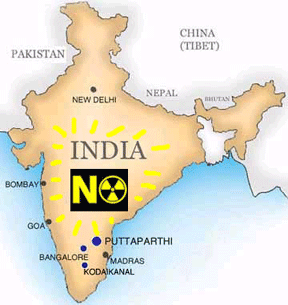 Notwithstanding PM’s nuke push, Sena to oppose Jaitapur plant Indian Express -By: Press Trust of India | Mumbai January 12, 2015 Notwithstanding Prime Minister Narendra Modi’s strong push for nuclear energy which he wants trebled by 2024, ally Shiv Sena today said it will continue to back those opposed to the 9,900 MW Jaitapur nuclear power project in Maharashtra.
“It has been our stand that Shiv Sena will support the locals of Jaitapur who have been opposing the plant. If there is an opposition, then why should we go against the will of the locals. After all, we are working for the development of the people,” senior Shiv Sena leader and state’s Industries Minister Subhash Desai told reporters.
Locals and anti-nuclear activists have been holding protests against the proposed plant over “scientific and environmental” concerns and Shiv Sena has been actively backing them.
“We (Shiv Sena) believe that if the need for power (for Maharashtra) is sufficed by other sources of energy including conventional and non-conventional resources, then why set up a destructive project,” he said.
Shiv Sena is a partner in BJP-led governments both at the Centre and in Maharashtra.The project is proposed to be set up in collaboration with French company Areva in the coastal Jaitapur village in Ratnagiri district. It will have six units of 1650 MW each built with Areva’s European Pressurised Reactor technology. JNPP would be one of the costliest nuclear power plant projects considering its sheer size and the new technology. – See more at: http://indianexpress.com/article/india/india-others/notwithstanding-pms-nuke-push-sena-to-oppose-jaitapur-plant/#sthash.aXD0KlPZ.dpuf
India’s Koodankulam reactor no 1 not really functioning, repeated shutdowns
 Reactors from Russia are unsafe and unreliable, India shouldn’t buy them: Russian environmentalist Vladimir Slivyak DiaNuke.org, 9 Jan 15 “……..The Koodankulam reactor no 1, despite its commissioning with much fanfare last year, is not really functioning and has seen repeated shut-downs. The people’s movement in Koodankulam says its because of the sub-standard equipments from Russia and it is unsafe. What do you think?
Bad quality of equipment and reactor components coming from Russia is not a secret anymore. It was noticed in China as well. Under current management, Rosatom became deeply corrupted which resulted in regular public scandals and arrests. In last 3 years several deputy directors of Rosatom were arrested on corruption charges, and in total about 300 people were fired from Rosatom’ organizations for the same reason. Very huge scandal happened with Zio-Podolsk producing steam-generators for nuclear plants – people there used cheap metal for manufacturing, instead of expensive one required by technology. Difference in price of cheap and expensive metals was going into pockets of top-management. Another scandal was about stealing money for radioactive waste treatment, and another one about bribes and procurement, etc.
Bad quality of reactor components, you are likely dealing with in case of Kudankulam, is a direct consequence of corruption. You can read more on corruption issue in the special report on Russian nuclear industry published in December (can be downloaded here)…….http://www.dianuke.org/russian-reactors-are-unsafe-and-unreliable-india-shouldnt-buy-them-russian-environmentalist-vladimir-slivyak/
Little chance that USA will get India to really change its Nuclear Liability Act
Insuring nuclear power The Financial Express | January 12, 2015 Given the relatively low level of political capital it has in the Rajya Sabha, and the backdrop of the Bhopal gas tragedy and recent tragedies such as the Fukushima disaster in 2011, it seems unlikely the government is going to go out of its way to try and amend the Civil Liability of Nuclear Damage Act in a hurry—the Act has once again come to the forefront with US President Barack Obama coming to the Republic Day function.
 Since no US firm is going to build nuclear plants in India until Section 17(b) of the Act allows the Nuclear Power Corporation of India Limited (NPCIL) to take action against them in case of a nuclear accident, revoking this has been on the US agenda for a long time. Apart from the political sensitivity around such an action, as finance minister Arun Jaitley acknowledged at a seminar on the Act earlier this week, both the BJP and the Congress had passed the Act—so changing an integral part of the Act doesn’t look as if it is on the cards…….http://www.financialexpress.com/article/economy/editorial-insuring-nuclear-power/28748/
1 This Month
19 February – VIRTUAL EVENT-Decision Time: AI and Our Nuclear Arsenal
12:45 p.m. Central / 1:45 p.m. Eastern
To see nuclear-related stories in greater depth and intensity – go to https://nuclearinformation.wordpress.com
-
Archives
- February 2026 (141)
- January 2026 (308)
- December 2025 (358)
- November 2025 (359)
- October 2025 (376)
- September 2025 (258)
- August 2025 (319)
- July 2025 (230)
- June 2025 (348)
- May 2025 (261)
- April 2025 (305)
- March 2025 (319)
-
Categories
- 1
- 1 NUCLEAR ISSUES
- business and costs
- climate change
- culture and arts
- ENERGY
- environment
- health
- history
- indigenous issues
- Legal
- marketing of nuclear
- media
- opposition to nuclear
- PERSONAL STORIES
- politics
- politics international
- Religion and ethics
- safety
- secrets,lies and civil liberties
- spinbuster
- technology
- Uranium
- wastes
- weapons and war
- Women
- 2 WORLD
- ACTION
- AFRICA
- Atrocities
- AUSTRALIA
- Christina's notes
- Christina's themes
- culture and arts
- Events
- Fuk 2022
- Fuk 2023
- Fukushima 2017
- Fukushima 2018
- fukushima 2019
- Fukushima 2020
- Fukushima 2021
- general
- global warming
- Humour (God we need it)
- Nuclear
- RARE EARTHS
- Reference
- resources – print
- Resources -audiovicual
- Weekly Newsletter
- World
- World Nuclear
- YouTube
-
RSS
Entries RSS
Comments RSS
 nuclear-news