India’s authorities in denial about nuclear industry’s radiation-caused deaths
“Inside UCIL, they see themselves as under siege, defending the nation, one atom at a time,” Biruli said, “and outside … we are absorbing those atoms and whatever else the corporation spews out from its broken pipes and dams. We’re drinking it all up, feeding it to our kids, and our wives, if they can conceive, are absorbing them into their blood stream.”

 India’s nuclear industry pours its wastes into a river of death and disease Scientists say nuclear workers, village residents, and children living near mines and factories are falling ill after persistent exposure to unsafe radiation Center For Public Integrity , By Adrian Levy
 December 14, 2015 Jadugoda, Jharkhand, INDIA
……..Denying what scientists documented
India’s nuclear project is seen as the country’s most prestigious enterprise, a tangible expression of the nation’s resilience and resourcefulness. This idea was cemented when India tested nuclear devices in 1998, in twin blasts. Feeding the weapons program was UCIL’s duty, and protecting the mines became paramount.
As a result, the UCIL-funded health studies were not welcomed by the Bhabha Atomic Research Center, the country’s premier civil and military nuclear research facility, which has a Health Physics Laboratory in Jadugoda. It said in 1999, after a quick visual inspection of villagers living close to the mines, that its own experts “unanimously agreed that the disease pattern could not be ascribed to radiation exposure.” The complainers were “backwards people” who suffered from “alcoholism, malaria and malnutrition,” the company said. But it took no soil, water or air samples and launched no epidemiological study.
UCIL subsequently reversed its own position. “There is no radiation or any related health problems in Jadugoda and its surrounding areas,” J.L. Bhasin, the managing director of UCIL, concluded in 1999, in a press conference before local reporters in Jadugoda. A.N. Mullick, UCIL’s chief medical officer for 25 years, issued a press statement a few months later that “I have not come across any radiation-related ailments during my entire career.” Continue reading
India’s secretive, toxic, uranium industry and its radiation deaths
According to the uranium corporation’s own records, 17 UCIL laborers died in 1994, 14 more in 1995, 19 in 1996 and 21 in 1997; no cause of death was revealed in the records seen by the Center, but critics claim most if not all were radiation-related.
The corporation will not discuss the causes of these deaths. But a spokesman for the Jarkhandi Organization Against Radiation (JOAR), a local group formed in 1998 out of a student lobby for indigenous rights, said it has investigated these cases and that “from what we can see all of them contracted illnesses associated with radiation or exposure to heavy metals.”
India’s nuclear industry pours its wastes into a river of death and disease Scientists say nuclear workers, village residents, and children living near mines and factories are falling ill after persistent exposure to unsafe radiation Center For Public Integrity , By Adrian Levy December 14, 2015 Jadugoda, Jharkhand, INDIA “………Charting the trail of disease and ill health back to its source, Ghosh’s team learned that the alpha radiation they had recorded came from the mines, mills and fabrication plants of East Singhbhum, a district whose name means the land of the lions, where the state-owned Uranium Corporation of India Ltd is sitting on a mountain of 174,000 tons of raw uranium. The company, based in Jadugoda, a country town 160 miles west of Kolkata, is the sole source of India’s domestically-mined nuclear reactor fuel, a monopoly that has allowed it to be both combative and secretive.
After starting work in 1967 with a single mine, the corporation now controls six underground pits and one opencast operation that stretch across 1,313 hilly acres, extracting an estimated 5,000 tons of uranium ore a day, generating an annual turnover of $123 million. It supplies nine of the reactors that help India produce plutonium for its arsenal of nuclear weapons, and is thus considered vital to India’s security.
The company crushes the ore below ground and treats it with sulfuric acid, transforming it into magnesium diuranate or “yellowcake,” which is then loaded into drums and taken to the Rakha Mines railway station. From there, it is transported to the Nuclear Fuel Complex in Hyderabad, 861 miles to the southwest. Workers ultimately process it into uranium dioxide pellets that are stacked in rods, inserted into reactors all over India.
Wherever uranium is extracted, anywhere in the world, from Australia to New Mexico, it is a messy, environmentally disruptive process. However, the poor quality of ore eked out of these wooded hills means that for every kilogram of uranium extracted, 1750 kilograms of toxic slurry, known as tailings, must be discarded into three, colossal ponds. Studies by scientists from North America, Australia and Europe show that while these ponds contain only small quantities of uranium, equally hazardous isotopes connected to uranium’s decay are also present, including thorium, radium, polonium and lead, some of which have a half-life of thousands of years. Arsenic is a byproduct, as is radon, a carcinogen.
The tailing ponds in Jharkhand, Ghosh’s team and other scientists discovered, have never been lined with rubble, concrete or special plastics, as organizations like the U.S. Environmental Protection Agency have advised for domestic ponds, and as a result their contents leached in winters into the water table. Lacking a cap, the ponds evaporated in summers, leaving a toxic dust that blew over nearby villages. Thirty five thousand people live in seven villages that lie within a mile and half of the three huge ponds, most of them members of tribal communities.
Moreover, during the monsoon season, the ponds regularly overflowed onto adjacent lands, with contaminants reaching streams and groundwater that eventually tainted the Subarnarekha River, according to studies of the issue by Ghosh’s team and other scientists. Pipes carrying radioactive slurry also frequently burst, leaching into rivers and across villages, according to photographs taken by residents. Lorries hired by the mines also dumped toxic effluent in local fields when the ponds were full, actions caught in photographs and on video taken by villagers and shown to the Center.
When Ghosh published his team’s results, there was no reaction from the mine or the Indian government. A senior official in the U.S. State Department declined to discuss the contents of Jardine’s leaked cable, but said he was aware of criticisms about the uranium corporation.
The evidence begins to pile up……… According to the uranium corporation’s own records, 17 UCIL laborers died in 1994, 14 more in 1995, 19 in 1996 and 21 in 1997; no cause of death was revealed in the records seen by the Center, but critics claim most if not all were radiation-related.
The corporation will not discuss the causes of these deaths. But a spokesman for the Jarkhandi Organization Against Radiation (JOAR), a local group formed in 1998 out of a student lobby for indigenous rights, said it has investigated these cases and that “from what we can see all of them contracted illnesses associated with radiation or exposure to heavy metals.” The spokesman, who asked the Center to withhold his name because intelligence officials and police have arrested him in the past and accused him of “anti-national activities,” claimed the number of deaths was actually “four times higher” than UCIL admitted.
Birulee contacted doctors and public health researchers at Jawaharlal Nehru University, in Delhi, one of India’s best government-funded institutions. They came up with a hypothesis about his mother’s death, blaming the family’s laundry. “My father,” Birulee said, “would bring back his cotton uniform, caked in uranium dust, to be washed once a week, as did all the other contract laborers. There were no facilities in the mines and no warnings.”
Birulee wondered how many other families had been similarly affected and, working with the JNU doctors, helped arrange for midwives to visit nearby villages. They found that 47% of women suffered disruptions to their menstrual cycle, while 18% had had miscarriages or stillborn babies over the previous 5 years. One third were infertile. Many complained their children were born with partially formed skulls, blood disorders, missing eyes or toes, fused fingers or brittle limbs. Livestock too were suffering, with veterinarians reporting that buffaloes and cows were infertile or suffering from blood disorders.
Arjun Soren was one of those affected. Born in Bhatin village, adjacent to another uranium mine on the other side of the tailing pond, Soren became the first member of the Santhal tribe to get a medical degree, and one of his first cases was to track the deteriorating health of his family. “My aunt died of cancer of the gallbladder,” Soren recalled. “My nephew has a rare blood disorder.” Then Soren himself was diagnosed with leukemia and transferred to Mumbai for treatment. “Radiation and toxins from the mining processes has to be the reason,” Soren said. “I spent my childhood playing, breathing, drinking, eating there.”………..
Birulee lodged a protest with the state’s Environment Committee, in Bihar’s capital. Its chairman, Gautam Sagar Rana, directed UCIL to finance an independent health inquiry, led by two professors from Patna Medical College, who were accompanied by the uranium conglomerate’s deputy general manager, R.P. Verma; and the head of its health unit, A.R. Khan. Analyzing a representative sample of those between 4 and 60 years old living within a mile and a half of the third tailing dam, the researchers hired by UCIL concluded that the residents were “affected by radiation.”……..http://www.publicintegrity.org/2015/12/14/18844/india-s-nuclear-industry-pours-its-wastes-river-death-and-disease
Jaitapur activists write to Japan’s PM to cease promoting the nuclear industry
Jaitapur nuclear power project: Protesters write to Japan PM, warn of stepping up pressure . http://indianexpress.com/article/cities/mumbai/jaitapur-nuclear-power-project-protesters-write-to-japan-pm-warn-of-stepping-up-pressure 10 Dec 15
Recently, a top officer of the Fukushima plant Akira Ono as well as Naohiro Masuda, president of Tepco’s Fukushima Daiichi Decommissioning Company, have both admitted that there is no existing technology to remove the melted cores; that such technology may not be available for hundreds of years, and it may be impossible to decommission the stricken reactors. Thus the radioactive contamination may continue indefinitely for hundreds of years. Further, there is increasing evidence that rates of incidence of thyroid cancers among children near Fukushima have increased sharply,” the letter claimed.
The letter added that councils of all the 27 villages surrounding the proposed Jaitapur project have passed unanimous resolutions to oppose it.
“We, therefore, once again reiterate strongly our request that in the light of its own experience with radioactive contamination, Japan should shun any agreement for the promotion of the use of nuclear power. If our request goes unheeded, then be cautioned that we will be forced to step up national and international pressure against this policy of your government and build public opinion in both our countries, as well as all over the world against the double
standards it represents,” the letter warned.
Say in light of its own experience, Japan should not put profits of its nuclear industry before the environment. Written by Mihika Basu | Mumbai | Published:December 11, 2015 CLAIMING that in the wake of opposition to nuclear power in Japan, the nuclear industry there was protecting its profits by getting into a civil nuclear agreement with India, the Maharashtra-based outfit ‘Jaitapur Anuveej Prakalpvirodhi Abhiyan’ (JAPVA) or ‘campaign against Jaitapur nuclear power project’ has written letters to the Prime Minister of Japan and the National Diet of Japan and stated that “it is highly unethical and immoral on your part to put profits of nuclear industry before lives of millions of Indian citizens and environment”. Continue reading
India’s PM Modi visiting Russia re nuclear purchase deal
 Nuclear expansion on agenda of PM visit to Russia, Zee News, , December 9, 2015 – New Delhi: The upcoming visit of Prime Minister Narendra Modi to Russia is expected to see the two countries deciding on expansion of nuclear programme, government told theLok Sabha on Wednesday. Minister of State for PMO Jitendra Singh said the earlier visits of the Prime Minister to various countries were also marked by signing of agreements to procure uranium and give boost the nuclear programme…….
He said during Modi’s visit the US, a deal was finalised for the construction of nuclear reactors in Gujarat and during the visit to France, a deal was finalised with AREVA, world’s leading nuclear power company.
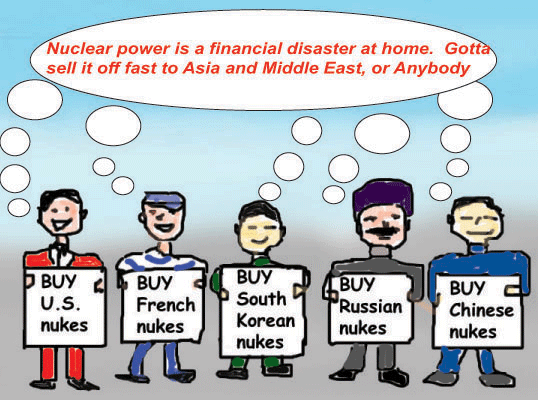
“For the visit of the Prime Minister to Russia, a programme has been finalised for expansion of nuclear programme,” he said about the trip expected later this month……http://zeenews.india.com/news/india/nuclear-expansion-on-agenda-of-pm-visit-to-russia_1832478.html
Indian Parliament may fast-track nuclear projects in Winter Session
Bill for fast-tracking nuclear power projects likely in Winter Session http://www.dnaindia.com/india/report-bill-for-fast-tracking-nuclear-power-projects-likely-in-winter-session-2152574 Sunday, 6 December 2015 A bill seeking to fast-track nuclear power projects is likely to be introduced in the Winter Session of Parliament, while another legislation for according greater autonomy to the atomic energy regulator may not be brought this time.
The Union Cabinet had last month approved amendments to the Atomic Energy Act to enable Nuclear Power Corporation of India Ltd (NPCIL) to enter into join ventures with other public sector undertakings (PSUs). The move will help secure funds for big ticket projects.
Concern over lack of financial resources has been raised by the Department of Atomic Energy (DAE) frequently. The amendment will enable NPCIL, which is one of the PSUs under the DAE, to enter into joint ventures with other government undertakings.
However, sources said, the Nuclear Safety Regulatory Authority (NSRA) Bill may not be presented before Parliament even in this session. The NSRA Bill will seek to create a more independent authority, replacing the Atomic Energy Regulatory Board (AERB)—the atomic energy sector watchdog.
The Bill, first introduced in the Lok Sabha in 2011, has lapsed and will have to be reintroduced.
Liability and compensation issues for a nuclear India
 India unprepared: what happens in case of a nuclear Bhopal?, Catch News, KUMAR SUNDARAM@pksundaram 4 December 2015
“……..On the issue of liability and compensation, the government has shown scant regard to potential victims. Safeguarding the foreign suppliers from any liability has been a paramount concern.
Nothing could be more absurd and ironic than the fact that since the inception of the Civil Liability for Nuclear Damage Act 2010, the government has been busy finding a way to address the concerns of the foreign suppliers, who want complete indemnification.
The clause 17(b), holding suppliers liable, albeit with severe limitations, was introduced under parliamentary and civil society pressure by a reluctant Manmohan Singh. But the Modi governmentt has dumped the earlier BJP position on nuclear liability, and tried to create an insurance pool to channel the liability back to the exchequer, thus undermining the law.
In the light of India’s vulnerability on the above three counts, the 31st anniversary of the Bhopal Gas Tragedy should be a moment to recognise that, in general, our administrative and political system can only be relied on to be totally inefficient and unaccountable.
As with Bhopal, in the case of a nuclear accident, the government would be unable to provide any relief for victims, especially as the main victims would be adivasis and villagers far away from the public gaze.
Irreversible and wide-ranging consequences……… http://www.catchnews.com/india-news/india-unprepared-what-happens-in-case-of-a-nuclear-bhopal-1449243696.html
India’s Bhopal gas victims call on PM Modi to shun nuclear power industry
RECONSIDER SELLING NUCLEAR TECH TO INDIA’ HTTP://WWW.DAILYPIONEER.COM/STATE-EDITIONS/RECONSIDER-SELLING-NUCLEAR-TECH-TO-INDIA.HTML , 06 DECEMBER 2015 | STAFF REPORTER | BHOPAL | IN BHOPAL SURVIVORS OF THE BHOPAL GAS DISASTER HAVE URGED THE JAPAN PRIME MINISTER SHINZO ABE TO RECONSIDER THE IDEA OF SELLING NUCLEAR TECHNOLOGY TO INDIA AFTER FUKISHIMA DISASTER.

Five organisations working for the gas victims in a letter to Japanese PM Abe scheduled to visit New Delhi on December 11 to hold annual summit talks with his Indian counterpart Narendra Modi urged him to shun the idea of selling nuclear technology after Fukishima disaster more so because the Indian Government has totally failed in the responding to the aftermath of Bhopal disaster and poisons of Union Carbide and Dow Chemical continue to find new victims every day, even after 31 years of the disaster. The letter to the Japanese PM further says that the victims of Bhopal continue to struggle for justice, adequate compensation and proper medical, economic, social and environmental rehabilitation even after 31 years of the tragedy.
The organisations also warned him that to make their pleas heard citizens in Japan and people in India living near existing and proposed nuclear power plants would stage protests during his upcoming visit to India.
They said that one of the main reasons they were opposed to the India-Japan nuclear agreement is that in India, the implementation of environment and labour laws are pathetic. The letter said that they also realise that this nuclear agreement has nothing to do with the energy situation in this country, rather the sole aim is to restore some confidence in the global nuclear lobby, which is facing its terminal crisis after Fukushima.
They said , “We urge you to desist from this impending agreement during your visit to India. We want strong relationship between India and Japan. We want both countries to come closer and work on technologies that make human lives better—renewable energy sources, effective decontamination and more accessible medicines. For a better future for India and Japan, and for safety, security and prosperity of our people, let us shun the nuclear path and opt for a peaceful future”.
Despite the hype, India’s Kudankulam nuclear plant isn’t working out too well
2 years on, Kudankulam isn’t working. Where are its cheerleaders now?Catch News, KUMAR SUNDARAM
The promises
- Kudankulam nuclear power plant was built despite opposition from locals, scientists
- It was projected as the answer to Tamil Nadu’s power woes
The reality
- Tamil Nadu continues to be short of electricity
- The Kudankulam plant has worked in first and starts and remains shut for 3 months now
More in the story
- How the project is proving to be ineffective – a white elephant
- Who is responsible for this mess
After all the brouhaha, however, the reality is that the plant has not been working for the last three months: Reactor No. 1 of the plant was shut down for “annual maintenance” on 26 June this year. It was to restart on 22 August, but the date was initially pushed back to 23 September.
Then the Nuclear Power Corporation of India, which operates the project, postponed the reopening to 7 October and then again to 15 October. The plant is yet to start, despite a public assurance from MR Srinivasan, former chariman of Department of Atomic Energy.
In fact, after a much-celebrated start, the power plant near Idinthakarai – a hamlet by the Bay of Bengal – has been under “routine maintenance” or has tripped and shut down, leaving the authorities red-faced.
Kudankulam has abnormally high ‘trip rate’. Basically, it fails much more than other N-power plants
After being commissioned, the plant took a long time to function at full capacity and was declared commercially operational only in 31 December, 2014. In these 14 months, the reactor shut down 19 times due to tripping and there were three maintenance outages.
Soon after the outset, the rotor of the power went into ‘reverse power’ mode and tripped. Instead of adding power to the grid, it started sucking power back. In reality, the NPCIL had declared the project to be commercially open in a hurry as the unending tests became an embarrassment………
Manmohan Singh govt made it an ego issue. But Kudankulam is now proving to be a non-starter
The issue can earn the BJP some brownie points against the Congress. But it also seems to be avoiding the issue as it supports nuclear energy in principle and as it may also expose Modi’s global nuclear shopping spree to uncomfortable questions……..
Can we rethink?
The world is moving towards sustainable and renewable energy sources which have become increasingly more efficient and viable.
After all the heavy investment in Kudankulam, deliberate neglect of environmental and safety concerns and the bulldozing of local people’s dissent, India has got a nuclear reactor that’s not working. Will policy-makers and their cheerleaders now stop and re-think?
It’s too dangerous to allow Kudankulam to fade away as it doesn’t suit the dominant interests that underpin the public gaze in India. The issue may have become unattractive for them or have simply outlived its shelf-life as a headline, but it concerns safety of Indian citizens, larger public policy on an issue of national importance and the emptiness of promises made to people to sell the expensive and dangerous project to them. http://www.catchnews.com/environment-news/kudankulam-is-not-working-where-are-its-cheerleaders-now-1445501297.html
India again tests a Nuclear-Capable Missile
India Completes Agni-I Nuclear-Capable Missile Test, defense World, November 27, 2015 India has test fired home-made nuclear capable Agni-I missile that can hit target from a distance of 700kms.
The missile was launched from off the Odisha coast as a part of Strategic Forces Command (SF) training centre, NDTV reported today.
The surface-to-surface, single-stage missile, was powered by solid propellants. It was test-fired from a mobile launcher at 1002 hours from launch pad-4 of the Integrated Test Range (ITR) at Abdul Kalam Island (Wheeler Island)…….he missile, which has already been inducted into armed forces, weighs 12 tonnes. The 15-metre-long missile is designed to carry a payload of more than one tonne. Moreover, its strike range can be extended by reducing the payload…….http://www.defenseworld.net/news/14714/India_Completes_Agni_I_Nuclear_Capable_Missile_Test#.Vli4odIrLGg
India’s PM Modi does a hollow, but quite toxic, nuclear deal with Britain

 Modi’s nuclear deal with Britain is hollow, but quite toxic, catch news, KUMAR SUNDARAM, 15 Nov 15
The deal
- Narendra Modi has just inked a nuclear deal with Britain
- He called it symbol of “our resolve to combat climate change’
- The deal comes when the British nuclear industry is in a crisis
The danger
- Britain has little to offer India in terms of nuclear energy
- It reinforces the myth that n-power is green, climate-friendly
- India is missing the shift from n-power to renewable energy
More in the story
- India is among the few nations on a nuclear shopping spree in the post-Fukushima world. Why?
- Nuclear energy isn’t a solution to climate change. Why is the industry peddling this myth?
Keeping to the script, Modi has just announced a civilian nuclear agreement with Britain.
The pact is largely symbolic. But it’s dangerous.
Spent force
Britain has little to offer India when it comes to nuclear energy. Its nuclear industry is facing a terminal crisis. The two power plants planned in Hinkley Point have been plagued by escalating costs, forcing the investors to abandon the project, as well as serious design risks.
Britain’s new nuclear plants in Hinkley Point are plagued by escalating costs, serious design risks
It seems that nobody will be liable for a nuclear disaster in India!
 liability for foreign suppliers may now be entirely removed, not just diluted.
In his one and a half year in office, Modi hasn’t demonstrated any particular penchant for consistency, but this would be his most dangerous U-turn, imperilling millions of innocent Indian lives.
Who will be liable for an Indian Fukushima? Nobody, it seems, Catch News, KUMAR SUNDARAM@pksundaram|10 November 2015
- India to entirely exempt foreign nuclear suppliers from liability – AEC said last week
- Who will be responsible in case of an accident then?
What breakthrough!
- There was a Indo-US breakthrough on N-liability – Modi last week
- Can a complete exemption from liability be called a breakthrough?
Highest cancer rate in Kerala, India, – (where natural radiation is high)
 Highest rate of cancer cases in Kerala: Chief Minister Oommen Chandy
South | Press Trust of India January 27, 2014 THIRUVANANTHAPURAM, KERALA: In a shocking revelation, Kerala Chief Minister Oommen Chandy today informed the state Assembly that the state has the highest number of cancer patients in the country.
Out of every one lakh males, 133 persons suffer from the disease while in the case of females, it is 123 for every one lakh females, he said while replying to a calling attention motion on the necessity to set up a cancer institute in Kochi.
As per statistics, nearly 50 per cent of cancer cases could be cured if the disease was identified in the initial stage itself and treatment started, Chandy said.
On the demand for a Cancer Institute, he said the cabinet had already decided to set up a Cancer Research Institute at the campus of Kochi Medical College hospital, which was taken over by the government from the co-operative sector……http://www.ndtv.com/south/highest-rate-of-cancer-cases-in-kerala-chief-minister-oommen-chandy-549016
India shuts down nuclear critic Greenpeace
 India orders Greenpeace to shut down http://www.heraldsun.com.au/news/breaking-news/india-orders-greenpeace-to-shut-down/news-story/81aa8e5e1c0e45927594dac4266c12fd November 7, 2015 India has cancelled Greenpeace International’s license to operate and given the group 30 days to close down, citing financial fraud and falsification of data.
Prime Minister Narendra Modi’s government has turned the spotlight on foreign charities since he took office last year, accusing some of trying to hamper projects on social and environmental grounds.
Last year, Modi government withdrew permission to Greenpeace to receive foreign funding, saying the money was used to block industrial projects.
Under the latest order issued by authorities in the southern Indian state of Tamil Nadu where Greenpeace is registered, the government said it had found the organisation had violated the provisions of law by engaging in fraudulent dealings.
A government official confirmed the closure order had been issued on Wednesday but did not elaborate.
Greenpeace India has campaigned against coal mines in forests, genetically modified crops, nuclear power and toxic waste management.
In recent months the federal government has toughened rules governing charities and cancelled the registration of nearly 9000 groups for failing to declare details of overseas donations.
USA- India nuclear sales quietly fading, as nuclear financially unviable
Solar power developers have offered to sell electricity in India at less than Rs 5/unit. This makes solar competitive with traditional forms of energy, and makes new nuclear power plants financially unviable. India must register the changed reality, and discard the idea of expensive Western reactors. Time to scrap the India-U.S. nuclear deal?
Hard on the heels of falling oil prices and affordable shale, comes another dramatic energy changes for the energy industry: The falling cost of solar energy. This has many implications, but the most immediate impact the nuclear power industry, large parts of which may have just become obsolete. This means that the new nuclear power plants being planned by India, especially those with foreign collaboration, must be reconsidered and scrapped if they are financially unviable.
Record low price for solar power to be sold by Indian Government
 Indian government plans to sell solar power at record low price of $0.07 per unit. News Forage, 13 Oct 15, India’s strategy of a foreign currency-denominated tariff plan for solar energy is aimed at providing solar power at a new low of Rs.4.75 per unit to the states. Continue reading
1 This Month
19 February – VIRTUAL EVENT-Decision Time: AI and Our Nuclear Arsenal
12:45 p.m. Central / 1:45 p.m. Eastern
To see nuclear-related stories in greater depth and intensity – go to https://nuclearinformation.wordpress.com
-
Archives
- February 2026 (141)
- January 2026 (308)
- December 2025 (358)
- November 2025 (359)
- October 2025 (376)
- September 2025 (258)
- August 2025 (319)
- July 2025 (230)
- June 2025 (348)
- May 2025 (261)
- April 2025 (305)
- March 2025 (319)
-
Categories
- 1
- 1 NUCLEAR ISSUES
- business and costs
- climate change
- culture and arts
- ENERGY
- environment
- health
- history
- indigenous issues
- Legal
- marketing of nuclear
- media
- opposition to nuclear
- PERSONAL STORIES
- politics
- politics international
- Religion and ethics
- safety
- secrets,lies and civil liberties
- spinbuster
- technology
- Uranium
- wastes
- weapons and war
- Women
- 2 WORLD
- ACTION
- AFRICA
- Atrocities
- AUSTRALIA
- Christina's notes
- Christina's themes
- culture and arts
- Events
- Fuk 2022
- Fuk 2023
- Fukushima 2017
- Fukushima 2018
- fukushima 2019
- Fukushima 2020
- Fukushima 2021
- general
- global warming
- Humour (God we need it)
- Nuclear
- RARE EARTHS
- Reference
- resources – print
- Resources -audiovicual
- Weekly Newsletter
- World
- World Nuclear
- YouTube
-
RSS
Entries RSS
Comments RSS
 nuclear-news