US nuclear corporation salivates at thought of selling reactors to India
 Ahead Of PM Modi’s Trip To US, Hopes For A Major Nuclear Reactor Deal, NDTV
A Westinghouse team is already in India to negotiate the deal, Chief Executive Daniel Roderick told news agency Reuters, but talks are likely to go down to the wire, as the crucial issue of nuclear liability insurance for suppliers remains unresolved. The aim, however, was to make a “commercially significant announcement” during PM Modi’s expected US visit in March and sign a final contract later in the year, Mr Roderick said.
A US diplomat said the United States had invited PM Modi to the March 31-April 1 Nuclear Security Summit and that Washington was thinking of turning the trip into a full-fledged official visit, which would give the Indian leader a similar reception as Chinese President Xi Jinping.
The Westinghouse contract would give a big boost to India’s $150 billion nuclear power programme…….
India has given two sites to US companies – Westinghouse and a nuclear venture between General Electric Co and Hitachi – to build six reactors each. http://www.ndtv.com/india-news/ahead-of-pm-modis-trip-to-us-hopes-for-a-major-nuclear-reactor-deal-1266211
Indian officials unwilling to answer questions about nuclear emergency guidelines

 Officials pass the buck on RTI queries on NDMA guidelines http://m.thehindu.com/news/cities/chennai/officials-pass-the-buck-on-rti-queries-on-ndma-guidelines/article8079555.ece
G. Sundarrajan of Poovulagin Nanbargal, an environmental forum had sought to know whether the NDMA Guidelines on Nuclear and Radiological Emergencies released in 2009 had been implemented in the district.
He also sought information on the infrastructure such as hospitals identified to treat radiological emergencies as per the guidelines.
The Public Information Officer (PIO) in Tirunelveli Collectorate, in his reply to the applicant, stated that the request was being forwarded to his counterpart in Kudankulam Nuclear Power Plant, as the latter was the officer concerned for the details sought for.
The Public Information Officer at Kudankulam Nuclear Power Plant of NPCIL on December 29 replied contending it was the District Management Authority, which was the authority concerned and returned the queries to the PIO of Tirunelveli Collectorate.
Mr. Sundarrajan said, “The Supreme Court was, in 2013, informed that all precautionary measures were taken and now they are denying information on the details of the implementation. This is anti-constitutional, anti-people and illegal. They cannot deny or point at each other when asked for information.”
Tirunelveli District Collector M. Karunakaran told The Hindu , “The applicant has not sent the queries to the right person, i.e., the DRDA, which deals with the information and the PIO in Collectorate would not have the information. If information is sought from the right person, it would have been provided.” When contacted by The Hindu , an NPCIL official said, on condition of anonymity, “There has been some misunderstanding among officials in some departments of the district administration on this issue. We complied with the implementation of the guidelines on our part.”
Info sought under RTI Act whether suggestions
on nuclear emergencies were implemented
Report of India’s Integrated Regulatory Review Services (IRRS) on Atomic Energy Board
India’s nuclear regulators have been audited, THE HINDU, MP RAM MOHAN ELS REYNAERS KINI , 3 JAN 16 But what’s the point? Parliament hasn’t passed the Nuclear Safety Regulatory Authority Bill 2015 as yet
Now, the full IRRS report has been made public and can be viewed on the AERB’s website. This is certainly one of the most significant transparency efforts initiated by the AERB in recent times. The authors believe this signals an important commitment to adopt a new public engagement model. At a substantive level, the IRRS team identified several good practices, but also areas warranting attention or in need of improvement, to enhance the overall performance of the regulatory system in India………
Many in civil society and the AERB itself in private communication maintain that its “de facto” independence should be cemented in a law “de jure” as well. That said, the IRRS mission observed that the “professionalism and integrity of the AEC, NPCIL and AERB senior staff towards ensuring the regulatory decision making processes/arrangements were completed independently and did not notice instances in which de facto AERB independence was compromised”.
Another important aspect that would need to be addressed is the grievance redress system or appeal procedure against decisions by the AERB. Currently, the constitution of the AERB states that appeals against decisions of the AERB shall be with the Atomic Energy Commission (AEC) whose decision shall be final. Here, the IRRS mission remained rather timid by merely referring to and not fully suggesting a more coherent appeal procedure which would be more in tune with a fully independent mechanism.
Addressing grievances
This is regrettable because one of the most important functions in any democratic system is the redressal of grievances, whether sought by an operator, a service provider, the public or anyone who has a role in an NPP activity. Moreover, the AERB constitution remains vague as to precisely who can appeal. These are aspects that also would need to be addressed more comprehensively to ensure that the public has faith in the nuclear regulatory system. The current redressal system also explains why people so far have generally opted to approach the courts with their grievances, rather than the AEC.
The DAE and the AERB should consider the IRRS mission review and many such suggestions of civil society in all earnestness, and thereby acknowledge that it is in the interest of the nation to make the regulatory system better, efficient and people-centric. It is important to remember what the Fukushima Nuclear Accident Independent Investigation Commission of Japan concluded: “The TEPCO Fukushima Nuclear Power Plant accident was the result of collusion between the government, the regulators and TEPCO, and the lack of governance by said parties. They effectively betrayed the nation’s right to be safe from nuclear accidents.”
The winter session of Parliament had in its agenda to consider the NSRA Bill 2015, but it didn’t see legislative light. The Bill going into hibernation again is a missed opportunity when the expansion of nuclear power is going ahead. …..
Mohan is an associate professor at TERI University; Kini is a partner at MV Kini & Co, Mumbai. The writers are members of the Nuclear Law Association, India. http://www.thehindubusinessline.com/opinion/indias-nuclear-regulators-have-been-audited/article8061473.ece
The message of Mahatma Ghandi is relevant today
 Ecological Meltdown And Nuclear Conflict: The Relevance Of Gandhi In The Modern World By Colin Todhunter Global Research, January 03, 2016 ………. Gandhi was ahead of his time. Although he might not have used today’s terms, ideas pertaining to environmentalism, agroecology, sustainable living, fair trade, local self-sufficiency, food sovereignty and so on were all present in his writings. He was committed to inflicting minimal damage on the environment and was concerned that humans should use only those resources they require and not amass wealth beyond their requirements. People have the right to attain certain comforts but a perceived right to unbridled luxuries would result in damaging the environment and impinge on the species that we share the planet with. His own lifestyle was a highly sustainable one, focusing on simplicity, austerity and need rather than want…………. government after government aggravates the problems by creating an impression that the villagers are a backward, inefficient and unproductive lot who can survive only on relief. With proper investment and appropriate policies, India’s rural economy could once again thrive.
T N Khoshoo argued that Gandhi’s advocacy of an ‘non-interventionist lifestyle’ provides the answer to the present day problems. The phrase ‘health of the environment’ is not just a literary coinage, he argues. It makes real biological sense because, as Gandhi argued, our planet is like a living organism. Without the innumerable and varied forms of life that the earth inhabits, without respecting the species we share this place with, our world will become lifeless.
Alternatively, before that happens, humans will become extinct and the planet will shake us off like a bad case of fleas. But, in the meantime, how much damage will have done by then and how much suffering will we have caused by a system that thrives on turning people into slaves to their desires and allowing imperialism to reign free?
Gandhi was “an apostle of applied human ecology,” according to T N Khoshoo. He offered a vision for a world without meaningless consumption which depleted its finite resources and destroyed habitats and the environment. Given the problems facing humanity, his ideas should serve as an inspiration to us all, whether we live in India or elsewhere.
Unfortunately, his message seems to have been lost on many of today’s leaders who have capitulated to an out-of-control ‘capitalism’ that is driving the world towards resource-driven conflicts with the ultimate spectre of nuclear war hanging over humanity’s head. http://www.globalresearch.ca/ecological-meltdown-and-nuclear-conflict-the-relevance-of-gandhi-in-the-modern-world/5499007
India’s race for nuclear weapons, promoted by US government policies
Indian Nuclear Program – A global migraine , The Nation Muhammad Umar December 30, 2015 American experts have been incessantly warning their government of the dire consequences of exempting India from the Nuclear Suppliers Group (NSG) requirements. On December 8, while testifying in front of the United States House Committee on Foreign Affairs, the Executive Director of the Nonproliferation Policy Education Center, Henry D. Sokolski said, “The US persuaded the NSG to allow India to import uranium for its civilian nuclear program but, as predicted, this has only allowed India to dedicate more of its meager domestic uranium production to military purposes. India, in short, with the deal now can make more bombs.”
Since last December, Putin, Obama, and Xi Jinping have all visited India, and with each one Modi has made promises that contradict the commitments he has made to the others. Modi thinks he can pull the wool over everyone’s eyes – yes, he does, but cannot fool them any longer. He used President Xi Jinping’s visit to leverage Russia and the visit by Vladimir Putin to force Barack Obama into his arms. This is the real face of the so-called incredible India.
The construction of this new top-secret nuclear city, as detailed in Levy’s report is clear evidence that America’s attempt to offer India a civil nuclear incentive has failed to reign in their nuclear weapons program, instead it has helped the weapons program grow to unthinkable new heights. The city when completed in 2017 would be “the subcontinent’s largest military-run complex of nuclear centrifuges, atomic-research laboratories, and weapons- and aircraft-testing facilities”, the report said.
Regional stability is essential to avoid war, the NSG exemption secured by the America for India has freed up un-safeguarded Indian uranium for weapons use, and as revealed by Levy for an entire city dedicated to building nuclear bombs. After all this, America still choses to continue with backing India’s bid for full membership to the NSG, ironically the very organization created to prevent future proliferation after India exploded their first bomb.
The Americans must know that if India is allowed to build such a huge facility for the sole purpose of enriching uranium, it will create instability in the region. It will further aggravate Pakistan’s security dilemma, and at the same time enrage the Chinese.
According to the report, the construction began three years ago, and it is hard to imagine that strategic thinkers in the United States did not raise any red flags……… http://nation.com.pk/columns/30-Dec-2015/indian-nuclear-program-a-global-migraine
ENE News summarises the most shocking points in India’s scandalous nuclear history
“Nuclear Nightmare”: Children with mutations “on almost every street” — Deformed heads, lopsided bodies, “toad skin”, eyelids turned inside out — School built using radioactive waste “part of community outreach project” — Nuclear Expert: “Exceptionally worrying, no one should’ve been living anywhere near” (VIDEO)http://enenews.com/nuclear-nightmare-village-birth-defects-deformed-heads-lopsided-bodies-toad-skin-eyelids-turned-inside-school-built-radioactive-waste-children-mutations-almost-every-street-video?utm_source=feedburner&utm_medium=email&utm_campaign=Feed%3A+ENENews+%28Energy+News%29Excerpts from report on Huffington Post, Dec 14, 2015 (emphasis added):
- How India’s Nuclear Industry Created A River Of Death…
- Researchers found that the Subarnarekha river and areas around Jadugoda, India, werepoisoned from the emissions of a nearby secret nuclear factory…
- [T]he Center for Public Integrity has reviewed hundreds of pages of personal testimony and clinical reports in the case that present a disturbing scenario…
- Doctors and health workers, as well as international radiation experts, say that nuclear chiefs have repeatedly suppressed or rebuffed their warnings… The case files include epidemiological and medical surveys warning of a high incidence of infertility, birth defects and congenital illnesses…
- [Dipak Ghosh, a respected Indian physicist and dean of the Faculty of Science at Jadavpur University, with his] team collected samples from the river and from adjacent wells, seven years ago, he was alarmed by the results… “It was potentially catastrophic,” Ghosh said in a recent interview. Millions of people along the waterway were potentially exposed…
- Many said their children were born with partially formed skulls, blood disorders,missing eyes or toes, fused fingers or brittle limbs…
- Analyzing a representative sample of people between 4 and 60 years old living within a mile and a half of the third tailing dam, the researchers hired by [Uranium Corporation of India Limited] concluded that the residents were “affected by radiation.”… symptoms included swollen joints, spleens and livers, and coughing up blood. The UCIL report also described “osteoporosis, defective limbs, and habitual abortion,” as well as many complaints of “missed menstrual cycle” and a cluster of cancer cases…
- [A]n American diplomat [warned that] “lax safety measures … are exposing local tribal communities to radiation contamination.” In a confidential cable to Washington, Henry V. Jardine, a career foreign service officer and former Army captain, expressed blunt dismay… In a new cable on June 6, 2008… Jardine told Washington that still another epidemiological study had concluded “indigenous groups … living close to the mines reportedly suffer high-rates of cancer, physical deformities, blindness, brain damage and other ailments.” UCIL “refuses to acknowledge these issues,” he noted. Jardine wrapped up: “Post contacts, citing independent research, say that it is difficult to point out any reason other than radiation…”
- Surendra Gadekar, a nuclear physicist, began taking soil, water and air samples… Their study was published in 2004… It found radiation levels inside the villages around the tailing ponds were almost 60 times the U.S. Nuclear Regulatory Commission “safe level.”… [They] also documented the existence in neighboring populations of children withmalformed torsos and deformed heads and the wrong number of fingers, as well as a cluster of cases where infants’ bodies grew at different rates, giving them alopsided gait. Some had hyperkeratosis, a condition known as “toad skin”…
- In late 2000, [Hiroaki Koide, a nuclear engineer who teaches at the Research Reactor Institute at Kyoto University] took soil and water samples… “These figures wereexceptionally worrying,” Koide said. “No one should have been living anywhere near“… Koide confirmed that uranium rock and finely ground mine tailings had been used as ballast for road leveling and house building and to construct a local school and clinic… [A] senior UCIL official… confirmed these construction projects using irradiated materials had gone ahead as “part of a community outreach project.”
Toronto Star, Sep 15, 2014: India’s nuclear nightmare: The village of birth defects… Neither Alowati nor Duniya can walk, nor can they hold anything; their limbs dangle lifelessly… Their knees and elbows are rubbed raw from crawling… They need help to bathe and use the toilet. Children with birth deformities like Alowati and Duniya live on almost every street in Jadugora… When people began to notice that young women were having miscarriages, witches and spirits were blamed… But people had lesions, children were born with deformities, hair loss was common. Cows couldn’t give birth, hens laid fewer eggs, fish had skin diseases… [L]ocal media reports… included shocking pictures of children who were sick or deformed… A 2007 report by the Indian Doctors for Peace and Development, a non-profit, found a far greater incidence of congenital deformity, sterility and cancer… Mohammad is 13 but looks 7. Like Alowati and Duniya, he drags himself forward with his elbows… A few huts away [a child’s] eyelids are turned inside out…
Vulnerability of India’s nuclear materials to theft
 India’s nuclear explosive materials are vulnerable to theft, U.S. officials and experts say. But Washington has chosen not to press for tougher security while its trade with India is booming, Center For Public Integrity, By Adrian Levy
 R. Jeffrey Smith 17 Dec 15 “…….. officials here and outside India depict as serious shortcomings in the country’s nuclear guard force, tasked with defending one of the world’s largest stockpiles of fissile material and nuclear explosives.
An estimated 90 to 110 Indian nuclear bombs are stored in six or so government-run sites patrolled by the same security force, according to the Stockholm International Peace Research Institute, an independent think tank, and Indian officials. Within the next two decades, as many as 57 reactors could also be operating under the force’s protection, as well as four plants where spent nuclear fuel is dissolved in chemicals to separate out plutonium to make new fuel or be used in nuclear bombs.
The sites are spread out over vast distances: from the stony foothills of the Himalayas in the north down to the red earth of the tropical south. Shuttling hundreds of miles in between will be occasional convoys of lightly-protected trucks laden with explosive and fissile materials — including plutonium and enriched uranium — that could be used in civilian and military reactors or to spark a nuclear blast.
The Kalpakkam shooting as a result alarmed Indian and Western officials who question whether this country — which is surrounded by unstable neighbors and has a history of civil tumult — has taken adequate precautions to safeguard its sensitive facilities and keep the building blocks of a devastating nuclear bomb from being stolen by insiders with grievances, ill motives, or in the worst case, connections to terrorists.
Although experts say they regard the issue as urgent, Washington is not pressing India for quick reforms. The Obama administration is instead trying to avoid any dispute that might interrupt a planned expansion of U.S. military sales to Delhi, several senior U.S. officials said in interviews.
The experts’ concerns are based in part on a series of documented nuclear security lapses in the past two decades, in addition to the shooting:
- Several kilograms of what authorities described as semi-processed uranium were stolen by a criminal gang, allegedly with Pakistani links, from a state mine in Meghalya, in northeastern India, in 1994. Four years later, a federal politician was arrested near the West Bengal border with 100 kilograms of uranium from India’s Jadugoda mining complex that he was allegedly attempting to sell to Pakistani sympathizers associated with the same gang. A police dossier seen by the Center states that ten more people connected with smuggling were arrested two years after this, in operations that recovered 57 pounds of stolen uranium.
- In 2008, another criminal gang was caught attempting to smuggle low-grade uranium, capable of being used in a primitive radiation-dispersal device, from one of India’s state-owned mines across the border to Nepal. The same year another group was caught moving an illicit stock of uranium over the border to Bangladesh, the gang having been assisted by the son of an employee at India’s Atomic Minerals Division, which supervises uranium mining and processing.
- In 2009, a nuclear reactor employee in southwest India deliberately poisoned dozens of his colleagues with a radioactive isotope, taking advantage of numerous gaps in plant security, according to an internal government report seen by the Center.
- And in 2013, leftist guerillas in northeast India illegally obtained uranium ore from a government-run milling complex in northeast India and strapped it to high explosives to make a crude bomb before being caught by police, according to an inspector involved in the case. Continue reading
India has rebuffed offers of help to make its nuclear industry safer
India’s nuclear explosive materials are vulnerable to theft, U.S. officials and experts say. But Washington has chosen not to press for tougher security while its trade with India is booming, Center For Public Integrity, By Adrian LevyR. Jeffrey Smith 17 Dec 15
“……..The Nuclear Threat Initiative, a nonprofit group in Washington, reported last year for example that India’s nuclear security practices ranked 23rd among 25 countries that possess at least a bomb’s-worth of fissile materials. Only Iran and North Korea fared worse in the analysis, which noted that India’s stockpiles are growing and said the country’s nuclear regulator lacked independence from political interference and adequate authority.
It said the risks stemmed in part from India’s culture of widespread corruption — which helped force the nation’s ruling Congress party from power in May 2014 — as well as its general political instability. “Weaknesses are particularly apparent in the areas of transport security, material control, and accounting, and measures to protect against the insider threat, such as personnel vetting and mandatory reporting of suspicious behavior,” the group’s report stated.
But India has rebuffed repeated offers of U.S. help. Gary Samore, President Obama’s coordinator for arms control and weapons of mass destruction from 2009 to 2013, said that at preparatory meetings for international summits on nuclear security in 2010 and 2012, “we kept offering to create a joint security project [with India] consisting of assistance of any and every kind. And every time they would say, to my face, that this was a wonderful idea and they should grasp the opportunity. And then, when they returned to India, we would never hear about it again.”
India also refused to collaborate with the Nuclear Threat Initiative project by sharing or confirming information about its practices, unlike 17 of the other 24 countries in the study. They responded ferociously to its conclusions, according to a researcher connected to the project, who was not sanctioned to talk about it. Officials at the Indian Atomic Energy Commission verbally attacked Ted Turner and Sam Nunn, the NTI’s founders, in conversations with Indian journalists, the researcher said……
Despite the celebration of close U.S.-Indian ties during President Obama’s visit to Delhi in January, “there is still no deep technical relationship” between the two countries on nuclear security issues, a White House official conceded in a recent interview, speaking on condition of anonymity. “We only hope that this will slowly change.”
At the moment, India is seeking three favors from Washington: It wants U.S. help to gain membership in the Missile Technology Control Regime, an international forum meant to limit the spread of nuclear-tipped missiles, which would give it access to certain otherwise restricted foreign space-launch technologies. And it wants to join the Nuclear Suppliers Group, composed of nations that agree to respect nonproliferation rules when they trade in nuclear-related technologies. Both ambitions reflect India’s desire to be accorded the status of a major world power, U.S. experts say.
It also wants to acquire U.S. defense technologies by co-producing weapons systems in India with key Pentagon contractors – an issue discussed between Secretary of Defense Ashton Carter and Indian defense minister Manohar Parrikar during the minister’s weeklong visit to Washington beginning on Dec. 4.
But the Obama administration decided not to use these issues as leverage to force better security measures for nuclear explosives, the senior U.S. official said, because of its judgment that doing so would only prompt India to walk away.
A former senior U.S. nonproliferation official said this was a mistake. Washington, he said on condition of not being named, “has allowed itself to be put into the position of not wanting to displease India for fear of putting things off-track” in its new, warming relationship, and it has wrongly “allowed the Indians to wall off things they are not interested in talking about” while its ties to the United States grow.
An official in Britain’s Foreign Office, who also spoke on condition he not be named, expressed a more jaundiced view of this reluctance to press Delhi harder.
“Nothing can be allowed to get in the way of investment in the capacious Indian market,” the British official said, describing the current American mindset. “India has effectively bought itself breathing space, over a lot of concerning issues, especially nuclear security, by opening itself up for the first time to significant trades with the U.S. and Europe.” The financial gains, he said, are “eye-watering.”
According to the U.S. Commerce Department, trade with India grew from $19 billion in 2000 to more than $100 billion in 2014. U.S. exports exceeded $38 billion — including substantial new U.S. arms shipments — supporting 181,000 U.S. jobs. Indian direct investment in the United States totaled $7.8 billion while U.S. investments reached $28 billion.
Washington, the British official explained, does not wish to provoke a spat over nuclear security simply because doing so could threaten this lucrative trade, which benefits many U.S. companies.
This is part four of a four-part series about india’s civil and military nuclear program, co-published with the Huffington Post worldwide and Foreign Policy magazine in Washington, D.C. The other articles can be found here: https://www.publicintegrity.org/national-security/nuclear-waste
R. Jeffrey Smith reported from Washington, D.C., and California. Adrian Levy is is an investigative reporter and filmmaker whose work has appeared in the Guardian, The Observer, The Sunday Times, and other publications. His most recent books are: The Meadow, about a 1995 terrorist kidnapping of Westerners in Kashmir, and The Siege: The Attack on the Taj, about the 2008 terrorist attacks in Mumbai. He reported from India and the United Kingdom. http://www.publicintegrity.org/2015/12/17/18922/india-s-nuclear-explosive-materials-are-vulnerable-theft-us-officials-and-experts
India’s PM Narendra Modi off to Russia to negotiate nuclear reactor purchases
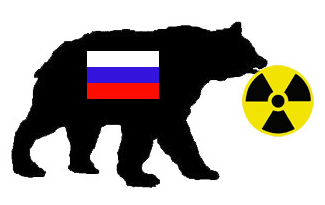 India, Russia eye nuclear, helicopter deals prior to Modi visit, Hindustan Times, Reuters, New Delhi Dec 18, 2015 Prime Minister Narendra Modi is expected to promote deals for Russian nuclear reactors and military helicopters worth billions of dollars on a trip to Moscow next week, attracted by promises to transfer technology that Western nations have been slow to make…….
Modi, who heads for Moscow on December 23, will also offer Russia a site in Andhra Pradesh to build six nuclear reactors of 1,200 megawatts (MW) each, the same sources added.
That is in addition to the six Russia is constructing in neighbouring Tamil Nadu, said the officials, who spoke on condition of anonymity because they were not authorised to speak to the press.
New Delhi has turned to Russia as US firm General Electric and Westinghouse, a US-based unit of Japan’s Toshiba, are still weighing an entry into India’s nuclear energy sector because of a law that makes reactor suppliers liable in case of an accident………
Russian President Vladimir Putin is banking on India’s drive to manufacture at home to regain market share…….http://www.hindustantimes.com/india/india-russia-eye-nuclear-helicopter-deals-prior-to-modi-visit/story-wdxOqkpbmKbbi8hu8QxHjM.html
China should not be supplying nuclear reactors to Pakistan – says India
India red flags fresh nuclear reactors in Pakistan with China’s help By Dipanjan Roy Chaudhury, ET Bureau | 18 Dec, 2015 NEW DELHI: India has red flagged fresh nuclear reactors that are being set up in Pakistan with Chinese assistance and asserted that it is taking adequate steps to safeguard any challenge to the country’s security due to these developments.
“The government remains committed to taking all necessary steps to safeguard India’s national security interests,” he said.
Earlier this year a Chinese official publicly confirmed that Beijing is involved in at least six nuclear power projects in Pakistan and is likely to export more to the country. …….
Revelations about the growing Sino-Pakistan nuclear partnership comes amid continuing concerns in some quarters that ongoing cooperation is happening without the sanction of the Nuclear Suppliers Group (NSG) which helps supervise the export of global civilian nuclear technology. China is a member of the NSG and existing regulations prohibit members from exporting such technology to nations such as Pakistan which does not have full-fledged safeguard mechanism……
http://economictimes.indiatimes.com/articleshow/50227479.cms?utm_source=contentofinterest&utm_medium=text&utm_campaign=cppst
“Culture of quiet” about India’s Top-Secret Nuclear City to Produce Thermonuclear Weapons
The nuclear city would, in short, be ringed by a security perimeter of thousands of military and paramilitary guards.
in choosing to remain publicly silent, the United States was taking a risk, evidently to try and reap financial and strategic rewards.
 India Is Building a Top-Secret Nuclear City to Produce Thermonuclear Weapons, Experts Say The weapons could upgrade India as a nuclear power — and deeply unsettle Pakistan and China. Foreign Policy.com BY ADRIAN LEVY DECEMBER 16, 2015 “………A culture of quiet
Like the villagers in Challakere, some key members of the Indian Parliament say they know little about the project.
One veteran lawmaker, who has twice been a cabinet minister, and who asked not to be named due to the sensitivity of the topic, said his colleagues are rarely briefed about nuclear weapons-related issues. “Frankly, we in Parliament discover little,” he said, “and what we do find out is normally from Western newspapers.” And in an interview with Indian reporters in 2003, Jayanthi Natarajan, a former lawmaker who later served as minister for environment and forests, said that she and other members of Parliament had “tried time and again to raise [nuclear-related] issues … and have achieved precious little.” Continue reading
India moves closer into nuclear industry of dubious safety
The strange love for nuclear energy http://www.thehindu.com/opinion/lead/on-the-indiajapan-civil-nuclear-deal/article7996972.ece M.V. RAMANA SUVRAT RAJU
The prospect of a nuclear deal with Japan is worrying because it ignores voices on the ground and takes India a step closer to the construction of untested and expensive reactors
During Japanese Prime Minister Shinzô Abe’s visit to India last week, Japan and India reportedly made progress on a nuclear deal that they have been discussing for more than seven years. The governments did not actually conclude the deal: the Joint Statement released by the Prime Ministers only includes a droll phrase welcoming the “agreement reached… on the Agreement… for Cooperation in the Peaceful Uses of Nuclear Energy” and expresses the hope that “this Agreement will be signed after the technical details are finalised”.
- These “details” include deep concerns about India’s growing weapons arsenal within Japan’s polity that even Mr. Abe’s militaristic government has found difficult to ignore. Nevertheless, even the prospect of an India-Japan nuclear deal is worrying because it takes the country a step closer to the construction of untested and expensive reactors. Moreover, despite the Narendra Modi government’s “Make in India” rhetoric, the agreement will primarily benefit multinational corporations based in Japan. Continue reading
India’s secret nuclear weapons building city
 India Is Building a Top-Secret Nuclear City to Produce Thermonuclear Weapons, Experts Say The weapons could upgrade India as a nuclear power — and deeply unsettle Pakistan and China. Foreign Policy.com BY ADRIAN LEVY DECEMBER 16, 2015 “………..Only after construction on the site began that year did it finally become clear to the tribesmen and others that two secretive agencies were behind a project that experts say will be the subcontinent’s largest military-run complex of nuclear centrifuges, atomic-research laboratories, and weapons- and aircraft-testing facilities when it’s completed, probably sometime in 2017. Among the project’s aims: to expand the government’s nuclear research, to produce fuel for India’s nuclear reactors, and to help power the country’s fleet of new submarines.
But another, more controversial ambition, according to retired Indian government officials and independent experts in London and Washington, is to give India an extra stockpile of enriched uranium fuel that could be used in new hydrogen bombs, also known as thermonuclear weapons, substantially increasing the explosive force of those in its existing nuclear arsenal.
India’s close neighbors, China and Pakistan, would see this move as a provocation: Experts say they might respond by ratcheting up their own nuclear firepower. Pakistan, in particular, considers itself a military rival, having engaged in four major conflicts with India, as well as frequent border skirmishes.
New Delhi has never published a detailed account of its nuclear arsenal, which it first developed in 1974, and there has been little public notice outside India about the construction at Challakere and its strategic implications. The government has said little about it and made no public promises about how the highly enriched uranium to be produced there will be used. As a military facility, it is not open to international inspection.
But a lengthy investigation by the Center for Public Integrity (CPI), including interviews with local residents, senior and retired Indian scientists and military officers connected to the nuclear program, and foreign experts and intelligence analysts, has pierced some of the secrecy surrounding the new facility, parts of which are slated to open in 2016. This new facility will give India a nuclear capability — the ability to make many large-yield nuclear arms — that most experts say it presently lacks.
A nuclear stockpile in a dangerous neighborhood
The independent Stockholm International Peace Research Institute (SIPRI)estimates that India already possesses between 90 and 110 nuclear weapons, as compared to Pakistan’s estimated stockpile of up to 120. China, which borders India to the north, has approximately 260 warheads…..
India, according to former Australian nonproliferation chief John Carlson, is one of just three countries that continue to produce fissile materials for nuclear weapons — the others are Pakistan and North Korea. The enlargement of India’s thermonuclear program would position the country alongside the United Kingdom, the United States, Russia, Israel, France, and China, which already have significant stockpiles of such weapons.
Few authorities in India are willing to discuss these matters publicly, partly because the country’s Atomic Energy Act and the Official Secrets Act shroud everything connected to the Indian nuclear program and in the past have been used to bludgeon those who divulge details. Spokesmen for the two organizations involved in the Challakere construction, the Defense Research and Development Organisation (DRDO) and the Bhabha Atomic Research Centre (BARC), which has played a leading role in nuclear weapons design, declined to answer any of CPI’s questions, including about the government’s ambitions for the new park. The Indian Ministry of External Affairs also declined to comment.
The secret city emerges
Western analysts, speaking on condition of anonymity, say, however, that preparation for this enrichment effort has been underway for four years, at a second top-secret site known as the Rare Materials Plant, 160 miles to the south of Challakere, near the city of Mysore.
Satellite photos of that facility from 2014 have revealed the existence of a new nuclear enrichment complex that is already feeding India’s weapons program
Satellite photos of that facility from 2014 have revealed the existence of a new nuclear enrichment complex that is already feeding India’s weapons program and, some Western analysts maintain, laying the groundwork for a more ambitious hydrogen bomb project. It is effectively a test bed for Challakere, they say, a proving ground for technology and a place where technicians can practice producing the highly enriched uranium the military would need……..
Gary Samore, who served from 2009 to 2013 as the White House coordinator for arms control and weapons of mass destruction, said there was little misunderstanding. “I believe that India intends to build thermonuclear weapons as part of its strategic deterrent against China,” said Samore. It is unclear, he continued, when India will realize this goal of a larger and more powerful arsenal, but “they will.”
A former senior British official who worked on nuclear issues likewise said intelligence analysts on both sides of the Atlantic are “increasingly concerned” about India’s pursuit of thermonuclear weapons and are “actively monitoring” both sites. U.S. officials in Washington said they shared this assessment. “Mysore is being constantly monitored, and we are constantly monitoring progress in Challakere,” a former White House official said.
Robert Kelley, who served as the director of the Iraq Action Team at the International Atomic Energy Agency (IAEA) from 1992-1993 and 2001-2005, is a former project leader for nuclear intelligence at the Los Alamos National Laboratory. He told CPI that after analyzing the available satellite imagery, as well as studying open source material on both sites, he believes that India is pursuing a larger thermonuclear arsenal. Its development, he warned, “will inevitably usher in a new nuclear arms race” in a volatile region.
However, Western knowledge about how India’s weapons are stored, transported, and protected, and how the radiological and fissile material that fuels them is guarded and warehoused — the chain of custody — remains rudimentary. After examining nuclear security practices in 25 countries with “weapons-usable nuclear materials,” the Nuclear Threat Initiative (NTI), a nonprofit organization headquartered in Washington, in January 2014 ranked India’s nuclear security practices 23rd, above only Iran and North Korea. An NTI analyst who asked to remain unnamed told CPI that India’s score stemmed in part from the country’s opacity and “obfuscation on nuclear regulation and security issues.”
But the group also noted the prevalence of corruption in India and the insecurity of the region: the rise ofIslamist jihad fronts in India and nearby Bangladesh, Pakistan, and Afghanistan, as well as homegrown leftist insurgencies. “Many other countries, including China, have worked with us to understand the ratings system and better their positions.” But India did not, the NTI analyst said.
A culture of quiet
Like the villagers in Challakere, some key members of the Indian Parliament say they know little about the project. ….http://foreignpolicy.com/2015/12/16/india_nuclear_city_top_secret_china_pakistan_barc/
Vehement anti nuclear protests in India
 India’s nuclear solution to global warming is generating huge domestic protests Transparency and accountability are lacking at India’s largest nuclear park, where a Russian reactor was constructed with faulty parts over violent local resistance Center for Public Integrity By Adrian Levy , 15 Dec 15
Key findings:
- India is planning to curb its greenhouse gas emissions partly by opening dozens of nuclear reactors over the next two decades, but domestic opposition to additional reactors has been fierce.
- Citizens have been alarmed by the nuclear industry’s poor reactor safety record and by evidence that the country’s new Russian-built reactors contain defective parts due to corrupt manufacturing.
- The government has reacted aggressively to the protests, arresting hundreds of thousands of participants and depicting some of them as stooges of the United States and other foreign powers who harbor anti-Indian sentiments.
- The vehemence of the protests raises questions about the Indian government’s plan to use nuclear power to keep from becoming the world’s largest contributor to global warming over the next 35 years.
Nagercoil, Tamil Nadu, INDIA — In a town riven by blackouts every summer, the startup in December of commercial operations for a multi-billion-dollar, Russian-built nuclear reactor near here would ordinarily have been a cause for celebration.
It was more than a billion dollars over its budget and six years late. But its full operation in Kudankulam, a remote fishing village in the southern tip of India, 1,700 miles from the capital, was portrayed by operators and builders from the two countries as the latest symbol of their national friendship and technical prowess, as well as a showcase step in India’s ambitious plan to bring a total of 57 reactors on line to power the subcontinent’s economic surge.
S.P. Udayakumar, a bespectacled 56-year-old schoolteacher and protest leader in the region, isn’t rejoicing, however. From his bungalow in Nagercoil, a town 30 miles west of the plant whose wealth rests on making coconut fiber and the spice trade, Udayakumar has organized a long-running protest movement that’s drawn in a large number of residents — hundreds of thousands.
It’s motivated, he says, by research that sympathetic lawyers and nuclear experts have conducted into the reactor’s problematic construction as well as the checkered safety records of the giant Indian and Russian consortiums that erected it. Although the reactor is now shuttered again for maintenance — due to problems with parts supplied by a Russian company that Moscow authorities have accused of wrongdoing — a second reactor at this vast nuclear park, India’s largest, should be completed soon, after fourteen years of construction and testing, to be followed by two more reactors next year.
Udayakumar worries that the massive new Russian pressurized-water reactors, of a size and type never before seen on the subcontinent, have been constructed of shoddy material; that their design and location leave them vulnerable to a flooding disaster like the one experienced by Japan’s Daichi reactor at Fukushima; and that India’s nuclear regulators are either asleep at the switch or under the thumb of pro-nuclear officials that he believes cannot be trusted. In Oct. 2011, the country’s prime minister attempted at a direct meeting to persuade Udayakumar these concerns were unwarranted, but without luck.
His complaints — many of which are backed up by documents obtained by the Center for Public Integrity from the country’s nuclear regulator, retired government officials, government auditors, and industry analysts — were echoed in an unprecedented letter sent in May 2013 to India’s prime minister by 60 of the country’s most prominent scientists, most of them pro-nuclear and working for elite state-run institutions. Their letter called for a moratorium in Kudankulam, while new inquiries were made into allegations of widespread corruption and a fraud associated with the fabrication of the reactor’s components in Russia.
The outcome of this bitter debate has implications far outside India’s borders…….http://www.publicintegrity.org/2015/12/15/18873/indias-nuclear-solution-global-warming-generating-huge-domestic-protests
India’s river of nuclear death and disease
 India’s nuclear industry pours its wastes into a river of death and disease Scientists say nuclear workers, village residents, and children living near mines and factories are falling ill after persistent exposure to unsafe radiation Center For Public Integrity , By Adrian Levy December 14, 2015 Jadugoda, Jharkhand, INDIA —
When Ghosh’s team seven years ago collected samples from the river and also from adjacent wells, he was alarmed by the results. The water was adulterated with radioactive alpha particles that cannot be absorbed through the skin or clothes, but if ingested cause 1,000 times more damage than other types of radiation. In some places, the levels were 160 percent higher than safe limits set by the World Health Organization.
“It was potentially catastrophic,” Ghosh said in a recent interview. Millions of people along the waterway were potentially exposed.
What the professor’s team uncovered was hard evidence of the toxic footprint cast by the country’s secret nuclear mining and fuel fabrication program. It is now the subject of a potentially powerful legal action, shining an unusual light on India’s nuclear ambitions and placing a cloud over its future reactor operations……..
On August 21, 2014, however, a justice in this state’s court ordered an official inquiry into allegations that the nuclear industry has exposed tens of thousands of workers and villagers to dangerous levels of radiation, heavy metals or other carcinogens, including arsenic, from polluted rivers and underground water supplies that have percolated through the foodchain — from fish swimming in the Subarnarekha River to vegetables washed in its tainted water.
Given the absolute secrecy that surrounds the nuclear sector in India, the case is a closed affair, and all evidence is officially presented to the judge. But the Center for Public Integrity has reviewed hundreds of pages of personal testimony and clinical reports in the case that present a disturbing scenario.
India’s nuclear chiefs have long maintained that ill health in the region is caused by endemic poverty and and the unsanitary conditions of its tribal people, known locally as Adivasi, or first people. But the testimony and reports document how nuclear installations, fabrication plants and mines have repeatedly breached international safety standards for the past 20 years. Doctors and health workers, as well as international radiation experts, say that nuclear chiefs have repeatedly suppressed or rebuffed their warnings. Continue reading
1 This Month
19 February – VIRTUAL EVENT-Decision Time: AI and Our Nuclear Arsenal
12:45 p.m. Central / 1:45 p.m. Eastern
To see nuclear-related stories in greater depth and intensity – go to https://nuclearinformation.wordpress.com
-
Archives
- February 2026 (141)
- January 2026 (308)
- December 2025 (358)
- November 2025 (359)
- October 2025 (376)
- September 2025 (258)
- August 2025 (319)
- July 2025 (230)
- June 2025 (348)
- May 2025 (261)
- April 2025 (305)
- March 2025 (319)
-
Categories
- 1
- 1 NUCLEAR ISSUES
- business and costs
- climate change
- culture and arts
- ENERGY
- environment
- health
- history
- indigenous issues
- Legal
- marketing of nuclear
- media
- opposition to nuclear
- PERSONAL STORIES
- politics
- politics international
- Religion and ethics
- safety
- secrets,lies and civil liberties
- spinbuster
- technology
- Uranium
- wastes
- weapons and war
- Women
- 2 WORLD
- ACTION
- AFRICA
- Atrocities
- AUSTRALIA
- Christina's notes
- Christina's themes
- culture and arts
- Events
- Fuk 2022
- Fuk 2023
- Fukushima 2017
- Fukushima 2018
- fukushima 2019
- Fukushima 2020
- Fukushima 2021
- general
- global warming
- Humour (God we need it)
- Nuclear
- RARE EARTHS
- Reference
- resources – print
- Resources -audiovicual
- Weekly Newsletter
- World
- World Nuclear
- YouTube
-
RSS
Entries RSS
Comments RSS
 nuclear-news