Indian navy announces test of 1st nuclear-propelled ballistic missile submarine
India tests 1st nuclear-propelled ballistic missile submarine RT.com 19 Apr, 2016 India’s first submarine capable of firing nuclear ballistic missiles, the INS Arihant, is undergoing sea acceptance trials and will be commissioned after their completion, the Navy has announced.
“INS Arihant is now undergoing sea acceptance trails as it had already passed several deep sea diving drills. The submarine will be commissioned after completing all the sea trials,” said H.C.S. Bisht, Vice Admiral of the Indian Navy. The 6,000-ton vessel is the first nuclear-powered submarine that can launch nuclear-capable missiles manufactured by India – the first nation to announce it has accomplished this feat after the five original nuclear powers…….https://www.rt.com/news/340146-arihant-nuclear-submarine-trial/
India plans 1,250 MW Solar Power Projects Over Waterways
 Indian Company Plans 1,250 MW Solar Power Projects Over Water Bodies http://cleantechies.com/2016/03/29/indian-company-plans-1250-mw-solar-power-projects-over-water-bodies/ by SAURABH on MARCH 29, 2016 Government-owned power generation company in the western state of Maharashtra has revealed expansive plans to utilise water bodies and generate solar power.

Maharashtra State Power Generation Company Limited (Mahagenco) recently floated tenders for the preparation of detailed project reports for setting up solar power projects over water bodies in the state.
Mahagenco plans to set up these projects in partnership with other government agencies that own these water bodies through a revenue-sharing model. The company plans to set up projects on a) reservoirs and canals and, b) lakes and other water bodies.
The company aims to replicate the canal-top solar power projects implemented in the neighbouring state of Gujarat. Canal-top solar power projects have dual advantage of little to no requirement of land requirement to set up the solar panels, thereby making substantial savings on project’s capital cost, and limiting the loss of water from canals/reservoirs due to evaporation.
Water bodies owned by villages and local self-governing bodies will also be roped in to set up such solar power projects. Mahagenco plans to implement these projects through net-metering scheme. Solar power projects set up at such water bodies will inject electricity during the day and the local utility will supply electricity to villages during the night. The balance in electricity units shall be settled on monthly basis. This will reduce the electricity bills for villagers and also improve electricity supply.
After the successful implementation of canal-top solar power projects in Gujarat several other states have announced plans to implement similar projects. Punjab, Damodar Valley Corporation and Kerala have publicly announced targets to set up projects over canals, reservoirs and other water bodies.
India ‘s nuclear programme reported as unsafe, by Harvard think tank
US think tank ranks Indian Nuclear programme as unsafe, http://www.pakistantoday.com.pk/2016/04/17/foreign/us-think-tank-ranks-indian-nuclear-programme-as-unsafe/PT, 17 Apr 16 An independent US report has declared the Indian nuclear programme not only unsafe but also called for a satisfactory international oversight.
The recently released report by the Belfer Center at the Harvard Kennedy School identified problems arising from the gaps in the commitments that India made after the nuclear deal, and focused on India’s separation plan, its Safeguards Agreement and Additional Protocol.
The report observes that India is currently running three streams that include: civilian safeguarded, civilian un-safeguarded, and military.
The Separation Plan did not extend safeguards to a number of nuclear facilities that serve civilian functions, and consequently these facilities may also be used in India’s military programme.
The safeguards agreement also allows India to store, use, or process nuclear material subject to safeguards at a facility that is not under continuous safeguards. In addition, the agreement contains provisions for the substitution of unsafeguarded material for safeguarded material.
India negotiated with the IAEA a much more limited additional protocol: the reporting and access provisions of India’s additional protocol are effectively restricted to India’s export activities. Consequently, India’s safeguards agreement and its additional protocol do not have any practical application to its uranium and thorium mines, heavy water production facilities, nuclear fuel cycle-related research activities, or plants where it manufactures equipment for its nuclear facilities.
Nuclear Power Corporation of India Ltd (NPCIL) to announce convoluted new public liability insurance policy
 NPCIL to get nuclear liability policy soon: Official, Economic Times By IANS | 17 Apr, 201 CHENNAI: India’s atomic power company, Nuclear Power Corporation of India Ltd (NPCIL) is confident of getting the public liability insurance policy in 10-15 days time, said a senior official.
Once the policy is received, then the company can go ahead in full steam to start its project in Haryana, said the official, speaking to IANS on the condition of anonymity.
“The negotiations as to the risk coverage conditions with the insurers are over and issues have been sorted out. We are confident of getting the policy in 10-15 days time,” the official said.
While the official declined to comment on the premium to be paid to get the policy to cover public liability up to Rs.1,500 crore per year, per accident industry sources had earlier told IANS that it will be around Rs.70 crore.
The proposed policy would cover the liability towards public as a consequence of any nuclear accident in the plants covered under the policy and also the right of recourse of NPCIL against equipment suppliers.
The insurance coverage will be for all the NPCIL’s plants – like a floater cover.
When a nuclear accident happens and the Rs.1,500 crore cover is exhausted, then there will not be any insurance cover for subsequent accidents that might occur during that policy year. According to the NPCIL official if such a situation occurs, then the policy coverage will get automatically reinstated to Rs.1,500 crore on payment of premium. ………
The insurance pool was formed as a risk transfer mode for the suppliers and also NPCIL. ……..http://economictimes.indiatimes.com/industry/energy/power/npcil-to-get-nuclear-liability-policy-soon-official/articleshow/51867511.cms
India: Gujarat’s government increases solar energy incentives, with rooftop subsidy
 India’s Gujarat introduces rooftop solar subsidy, PV Tech By Tom Kenning Apr 11, 2016 The Indian state of Gujarat has introduced a subsidy for residential grid-connected rooftop solar systems on top of any benefits provided by India’s Central government.
The subsidy amounts to INR10,000 per kW of installed PV (US$151) with a maximum of INR20,000 per consumer. This financial support will be dispersed by the Gujarat Energy Development Agency (GEDA) after installation and commissioning of each rooftop system.
Gujarat’s government plans an initial target of 100,000 consumers, after which, based on a review, the scheme will be continued, modified or discontinued. The scheme is planned to encourage and promote setting up rooftop solar across the state.
This subsidy will be in addition to any benefit received from the Central government, which announced a return to 30% subsidy for residential rooftop systems last November
As part of India’s overall 100GW target by 2022, Gujarat was given a goal of 8,024MW solar by 2021/22, of which 3,200MW is to come from rooftop solar…….http://www.pv-tech.org/news/indias-gujarat-introduces-rooftop-solar-subsidy
Nuclear competition between India and Pakistan is now a global threat
Nuclear Winter on a Planetary Scale: The Biggest Threat to Mankind Virtually No One Is Talking About, ALTERNET, By Dilip Hiro / TomDispatch April 8, 2016 A war between India and Pakistan could produce human suffering the likes of which the world has never seen before…….

When it comes to Pakistan’s strategic nuclear weapons, their parts are stored in different locations to be assembled only upon an order from the country’s leader. By contrast, tactical nukes are pre-assembled at a nuclear facility and shipped to a forward base for instant use. In addition to the perils inherent in this policy, such weapons would be vulnerable to misuse by a rogue base commander or theft by one of the many militant groups in the country.
In the nuclear standoff between the two neighbors, the stakes are constantly rising as Aizaz Chaudhry, the highest bureaucrat in Pakistan’s foreign ministry, recently made clear. The deployment of tactical nukes, he explained, was meant to act as a form of “deterrence,” given India’s “Cold Start” military doctrine — a reputed contingency plan aimed at punishing Pakistan in a major way for any unacceptable provocations like a mass-casualty terrorist strike against India.
New Delhi refuses to acknowledge the existence of Cold Start. Its denials are hollow. As early as 2004, it was discussing this doctrine, which involved the formation of eight division-size Integrated Battle Groups (IBGs). These were to consist of infantry, artillery, armor, and air support, and each would be able to operate independently on the battlefield. In the case of major terrorist attacks by any Pakistan-based group, these IBGs would evidently respond by rapidly penetrating Pakistani territory at unexpected points along the border and advancing no more than 30 miles inland, disrupting military command and control networks while endeavoring to stay away from locations likely to trigger nuclear retaliation. In other words, India has long been planning to respond to major terror attacks with a swift and devastating conventional military action that would inflict only limited damage and so — in a best-case scenario — deny Pakistan justification for a nuclear response.
Islamabad, in turn, has been planning ways to deter the Indians from implementing a Cold-Start-style blitzkrieg on their territory. After much internal debate, its top officials opted for tactical nukes. In 2011, the Pakistanis tested one successfully. Since then, according to Rajesh Rajagopalan, the New Delhi-based co-author of Nuclear South Asia: Keywords and Concepts, Pakistan seems to have been assembling four to five of these annually.
All of this has been happening in the context of populations that view each other unfavorably. ……….
India’s Two Secret Nuclear Sites
On the nuclear front in India, there was more to come. Last December, an investigation by the Washington-based Center for Public Integrity revealed that the Indian government was investing $100 million to build a top secret nuclear city spread over 13 square miles near the village of Challakere, 160 miles north of the southern city of Mysore. When completed, possibly as early as 2017, it will be “the subcontinent’s largest military-run complex of nuclear centrifuges, atomic-research laboratories, and weapons- and aircraft-testing facilities.” Among the project’s aims is to expand the government’s nuclear research, to produce fuel for the country’s nuclear reactors, and to help power its expanding fleet of nuclear submarines. It will be protected by a ring of garrisons, making the site a virtual military facility.
Another secret project, the Indian Rare Materials Plant, near Mysore is already in operation. It is a new nuclear enrichment complex that is feeding the country’s nuclear weapons programs, while laying the foundation for an ambitious project to create an arsenal of hydrogen (thermonuclear) bombs.
The overarching aim of these projects is to give India an extra stockpile of enriched uranium fuel that could be used in such future bombs. As a military site, the project at Challakere will not be open to inspection by the International Atomic Energy Agency or by Washington, since India’s 2008 nuclear agreement with the U.S. excludes access to military-related facilities. These enterprises are directed by the office of the prime minister, who is charged with overseeing all atomic energy projects. India’s Atomic Energy Act and its Official Secrets Act place everything connected to the country’s nuclear program under wraps. In the past, those who tried to obtain a fuller picture of the Indian arsenal and the facilities that feed it have been bludgeoned to silence.
Little wonder then that a senior White House official was recently quoted as saying, “Even for us, details of the Indian program are always sketchy and hard facts thin on the ground.” He added, “Mysore is being constantly monitored, and we are constantly monitoring progress in Challakere.” However, according to Gary Samore, a former Obama administration coordinator for arms control and weapons of mass destruction, “India intends to build thermonuclear weapons as part of its strategic deterrent against China. It is unclear, when India will realize this goal of a larger and more powerful arsenal, but they will.”
Once manufactured, there is nothing to stop India from deploying such weapons against Pakistan. “India is now developing very big bombs, hydrogen bombs that are city-busters,” said Pervez Hoodbhoy, a leading Pakistani nuclear and national security analyst. “It is not interested in… nuclear weapons for use on the battlefield; it is developing nuclear weapons for eliminating population centers.”
In other words, as the Kashmir dispute continues to fester, inducing periodic terrorist attacks on India and fueling the competition between New Delhi and Islamabad to outpace each other in the variety and size of their nuclear arsenals, the peril to South Asia in particular and the world at large only grows.
India’s planned 12 new nuclear reactors are not economically viable – report
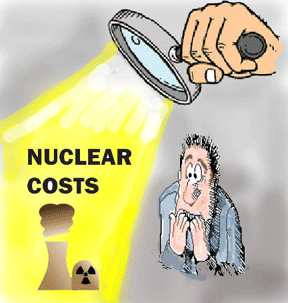 New Report Claims India’s 12 New Nuclear Reactors Are Economically Unviable http://cleantechnica.com/2016/03/31/new-report-claims-indias-12-new-nuclear-reactors-economically-unviable/?utm_source=feedburner&utm_medium=feed&utm_campaign=Feed%3A+IM-cleantechnica+%28CleanTechnica%29 March 31st, 2016 by Joshua S Hill
A new report published by the Institute for Energy Economics and Financial Analysis has concluded that India’s plans to build 12 new nuclear reactors is economically unviable.
According to the new report (PDF), published this week by the Institute for Energy Economics and Financial Analysis (IEEFA), India’s current plans to build 12 new nuclear-powered plants is not only economically unviable, but fraught with risk, as the plants are intended to be a “first-of-its-kind” design that is untested. As such, the development of the nuclear power plants would likely result in numerous delays and technical problems.
David Schlissel, IEEFA’s director of resource planning analysis, concludes that the proposed nuclear plants, designed by Toshiba-Westinghouse and General Electric-Hitachi, and planned for the Mithi Virdi and Kovvada complexes, “are neither economically nor financially viable.” The plans intend for the 12 plants to be built across two separate sites in India. Six would be sited at Mithi Virdi in Gujarat, and would use the new Westinghouse AP1000 reactor design — which Schlissel notes has already “run into technical problems and significant cost increases and schedule delays” in other locations where the design is already under construction. The other six new plants, intended to be developed in Kovvada in Andhra Pradesh, would use GE’s Economic Simplified Boiling Water Reactor (ESBWR) design, and would be the first country in the world to develop this particular design.
“They would take much longer than expected to build, they would result in higher bills for ratepayers, and, if they are built, they might not work as advertised,” Schlissel said.
The report also noted that the development of the new nuclear power plants would come at the expense of solar, leading the author to conclude that India would do well to instead direct that money and effort into developing solar resources. “Investing in new solar photovoltaic (PV) capacity would be a much lower-cost, significantly less environmentally harmful and far more sustainable alternative to the Mithi Virdi and Kovvada projects,” Schlissel said.
Among the report’s specific findings:
- Capital costs of the 12 plants would far exceed those of comparable solar-energy projects and, barring long-term and probably unsustainable government subsidies, consumers will pay more for electricity from the plants than they would for solar energy
- The first new reactors in the expansions at Mithi Virdi and Kovvada will take 11 to 15 years to build, if approved, even assuming the projects manage to avoid likely delays. None of the new reactors at Mithi Virdi and Kovvada would generate any power for the electric grid until sometime between 2029 and 2032. The remaining units at each project are unlikely to be completed, if approved, until late in the 2030s
- Even without likely time-and-cost overruns, both projects would require massive investment over the next two decades, ranging from Rs. 6.3 lakh crores (US $95 billion) to 11.3 lakh crore rupees (US $170 billion). It is unlikely that the Indian government would be able to simultaneously support other electricity-sector expansions, including in renewable resources and energy-efficiency programs
- Both projects, if approved, would probably be slowed by lengthy land-acquisition delays, complicated liability issues, lags associated with new-technology difficulties and compliance with the country’s “Make in India” policy
“All of these can be expected to lead to substantial, and perhaps indefinite, delays and significant increases in capital costs, possibly even far beyond those we have assumed in our analyses,” Schlissel said.
Rural Indians’ lawsuit against coal power plant is dismissed by USA judge
U.S. judge nixes lawsuit against World Bank over power plant in India BY SEBASTIEN MALO http://www.reuters.com/article/us-india-lawsuit-worldbank-idUSKCN0WW2H2 NEW YORK (Thomson Reuters Foundation) 30 Mar 16 – A U.S. federal judge has dismissed a lawsuit filed by Indian fishermen and farmers who sued the World Bank over a loan for a power plant they claimed ravaged the environment.
The World Bank’s International Finance Corporation (IFC) is shielded by immunity and cannot be sued in the United States, the U.S. District Court judge ruled.
The IFC loaned $450 million to help build the coal-fueled Mundra power plant in India’s coastal region of Gujarat, which became fully operational in 2013.
The Indian company that carried out the project, Coastal Gujarat Power Limited, a subsidiary of Tata Power, said it would create jobs, benefit 16 million domestic consumers and provide competitively priced electricity to industry and agriculture.
But fishermen, farmers and others living near the plant said it took a huge toll on the environment.
Saltwater leaking from the plant made groundwater undrinkable and unfit for irrigation, hot water from the cooling system harmed the fish catch and air quality suffered, they said in the U.S. lawsuit filed last year in the District of Columbia.
Their way of life could be “fundamentally threatened or destroyed,” the complaint said, accusing the IFC of irresponsible and negligent conduct in financing and supervising its loan.
But U.S. District Court Judge John Bates in a ruling last week said under the International Organizations Immunities Act, the IFC is immune to prosecution in the United States.
The Indians plan to appeal, the U.S. nonprofit EarthRights International, which filed the lawsuit, told the Thomson Reuters Foundation.
“This is a fight for our lives and livelihood,” Gajendrasinh Jadeja, head of Navinal Panchayat, a village that is a party in the case, said in an email.
“We believe we will prevail,” Jadeja said.
An IFC spokeswoman said the organization would not comment on active legal matters.
A plan being implemented by Coastal Gujarat Power, however, includes what she called “mitigation measures,” she said, but she did not elaborate.
The World Bank and IFC have come under criticism by groups that contend their focus on big projects can disrupt the environment and displace people.
The IFC, with 184 member countries, is the “largest global development institution focused exclusively on the private sector in developing countries,” according to its website.
(Reporting by Sebastien Malo, Editing by Ellen Wulfhorst. Please credit the Thomson Reuters Foundation, the charitable arm of Thomson Reuters, that covers humanitarian news, women’s rights, trafficking, land rights and climate change. Visit news.trust.org)
India needs to come on itys nuclear security issues
 Come clean on nuclear security http://www.thehindu.com/opinion/op-ed/come-clean-on-nuclear-security/article8406194.ece THE HINDU, NARAYAN LAKSHMAN 29 Mar 16,
If India is more open about discussing its nuclear weapons programme with a view to ultimately denuclearising the neighbourhood, it would be one of its most courageous contributions
This week, Prime Minister Narendra Modi will touch down in Washington, DC for the fourth and final Nuclear Security Summit, a biennial conference series initiated in 2010 by the Barack Obama administration. Mr. Modi will no doubt seek to showcase India’s nuclear regime as one that adheres to the highest standards of transparency and safety through rigorous regulation of nuclear products and institutions. Although that would be welcome, what Mr. Modi’s interlocutors in the U.S. may be hoping for is that he will break with India’s tradition of maintaining a masterful silence on two questions surrounding its nuclear policy. First, how can India address disquieting signals that have emerged in recent times, which point to growing concerns over the security of its nuclear materials? Second, at a time when India’s macro strategy of rapid economic development is premised on a climate of neighbourly peace and stability in the region, is it not appropriate that Mr. Modi call for an end to the nuclear arms race in Asia, and address environmental risks of India’s covert weapons plants?
Let us consider each of these questions in turn.
India’s nuclear security
First, the need for heightened nuclear security has now become urgent, especially with the emergence of global jihadi threats such as the Islamic State. In this context, three potential nuclear terrorist threats relate to extremists making or acquiring and exploding a nuclear bomb; the danger of radioactive material being fashioned into a “dirty bomb”; and the risk of nuclear reactor sabotage.
The first and second scenarios are vectors of imminent concern in Pakistan, with analysts citing as examples a series of terrorist attacks in 2007 on nuclear weapons facilities in that country, including a nuclear missile storage facility at Sargodha and a nuclear airbase at Kamra.
However, a paper published earlier this month by Harvard University’s Kennedy School of Government cautioned that U.S. officials ranked Indian nuclear security measures as “weaker than those of Pakistan and Russia”, and U.S. experts visiting the sensitive Bhabha Atomic Research Centre (BARC) in 2008 described the security arrangements there as “extraordinarily low key” Further, the Harvard report notes, there are concerns about threats within Indian nuclear facilities stemming in part from “significant insider corruption”, and what appears to be inconsistent strength of regulation. An example that the report cites relates to the 2014 case of Vijay Singh, head constable at the Madras Atomic Power Station at Kalpakkam, who shot and killed three people with his service rifle. According to the report, this event may have been avoided had the Central Industrial Security Force’s personnel reliability programme been able to detect Mr. Singh’s deteriorating mental health, which it failed to do “despite multiple red flags, including his telling colleagues that he was about to explode like a firecracker.” With a scarcity of data points on insider threats and the attendant concerns about sabotage and nuclear accidents, the unsurprising conclusion of the report was: “Given the limited information available about India’s nuclear security measures, it is difficult to judge whether India’s nuclear security is capable of protecting against the threats it faces.”
Weapons development programme
This brings us to the second question, which relates to India’s clandestine weapons development programme.
Set within the broader context of nuclear deterrence vis-à-vis Pakistan and China, it has quietly steamed forward since the 1998 Pokhran-II tests. Recent evidence that this shadowy realm of government activity has been proceeding apace beyond the scrutiny of the media and public surfaced in June 2014when IHS Jane’s, a U.S.-based military intelligence think tank, discovered satellite imagery showing efforts underway to extend a Mysore nuclear centrifuge plant constructed in 1992 at the Rare Metals Plant at that location. According to Jane’s, the purpose behind this extension may have been the covert production of uranium hexafluoride, which could be channelled towards the manufacture of hydrogen bombs or naval reactors to power India’s nuclear submarine fleet.
One month later, another U.S. think tank, the Institute for Science and International Security, revealed additional satellite imagery suggesting that India was building a Special Material Enrichment Facility, including constructing an industrial-scale centrifuge complex in Chitradurga district in Karnataka. Some time during 2009 and 2010, approximately 10,000 acres of land were allegedly diverted at that site for various defence purposes, including 290 acres in Khudapura allocated to the Defence Research and Development Organisation (DRDO) for developing and testing drones.
A few years later, in December 2015, a study by the Centre for Public Integrity (CPI), reported in Foreign Policy magazine, confirmed that India’s under-radar ambition to acquire thermonuclear weapons at the Chitradurga site had advanced much further than many had suspected.
There are likely to be a number of other such walled-off weapons development zones across the breadth of the country, and this begs two critical questions. First, what are the broader implications of India’s covert nuclear programme for the triangular standoff vis-à-vis Pakistan and China? Second, while the Nuclear Liability Law protects its citizenry from the potentially catastrophic fallout of a nuclear accident in the civilian nuclear sector, what guarantees do we have that India’s nuclear black sites do not endanger the health of the people and the environment?
On the first question, India’s search for thermonuclear weapons certainly exacerbates the nuclear arms race with its neighbours, specifically by sparking dangerous games of tit-for-tat weaponisation, loose talk about tactical superiority and theatre nukes, and growing doubts about deterrence stability. The region is already a potential hothouse of nuclear posturing — a fact corroborated by the independent Stockholm International Peace Research Institute’s estimates that India has something in the range 90-110 nuclear weapons, Pakistan has around 120, and China has close to 260.
Environmental impact
On the question of environmental impact, evidence suggests that the Chitradurga and Khudapura sites may be degrading the surrounding grassland ecosystems called kavals, which are habitats for critically endangered local species such as the Great Indian Bustard, the Lesser Florican and the Black Buck, not to mention the livelihoods source for thousands of pastoral communities.
In February 2014, NGOs in Karnataka including the Environment Support Group complained about government land acquisitions for DRDO and BARC in the Challakere in Chitradurga, and obtained a direction from the National Green Tribunal to halt construction activity that had commenced without securing permission from the Karnataka Forest Department and the Union Ministry of Environment and Forests.
Since then, it is unclear whether the government ever paused its weapons development activity to conduct proper environmental assessments, but the CPI study indicates otherwise, citing as evidence an October 2012 letter marked “Secret” from the Ministry to atomic energy officials which suggested approval of the Mysore site’s construction as “a project of strategic importance” that would cost nearly $100 million.
When he meets Mr. Obama at the end of this month, Mr. Modi may come laden with a “house gift” as a sign of India’s sustained commitment to nuclear security. If this could be an indication that India is willing be more open about discussing its nuclear weapons programme with a view to ultimately denuclearising the neighbourhood, it would by far be one of the most courageous contribution that India could make towards a lasting subcontinental security.
India’s push for solar power to bring over a million jobs
 India Solar Power Push May Produce Over 1 Million Jobs http://cleantechnica.com/2016/03/23/india-solar-power-push-may-produce-over-1-million-jobs/ March 23rd, 2016 by Smiti Mittal Originally published on Sustainnovate. India’s massive solar power capacity addition target is expected to be a revolution in the Indian jobs market as well.
According to a report by the Natural Resources and Defense Council (NRDC), India may end up creating over a million new jobs in its endeavour to have 100 GW of operational solar power capacity by March 2022.
The report suggests that a massive army of engineers, construction, and maintenance workers shall be required set up the scores of solar power capacity planned by the central and state governments.

Around 210,800 site engineers and designers would be required to set the large-scale as well as rooftop solar power systems rolling. Around 624,600 semi-skilled workers would be needed for the construction and on-field execution of the projects. To monitor ongoing operations at the power plants and their maintenance, another 182,400 semi-skilled workers would be needed. Thus, a total of 1,017,800 jobs are expected be created if India indeed manages to set up a cumulative operational capacity of 100 GW by 2022.
Jobs creation and empowering youth is one of the major policies of the current government. The ‘Skill India’ program launched by the Indian government aims to provide employment to youth by providing them industrial training in the solar power sector. Several agencies across the country have already started such training programs.
Some state governments have also announced financial support to unemployed youth to set up rooftop solar power systems to help them generate a source of income.
Kakrapar radiation leakage highlights need for investigation of All of India’s nuclear reactors
Kakrapar leakage: Call for stronger regulation, investigation Of all nuclear reactors in the country, after determining what went wrong at the atomic power station, termed ‘lucky’ for having a radiation disaster averted, Business Standard, BS Reporter | Ahmedabad March 26, 2016 Those worried say Kakrapar was lucky to have witnessed leakage of heavy and light water from the coolant channel without any serious damage to fuel bundles in the reactor
The recent leak in coolant channels of the unit-1 reactor at the Kakrapar Atomic Power Station (KAPS, near Surat in Gujarat) is a warning which necessitates thorough investigation of all such reactors in the country, experts say.
At 9 am on March 11, a leakage in the Primary Heat Transfer (PHT) system led to the reactor being shut down and a plant emergency declared at KAPS. It has two units of pressurised heavy water reactors of 220 Mw each;Nuclear Power Corporation of India (NPCI) is the operator. According to site officials, one of the channels carrying the fuel bundles and the heavy water coolant had leaked. The high-grade radioactivity from the fuel itself was confined within the fuel bundles and no radioactive substances escaped from the reactor containment building.
The Atomic Energy Regulatory Board (AERB) has stated that, as of now, KAPS’ Unit-1 is in a shutdown state, even as all plant systems are “functioning normally”……
Any damage to fuel bundles could have resulted in thousands of times more severe radiation leakage from the reactor, and some of it could have eventually escaped into the public domain, he said.
Seconding him is nuclear activist and physicist Surendra Gadekar, monitoring the Indian nuclear industry since 1987. “The problem has been isolated but the fact is it took them 10 days to do that, with the plant emergency ending on March 22. They claim it is a ‘small leak’, which otherwise does not call for a plant emergency for 10 days. They were lucky that they didn’t find any radiation in a 20-km radius,” says Gadekar……. http://www.business-standard.com/article/current-affairs/kakrapar-leakage-call-for-stronger-regulation-investigation-116032500684_1.html
Renewable energy beating nuclear power in India
Cheaper renewable energy has soared past nuclear power, Business Standard 18 Mar 16, Renewable energy in India has overtaken nuclear power as the country seeks carbon-free sources of energy to balance its reliance on coal. Such energy generation in India is higher than its nuclear power generation and is growing at a much faster pace because it is cheaper and quicker to install. The cost of renewable energy is now lower than the cost of nuclear power and does not come with attendant risks, such as this week’s radioactive fuel leak in Gujarat.
Renewable-energy generation in India was 61.8 billion units, versus 36.1 billion units of nuclear-power generation during the financial year (FY) 2014-15. Renewable energy accounted for 5.6 percent of electricity generated in India, against 3.2 percent for nuclear power.
Renewable energy has been growing at a faster pace than nuclear power over two years. During 2013-14 and 2014-15, renewable energy grew at 11.7 percent and 16.2 percent, respectively, while nuclear-power growth has been almost flat over the same period.
If the 2022 solar target is met, it will become India’s second largest energy source. The bulk of India’s renewable energy comes from wind, but solar energy is growing faster with installed capacity reaching 5,775 mega watts (MW) in February 2016. The national solar mission has set a target of 100,000 MW of solar power by 2022. If this target is met, renewable energy will become the second largest source of power for India after coal, and ahead of hydropower, natural gas and nuclear energy…….http://www.business-standard.com/article/news-ians/cheaper-renewable-energy-has-soared-past-nuclear-power-special-to-ians-116031800578_1.html
India’s poor nuclear safety record is alarming
This is not the first time that India is facing safety issues regarding its nuclear program. In historical context one can generate a list of leaks, fires and structural damages that have been faced by India’s civilian nuclear power sector. There are abundant examples of oil leaks, hydrogen leaks, fires and high bearing vibrations which often shut down numbers of nuclear reactors in India.
 Lack Of Nuclear Sanity In India Anaya Shahid Mar 20 16, http://www.eurasiareview.com/19032016-lack-of-nuclear-sanity-in-india-oped/ Ironically on March 14, 2011 after the Japan’s nuclear disaster, India was the first country to announce that Fukushima reactors were safe. Top officials of the Department of Atomic Energy (DAE) were of the view that Indian nuclear reactors will continue to work as they are safe and also claimed that what happened in Fukushima was not a “nuclear accident”.
S.K. Jain, the Chairman and Managing Director of Nuclear Power Corporation was propagating on Fukushima accident that, “There is no nuclear accident or incident in the Japan’s Fukushima plants. It is a well-planned emergency preparedness program which the nuclear operators of the Tokyo Electric Power company are carrying out to contain the residual heat after the plants had an automatic shutdown following a major earthquake.”
Now it is really scary that on the 5th anniversary of Fukushima, an emergency has been declared at the Kakrapar nuclear plant in Gujarat near Surat after a major heavy water leak in a nuclear reactor. The authorities are disseminating the situation by saying that all safety systems worked fine and the technicians has successfully been able to shut down the unit. The declaration of an on-site emergency and the fact that the heavy water leak affected the reactor’s cooling system, which also has high radioactivity, raises many questions on Indian nuclear expertise.
The Fukushima disaster forced Indian nuclear establishment to initiate a safety audit process and it was conducted within by NPCIL. After the extensive review, Indian auditor general informed that the nuclear program of the country is insecure and unregulated with many disorders. Furthermore the parliamentary report on nuclear safety regulation in India had pointed out serious organizational flaws and numerous failings relative to international norms.
When in opposition, the Bharatiya Janata Party was the major contrasting party to civil nuclear expansion and had strong reservations on limiting nuclear liability. It was also supporting the just protests in Kudankulam and wanted environmental clearance for Jaitapur nuclear power plants. Now in government, it has taken a complete U-turn and seeks to bring same old vine in new bottles. This year, Dr. A Gopalakrishnan labeled the Indian government plans punier than the existing regulatory framework and despite this the government is introducing the Nuclear Safety Regulatory Authority bill in Parliament.
This is not the first time that India is facing safety issues regarding its nuclear program. In historical context one can generate a list of leaks, fires and structural damages that have been faced by India’s civilian nuclear power sector. There are abundant examples of oil leaks, hydrogen leaks, fires and high bearing vibrations which often shut down numbers of nuclear reactors in India.
- March 1991: Heavy water leak at Madras Atomic Power Station takes four days to clean up.
- July 1991: A contracted laborer mistakenly paints the walls of Rajasthan Atomic Power Station (RAPS) with heavy water before applying a coat of whitewash.
- December 1991: A leak from pipelines in the vicinity of CIRUS and Dhruva research reactors at the Bhabha Atomic Research Centre (BARC) in Trombay, Maharashtra, results in severe Cs-137 soil contamination of thousands of times the acceptable limit.
- January 1992: Four tons of heavy water spilt at RAPS.
- May 1992: Tube leak causes a radioactive release of 12 Curies of radioactivity from Tarapur Atomic Power Station.
- March 1993: Two blades of the turbine in Narora Atomic Power Station’s (NAPS) Unit I break off, slicing through other blades and indirectly causing a raging fire, which catches onto leaked oil and spreads through the turbine building. The smoke sensors fail to detect the fire, which is only noticed once workers see the flames.
- February 1994: Helium gas and heavy water leak in Unit 1 of RAPS. The plant is shut down until March 1997.
- May 1994: The inner surface of the containment dome of Unit I of Kaiga Generating Stationcollapses (delaminates) while the plant is under construction.
- March 1999: Somewhere between four and fourteen tons of heavy water leaks from the pipes at MAPS at Kalpakkam, Tamil Nadu, during a test process. The pipes have a history of cracks and vibration problems. Forty-two people are reportedly involved in mopping up the radioactive liquid.
- April 2000: A leak of about seven tons of heavy water from the moderator system at NAPS Unit II.
- November 2001: A leak of 1.4 tons of heavy water at the NAPS I reactor, resulting in one worker receiving an internal radiation dose of 18.49 mSv.
- May 2002: Tritiated water leaks from a downgraded heavy water storage tank at the tank farm of RAPS 1&2 into a common dyke area.
- January 2003: The failure of a valve in the Kalpakkam Atomic Reprocessing Plant in Tamil Nadu results in the release of high-level waste, exposing six workers to high doses of radiation.
- April 2003: Six tons leak of heavy water at reactor II of the NAPS in Uttar Pradesh.
- November 2009: Fifty-five employees consumed radioactive material after tritiated water finds its way into the drinking water cooler in Kaiga Generating Station.
- April 2011: Fire alarms blare in the control room of the Kaiga Generating Station in Karnataka.
India’s nuclear establishment is hasting for nuclear energy though it has obstinately missed targets and delivered a portion of the promised electricity with uncertain safety. The Indian government is irrationally pursuing for nuclear power without explaining its destructive potential and answering critiques. Nowadays, the U.S. and major powers are trying to “normalize” India’s nuclear weapons through special waivers and numerous nuclear deals. Therefore, France is using such normalizing strategy to bargain for cash-strapped Areva. Meanwhile, its complement is the disaster-in-waiting called Jaitapur. The secrecy shrouded to Indian nuclear program has subjugated its energy policy and budgets to an unaccountable, self-propagating, pampered technocracy and degrading their democracy.
*Anaya Shahid graduated from Defense & Diplomatic Studies, Fatima Jinnah Women University Rawalpindi.
Japan claims that Memorandum of Understanding with India is “legally binding”
Japan says India’s nuclear MoU “legally binding” THE HINDU, KALLOL BHATTACHERJEE 20 Mar 16 Nuclear experts describe the MoU as a backdoor attempt to draw India into the NPT
Days before Prime Minister Narendra Modi’s visit to Washington DC for the Nuclear Security Summit, a senior Japanese diplomat told The Hindu that India had committed to adhere to the “control of nuclear material, traceability [of nuclear fuel] and consequence in case of a nuclear accident” under the memorandum of understanding (MoU) on civil nuclear cooperation with Japan signed during Prime Minister Shinzo Abe’s visit to India in 2015.
Intrusive, feel experts
Though the bilateral agreement leaves out India’s military nuclear programme, experts warn that the agreed principles impinge on India’s independent nuclear programme as they imply intrusive inspection of civilian nuclear reactors as warranted under the Nuclear Non-proliferation Treaty (NPT).
The Japanese diplomat pointed out that so far, the world had to rely on India’s verbal commitments on nuclear non-proliferation, but the India-Japan MoU marked the first occasion when India came under legal obligation to uphold non-proliferation concerns.
“There were no tools to bind India, only India’s voluntary self-claimed policy existed, but now there is legally binding measures by the agreement between India and Japan,” said the diplomat, explaining that the commitments were proof of India’s peaceful and transparent intentions in using nuclear reactors solely for energy generation. He said India will be financially accountable if it is found to be violating the principles.
An Indian official who has been associated with the negotiations said the principles being cited by the Japanese were nothing extraordinary and were part of the “standard template for civil nuclear deal” that India had signed with several countries. However, he refused to address the Japanese assertion that India would have to financially compensate Japan if it violated the principles……..http://www.thehindu.com/news/national/japan-says-indias-nuclear-mou-legally-binding/article8377976.ece
India’s massive bet on solar power is paying off
India’s big move into solar is already paying off CNN Money by Huizhong Wu @CNNTech March 7, 2016: India’s massive bet on solar power is paying off far earlier than anticipated.
The price of solar power has plummeted in recent months to levels rivaling that of coal, positioning the renewable source as a viable mainstream option in a country where 300 million people live without electricity.
And that could turn out to be a conservative forecast. At a recent government auction, the winning bidder offered to sell electricity generated by a project in sunny Rajasthan for 4.34 rupees (6 cents) per kilowatt hour, roughly the same price as some recent coal projects.
“Solar is very competitive,” said Vinay Rustagi of renewable energy consultancy Bridge to India. “It’s a huge relief for countries like India which want to get more and more solar power.”
Prime Minister Narendra Modi has made access to electricity a top priority, and has set the goal of making 24-hour power available to all 1.3 billion Indians. Currently, even India’s biggest cities suffer from frequent power outages…..http://money.cnn.com/2016/03/07/technology/india-solar-energy-coal/index.html
1 This Month
19 February – VIRTUAL EVENT-Decision Time: AI and Our Nuclear Arsenal
12:45 p.m. Central / 1:45 p.m. Eastern
To see nuclear-related stories in greater depth and intensity – go to https://nuclearinformation.wordpress.com

-
Archives
- February 2026 (128)
- January 2026 (308)
- December 2025 (358)
- November 2025 (359)
- October 2025 (376)
- September 2025 (258)
- August 2025 (319)
- July 2025 (230)
- June 2025 (348)
- May 2025 (261)
- April 2025 (305)
- March 2025 (319)
-
Categories
- 1
- 1 NUCLEAR ISSUES
- business and costs
- climate change
- culture and arts
- ENERGY
- environment
- health
- history
- indigenous issues
- Legal
- marketing of nuclear
- media
- opposition to nuclear
- PERSONAL STORIES
- politics
- politics international
- Religion and ethics
- safety
- secrets,lies and civil liberties
- spinbuster
- technology
- Uranium
- wastes
- weapons and war
- Women
- 2 WORLD
- ACTION
- AFRICA
- Atrocities
- AUSTRALIA
- Christina's notes
- Christina's themes
- culture and arts
- Events
- Fuk 2022
- Fuk 2023
- Fukushima 2017
- Fukushima 2018
- fukushima 2019
- Fukushima 2020
- Fukushima 2021
- general
- global warming
- Humour (God we need it)
- Nuclear
- RARE EARTHS
- Reference
- resources – print
- Resources -audiovicual
- Weekly Newsletter
- World
- World Nuclear
- YouTube
-
RSS
Entries RSS
Comments RSS
 nuclear-news