A hitch in India’s entry to the nuclear selling cartel
- Nuclear Suppliers Group still debating India’s application
-
Obama and Modi have pushed for membership in nuclear cartel
India will probably need to wait a while longer before it joins the elite club of nations that control trade in advanced nuclear technologies, according to three diplomats with knowledge of the process.
The Nuclear Suppliers Group, or NSG, is unlikely to accept India’s application for membership when it meets June 20 in Seoul because officials in New Delhi haven’t yet met all the criteria for admission, said the diplomats, who represent governments inside the 48-nation group. They asked not to be named in line with diplomatic rules for discussing private deliberations.
 A delay could roil plans by U.S. President Barack Obama and Indian Prime Minister Narendra Modi, who were meeting in Washington on Tuesday, to bring the world’s second-most-populous nation into the nuclear mainstream. It would push back a decision on Indian membership to later in the year, and risk bumping into the U.S. presidential election. Continue reading
India and Japan – no progress yet on nuclear business co-operation deal
India-Japan nuclear deal stuck on technical details, THE HINDU, KALLOL BHATTACHERJEE
The agreement misses Japan’s National Diet session
The India-Japan civil nuclear agreement is likely to have a long waiting period, probably more than a year, before it fructifies. This is because, the National Diet failed to take up the agreement in the summer legislative session which ended on June 1. Japanese diplomats further told The Hindu that even the “technical details” of the deal were yet to be finalised.
The civil nuclear agreement firmed up during the visit of Prime Minister Shinzo Abe in December 2015 needs the legislative approval as Japan wants to convince the political parties in the Diet that the “nuclear cooperation by Japan shall be carried out only for peaceful purposes”, Yasuhisa Kawamura, Press Secretary of Ministry of Foreign Affair of Japan told The Hindu.
- “The summer session of the Diet ended on June 1 and the nuclear agreement was not taken up for discussion. The next session of the Diet is in autumn,” Japanese ambassador to India Kenji Hiramatsu said on Tuesday in Delhi indicating that the agreement failed to make it to the Diet despite growing expectation that Japan would fast track the legislative approval for the same which came up after India concluded similar agreements with several major nuclear energy producing countries including the U.S.
Elaborating on the ambassador’s comments, Mr. Kawamura said “both Japan and India have been working on technical details of the Japan-India nuclear cooperation agreement, which have to be finalised as is mentioned in the memorandum which two Prime Ministers signed last December,” and added that the “schedule of submitting the Agreement to the Diet has not been yet decided”…….http://www.thehindu.com/news/national/indiajapan-nuclear-deal-stuck-on-technical-details/article8701794.ece
USA tries to bend the rules, so Toshiba-Westinghouse can sell nuclear reactors to India
 No Exceptions for a Nuclear India http://www.nytimes.com/2016/06/05/opinion/sunday/no-exceptions-for-a-nuclear-india.html?_r=0 By THE EDITORIAL BOARD JUNE 4, 2016 America’s relationship with India has blossomed under President Obama, who will meet with Prime Minister Narendra Modi this week. Ideally, Mr. Obama could take advantage of the ties he has built and press for India to adhere to the standards on nuclear proliferation to which other nuclear weapons states adhere.
President Bush squandered an opportunity to demand more of India when he signed the 2008 deal, which opened the door to American trade in nuclear technology for civilian energy, something India had insisted was a prerequisite to more cooperation and lucrative business deals.
As part of the 2008 deal, the Indians promised they would be “ready to assume the same responsibilities and practices” as other nations with advanced nuclear technology. But they have fallen far short by continuing to produce fissile material and to expand their nuclear arsenal.
The Nuclear Suppliers Group is to discuss India’s application later this month. Mr. Obama is lobbying for India to win membership through a special exception. If he succeeds, India would be in a position to keep Pakistan, which has also applied for membership, from gaining membership because group decisions must be unanimous. That could give Pakistan, which at one time provided nuclear technology to North Korea and Iran, new incentives to misbehave.
Opposition from China, which is close to Pakistan and views India as a rival, could doom India’s bid for now. But the issue will not go away. India is growing in importance and seeking greater integration into organizations that govern international affairs. If it wants recognition as a nuclear weapons state, it should be required to meet the nuclear group’s standards, including opening negotiations with Pakistan and China on curbing nuclear weapons and halting the production of nuclear fuel for bombs.
USA pushing nuclear deal with India, in the interests of Japanese company Toshiba Westinghouse
this [India] is a country both Wall Street and Washington have their eyes on
Will U.S. Get India To Ink Big Nuclear Deal With A Japanese Owned Company?, Forbes, Kenneth Rapoza , 2 June,
When Indian Prime Minister Narendra Modi comes to town on Monday, a Japanese-owned company may be the biggest beneficiary.
One of the key takeaways Modi and President Obama would would like to see come of this trip is a commitment to build six nuclear power plants by Westinghouse Electric. The Western Pennsylvania based company is an historic American electric manufacturer, but it was acquired by Toshiba in February 2006. Even the Kazakhs own 10% of it under Kazatomprom, their state-owned nuclear power company. Yet, Westinghouse is Washington’s favorite nuclear power company and next week it might make headlines again if it manages to ink a muito-billion dollar deal for its new AP-1000 reactors.
India Ambassador Arun Singh told reporters on Wednesday that the deal was in its “advanced stages.”
The two sides were largely waiting on a nuclear liability law that will essentially create a new insurance product for nuclear power utilities. Westinghouse and its partner in India, the Nuclear Power Corporation (NPCIL), are still waiting for the details of that insurance policy to be ironed out, thinks Richard M. Rossow, a senior fellow on U.S.-India policy for the Center for Strategic and International Studies in Washington………
Westinghouse has a long history of tapping Washington for lucrative deals abroad. Since the mid-2000s, Westinghouse has been able to count on Washington to pitch its wares to countries where Russia is a key, if not dominant player. Currently, Russia’s Rosatom has only two reactors in India, both located in Tamil Nadu state. India has 21 nuclear power plants, most of it indigenous technology.
A deal for all six power plants would be good news for Westinghouse Electric and its owners at Toshiba, which has fallen on hard luck over the past five years.
Toshiba used to design and build reactors for half of Japan, also supplying those reactors with the fuel rods that hold the uranium used to generate electricity. The March 2011 Fukushima disaster lit a match to those service contracts and Toshiba’s Fukushima reactors are decommissioned. Germany shut its reactors down after Fukushima, too. They also used Westinghouse as a source for fuel rods. In less than two years, Toshiba and Westinghouse Electric lost contracts at 60 reactors. Between 2012 and 2014, Westinghouse Electric’s cumulative operating losses reached $1.43 billion, according to Toshiba……
this [India] is a country both Wall Street and Washington have their eyes on…….http://www.forbes.com/sites/kenrapoza/2016/06/03/will-u-s-get-india-to-ink-big-nuclear-deal-with-japanese-owned-company/#4f7edc32c94f
India will be Kept Out of the Nuclear Suppliers Group – the reasons why
Why India will be Kept Out of the Nuclear Suppliers Group, The National Interest, Ruhee Neog, 2 June 16 Ahead of this month’s Nuclear Suppliers Group (NSG) plenary, at which the consideration of India’s membership is expected, a couple of things have happened in quick succession. China announced its opposition to permitting non-Nuclear Nonproliferation Treaty (NPT) members into the NSG, and Pakistan, citing its observance of NSG guidelines, made an application for membership. The United States, which has been quite vociferous in its support for India’s membership, and has, for some time, lobbied NSG members for their positive vote, reiterated its traditional line. Of the 48 members of the NSG, three players—China, the “non-proliferation hardliner” countries, and the United States—will play an important role in deciding which way the vote will sway.
USA’s Westinghouse in rush to sell nuclear reactors to India
 India, Westinghouse in advanced talks to close nuclear deal, live mint, http://www.livemint.com/Politics/DscD8CWjYrsVgpqQO7Fp1J/India-Westinghouse-in-advanced-talks-to-close-nuclear-deal.html Valerie Volcovici, 2 June 16,
India’s ambassador to the US Arun Singh says the issues that remain to be worked out are related to cost and financing. Washington: Toshiba Corp.’s Westinghouse Electric and India are in “advanced discussions” for the company to build six nuclear reactors there, the country’s ambassador to the United States said on Wednesday, ahead of Indian Prime Minister Narendra Modi’s planned visit to Washington next week.
A deal with Westinghouse would be the first such contract reached under the 2008 US-India civil nuclear accord.
“There is a very detailed and advanced negotiation between Westinghouse and India,” Ambassador Arun Singh told reporters. “The issues that remain to be worked out are related to cost and financing.”
Progress on the deal to build six AP-1000 nuclear reactors is one of the key developments anticipated during the 7-8 June visit by Modi to Washington, where he will be hosted by President Barack Obama for a final summit before the US presidential election in November. Modi will address both houses of Congress.
The US and India agreed in 2008 to cooperate in the civil nuclear arena, but there have been no agreements yet to build any plants. Reuters reported on Tuesday that Westinghouse and India reached a breakthrough after officials said it will relocate the planned project in Andhra Pradesh. The original site proposed for the multi-billion-dollar project, in Modi’s home state of Gujarat, faced local opposition.
Another obstacle had been to bring India’s liability rules into line with international norms, which require the costs of an accident to be channelled to the operator rather than the maker of a nuclear power station.
That issue had been largely resolved to the satisfaction of the US government in January 2015 after the US and India reached a “breakthrough understanding” on nuclear cooperation.
Singh told reporters “to the best of my knowledge” insurance was no longer an issue in the discussions.
Westinghouse had hoped to clinch a deal to build six nuclear reactors in India by the end of March, during Modi’s last Washington trip to attend a global nuclear summit.
US lawmakers ratified the civil nuclear accord three years after it was struck in 2005, as part of an attempt to deepen the strategic relationship with India, but have expressed growing dismay over its failure to yield follow-on deals for US-based reactor makers. Reuters
USA trying to beat Russia in selling nukes to India
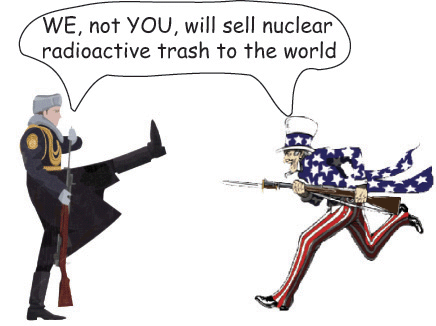 Westinghouse to get new site for Indian nuclear plant – officials,
  Reuters NEW DELHI | BY DOUGLAS BUSVINE AND RUPAM JAIN , 31 May 16 Toshiba Corp’s (6502.T) Westinghouse Electric will relocate a planned project to build six nuclear reactors in India, said officials, bringing the first deal stemming from a U.S.-India civil nuclear accord struck over a decade ago closer to reality.
The six AP-1000 reactors would be built in the southern state of Andhra Pradesh, after the original site proposed for the multi-billion-dollar project, in Prime Minister Narendra Modi’s home state of Gujarat, faced local opposition.
The breakthrough comes ahead of a June 7-8 visit by Modi to Washington, where he will be hosted by President Barack Obama for a final summit before the U.S. presidential election in November, and will address both houses of Congress.
U.S. lawmakers ratified the civil nuclear accord three years after it was struck in 2005, as part of an attempt to deepen the strategic relationship with India, but have expressed growing dismay over its failure to yield follow-on deals for U.S.-based reactor makers like Westinghouse…….
Analysts say resolving the land issue is a crucial step, but complex issues remain, including project financing and reaching a civil nuclear pact with Japan, where Westinghouse parent Toshiba is based…..
Russia’s Rosatom operates two reactors at Kudankulam, in Tamil Nadu, while France’s EDF (EDF.PA) signed a preliminary deal with the state-owned Nuclear Power Corporation of India (NPCIL) [NPCIL.UL] in January to build six reactors at Jaitapur, Maharashtra…..
Two sources, requesting anonymity due to the sensitivity of the matter, confirmed that the site was being acquired for Westinghouse, which plans to build six AP-1000 pressurized water reactors, each with a design capacity of around 1,100 megawatts.
Westinghouse did not respond to requests for comment, while senior executives at NPCIL were not available ………http://www.reuters.com/article/us-india-westinghouse-idUSKCN0YM0L2
Indian company exits nuclear project, switches to wind energy
Nalco pulls out of JV with NPCIL for nuclear power plant in Gujarat Business Standard, Dillip Satapathy | Bhubaneswar May 30, 2016 Aluminium major Nalco has decided to drop its plan to foray into nuclear energy generation. The company had signed a memorandum of understanding (MoU) with Nuclear Power Corporation of India Ltd (NPCIL) in 2012 to set up two units of Kakrapara Atomic Power Station in Gujarat with capacities of 700 Mw each. The cost of the project was estimated at Rs 12,000 crore…….
We have decided to pull out of the JV with NPCILfollowing change in technology of the project. Initially, it was decided to build the plant with indigenous technology. But later, it was decided to use foreign technology. The foreign technology will not only be more expensive, the gestation period of the project will also be more and we are not in a mood to wait that long with so much of investment exposure,” said Nalco Chairman and Managing Director Tapan Kumar Chand……..
Notwithstanding its unsuccessful bid to foray into nuclear energy, Nalco has identified renewable energy as its next focus area. “We have set up wind mills in Andhra Pradesh (50.4 Mw) and Jaisalmer, Rajasthan (47.6 Mw). We plan to set up more wind power mills in Rajasthan and Maharashtra (50 Mw each) and a 20 Mw solar power plant in Madhya Pradesh. We are also in the processing of installing a 14-Mw wind power mill at Damanjodi,” said Chand. http://www.business-standard.com/article/companies/nalco-pulls-out-of-jv-with-npcil-for-nuclear-power-plant-in-gujarat-116052900518_1.html
USA desperately wants to market nuclear power to India

 U.S. official says India has addressed nuclear concerns, May 24, 2016 Reuters WASHINGTON | BY PATRICIA ZENGERLE A U.S. State Department official assured lawmakers on Tuesday that India has addressed concerns over liability that had for years kept U.S. corporations from signing nuclear power contracts in the country.
“We believe that the steps that India has taken have addressed by and large the key concerns that have been in place,” Assistant Secretary of State for South and Central Asian Affairs Nisha Desai Biswal told the Senate Foreign Relations Committee.
She also said the United States supported India joining the Nuclear Suppliers Group, a 48-member group of nuclear trading nations.
India wants to increase its nuclear energy capacity dramatically………
ndia was shut out of the nuclear trade for decades because of its weapons program. A 2008 agreement with the United States gave it access to foreign suppliers without giving up arms primarily meant as a deterrent against nuclear-armed China.
But hopes that U.S. nuclear reactor manufacturers would get billions of dollars of new business evaporated after India adopted a law in 2010 giving the state-run Nuclear Power Corp of India Ltd (NPCIL) the right to seek damages from suppliers in the event of an accident.
Biswal declined to say that all U.S. companies would now be comfortable doing business in India. “Those are going to be individual determinations that companies are going to have to make,” she said.
Some companies are moving into the market. The chief executive of Toshiba Corp’s Westinghouse Electric said in March he expected to sign a deal in June to build six nuclear reactors in India.
Senator Edward Markey questioned Biswal on whether India had met the requirements to join the Nuclear Suppliers Group, which is dedicated to curbing nuclear arms proliferation by controlling the export and re-transfer of materials that could foster nuclear weapons development.
Diplomats quietly launched a new push last year to induct India into the group, which would carry the risk of antagonizing Pakistan as well as its ally, China. Beijing could veto any application by India.
Biswal said the United States backs India. http://www.reuters.com/article/us-usa-india-nuclearpower-idUSKCN0YF2C1
India rejects China contention for entry into nuclear suppliers group
Live Mint, 20 May 16
India cites example of France to contend that it needn’t sign nuclear non-proliferation treaty to get membership of nuclear suppliers group. New Delhi: India on Friday rejected China’s contention that it must sign the Nuclear Non-Proliferation Treaty (NPT) to get membership of the Nuclear Suppliers Group (NSG), citing the example of France, which was part of the NSG without being a signatory to the NPT.
India’s comments followed China’s reported blocking of India’s entry to the NSG earlier this month on grounds that it had not signed the NPT…..
Last week, Chinese foreign ministry spokesman Lu Kang had said all the multilateral non-proliferation export control regime including the NSG have regarded NPT as an important standard for the expansion of the NSG.
“Apart from India, a lot of other countries expressed their willingness to join. Then it raised the question to the international community—shall non-NPT members also become part of NSG?” he said, adding, “China’s position is not directed against any specific country but applies to all the non-NPT members.”…..http://www.livemint.com/Politics/3A2dMOnJXti1RaSmoPa7LO/India-rejects-China-contention-for-entry-into-nuclear-suppli.html
India to sell nuclear reactors to Bangladesh (But what if Bangladesh is under water before long?)
India, Bangladesh power ties with 21st-century nuclear deal Times of India Indrani Bagchi| TNN | May 15, 2016, NEW DELHI: India has concluded a nuclear agreement with Bangladesh in a sign that the bilateral neighbourhood relationship is becoming special. …..The nuclear agreement is a three-document package that has been negotiated between the MEA and the Bangladesh department of science and technology over the past few months……
EDF desperate for business? trying to quickly sell 6 nuclear reactors to India
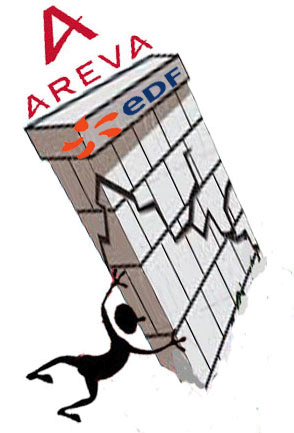 EDF to propose deal for six nuclear reactors in India by year-end By Reuters | 12 May, 2016 PARIS: EDF will deliver a proposal to theIndian government by year’s end to build six nuclear reactors, an executive at the French utility said on Thursday, in what could be the world’s biggest nuclear deal.
“Hinkley Point will help us continue our activities and preserve our skills base and jobs,” he said. ……..
Chief Executive Jean-Bernard Levy told shareholders that EDF needs growth in international markets because European power markets are stagnant. http://economictimes.indiatimes.com/articleshow/52240726.cms?utm_source=contentofinterest&utm_medium=text&utm_campaign=cppst
Climate change is already taking its toll
Jeff Masters: Food system shock: climate change’s greatest threat to civilization.
The greatest threat of climate change to civilization over the next 40 years is likely to be climate change-amplified extreme droughts and floods hitting multiple major global grain-producing “breadbaskets” simultaneously.
https://www.wunderground.com/blog/JeffMasters/food-system-shock-climate-changes-greatest-threat-to-civilization & http://www.environmentalhealthnews.org/t/-8878616388554072809
India heatwave: Train keeps city alive as cricket matches cancelled, farmers and animals suffer
In India, 330 million people across 10 states are in the grip of a crippling drought and heatwave.
Supplies are so depleted in one city that it is entirely reliant on drinking water delivered daily by train.
http://www.abc.net.au/news/2016-05-01/train-keeps-indian-city-alive-in-heatwave/7373546
Global nuclear salesmen still not happy with India’s Nuclear Liability Law
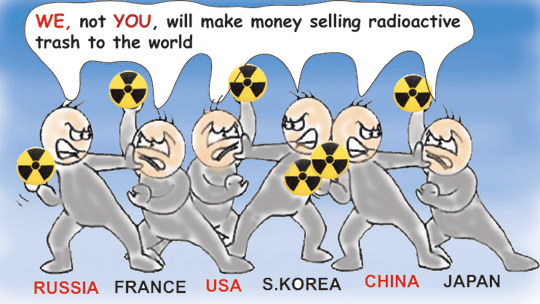 Concern Over India’s Nuclear Liability Law Still Remains: French Firm EDF http://www.ndtv.com/india-news/concern-over-indias-nuclear-liability-law-still-remains-french-firm-edf-1398896
The fresh techno-commercial proposal will also take into account India’s concern over high per unit tariff, French government officials said.
“The French feel that there is a lot of ambiguity in Clause 46 and there is fear in the minds of suppliers. We have raised this issue both with NPCIL and the Department of Atomic Energy,” said a French official.
Last month, Nuclear Power Corporation of India Limited (NPCIL) had signed an agreement for building six European Pressurised Reactors (EPR) as against the earlier proposal of two such reactors.
The delay in the project, which was first signed in 2008, and concern over India’s liability law came in the wake of nuclear firms Areva and EDF merging their reactor businesses into a joint venture controlled by EDF, as part of a broad restructuring last year.
In 2014, the US too had raised similar concerns about Clause 46 in particular.
In April last year, Areva had also signed an agreement with NPCIL to expedite the programme.
“Things are unclear over how much insurance cover does supplier have to take. There is still a lot of ambiguity in this,” the French official said.
The French government officials said the liability issue is still “manageable” but pricing still remains a major hurdle.
While the cost of the electricity generated by Kudankulam Nuclear Power Project (KKNPP) Units I and II hovers between Rs. 3 to 3.50 per unit, for JNPP, it is expected to be Rs. 9.14 per unit. India is not ready to go beyond Rs. 6.50 per unit.
Indian govt announces highly ambitious solar energy target
 India Sets Target Of 48 GW Solar Power Capacity By March 2019, Clean Technica April 23rd, 2016 by Saurabh Mahapatra Originally published on PlanetSave.
Highly ambitious annual solar power capacity addition targets have been announced by the Indian Ministry of New & Renewable Energy.
With a target to have an operational solar power capacity of 100 GW by March 2022, the Indian government has announced annual capacity addition targets for the next few years. The Ministry of New & Renewable Energy (MNRE) plans to add 15 GW and 16 GW solar power capacity in the financial years 2017-18 and 2018-19, respectively.
In the current financial year, the government targets an addition of 12 GW solar power capacity. If this target is achieved, India’s installed solar power capacity will cross 17 GW by the end of March 2017. By early March this year more than 5.7 GW of solar power capacity was operational in India…….
India is also in talks with development banks like the Asian Development Bank, International Finance Corporation, KfW, the Japan International Cooperation Agency, and the New Development Bank to access cheap debt finance for setting up solar power projects. https://cleantechnica.com/2016/04/23/101231/
1 This Month
19 February – VIRTUAL EVENT-Decision Time: AI and Our Nuclear Arsenal
12:45 p.m. Central / 1:45 p.m. Eastern
To see nuclear-related stories in greater depth and intensity – go to https://nuclearinformation.wordpress.com
-
Archives
- February 2026 (127)
- January 2026 (308)
- December 2025 (358)
- November 2025 (359)
- October 2025 (376)
- September 2025 (258)
- August 2025 (319)
- July 2025 (230)
- June 2025 (348)
- May 2025 (261)
- April 2025 (305)
- March 2025 (319)
-
Categories
- 1
- 1 NUCLEAR ISSUES
- business and costs
- climate change
- culture and arts
- ENERGY
- environment
- health
- history
- indigenous issues
- Legal
- marketing of nuclear
- media
- opposition to nuclear
- PERSONAL STORIES
- politics
- politics international
- Religion and ethics
- safety
- secrets,lies and civil liberties
- spinbuster
- technology
- Uranium
- wastes
- weapons and war
- Women
- 2 WORLD
- ACTION
- AFRICA
- Atrocities
- AUSTRALIA
- Christina's notes
- Christina's themes
- culture and arts
- Events
- Fuk 2022
- Fuk 2023
- Fukushima 2017
- Fukushima 2018
- fukushima 2019
- Fukushima 2020
- Fukushima 2021
- general
- global warming
- Humour (God we need it)
- Nuclear
- RARE EARTHS
- Reference
- resources – print
- Resources -audiovicual
- Weekly Newsletter
- World
- World Nuclear
- YouTube
-
RSS
Entries RSS
Comments RSS
 nuclear-news