Nuclear non-proliferation is undermined by India-Japan deal
Deal with India undermines nuclear nonproliferation, Editorial Asahi Shimbun, November 9, 2016 Indian Prime Minister Narendra Modi is scheduled to arrive in Japan on Nov. 10 for a summit with Prime Minister Shinzo Abe to sign a bilateral deal that will open the way for Japan’s nuclear reactor exports to India.
When the two prime ministers reached a basic agreement on this deal in December last year, we expressed our opposition. We now renew our objection and strongly urge the Japanese government to reconsider.
India became a nuclear power without becoming a signatory to the Nuclear Nonproliferation Treaty (NPT). To provide nuclear technology to such a nation flatly contradicts Japan’s traditional calls for nuclear disarmament and the elimination of nuclear weapons.
Naturally, objections to the Japan-India treaty have been raised, not only by Hiroshima and Nagasaki atomic bomb survivors but also by citizens of many countries demanding the abolition of nuclear weapons.
The NPT recognizes only five nuclear powers–the United States, Britain, France, China and Russia–while promoting nuclear disarmament. The treaty also guarantees all other nations their right to peaceful use of nuclear power, such as operating nuclear reactors, provided they refrain from developing nuclear weapons.
In essence, the NPT prevents nations of the world from competing to develop nuclear weapons.
India has remained a nonsignatory to the NPT, objecting to the treaty’s unequal treatment of the nuclear powers and the rest of the world. But India has proceeded with nuclear development in the meantime on the pretext that this is for “peaceful purposes.”
We must say India has trampled on the very spirit of nuclear nonproliferation……..
India’s freeze on nuclear tests is merely voluntary, and the country has not even signed the Comprehensive Nuclear-Test-Ban Treaty (CTBT).
The Japanese government appears to be hoping to include in the bilateral agreement a clause to the effect that Japan will withdraw cooperation if India conducts a nuclear test.
But is there any guarantee that India will never extract plutonium from spent nuclear fuel from reactors made with Japanese technology and use the plutonium to build nuclear weapons?
When the United Nations adopted a resolution late last month to start negotiations on the Nuclear Weapons Convention, Japan opposed the resolution, saying it could undermine the NPT and the existing nuclear disarmament negotiations.
But the Japan-India nuclear deal may further weaken and even destroy the NPT.
Come to think of it, is it really appropriate for Japan, which caused the nuclear disaster at Fukushima, to export nuclear reactors to India?
We can never condone the folly of only seeking immediate commercial gains in selling nuclear reactors to a country that is turning its back on nuclear nonproliferation. http://www.asahi.com/ajw/articles/AJ201611090023.html
India’s Defence Minister Manohar Parrikar makes bizarre nuclear statement
Manohar Parrikar makes bizarre nuclear statement, his ministry says personal opinion Defence Minister Manohar Parrikar today wondered why India cannot say “we are a responsible nuclear power and I will not use it irresponsibly” instead of affirming a “no first use policy”, remarks he said were personal in nature. IndiaToday.in New Delhi, November 10, 2016 Defence Minister Manohar Parrikar today spoke about India’s no first use nuclear policy at the book launch of (Retd.) Brig Gurmeet Kanwal’s ‘The New Arthashastra: A security strategy for India’.
Renowned Indian film-maker makes his first international film – “Nuclear”
RAM GOPAL VARMA ANNOUNCES HIS FIRST INTERNATIONAL PROJECT ‘NUCLEAR’ http://mumbaimirror.indiatimes.com/entertainment/bollywood/Ram-Gopal-Varma-announces-his-first-international-project-Nuclear/articleshow/55288938.cms Think about films with harsh realities, and the first name that pops up in your mind is none other than Ram Gopal Varma. The director, popularly known as RGV, has always managed to be in the news. A no-nonsense man, RGV shared details about his first international project, titled Nuclear, on his social media handle.
He wrote, “My first international film to be made at a cost of 340 crore is NUCLEAR.” He further added that the film will be shot in America, China, Russia, Yemen and India with American, Chinese, Russian and Indian actors.”
Varma has mostly delved into real-life incidents in his films. Shifting his focus to the global concern of terrorism, the director has raised many questions about possible nuclear attacks. In a note, RGV said, “I have been an avid and voracious reader of both fiction and non-fiction but never in my life until now, have I come across a subject matter like NUCLEAR. Yes it’s going to be much more costlier than the most expensive film ever made in India and the reason for that is because the subject matter truly demands that it is filmed on a scale never before seen.”
Raising his concern about terrorism, RGV wrote, “The only thing which can be more terrifying than that is, if that explosion happens now in our times. It is because of this fear that America acted against Iraq. If an act based on mere suspicion that someone could be in possession of a nuclear bomb bring in so much of hate and divide between the countries of the world resulting in regime collapses, friendly countries becoming sworn enemies, rise of ISIS etc., then it’s obvious that an actual nuclear explosion in a big city like Mumbai can easily trigger WORLD WAR III and thus end the WORLD.”
Ram Gopal Varma will be starting Nuclear after he wraps up Sarkar 3 starring Amitabh Bachchan.
India turning away from fossil fuels, to replace coal with Cheaper Solar Power by 2022
Renewable Energy: India to Replace Coal with Cheaper Solar Power by 2022 http://www.natureworldnews.com/articles/30601/20161024/renewable-thinking-india-replace-coal-cheaper-solar-power-2022.htm by Monica Antonio Oct 24, 2016 India is taking the lead in creating a country powered by renewable energy by replacing expensive imported coal with affordable solar power in just six years’ time. But how will they do it? According to a report from Eco Business, India is aiming to alleviate poverty by providing the entire population with cheap electricity while, at the same time, not contributing to global warming by turning its back on fossil fuels and fully embracing solar energy.
The report says the key drivers in the rising demand for energy in the future are population growth and the doubling of GDP.
Turning Its Back on Fossil Fuels As a solution to the ballooning of energy consumption, India’s government has recently updated its National Solar Mission Target. By the year 2022, the country aims to achieve 175 GW of renewable power, including 100 GW of solar power. This means that India’s capacity for renewable energy needs to be seven times bigger, from 3 GW to 20 GW per year.
However, a big feat as it may seem, this new focus on renewable energy will benefit 600 million people with electricity by 2040. Ajay Goel, president of solar and chief of new businesses at ReNew Power said,”Especially for the 400 million Indians who have no access to electricity, solar power would mean access to clean and affordable energy.”
Is a Solar-Powered India Possible?
According to Bloomberg New Energy Finance, if India manages to create photovoltaic ground-mounted systems, the country will have an energy source that’s more affordable than imported coal. By using the levelised cost of energy (LCOE), the outlet notes that in the future, solar energy will be more economic than using coal.
Apart from giving access to cheap electricity, solar energy will also provide livelihood and “generate more than 675,000 jobs in the Indian solar industry,” Goel notes.
Poor prospects for completing a Japna-India nuclear co-operation deal
When Modi Flies To Japan, Bleak Chances For Long-Pending Nuclear Deal Outlook, Tokyo will recognise New Delhi as de facto N power with the deal. But it wants, in writing, a verification mechanism to check fuel diversion, an end to deal in case of testing, and signing of CTBT
The nuclear deal has been straddling the fences, certainly, not for lack of political will but a variety of domestic factors at play, particularly in Japan.
In December 2015, the Japanese Prime Minister Shinzo Abe and his Indian counterpart announced an in-principle decision to cooperate on civil nuclear matters which would facilitate export of Japanese civil nuclear technology to India.
The joint statement stated that the two Prime Ministers welcomed the agreement “for cooperation in the peaceful uses of nuclear energy, and confirmed that this agreement will be signed after the technical details are finalised, including those related to the necessary internal procedures”.
But why haven’t both the countries yet put pen to paper?……..
It is important to see what is driving Japan to consider nuclear commerce with India, a country that has not signed the Nuclear Non-Proliferation Treaty (NPT). If it does, it will be a first for Japan. If the nuclear agreement is signed, it would amount to Tokyo accepting the de facto status of India as a nuclear weapon power. …….
Japan’s history will make it difficult for it to accept this and develop a full-fledged nuclear cooperation agreement. This will especially be the case due to Japan’s domestic context where there is a large public antipathy to nuclear weapons.
Japan’s general anti-nuclear sentiment will continue to be a stumbling block in realising the full potential of the relationship in this regard. The fact that the bilateral negotiations on nuclear cooperation have gone on for several years is indicative of how lukewarm Japanese sentiment is to this type of cooperation. …….
 the deal is important for more than one reason. Signing of the India-Japan nuclear agreement will pave way for the operationalisation of India’s agreement with Westinghouse, a US unit of Toshiba Corporation.
But the negotiations have gone on for so long that New Delhi may be beginning to lose interest. http://www.outlookindia.com/website/story/when-modi-flies-to-japan-bleak-chances-for-long-pending-nuclear-deal/297317
India not happy with Costs of Nuclear Power Project With France
India Dissatisfied With Costs of Nuclear Power Project With France / sandeepachetan
BUSINESS 19:11 21.10.2016 India sent a strong message to France that it will not go ahead with the project unless the costs of production for the Jaitapur nuclear power project would be affordable.
New Delhi (Sputnik) — India’s Atomic Energy Commission has made it clear that Western nuclear reactors will be welcomed only if it generates power at affordable rates.
https://sputniknews.com/business/201610211046596608-india-france-nuclear-project/
Modi and Putin revive Cold War bond with lucrative agreements between two nations
 India-Russia ties boosted by defence, energy deals, Straits Times, OCT 16, 2016, Modi and Putin revive Cold War bond with lucrative agreements between two nations BENAULIM (India) • Indian Prime Minister Narendra Modi and Russian President Vladimir Putin signed a raft of lucrative defence and energy pacts yesterday following talks aimed at reinvigorating ties between the former Cold War allies.
Mr Modi hailed Mr Putin as an “old friend” after their meeting in the Indian state of Goa, where leaders of Brazil, Russia, India, China and South Africa (Brics) were gathering for a summit.
“Your leadership has provided stability and substance to our strategic partnership,” Mr Modi said alongside Mr Putin at a beachside resort, after officials signed up to 20 agreements between the two nations……..
They also signed an initial agreement on India’s purchase of Russia’s state-of-the-art S400 missile defence system, capable of shooting down multiple incoming missiles, although there were no details on a timeframe for delivery. The system would strengthen India’s defences along its borders with China and Pakistan……..
The leaders also signed a framework agreement to supply more reactors to a nuclear plant in Kudankulam in southern India, which is attempting to reduce its reliance on highly polluting coal for power. Mr Putin said that Russia would be able to build a dozen nuclear reactors in India over the next 20 years to back Mr Modi’s growth strategy for Asia’s third-largest economy, which continues to suffer power shortages………
Mr Modi was expected to hold talks with China’s President Xi Jinping late yesterday, also in the hope of boosting investment and trade. Relations, however, have been frustrated by Beijing’s decision so far to block New Delhi’s entry to a nuclear trade group, among other issues. http://www.straitstimes.com/asia/south-asia/india-russia-ties-boosted-by-defence-energy-deals
India’s government seeking private investment for its costly Light Water Nuclear Reactors
Nuclear energy: Government to push for JVs in light water reactor projects, Economic Times By PTI | Oct 09, 2016, NEW DELHI: To meet the high cost of Light Water Reactors, the government has decided to bring in such projects, which currently involve foreign collaborators, as joint ventures (JVs)with public sector undertakings (PSUs).
Japan and India to make nuclear marketing deal in November
 Japan, India to sign nuclear cooperation deal in November – report http://www.firstpost.com/fwire/japan-india-to-sign-nuclear-cooperation-deal-in-november-report-reuters-3030874.html First Post 2 Oct 16 Reuters TOKYO Japan and India are likely to sign a civil nuclear cooperation pact during a visit to Japan by Indian Prime Minister Narendra Modi in mid-November, the Mainichi newspaper reported on Saturday.The governments of Asia’s second- and third-largest economies are leaning toward holding a summit meeting between Modi and his Japanese counterpart Shinzo Abe, the report said, citing unidentified diplomatic sources from both nations.The two leaders last December reached a basic agreement for cooperation in the peaceful use of nuclear energy, but they stopped short of signing the agreement, citing outstanding technical and legal differences.Japan, the only country to have suffered a nuclear attack, has been demanding additional non-proliferation guarantees from India, which has a nuclear weapons programme, before exporting nuclear reactors.
India and Japan have been negotiating the nuclear energy deal since Japan’s ally, the United States, opened the way for nuclear commerce with India, which has shunned the global Non-Proliferation Treaty (NPT).
The two countries have reached a basic agreement during the working level negotiations that Japan would halt cooperation immediately if India conducted a nuclear test, the report added.A final deal with Japan would benefit U.S. firms. India has already given land for nuclear plants to GE-Hitachi – which is an alliance between the U.S. and Japanese firms – and to Toshiba’s Westinghouse Electric Company.
(Reporting by Osamu Tsukimori; Editing by Christian Schmollinger)
The consequences of a nuclear war between India and Pakistan
What happens if India and Pakistan both fire nuclear warheads at each other? http://www.thenewsminute.com/article/what-happens-if-india-and-pakistan-both-fire-nuclear-warheads-each-other-50604
If India and Pakistan fought a war detonating 100 nuclear warheads (around half of their combined arsenal), each equivalent to a 15-kiloton Hiroshima bomb, more than 21 million people will be directly killed, about half the world’s protective ozone layer would be destroyed, and a “nuclear winter” would cripple monsoons and agriculture worldwide.
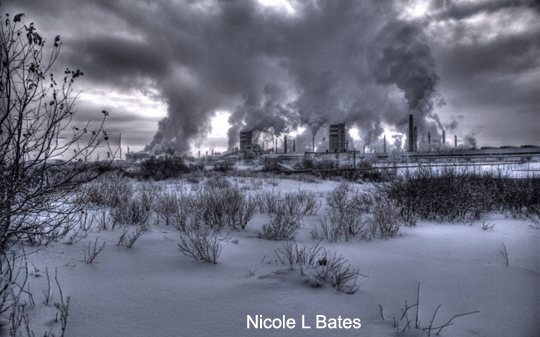
As the Indian Army considers armed options, and a Bharatiya Janata Party (BJP) MP urges a nuclear attack, even as the Pakistan Defence Minister threatens to “annihilate” India in return, the following projections, made by researchers from three US universities in 2007, are a reminder of the costs of nuclear war.
According to the study by researchers from Rutgers University, University of Colorado-Boulder and University of California, Los Angeles, about 21 million people – half the death toll of World War II – would perish within the first week from blast effects, burns and acute radiation in India and Pakistan.
This death toll would be 2,221 times the number of civilians and security forces killed by terrorists in India over nine years to 2015, according to an IndiaSpend analysis of South Asia Terrorism Portal data.
Another two billion people worldwide would face risks of severe starvation due to the climatic effects of the nuclear-weapon use in the subcontinent, according to a 2013 assessment by the International Physicians for the Prevention of Nuclear War, a global federation of physicians. Continue reading
India and Pakistan both looking to an alliance with Russia
Nuclear War: Pakistan, China, Russia Vs India, America Nuclear Warheads USA Morning News 1 Oct 16 “……… Nuclear Warhead Assessment
So if it comes down to an all-out nuclear war between the US-India on one side and China-Russia-Pakistan on the other, here is an assessment of which side is likely to have an upper hand in the war:
- It has been estimated that China, India, and Pakistan all possess ballistic missile, cruise missile, and sea-based nuclear weapons.
- Even though China, Russia, and the U.S. possess nuclear weaponry, according to the NPT, they have been banned from building and maintaining such weapons in perpetuity.
- China has 260 approximate warheads, Russia has roughly 7300 and Pakistan has 120.
- The USA is lagging slightly behind Russia with 7100 warheads and India currently has 110.
Hence, with Russia currently ahead than all the rest in the nuclear race, both India and Pakistan are looking to Russia to build an alliance with. http://www.morningnewsusa.com/nuclear-war-pakistan-china-russia-vs-india-america-nuclear-warheads-23109179.html
Japan busting to market nuclear reactors to India, and busting the Nuclear Non-Proliferation Treaty
 Abe, Modi look to ink civil nuclear pact at November meeting, Japan Times, KYODO, 30 Sept 16 A meeting between Prime Minister Shinzo Abe and his Indian counterpart Narendra Modi is set to be held in Tokyo in mid-November, with a civil nuclear cooperation pact likely to be signed, a source said Friday.
The pact would pave the way for Japan to export nuclear power plant technology to the fast-growing Asian economy. It would be Japan’s first signing of a civil nuclear cooperation pact with a country which has not joined the Nuclear Non-Proliferation Treaty…….
Earlier, other diplomatic sources said that under a provision in the pact, Japan will permit Indian power producers to reprocess spent fuel at designated facilities on the condition the country accepts comprehensive inspections by the International Atomic Energy Agency…….
Following the signing of the treaty, the Japanese government will seek swift approval from the Diet in a bid to promote Japanese companies’ participation in construction of such power plants in India……http://www.japantimes.co.jp/news/2016/09/30/national/japan-india-look-ink-civil-nuclear-pact-november-meeting/#.V-7jmIh97Gg
USA could lend $billions to India – anything to sell nuclear reactors!
India Could Get Billions from the U.S. To Build a Nuclear Reactor, Fortune, by Reuters SEPTEMBER 22, 2016 If a lending freeze doesn’t get in the way.
India is negotiating with U.S. Export-Import Bank for an $8-9 billion loan to finance six Westinghouse Electric nuclear reactors, two sources familiar with the talks said, although a lending freeze at the trade agency threatens progress.
The mega-project, the result of warming U.S.-India ties in recent years, could open up billions of dollars of further investment in India’s nuclear power sector, ……..
The Westinghouse deal, however, is contingent on financing and Ex-Im cannot approve loans of more than $10 million, owing to a row in the U.S. Congress over board appointments stemming from a campaign by conservatives to close the government lender……..
“Financing of the reactors is the critical piece; everything is down to this,” said one source involved in protracted negotiations to build the reactors in the south-eastern Indian state of Andhra Pradesh.
The source, requesting anonymity because of the sensitivity of the talks, said Indian negotiators and Ex-Im officials were trying to set the terms of the financial package in the hope that the freeze on the bank, affecting potential sales of several major U.S. companies, would lift soon.
Westinghouse is owned by Japan’s Toshiba Corp but is based in the United States……..
In addition to U.S. Ex-Im, India is also seeking funding from Japan and South Korea for the reactors to be built in Kovvada, two sources familiar with the talks said……..
While negotiators are unlikely to nail down a contract under Obama, who steps down in January, their challenge will be to come up with concessional financing terms that will make Westinghouse’s AP1000 reactors affordable.
Westinghouse did not respond to a request for comment, while a U.S. Ex-Im Bank spokeswoman declined to comment. An NPCIL official said the firm had nothing to say at this stage…….
ndia is also in talks with Russia to build four more reactors on top of the two already completed in Kudankulam in southern Tamil Nadu state, as well as with France’s EDF for the construction of six reactors of 1650 MW each in western India, which would be the world’s biggest nuclear power complex.
But talks with Westinghouse are more advanced than those with the French, with the two sides aiming to sign an early works agreement next month, sources familiar with their progress said.
A delegation from the U.S.-based firm visited New Delhi earlier this month to finalize the pact that would include the timeline and up-front costs such as land acquisition and site preparation, said a source familiar with the matter. http://fortune.com/2016/09/22/india-nuclear-power/
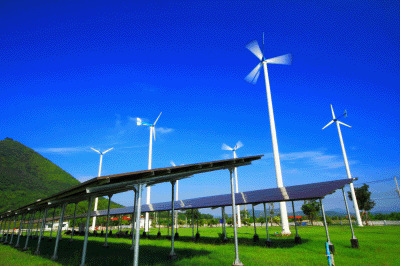
Indian companies see Hybrid Solar and Wind Systems as the renewable energy future
Hybrid Solar and Wind Systems Attract Turbine Makers in India http://www.bloomberg.com/news/articles/2016-09-05/hybrid-solar-and-wind-systems-attract-turbine-makers-in-india Anindya Upadhyay September 6, 2016
-
Gamesa planning 50-megawatt wind-solar hybrid project
-
Combined power generation can boost a project’s reliabilityWind turbine makers in India are looking at building more renewable energy projects that would combine solar and wind in a bid to provide a reliable and cost-effective power supply.Gamesa Corp. Tecnologica SA, the largest wind-turbine maker in India by market share, is preparing to announce its first wind-solar project within the next two months. Suzlon Energy Ltd., India’s largest domestic manufacturer of wind turbines, says it expects to focus on hybrids starting next year.“We feel that hybrid projects will make 50 to 60 percent of our sales over the next three years,” Ramesh Kymal, the chief executive officer of Gamesa’s India operations, said in an interview in New Delhi. “In a couple of months an announcement of a hybrid project from Gamesa can be expected.”The major advantage of a solar-wind hybrid is a boost to the reliability of the system as power generation from the two different sources supplement each other. Combining the two technologies and sharing a grid connection can also increase capacity, developers say. Hybrids hold an additional appeal in India where land acquisition remains a challenge.
India aims to install 10 gigawatts of hybrid capacity by 2022, according to a draft policyreleased earlier this year by the Ministry of New and Renewable Energy.
- Interest in hybrids is spreading. In 2014, Toshiba Corp. and Mitsui & Co. announced the completion of a solar and wind project in Japan’s Aichi prefecture. That project, developed in cooperation with six other companies including Toray Industries Inc., consists of 50 megawatts of solar capacity and 6 megawatts of wind. Canberra-based Windlab Systems Pty Ltd. and Japan’s Eurus Energy Holdings Cop. are building a large-scale hybrid solar-wind plant in the state of Queensland.“A common grid infrastructure for wind and solar installations will bring stability in the grid and will help avoid curtailment and seasonality of energy production,” Tulsi Tanti, founder and chairman of Pune, India-based Suzlon Energy, said in an interview, adding that wind and solar are complementary.
Suzlon will focus more intensely on wind and solar hybrid projects beginning next year, with a target to win market share of more than 40 percent in the next five years, Tanti said. In the case of Gamesa, the Zamudio, Spain-based turbine manufacturer has already identified some projects owned by existing customers that could benefit by adding solar, Kymal said.
- Other developers have also shown interest. Inox Wind Ltd.’s wind sites in the Indian states of Rajasthan, Gujarat and Madhya Pradesh are all ideal for hybrid projects, said Devansh Jain, a director at Inox, adding that he’s waiting for the ministry’s policy to be finalized before moving forward.“Wind-solar hybrid projects will boost growth but will not be a fundamental game changer,” Jain said in a phone interview, saying the government’s auctions of wind projects will likely be the biggest driver of growth in the sector.
India Goals
The interest in hybrid projects comes as India pushes aggressively to develop its clean energy capacity. Under a effort led by Prime Minister Narendra Modi, India is aiming by 2022 to install 100 gigawatts of solar capacity and 60 gigawatts of wind power.
India installed a record 3.5 gigawatts of wind in the fiscal year ended March 31, according to the Indian Wind Turbine Manufacturers Association.
“Hybrid projects offer advantages in sharing of resources for construction and maintenance of a project, as well as power transmission,” according to Shantanu Jaiswal, a Bloomberg New Energy Finance analyst in New Delhi.
India and Canada hoping to market nuclear technology together?
India, Canada discuss civil-nuclear cooperation The two leaders discussed a wide range of issues of mutual interest, including civil-nuclear cooperation between the two countries, an official release issued said today. Indian Express By: PTI | New Delhi September 8, 2016 India and Canada have discussed a wide range of issues of mutual interest, including the civil-nuclear cooperation between the two countries. The discussion was held during a meeting between Union Minister Jitendra Singh and visiting Canada Minister for Natural Resources, James Gordon Carr, here on Wednesday.
The two leaders discussed a wide range of issues of mutual interest, including civil-nuclear cooperation between the two countries, an official release issued said today. As a country with large energy requirements, India looks forward to promoting nuclear energy production at a significant scale and the two nations can jointly work to achieve this, said Singh, Minister of State in Prime Minister’s Office.
He referred to a common technological base of Pressurised Heavy Water Reactor (PHWR) in which India and Canada are global leaders and it is an area offering opportunity of potential bilateral cooperation between the two countries……….
Singh referred to the visit of Prime Minister Narendra Modi to Canada in April 2015 during which a long term uranium procurement contract was signed by Department of Atomic Energy, Government of India with the Canadian Uranium producer CAMECO…….http://indianexpress.com/article/india/india-news-india/india-canada-discuss-civil-nuclear-cooperation-3020552/
1 This Month
To see nuclear-related stories in greater depth and intensity – go to https://nuclearinformation.wordpress.com/
12 February – Webinar The Big Push: New Nuclear Projects in Canada
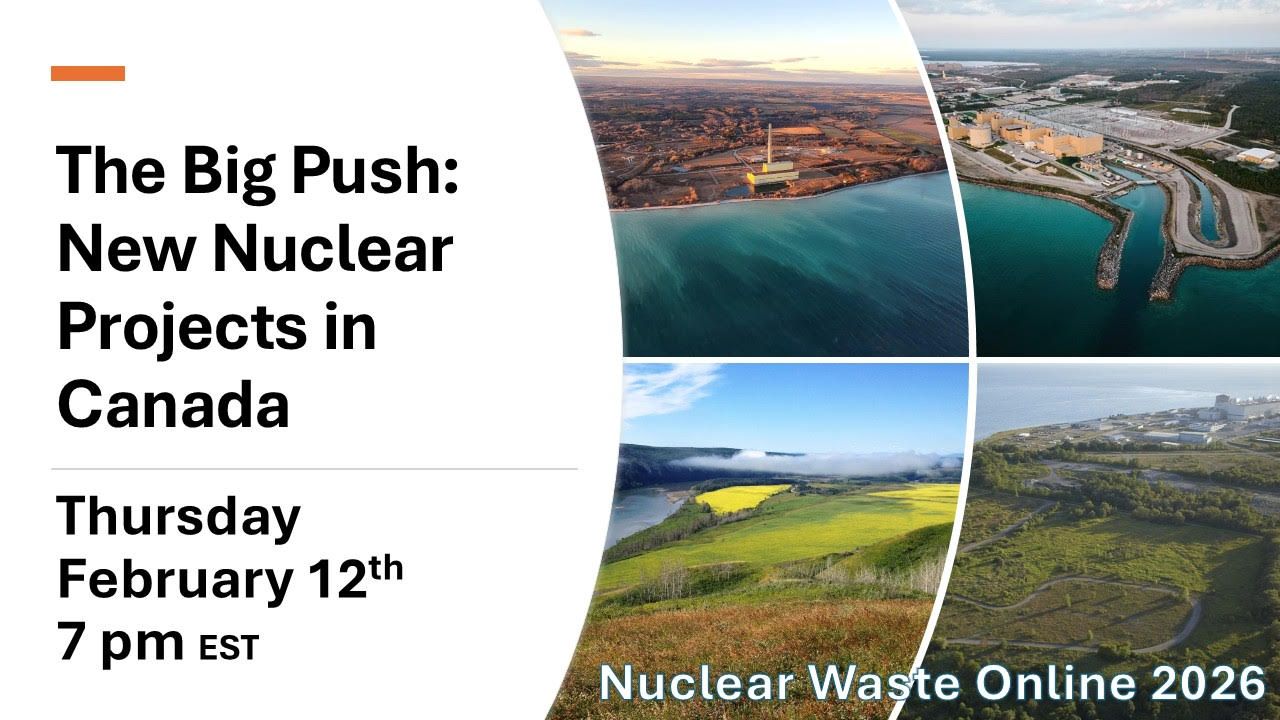
Thursday, February 12, 7 pm Eastern | 2nd of 4 sessions in the 2026 Nuclear Waste Online webinar series
Join a webinar on the push for new nuclear generation in Canada. Go to Northwatch.org to register or use the registration link https://us02web.zoom.us/webinar/register/WN_ZfWOf1GITqSRIZX8CB-A9w
-
Archives
- February 2026 (127)
- January 2026 (308)
- December 2025 (358)
- November 2025 (359)
- October 2025 (376)
- September 2025 (258)
- August 2025 (319)
- July 2025 (230)
- June 2025 (348)
- May 2025 (261)
- April 2025 (305)
- March 2025 (319)
-
Categories
- 1
- 1 NUCLEAR ISSUES
- business and costs
- climate change
- culture and arts
- ENERGY
- environment
- health
- history
- indigenous issues
- Legal
- marketing of nuclear
- media
- opposition to nuclear
- PERSONAL STORIES
- politics
- politics international
- Religion and ethics
- safety
- secrets,lies and civil liberties
- spinbuster
- technology
- Uranium
- wastes
- weapons and war
- Women
- 2 WORLD
- ACTION
- AFRICA
- Atrocities
- AUSTRALIA
- Christina's notes
- Christina's themes
- culture and arts
- Events
- Fuk 2022
- Fuk 2023
- Fukushima 2017
- Fukushima 2018
- fukushima 2019
- Fukushima 2020
- Fukushima 2021
- general
- global warming
- Humour (God we need it)
- Nuclear
- RARE EARTHS
- Reference
- resources – print
- Resources -audiovicual
- Weekly Newsletter
- World
- World Nuclear
- YouTube
-
RSS
Entries RSS
Comments RSS
 nuclear-news