The high cost of Units 5, 6 at Kudankulam Nuclear power – most of it owed to Russia

 Units 5, 6 at Kudankulam Nuclear power plant to cost Rs 50,000 crore: The New Indian Express, NPCIL 2 June 17 ST. PETERSBURG: The construction of the fifth and sixth units of India’s largest nuclear power plant in Tamil Nadu will cost about Rs 50,000 crore with half of the amount being funded by Russia as loan.
The project will take seven years to start generating electricity, Nuclear Power Corporation of India (NPCIL) Chairman and Managing Director S K Sharma told PTI here.
India and Russia yesterday signed an agreement for the two new reactors for the Kudankulam Nuclear Power Plant (KNPP) on the sidelines of the annual summit between Prime Minister Narendra Modi and Russian President Vladimir Putin.
“The entire project will cost about Rs 50,000 crore. The first unit will be commissioned in 66 months and the second six months thereafter,” Sharma said.
Atomstroyexport, a unit of Russian state nuclear corporation Rosatom, will build the reactors.
“The project will be funded in 70:30 debt-equity ratio (70 per cent debt, 30 per cent equity),” he said.
The Russian government will lend India USD 4.2 billion to help cover the construction cost……http://www.newindianexpress.com/states/tamil-nadu/2017/jun/02/units-5-6-at-kudankulam-nuclear-power-plant-to-cost-rs-50000-crore-npcil-1612150.html
India’s growing stash of nuclear weapons
India’s nuclear-weapon inventory set to increase: Report http://www.hindustantimes.com/india-news/india-s-nuclear-weapon-inventory-set-to-increase-report/story-nmZt1ftciL78AuB73xlRBM.htmlThe IISS report stated that India’s base of long range nuclear missiles and nuclear submarines is set to grow, as a defence measure against China. Jun 02, 2017 India’s nuclear-weapons inventory is expected to expand in both quantity and quality as the country is aiming to build an “adequate deterrent capacity” against China, according to a new report.
The report on Asia Pacific Regional Security Assessment for 2017 released by the International Institute of Strategic Studies at the ShangriLa Dialogue here today.
“Much of this will be driven by the need to build an adequate deterrent capacity against China,” the report said.
“Analysts broadly agree that India holds around 100-120 nuclear warheads in its inventory, half of which are mounted on ballistic missiles,” said the US-linked IISS report.
Currently, none of India’s deployed surface-to-surface missiles has the range to cover all of China unless deployed close to the Sino-Indian border, it said.
However, India has at least two longer-range missiles under development, including the Agri-IV intermediate-range ballistic missile and the Agni-V intercontinental ballistic missile (ICBM), the report said.
A developmental ICBM dubbed Agni-VI with a planned range somewhere between 6,000 and 10,000 km was reported in local news media in 2013, it pointed out.
However, the status of existence of this project is unclear, added the report.
New Delhi is also developing a submarine-based nuclear force, the report said. Its first nuclear-powered ballistic-missile submarine, the Arihant, began sea trial in 2014 and was reportedly commissioned in August 2016, it said.
Of the nuclear-capable missiles, various reports suggest the submarine might carry, the 700-km range K-15 cannot hit mainland China from the Bay of Bengal, while the K-4 may be able to target most of China if its reported 3,500-km range is accurate.
India is reportedly building four more submarines and will probably seek to develop longer-range missiles for them, said the report.
The Shangri-La Dialogue, an annual gathering of defence ministers, armed forces chiefs, military strategists an experts began this evening at Singapore’s Shangri-La hotel.
It will be hearing speakers on various defence issues and security strategies tomorrow and ends at noon on Sunday.
India going into debt to Russia, for expanded Kudankulam nuclear plant ?
 Russia signs deal to expand India’s Kudankulam nuclear plant https://uk.reuters.com/article/russia-economic-forum-india-nuclear-idUKL8N1IY5KR Russia signed an agreement with the Indian government on Thursday to build two new reactors for the Kudankulam nuclear power station in Tamil Nadu and said it would loan India $4.2 billion to help fund construction.
President Vladimir Putin says Russia is ready to build a dozen nuclear reactors in India over the next 20 years to back Prime Minister Narendra Modi’s growth strategy for Asia’s third-largest economy, which continues to suffer chronic power shortages.
The agreement to build reactors 5 and 6 at Kudankulam was signed in St Petersburg during a meeting between Putin and Modi at an economic forum. It should help cement already close ties between the two countries.
Atomstroyexport, a unit of Russian state nuclear corporation Rosatom, will carry out the work, Kremlin documents seen by Reuters showed.
Russian Finance Minister Anton Siluanov told reporters the Russian government was lending India $4.2 billion from next year for a 10-year period to help cover construction costs.
Separately, in a joint declaration, the two countries said they noted the “wider use of natural gas” which they hailed as an economically efficient and environmentally friendly fuel that would help reduce greenhouse gas emissions and help them fulfil the terms of the Paris climate change accord. (Reporting by Denis Pinchuk; Writing by Vladimir Soldatkin/Andrew Osborn; Editing by Alexander Winning)
A victory for Indian farmers, as nuclear power proposal shifted from coastal district of Gujarat
Gujarat’s Mithivirdi nuclear plant to be shifted to AP http://www.thehindubusinessline.com/economy/policy/gujarats-mithivirdi-nuclear-plant-to-be-shifted-to-ap/article9717922.ece Thanks to farmers’ protest, MoEF asks Green Tribunal to shift project site AHMEDABAD, JUNE 1:
A decade-long legal battle to save their fertile land from being used for the country’s largest nuclear power plant ended in a victory for farmers from Saurashtra’s Bhavnagar district.
The Ministry of Environment and Forest (MoEF) recently informed the National Green Tribunal (NGT) to shift the proposed 6,000 megaWatt (MW) nuclear plant — the first under the Indo-US civil nuclear pact of 2008 — from the coastal district of Gujarat to Kavvada in Andhra Pradesh “on account of delay in land acquisition at Chhaya-Mithivirdi site”.
The plant was to be set up by state-owned Nuclear Power Corporation of India Ltd (NPCIL) with technical support from Toshiba Corp’s Westinghouse Electric Company (WEC), which will build six nuclear reactors at the new site.
On May 18, MoEF said that in view of shifting of the said project the proposal for environment clearance (EC) before it has been delisted.
The villagers had approached NGT on March 3, 2015, challenging the coastal regulatory zone (CRZ) clearance given to NPCIL for the project. NGT’s Western Zone Bench, comprising Justice UD Salvi and Ranjan Chatterjee as expert member, disposed of the petition post the MoEF submission regarding shifting the site for the project.
India has planned to increase its nuclear power generation capacity from the existing 6,780 MW to 63,000 MW by 2032.
It is learnt that farmers in Andhra Pradesh have agreed to give away their lands for Westinghouse Electric’s AP-1000 pressurised water reactors. The project will initially require about 800 hectares of land in the eastern coastal district of Srikakulam.
In Gujarat’s Mithivirdi, however, farmers are celebrating. “A get-together has been planned on June 2 to celebrate the victory. The project would have directly affected about 340 farmer families and about 2,000 people indirectly associated with farm-related activities,” said Shaktisinh Gohi, one of the petitioners.
Gohil stated that NPCIL wanted about 777 hectares of land for the project from three to four villages around Mithivirdi. On March 5, 2013, before the company was granted CRZ clearance for the site, there were about 7,000 villagers who staged a walk-out from the Environmental Public Hearing as a mark of protest. Farmer leaders have been “sensitising” people about the risks of a nuclear reactor in the vicinity by distributing materials and showcasing films of the nuclear disasters in parts of the world.
“Our protests and arguments were backed by academic and scientific facts. We fought a very well-organised battle to get rid of this project. ,” said Rohit Prajapati, another petitioner.
As solar costs plunge, India rethinks coal projects
Cheaper Solar in India Prompts Rethink for Coal Projects, Bloomberg, by Anindya Upadhyay and Rajesh Kumar Singh June 1, 2017,
-
Power from solar panels now half the cost of a new coal plant
-
Shift in electricity economics helps Modi’s goal on pollution
India’s coal-power plant developers are growing more pessimistic about their projects after a plunge in the cost of electricity from solar panels improved the economics of renewable energy.
After a string of federal auctions, solar is suddenly the cheapest source of electricity in India. That’s darkening the outlook for the coal-fired power industry as projects struggle to find customers or face cancellation amid a glut of capacity.
“The crashing solar tariffs are creating a mental block for distribution companies and holding them back from signing long-term purchase agreements with conventional power producers,” said T. Adi Babu, chief operating officer for finance at Lanco Infratech Ltd., an Indian power producer. “A couple of years back, when people talked of solar reaching grid parity, people were skeptical. Now the solar tariffs have gone well below that. It is definitely making conventional players sit up and take notice.”……
evidence of a shift away from coal is gathering by the day.
- State-run NTPC Ltd., India’s largest power producer, along with RattanIndia Power Ltd. are considering installing solar panels over land initially intended for thermal projects.
- NTPC said in February it’s aiming to have 30 percent of its capacity come from non-fossil fuel by 2032
- The Indian subsidiary of Hong Kong-listed CLP Holdings Ltd., which owns both coal and renewable projects, is debating whether to participate in another round of conventional projects. “A transition from coal to solar is a generic direction that all utilities are taking. We are an early mover into the renewables space so our journey continues,” Mahesh Makhija, business-development director for renewables, said in a phone interview.
- The government of the sunny state of Rajasthan expects more conventional power to be replaced by clean energy as higher renewable purchase targets are fulfilled. “At the rate the renewable power tariffs are decreasing, the time is not far when renewable power will start replacing costlier conventional power,” Sanjay Malhotra, principal secretary for energy in the Rajasthan government, said by phone.
Solar is now as much as 50 percent cheaper than new coal power, according to solar research firm Bridge to India.
“That’s why we have seen many new coal power tenders being suspended or canceled in the last three months,” said Vinay Rustagi, managing director at Bridge to India…….
renewables are expanding quickly in India. Solar capacity has surged fourfold since December 2014 to about 12 gigawatts, while wind farms now provide 32 gigawatts, up from 22.5 gigawatts over the same period. Modi is seeking an additional 88 gigawatts of solar and 28 gigawatts more of wind by 2022. And those projects are crowding coal out of the power market…….https://www.bloomberg.com/news/articles/2017-06-01/cheaper-solar-in-india-prompts-rethink-for-more-coal-projects
India’s Nuclear Weapons
This Is Why the World Should Fear India’s Nuclear Weapons, National Interest, Kyle Mizokami, 28 May 17, India, the world’s most populous democracy, occupies a unique strategic position flanked by powerful adversaries. As a result, its 1.3 billion people are guarded by an arsenal of approximately one hundred nuclear weapons deployed on land, at sea and in the air. Despite its status as a Cold War holdout, the country was forced to develop its own nuclear weapons…….
As a result India has built its own “triad” of land, sea and air forces, all equipped with nuclear weapons. The first leg to develop was likely tactical nuclear devices for strike aircraft of the Indian Air Force. Today, India possesses more than two hundred Su-30MK1 twin-engine fighters, sixty-nine MiG-29s and fifty-one Mirage 2000 fighters. It is likely at least some of these aircraft have been modified and trained to carry nuclear gravity bombs to their targets.
The land-based missile leg of the triad consists of Prithvi tactical ballistic missiles. First produced in the late 1990s, Prithvi initially had a range of just ninety-three miles, but future versions increased their range to 372 miles. Despite this, Prithvi is still firmly a tactical weapon, while the Agni I-V series of missiles, with ranges from 434 to 4,970 miles, are strategic weapons with the ability to hit foreign capitals—as well as all of China.
The third leg of the triad is new, consisting of nuclear ballistic-missile submarines (SSBNs) of the Arihant class. Four submarines are planned, each with the ability to carry twelve K-15 Sagarika (“Oceanic”) short-range ballistic missiles with maximum range of 434 miles, or K-4 medium-range ballistic missiles with a 2,174 mile range. Using the Bay of Bengal as a bastion and protected by assets such as India’s carrier INS Vikramaditya, the Arihant SSBNs can just barely reach Beijing.
India’s nuclear buildup has been relatively responsible, and the country’s No First Use policy should act to slow escalation of any conventional conflict into a nuclear one. As long as India’s nuclear deterrent remains credible, it should cause rational adversaries to think twice before edging to the nuclear threshold. Still, the country’s volatile relationship with Pakistan, which has no such policy, as well as its “Cold Start” blitzkrieg plan of action against its neighbor, means nuclear war cannot be ruled out.
Energy tide turning in India, with cheaper renewables, and coal losing favour
Will India Ever Need Another Coal Plant?, The country’s energy infrastructure is changing rapidly as solar prices plummet. CityLab.com , KRUTIKA PATHI, @krutikapathi03, May 25, 2017
“…..over the last five months, the price of renewable energy has plummeted so low that analysts have hailed it as both “record-breaking” and “unsustainable” in the same breath. In fact, the pace of change in the country’s energy infrastructure has been so swift that even researchers are scrambling to keep a steady pulse on a constantly developing beat.
As China slowly cut down on its own coal infrastructure, the International Energy Agency in 2015 projected India to be the next coal center in the near future. It stated that “half of the net increase in coal-fired generation capacity worldwide [through 2040] occurs in India.” Nearly a year later, in July 2016, the nonprofit CoalSwarm put out a report that found 370 proposals for coal plants in the works across the country.
The findings revealed a pretty explosive conclusion: that India’s outsized plans for coal energy would wipe out climate goals set out in the Paris Agreement. Merely a few months after the report, the researchers at CoalSwarm were surprised by a new twist.
In December 2016, the Central Authority of India (CAI) laid out an electricity plan that said no new coal plants, beyond those already under construction, are needed for at least the next decade. The CAI also put forth new renewable energy goals—a production of 275 gigawatts (GW) generated from solar, wind, and hydro by 2027.
This means that the majority of the plants that CoalSwarm tracked are now going to be shelved. It’s also a show of India’s push towards reforming its energy infrastructure: the country added more renewable power than thermal in the 2016 fiscal year.“It was hard to keep up,” says Christine Shearer, a senior researcher at CoalSwarm and lead author of the report. “The country is supposed to be at the heart of coal plant growth, but it’s interesting to see the tide go against what we often hear about China and India—that they’re going to keep building coal plants—when actually, they’re both stalling production.”…..
As prospects for India’s coal sector are falling, so is the price of renewable energy. In turn, the country’s future outlook, if all goes accordingly, is pretty good news for the planet. India first set a record-low price in February this year when a kilowatt-hour of solar energy was selling at Rs. 2.97 ($0.046 USD). This month, the country hit another record low—the price of solar dropped 12 percent further, currently selling at Rs. 2.62 ($0.041 USD) per kilowatt-hour. “To spell it out, new solar is 15 percent cheaper than existing domestic coal. No one, anywhere in the world, was expecting solar to get that cheap for at least a decade,” Buckley says, “and India just got there this year.” It’s a marked shift for India—which, in a matter of months, went from potentially thwarting global climate goals to possibly saving them.
The news of falling solar prices in India, and the country’s recent (but significant) efforts to divest from coal as the fundamental energy source, stands in contrast to the current scenario in the U.S. Analysts fear that President Trump’s “America First Energy Plan” will put the country behind China and India in the push to reinvigorate renewable solutions. “What gives me hope is that at a time when Trump is busy trying to destroy the Paris Agreement, the two most important countries in the world for the agreement are China and India,” says Buckley.
According to a study released last week by the Climate Action Tracker, India and China are on pace to “overachieve” their climate goals by 2030. ……
Solutions like off-grid solar panels are one kind of sustainable technology that could address the distribution problem, says Harish Hande, co-founder of SELCO, an enterprise that introduced off-grid solar energy in the Siddhi community in 2010. Within a year, 100 homes in the area were connected to power in the Western Ghats region. SELCO has been nationally awarded for its energy work in under-served households and areas—but, as Hande points out, a long-standing solution has to go beyond the mere mechanics of the supply chain. “It’s much larger than providing electricity,” he says, “and there have to be enough public-private partnerships that cross over education, health, and the bigger ecosystem for sustainable energy services to become more accessible.”https://www.citylab.com/tech/2017/05/will-india-ever-need-another-coal-plant/528111/
India’s fast growth in renewable energy
FT 23rd May 2017, Until recently, the answer was overwhelmingly coal, which accounts for about 60 per cent of Indian power generation. Coal capacity has almost tripled in the past decade to 192GW and a further 65GW is under construction.
The fastest growth, however, is coming from renewables. Significant amounts of hydro and wind generation have already pushed the share of green energy to about 30 per cent. This is now being supplemented by rapid expansion in solar power. A landmark was reached this May when an auction to supply 500MW of new solar capacity at a 10,000 hectare facility on the edge of the Thar desert secured a record low price of Rs2.44 ($0.04) per kilowatt-hour — down two-thirds from three years ago and, for the first time, cheaper than coal-fired generation.
Plummeting costs have spurred forecasts that Indian solar capacity could double this year to 18GW, which would be more than six times greater than when Mr Modi’s government took power three years ago…..https://www.ft.com/content/a106c468-3567-11e7-99bd-13beb0903fa3
India diverts ‘peaceful’ nuclear materials to weapons development
 India Has Been Diverting Nuclear Materials to Make Weapons: Pakistan News .com May 18, 2017, Islamabad: Pakistan on Thursday alleged that India has been diverting nuclear materials it had obtained for peaceful purposes under the NSG waiver to make weapons.
Foreign Office spokesman Nafees Zakaria told reporters that Pakistan has been underscoring for decades the risks of diversion by India of imported nuclear fuel, equipment and technology, received pursuant to civil nuclear cooperation agreements and the 2008 Nuclear Suppliers Group (NSG) waiver.
“The concerns over diversion are neither new nor unfounded. India enjoys the rare distinction of diverting nuclear material, obtained on its peaceful use commitment, to its nuclear weapons programme,” he said.
“The past and potential misuse of nuclear materials by India entails not only serious issues of nuclear proliferation but also carry grave implications for strategic stability in South Asia and national security of Pakistan.”
He said media reports and papers substantiate an otherwise largely “ignored fact” that India’s nuclear weapons programme is the fastest growing in the world.
Talking about a paper recently released by Harvard Kennedy School, he said that this paper and other several reports corroborate growing concerns related to the use of nuclear material acquired by India from abroad in its existing and future unsafeguarded nuclear reactors, plants and facilities for development of nuclear weapons.
“The recent Belfer paper inter alia concludes that India has accumulated nuclear material for over 2600 nuclear weapons,” he said.
He said that NSG states have a responsibility to take into account these well-founded concerns while considering transfer of nuclear material to India and its NSG membership bid.
India plans to build 10 nuclear reactors
 Indian cabinet approves plans to build 10 nuclear reactors, Reuters, 18 May 17, India’s cabinet approved plans on Wednesday to build 10 nuclear reactors with a combined capacity of 7,000 megawatts (MW), more than the country’s entire current capacity, to try fast-track its domestic nuclear power program.
The decision by Prime Minister Narendra Modi’s government marks the first strategic response to the near collapse of Westinghouse, the U.S. reactor maker that had been in talks to build six of its AP1000 reactors in India.
Westinghouse, owned by Japan’s Toshiba, filed for Chapter 11 bankruptcy in March after revealing billions of dollars in cost overruns at its U.S. projects, raising doubts about whether it can complete the India deal.
India has installed nuclear capacity of 6,780 MW from 22 plants and plans to add another 6,700 MW by 2021-22 through projects currently under construction. The 10 additional reactors would be the latest design of India’s Pressurised Heavy Water Reactor.
“This project will bring about substantial economies of scale and maximize cost and time efficiencies by adopting fleet mode for execution,” the government said in a statement……..http://www.reuters.com/article/us-india-nuclear-idUSKCN18D21X
India’s secret radioactive horror story – Jadugoda
 The Terrible Things Happening To Children In India’s ‘Nuclear Graveyard’ Will Scar You For Life [PHOTOGRAPHS] scoopwhoop.com, by Era Tangar, 16 May 17 “…….Jadugoda, a town of 19,500 people about 1,370km from New Delhi, is a four-hour drive from Ranchi, Jharkhand. In 1967, this tribal town became the site for India’s first nuclear mine. It is often called India’s best kept secret. The government-owned Uranium Corporation of India (UCIL) mines for uranium in the region. The small township is home to the world’s finest uranium ore, magnesium diuranate,
The crimes of the UCIL have been under-reported in the media. There are articles and documentaries portraying the state of the town and the areas nearby but not much has been done as a follow up while people of Jadugoda continue to suffer for 50 years now. India’s nuclear dream has costed the well-being of Jharkhand’s tribals and made them suffer in silence. …….. Share the word about Jadugoda till it reaches someone who can help these innocent souls.
These photos were featured at the 3rd International Uranium Film Festival, Rio De Janeiro, Brazil, World Uranium Symposium in Quebec City, Canada 2015, World Nuclear Victims Forum, 2015 in Hiroshima, Japan and at UCCJ International Youth Conference in Kyoto, Japan 2017. https://www.scoopwhoop.com/the-dark-truth-about-nuclear-graveyard-jadugoda/#T.t2a4psvnq
Water and steam leakage causes shutdown of Kudankulam Nuclear Power Reactor
Kudankulam Nuclear Unit Shut Down Due to Water, Steam Leakage,http://www.news18.com/news/tech/kudankulam-nuclear-unit-shut-down-due-to-water-steam-leakage-1393639.html The second unit of the Kudankulam Nuclear Power Project (KNPP) has been shut down due to water and steam leakage, an official said on Saturday.
The plant’s operator, Nuclear Power Corporation of India Ltd (NPCIL) said the Unit-II is likely to restart on May 11.
“The unit was shut down due to steam and water leakage. We have to first cool the reactor and then set right the system,” H.N. Sahu, Site Director, KNPP told IANS over phone from Kudankulam in Tirunelveli district around 650 km from here.
The NPCIL has two 1,000 MW nuclear power plants at KNPP built with Russian equipment.
The first unit was shut down on April 13, for annual maintenance and refuelling, a process that would take around two months.
Lots of renewable energy news. For example: India
 Sorry. I can’t keep up with all the renewable energy news. Can only give headlines. I recommend Renewable Energy Buzz
World’s hottest market: Air conditioners for India and hundreds of new electric plants to power them.
The country is likewise poised to avoid the costs of such an explosion—including billions of tons of carbon pollution—by deploying units that are super efficient, with climate-friendly refrigerants and powered by renewable energy.
http://www.dailyclimate.org/t/-995200128361643930
Global pension funds warm to India’s solar power ambitions.
Some of the world’s biggest pension funds, seeking long-term returns on green investments, are scouting for deals in India’s solar power sector, where Prime Minister Narendra Modi is targeting $100 billion in investment in the next five years.
http://www.dailyclimate.org/t/-995200128361646659
India to make every single car electric by 2030 in bid to tackle pollution that kills millions.
Every car sold in India will be powered by electricity by the year 2030, according to plans unveiled by the country’s energy minister.
http://www.dailyclimate.org/t/-995200128361643930
Long delay in development of India’s fast breeder nuclear reactor
Fast breeder nuclear reactor delayed by 8 yrs, Deccan Herald, Kalyan Ray, DH News Service, New Delhi, Apr 15 2017, On record, the target continues to be October 2017 The Centre has set a new target schedule of mid-2018 to commission India’s first gen-next fast breeder nuclear reactor – eight years behind original schedule. Sources in the Department of Atomic Energy told Deccan Herald that the middle of 2018 was being looked at a more realistic target to put the new reactor into operation.
Once functional, the fast breeder reactor would usher in the second stage of India’s three-stage nuclear power programme as envisioned by Homi Bhabha, the father of Indian nuclear programme.
Fast breeder reactors “breed” more fissile material than the fuel they consume. They burn plutonium – generated in Uranium-fueled pressured heavy water reactors and light water reactors – to breed a special type of fissile uranium known as U-233, which is used as fuel.
Anti-nuclear activists, however, are concerned on the FBR reactors for two reasons. No one is sure about its long-term commercial viability and ecological-impact in the absence of similar reactors in other nations. Secondly, it uses liquid sodium, a hazardous material as coolant.
The sodium cooling leads to a temperature of 600 degrees Celsius inside the reactor, because of which there are safety concerns.
“From the day of pouring liquid sodium into the system, we need at least five months for the FBR to generate commercial electricity,” sources said.
As per the original schedule, the project was to be commissioned in September, 2010, which was later rescheduled to September 2014.
The goalpost was against shifted to September 2016 and later on to October 2017….http://www.deccanherald.com/content/606431/fast-breeder-nuclear-reactor-delayed.html
Why is India still looking to nuclear companies that now face financial ruin?
India flirts with nuclear firms facing financial ruin Two of the major nuclear firms, India is dealing with, have run into financial crisis. As India looks forward to increase its share of nuclear energy in total power generation, the wavering financial condition of the firms raises some serious questions. India Today, IANS by Prabhash K Dutta New Delhi, April 16, 2017, For long a pariah in the global nuclear technology market, Indian policymakers are pleasantly discovering how the boot is on the other foot as they are furiously courted by foreign firms themselves facing financial ruin.
1 This Month
To see nuclear-related stories in greater depth and intensity – go to https://nuclearinformation.wordpress.com/
12 February – Webinar The Big Push: New Nuclear Projects in Canada
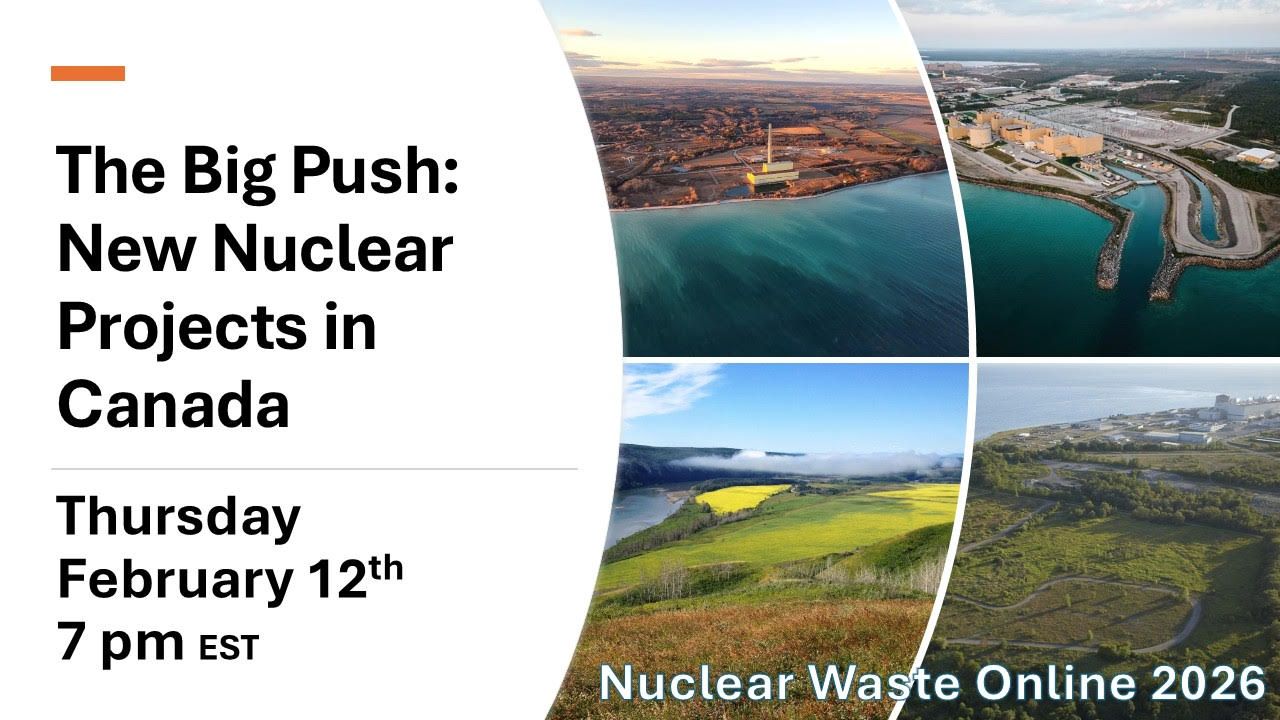
Thursday, February 12, 7 pm Eastern | 2nd of 4 sessions in the 2026 Nuclear Waste Online webinar series
Join a webinar on the push for new nuclear generation in Canada. Go to Northwatch.org to register or use the registration link https://us02web.zoom.us/webinar/register/WN_ZfWOf1GITqSRIZX8CB-A9w

-
Archives
- February 2026 (127)
- January 2026 (308)
- December 2025 (358)
- November 2025 (359)
- October 2025 (376)
- September 2025 (258)
- August 2025 (319)
- July 2025 (230)
- June 2025 (348)
- May 2025 (261)
- April 2025 (305)
- March 2025 (319)
-
Categories
- 1
- 1 NUCLEAR ISSUES
- business and costs
- climate change
- culture and arts
- ENERGY
- environment
- health
- history
- indigenous issues
- Legal
- marketing of nuclear
- media
- opposition to nuclear
- PERSONAL STORIES
- politics
- politics international
- Religion and ethics
- safety
- secrets,lies and civil liberties
- spinbuster
- technology
- Uranium
- wastes
- weapons and war
- Women
- 2 WORLD
- ACTION
- AFRICA
- Atrocities
- AUSTRALIA
- Christina's notes
- Christina's themes
- culture and arts
- Events
- Fuk 2022
- Fuk 2023
- Fukushima 2017
- Fukushima 2018
- fukushima 2019
- Fukushima 2020
- Fukushima 2021
- general
- global warming
- Humour (God we need it)
- Nuclear
- RARE EARTHS
- Reference
- resources – print
- Resources -audiovicual
- Weekly Newsletter
- World
- World Nuclear
- YouTube
-
RSS
Entries RSS
Comments RSS
 nuclear-news