The sleuths called for a special unit of NDRF from Kolkata and the unit reached Borkula village by Monday evening. The sources added that the sleuths of Army Red Horn Division on Sunday followed both the youth, Jatin Das and Apurba Das along with the Chevrolet car from Guwahati and reached Nagaon. Later the suspected materials were recovered from the household.
With its rapid growth in solar power, India now a leading clean energy generator
 ‘India plans big on solar, wind power’ http://www.thehindu.com/news/national/andhra-pradesh/india-plans-big-on-solar-wind-power/article19821527.ece SAKUNALA (KURNOOL DT.), OCTOBER 07, 2017 India has chalked out ambitious plans to generate 84 gigawatts of solar power and 32 gigawatts of wind power by 2022, asserted Anjali Jaiswal, India Director of Natural Resources Defence Council (NDRC), California, on Saturday.
Tamil Nadu: Union Ministry of Environment now allowing mining of thorium, uranium, in ecologically sensitive CRZ areas
 Greed for atomic minerals to leave Tamil Nadu in peril, INDIAN EXPRESS, By Sv Krishna Chaitanya & Sushmitha Ramakrishnan | Express News Service 13th October 2017 CHENNAI: Tamil Nadu has been the biggest victim of illegal beach sand mining in the country. As per the report submitted recently by senior lawyer and rights activist V Suresh, appointed as amicus curiae by Madras High Court in the case relating to illegalities in mining of beach sand minerals in Thoothukudi, Tirunelveli and Kanniyakumari, out of 1.5 crore tonnes of raw sand mined between 2000 and 2017, 57 per cent had been mined illegally.
 Now, the latest “horrific” amendment, as activists call it, to Coastal Regulation Zone (CRZ) Notification, 2011 by Union Ministry of Environment, allowing mining of atomic minerals like uranium, thorium or titanium in ecologically sensitive CRZ areas, irrespective of whether they are available in non-CRZ areas or not, is only going to deliver a telling blow on the already under-stress Tamil Nadu coast.
As per the study titled “Coastal Mineral Mapping” done by researchers in Institute of Ocean Management (IOM) in Anna University, it is revealed that Tamil Nadu arguably has highest concentration of Monazite deposits in the country along its coastline that spans over 1,076 km. Monazite, an atomic mineral, contains 8-10 percent thorium, which is a nuclear fuel. This was India’s first exhaustive attempt to map and record all the natural minerals available, done is tandem with Atomic Mineral Directorate for Exploration and Research (AMD) of Department of Atomic Energy and funded by Environment Ministry. The beach sands of India — especially in Tamil Nadu, Odisha, Kerala and Andhra Pradesh — are rich in several heavy minerals such as ilmenite, rutile, leucoxene, garnet, sillimanite, zircon and monazite.
Supreme Court lawyer Ritwick Dutta, who is also the managing trustee of Legal Initiative for Forest and Environment, said the latest notification will compromise the integrity of the coast. “I can’t make sense of this notification. There is no consultation, there is no fixation on extraction of minerals. This will give a free run for miners to plunder India’s natural treasure. There is a pattern in what the Centre is doing. It is systematically weakening all the laws coming under Environment (Protection) Act, 1972. Firstly, construction projects were exempted from preparing EIA, later Central Wetlands Regulatory Authority was replaced with ‘toothless’ Wetlands (Conservation and Management) Rules, 2016, where state authorities call the shots. Now, this mindless amendment to CRZ Notification, 2011.”………
Environmental activist Nityanand Jayaraman says that Tamil Nadu has already been plundered violating CRZ norms. The intertidal, CRZ-1 areas were not spared even when there were laws. “Now, this is legitimising some of the wrongdoing done in the past and people have also lost their right to question the illegality.”
Environmental dangers
It’s not just the loss of precious minerals that should worry the States. Tampering of fragile coastline would also invite disasters like salt water intrusion, qualitative and quantitative degradation of ground water……..
Health effects
While social and environmental consequences seem inevitable, Konstantine claimed that atomic mining has brought serious health complications to residents around the mines. “Since 1965, mining for radioactive minerals has been prominent in Kanniyakumari, particularly in Manavalakruchi. Studies in the neighbouring mines in Kollam have revealed that the effect of radiation has had a far reaching effect, up to 85 km,” he rued.
He added that no comprehensive study has been brought to public forum about the health effects of these radiations. “The incidences of cancer has been rising over the decades and most victims from Manavalakuruchi and Midalam, approach the Regional Cancer Centre in Thiruvananthapuram or the International Cancer Centre , by CSI Medical Mission at Neyyoor. “These cases are however are not mapped back to radioactivity,” he said claiming that the incidence of the disease is relatively lower the farther one lives from atomic mining areas……..
Alarm bells ringing
- Activists say the resources could end up in foreign soil owing to lack of state-run companies’ expertise in handling such rare-earth minerals
- Mining for radioactive minerals can contribute to cancer among those in the vicinity of the project
- Tampering of fragile coastline would also invite disasters like salt water intrusion, leading to degradation of ground water. They say there are many areas in the State already battling such issues due to unscientific construction
- Activities like coral mining, beach sand mining and other dredging activities are highly harmful and contribute to sea erosion http://www.newindianexpress.com/states/tamil-nadu/2017/oct/13/greed-for-atomic-minerals-to-leave-tamil-nadu-in-peril-1672778.html
Sri Lanka enforces UN resolution on nuclear and biological weapons
 Colombo Gazette 7 Oct 17 The Government has issued a gazette against the use of nuclear, chemical and biological weapons and other related activities in line with United Nations regulations…….
Any person who or group or entity which manufactures, acquires, possesses, develops, transports, transfers or uses nuclear, chemical or biological weapons and their means of delivery within Sri Lanka, will be seen as committing an offence under these regulations and shall on conviction by the High Court, be liable to imprisonment of either description for a period not exceeding twenty years or a fine not exceeding five million rupees or both such fine and imprisonment.
Any person who or group or entity which participates in manufacturing, acquiring, developing, possessing, transporting, transferring or using nuclear chemical or biological weapons and their means of delivery as an accomplice or assists or finances them commits an offence under these regulations and shall on conviction by the High Court, be liable to imprisonment of either description for a period not exceeding five years or a fine not exceeding one million rupees or both such fine and imprisonment.
A person shall not make available any funds, other financial assets and economic resources and financial or other related services directly or indirectly to, or for the benefit of, a person, group or entity to manufacture, acquire, develop, possess, transport, transfer or use nuclear, chemical or biological weapons and their means of delivery or for the purposes to proliferate nuclear, chemical, and biological weapon related materials…….
There shall for the purpose of these regulations, be a Competent Authority who shall be appointed by the Minister in consultation with the Minister assigned the subject of Defence. (Colombo Gazette) http://colombogazette.com/2017/10/07/government-issues-gazette-against-nuclear-chemical-weapons/
Health effects of uranium mining in India
Radiation in uranium mines People working in nuclear power plants face considerable health hazards. http://www.millenniumpost.in/opinion/radiation-in-uranium-mines-264457?utm_source=web-social-share&utm_partner=mpost&utm_campaign=share&utm_medium=facebook Arun Mitra | 2 Oct 2017, Nuclear energy is being projected as the panacea for the energy crisis in our country. It is true that we have acute shortage of electricity which is so essential for development. But there has been debate around the globe whether nuclear energy is the answer. There is evidence to prove that It is fraught with dangers right from digging of its ore – the uranium, to its transport to the nuclear power plants, hazards involved in its utilisation in nuclear facilities and lastly its waste management. There have been many accidents worldwide in the nuclear facilities which have been of extremely serious nature. The Three Mile island accident in 1979, the Chernobyl accident in 1986 and the Fukushima nuclear disaster in 2011. In India, too, several low-level accidents have occurred but they have gone unreported because there is no transparency in the nuclear energy industry and it is not covered under the RTI act.
A large number of workers are involved at every step of nuclear energy. Since nuclear energy is directly linked to radiations, it is important to examine if the workers or their families living in and around these facilities have any associated health problems. The Indian Doctors for Peace and Development (IDPD) had conducted a study on the health status of indigenous people around Jadugoda uranium mines situated in Jharkhand. The study was conducted under the leadership of Dr Shakeel Ur Rahman, who at present the General Secretary of IDPD.
All mining operations have related occupational health and safety hazards. Uranium mines present another hazard to workers and to members of the public. That is a radiation hazard. There are three types of exposure paths in the surrounding of uranium mine. Uranium mining and milling operations produce dust and gas (radon) having radioisotopes that are inhaled by miners and deliver internal radiation.
Through the ingestion of uranium series radioisotopes, transported in surface waters discharged from the mine delivering an internal radiation. The gamma-ray exposure by approaching tailing ponds or mine-tailings. The population living around the Jadugoda uranium mines was found to be suffering from following health effects:
Congenital Deformities: The investigation showed that babies from mothers, who lived near the uranium mining operation area, suffered a significant increase in congenital deformities. While 4.49 per cent mothers living in the study villages reported that children with congenital deformities were born to them, only 2.49 per cent mothers in reference villages fell under this category. The study when seen in this background reveals that people with disabilities in the study villages are significantly more than the all India average. Moreover, increased number of children in the study villages are dying due to congenital deformities. Out of mothers who have lost their children after birth, 9.25 per cent in the study villages reported congenital deformities as the cause of death of their children as compared to only 1.70 per cent mothers in the reference villages. The result shows that children born to mothers who lived near uranium mining operational area are more likely to die due to congenital deformities.
Primary Sterility: For the study purpose, the criteria of primary sterility were laid down to be a married couple not having conceived for at least three years after the marriage, and not using any method of contraception. The result shows that while 9.60 per cent of couples in study villages have not conceived even after three years of marriage, only 6.27 per cent of couples from reference villages fell under this category. The finding demonstrates that couples living near uranium mining operational area are approximately 1.58 times more vulnerable to primary sterility.
Cancer: On being asked the cause of last death in the household, 2.87 per cent households in the study villages attributed the cause of death to be cancer, whereas, 1.89 per cent households in reference village fell under this category. The study reveals that cancer as a cause of death among people living near uranium mining operational area is significantly high.
Life Expectancy: The study shows that increased numbers of people living near uranium mining operational area are dying before completing 62 years of age. The average life expectancy in the state of Jharkhand is 62 years. The study shows that 68.33 per cent the of deaths in the study villages were happening before attaining 62 years of age, whereas 53.94 per cent deaths were reported in reference villages under this category. The findings are discerning and the difference is significant. Other variables: The study tried to look at a few other health variables as well, like prevalence of spontaneous abortion among married women, stillbirths, and chronic lung diseases. The prevalence of all these health variables was definitely more in the study villages as compared to reference village, but the results were statistically not significant. (Dr. Arun Mitra is a leading ENT specialist based in Ludhiana. He is the Senior Vice-President of Indian Doctors for Peace and Development (IDPD) and is presently a member of the core committee of Alliance of Doctors for Ethical Health care in India. Views expressed are personal.)
Nuclear submarine accident – India’s nuclear-powered submarine, INS Chakra, damaged
 India’s Nuclear Submarine Chakra Suffers Damage In Accident https://defenceaviationpost.com/indias-nuclear-submarine-chakra-suffers-damage-accident/ New Delhi: In a setback to the Indian Navy, nuclear-powered submarine, INS Chakra, has met with an accident and being repaired to rectify “some damage” in sonar dome, media report said.
Quoting unnamed sources news portal The Print reported that the damage could be the result of either a collision at sea or accidental scraping while entering the harbour. Officials in the the Navy refused to comment on the incident.
“Repair work on the submarine is likely to be complicated given that the sonar dome is made of titanium, a difficult metal that requires both specialised machinery and manpower to work on. However, the indigenous Arihant nuclear armed submarines are also being made in Visakhapatnam and that could help,” said the report.
INS Chakra, inducted in April 2012, is on ten year lease. The vessel is belongs to Akula-II class of Russian submarine.
The submarine, having displacement of 12,000 tonnes, is powered by a 190 MW reactor with top speed of over 30 knots.
Farmers in 575 villages unite against Chutka nuclear project in Madhya Pradesh
 Protest intensifies against Chutka nuclear project in Madhya Pradesh http://timesofindia.indiatimes.com/city/bhopal/protest-intensifies-against-chutka-nuclear-project-in-madhya-pradesh/articleshow/60902228.cms
P Naveen| TNN | Oct 1, 2017, BHOPAL: Farmers in 575 villagers across three districts in Madhya Pradesh have united against the Rs 17,000-crore Chutka-nuclear power plant project, citing it as disastrous to their development.
A major protest rally is being organised by project affected villages from Mandla, Jabalpurand Seoni districts under the banner of Chutka Parmanu Virodhi Sangarsh Samiti from October 2 to December 17. Earlier Kunda village, one of the three affected by the project on the banks of Narmada, had passed resolutions rejecting the government proposal to set up the nuclear plant.
“Villagers had made written submissions in their banks that no deposits should be allowed in their accounts, despite that the state government has deposited compensation money. All 575 villages surrounding the proposed site have decided to protest,” said Navratna Dubey, Samiti’s secretary.
Several organisations and social activists, including Medha Patkar, have raised their voice against the proposed nuclear power plant.
“Villagers had made written submissions in their banks that no deposits should be allowed in their accounts, despite that the state government has deposited compensation money. All 575 villages surrounding the proposed site have decided to protest,” said Navratna Dubey, Samiti’s secretary.
Several organisations and social activists, including Medha Patkar, have raised their voice against the proposed nuclear power plant.
The site is about 100km from Jabalpur and the famous marble rock formations on the Narmada and a mere 35k from Kanha national park. Most of those affected are tribals, who were earlier displaced by the ‘Bargi Dam’ in the 1990s. Being displaced again rankles them.
India-USA civil nuclear cooperation agreement is really just a weapons marketing deal
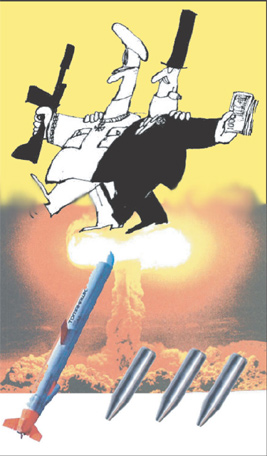
 Indo-US Nuclear Agreement Is An Arms Deal: Ex-US Senator Larry Pressler https://www.ndtv.com/india-news/indo-us-nuclear-agreement-is-an-arms-deal-ex-us-senator-larry-pressler-1756557 Former US Senator Larry Pressler said the focus of Indo-US bilateral partnership should be on ‘agriculture, technology and health care’ All India | Press Trust of India September 29, 2017 NEW DELHI: The civil nuclear cooperation agreement between India and the US is more of an “arms deal”, but the focus of the bilateral partnership should be on “agriculture, technology and health care”, former US Senator Larry Pressler said today. Mr Pressler, who has served as chairman of the US Senate’s Arms Control Subcommittee, also had a word of caution for Pakistan.
He said if Pakistan did not act on terrorism, the Trump administration could declare it “a terror state”. “I would love to see peaceful use of nuclear energy, but I am worried that so far it (nuclear agreement) has mostly been an arms deal. It seems to me that much of the new agreement is a large arms sale to Indians,” Mr Pressler said.
The former US Senator was speaking during the launch of his book.
India and the US signed the nuclear cooperation agreement in October 2008, ending India’s isolation by the West in the nuclear and space arena. The deal has given a significant boost to India’s nuclear energy production.
Mr Pressler said former US President Barack Obama’s visit to New Delhi was “largely an arms sale trip”. On whether the US could declare Pakistan a “terror state”, he said, “Unless Pakistan does not change certain things, it may happen. Moreover, the Trump administration is making sounds that they are getting near this. And I hope they do.”
Mr Pressler is known for advocating amendments in the 1990s which banned most of the economic and military assistance to Pakistan, unless the US President certified on an annual basis that Islamabad did not possess nuclear explosive devices.
Suspected theft of uranium: arrests of 3 people in Indian village
3 nabbed with 35 kg suspected uranium http://sentinelassam.com/story/news/14/3-nabbed-with-35-kg-suspected-uranium/2017-09-26/1/321357, BY OUR STAFF REPORTER, September 26, 2017
NAGAON (HAIBORGAON), Sept 25: Sensation prevailed in Nagaon as well as in the State on Monday morning soon after sleuths of Army Red Horn Division along with Nagaon Police seized a large quantity of suspected materials related to IED or bomb from a household at Dakhinpat Borkula village under Nagaon Sadar Police station and also apprehended three persons, including a woman.
Interestingly, the weight of the seized suspected materials is around 35 kg. According to sources, the nabbed persons have been identified as Jatin Bora of Baksa, Apurba Das of Tihu in Nalbari district and Mamoni Kour of Borkula village. The suspected materials were hidden inside a big hole behind her house. Army as well as police later seized a Chevrolet car bearing registration number AS 01BZ 4775 from their possession.
The sources further added that the materials although earlier suspected as bomb-related materials, were later suspected to be uranium. But till filing of this report it had not been confirmed.
Massive protest : thousands against French Nuclear Project in Jaitapur
In Pictures: Jaitapur says a Resounding ‘Nako’ (No!) to French Nuclear Project, http://www.dianuke.org/pictures-jaitapur-says-resounding-nako-no-french-nuclear-project/ 20 Aug 17, Thousands of men, women, and children from the farming, agro-trading, and fishing communities of Jaitapur in India’s picturesque Ratnagiri District in Maharashtra, today courted arrest en-masse, after a march from Sakhri Nate to Madban village – the site of the upcoming Jaitapur Nuclear Power Park (slated to be the world’s largest such nuclear power facility) – in the presence of heavily-armed state police personnel.
Today’s massive and entirely peaceful protest against the setting up of the Nuclear Power Plant in this ecologically-rich but fragile zone, is of a piece with several such protests and jail-bharo campaigns which have been organized by these local communities in previous years.
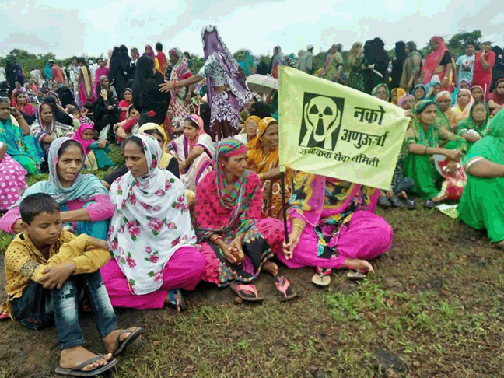
Speaking to DiaNuke.org, Satyajit Chavan, young leader of the local community’s protest group Jan Hakka Seva Samiti said – “it is shocking that the police used drones, hovering over the entire route of the demonstration and over our protest meeting, for the first time in our thoroughly peaceful protest that has been ongoing for years now. It is clearly a way for the state to project its power and intimidate people’s struggles. It is unfortunate that the right of collective and democratic movement enshrined in our constitution is being undermined so brazenly.” Satyajit also emphatically added that the protest in Jaitapur has been organised spontaneously by local people, and is not funded or co-ordinated by any political party. “The banner of Jan Hakka Seva Samiti under which people assembled and registered their protest today is totally non-political. However, the media that had come to cover the protests interviewed only some leaders of political parties who just came their to show solidarity. In the past the media has used such occasions to portray the entire protest being anchored by Shiv Sena and other political groups, which is completely far from the reality”, Satyajit Chavan said. He is also a key leader of the National Alliance of Anti-Nuclear Movements(NAAM), a country-wide network of grassroots anti-nuke movements in India.
A solidarity letter sent by activists from France was read out at the protest in Jaitapur today, which highlighted the common struggle against nuclear lobbies dangerous profiteering:
“Far and close friends of the international anti-nuclear family !
You are not alone ! From various countries we watch carefully what is happening in Jaitapur, India.
Here from France we are impressed by your courageous actions that we totally support.
Here from France we spread the news on what you do (in French and in English for other international networks).Here too, the central government is acting against the will of its own people and violating their basic right for a sane life at home.
Here too, there are many people wishing and working actively for the final death of the devil Areva.
Here too, this devil Areva is surviving until today only because the central government, without the agreement of the people, is giving to it non-stop billions of Euros coming directly from the tax-payers pockets.
Like yourself, as world citizens, we reclaim respect and justice for people and Nature as a first condition for a livable and even better world.
With full and renewable solidarity!”
More details about the protest and objections by the local community can be read here.
Is Trump aware of that other imminent nuclear war danger – the standoff between India and China ?
The potential conflict between nuclear powers that Trump barely acknowledges, https://www.washingtonpost.com/news/worldviews/wp/2017/08/18/the-potential-conflict-between-nuclear-powers-that-trump-barely-acknowledges/?utm_term=.bdf29c5159e7 The two most populous countries in the world are dangerously close to armed conflict. Both are fast-growing and ambitious nations with something to prove — and they have nuclear weapons. Yet you’ll find surprisingly little discussion of the issue in Washington, where President Trump’s ongoing controversies and the threat of terrorist attacks (more on the horrific attack in Barcelona later in the newsletter) continue to dominate the discussion.The military standoff between India and China over a remote plateau in the Himalayas has been going on for months now. This week, The Post’s Annie Gowen and Simon Denyer took a look at the complicated dispute, which was sparked by China’s move to build a road in territory claimed by Bhutan, a close ally of India that does not have formal diplomatic relations with Beijing.
Territorial disputes between in the area are far from new — India and China briefly went to war over contest territory in 1962. And much of the present dispute dates back to an 1890 border agreement made between British India and China’s Qing Dynasty, one of a number of lingering problems caused by colonial cartographers.
But experts say the current standoff is the worst in decades and has taken on a different tone than previous flare-ups. “It would be very complacent to rule out escalation,” Shashank Joshi, an analyst with the Royal United Services Institute in London, told The Post. “It’s the most serious crisis in India-China relations for 30 years.”
Both India and China are speaking openly and seriously of armed conflict, with Beijing’s state media striking a indigent and at times uncharacteristically vulgar tone. An English-language video posted by the Xinhua news agency Wednesday accused India of “trampling international law” and “inventing various excuses to whitewash its illegal moves” — before showing a Chinese actor in a Sikh turban who spoke in an insulting Indian accent.
If India and China were to go to war, it would be no small matter. Over 2.6 billion people live in the two nations. Between them, they are estimated to have 380 nuclear weapons (though both China and India subscribe to a “no first use” policy, which should — hopefully — mean they wouldn’t be used in such any conflict).
In a briefing last month, the U.S. State Department urged restraint. During a press briefing last week, spokeswoman Heather Nauert said, “It’s a situation that we have certainly followed closely. And as you know, we have relationships with both governments. We continue to encourage both parties to sit down and have conversations about that.”
The dispute centers not only on the territory in question — an obscure, 34-square-mile area known as the Dolam Plateau that is claimed by both Bhutan and China — but a narrow strip of strategically important Indian land called the Siliguri Corridor. This tract, unaffectionately nicknamed the “chicken’s neck,” connects the bulk of the India with its remote east. Delhi has long feared Chinese troops could cut across the corridor if war broke out, effectively cutting the country in half. It’s not an unreasonable fear, given that the region is just 14 miles wide at its thinnest point; Ankit Panda of the Diplomat once dubbed it a “terrifyingly vulnerable artery in India’s geography.”
It is widely assumed that Washington would side with India in the dispute. Trump is a frequent critic of China, and some in his administration have pushed for tough responses to other territorial claims made by Beijing, such as the ongoing disputes in the South China Sea. Trump called Indian Prime Minister Narendra Modi on India’s Independence Day this week, which some media outlets interpreted as a gesture of support for New Delhi.
And yet, there is a nagging sense among some in India that Trump won’t have Modi’s back if push comes to shove. “If ever there was a war with China, America would never come to our rescue,” one government official told Indian journalist Barkha Dutt recently, according to a story Dutt wrote for The Post’s Global Opinion section.
Washington also may be diplomatically limited in the region: A number of key State Department positions that would have responsibility for handling an India-China crisis remain unfilled. Another part of the problem is simply the complexity of the issue, which could prove hard to communicate to a leader with seemingly limited knowledge of the world and a notoriously short attention span.
There is also an argument that perhaps Trump should keep his nose out of this. The Post’s Jackson Diehl wrote he didn’t find much enthusiasm for U.S. involvement in the dispute while in Delhi last week. The U.S. president has gained a reputation there for being hotheaded and impulsive — even the drawdown in tensions with North Korea seems to have happened in spite of his involvement, not because of it.
India’s Adani mining giant accused of corruption just as it seeks funds from the Australian government for coal mine
 If true, one effect of the alleged scheme would have been to move vast sums of money from the Adani Group’s domestic accounts into offshore bank accounts where it could no longer be taxed or accounted for.
Adani mining giant faces financial fraud claims as it bids for Australian coal loan, Exclusive: Allegations by Indian customs of huge sums being siphoned off to tax havens from projects are contained in legal documents but denied by company, Guardian, Michael Safi in Delhi, 16 Aug 17, A global mining giant seeking public funds to develop one of the world’s largest coal mines in Australia has been accused of fraudulently siphoning hundreds of millions of dollars of borrowed money into overseas tax havens.
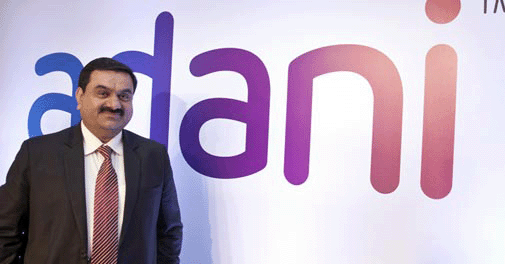
Indian conglomerate the Adani Group is expecting a legal decision in the “near future” in connection with allegations it inflated invoices for an electricity project in India to shift huge sums of money into offshore bank accounts.
The directorate of revenue intelligence (DRI) file, compiled in 2014, maps out a complex money trail from India through South Korea and Dubai, and eventually to an offshore company in Mauritius allegedly controlled by Vinod Shantilal Adani, the older brother of the billionaire Adani Group chief executive, Gautam Adani.
Vinod Adani is the director of four companies proposing to build a railway line and expand a coal port attached to Queensland’s vast Carmichael mine project.
The proposed mine, which would be Australia’s largest, has been the source of years of intense controversy, legal challenges and protests over its possible environmental impact.
Expanding the coal port to accommodate the mine will require dredging an estimated 1.1m cubic metres of spoil near the Great Barrier Reef marine park. Coal from the mine will also produce annual emissions equivalent to those of Malaysia or Austria according to one study.
One of the few remaining hurdles for the Adani Group is to raise finance to build the mine as well as a railway line to transport coal from the site to a port at Abbot Point on the Queensland coast.
To finance the railway Adani hopes to persuade the Northern Australia Infrastructure Facility (Naif), an Australian government-backed investment fund, to loan the Adani Group or a related entity about US$700m (A$900m) in public money.
While it awaits the decision on the loan, in Delhi the company is also expecting the judgment of a legal authority appointed under Indian financial crime laws in connection to allegations it siphoned borrowed money overseas.
The Adani Group fully denies the accusations, which it has challenged in submissions to the authority.
The investigation
News of the investigation was first reported in India three years ago, but the full customs intelligence document reveals forensic details of the workings of the alleged fraud which have not been publicly revealed.
The 97-page file accuses the Adani Group of ordering hundreds of millions of dollars’ worth of equipment for an electricity project in western India’s Maharashtra state using a front company in Dubai.
To read the pdf click here.
The Dubai company allegedly sold the exact same equipment back to Adani Group-controlled businesses in India at massively inflated prices, in some instances said to be eight times the sale price.
According to the allegations in the file, the effect of these transactions was that the Adani Group spent an average 400% more for the materials. That money was allegedly paid to a company Indian authorities allege was owned through a series of shell companies leading to a Mauritius trust controlled by Vinod Adani.
If true, one effect of the alleged scheme would have been to move vast sums of money from the Adani Group’s domestic accounts into offshore bank accounts where it could no longer be taxed or accounted for.
Because tariffs for using electricity transmission networks are determined partly by what they cost to build, if the DRI’s accusations are correct, the overvaluation of capital goods would have been likely to have led to higher power prices for Indian consumers……
The Australian loan
The Adani Group, or a linked entity, has reportedly been granted “conditional approval” for the US$700m (AU$900m) concessional loan from Naif, the Australian government investment fund.
But due to secrecy around the operation of the investment fund, it is not clear whether the loan application discloses the existence of the DRI notice or the ongoing legal proceedings, or whether the applicant is required to do so under the Naif’s anti-money laundering provisions……
The Guardian is publishing excerpts from the DRI file in the interests of ensuring Naif, as well as the public, have access to as much relevant information as possible in assessing whether Adani or linked companies would be suitable recipients of public money.
In a separate case last year, six Adani subsidiaries were listed among 40 other companies being investigated for allegedly running a similar price-inflation scheme. The companies are accused of inflating the price of coal imports from Indonesia to hide profits in overseas tax havens.
The DRI and the ED did not respond to a request to clarify the status of the investigations.
The alleged money trail…..
How Adani allegedly siphoned money from India….
Who controls the companies?
Key to the alleged fraud, according to investigators, is that EIF, the company subcontracted to purchase the equipment from manufacturers in South Korea and China, was directly controlled by the Adani Group and its associates…. https://www.theguardian.com/world/2017/aug/16/adani-mining-giant-faces-financial-claims-as-it-bids-for-australian-coal-loan
Levels of humid heat will kill millions, if warming is not tackled
“If given just one word to describe climate change, then ‘unfairness’ would be a good candidate. Raised levels of carbon dioxide in the atmosphere are expected to cause deadly heatwaves for much of South Asia. Yet many of those living there will have contributed little to climate change.”

Climate change to cause humid heatwaves that will kill even healthy people https://www.theguardian.com/environment/2017/aug/02/climate-change-to-cause-humid-heatwaves-that-will-kill-even-healthy-people
If warming is not tackled, levels of humid heat that can kill within hours will affect millions across south Asia within decades, analysis finds, Guardian, Damian Carrington, 3 Aug 17, Extreme heatwaves that kill even healthy people within hours will strike parts of the Indian subcontinent unless global carbon emissions are cut sharply and soon, according to new research.
Even outside of these hotspots, three-quarters of the 1.7bn population – particularly those farming in the Ganges and Indus valleys – will be exposed to a level of humid heat classed as posing “extreme danger” towards the end of the century.
The new analysis assesses the impact of climate change on the deadly combination of heat and humidity, measured as the “wet bulb” temperature (WBT). Once this reaches 35C, the human body cannot cool itself by sweating and even fit people sitting in the shade will die within six hours.
The revelations show the most severe impacts of global warming may strike those nations, such as India, whose carbon emissions are still rising as they lift millions of people out of poverty.
“It presents a dilemma for India between the need to grow economically at a fast pace, consuming fossil fuels, and the need to avoid such potentially lethal impacts,” said Prof Elfatih Eltahir, at Massachusetts Institute of Technology in the US who led the new study. “To India, global climate change is no longer abstract – it is about how to save potentially vulnerable populations.”
Heatwaves are already a major risk in South Asia, with a severe episode in 2015 leading to 3,500 deaths, and India recorded its hottest ever dayin 2016 when the temperature in the city of Phalodi, Rajasthan, hit 51C. Another new study this week linked the impact of climate change to the suicides of nearly 60,000 Indian farmers.
Eltahir said poor farmers are most at risk from future humid heatwaves, but have contributed very little to the emissions that drive climate change. The eastern part of China, another populous region where emissions are rising, is also on track for extreme heatwaves and this risk is currently being examined by the scientists.
Their previous research, published in 2015, showed the Gulf in the Middle East, the heartland of the global oil industry, will also suffer heatwaves beyond the limit of human survival if climate change is unchecked, particularly Abu Dhabi, Dubai, Doha and coastal cities in Iran.
The new work, published in the journal Science Advances, used carefully selected computer climate models that accurately simulate the past climate of the South Asia to conduct a high resolution analysis of the region, down to 25km.
The scientists found that under a business-as-usual scenario, where carbon emissions are not curbed, 4% of the population would suffer unsurvivable six-hour heatwaves of 35C WBT at least once between 2071-2100. The affected cities include Lucknow in Uttar Pradesh and Patna in Bihar, each currently home to more than two million people.
Vast areas of South Asia – covering 75% of the area’s population – would endure at least one heatwave of 31C WBT. This is already above the level deemed by the US National Weather Service to represent “extreme danger”, with its warning stating: “If you don’t take precautions immediately when conditions are extreme, you may become seriously ill or even die.”
However, if emissions are reduced roughly in line with the global Paris climate change agreement, there would be no 35C WBT heatwaves and the population affected by the 31C WBT events falls to 55%, compared to the 15% exposed today.
The analysis also showed that the dangerous 31C WBT level would be passed once every two years for 30% of the population – more than 500 million people – if climate change is unchecked, but for only 2% of the population if the Paris goals are met. “The problem is very alarming but the intensity of the heatwaves can be reduced considerably if global society takes action,” said Eltahir.
South Asia is particularly at risk from these extreme heatwaves because the annual monsoon brings hot and humid air on to the land. The widespread use of irrigation adds to the risk, because evaporation of the water increases humidity. The projected extremes are higher in the Gulf in the Middle East, but there they mostly occur over the gulf itself, rather than on land as in South Asia.
The limit of survivability, at 35C WBT, was almost reached in Bandar Mahshahr in Iran in July 2015, where 46C heat combined with 50% humidity. “This suggests the threshold may be breached sooner than projected,” said the researchers.
Prof Christoph Schär, a climate scientist at ETH Zurich, Switzerland, and who was not involved in the study, said: “This is a solid piece of work, which will likely shape our perception of future climate change. In my view, the results are of concern and alarming.”
The report demonstrates the urgency of measures to both cut emissions and help people cope better with such heatwaves, he said. There are uncertainties in the modelling – which Schär noted could underestimate or overestimate the impacts – as representing monsoon climates can be difficult and historical data is relatively scarce.
Prof Chris Huntingford, at the UK Centre for Ecology and Hydrology, said: “If given just one word to describe climate change, then ‘unfairness’ would be a good candidate. Raised levels of carbon dioxide in the atmosphere are expected to cause deadly heatwaves for much of South Asia. Yet many of those living there will have contributed little to climate change.”
Many thousands of suicides in India – linked to climate change
 Climate change linked to suicides of 59,000 farmers in India, finds report, Researchers find extra 67 people take their own lives for every one degree Celsius of warming,The Independent, 1 Aug 17 Tom Batchelor @_tombatchelor Scorching temperatures, drought, storms and famine triggered by climate change have led to thousands of extra suicides in India, a report has found.
During the south Asian nation’s growing season, every one degree Celsius of warming above 20°C sees an average of 67 more people take their own lives, according to the study.
Experts said the findings, published in the Proceedings of the National Academy of Sciences (PNAS), are particularly alarming as India’s average temperatures are expected to rise another 3°C by 2050, meaning hundreds of extra deaths.India’s farmers are already regularly hit by extreme weather events, including strong storms and heat waves, and some still rely on natural rainfall to water their crops.
Scientists have shown that those weather patterns are already increasing as the planet warms.
Tamma Carleton, who conducted the research, said nearly 60,000 suicides over the past 30 years may be linked to climate change.
Looking at suicide data from India’s National Crime Records Bureau between 1967 and 2013, along with data on agricultural crop yields and on temperature change, she estimated that “warming temperature trends over the last three decades have already been responsible for over 59,000 suicides throughout India”.
“We may not be able to stop the world from warming, but that doesn’t mean we can’t do something to address suicide,” said Vikram Patel, an Indian psychiatrist and mental health expert with Harvard Medical School in Boston, who was not involved in the study.
There are many factors that can contribute to suicide, including poor crop yields, financial problems, access to easy methods of self-harm, or a lack of community support.In India, many farmers will drink toxic pesticides as a way out of backbreaking debt.
For the past month, hundreds of farmers – some carrying human skulls they say are from farmers who committed suicide in the drought-stricken southern state of Tamil Nadu – have been staging what they say will be a 100-day protest in New Delhi to “prevent the suicide of farmers who feed the nation”.
Parts of western and north-eastern India have been hit by floods that have washed away villages and crops.
Heavy rains have caused rivers in states such as Gujarat, Assam and Rajasthan to burst their banks, killing 130 people……..http://www.independent.co.uk/news/world/asia/climate-change-india-suicide-59000-global-warming-report-farmer-deaths-a7870496.html
Pictures of the devastating effects of uranium mining in Jadugoda, India
 India’s Nuclear Graveyard: Haunting images show the devastating effects of uranium mining in Jadugoda http://www.mirror.co.uk/news/gallery/indias-nuclear-graveyard-haunting-images-10871818, NATALIE EVANSJAMIE FERGUSON, 1 Aug 17,
For years, the local population has suffered from the extensive environmental degradation caused by mining operations, responsible for the high frequency of radiation related sicknesses and developmental disorders found in the area. Increases in miscarriages, impotency, infant mortality, Down’s syndrome, skeletal deformities, thalassemia have been reported. With raw radioactive ‘yellow-cake’ production to increase and more than 100,000 tons of radio-active waste stored at Jadugoda the threat to the local tribal communities is set to continue.
Thousands homeless, hundreds die in East India floods
Monsoon 2017: Floods Across Gujarat, Rajasthan, East India Kill Hundreds; Thousands Homeless, Sky Weather, 28 July 2017 Floods across many parts of the country have wreaked havoc resulting in chaos in several areas. The flood toll has reached a whopping 200 now and a few thousands have become homeless.
Rescue and relief operations were in full swing which is why thousands were sent to safer places. Not only this, PM Modi announced that the injured are entitled to compensation of Rs 50,000, while the family of deceased will get Rs 2 lakh.
The two weather systems which developed over either side of the country, one being over South Rajasthan and Gujarat and another over Gangetic West Bengal as well as Jharkhand were responsible for bringing torrential rains. Heavy rains were witnessed over many parts of the country.
Parts of Odisha, Gangetic West Bengal and Jharkhand witnessed extremely heavy rains between July 21 and 25. These weather conditions were attributed to the low over Gangetic West Bengal and adjoining Jharkhand intensified into a low pressure area and now the system is lying over Southeast Uttar Pradesh as a depression…..
many parts of Gujarat and South Rajasthan have been reeling under flood conditions which escalated to being severe due to non stop rains.
Since the second week of July, back to back weather systems have been affecting Gujarat and South Rajasthan. Initially, the low which formed over Southeast Uttar Pradesh travelled over Gujarat and gave heavy rains over the region.
Another Weather system which formed over West Central Bay off Odisha coast also travelled up to South Rajasthan and Gujarat around July 20. Since then, the system has been persisting over the region and giving heavy to extremely heavy rains over that area…..https://www.skymetweather.com/content/weather-news-and-analysis/monsoon-2017-floods-across-gujarat-rajasthan-east-india-kill-hundreds-thousands-homeless/
1 This Month
To see nuclear-related stories in greater depth and intensity – go to https://nuclearinformation.wordpress.com/
12 February – Webinar The Big Push: New Nuclear Projects in Canada

Thursday, February 12, 7 pm Eastern | 2nd of 4 sessions in the 2026 Nuclear Waste Online webinar series
Join a webinar on the push for new nuclear generation in Canada. Go to Northwatch.org to register or use the registration link https://us02web.zoom.us/webinar/register/WN_ZfWOf1GITqSRIZX8CB-A9w
-
Archives
- February 2026 (127)
- January 2026 (308)
- December 2025 (358)
- November 2025 (359)
- October 2025 (376)
- September 2025 (258)
- August 2025 (319)
- July 2025 (230)
- June 2025 (348)
- May 2025 (261)
- April 2025 (305)
- March 2025 (319)
-
Categories
- 1
- 1 NUCLEAR ISSUES
- business and costs
- climate change
- culture and arts
- ENERGY
- environment
- health
- history
- indigenous issues
- Legal
- marketing of nuclear
- media
- opposition to nuclear
- PERSONAL STORIES
- politics
- politics international
- Religion and ethics
- safety
- secrets,lies and civil liberties
- spinbuster
- technology
- Uranium
- wastes
- weapons and war
- Women
- 2 WORLD
- ACTION
- AFRICA
- Atrocities
- AUSTRALIA
- Christina's notes
- Christina's themes
- culture and arts
- Events
- Fuk 2022
- Fuk 2023
- Fukushima 2017
- Fukushima 2018
- fukushima 2019
- Fukushima 2020
- Fukushima 2021
- general
- global warming
- Humour (God we need it)
- Nuclear
- RARE EARTHS
- Reference
- resources – print
- Resources -audiovicual
- Weekly Newsletter
- World
- World Nuclear
- YouTube
-
RSS
Entries RSS
Comments RSS
 nuclear-news