In India, groups unite to oppose construction of the atomic power plant at Kovvada
The Hindu 8th Feb 2018, The CPI(M), the Human Rights Forum, and several non-governmental
organisations on Wednesday opposed the proposed visit of the team from
Westinghouse Electric Corporation to India to discuss with the government
the construction of the atomic power plant at Kovvada in Ranasthalam mandal
of the district.
http://www.thehindu.com/news/national/andhra-pradesh/signature-drive-against-proposed-visit-of-westinghouse-team/article22683259.ece
Nuclear weapons – always the goal of India’s “peaceful” nuclear power
The Nation 11th Feb 2018, Indian army chief calls our strategic and tactical nuclear capability `a bluff’. His view may be rooted in India’s own bitter enrichment experience (1980-1985).
Ramana points out during initial operations that India’s enrichment plant `had frequent breakdown as a result of corrosion and failure of parts’. `Many leaders of Indian Department of Atomic Energy held that uranium enrichment was very difficult and were skeptical of Pakistani claims that they had succeeded in enriching uranium to weapons grade levels’.
From day one, India’s nuclear programme has been dual-use oriented. Nehru never ruled out the nuclear option for India . He wrote to Homi Bhabha `Apart from building power stations and developing electricity there is always a built-in advantage of defence use [of nuclear enrichment] if the need should arise’. According to Srinivasan, former head of Indian Atomic Energy Commission, `Nuclear technology was developed by a country for its own benefit, whether for peaceful purposes or military applications’.
https://nation.com.pk/11-Feb-2018/unmasking-india-s-secret-nuclear-capability
Russia’s nuclear macho men spin propaganda to Indian kids
 I had a bit of a laugh, reading this one.
Russia is using the same pathetic old comics and jolly stories that Western nuclear companies have now  given up on.
And once again – it’s the macho nuclear men that are doing the nuclear spinning to kids. (The West now uses sophisticated young women as much as they can, with more subtle propaganda)
Nuclear ABC: Rosatom Explains Nuclear Science to Indian School Children, https://sputniknews.com/asia/201802091061516702-nuclear-eduction-indian-children/

New Delhi (Sputnik) — During the festival that was held from 6 to 9 February, experts gave presentations and held interactive sessions with children and teachers from different schools in Delhi. The occasion was designed to nurture the interest of children towards nuclear physics, Rosatom officials told Sputnik.
Nuclear experts and scientists of Rosatom also visited some schools in Delhi and conducted awareness sessions for children on the peaceful use of the atomic energy. Rosatom also released a book titled ‘Nuclear ABC’ in English and Hindi to help in the awareness drive. The book was jointly released on Thursday by Russian Ambassador to India Nikolay Kudashev, Professor Emeritus of Jawaharlal University R Rajaraman, Fedor Rozovskiy, Director of Russian Center along with officials of Rosatom at the Russian Centre for Science and Culture, New Delhi. The book launch was attended by hundreds of school children.
“The book is yet another instance of the rich history of Indo-Russian scientific cooperation dating back to the Soviet era,” professor R. Rajaraman said during the launch.
Prof Rajaraman hailed Russia’s assistance in achieving its nuclear energy targets.
India keeping up in the nuclear arms race – 2 Nuclear Capable Ballistic Missile in one Week

 India Test Fires Second Nuclear Capable Ballistic Missile in a Week, The nuclear capable Prithvi-II missile was test fired on February 7. The Diplomat, By Franz-Stefan GadyFebruary 09, 2018
American companies’plans to market nuclear technology to India have come to nothing
 The Hindu 3rd Feb 2018, Watching the Republic Day parade, where 10 ASEAN leaders were chief guests,
it was easy to miss the fact that the dates of their visit also marked the
anniversary of another big visit three years ago: the visit by then U.S.
President Barack Obama, when he announced a “breakthrough” in the
India-U.S. civil nuclear deal, to finally pave the way for a commercial
contract.
“The deal is done,” Sujatha Singh, who was Foreign Secretary
at the time, said as the government issued papers and held briefings
describing the nature of the agreement between India and the U.S. on
supplier liability and tracking requirements, which would enable American
companies to build nuclear power reactors in India.
Today, nearly a decade since the memoranda of understanding were inked, and three years after the
last wrinkles were ironed out, there is no sign yet of any concrete
contract between an American company and the Indian authorities to build a
reactor.
In 2009, both GE-Hitachi and Toshiba-Westinghouse had begun talks
on techno-commercial agreements for six reactors each in India. These
commercial contracts were to be the start of the ‘payoff’ for the U.S.
that had considerably shifted its stand on non-proliferation to give India
the waivers needed, and they were to herald India’s arrival on the global
nuclear power stage in return.
Instead, GE-Hitachi’s plans were shelved after it rejected the Obama-Modi agreement in January 2015, saying GE would
not accept the compromise formula on supplier liability. (While others have
indicated they would accept the liability offer, none of them has put that
on paper.) Toshiba-Westinghouse then carried the baton to actualise the
India-U.S. civil nuclear deal, but ran into a different storm as both
Toshiba and Westinghouse had major financial troubles last year. After a
near-bankruptcy, Toshiba jettisoned Westinghouse for just $4.6 billion to a
Canadian consortium, a deal that is now expected to be cleared by the end
of 2018.
http://www.thehindu.com/opinion/lead/forging-a-new-nuclear-deal/article22637628.ece
Forcible displacement of Indian villagers to make way for unnecessary, uneconomic, nuclear reactors
The Kovvada Nuclear Reactor was to be built by US nuclear reactor maker, Westinghouse. But, in March 2017, Westinghouse filed for bankruptcy. The company was bled to death because of cost-escalations in two of the four nuclear power plants it designed and is constructing in the United States. “Kovvada will benefit only Westinghouse, and no one else. Not the people. Not India’s energy security,” said EAS Sarma, former Union Energy Secretary.
“India is being bamboozled by the multinationals into signing these agreements with foreign companies”
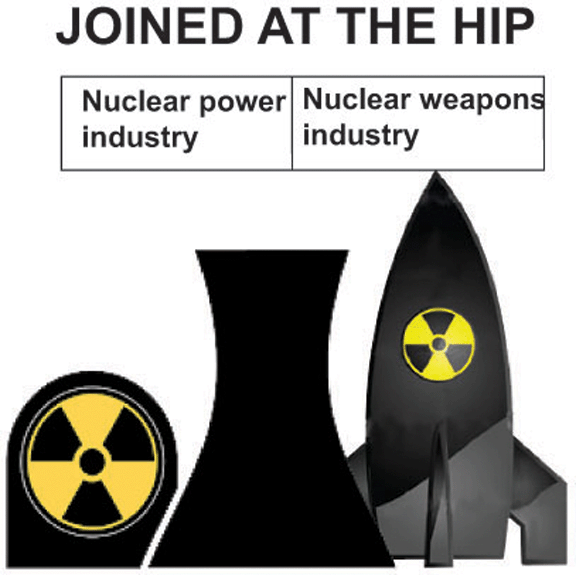 “It is not just the US, even Europe is not gung-ho about nuclear. So, Westinghouse and GE have very little business,” said Dr Sarma. “They are looking for a market and India is fertile ground of them”
If nuclear energy is not as safe or inexpensive then why invest in it? “Because nuclear energy is a possible front for weaponisation
In Kovvada, villagers displaced forcibly even as the prospects of Westinghouse’s nuclear project remain uncertain, DiaNuke.org, JANUARY 19, 2018 Raksha Kumar | The News Minute
The coast curves through northern Andhra Pradesh and forms a giant U. Deep in the womb of this horseshoe lies Ranastalam mandal of Srikakulam district. During the light winter showers in November, this region takes on a darker shade of green. Small fishing villages are sprinkled across the uneven coast.
People here consider the vast sea their sole asset. “We have been fishermen for generations,” said Juggle Mailapally, ex-sarpanch of Chinna Kovvada village. “I was taught how to stitch a fishing net when I was 9,” he added.
Since 2008, when the Indo-US Nuclear Deal was signed, there have been rumours in the air about a giant nuclear plant taking over their idyllic existence. However only in 2015 did those rumours get confirmed.The District Collector of Srikakulam came to their village to talk to them about relocation, recollected Mailapally.
First, the villagers protested. Then they went on a year long hunger strike, which got the support of several political parties. However, their resilience proved to be weak in front of the government’s grit to see the project through.
Soon there will be six 1000MW nuclear reactors lining the coast. Over 2,074 acres in seven villages – Kovvada, Ramachandrapuram, Gudem, Kotapalem, Maruvada, Tekkali and Jeerukovvada – will house the reactors, displacing about 10,000 people.
Lands acquired
While questions about the viability of the project still persist, people of Ranastalam have had to give up their lands. The Andhra Pradesh government announced in December 2017 that the land acquisition for the project was completed successfully.
In 2014, before the current Telugu Desam Party government was voted into power for the first time in divided Andhra Pradesh, Chief Minister Chandrababu Naidu made a campaign promise to relocate the nuclear power plant from Kovvada and neighbouring villages. “Immediately after he was sworn in, he changed his stance,” said Mailapally.
After his election, efforts on the nuclear plant only accelerated. “Only TV channels owned by the opposition party showcase the hypocrisy and treachery,” said Rajesh of National Alliance for People’s Movements, who is researching the power plant. “Otherwise, the media is fairly jubilant about the project.”
According to the World Nuclear Industry Status Report 2017, the Prototype Fast Breeder Reactor (PFBR) in India has been listed as “under construction” for a decade or more. “The average construction time of the latest 51 units in ten countries that started up in the past decade, since 2007, was 10.1 years with a very large range from 4 to over 43 years,” the report reads.
In Maharashtra, work is yet to begin on the Jaitapur Nuclear Plant whose agreement was signed in December 2010.
According to the Land Acquisition, Rehabilitation and Resettlement Act of 2013, if the government does not use the land acquired for the purposes it was taken, the lands should be returned to the people. “Since nuclear energy is seeing a downward slide across the world, most proposed nuclear plants are tentative. Might never be built at all,” said Dr K Babu Rao, retired scientist, IICT.
Acquiring lands to construct a nuclear facility has certain additional rules. Atomic Energy Regulatory Board (AERB) is the national authority which is responsible for approving construction, commissioning, operation and decommissioning of nuclear power facilities in the country.
As per the AERB guidelines, 1.6 kilometres from the periphery of the project’s rim is exclusive zone – no one can inhabit that zone. Beyond that, upto 30 kilometres, the place needs to be monitored and evacuation-ready. Even though people living within those 30-odd kilometres will be exposed to high doses of radiation, compensation is given only to those whose lands are taken away.
Add to this, India has a weak Civil Nuclear Liability law, which guarantees lower compensation in case of a disaster.
Seven hundred and ninety one acres of the required 2074 acres are government lands, therefore easier to acquire for the nuclear project. However, 684 acres are lands assigned to landless poor, with a condition that they be sold only to the government. And 599 acres are private lands………
Bankruptcy
The Kovvada Nuclear Reactor was to be built by US nuclear reactor maker, Westinghouse. But, in March 2017, Westinghouse filed for bankruptcy. The company was bled to death because of cost-escalations in two of the four nuclear power plants it designed and is constructing in the United States. “Kovvada will benefit only Westinghouse, and no one else. Not the people. Not India’s energy security,” said EAS Sarma, former Union Energy Secretary………
“India is being bamboozled by the multinationals into signing these agreements with foreign companies,” said Dr Sarma. Since the 1979 Three Mile Island nuclear accident in the US, when a Pennsylvania-based nuclear plant malfunctioned, the US has been cautious in using nuclear energy. “It is not just the US, even Europe is not gung-ho about nuclear. So, Westinghouse and GE have very little business,” said Dr Sarma. “They are looking for a market and India is fertile ground of them,” he added.
Westinghouse is not alone. In May 2015, weeks after Modi’s visit to France, a French company announced it was going into loss. Areva, the French nuclear reactor manufacturer, is to design the nuclear reactor in Jaitapur, Maharashtra. The French government is desperately trying to breathe life into Areva. “Again, it is in their favour to woo India. And India is being naive,” said Dr Sarma………
A more basic question remains in the minds of most villagers. Is the nuclear power plant necessary at all? Should we invest in nuclear energy?
As on date, nuclear power constitutes only 1.83% of the total installed electricity generation capacity in India. Moreover, nuclear energy generates only 3.23% of the total electricity. With renewable sources like solar and wind energy becoming cheaper, the moot question is should the country invest in nuclear energy at all?
“Since India is planning to depend heavily on such foreign reactor suppliers, the future trajectory of nuclear development in the country is going to be uncertain and highly expensive,” said Dr Sarma.
If nuclear energy is not as safe or inexpensive then why invest in it? “Because nuclear energy is a possible front for weaponisation,” said Sukla Sen, a Mumbai-based activist.
Villagers in Kovvada have no time to think about all that. They are busy trying to think alternate modes of employment in the villages they would have to move into. http://www.dianuke.org/kovvada-villagers-displaced-forcibly-even-prospects-westinghouses-nuclear-project-remain-uncertain/
India again test-fires a nuclear-capable intercontinental ballistic missile
- The nuclear-capable Agni-V ICBM was fired from Abdul Kalam island off the coast of the eastern state of Odisha at around 9:53 a.m. local time (11:23 p.m. ET on Wednesday)
- The same missile has been tested five times over the past six years, with the most recent test prior to Thursday’s launch coming in December 2016
- Relations between China and India deteriorated significantly in 2017, following a protracted border dispute in the western Himalayas
The nuclear-capable Agni-V ICBM was fired from Abdul Kalam island off the coast of the eastern state of Odisha at around 9:53 a.m. local time (11:23 p.m. ET on Wednesday).
India’s Defense Ministry said the test was a “major boost” to the country’s defense capabilities. The same missile has been tested five times over the past six years, with the most recent test prior to Thursday’s launch coming in December 2016. That test prompted exasperation from two of New Delhi’s most important continental rivals, China and Pakistan.
Relations between China and India deteriorated significantly in 2017, following a protracted border dispute in the western Himalayas. And given the world’s two biggest emerging economies are both equipped with nuclear weapons, observers were fearful of escalating geopolitical tensions……….https://www.cnbc.com/2018/01/18/india-missile-new-delhi-successfully-tests-a-nuclear-capable-icbm.html
Truck overturns, on its way to collect nuclear waste
Vehicle on way to bring nuclear waste topples in Karwar, TNN | Jan 18, 2018, Karwar: A multi-axle vehicle, which was going towards Kaiga to bring nuclear waste, met with an accident near Bole village in Karwar taluk on Wednesday afternoon. The trailer of the vehicle, which was loaded with an empty flask, separated and turned upside down.
The Nuclear Power Corporation of India (NPCIL) clarified that the flask was empty and there was no nuclear leakage. No one has been injured in the accident, NPCIL said. Sanjay Kumar, site director of Kaiga Generating Station, said that there is no effect on environment or human beings due to this accident.
This is second such accident involving vehicles meant for transporting nuclear waste between Karwar and Kaiga in the past three months. In October last year, one such vehicle fell into a gorge near Keravadi village.
Stop nuclear power expansion – says Former Chairman of India’s Atomic Energy Regulatory Board
World is Abandoning Nuclear Power
with the whole world receding from setting up nuclear plants, by the time this “major powerhouse” is established in 4-6 years, where are the foreign orders for nuclear plant components going to come from? Or, are we planning to use tax-payers’ money to continually prop up the ailing big manufacturing industries in India by giving them nuclear power orders, whether we want nuclear power or not?
 India Should Halt Further Expansion of its Nuclear Power Program The Citizen, –-A. GOPALAKRISHNAN [Dr A.Gopalakrishnan is former Chairman, Atomic Energy Regulatory Board,Governmentof India. He welcomes discussions and comments from readers. They can contact him at his e-mail: agk37@hotmail.com]13 NOVEMBER, 2017
Nuclear safety is in jeopardy An overall evaluation of the status of the Indian civilian nuclear power sector, and the government’s uncertain future plans, do cause a great deal of concern for the welfare of the country and the safety of our people. Therefore, it is best to freeze all plans for the further expansion of this sector until Parliament and the public are provided full details of the government’s intentions and rationale and a national consensus is reached.
Background: The Indian civilian nuclear power program is ultimately administered by the Department of Atomic Energy (DAE) which reports to the Prime Minister.
The detailed policies, programs, and projects of both the civilian and military aspects of atomic energy are overseen and approved by a supra-powerful body called the Atomic Energy Commission (AEC).
We are still waiting for the very first1000 MWe AP-1000 reactor of Westinghouse and the very first 1650 MWe European Pressurized Reactor (EPR) of Areva to be commissioned anywhere in the world.In the meantime, the Westinghouse Co. has filed for bankruptcy in the US and Areva is in the middle of serious technical &financial difficulties, because of which the company has been sold to the French national electricity utility EDF.
However, even before the Indo-US nuclear deal was signed, we had started building two VVER-1000 reactors with Russian collaboration, which have since been commissioned at Kudankulam in South India. The initial performance of the first of these two reactors is still not satisfactory, and the BJP had then agreed that apprehensions of the local population about the plant were genuine and the Centre should address the public’s issues. Notwithstandingthis, thegovernment had entered into an agreement to purchase four (4) more VVER reactors to be set up in the same site at Kudankulam…..
It should be noted that the delivered unit costs of electricity from solar, wind and other modes of renewable power generation have been falling rapidly in recent years and the PM’s decision could be timely for India. In India, as on March 31, 2017, the total installed solar electric power is 12,288 MW and the total installed wind power capacity is 32,280 MW. As of today, we seem to be on track to achieve PM Modi’s challenging target of 175 GW renewable powers by 2022. [Note that these MW numbers have to be associated with respective system load factors of — roughly 16-19% for solar, 20-23 % for on-shore wind and 30-41 % for off-shore wind, to obtain real-term busbar electricity one gets].
World is Abandoning Nuclear Power: Some of the countries, presently relying partly on nuclear power, are in the process of lowering or shedding the nuclear power component from their current portfolios.In France, for example, a law enacted in 2015 requires that the country should reduce nuclear power generation from the current figure of 75 % to 50% of the aggregate by 2025. This will mean shutting down 17 of the 58 nuclear reactors which their major utility EDF is presently operating.
It is, however, not finally confirmed that France will adhere to the 2025 deadline.Taiwan, on the other hand, is definite that all nuclear power in that country will be phased out by 2025. Japan has 54 nuclear reactors of which only 4 are operational now after the Fukushima accident. In view of the serious opposition by local governments and the nearby population, and in view of the tightened safety regulations, not more than 8 more reactors are likely to be re-started. In Russia, Rosatom’s Deputy General Director said in June 2017, that the world market for new nuclear plants is shrinking and possibilities for building new large reactors abroad are almost exhausted.
As against the above world trend, India appears to be blindly proceeding in the opposite direction. On May 17 2017, India’s Union Cabinet approved the construction of 10 more 700 MWe PHWRs, in addition to four of the same kind which are presently approved for construction. The government press release says, “…With likely manufacturing orders of close to Rs. 70,000 crores to the domestic industry…it will be a major step toward strengthening India’s credentials as a major nuclear manufacturing powerhouse”.
But, with the whole world receding from setting up nuclear plants, by the time this “major powerhouse” is established in 4-6 years, where are the foreign orders for nuclear plant components going to come from? Or, are we planning to use tax-payers’ money to continually prop up the ailing big manufacturing industries in India by giving them nuclear power orders, whether we want nuclear power or not?
Pakistan and India exchange information on their nuclear installations and facilities.

 Uneasy neighbors share information on nuclear facilities, http://www.mywabashvalley.com/news/uneasy-neighbors-share-information-on-nuclear-facilities/896851253, 2 Jan 18, ISLAMABAD (AP) — Uneasy neighbors Pakistan and India, who regularly trade gunfire in the disputed Kashmir region, are sticking to a 20-year-old agreement to exchange information on their nuclear installations and facilities.
In a statement Tuesday, Pakistan’s foreign ministry said the 1988 agreement requires each country to hand over the list on Jan. 1 each year, which the representatives of the two countries did on Monday. It has been adhered to every year since 1992, the statement said.
Although neither country is signatory to the Nuclear Non-Proliferation Treaty (NPT), they both became declared nuclear powers after India conducted an underground nuclear weapons test in 1998 and Pakistan followed suit a few weeks later.
Pakistan and India have fought three wars since the 1947 creation of Pakistan from a larger India.
India kickstarts process to build 6 nuclear-powered attack submarines
Dec 01, 2017, NEW DELHI: India has kick-started an ambitious project to build six nuclear-powered attack submarines that is expected to boost the Navy’s overall strike capabilities in the face of China’s naval build-up and increasing military manoeuvring in the Indo-Pacific region. ………https://economictimes.indiatimes.com/news/defence/india-kickstarts-process-to-build-6-nuclear-powered-attack-submarines/articleshow/61880118.cms
Lobbyists scramble to market nuclear submarines to India
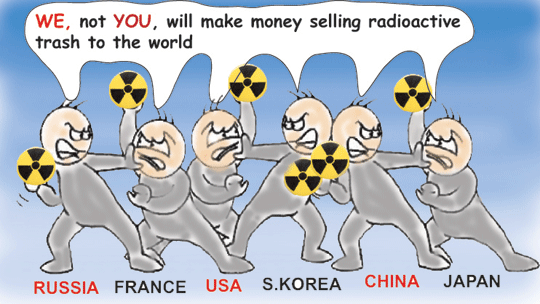
India Wants Second Nuclear Submarine From Russia. Lies By Lobbyists Erupt
Russian news portal Kommersant reported that the Indian Navy allowed a US technical crew into top secret compartments of India’s existing Russian-built nuclear submarine, the INS Chakra NDTV All India by Vishnu Som : November 10, 2017 NEW DELHI:
According to Kommersant, which referred to this as “an unprecedented scandal,” the incident “threatens to seriously complicate the negotiations both on the lease of the second nuclear submarine, and on other projects in the field of military-technical cooperation.”
The Chakra, an Akula-2 class submarine, widely considered among the world’s most sophisticated, has been leased by India for 10 years but all ownership rights reside with Russia.
Today, another Russian news portal, NEWS.ru, has debunked the account of the Kommersant and states that French lobbyists have an ulterior role in spreading misinformation to further their own chances of selling a nuclear-powered attack submarine to India. NEWS.ru quotes a source stating “there is complete confidence that the throw-in is organised by the lobbyists of France, and it’s pretty high quality.” According to this source, “In addition to the contract for the construction of non-nuclear boats such the Scorpene [now being inducted by the Indian Navy,] the French have a great desire to enter the Indian nuclear fleet.”
France, the article states, is also aggressively trying to participate in India’s programme to construct a second home-grown aircraft carrier. The first indigenous carrier, INS Vikrant is being built in Kochi using technology from a host of countries including Russia……..
At the time, the French newspaper Le Monde, quoting multiple sources had said that the leak of this data was driven by competition between the French designer of the Scorpene Class submarine and a German firm as they compete to win international orders. https://www.ndtv.com/india-news/not-true-that-us-officers-allowed-on-russian-submarine-in-vizag-sources-1773761
India -the frontline state in the climate change battle
How India’s battle with climate change could determine all of our fates, Guardian, Damian Carrington and Michael Safi , 6 Nov 17 India’s population and emissions are rising fast, and its ability to tackle poverty without massive fossil fuel use will decide the fate of the planet “It’s a lucky charm,” says Rajesh, pointing to the solar-powered battery in his window that he has smeared with turmeric as a blessing. “It has changed our life.”
He lives in Rajghat, a village on the border of Rajasthan and Madhya Pradesh states, and until very recently was one of the 240 million Indians who live without electricity. In the poverty that results, Rajghat has become a village of bachelors, with just two weddings in 20 years.
“No one wants to give their daughter to me,” says Sudama, another young man. “People come, they visit, but they see the conditions here and they leave.”
For now, the technology is proving most useful to Rajesh as a way to charge his mobile phone, saving a lengthy journey to the nearest city, but he also hopes for future benefits: “I’ll use this to let my children study.”
According to an ambitious pledge by India’s prime minister, Narendra Modi, every Indian will have electricity, and the education, health and business benefits that follow, by the end of 2018. But how Modi achieves that, and the development of what will soon become the world’s most populous nation, matters to the entire world.
“India is the frontline state,” says Samir Saran, at the Observer Research Foundation in Delhi. “Two-thirds of India is yet to be built. So please understand, 16% of mankind is going to seek the American dream. If we can give it to them on a frugal climate budget, we will save the planet. If we don’t, we will either destroy India or destroy the planet.”
This view is shared internationally: Christiana Figueres, the UN’s former climate chief who delivered the landmark Paris climate change agreement says India is “very, very important” for everybody, and the nation will play a key role at the UN summit that starts in Bonn, Germany next week………
There are signs of hope, however, driven by astonishing drops in the price of renewable energy in the last few years. Costs are falling faster than anyone predicted, with new record-low prices set this year for solar and wind. State governments can now pay less for clean energy than they pay for new coal power.
Mathur, who was the Indian delegation’s spokesman at the 2015 Paris climate summit, says that once batteries become powerful enough to store renewable energy for night time or when winds are weak, India’s energy emissions are likely to plateau and then fall. “I personally saw this happening around 2035, but in the past three years, that has shifted to 2025, driven by the news in the solar prices and the sharper than expected fall in the price of batteries.”
India’s government has now forecast that no new coal-fired power stations will need to be built for at least 10 years. By that time, Mathur argues, it will be cheaper to supply new demand using renewable power. “As [existing] coal plants retire they will be replaced by renewables, because that’s what makes economic sense.”……..
The whole world would benefit from a clean, green India and can help make it happen, says Stern, by bringing down the interest rates on the loans used to fund the low carbon transition: “The best thing the world could do is help bring down the cost of capital.” That means long term finance and help to cut project risks.
The path India’s chooses will affect the whole world and, despite the uncertainties and risks, the mood is optimistic, for a variety of reasons. “India has all the institutions of democracy and a very smart entrepreneurial class which will respond, and that gives me optimism,” says Saran……. https://www.theguardian.com/environment/2017/nov/06/how-indias-battle-with-climate-change-could-determine-all-of-our-fates
India’s nuclear industry problems: repeated shutdowns at Kudankulam nuclear power plant
 ‘Maintenance shutdown’ at Kudankulam nuclear plant raises questions among activists http://www.thenewsminute.com/article/maintenance-shutdown-kudankulam-nuclear-plant-raises-questions-among-activists-70950, Unit 2 of the Kudankulam Nuclear Power Plant began operations in March and was shut down after a few weeks. Pheba Mathew
The second reactor was shut down on August 4 due to hydrogen concentration in the stator. It was originally expected to restart generation on September 4. However, the restart date was postponed to October 7, then to November 3 and now to November 15.
SV Jinna, Site Director at Kudankulam Nuclear Power Project (KNPP) has, however, blamed the delay on the overhaul of system.
With the 1000 MW second unit beginning commercial operations in March this year, activists wonder why the nuclear power plant had to be shut down so early on. “It is a very new plant. It has run only for a few weeks and such a plant need to be overhauled,” said G Sundarrajan, coordinator of Poovulagin Nanbargal, an NGO.
India-USA nuclear arrangement just an American marketing effort – “dead at the very beginning”
 India-US nuke deal signed without ground work: Ex-US Senator PTI|Oct 26, 2017, WASHINGTON: The landmark India-US civil nuclear deal was “dead at the very beginning” as it was signed without ground work, a former top Republican Senator has alleged, describing the agreement as more of an “arms deal” for American defence manufacturing companies.
Former Senator Larry Pressler, who has served as chairman of the US Senate’s Arms Control Subcommittee, told a Washington audience that the deal was much-praised “but there is no chance of it being implemented as the liability issues have not been addressed and it has not been worked through.”
He said that the India-US civil nuclear deal “was dead at the very beginning.
Pressler said that there was “no groundwork done” in India or the US on the civil nuclear deal.
The India-US nuclear cooperation agreement was signed in October 2008, ending India’s isolation by the West in the nuclear and space arena. The deal has given a significant boost to India’s nuclear energy production.
Pressler was speaking at an event organised by The Hudson Institute, a top American think-tank, to discuss his latest book ‘Neighbours in Arms: An American Senator s Quest for Disarmament in a Nuclear Subcontinent’.
“…There was nothing to it really. If you look into it, it is more of an arms sale agreement,” he alleged.
Pressler claimed the then US president Barack Obama’s visit to New Delhi was “largely an arms sale trip”.
“The then president Obama’s last trip to India was an arms sales trip and the poor people of India have to pay for all of these new arms that their country is buying from the US. This is really one of us but it’s a new friendship we’re told. But we have to be very careful. I’m somewhat critical that India has accepted that on those terms,” the former American Senator said. …….https://economictimes.indiatimes.com/news/politics-and-nation/india-us-nuke-deal-signed-without-ground-work-ex-us-senator/articleshow/61236998.cms
1 This Month
To see nuclear-related stories in greater depth and intensity – go to https://nuclearinformation.wordpress.com/
12 February – Webinar The Big Push: New Nuclear Projects in Canada
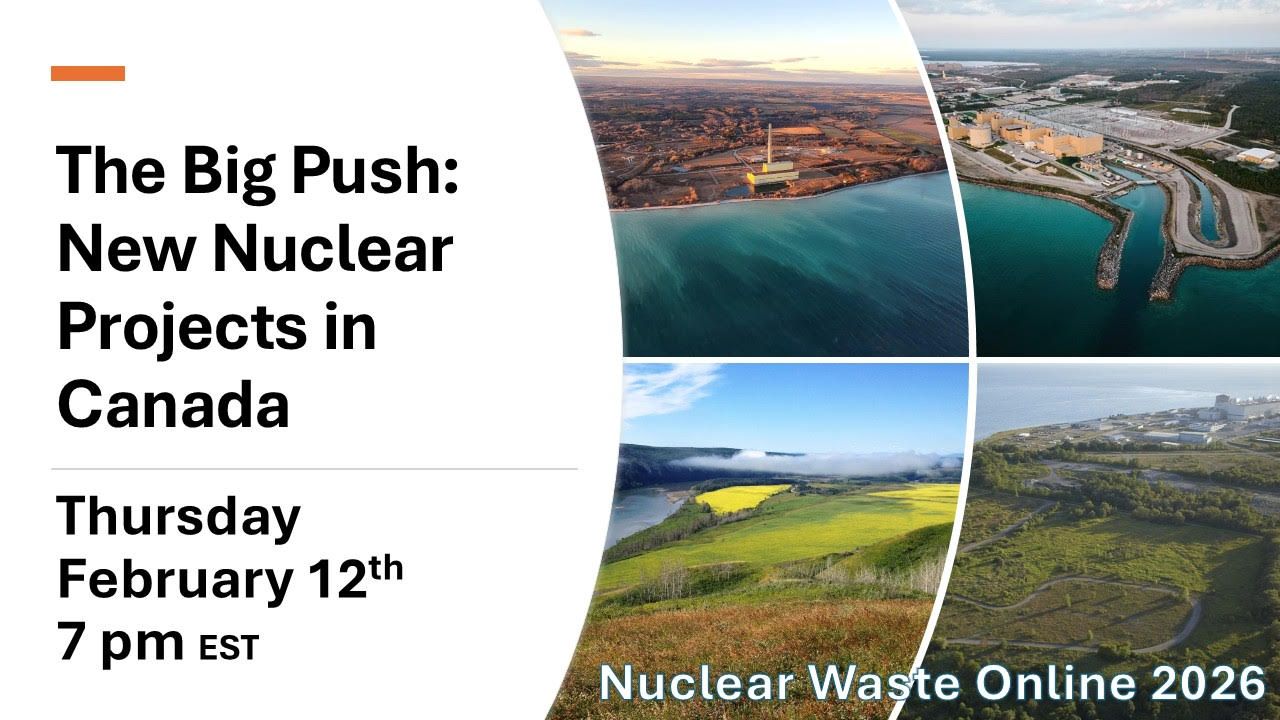
Thursday, February 12, 7 pm Eastern | 2nd of 4 sessions in the 2026 Nuclear Waste Online webinar series
Join a webinar on the push for new nuclear generation in Canada. Go to Northwatch.org to register or use the registration link https://us02web.zoom.us/webinar/register/WN_ZfWOf1GITqSRIZX8CB-A9w
-
Archives
- February 2026 (127)
- January 2026 (308)
- December 2025 (358)
- November 2025 (359)
- October 2025 (376)
- September 2025 (258)
- August 2025 (319)
- July 2025 (230)
- June 2025 (348)
- May 2025 (261)
- April 2025 (305)
- March 2025 (319)
-
Categories
- 1
- 1 NUCLEAR ISSUES
- business and costs
- climate change
- culture and arts
- ENERGY
- environment
- health
- history
- indigenous issues
- Legal
- marketing of nuclear
- media
- opposition to nuclear
- PERSONAL STORIES
- politics
- politics international
- Religion and ethics
- safety
- secrets,lies and civil liberties
- spinbuster
- technology
- Uranium
- wastes
- weapons and war
- Women
- 2 WORLD
- ACTION
- AFRICA
- Atrocities
- AUSTRALIA
- Christina's notes
- Christina's themes
- culture and arts
- Events
- Fuk 2022
- Fuk 2023
- Fukushima 2017
- Fukushima 2018
- fukushima 2019
- Fukushima 2020
- Fukushima 2021
- general
- global warming
- Humour (God we need it)
- Nuclear
- RARE EARTHS
- Reference
- resources – print
- Resources -audiovicual
- Weekly Newsletter
- World
- World Nuclear
- YouTube
-
RSS
Entries RSS
Comments RSS
 nuclear-news