India’s nuclear submarines
ANGLES AND DANGLES: ARIHANT AND THE DILEMMA OF INDIA’S UNDERSEA NUCLEAR WEAPONS, YOGESH JOSHI, War on the Rocks,
JANUARY 14, 2019, SPECIAL SERIES – SOUTHERN (DIS)COMFORT Editor’s Note: This is the 24th installment of “Southern (Dis)Comfort,” a series from War on the Rocks and the Stimson Center. The series seeks to unpack the dynamics of intensifying competition — military, economic, diplomatic — in Southern Asia, principally between China, India, Pakistan, and the United States. Catch up on the rest of the series.
After INS Arihant, India’s first ballistic missile submarine (SSBN), finished its maiden deterrent patrol in November 2018, Prime Minister Narendra Modi emphatically declared India’s nuclear triad complete. Arihant’s operationalization has catapulted India into a select group of states with an underwater nuclear launch capability. It has also raised alarm over the safety and security of India’s nuclear arsenal because a sea-based deterrent may entail a ready-to-use arsenal and less restrictive command and control procedures, increasing probability of their accidental use. For Pakistan, India’s nuclear force modernization endangers the balance of strategic forces in the region and could intensify the nuclear arms race on the subcontinent……….
Arihant’s operationalization is an opportunity for New Delhi to reflect upon its nuclear trajectory. With China and Pakistan as nuclear adversaries, India confronts a unique challenge. It has to build up its nuclear capability enough to ensure that Chinese decision-makers fear it, without sending Islamabad into panic and undermining regional stability. This “Goldilocks dilemma” will be difficult to resolve, and India should not leave it to chance — especially as the United States, once South Asia’s chief crisis manager, loses both interest and influence in the region. India should reassure Pakistan by reaffirming its policy of no first use of nuclear weapons and a retaliation-only nuclear doctrine. More importantly, India should rethink its deterrence requirements vis-à-vis China.
Ultimately, the risk is that India will fail to achieve its aim of deterring China while unintentionally provoking its smaller rival……………..
To increase stability, India should publicly reaffirm its policy of no first use and adopt a retaliation-only nuclear posture, particularly since prominent voices in India’s strategic community have questioned these principles in the recent past. It should clarify that it has no intentions to use its nuclear forces in a preemptive mode. One Strategic Forces Command official told me that Arihant will only be used for countervalue strikes — that is, retaliatory strikes against Pakistani cities. Such declarations ought to be made at the highest levels of the Indian government. Arihant’s job — and, for that matter, the job of India’s entire nuclear arsenal — is to not create “fearlessness” in the Indian mind, as Modi’s office claimed. Rather, it is to ensure that India’s nuclear adversaries fear the consequences of their actions. A nuclear dialogue with Pakistan should therefore be reopened and shielded from the vagaries of domestic politics.
The nuclear competition between China, India, and Pakistan is a classic case of a triangular security dilemma. As India pursues deterrence stability vis-à-vis one adversary, it makes another adversary feel increasingly vulnerable……..
Yogesh Joshi is a Stanton Nuclear Security Postdoctoral Fellow at the Center for International Security and Cooperation, Stanford University. He is the coauthor of India and Nuclear Asia: Forces, Doctrine and Dangers (Georgetown University Press, 2018). https://warontherocks.com/2019/01/angles-and-dangles-arihant-and-the-dilemma-of-indias-undersea-nuclear-weapons/
Uranium mining brings disease, deaths, deformities to Jharkhand, India
Cancers, Abortions, Deformed Children are the High Cost of ‘Clean’ Nuclear Energy in Jharkhand https://www.thecitizen.in/index.php/en/NewsDetail/index/9/15948/Cancers-Abortions-Deformed-Children-are-the-High-Cost-of-Clean-Nuclear-Energy-in-Jharkhand – AMLAN HOME CHOWDHURY | 6 JANUARY, 2019
By 2050 the government intends to meet 25% of its electricity needs from nuclear power JADUGUDA, JHARKHAND: Nestled in the mountainous district of East Singhbhum, this tiny dot on India’s vast map has become a virtual cancer ward for its residents, following years of dangerous radiation being emitted from uranium mines and tailing ponds in the area.
Jaduguda (or Jadugora) made its tryst with the hazardous byproducts of ‘clean’ nuclear power just 20 years after independence, when the country launched its nuclear programme.
Meeting 25 percent of India’s uranium needs, the town is in the news again as the Uranium Corporation of India Limited (UCIL) recently announced that it would soon resume its excavation operations here, following the renewal of its land lease for another 50 years.
Will Jaduguda’s residents still be able to live there 50 years from now?
As part of its indigenous nuclear power programme, India aims to generate 14.6 GWe (gigawatts electrical) of power through nuclear reactors in the next seven years – and 63 GWe by 2032.
By 2050 the Indian government intends to meet 25% of its electricity needs from uranium-based nuclear power, as against 5% at present.
This ambition, however, may annihilate a large number of Adivasi citizens resident in Jaduguda – from the Ho, Birhore, Santhal, Kora, Beiga, Munda, Malpahari and Mahali communities – who already are paying very dearly for uranium mining.
Due to the dangerous fallout of radiation, they are suffering from a plethora of clinical problems which were unheard of in the area before the public sector UCIL began excavating uranium ores in 1967.
People in the area suffer disproportionately from congenital deformities, sterility, spontaneous abortions, cancers and a plethora of other serious diseases known to be caused by radiation and industrial pollution.
Despite the low risk and damage done by wind and solar renewable energy generation, large, destructive hydel projects and nuclear reactors with highly toxic byproducts continue to be a part of India’s energy generation plans – not to mention the use of fossil fuels which continues unabated.
Jaduguda’s residents inhale toxic air. They drink poisoned water. They consume vegetables and cereals laced with radioactive iodine. They are exposed to radiation 24×7.
As you enter the hamlets located around UCIL’s mines and tailing ponds, where radioactive elements are dumped, the gory sight of deformed children playing innocently with their homemade toys meets your eyes.
The culprit is uranium, the highly radioactive mineral used in making nuclear warheads and for generating electricity.
Uranium is a sleeping monster. An estimated 99.28% of mined uranium ore is effectively waste – referred as tailings. These wastes are very highly radioactive with a centuries’ long half life.
In India the process of neutralising the toxicity of tailings is still done in a rudimentary manner, with simple lime, with the wastes carried through pipes to tailing ponds.
Radioactive elements also leak out of the tailing ponds and enter the earth and water during floods, affecting people, livestock, rivers, forests and agricultural produce in and around Jaduguda.
Yellowcake or urania, processed from uranium, is the lifeblood of any nuclear programme. Jaduguda uranium ore can be enriched to 0.065-grade, making it highly valuable for nuclear power generation. The yellowcake produced Jaduguda is sent to nine nuclear reactors in India.
To obtain about 65 grams of usable uranium, UCIL needs to mine, grind and process 1000 tonnes of uranium ore. The waste is thrown into the tailing ponds.
As mentioned these tailings undergo radioactive decay to produce other radioactive substances, such as radium-226 which in turn produces radon-222 gas, a highly toxic cancer-causing gas, which emits high-energy alpha and gamma particles that can shred genetic material in our cells, leading to cancer and other illnesses.
For instance, radon-222 gas damages the air passages in our lungs. It remains radioactive for 1,600 years.
The ores go through several process of purification. At each and every process, the ores emit radiation and other carcinogens.
Since the mining is carried out at depths as great as 880 metres, the miners also endanger their lives.
As long as uranium remains buried deep inside the earth, it does not pose any danger to living beings. But the moment it is brought out to the surface of the earth and ground, levels of radioactivity become hazardous in the ways described above.
Inside the Cancer Ward
According to an official estimate by the Union Ministry of Social Justice and Empowerment, nearly 3 percent of Indians suffer from physical disabilities, with congenital deformity being one of them.
In Jaduguda the rate is 50 percent higher, at 4.49 percent.
Cases of impotency, frequent abortions, infant mortality, Down’s syndrome, cancers, thalassemia and other serious diseases have made Jaduguda their home.
Some 9,000 people here – almost a quarter of the population – are suffering from congenital deformities, leukemia, and various forms of cancer. Cancer deaths are commonplace here, and do not surprise locals at all now.
India has 140 Nuclear Warheads – And More Are Coming
Should we worry? National Interest ndia has 130 to 140 nuclear warheads—and more are coming, according to a new report.“India is estimated to have produced enough military plutonium for 150 to 200 nuclear warheads, but has likely produced only 130 to 140,” according to Hans Kristensen and Matt Korda of the Nuclear Information Project at the Federation of American Scientists. “Nonetheless, additional plutonium will be required to produce warheads for missiles now under development, and India is reportedly building several new plutonium production facilities.”
In addition, “India continues to modernize its nuclear arsenal, with at least five new weapon systems now under development to complement or replace existing nuclear-capable aircraft, land-based delivery systems, and sea-based systems.”…….https://nationalinterest.org/blog/buzz/india-has-140-nuclear-warheads-%E2%80%93-and-more-are-coming-38612
Political connections in Holtec’s plans for boosting nuclear power in India
Holtec’s Singh plans to build $680 million factory to boost nuclear power in India, The Inquirer, by Joseph N. DiStefano, On a flower-decked table in Mumbai, India, last week, a Holtec International delegation led by Krishna P. Singh, the India native and triple-degree Penn grad, joined with a group headed by Chief Minister Devendra Fadnavis, of Maharashtra, India’s second-most populous state, to sign a memo of understanding allowing Holtec to build a factory the company says will “give India autonomous capability” to make systems and parts for “the country’s planned expansion of nuclear generation.”……….
Prime Minister Modi’s doublespeak on India’s first nuclear submarine
Nuclear submarine Arihant completes first deterrence patrol mission
The success of INS Arihant gives a fitting response to those who indulge in nuclear blackmail, says Prime Minister Narendra Modi
Live Mint, Nov 05 2018. New Delhi: Prime Minister Narendra Modi on Monday said that India’s first nuclear armed submarine INS Arihant had successfully completed its first deterrence patrol, heralding India’s entry into an exclusive club of powers with land, air and sea-based nuclear weapons delivery platforms………
Community in Madhya Pradesh protest against proposed nuclear plant
 Activists, villagers raise concern over proposed nuclear plant in MP https://www.business-standard.com/article/pti-stories/activists-villagers-raise-concern-over-proposed-nuclear-plant-in-mp-118091801368_1.html
Press Trust of India | New Delhi September 18, 2018 Activists and villagers raised their concerns over a proposed nuclear power plant in Chutka in Madhya Pradesh on Tuesday, saying it would destroy nature and take away their homeland.
In 2009, Nuclear Power Corporation of India Ltd. (NPCIL) has decided to set up the atomic station in Mandla district of Madhya Pradesh to generate 1,400 MW power.
The villagers claimed they have been protesting for the past nine years over the atomic power plant and when they did not relent, compensation was put into their accounts forcefully. “MPPGCL forcefully put the compensation amount in our bank accounts and took our Aadhaar copies from the bank. We have written to the bank to remove their money,” said Meera Bai, a resident of Chutka.
Another resident, Dadu Lal Kudape, said they visited other villages where nuclear plants would be coming up and they found contaminated water and polluted environment.
“We do not want the same things to happen to us,” he said.
Padmini Ghosh, Women’s Regional Network India Coordinator, said if European countries are dismantling nuclear power plants, India is building them. “We need to review nuclear policy and install renewable energy plants,” Ghosh said.
Raj Kumar Sinha, activist working with the villagers, said they are being exploited and no amount of money could compensate for their land.
“These people are nature lovers. They can’t be bought with money,” he said.
The Women’s Regional Network said a total of 17,000 people would be displaced if the plant comes up.
 |
ReplyForward
|
India’s hopes to become a nuclear export hub
 India Can Export Nuclear Power Plants, Economic Times, September 7, 2018
But Westinghouse has had billions of dollars of cost overruns in its nuclear reactors in the US, and stands to gain from joining hands with Nuclear Power Corporation of India (NPCIL) to better manage its project implementation.
The fact is that NPCIL has been able to streamline project implementation with standardised designs and equipment, and is implementing at least 10 new pressurised heavy water reactors (PHWRs) nationally.
In sharp contrast, the US, which is building nuclear plants after a long hiatus, seems to have rather rusty expertise when it comes to construction of nuclear power plants.
There is much potential for export of India’s indigenous PHWRs, and the Joint Statement rightly calls for India’s “immediate accession” to the Nuclear Suppliers Group. …….https://blogs.economictimes.indiatimes.com/et-editorials/india-can-export-nuclear-power-plants/
How India & Pakistan Deal With The Bomb -“Brokering Peace in Nuclear Environments “
Diplomacy In The Nuclear Age, Kashmir Observer, HAIDER NIZAMANI • Aug 28, 2018, How India & Pakistan Deal With The Bomb
India and Pakistan ‘gatecrashed’ the nuclear club in May 1998. Children who were born right after the nuclear tests, carried out by the two countries in that year, are now able to vote — a generation, particularly in Pakistan, that has grown up on a steady diet of nuclear nationalism that portrays weapons of mass destruction as guarantors of national security and sources of collective pride. In times when the country can showcase little by way of achievements, we always console ourselves by saying that we have nuclear weapons.
Nuclear weapons and their delivery systems are made by experts trained in science and engineering but there is also another ‘nuclear expert’ whose bread and butter is linked to writing about these. There was only a small group of such experts two decades ago but nuclear tests by India and Pakistan have opened up many new spots for them. They are camped mainly in think tanks in New Delhi, Islamabad and Washington DC.
An overwhelming majority of them use the lens of political realism that sees states as key actors who pursue their national interests in competition with each other. Moeed Yusuf also belongs to this tribe of nuclear experts. He defines the crises explored in his book as “exercises in coercion through adversaries seek to enhance their relative bargaining strength vis-à-vis their opponents”………..
limitations of Yusuf’s book Brokering Peace in Nuclear Environments are, in fact, the limitation of realist theory that focuses on state actors and their actions and does not delve into the social, economic, political and strategic factors that cause those actions and determine their direction and outcome. Additionally, many Indian and Pakistan security experts consciously or unwittingly end up echoing official versions as the true versions of history. In many parts, Brokering Peace in Nuclear Environments also follows the same path which makes its analysisa bit lopsided and its prescriptions a little too Pakistan-centric.
Its strength, however, is the large number of interviews that Yusuf has conducted with policymakers, especially from the United States and Pakistan, who played key roles during the three crises mentioned above. For this reason alone, if for nothing else, his book should be seen as a good addition to the academic literature available on war and peace between India and Pakistan. https://kashmirobserver.net/2018/feature/diplomacy-nuclear-age-35464
Missile defense systems bad for India-Pakistan nuclear détente
Asia Times, By MOHAN GURUSWAMY AUGUST 24, 2018 It has been reported that theDefense Acquisitions Council (DAC), chaired by Indian Defense Minister Nirmala Sitharaman, has approved the “acceptance of necessity” (AoN) for the acquisition of the National Advanced Surface to Air Missile System-II (NASAMS-II) worth around US$1 billion from the United States. However, in 2002 the US had vetoed India’s bid to acquire the Israeli Arrow-2 missile interceptor system.
Consequently, India’s Defense Research and Development Organization began developing the Prithvi Air Defense (PAD), which will provide long-range high-altitude interception during an incoming ballistic missile’s mid-course phase as well as interception during the terminal phase. At various times these systems had different monikers, such as ballistic missile defense (BMD) or anti-ballistic missile system (ABM).The people who decide on such things reside in New Delhi and understandably their safety gets priority. So it is the National Capital Region that will get the expensive and exaggerated sense of protection such systems tend to generate.But no air defense system can be deemed impenetrable. The Americans and Russians realized long before the Cold War ended that the costs involved were prohibitive, even for them. But the idea was seductive
……….We need to learn from how nuclear-weapons strategies evolved during the Cold War, instead of mimicking US and Soviet follies. The notion of deterrence between the US and USSR was based on no escape from MAD.
Cold War follies peaked with the two antagonists together deploying almost 70,000 warheads each aimed at a specific target. At the height of this madness almost every open ground was targeted as possible tank-marshaling or military-logistics areas.
Hence the last thing India wants is to get into a numbers game with Pakistan or China. Credibility depends on reducing the uncertainty of use from the opposite perspective. The Indian PAD missile defense system only increases them.
India and Pakistan have ensured a modicum of confidence by not mating the warheads and delivery systems, giving a vital period to roll back the unleashing of Armageddon. But now both countries will have to evolve a launch-on-warning doctrine.
Clearly, the two South Asian nuclear powers have a local version of MAD in place. The Pakistani doctrine “commits itself” to use battlefield nuclear weapons if an Indian conventional assault threatens its essential nationhood, and hence it has steadfastly refused to accept the notion of “no first use” (NFU). The Indian doctrine emphasizes NFU but also makes it explicit that any Pakistani use of nuclear weapons on India or its forces will be responded to with a massive retaliation.
India may have fewer nuclear weapons, not because it cannot make more, but because what it has is enough to ensure the complete annihilation of Pakistan, which is geographically a much smaller country.
For its part, China has moved on from NFU to a doctrine now called “credible minimum deterrence.” But how much is credible?
Mercifully, nuclear doctrines these days are couched in such abstractions since MAD requires a degree of predictability, ironically ensured by opacity. The United States’ “single integrated operational plan” (SIOP) began with the ominous words that its objective, after the outbreak of a general war with the then Soviet Union, was to turn it into a “smoking, radiating ruin.” This was written by its certifiable US Air Force chief, General Curtis Lemay Jr, based on whom the character played by George C Scott in the Stanley Kubrick classic Dr Strangelove was created.
But it was people like Lemay who gave MAD credibility. Since no one of a sane frame of mind would even contemplate the enormity of the disaster of a nuclear war, uncertainty of use was a key element of MAD. It has been written that Soviet leader Leonid Brezhnev used to have sleepless nights thinking of a man like Richard Nixon with his finger on the button.
India’s nuclear strategy documents in detail who the nuclear command would devolve to in the unlikely event of a decapitating first strike on New Delhi with the aim of eliminating its national leadership. It is said that the chain of nuclear command keeps descending to a major-general, a modern-day Raja Parikshit so to say, who will perform the final obsequies.
At last count India had more than 600 military officers at that level. Decapitating all of them is a near statistical and physical impossibility. It would take tens of thousands to precision nuclear weapons to annihilate India’s military chain of command, and it can be speculated whether even America or Russia could achieve that, let alone Pakistan.
Ironically, the evocative acronym MAD is an eminently sensible doctrine. Good sense should tell us: Enough of this madness, and leave MAD alone. http://www.atimes.com/missile-defense-systems-bad-for-india-pakistan-nuclear-detente/
Unbearable heat in India becoming a major threat to health
 In India, summer heat could soon be unbearable — literally
An analysis of South Asia’s biggest cities found that if current warming trends continued, wet bulb temperatures — a measure of heat and humidity indicating when the body can no longer cool itself — will become so high people directly exposed for six hours or more would die.
Somini Sengupta-Seattle Times, July 18, 2018 The New York Times
NEW DELHI — On a sweltering Wednesday in June, a rail-thin woman named Rehmati gripped the doctor’s table with both hands. She could hardly hold herself upright, the pain in her stomach was so intense.
She had traveled for 26 hours in a hot oven of a bus to visit her husband, a migrant worker here in the Indian capital. By the time she got here, the city was an oven, too: 111 degrees by lunchtime, and Rehmati was in an emergency room.
The doctor, Reena Yadav, did not know exactly what had made Rehmati sick, but it was clearly linked to the heat. Yadav suspected dehydration, possibly aggravated by fasting during Ramadan. Or it could have been food poisoning, common in summer because food spoils quickly.
Yadav put Rehmati, who is 31 and goes by one name, on a drip. She held her hand and told her she would be fine. Rehmati leaned over and retched.
Extreme heat can kill, as it did by the dozens in Pakistan in May. But as many of South Asia’s already-scorching cities get even hotter, scientists and economists are warning of a quieter, more far-reaching danger: Extreme heat is devastating the health and livelihoods of tens of millions more.
If global greenhouse-gas emissions continue at their current pace, they say, heat and humidity levels could become unbearable, especially for the poor.
It is already making them poorer and sicker.
…….Indeed, a recent analysis of climate trends in several of South Asia’s biggest cities found that if current warming trends continue, by the end of the century, wet bulb temperatures — a measure of heat and humidity that can indicate the point when the body can no longer cool itself — would be so high that people directly exposed for six hours or more would not survive.
In many places, heat only magnifies the more thorny urban problems, including a shortage of basic services, like electricity and water.
…The science is unequivocally worrying. Across the region, a recent World Bank report concluded, rising temperatures could diminish the living standards of 800 million people.
Worldwide, among the 100 most populous cities where summer highs are expected to reach at least 95 degrees Fahrenheit by 2050, according to estimates by the Urban Climate Change Research Network, 24 are in India.
………Delhi’s heat index, a metric that takes average temperatures and relative humidity into account, has risen sharply — by 0.6 degrees Celsius in summer and 0.55 degrees during monsoons per decade between 1951 and 2010, according to one analysis based on data from 283 weather stations across the country.
Some cities are getting hotter at different times of year. The average March-to-May summertime heat index for Hyderabad had risen by 0.69 degrees per decade between 1951 and 2010. In Kolkata, a delta city in the east, where summers are sticky and hot anyway, the monsoon is becoming particularly harsh: The city’s June-September heat index climbed by 0.26 degrees Celsius per decade.
Joyashree Roy, an economist at Jadavpur University in Kolkata, found that already, most days in the summer are too hot and humid to be doing heavy physical labor without protection, with wet-bulb temperatures far exceeding the thresholds of most international occupational health standards. of most international occupational health standards……… https://www.seattletimes.com/nation-world/in-india-summer-heat-could-soon-be-unbearable-literally/
India – the global nuclear weapons threat that is being ignored
 A global nuclear threat, The News CN, , 27 June 18, India’s nuclear weapons now pose a potential threat to the world. The Agni-V, India’s longest-range intercontinental ballistic missile (ICBM), can travel 6,000 kilometres.
Keep in mind that the Agni-V ICBM is capable of carrying a nuclear warhead to almost anywhere in Asia and to parts of Europe and Africa. Because it can be fired from a mobile launcher, essentially a canister mounted on a truck, instead of a hard concrete launch-pad, it gives the Indian armed forces operational flexibility. They now have the ability to launch the missile against any adversary, almost guaranteeing to take them by surprise by offering a shorter period of time to react. But the Agni-V is not the real danger and is only being seen as a stepping stone towards completing the Agni-VI ICBM, which is rumoured to be in its final phase of development.
The Agni-VI can potentially travel 12,000 kilometres or more, and is supposed to have MIRV capability – the ability to carry several independent nuclear warheads – and a manoeuvrable re-entry vehicle (MaRV) capability, the warhead of which is capable of autonomously tracking ground targets. Because of these capabilities, this missile will be unstoppable by the current anti-missile defence systems. Once completed, the Agni-VI will put the whole world within the range of India’s nuclear warheads.
India has taken advantage of the fact that the world has been distracted by North Korea’s nuclear capabilities and the threat they pose that they have entirely ignored the growing threat of India’s nuclear capabilities, its global ambitions, and its threat to international and regional security.
……….By investing on building up its nuclear and conventional forces, PM Modi hopes to project his country as a global power, standing shoulder to shoulder with the likes of the US and China. But, in fact, India is causing a massive headache for the South Asian region by threatening to destabilise the fragile strategic balance with its actions. If India’s ambitions are not kept in check, its growing capabilities are guaranteed to turn into a global threat. Instead of trying to impress the international community by investing so heavily on its defences (and causing havoc), PM Modi should perhaps first invest in his people, which include the more than 330 million Indians living in poverty – nearly a quarter of the country’s total population.There has been very little outcry in the West, particularly in the US, because American presidents in the past have turned a blind eye towards India’s dangerous global nuclear ambitions, hoping to create a new strategic partner capable of taking on China. This has provided India with a situation that it has taken, and continues to take, advantage of by growing its military’s conventional and nuclear capabilities………https://www.thenews.com.pk/print/334105-a-global-nuclear-threat
Thanks, Muhammad Umar, for this insightful article. But that last paragraph? Have you forgotten who President Trump is? He is a ruthless and not terribly intelligent salesman and attention-seeker. His over-riding aim would be to SELL NUCLEAR TECHNOLOGY to India – quite the opposite of “curbing the country’s massive and extremely dangerous military nuclear weapons programme”
India’s space dream – to develop nuclear fuel from helium on the moon
India’s quest to find a trillion-dollar zero-waste nuclear fuel on the moon, Financial Review by Anurag Kotoky, 28 June 18
India‘s space program wants to go where no nation has gone before – to the south side of the moon. And once it gets there, it will study the potential for mining a source of waste-free nuclear energy that could be worth trillions of dollars.
The nation’s equivalent of NASA will launch a rover in October to explore virgin territory on the lunar surface and analyse crust samples for signs of water and helium-3. That isotope is limited on Earth yet so abundant on the moon that it theoretically could meet global energy demands for 250 years if harnessed……..
The mission would solidify India’s place among the fleet of explorers racing to the moon, Mars and beyond for scientific, commercial or military gains. The governments of the US, China, India, Japan and Russia are competing with start-ups and billionaires Elon Musk, Jeff Bezos and Richard Branson to launch satellites, robotic landers, astronauts and tourists into the cosmos. ……..
In the US, President Donald Trump signed a directive calling for astronauts to return to the moon, and NASA’s proposed $US19 billion ($26 billion) budget this fiscal year calls for launching a lunar orbiter by the early 2020s. …….
A primary objective, though, is to search for deposits of helium-3. Solar winds have bombarded the moon with immense quantities of helium-3 because it’s not protected by a magnetic field like Earth is. ……. “It is thought that this isotope could provide safer nuclear energy in a fusion reactor, since it is not radioactive and would not produce dangerous waste products,” the European Space Agency said.
…….. there are numerous obstacles to overcome before the material can be used – including the logistics of collection and delivery back to Earth and building fusion power plants to convert the material into energy. Those costs would be stratospheric…….https://www.afr.com/news/world/asia/indias-quest-to-find-a-trilliondollar-zerowaste-nuclear-fuel-on-the-moon-20180627-h11ykr
USA’s General Electric and France’s EDF getting together to market to India huge and costly nuclear station

France’s EDF, GE to co-build reactors for huge Indian nuclear plant, Reuters Staff, NEW DELHI (Reuters) 28 June 18- GE and French utility EDF have agreed to team to build six reactors for a nuclear power project in western India, which is due to be the world’s biggest when finished……… The six European Pressurised Water reactors will be for a 9,900 mw nuclear power project at Jaitapur, south of Mumbai in the state of Maharashtra, GE and EDF said in a joint statement released on Tuesday…….
EDF will be responsible for engineering integration of the entire project, while GE Power will design the critical part of the plant and supply its main components, the companies said.
GE will also provide operational support services and a training programme to meet the needs of the state-run Nuclear Power Corp. of India Ltd, the plant’s owner and operator.
Reporting by Nidhi Verma; Editing by Alexander Smith https://www.reuters.com/article/us-india-nuclear-ge/frances-edf-ge-to-co-build-reactors-for-huge-indian-nuclear-plant-idUSKBN1JM1J8
Adivasis (indigenous people) in a remote area of India, suffer health effects from the nuclear industry?
News Click 21st June 2018 , Sanjay Gope, a 13-year-old boy from Bango village near Jadugora town in
East Singhbhum district of Jharkhand, cannot move or speak because he has
been suffering from muscular dystrophy – a group of disorders that
involves a progressive loss of muscle mass and consequent loss of strength
– for the past nine years. At least one person of his family has to be
with him all the time to look after him. He cannot be left unattended.
Eighteen-year-old Parvati Gope from the same village is suffering from
lumbar scoliosis – a C-shpaed curve formation of her vertebral column.
Rakesh Gope, a 13-year-old school-going boy, is also suffering from
muscular dystrophy. Although he is active and walks with arched feet and
soles, he is unable to speak normally.
A three-year-old child Kartik Gope has been having seizures since birth and is developing muscular dystrophy
too. These examples are not enough; there are hundreds of such cases of
congenital illness and other birth defects in addition to high incidence of
infertility, miscarriages and pre-mature deliveries.
Now, a pertinent question arises here: why are such large number of health hazards being
reported from this remote and overlooked corner of the country? While India
is dreaming to become energy efficient by 2032 by generating 63 Gigawatts
of nuclear power, it is taking a major toll on human lives in a small
township of Jharkhand. Jadugora has the deposits of world’s best quality
uranium ore, magnesium diuranate. It is because of the rich deposits of the
region, India is capitalising its nuclear dreams. The whole belt of the
reactors is affecting the Adivasis (indigenous people) disproportionately
in and around the uranium mining operational area.
https://newsclick.in/uranium-mining-jharkhand-radioactive-poisoning-ravaging-lives-villages
India and Pakistan have increased their stockpiles of nuclear weapons
India, Pakistan expanding their new nuclear weapons stockpiles: SIPRI https://www.moneycontrol.com/news/india/india-pakistan-expanding-their-new-nuclear-weapons-stockpiles-sipri-2605161.html There are nine countries which have nuclear warheads. They include Russia, the US, the UK, France, China, Israel, India, Pakistan and North Korea, Moneycontrol News@moneycontrolcom , 19 June 18
The Stockholm International Peace Research Institute in its 2018 edition of the yearly report on the current state of armaments, disarmament and international security said despite the overall decrease in global nuclear weapons year-on-year, India and Pakistan have increased their stockpiles.
India, which had an estimated 120-130 nuclear warheads as per 2017 report, now has 130-140 warheads. Similarly, Pakistan, which had 130-140 warheads now has increased to 140-150 warheads. Both countries are also developing new land, sea and air-based missile delivery systems.
Another nuclear country in Asia, China continues to modernise its nuclear weapon delivery systems and is slowly increasing the size of its nuclear arsenal. The country now has an estimated 280 nuclear warheads. In 2017 report, the number was 270.
The US and Russia still constitute a major share of approximately 14,465 nuclear weapons that exist in the world. Both together account for nearly 92 percent of all nuclear weapons despite reducing their strategic nuclear forces pursuant to the implementation of the 2010 Treaty on Measures for the Further Reduction and Limitation of Strategic Offensive Arms.
Moreover, the cold war-era rivals also have long-term programmes underway to replace and modernise their nuclear warheads, missile and aircraft delivery systems, and nuclear weapon production facilities.
“The renewed focus on the strategic importance of nuclear deterrence and capacity is a very worrying trend,” says Ambassador Jan Eliasson, Chair of the SIPRI Governing Board.
“The world needs a clear commitment from the nuclear weapon states to an effective, legally binding process towards nuclear disarmament.”
Other countries which are a nuclear state include the UK (215 warheads), France (300 warheads), Israel (80 warheads) and North Korea (10-20 warheads). The figures for North Korea are uncertain, the report said, however, there was no doubt that it has nuclear weapons.
In 2017, North Korea has made technical progress in developing its nuclear weapon capabilities, including the test of—what was claimed to be—a thermonuclear weapon, in September. North Korea also demonstrated unexpected rapid progress in the testing of two new types of long-range ballistic missile delivery systems. These testing led to a crisis in the Korean peninsula.
However, in a meeting with US president Donald Trump, North Korean supreme leader Kim Jong-un vowed to work towards the complete denuclearisation of the Koran peninsula.
1 This Month
To see nuclear-related stories in greater depth and intensity – go to https://nuclearinformation.wordpress.com/
12 February – Webinar The Big Push: New Nuclear Projects in Canada
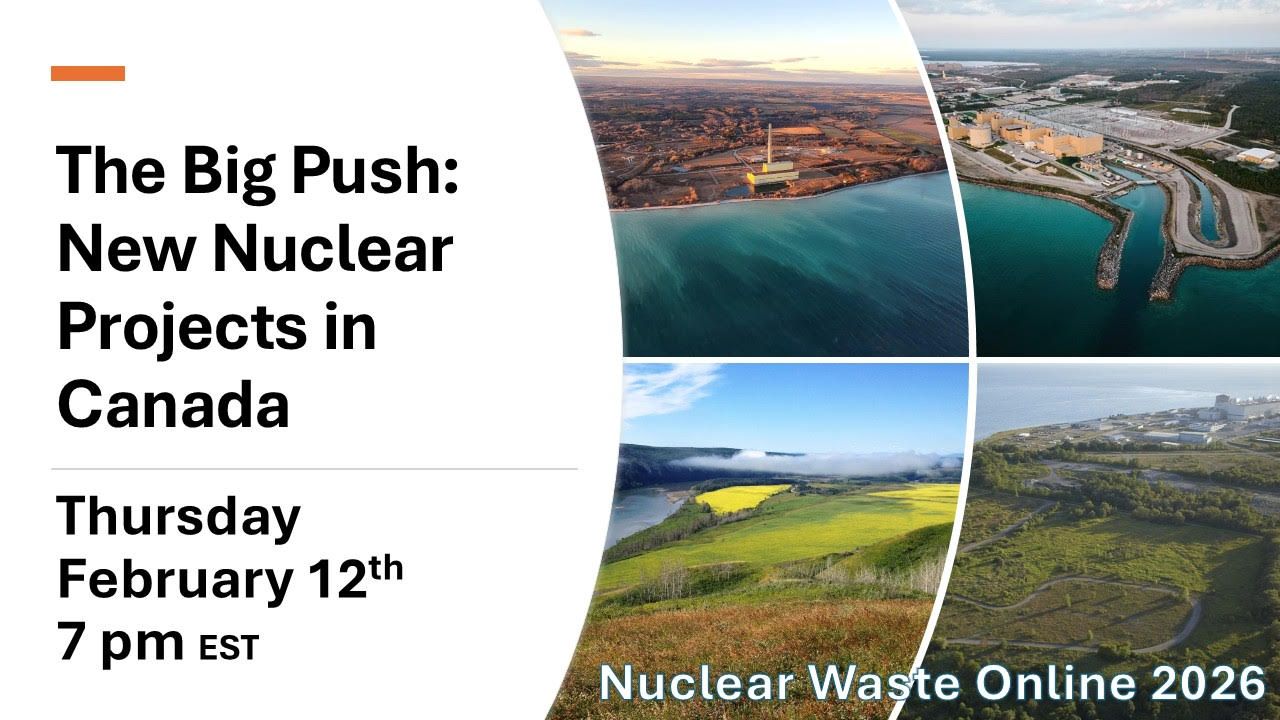
Thursday, February 12, 7 pm Eastern | 2nd of 4 sessions in the 2026 Nuclear Waste Online webinar series
Join a webinar on the push for new nuclear generation in Canada. Go to Northwatch.org to register or use the registration link https://us02web.zoom.us/webinar/register/WN_ZfWOf1GITqSRIZX8CB-A9w
-
Archives
- February 2026 (127)
- January 2026 (308)
- December 2025 (358)
- November 2025 (359)
- October 2025 (376)
- September 2025 (258)
- August 2025 (319)
- July 2025 (230)
- June 2025 (348)
- May 2025 (261)
- April 2025 (305)
- March 2025 (319)
-
Categories
- 1
- 1 NUCLEAR ISSUES
- business and costs
- climate change
- culture and arts
- ENERGY
- environment
- health
- history
- indigenous issues
- Legal
- marketing of nuclear
- media
- opposition to nuclear
- PERSONAL STORIES
- politics
- politics international
- Religion and ethics
- safety
- secrets,lies and civil liberties
- spinbuster
- technology
- Uranium
- wastes
- weapons and war
- Women
- 2 WORLD
- ACTION
- AFRICA
- Atrocities
- AUSTRALIA
- Christina's notes
- Christina's themes
- culture and arts
- Events
- Fuk 2022
- Fuk 2023
- Fukushima 2017
- Fukushima 2018
- fukushima 2019
- Fukushima 2020
- Fukushima 2021
- general
- global warming
- Humour (God we need it)
- Nuclear
- RARE EARTHS
- Reference
- resources – print
- Resources -audiovicual
- Weekly Newsletter
- World
- World Nuclear
- YouTube
-
RSS
Entries RSS
Comments RSS
 nuclear-news