nuclear-news

The News That Matters about the Nuclear Industry Fukushima Chernobyl Mayak Three Mile Island Atomic Testing Radiation Isotope

  • Home
  • 1 This Month
  • ACTION !
  • Disclaimer
  • Links
  • PAGES on NUCLEAR ISSUES

India’s irresponsible behaviour in its pursuit of nuclear weapons supremacy

Indian Irresponsible Behavior as Nuclear Power, Modern Diplomacy, 23 Apr 19,  South Asia is termed as one of the volatile regions of the world, where nuclear brinkmanship is probable because of the longstanding historical animosity between India and Pakistan. The onus of instability and volatility in the region rests with India’s inspiration for regional hegemon, which seeks domination through coercion and use of power. Its ambitions to join global cartels such as Nuclear Suppliers Group (NSG) without meeting the criteria is self-explanatory of its coercive yet illegitimate policies.

The irresponsible behavior of India as a nuclear power in pursuit of prestige is more fearsome than the threat of nuclear war.  “…………South Asia is termed as one of the volatile regions of the world, where nuclear brinkmanship is probable because of the longstanding historical animosity between India and Pakistan. The onus of instability and volatility in the region rests with India’s inspiration for regional hegemon, which seeks domination through coercion and use of power. Its ambitions to join global cartels such as Nuclear Suppliers Group (NSG) without meeting the criteria is self-explanatory of its coercive yet illegitimate policies.

One of the best examples of irresponsible Indian behavior was misuse of Canadian nuclear power reactor CIRUS. The reactor was given to India for research and development, instead Indian government used that material for making weapons of mass destruction. This Indian decision changed the South Asian security environment for worse and permanently effected the strategic stability. India has never demonstrated acknowledgement of international nonproliferation and disarmament regimes.

India is not a signatory to the Treaty on the Non-Proliferation of Nuclear Weapons (NPT) or Comprehensive Nuclear-Test-Ban Treaty (CTBT) and in fact the main conflict in ratification of Fissile Material Cut-off Treaty (FMCT) is Indian stockpile of material that would be used for military purposes. Before 1998, only China was a nuclear power posing no threat to any neighboring country, but Indian nuclearization poses threat to not only China and Pakistan, but also to other regional states. For instance, Indian deployment of Agni series missile targeting strategic locations in Sri Lanka. Though India had denied any such claims, but the purpose was to threat Sri Lanka to refrain from friendly relations with China or Pakistan.

Ever since India tested nuclear weapons, it has proliferated vertically and now it has the fastest growing nuclear weapons program. India is building a largest covertmilitary complex for nuclear centrifuges, atomic-research laboratories and development of thermonuclear weapons. Another research carried out by Belfer Centre for Science and International Affairs suggests that India can produce over 2,600 weapons, while Pakistan can only produce 207. There are reports not just by international scholars but also from domestic Indian scholars. For instance, Dr R. Rajaraman, an Indian nuclear physicist at JNU expressed that “India does possess around two tones of reactor grade plutonium which can make between 300-400 nuclear bombs”.

Over a decade now India is ranked as the world’s largest importer of arms, which includes both conventional and strategic weaponry. Besides, India not only misused nuclear technology but also the space technology provided for peaceful exploration. Indian ballistic missile program is the by product of Western space cooperation and it tested 22 variant missiles in 2018, making its missiles program also the fastest growing in the world. For instance, K Jayaraman, the director of India’s Defense Research and Development Laboratory (DRDL) revealed that India is planning to increase missile production capacity rate to 100 per month and is currently producing 50-60 indigenously-developed missiles

Indian proliferation record is not only confined to nuclear technology, but also to weaponization of space domain. With the test of ASAT missile, India has initiated a new global arms race, which eventually will result in Indian claims to carry nuclear warhead in space. Indian DRDO chief has recently termed the tested missile a direct-ascent, kinetic kill weapon and further highlighted military dimension of Western aided Indian spaceprogram that the country is working on number of killer technologies, for instance, directed energy weapons (DEWs), lasers, electromagnetic pulse (EMP) and co-orbital killer weapons.

Indian attempt to test ASAT missile in outer space, further undermine nuclear nonproliferation and disarmament policies and its credibility to enter NSG…………https://moderndiplomacy.eu/2019/04/24/indian-irresponsible-behavior-as-nuclear-power/

April 25, 2019 Posted by Christina Macpherson | India, weapons and war | Leave a comment

In Ratnagiri’s Jaitapur, Fishermen Vehemently Oppose Nuclear Plant.

In Ratnagiri’s Jaitapur, Fishermen Vehemently Oppose Nuclear Plant. The Wire, 22 Apr 19

In Maharashtra’s Ratnagiri, the Sadak se Sansad team finds out why farmers are opposing the world’s largest nuclear power plant.   In this special story from the Ratnagiri Lok Sabha constituency in Maharashtra, we speak to fishermen who have been protesting against the Jaitapur nuclear power project for over a decade. They say that the project will adversely affect their ecology and threaten their livelihoods. If completed, the plant will be the largest nuclear power generating station in the world.  https://thewire.in/video/watch-in-ratnagiris-jaitapur-fishermen-vehemently-oppose-nuclear-plant

April 23, 2019 Posted by Christina Macpherson | India, opposition to nuclear | Leave a comment

PM Narendra Mo di , at election rallies, repeatedly boasts of India’s nuclear weapons

At Indian General Election Rallies, Modi Beats the Nuclear Drums
The Indian prime minister touts New Delhi’s nuclear capabilities. 
The Diplomat 

By Ankit Panda, April 23, 2019  Less than two months after India’s worst crisis with Pakistan since 2002, Indian Prime Minister Narendra Modi has made repeated references to nuclear dynamics between the two countries at election rally addresses. India’s general elections began earlier this month and will run into mid-May, with Modi’s nationally dominant Bharatiya Janata Party (BJP) hoping seize on its stewardship of India’s national security to maintain a dominant position in the Lok Sabha (the lower house of India’s bicameral parliament).

On April 17, at a campaign rally, Modi touted that India had called Pakistan’s nuclear bluff. It’s unclear if the prime minister was referring to a specific weapon. “Earlier, terrorists from Pakistan would come here and go back after conducting an attack. Pakistan would threaten us, saying it has the nuclear bomb and will press the button,” Modi said, underscoring what had long been a dilemma for India, whose conventionally superiority was undermined by Pakistan’s development of low-yield nuclear weapons in particular. “We have nuclear of nuclear bombs,” Modi said, intending to highlight India’s capabilities. “I decided to tell them, do whatever you want to do,” Modi added, promising that India would retaliate.

On April 20, at a separate rally, Modi returned to the theme: “Every other day, they used to say ‘we have nuclear button, we have nuclear button.’ What do we have then? Have we kept it for Diwali? (A Hindu holiday traditionally involving lights and firecrackers.)” Modi also discussed the events of February 26 and 27, when India and Pakistan nearly went to war. ……

The context of Modi’s remarks on nuclear weapons — election rallies — matter, of course. With a poor economic track record since 2014, the BJP has rightly decided to focus on what much of the Indian public perceives as a strength: its management of national security and defense. Within India, the decision by Modi to retaliate using conventional air power into Pakistani territory after the February 14 Pulwama attack was widely popular. But utterances on nuclear weapons do not take place in a vacuum and Modi’s remarks will be heard across the world.

Pakistan has already seized on the opportunity to chide India for Modi’s comments. A Pakistani Foreign Ministry spokesman released a statement on Monday noting that “Pakistan considers these remarks as highly unfortunate and irresponsible.” “Such rhetoric for short-term political and electoral gains, with complete disregard to its effects on strategic stability in South Asia is regrettable and against norms of responsible nuclear behaviour,” the statement added. https://thediplomat.com/2019/04/at-indian-general-election-rallies-modi-beats-the-nuclear-drums/

April 23, 2019 Posted by Christina Macpherson | India, politics, weapons and war | Leave a comment

Problems and many outages at India’s Kudankulam nuclear power plant
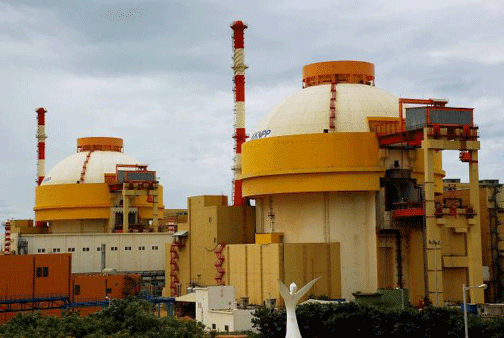
Frequent outages at Kudankulam plant unusual, trying to fix it: Dept of Atomic Energy

This is the first acknowledgement from a government authority and comes months after the issue of frequent power outages was flagged by Poovulagin Nanbargal. The NEWS Minute, TNM Staff

    April 20, 2019 Months after Poovulagin Nanbargal, a Tamil Nadu based volunteer group working on environmental issues, raised concerns over the unusual number of outages of reactors at the Kudankulam nuclear power plant, the Department of Atomic Energy (DAE) has accepted the NGO’s claim.

  • Kamlesh Nilkanth Vyas, the Secretary of the DAE and Chairman of the Atomic Energy Commission, in an interview to News18 Tamil Nadu, said that the Nuclear Power Corporation of India Limited (NPCIL) is trying to fix the issues faced by the Kudankulam power plant.

    “I do agree (that the number of stoppages of units 1 and 2 are unusual). We are trying to address it. There are some initial problems,” he said. Adding that similar operational issues were faced in Tarapore also during the initial years of operations  he said, “I feel definitely NPCIL is putting in tremendous amount of effort and they will be able to overcome the difficulties.”

  • This is the first time someone from the government is accepting that there are issues with the Kudankulam nuclear power plant. In November 2018, the group had written to the Atomic Energy Regulatory Board (AERB) seeking the appointment of a committee with independent experts to inspect Units 1 and 2 of the Kudankulam plant. In its 5-page letter, Poovulagin Nanbargal had stated that Unit 1 of the plant had tripped 40 times since it began its operations in 2013 and also listed a few instances of such outages. The letter had also called AERB’s attention towards the fact that on every instance the plant stops working, it takes at least four months for it to restart operations.  …..

  • The letter also alleged that contrary to an order by the Supreme Court which made it compulsory for the NPCIL to report every outage that happens in the plant to the AERB, the NPCIL did not submit any report of these outages. …..

    https://www.thenewsminute.com/article/frequent-outages-kundankulam-plant-unusual-trying-fix-it-dept-atomic-energy-100385

April 23, 2019 Posted by Christina Macpherson | India, politics | Leave a comment

Dangerous electioneering: India’s Modi ramps up the nuclear weapons rhetoric

Express Tribune 19th April 2019 During an election rally on April 14, Prime Minister Narendra Modi claimed
that he had called Pakistan’s nuclear “bluff” by carrying out air
strikes within Pakistan. In his exact words, Modi boasted, “Pakistan has
threatened us with nuclear, nuclear, nuclear” and then he asked
rhetorically, “Did we deflate their nuclear threat or not?”

Of course, Modi’s supporters raised chants in an expression of their approval.
Perhaps this was merely a case of aggressive electioneering in which Modi
has focused on national security as the main theme. But such claims have
also been made by several Indian policymakers and defence analysts after
the recent Pulwama crisis which demonstrates that there is a wider
acceptance for such views. In reality this is a dangerous delusion.

https://tribune.com.pk/story/1953964/6-indias-dangerous-delusions/

April 22, 2019 Posted by Christina Macpherson | India, politics | Leave a comment

India’s Prime MinisterModi boasts of India’s nuclear arsenal

India’s nuclear weapons not for Diwali — Modi, PM accuses Congress party of losing the upper hand after the 1971 war with Pakistan


Gulf News :  April 21, 2019  Barmer: Prime Minister Narendra Modi on Sunday said India is no longer afraid of Pakistan’s nuclear threats as today it is among the world powers with capability to carry out nuclear attacks across land, water, and in the air.

Addressing a poll rally here, he said: “The NDA government has instilled fear in the minds and hearts of terrorists. We hit terrorists, getting right into their homes. Now India is no more afraid of Pakistan’s threats.”

“There was a time when Pakistan used to threaten India every second day saying ‘We have the nuclear button, we have the nuclear button’, which was also reported by our media.

“Then what do we have? Is it [India’s nuclear arsenal] for Diwali?” he asked as the crowd applauded and started chanting his name……..https://gulfnews.com/world/asia/india/indias-nuclear-weapons-not-for-diwali–modi-1.63471306

April 22, 2019 Posted by Christina Macpherson | India, politics international | Leave a comment

The risk of nuclear war between India and Pakistan: it’s been a close call
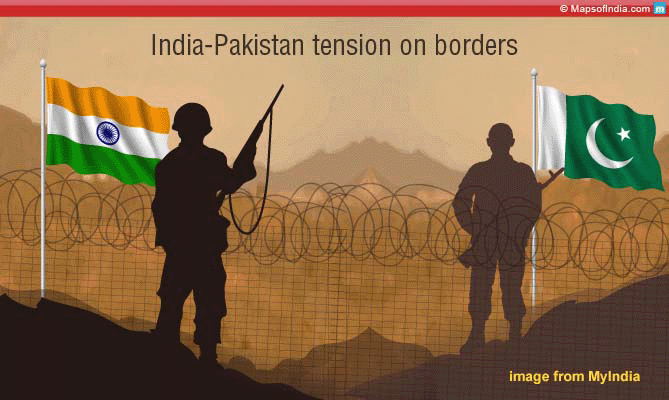
South Asia’s nuclear-armed neighbors pull back from the abyss…barely

India and Pakistan have created the most perilous place on Earth. Salon DILIP HIRO, APRIL 7, 2019 This piece originally appeared on TomDispatch.

It’s still the most dangerous border on Earth. Yet compared to the recent tweets of President Donald Trump, it remains a marginal news story.  That doesn’t for a moment diminish the chance that the globe’s first (and possibly ultimate) nuclear conflagration could break out along that 480-mile border known as the Line of Control (and, given the history that surrounds it, that phrase should indeed be capitalized). The casus belli would undoubtedly be the more than seven-decades-old clash between India and Pakistan over the contested territory of Kashmir. Like a volcano, this unresolved dispute rumbles periodically — as it did only weeks ago — threatening to spew its white-hot lava to devastating effect not just in the region but potentially globally as well.

The trigger for renewed rumbling is always a sensational terrorist attack by a Pakistani militant group on an Indian target. That propels the India’s leadership to a moral high ground. From there, bitter condemnations of Pakistan are coupled with the promise of airstrikes on the training camps of the culprit terrorist organizations operating from the Pakistan-controlled part of Kashmir.  As a result, the already simmering relations between the two nuclear-armed neighbors are quickly raised to a boiling point. This, in turn, prompts the United States to intervene and pressure Pakistan to shut down those violent jihadist groups. To placate Washington, the Pakistani government goes through the ritual of issuing banning orders on those groups, but in practice, any change is minimal.

And in the background always lurks the possibility that a war between the two neighbors could lead to a devastating nuclear exchange.  Which means that it’s time to examine how and why, by arraying hundreds of thousands of troops along that Line of Control, India and Pakistan have created the most perilous place on Earth.

How It All Began Continue reading →

April 8, 2019 Posted by Christina Macpherson | India, Pakistan, politics international, weapons and war | Leave a comment

India and Pakistan may have just narrowly avoided a nuclear confrontation

South Asia’s Overlooked Nuclear Crisis, While few were watching, India and Pakistan may have just narrowly avoided a nuclear confrontation. The Nation, By Dilip Hiro 5 Apr 19, It’s still the most dangerous border on Earth. Yet compared to the recent tweets of President Donald Trump, it remains a marginal news story. That doesn’t for a moment diminish the chance that the globe’s first (and possibly ultimate) nuclear conflagration could break out along that 480-mile border known as the Line of Control (and, given the history that surrounds it, that phrase should indeed be capitalized). The casus belli would undoubtedly be the more than seven-decades-old clash between India and Pakistan over the contested territory of Kashmir. Like a volcano, this unresolved dispute rumbles periodically—as it did only weeks ago—threatening to spew its white-hot lava to devastating effect not just in the region but potentially globally as well.

The trigger for renewed rumbling is always a sensational terrorist attack by a Pakistani militant group on an Indian target. That propels India’s leadership to a moral high ground. From there, bitter condemnations of Pakistan are coupled with the promise of airstrikes on the training camps of the culprit terrorist organizations operating from the Pakistan-controlled part of Kashmir. As a result, the already simmering relations between the two nuclear-armed neighbors are quickly raised to a boiling point. This, in turn, prompts the United States to intervene and pressure Pakistan to shut down those violent jihadist groups. To placate Washington, the Pakistani government goes through the ritual of issuing banning orders on those groups, but in practice, any change is minimal.

And in the background always lurks the possibility that a war between the two neighbors could lead to a devastating nuclear exchange. Which means that it’s time to examine how and why, by arraying hundreds of thousands of troops along that Line of Control, India and Pakistan have created the most perilous place on Earth.

HOW IT ALL BEGAN

The Kashmir dispute began with the birth of the kicking twins—Hindu-majority India and Muslim-majority Pakistan—as independent countries. They emerged from the belly of the dying British Raj in August 1947. The princely states in British India were given the option of joining either of the new nations. The dithering Hindu ruler of Muslim-majority Jammu and Kashmir (its full title) finally signed a legally binding instrument of accession with New Delhi after his realm was invaded by armed tribal raiders from Pakistan. This document offered that state’s citizens the chance to choose between the two countries once peace had been restored. This has not happened so far and there is no credible prospect that it will………..

while India has long been in a nuclear arms race with Pakistan, it is no longer sticking to the same race course. In late March, Modi announced that India recently launched a rocket successfully shooting down one of its satellites. This creates the possibility that, in a future nuclear war with Pakistan, it could preemptively “blind” the Pakistanis by destroying their space-based communication and surveillance satellites. A race of another kind could be in the offing.

The central motive that drove Pakistan to develop its nuclear arsenal, however, remains unchanged. It was the only way Islamabad could deter New Delhi from defeating it in a war waged with conventional weapons……….

Now, the international community can only hope that the carnage and chaos of February was the last in a tragic series of encounters between nuclear neighbors that could otherwise lead South Asia to devastation and the world to nuclear winter. https://www.thenation.com/article/south-asia-overlooked-nuclear-crisis-india-pakistan-kashmir/

April 6, 2019 Posted by Christina Macpherson | India, Pakistan, politics international | Leave a comment

India is waking up from nuclear energy dream, as renewables become safer, cheaper

 https://www.orfonline.org/research/india-waking-nuclear-energy-dream-49434/MANOJ JOSHI

Around the world, nuclear energy has taken a back seat because of the risks that reactors bring with them. The report that the US will help build six nuclear power plants in India should be taken with the proverbial pinch of salt. When it comes to the US, inter-governmental declarations are not how business gets done. It requires working through a labyrinth of terms and conditions with companies and financial institutions. And, the nuclear-reactor business is not too healthy in the US.The six reactors to be set up in Kovvada, Andhra Pradesh are Westinghouse-designed AP1000 Pressurised Water Reactors (PWR). Westinghouse has just emerged from a Chapter 11 bankruptcy settlement on account of the construction of four AP1000 reactors in Georgia and South Carolina.

The announcement, which came during foreign secretary Vijay Gokhale’s visit to the US, seems aimed at pleasing Washington at a time when bilateral trade ties appear to have hit turbulence. It is also a token genuflection towards the Indo-US nuclear deal of 2008 that was justified by the US desire to promote civil nuclear cooperation. This deal, with its commitment to promote US nuclear reactor sales to India, came unstuck after India passed a stringent liability law that made the manufacturers, rather than the operator, primarily liable for damage in the event of an accident.

India has 22 functioning reactors, most of them pressurised heavy water reactors (PWHRs), which provide three per cent of the country’s electricity. Seven units, one of them a prototype fast breeder reactor, are under construction.

India’s nuclear power sector was coddled by the government because it served the dual purpose of providing the capacity to produce nuclear weapons and also the promise of limitless sources of energy. This was premised on Homi Bhabha’s three-stage plan that involves making fast breeder reactors (FBR) to use plutonium reprocessed from the spent fuel from the first stage PWHR plants.

Stage 2 FBRs will use a mixed oxide fuel to produce more plutonium than they consume.

In Stage 3, thorium would be used to blanket the reactor to yield Uranium 233 for the third-stage reactor, which can be refuelled by abundant natural thorium after its initial fuel charge.

Nuclear energy received the bulk of the government’s research and development (R&D) funding during the 1950-1970 period. It got some 15 per cent in the 1990s, at a time when Indian Space Research Organisation (Isro) got 20 per cent and renewables got less than one per cent. While ISRO achieved world-class launch and satellite capability, despite embargoes, the department of atomic energy found it hard to even scale up the 220 MWe Canadian reactor it had got in the 1960s to 700 MWe. We have just about managed to get one going in Andhra Pradesh’s Kakrapar in 2018. The world norm for power reactors is 1,000-1,500 MWe.

The country was promised a 10,000 MWe capacity by the year 2000, but even now it has only touched 7,000 MWe. After the nuclear deal there was talk of boosting nuclear energy to 63,000 MWe by 2032. But in 2011, following the blow-back from the nuclear liability legislation, this was scaled down to 14,600 MWe by 2020 and 27,500 by 2032. We will be lucky if we meet the 2000 target in 2020.

In contrast to nuclear power, India has usually exceeded its targets, at far lesser investment, in the area of renewable energy. The country’s installed wind-power capacity is 34,000 MW, hydropower 44,000 MW and solar power 25,000 MW, with a target of 100,000 MW by 2022. Wind and solar power have not been provided the kind of investment that has been made in nuclear energy.

Around the world, nuclear energy has taken a back seat because of the risks that reactors bring with them. Three Mile Island, Chernobyl and Fukushima have dampened the ardour of the developed world. The US, which has over 100,000 MWe capacity, stopped issuing licences for nuclear plants between 1979 and 2012. Even now, just two are under construction, while 34 have been shut down.

It is not safety alone that is a concern. The economics of nuclear power is another issue. Huge sums of money go into setting up of power plants. Most face delays and cost over-runs. Operating costs per unit of electricity tends to be higher than alternative energy sources.

There are a range of experimental reactors that promise greater safety and economy but they are yet to reach maturity. China is investing big in new reactor technologies. The stakes are huge. Nuclear technology has always had two faces—the promise of incredible bounty and its enormously destructive capacity.

As of now, India remains fixated on its three-stage plan. We will reach Stage 3 only by 2050 or so; we’re still mainly in Stage 1. Caution is needed, especially since the record of our nuclear R&D and industry is not great. We need to hedge our risks by working on alternatives, not just in the field of nuclear energy, but also renewables, where our performance has been much better.

April 1, 2019 Posted by Christina Macpherson | India, politics | Leave a comment

Indian military confirms deployment of nuclear subs amid rising tensions with Pakistan

AMN By News Desk2019-03-17  Tensions between the two nuclear-armed Asian powers escalated last month, after an incursion into Pakistani territory in Kashmir by Indian Air Force warplanes to strike at Jihadist militants led to skirmishes in the air and small arms and artillery fire along the shaky Line of Control border.

Major combat units of the Indian Navy including the INS Vikramaditya aircraft carrier-led battle group, nuclear submarines “and scores of other ships, submarines and aircraft” were quickly shifted from exercises to operational deployment as tensions between New Delhi and Islamabad escalated, India’s Ministry of Defence revealed in a statement Sunday……..

Earlier Sunday, sources speaking to Reuters reportedly said that India and Pakistan had threatened to lob nuclear missiles at each other during the crisis and that only US officials’ intervention helped to defuse what may have well turned into a much deadlier conflict. ……

Tensions continue to smolder, with regular reports of airspace violations, military drills held in the sensitive border area, and back and forth allegations of ceasefire violations amid small arms and artillery fire along the Line of Control in Kashmir. https://www.almasdarnews.com/article/indian-military-confirms-deployment-of-nuclear-subs-amid-rising-tensions-with-pakistan/

March 18, 2019 Posted by Christina Macpherson | India, Pakistan, politics international, weapons and war | Leave a comment

Proposed nuclear power station at Indian village – a  serious threat to living beings 

Nuclear power serious threat to living beings Hans News Service https://www.thehansindia.com/andhra-pradesh/nuclear-power-serious-threat-to-living-beings-512866 18 March 2019 

HIGHLIGHTS The proposed Nuclear Power Plant (NPP) at Kovvada village in Ranastalam mandal is a serious threat to all living beings in the surrounding 250 kilometers radius of north coastal AP districts and south Odisha state, said Anti-Nuclear Committee national member Dr Vivek Mantory.

Srikakulam: The proposed Nuclear Power Plant (NPP) at Kovvada village in Ranastalam mandal is a serious threat to all living beings in the surrounding 250 kilometers radius of north coastal AP districts and south Odisha state, said Anti-Nuclear Committee national member Dr Vivek Mantory. Addressing a seminar on ‘Nuclear power plant at Ranastalam’ on Sunday, held under the aegis of CITU, he came down heavily on both the Central and State governments’ for neglecting the interest of people living in the area and for violation of environmental laws.
Stating that the establishment of nuclear power was a costly affair than any other power like wind, hydro, coal-based thermal power and solar power, he said all the developed and advanced countries like the USA, Russia, Japan and other nations were backed away from the nuclear power. He wondered as to why India is showing much interest without thinking safety measures and preventive technology. CITU State vice-president D Govinda Rao, district president K Srinivas and members of other unions also participated. Residents of NPP affected villages also present in the seminar.

March 18, 2019 Posted by Christina Macpherson | India, opposition to nuclear | Leave a comment

A nuclear nightmare is brewing between India and Pakistan

Japan Times  BY JAMES STAVRIDIS, BLOOMBERG, MAR 11, 2019 NEW YORK – While India and Pakistan seem to have stopped bombing one another, the causes behind the cross-border tensions aren’t going away any time soon. The two nations are nuclear-armed; have large conventional armed forces; have had four serious wars since they became independent in 1947; and have enormous cultural and religious antipathy. This is a prescription for a disaster, and yet the confrontation is flying below the international radar — well below North Korea, Brexit, China-U.S. trade confrontations, Iran and even the “yellow vests” of France. A full-blown war in Kashmir is a very real possibility……….

The most recent crisis was set off in mid-February when a Pakistani terrorist group, Jaish-e-Mohammad, detonated a suicide bomb in Indian-controlled Kashmir, killing 40 Indian soldiers. ………

The fragile cease-fire in place for two decades is fraying. Partly this is the result of domestic politics in India:……..

Most worrisome, of course, are the significant nuclear arsenals of the combatants. Each has roughly 150 missiles, although only India has a submarine-based ballistic missile capability and thus a true nuclear triad (land, air and sea). Pakistan is developing sea-launched cruise missiles to counter that Indian threat. India has adopted a “no first use” doctrine, although Pakistan — which has smaller conventional forces and thus potentially the need for a more ambiguous doctrine — has not made an equivalent pledge.

………. With Pakistan’s economic plight and the upcoming elections in India, South Asia is in a situation in which a military miscalculation, perhaps even a nuclear one, is real possibility. https://www.japantimes.co.jp/opinion/2019/03/11/commentary/world-commentary/nuclear-nightmare-brewing-india-pakistan/#.XIbKfskzbGg

March 12, 2019 Posted by Christina Macpherson | India, Pakistan, politics international, weapons and war | Leave a comment

People of Kashmir – stuck in a dangerous, potentially nuclear, conflict

In Kashmir, we’re stuck in the middle of a potentially nuclear conflict but the world looks away, ABC News, By Umar Lateef Misgar   9 Mar 19, When Adil Dar rammed a car stuffed with explosives into a paramilitary convoy in Indian-administered Kashmir last month, I didn’t make much of the news.

I was travelling across northern India at the time. Having been born and brought up amid a conflict that has defined the life of every young Kashmiri for the past three decades it just seemed more of the same: military cordons, gunfights, curfews, blown-up houses, maiming and the death of our friends and acquaintances.

But the magnitude of this attack by Dar, a 22-year-old Kashmiri, crept up on me through numbers and images. It was the worst attack against Indian forces since the armed insurgency erupted in Kashmir in the late 1980s.

At least 40 Indian paramilitary personnel had been killed, setting off a chain of events that almost brought South Asia to the brink of an all-out nuclear war.

I felt heartbroken by the loss of life that had occurred.

The Indian media instantly began to whip up a frenzy against the Kashmiris, doubling down on efforts to demonise an entire people.

The Indian population’s anger was focused against Kashmiri civilians, students and migrant businessmen, who were attacked by mobs. As many as 2000 of them were forced to flee from different Indian cities…….

I have lived in India as a student and travelled across the country throughout my life, but I have never felt as threatened as during this recent visit.

Constantly dehumanised in the Indian media as well as politics, Kashmiris have been undermined and permanently relegated as dispensable other in the Indian consciousness. Even the India’s parliamentary opposition, led by the Indian National Congress party that finds its roots in the anti-colonial struggles of the subcontinent, didn’t even dare to speak a word against this wave of anti-Kashmiri hate-crimes………

Amid rising tensions, both the countries mobilised their armed forces, leading to the worst tension in 20 years. Diplomats succeeded in persuading the two nuclear-armed nations to back-off. For now.

It is local Kashmiris whose lives were disrupted by this military posturing and brinkmanship. Civilians across the de-facto border that divides Indian and Pakistani-administered Kashmir, suffered the stress of warplanes hovering above and the impending threat of war………

Deadliest decade

The confrontation between India and Pakistan has slowly de-escalated but people continue to be killed, and while last year was the deadliest in a decade the coming year looks catastrophically bleak.

In the past week 15 people including eight Kashmiri civilians died in shelling and gunfights on the border.

As world attention shifts elsewhere the plight of Kashmiri people remains constant. Our land, our air and our bodies will remain the sites of violent confrontation and electoral bargaining.

Will anyone bat an eye before the next nuclear showdown? https://www.abc.net.au/news/2019-03-09/kashmir-is-stuck-in-the-middle-of-nuclear-tension/10878950

March 9, 2019 Posted by Christina Macpherson | India, Pakistan, weapons and war | Leave a comment

Nuclear threat still hangs over India and Pakistan

Crisis may be easing, but nuclear threat still hangs over India and Pakistan, Analysis by Brad Lendon, CNN, March 4, 2019  Hong Kong Tensions on the border between India and Pakistan last week pushed the two nuclear-powered South Asian adversaries closer to conflict than at any point in the past two decades.

While the situation has calmed — Pakistan on Friday released an Indian air force pilot it captured after shooting his pane down — drastic swings in relations are the norm. Both countries know the risks when tensions spike.
Following their separation in 1947, relations between India and Pakistan have been in a near constant state of agitation. The two sides have fought several major wars — the last being in 1999 — involving thousands of casualties and numerous skirmishes across the Line of Control in the contested Kashmir region.
Since that last clash, both countries have quietly sought to enlarge and upgrade their military capabilities.
With its military buildup over those decades, India now exceeds Pakistan on most numerical measurements — fighter jets, troops, tanks and helicopters.
India far surpasses Pakistan in other measures, too, especially in military budget, $64 billion to $11 billion, according to the Stockholm International Peace Research Institute (SIPRI).
But, as is often the case, numbers don’t tell the whole story.

The China question

India has about 3 million military personnel compared to fewer than 1 million for Pakistan, according to the International Institute for Strategic Studies, but New Delhi can’t focus them all on its neighbor to the west.
A chunk is focused on India’s northeast and its border with China……….
ina is able to keep Indian attentions divided by keeping a close military relationship with Pakistan.
“There is a convergence with Chinese and Pakistan strategic thinking that has continued for five decades now,” said Nishank Motwani, a visiting fellow at the Asia-Pacific College of Diplomacy with expertise on India and Pakistan…………

India’s ties to the West

While Pakistan has formed a close relationship with China, India — with a defense budget six times the size of Pakistan’s — has been on a rapid military modernization program of its own.
“India has more spending power and has been investing in platforms that Pakistan can’t afford,” Motwani said……….

The size disparity

India, with a landmass nearly four times that of Pakistan, can put military assets well back from tense border regions, where any Pakistani strikes against them would encounter multiple layers of air defenses.
In the smaller and more narrow Pakistan, military bases and assets are harder to shield………

The nuclear threat

One area where Indian and Pakistan are evenly matched is the area that raises the most worry whenever hostilities spike between the two — nuclear weapons.
Figures from the Stockholm International Peace Research Institute last year show Pakistan with 140 to 150 nuclear warheads and India with 130 to 140.
Layton worries that if the situation gets dire for Pakistan — something that’s far from what we’re seeing at the moment — they could be used before commanders in Islamabad could stop them.
“Pakistan has a strategic policy of delegating nuclear release approval down to lower level tactical units,” he said. “There is a real danger of ‘loose nukes,’ that is lower-level bellicose commanders using tactical nuclear weapons if they see fit.”
Motwani said Pakistan wants India to know that nuclear threat is always there………  https://edition.cnn.com/2019/03/01/asia/india-pakistan-military-balance-intl/index.html

March 7, 2019 Posted by Christina Macpherson | India, Pakistan, politics international | Leave a comment

Russia to lease nuclear-powered attack submarine to India for a cool $3 billion

India, Russia To Sign $3 Billion Nuclear Sub Deal This Week

India and Russia are set to sign a $3 billion lease agreement for a nuclear-powered attack sub on March 7, according to local media reports. The Diplomat, By Franz-Stefan Gady, March 05, 2019 India and Russia are expected to conclude an intergovernmental agreement for a 10-year lease of a Russian nuclear-powered attack submarine (SSN) this week. The deal, estimated to be worth around $3 billion, will likely be inked on March 7, according to sources cited by The Economic Times. Neither the Indian nor Russian defense ministries, however, have officially confirmed that a signing ceremony will be held in the coming days.

This will be the third instance of a Russian submarine leased to the Indian Navy by Moscow. In 1988, the Navy inducted a Project 670 Skat-class (NATO classification: Charlie-class) nuclear-powered cruise missile submarine, rechristened INS Chakra, on a three-year lease. In 2012, a second INS Chakra, the retrofitted K-152 Project 971 Akula-class Nerpa, was leased for 10 years. The Chakra was officially commissioned by the Navy in 2012 and currently serves with the Eastern Naval Command. India and Russia are currently discussing extending the lease for another five years to 2027.

The new sub, designated Chakra III, purportedly the Russian Navy’s K-322 Kashalot (Akula II-class) SSN, is expected to be ready for service by 2025. It is currently mothballed at a Russian naval shipyard in Severodvinsk. (Notably, there have also been reports that senior Indian naval officers inspected to other SSNs for possible transfer to India in 2018, the K-391 Bratsk and K-295 Samara–both serving with the Russian Pacific Fleet. It should be understood that the selection of the Kashalot has not been officially confirmed.)………..     https://thediplomat.com/2019/03/india-russia-to-sign-3-billion-nuclear-sub-deal-this-week/

March 5, 2019 Posted by Christina Macpherson | India, marketing, Russia, weapons and war | Leave a comment

« Previous Entries     Next Entries »

1 This Month

​To see nuclear-related stories in greater depth and intensity – go to https://nuclearinformation.wordpress.com/

12 February – Webinar The Big Push: New Nuclear Projects in Canada
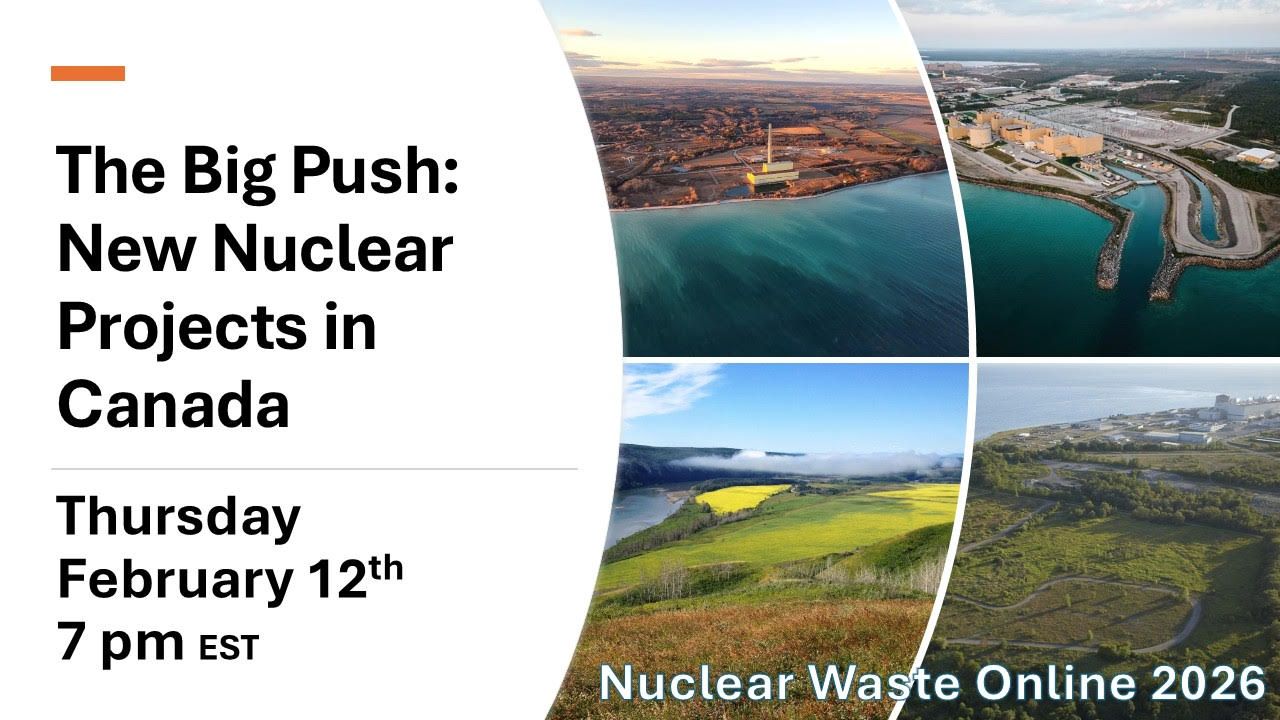
Thursday, February 12, 7 pm Eastern | 2nd of 4 sessions in the 2026 Nuclear Waste Online webinar series

 Join a webinar on the push for new nuclear generation in Canada. Go to Northwatch.org to register or use the registration link https://us02web.zoom.us/webinar/register/WN_ZfWOf1GITqSRIZX8CB-A9w
  • Categories

    • 1
      • Arclight's Vision
    • 1 NUCLEAR ISSUES
      • business and costs
        • employment
        • marketing
      • climate change
      • culture and arts
      • ENERGY
        • renewable
          • decentralised
          • energy storage
      • environment
        • oceans
        • water
      • health
        • children
        • psychology – mental health
        • radiation
        • social effects
        • women
      • history
      • indigenous issues
      • Legal
        • deaths by radiation
        • legal
      • marketing of nuclear
      • media
        • investigative journalism
        • Wikileaks
      • opposition to nuclear
      • PERSONAL STORIES
      • politics
        • psychology and culture
          • Trump – personality
        • public opinion
        • USA election 2024
        • USA elections 2016
      • politics international
      • Religion and ethics
      • safety
        • incidents
      • secrets,lies and civil liberties
        • civil liberties
      • spinbuster
        • Education
      • technology
        • reprocessing
        • Small Modular Nuclear Reactors
        • space travel
      • Uranium
      • wastes
        • – plutonium
        • decommission reactor
      • weapons and war
        • Atrocities
        • depleted uranium
      • Women
    • 2 WORLD
      • ANTARCTICA
      • ARCTIC
      • ASIA
        • Burma
        • China
        • India
        • Indonesia
        • Japan
          • – Fukushima 2011
          • Fukushima 2012
          • Fukushima 2013
          • Fukushima 2014
          • Fukushima 2015
          • Fukushima 2016
          • Fukushima continuing
        • Malaysia
        • Mongolia
        • North Korea
        • Pakistan
        • South Korea
        • Taiwan
        • Turkey
        • Vietnam
      • EUROPE
        • Belarus
        • Bulgaria
        • Denmark
        • Finland
        • France
        • Germany
        • Greece
        • Ireland
        • Italy
        • Kazakhstan
        • Kyrgyzstan
        • Russia
        • Spain
        • Sweden
        • Switzerland
        • UK
        • Ukraine
      • MIDDLE EAST
        • Afghanistan
        • Egypt
        • Gaza
        • Iran
        • Iraq
        • Israel
        • Jordan
        • Libya
        • Saudi Arabia
        • Syria
        • Turkey
        • United Arab Emirates
      • NORTH AMERICA
        • Canada
        • USA
          • election USA 2020
      • OCEANIA
        • New Zealand
        • Philippines
      • SOUTH AMERICA
        • Brazil
    • ACTION
    • AFRICA
      • Kenya
      • Malawi
      • Mali
      • Namibia
      • Niger
      • Nigeria
      • Somalia
      • South Africa
    • Atrocities
    • AUSTRALIA
    • Christina's notes
    • Christina's themes
    • culture and arts
    • Events
    • Fuk 2022
    • Fuk 2023
    • Fukushima 2017
    • Fukushima 2018
    • fukushima 2019
    • Fukushima 2020
    • Fukushima 2021
    • general
    • global warming
    • Humour (God we need it)
    • Nuclear
    • RARE EARTHS
      • thorium
    • Reference
      • Reference archives
    • resources – print
    • Resources -audiovicual
    • Weekly Newsletter
    • World
    • World Nuclear
    • YouTube
  • Pages

    • 1 This Month
    • ACTION !
    • Disclaimer
    • Links
    • PAGES on NUCLEAR ISSUES
      • audio-visual news
      • Anti Nuclear, Clean Energy Movement
        • Anti Nuclear movement – a success story
          • – 2013 – the struggle for a nuclear-free, liveable world
          • – 2013: the battle to expose nuclear lies about ionising radiation
            • Speakers at Fukushima Symposium March 2013
            • Symposium 2013 Ian Fairlie
      • Civil Liberties
        • – Civil liberties – China and USA
      • Climate change
      • Climate Change
      • Economics
        • – Employment
        • – Marketing nuclear power
        • – Marketing Nuclear Power Internationally
        • nuclear ‘renaissance’?
        • Nuclear energy – the sick man of the corporate world
      • Energy
        • – Solar energy
      • Environment
        • – Nuclear Power and the Tragedy of the Commons
        • – Water
      • Health
        • Birth Defects in the Chernobyl Radiation Affected Region.
      • History
        • Nuclear History – the forgotten disasters
      • Indigenous issues
      • Ionising radiation
        • – Ionising radiation – medical
        • Fukushima FACT SHEET
      • Media
        • Nuclear Power and Media 2012
      • Nuclear Power and the Consumer Society – theme for December 2012
      • Peace and nuclear disarmament
        • Peace on a Nuclear Free Earth
      • Politics
        • – Politics USA
      • Public opinion
      • Religion and ethics
        • -Ethics of nuclear power
      • Resources – print
      • Safety
      • Secrets and lies
        • – NUCLEAR LIES – theme for January 2012
        • – Nuclear Secrets and Lies
      • Spinbuster
        • 2013 nuclear spin – all about FEAR -theme for June
        • Spinbuster 1
      • Technology
        • TECHNOLOGY Challenges
      • Wastes
        • NUCLEAR WASTES – theme for October 2012
        • – Plutonium
      • Weapons and war
      • Women
  • Archives

    • February 2026 (115)
    • January 2026 (308)
    • December 2025 (358)
    • November 2025 (359)
    • October 2025 (376)
    • September 2025 (258)
    • August 2025 (319)
    • July 2025 (230)
    • June 2025 (348)
    • May 2025 (261)
    • April 2025 (305)
    • March 2025 (319)
  • Categories

    • 1
      • Arclight's Vision
    • 1 NUCLEAR ISSUES
      • business and costs
        • employment
        • marketing
      • climate change
      • culture and arts
      • ENERGY
        • renewable
          • decentralised
          • energy storage
      • environment
        • oceans
        • water
      • health
        • children
        • psychology – mental health
        • radiation
        • social effects
        • women
      • history
      • indigenous issues
      • Legal
        • deaths by radiation
        • legal
      • marketing of nuclear
      • media
        • investigative journalism
        • Wikileaks
      • opposition to nuclear
      • PERSONAL STORIES
      • politics
        • psychology and culture
          • Trump – personality
        • public opinion
        • USA election 2024
        • USA elections 2016
      • politics international
      • Religion and ethics
      • safety
        • incidents
      • secrets,lies and civil liberties
        • civil liberties
      • spinbuster
        • Education
      • technology
        • reprocessing
        • Small Modular Nuclear Reactors
        • space travel
      • Uranium
      • wastes
        • – plutonium
        • decommission reactor
      • weapons and war
        • Atrocities
        • depleted uranium
      • Women
    • 2 WORLD
      • ANTARCTICA
      • ARCTIC
      • ASIA
        • Burma
        • China
        • India
        • Indonesia
        • Japan
          • – Fukushima 2011
          • Fukushima 2012
          • Fukushima 2013
          • Fukushima 2014
          • Fukushima 2015
          • Fukushima 2016
          • Fukushima continuing
        • Malaysia
        • Mongolia
        • North Korea
        • Pakistan
        • South Korea
        • Taiwan
        • Turkey
        • Vietnam
      • EUROPE
        • Belarus
        • Bulgaria
        • Denmark
        • Finland
        • France
        • Germany
        • Greece
        • Ireland
        • Italy
        • Kazakhstan
        • Kyrgyzstan
        • Russia
        • Spain
        • Sweden
        • Switzerland
        • UK
        • Ukraine
      • MIDDLE EAST
        • Afghanistan
        • Egypt
        • Gaza
        • Iran
        • Iraq
        • Israel
        • Jordan
        • Libya
        • Saudi Arabia
        • Syria
        • Turkey
        • United Arab Emirates
      • NORTH AMERICA
        • Canada
        • USA
          • election USA 2020
      • OCEANIA
        • New Zealand
        • Philippines
      • SOUTH AMERICA
        • Brazil
    • ACTION
    • AFRICA
      • Kenya
      • Malawi
      • Mali
      • Namibia
      • Niger
      • Nigeria
      • Somalia
      • South Africa
    • Atrocities
    • AUSTRALIA
    • Christina's notes
    • Christina's themes
    • culture and arts
    • Events
    • Fuk 2022
    • Fuk 2023
    • Fukushima 2017
    • Fukushima 2018
    • fukushima 2019
    • Fukushima 2020
    • Fukushima 2021
    • general
    • global warming
    • Humour (God we need it)
    • Nuclear
    • RARE EARTHS
      • thorium
    • Reference
      • Reference archives
    • resources – print
    • Resources -audiovicual
    • Weekly Newsletter
    • World
    • World Nuclear
    • YouTube
  • RSS

    Entries RSS
    Comments RSS

Site info

nuclear-news
Blog at WordPress.com.
Privacy & Cookies: This site uses cookies. By continuing to use this website, you agree to their use.
To find out more, including how to control cookies, see here: Cookie Policy
  • Subscribe Subscribed
    • nuclear-news
    • Join 2,077 other subscribers
    • Already have a WordPress.com account? Log in now.
    • nuclear-news
    • Subscribe Subscribed
    • Sign up
    • Log in
    • Report this content
    • View site in Reader
    • Manage subscriptions
    • Collapse this bar
 

Loading Comments...