China halts floating nuclear power plan over security fears
Global Construction Review, David Rogers, 31.05.23
China’s plan to build a fleet of nuclear power reactors that would provide electrical power to islands on the South China Sea have been suspended over security concerns, the South China Morning Post reports.
As construction of the first units was about to begin, regulators announced that they were withholding approval.
The decision came as a surprise for the project’s scientists, who believed the technology was mature and that floating reactors were generally safer than those on land, since the ocean acts as a natural heat sink and is immune to seismic activity.
Writing in the journal Nuclear Power Engineering, Wang Donghui, a scientist at the National Energy Offshore Nuclear Power Platform Technology Research Centre, said safety and feasibility were the main concerns of authorities.
He said the decision was made in spite of a 10-year research project into floating plants, and the fact that China has advanced ship design capabilities, as well as domestic design and manufacturing units capable of building floating platforms.
It had been hoped that a floating nuclear power plant would provide power to support military and civilian activities on remote islands in the South China Sea, and China was envisaging the construction of a fleet of such vessels (see further reading)………………
n
One of the major safety concerns is that floating power plants could face attacks from sea and air, but also from underwater attacks, according to Wang.
An enemy submarine, for example, could attempt to sabotage the facility by planting explosives on its hull or damaging its cooling systems. Unmanned aerial vehicles could also fly over the plant and drop bombs or other projectiles on it.
According to Wang, protecting a floating nuclear power plant from “underwater divers, vessels, floating objects or airborne objects”, would require a comprehensive ship security system. https://www.globalconstructionreview.com/china-halts-floating-nuclear-power-plan-over-security-fears/
China firmly opposes Japan’s discharge of Fukushima nuclear-contaminated water into sea
Source: Xinhua, Editor: huaxia, 2023-05-30 https://english.news.cn/20230530/5bdd921cc81744ffbcfd0eb7b76dd09b/c.html
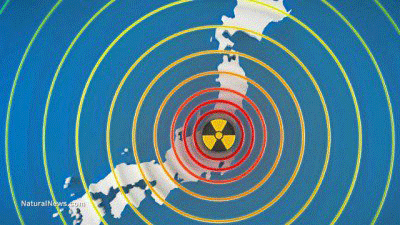
GENEVA, May 28 (Xinhua) — A Chinese delegate on Saturday expressed firm opposition to Japan’s unilateral decision to discharge the nuclear-contaminated water from Fukushima into the sea, when attending related discussions at the 76th World Health Assembly (WHA) held here.
Given the strong currents along Fukushima’s coast, the radionuclides will spread to waters worldwide in 10 years after a discharge, the delegate said, adding that this move is to shift the risks to all mankind, and is not Japan’s private matter, but a crucial issue affecting global public health.
Noting many countries and stakeholders have expressed serious concerns, the delegate urged Japan not to unilaterally discharge the nuclear-contaminated water before reaching an agreement with all parties.
In response to a Japanese delegate’s defense, the Chinese side said that the defense can be summed up as “the water quality is non-toxic and the discharge is reasonable,” but what the Japanese side said is completely untenable and they must give convincing answers to a series of questions.
The Chinese delegate raised three questions: First, if the nuclear-contaminated water is safe, why doesn’t Japan itself use the water? Why not use the water for domestic agriculture and manufacturing, or discharge it into domestic lakes? Second, is discharging the nuclear-contaminated water into the sea the only feasible solution? Third, what kind of long-term impact will such a discharge have on the world?
When it comes to the disposal of the nuclear-contaminated water, the Chinese delegate pointed out that Japan’s Ministry of Economy, Trade and Industry has proposed five plans. The Japanese government’s expert committee has admitted that compared to such options as emitting the water into the atmosphere through vaporization, building new storage tanks and solidifying the water with cement, a discharge into the sea is the cheapest option with minimum risk of pollution to Japan itself.
Japan’s current choice is to save itself trouble and money by pushing the world to suffer consequences, the delegate said, emphasizing that such actions, which only serve the short-term interests of Japan but harm the common interests of all mankind, must be severely condemned and resolutely resisted, and that the Pacific Ocean is not a sewer into which Japan can dump nuclear-contaminated water.
In April 2021, Japan announced that it would discharge the polluted water from the Fukushima nuclear accident into the ocean. Many countries, including China, have expressed firm opposition, and Russia also expressed serious concerns at this WHA. However, Japan has disregarded the reasonable appeals and demands of the international community.
Director General Grossi Highlights China as Indispensable IAEA Partner, Leader in Nuclear Energy
IAEA Joanne Liou, IAEA Office of Public Information and Communication, 24 May 23
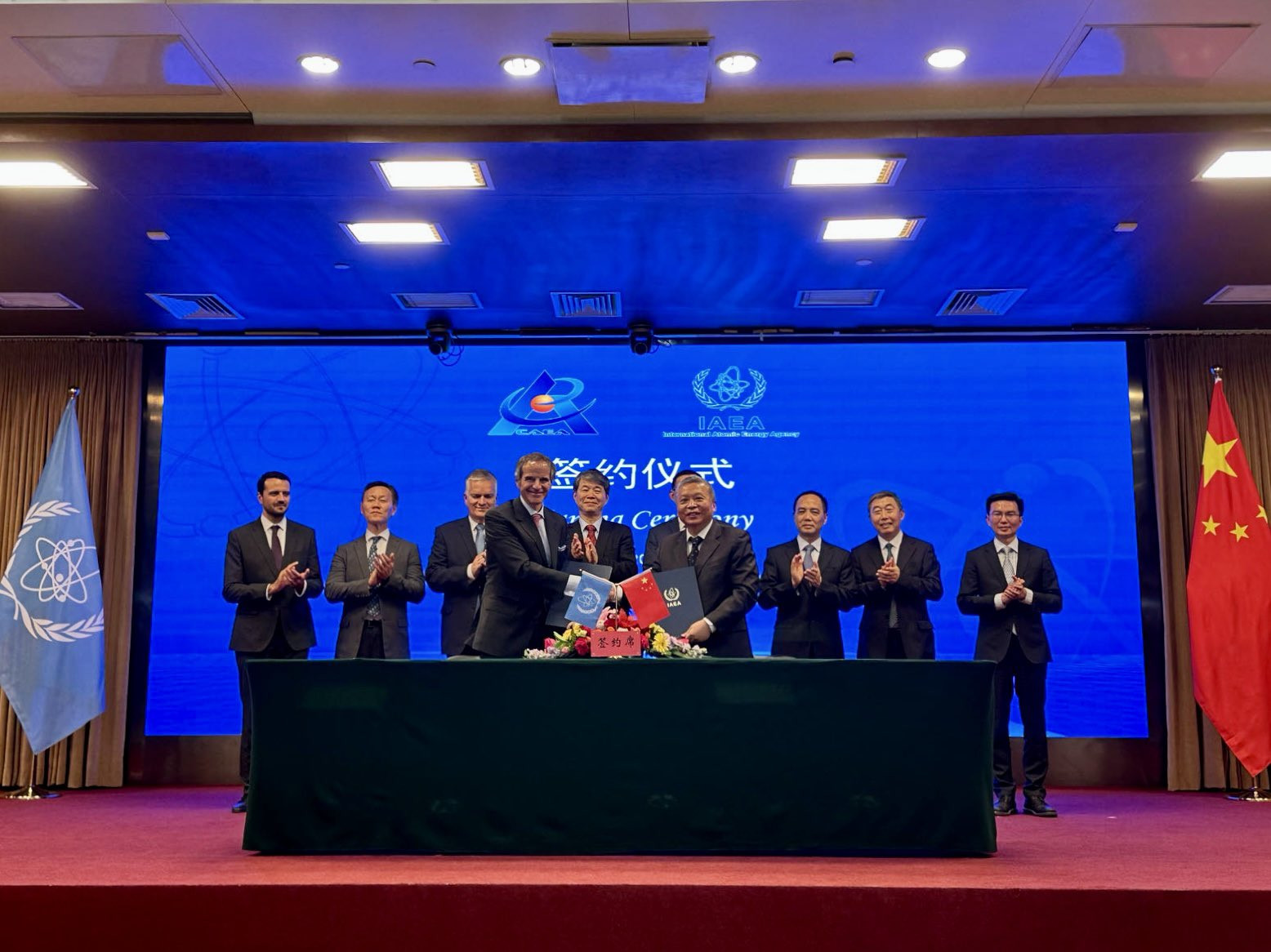
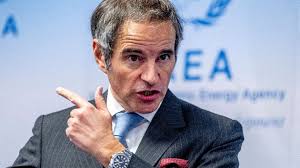
As the IAEA supports efforts to accelerate the contribution of atomic energy to peace, health and prosperity around the world, China is an indispensable partner in this endeavour, said Rafael Mariano Grossi, IAEA Director General, at the start of a week-long visit to China. Mr Grossi is meeting with several high-level officials and visiting nuclear facilities and institutions in Beijing, Shanghai and Shandong, during his first official visit to the country.
“China is one of the IAEA’s most important partners and a global leader in nuclear energy,” Mr Grossi said. “This week’s agenda will cover the remarkable progress of China’s nuclear energy programme, cooperation in nuclear applications and indispensable exchanges on non-proliferation and nuclear safety.” China has more than 50 operational nuclear power units and 24 are under construction. By 2035, China’s nuclear power generation will account for 10 per cent of the country’s electricity generation, according to the latest Blue Book of China Nuclear Energy Development Report.
On Monday, Mr Grossi and other IAEA officials signed several agreements at the China Atomic Energy Authority (CAEA), which reflect the diverse scope of work between the IAEA and China. The agreements will strengthen cooperation on small modular reactors, nuclear fusion, and nuclear data, fuel cycle and waste management, as well as communication activities……………………………………………. more https://www.iaea.org/newscenter/news/director-general-grossi-highlights-china-as-indispensable-iaea-partner-leader-in-nuclear-energy
China’s nuclear ambitions get a boost from Russia, but is energy the only goal?

- Moscow is feeding Beijing’s growing appetite for highly enriched uranium, but observers say those supplies could be used for nuclear weapons
- China will replace the US to become the world’s top uranium buyer by 2030, experts say
Liu Zhen, 13 May, 2023, SCMP,
China is importing highly enriched uranium from Russia to produce energy, but observers caution that Beijing also plans to expand its nuclear arsenal. Photo: Shutterstock
The confirmation came last week when Russia said it had agreed to supply highly enriched uranium-235 to energy-hungry China over the next three years.
The announcement backed up reports that the shipments of nuclear fuel – enriched up to 30 per cent – were part of a deal to supply a demonstration fast-neutron power plant, a technology that could help China ease its shortage of nuclear fuel.
…….. with the enriched uranium fuelling a demonstration project for the new technology, China could improve its output of nuclear fuel and go some way to overcoming itst supply problem.
The final product would be plutonium 239, an artificial element that is primarily used in nuclear warheads – and that worries the West.
Although never officially admitted, Beijing is believed to be expanding the country’s nuclear arsenal, in line with President Xi Jinping’s pledge at last October’s 20th Communist Party congress to “strengthen strategic deterrence” as military tensions with the United States and its allies rise.
The US Department of Defence (DOD) has estimated China will increase from 400 warheads today to 1,500 by 2035.
……………………………………………………… With its two 600 megawatt power generators, the CFR-600 is not particularly large and is only considered a “demonstration project”. By comparison, the Daya Bay Nuclear Power Plant near Hong Kong, which has been operating since the 1990s, has two 944 megawatts generators.
In March, US DOD official John Plumb described the China-Russia cooperation deal as “very troubling”, but China’s foreign ministry has defended the arrangement as “perfectly normal and we do not see anything wrong about it”.
………………………… Fast-neutron reactors are an advanced fourth-generation nuclear power plant technology, which function to generate power, multiply nuclear fuel, and incinerate long-lived radionuclides, according to Xue Xiaogang, head of the China Institute of Atomic Energy Science.
……………………………………………. Russia has for decades been a leader in fast-neutron reactor technology, and last year its Beloyarsk BN-800 reactor began running completely on reprocessed spent fuel known as MOX.
But China’s imports of 30 per cent concentrated uranium-235 fuel for the Xiapu CFR-600 meant it was still at an earlier stage of technological development with many obstacles to overcome, said the researcher. https://www.scmp.com/news/china/military/article/3220391/chinas-nuclear-ambitions-get-boost-russia-energy-only-goal
Understanding The Highly Complex World Of Western China Analysis

CAITLIN JOHNSTONE, MAY 15, 2023 https://caitlinjohnstone.substack.com/p/understanding-the-highly-complex?utm_source=post-email-title&publication_id=82124&post_id=121463595&isFreemail=true&utm_medium=email
—
Former Pentagon official Elbridge Colby was interviewed on The National Review’s Charles CW Cooke Podcast, where he provided some very high-level analysis on the tensions around China, Taiwan, and the United States.
I will here attempt to explain some of Colby’s comments for the benefit of the average reader, because Colby has been studying these things for many years and his commentary can be a bit advanced and esoteric for the casual punditry consumer.
“The analogy I use is… Taiwan is like a man with a cut in the ocean, and China is like a great white shark, and America is like a man in a boat,” Colby said in the interview.
“The problem is once that great white shark starts moving, you got no time,” added Colby. “You’re done. You know, if you’re not already by the side of the boat, right? Because it’s a great white shark.”
Now bear with me if Colby’s incisive observations went a bit over your head here, but if we break it down I’m confident that we can all catch up to this man’s towering intellect enough to catch a glimpse of his understanding on the matter.
What Colby appears to be saying — and please correct me of you think I’m reading this wrong — is that China is like a Great White Shark, which as we all know is an extremely dangerous aquatic predator with a voracious appetite, capable of gulping down a human being in a few swift bites.
Now, try to imagine being in a situation where you’re out there in the ocean, and there’s a Great White Shark right there with you in the water. And to make matters worse, you’re bleeding — a problem not only due to the wound from whence the blood is emanating, but also because sharks can smell blood in the water! That would be pretty bad, right?
Okay, so are you with me so far? Remember, this is very advanced stuff, so feel free to read back and review as much as you need.
Now, imagine you’re in that situation with the cut and the shark, and there’s a boat that you can go to to get away from the shark. You’d want to hop aboard that vessel as swiftly as possible, don’t you think? I know I would!
So to put it all together, what the esteemed Elbridge Colby is telling us is that China is analogous to the Great White Shark which is eyeing the bleeding man in the water, and the man can be compared to Taiwan, and the United States of America is comparable to the boat that is coming to the rescue of the man.
Make sense? If you’re still struggling to comprehend Colby’s scalpel-like geopolitical analysis, don’t worry, because I’ve obtained this helpful infographic above, to further illuminate your understanding:
Interestingly enough, this is not the first time China has been compared to a Great White Shark in recent western punditry. The Hoover Institution’s Matt Pottinger, a former advisor to President Donald Trump, made a similar comparison in an interview with Nikkei Asia earlier this month:
“We saw a baby shark and thought that we could transform it into a dolphin over time, to become a friendly sort of system,” Pottinger said. “Instead, what we did was we kept feeding the shark and the shark got bigger and bigger and bigger and bigger. And now we’re dealing with a formidable, great white.”
“With a shark you put up a shark cage,” added Pottinger. “The shark doesn’t take it personally. It bumps into the cage. It respects those barriers.”
Again, this is very complicated for the uninitiated layperson, but what Pottinger appears to be saying is that China is not at all comparable to a dolphin, which is an oceanic mammal known to be friendly toward people and easily trained to do tricks in aquatic theme parks. Rather, in Pottinger’s understanding, China is more comparable to a Great White Shark, which as you’ll recall from our discussion earlier in this essay is actually known to be rather dangerous.
If you’re still struggling to make sense of Pottinger’s luminous understanding, here’s another illustration to help make things a bit clearer:
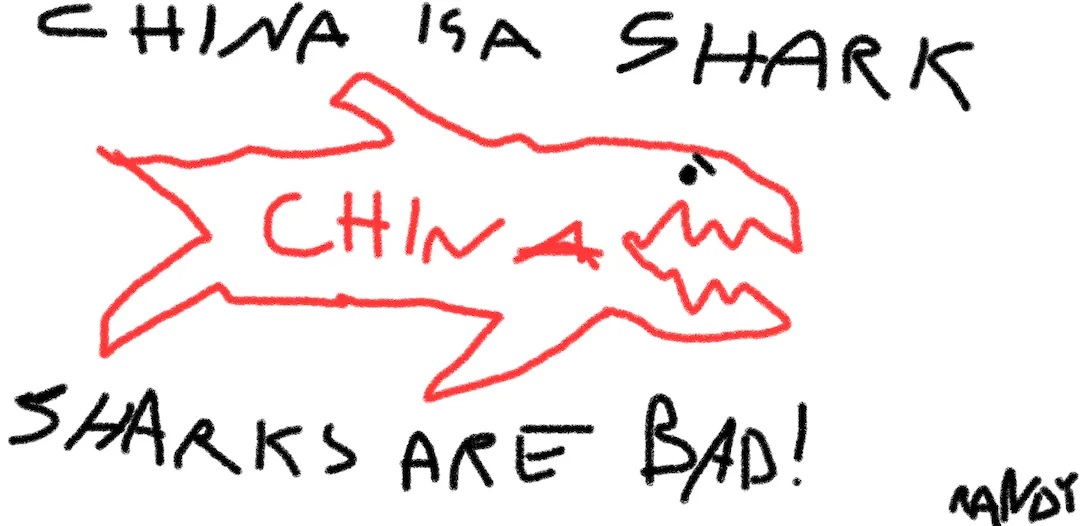
If you need it simplified even further, another way to put it might be, CHINA BAD. SHARK BAD. CHINA LIKE SHARK. CHINA VERY, VERY BAD. BAD CHINA. BAD.
Again, don’t be hard on yourself if you can’t quite wrap your head around the high-level analysis of intellectual giants like Matt Pottinger and Elbridge Colby. If we could understand these things as well as they do, we’d be the ones earning big bucks from Washington think tanks, not them!
Well I think that’s enough work for your gray matter today. Have a rest and a nice sleep and come back fresh tomorrow, where we’ll be discussing some mind-blowing comparisons western analysts have been drawing between Vladimir Putin and Adolf Hitler.
US troops to China? Not a good idea, really
Some pertinent comments to New York Post’s rather war-mongering article.
bob bob. 8 April, 2023
No, “Sending Troops” is not on the table. Taiwan is part of China as Puerto Rico is to the US. Imagine China intervening with our island and threatening us. Taiwan recently held elections, based on pro and anti China issues. Voters overwhelming support China regardless of what our own press and politicians say. Any country deciding to put their fate in US hands should take a long look at Afghanistan.
Cronkyte, 8 April, 2023
China has no desire to “invade” Taiwan, which would require a massive military operation and likely destroy the goose that lays the golden egg. China will do everything it can to persuade Taiwan to agree to reunification, most likely by offering semi-autonomous governance as they promised Hong Kong (and just like Hong Kong, they will then renege on those promises).
There is a growing push for reunification on the island, and after former Taiwan President Ma Ying-jeou’s speech upon returning from China, that will likely grow. He describes the choice as “peace or war,” and no one on either side of the Taiwan Strait want to see the island razed. https://nypost.com/2023/04/07/rep-michael-mccaul-us-troops-to-taiwan-on-the-table-if-china-invades/
China on track to triple its terawatt-scale wind and solar target.
The research arm of American banking giant Goldman Sachs has concluded
that China is currently on track to generate almost three times more power
from wind turbines and solar panels than the government has targeted.
According to a report published by Goldman Sachs in late March, combined
capacity from China’s solar and wind energy sector will reach 3.3
terawatts (TW) by 2030. This far outstrips the Chinese government’s
current target of 1.2TWh. The conclusion from the report is that, with such
an accelerated pace for wind and solar deployment, China could become
energy self-sufficient by 2060.
Renew Economy 5th April 2023
China warns of World War III with ‘nuclear sword hanging over our heads’ over Putin’s plan to send nukes to Belarus
China has called for superpowers to step back from the brink of nuclear war as Russia announces a plan to deploy tactical nukes.
news.com.au Alike Kraterou and Jack Evans 2 Apr 23
China has issued a warning of a possible World War III after Russia’s announcement to deploy tactical nuclear weapons in Belarus.
Geng Shuang, China’s representative in the United Nations, called for all world powers to step back from the brink and maintain “global strategic stability”.
He urged nations to prevent nuclear proliferation and crisis, avoid armed attacks against nuclear power plants and the use of nuclear weapons in Ukraine.
Speaking at a Security Council meeting on international peace, Shuang made clear China’s opposition to Kremlin’s plan to send nuclear weapons to Minsk.
He described nuclear weapons as “the sword of Damocles hanging over our heads” and called on all nuclear weapon states to reduce the risk of a nuclear war and avoid any armed conflict between nuclear weapons states.
“We call for the abolition of the nuclear-sharing arrangements and advocate no deployment of nuclear weapons abroad by all nuclear weapons states, and the withdrawal of nuclear weapons deployed abroad,” Shuang said.
Shuang stressed that “nuclear proliferation must be prevented and nuclear crisis avoided.” He added that “a nuclear war cannot be won and must not be fought,” and that China’s position on nuclear weapons has been “clear and consistent”.
China has firmly committed to a defensive nuclear strategy, not using or threatening to use nuclear weapons against non-nuclear weapon states or nuclear-weapon-free zones, and to no first use of nuclear weapons at any time and under any circumstances.
While not directly mentioning Russia, Geng called for all parties to “stay rational, avoid aggravating tensions, and intensifying frictions, or fanning the flames”.
China has claimed to maintain a neutral stance in the war but has also pointed out its “no-limits friendship with Russia”.
Last month, China released a point peace plan to end the war, calling for a ceasefire and talks between Ukraine and Russia…………………………………………………….
China’s new warning to Australia over nuclear submarine deal
China has fired off another dire warning to Australia, amid growing tension over the nuclear submarine deal with the US and Britain.
Carla Mascarenhas, 1 Apr 23
Global superpowers unite against US
‘Anytime, anywhere’: Kim’s nuke threat
Dan appears on Chinese TV
China has fired off a frightening warning to Australia over its nuclear submarines deal with the US and the UK, declaring it may trigger an unpredictable global arms race.
The Chinese foreign ministry said on Thursday that once a Pandora’s box is opened, the “regional strategic balance will be disrupted and regional security will be seriously threatened”.
The United States, Australia and UK this month unveiled details of a plan to provide Australia with nuclear-powered attack submarines from the early 2030s to counter China’s ambitions in the Indo-Pacific.
“China firmly opposes the establishment of the so-called ‘trilateral security partnership’ between the United States, the United Kingdom and Australia,” said Tan Kefei, a spokesman at the Chinese defence ministry, during a regular press briefing.
“This small circle dominated by Cold War mentality is useless and extremely harmful.”
Mr Tan added such co-operation was an extension of the nuclear deterrence policy of individual countries, a game tool for building an “Asia-Pacific version of NATO” and seriously affected peace and stability in the Asia-Pacific region………………………………………………………….
Richard Dunley, a naval and diplomatic historian, said the deal “looks best from Washington – they get major wins in terms of basing, maintenance support and recapitalisation in their yards”.
He noted the Australian perspective was “less clear”.
“The cost is astronomical,” he wrote on Twitter.
Huge but still unknown amounts will be paid to the US in subsidies and then to buy the Virginias. This capability will only realise materialise mid-next decade, and is only a stopgap.”
carla.mascarenhas@news.com.au https://www.news.com.au/world/asia/chinas-new-warning-to-australia-over-nuclear-submarine-deal/news-story/16904f97d0a534af20dd69815f9c1986
Aukus subs deal firms China support for Asean nuclear weapon-free zone
Beijing ‘willing’ to become first nuclear-armed state to sign treaty pledging to keep the weapons out of Southeast Asia
China’s efforts to woo its neighbours is a counter to US alliance building in the region, which now includes nuclear-powered submarines for Australia
Laura Zhou SCMP, 28 Mar 23
China is willing to sign a treaty making Southeast Asia a nuclear weapons-free zone, in Beijing’s latest effort to woo its neighbours and counter Washington’s decision to speed the sale of nuclear-powered submarines and technology to Australia.
Chinese Foreign Minister Qin Gang made the pledge at a meeting with Kao Kim Hourn, secretary general of the Association of Southeast Asian Nations, in Beijing on Monday. It would make China the first major nuclear power to commit to the zone.
Asean secretary general Kao Kim Hourn (left) and Chinese foreign minister Qin Gang in Beijing on Monday. Photo: Xinhua
China is willing to sign a treaty making Southeast Asia a nuclear weapons-free zone, in Beijing’s latest effort to woo its neighbours and counter Washington’s decision to speed the sale of nuclear-powered submarines and technology to Australia.
Chinese Foreign Minister Qin Gang made the pledge at a meeting with Kao Kim Hourn, secretary general of the Association of Southeast Asian Nations, in Beijing on Monday. It would make China the first major nuclear power to commit to the zone.
“China is willing to take the lead in signing the protocol to the Southeast Asia Nuclear Weapon Free Zone treaty and advocate with Asean for solidarity and win-win cooperation to safeguard regional security and stability,” he said.
The treaty has been in force since 1997 and obliges the 10 Asean member states “not to develop, manufacture or otherwise acquire, possess or have control over nuclear weapons; station or transport nuclear weapons by any means; or test or use nuclear weapons”.
None of the five recognised nuclear-armed states – China, France, Russia, Britain and the US – has acceded to the treaty’s protocol, which implies a commitment not to use nuclear weapons within the zone or against any contracting state.
Chinese President Xi Jinping said in 2021 that Beijing was ready to sign the protocol – also known as the Bangkok Treaty – “at the earliest possible date”, just months after the US-led Aukus alliance with Australia and Britain was unveiled.
The latest pledge comes at a time when China is increasingly vigilant towards Aukus, which two weeks ago announced a pathway for Australia to acquire three, possibly five, US nuclear-powered submarines by the early 2030s.
In his meeting with Kao, Qin said China’s domestic and foreign policies had maintained “a high degree of stability and continuity”, according to a Chinese foreign ministry readout.
Qin said China’s policies would “inject more stability into regional peace and tranquillity, while providing more strong momentum for regional development and prosperity”………………….
Beijing is strongly opposed to Aukus and the Quad – a US-led partnership with Japan, India and Australia – which together form the centrepiece of Washington’s strategy of building alliances to contain China, in its view.
The Aukus announcement – which may pave the way for Canberra to eventually build its own attack submersibles – was described by Chinese foreign ministry spokesman Wang Wenbin as “nothing but selfish”. The US, Australia and Britain “had gone further down a wrong and dangerous road”, he said.
The deal also intensified regional concerns in Southeast Asia. Hours after the announcement, Malaysia said it was important for all countries to refrain “from any provocation that could potentially trigger an arms race or affect peace and security in the region”.
Indonesia, another major power in Southeast Asia, urged Australia to comply with its non-proliferation treaty obligations, saying that it was the responsibility of all countries to maintain peace and stability in the region………………………….. https://www.scmp.com/news/china/diplomacy/article/3215103/aukus-subs-deal-firms-china-support-asean-nuclear-weapon-free-zone
Xi Jinping’s Russia trip reduced chance of nuclear war, says EU foreign policy chief
Josep Borrell says Chinese leader made it clear Vladimir Putin should not deploy atomic weapons
The Chinese president’s trip to Moscow this month has made the world safer, reducing the chance that Vladimir Putin will use nuclear weapons, according to the EU’s foreign policy chief.
Josep Borrell told reporters that President Xi Jinping had made it “very, very clear” to the Russian leader that he should not deploy nuclear weapons, citing China’s peace 12-point Ukraine peace plan, which condemned their use.
“One important thing is this visit reduces the risk of nuclear war and they [the Chinese] have made it very, very clear,” Borrell said. ………………………………… https://www.ft.com/content/8f895b27-9e16-47b4-8608-dbd002facd65
China is competing in a great Asian arms race because it has no other choice
Timur Fomenko, more https://www.sott.net/article/478199-China-is-competing-in-a-great-Asian-arms-race-because-it-has-no-other-choice
Thu, 09 Mar 2023
Hechi City, Guangxi Province, China • Feb. 17, 2023Beijing’s continued militarization is a forced response to US pressure. But can it keep its cool?
During the two sessions of the National People’s Congress (NPC) over the weekend, China announced that its military budget would increase by 7.2% year on year. The news made headlines around the world.
The Chinese premier’s work report, submitted to the NPC, says the country’s military “should intensify military training and preparedness across the board,” and points to escalating “external attempts to suppress and contain China.” The country’s state media reacted conservatively, stressing that the defense spending increase is in keeping with the “single-digit” growth pattern of recent years (7.1% in 2022, 6.8% in 2021, 6.6% in 2020).
Western media took a much different angle, with many outlets making obligatory mention of warnings from analysts and officials that China’s real military spending could be much higher than the announced budget. For example the Guardian cited the US Department of Defense as claiming it could be up to two times higher. These outlets do mention that China’s defense budget is still dwarfed by that of the US ($224B versus $772B), before moving on to talk about the size of China’s navy and infantry, its “militarization” of the South China Sea and, of course, repeating the warnings emanating from Washington DC that “China may invade Taiwan” soon.
Such warnings from the US come coupled with a string of deliberate provocations such as official visits to Taiwan, flyovers, and ‘freedom of navigation’ operations. The US itself has made it a priority to militarize the region and to encircle China. None of these points can be found in Western media reports on Beijing’s defense spending – even though they are directly responsible for continued growth in China’s military budget.
Owing to the US attempt to contain China, the Asia-Pacific is now locked in a growing arms race and military competition, and Beijing has no choice but to participate. Washington has initiated a militarization of the region, under the label of its “Indo-Pacific” strategy, with the focus on suppressing the rise of China. To do this, the US has created minilateral blocs targeting China,one being the Quad (Australia, India, Japan, US) and the other being AUKUS with Britain. Additionally, the US has dramatically increased its deployment of military assets in the region, has pushed the Philippines to increase access to its bases, and has also deliberately pushed the Taiwan issue and walked back from its existing commitments to China in order to escalate regional tensions.
The US has actively encouraged and pushed for the arming of its regional allies too, the most notable example being Japan’s pledge to double its military spending and to buy hundreds of cruise missiles from the US. This militarization has been complementary to the parallel expansion of sanctions and embargoes aimed at crushing China’s rise in high-end technologies, which the US sees as directly contributing to its military capabilities. In this sense, the technological and military aspects of China-US competition are intrinsically linked, all in the name of American supremacy over the region.
So facing this growing military encirclement and competition, how does China respond? The answer is that it continues to develop and strengthen its military, with the optimism that it can keep up with the United States in the long term. The US military budget continues to be over three times the size of China’s, which is also sobering for those calling Beijing a “threat.” However, this does not mean that China is incapable, as its resources are concentrated in one region around itself, while the US is aiming for worldwide domination. When it comes to raw numbers, for example, China already has a larger navy than the United States and greater shipbuilding capacity.
2023 will be a year of significantly increased tensions. It hasn’t started well, with the US kicking up a storm over an alleged Chinese spy balloon, continuing provocations around Taiwan and reviving the Covid-19 lab leak theory. But will China bite? It seems unlikely.
One of the primary goals of this US-led effort is precisely to provoke Beijing so that Washington might be able to induce instability and therefore increase its geopolitical clout over other countries, breaking up positive regional integration. That is why China needs to be careful.
With Beijing recognizing it is facing US encirclement, it has to defend its critical national interests, but in conjunction, it also needs to play a diplomatic game to reassure other countries simultaneously. China does not want ties with India to deteriorate further, or to create anxiety for ASEAN claimants in the South China Sea, such as Vietnam, Malaysia, Indonesia or the Philippines.
It also wants to avoid Europe becoming more militarily involved against China, which would represent a great success for the US. China strives to be firm but also calm and cautious. There is a lot to lose in facing a hostile US, but sitting idly by is not an option. A military competition has begun, and it isn’t going away. Beijing must be strong but also avoid “rocking the boat” too much.
China increasing the number of nuclear warheads, aiming to match USA’s nuclear arsenal
Moscow is cementing its alliance with Beijing through deliveries of highly
enriched uranium that are fuelling China’s race to match the nuclear
arsenal of the United States, the Pentagon has warned. President Xi’s
military chiefs are seeking nuclear parity with Washington by increasing
the number of nuclear warheads from the present estimated 350 to 400 to
1,500 by 2035.
That total would approximately equal the strategic nuclear
arsenal of the US, limited to 1,550 warheads by New Start, the only
remaining arms control treaty between the US and Russia, which President
Putin has announced could be abandoned.
Times 10th March 2023
https://www.thetimes.co.uk/article/putin-china-plutonium-nuclear-xwlzvjfwh
China calls for Russia to not go down the ‘nuclear weapons route’
DFAT Australia China Council Scholar Andrew Phelan says that China has called for Russia to ‘leave nuclear power plants’ and not pursue the ‘nuclear weapons route’ in a 12-point peace plan released this afternoon.
“There are a couple of good things about it,” Mr Phelan told Sky News host Caleb Bond.
China’s Position on the Political Settlement of the Ukraine Crisis
2023-02-24 https://www.fmprc.gov.cn/mfa_eng/zxxx_662805/202302/t20230224_11030713.html
1. Respecting the sovereignty of all countries. Universally recognized international law, including the purposes and principles of the United Nations Charter, must be strictly observed. The sovereignty, independence and territorial integrity of all countries must be effectively upheld. All countries, big or small, strong or weak, rich or poor, are equal members of the international community. All parties should jointly uphold the basic norms governing international relations and defend international fairness and justice. Equal and uniform application of international law should be promoted, while double standards must be rejected.
2. Abandoning the Cold War mentality. The security of a country should not be pursued at the expense of others. The security of a region should not be achieved by strengthening or expanding military blocs. The legitimate security interests and concerns of all countries must be taken seriously and addressed properly. There is no simple solution to a complex issue. All parties should, following the vision of common, comprehensive, cooperative and sustainable security and bearing in mind the long-term peace and stability of the world, help forge a balanced, effective and sustainable European security architecture. All parties should oppose the pursuit of one’s own security at the cost of others’ security, prevent bloc confrontation, and work together for peace and stability on the Eurasian Continent.
3. Ceasing hostilities. Conflict and war benefit no one. All parties must stay rational and exercise restraint, avoid fanning the flames and aggravating tensions, and prevent the crisis from deteriorating further or even spiraling out of control. All parties should support Russia and Ukraine in working in the same direction and resuming direct dialogue as quickly as possible, so as to gradually deescalate the situation and ultimately reach a comprehensive ceasefire.
4. Resuming peace talks. Dialogue and negotiation are the only viable solution to the Ukraine crisis. All efforts conducive to the peaceful settlement of the crisis must be encouraged and supported. The international community should stay committed to the right approach of promoting talks for peace, help parties to the conflict open the door to a political settlement as soon as possible, and create conditions and platforms for the resumption of negotiation. China will continue to play a constructive role in this regard.
5. Resolving the humanitarian crisis. All measures conducive to easing the humanitarian crisis must be encouraged and supported. Humanitarian operations should follow the principles of neutrality and impartiality, and humanitarian issues should not be politicized. The safety of civilians must be effectively protected, and humanitarian corridors should be set up for the evacuation of civilians from conflict zones. Efforts are needed to increase humanitarian assistance to relevant areas, improve humanitarian conditions, and provide rapid, safe and unimpeded humanitarian access, with a view to preventing a humanitarian crisis on a larger scale. The UN should be supported in playing a coordinating role in channeling humanitarian aid to conflict zones.
6. Protecting civilians and prisoners of war (POWs). Parties to the conflict should strictly abide by international humanitarian law, avoid attacking civilians or civilian facilities, protect women, children and other victims of the conflict, and respect the basic rights of POWs. China supports the exchange of POWs between Russia and Ukraine, and calls on all parties to create more favorable conditions for this purpose.
7. Keeping nuclear power plants safe. China opposes armed attacks against nuclear power plants or other peaceful nuclear facilities, and calls on all parties to comply with international law including the Convention on Nuclear Safety (CNS) and resolutely avoid man-made nuclear accidents. China supports the International Atomic Energy Agency (IAEA) in playing a constructive role in promoting the safety and security of peaceful nuclear facilities.
8. Reducing strategic risks. Nuclear weapons must not be used and nuclear wars must not be fought. The threat or use of nuclear weapons should be opposed. Nuclear proliferation must be prevented and nuclear crisis avoided. China opposes the research, development and use of chemical and biological weapons by any country under any circumstances.
9. Facilitating grain exports. All parties need to implement the Black Sea Grain Initiative signed by Russia, Türkiye, Ukraine and the UN fully and effectively in a balanced manner, and support the UN in playing an important role in this regard. The cooperation initiative on global food security proposed by China provides a feasible solution to the global food crisis.
10. Stopping unilateral sanctions. Unilateral sanctions and maximum pressure cannot solve the issue; they only create new problems. China opposes unilateral sanctions unauthorized by the UN Security Council. Relevant countries should stop abusing unilateral sanctions and “long-arm jurisdiction” against other countries, so as to do their share in deescalating the Ukraine crisis and create conditions for developing countries to grow their economies and better the lives of their people.
11. Keeping industrial and supply chains stable. All parties should earnestly maintain the existing world economic system and oppose using the world economy as a tool or weapon for political purposes. Joint efforts are needed to mitigate the spillovers of the crisis and prevent it from disrupting international cooperation in energy, finance, food trade and transportation and undermining the global economic recovery.
12. Promoting post-conflict reconstruction. The international community needs to take measures to support post-conflict reconstruction in conflict zones. China stands ready to provide assistance and play a constructive role in this endeavor.
1 This Month

of the week – Shut Down Drone Warfare!


Tell the Ukrainian Government to Drop Prosecution of Peace Activist Yurii Sheliazhenko

Petition to revoke the licensing of the Near Surface Nuclear Disposal Facility (NSDF) at Chalk River. https://www.ourcommons.ca/petitions/en/Petition/Details?Petition=e-7247
To see nuclear-related stories in greater depth and intensity – go to https://nuclearinformation.wordpress.com
-
Archives
- April 2026 (68)
- March 2026 (251)
- February 2026 (268)
- January 2026 (308)
- December 2025 (358)
- November 2025 (359)
- October 2025 (376)
- September 2025 (257)
- August 2025 (319)
- July 2025 (230)
- June 2025 (348)
- May 2025 (261)
-
Categories
- 1
- 1 NUCLEAR ISSUES
- business and costs
- climate change
- culture and arts
- ENERGY
- environment
- health
- history
- indigenous issues
- Legal
- marketing of nuclear
- media
- opposition to nuclear
- PERSONAL STORIES
- politics
- politics international
- Religion and ethics
- safety
- secrets,lies and civil liberties
- spinbuster
- technology
- Uranium
- wastes
- weapons and war
- Women
- 2 WORLD
- ACTION
- AFRICA
- Atrocities
- AUSTRALIA
- Christina's notes
- Christina's themes
- culture and arts
- Events
- Fuk 2022
- Fuk 2023
- Fukushima 2017
- Fukushima 2018
- fukushima 2019
- Fukushima 2020
- Fukushima 2021
- general
- global warming
- Humour (God we need it)
- Nuclear
- RARE EARTHS
- Reference
- resources – print
- Resources -audiovicual
- Weekly Newsletter
- World
- World Nuclear
- YouTube
-
RSS
Entries RSS
Comments RSS
 nuclear-news