China’s summer of climate destruction
China’s summer this year has seen both extreme heat and devastating floods.
And the flooding this time around has struck areas where such weather has
been unheard of, with scientists – blaming climate change – warning that
the worst is yet to come.
“I’ve never seen a flood here in my whole life,”
says 38-year-old Zhang Junhua, standing next to a vast patch of rice, now
completely useless. “We just didn’t expect it.” His family and friends are
safe, he says, because they were given plenty of warning to get to higher
ground, but everyone in his village now has some tough months ahead. What’s
more, the devastation in north-east China’s Heilongjiang Province has had a
major impact on food supplies for the whole country.
BBC 28th Aug 2023
Chinese government acknowledges problems for nuclear power due to climate change
Govt orders new nuclear power plants to carefully consider water intake safety
By Global Times Aug 28, 2023
The National Nuclear Safety Administration (NNSA) has urged China’s newly-built and projected nuclear power plants to fully consider water intake issues, in a bid to ensure the safe operation of nuclear power facilities.
During a recent meeting, the administration emphasized that relevant departments should improve water intake procedures due to changes in climate and sea environment over the years, to further ensure the smooth operation of nuclear power plants. This was stated by NNSA’s official social media account on Monday…………………………………………. https://www.globaltimes.cn/page/202308/1297149.shtml
China outraged at water release from wrecked Fukushima nuclear power plant
Japan started releasing treated radioactive water from the wrecked
Fukushima nuclear power plant into the Pacific Ocean yesterday, a
polarising move that prompted China to announce an immediate blanket ban on
all aquatic products from Japan.
Irish Independent 25th Aug 2023
China bans Japanese seafood after Fukushima wastewater release
Water containing radioactive tritium being pumped into Pacific via tunnel from Tepco plant, amid protests from China, South Korea and fishing communities
Guardian, Justin McCurry, 24 Aug 23
Japan has begun discharging more than 1m tonnes of tainted water into the Pacific Ocean from the wrecked Fukushima Daiichi nuclear power plant in a move that has move that prompted China to announce an immediate blanket ban on all seafood imports from Japan and sparked anger in nearby fishing communities.
The plant’s operator, Tokyo Electric Power (Tepco), pumped a small quantity of water from the plant on Thursday, two days after the plan was approved by Japan’s government.
Tepco said the release began at 1:03pm local time (0403 GMT) and it had not identified any abnormalities with the seawater pump or surrounding facilities. Live video showed engineers behind computer screens and an official saying – after a countdown – that the “valves near the seawater transport pumps are opening.”
Monitors from the UN atomic watchdog, which has endorsed the plan, were due to be on site for the procedure, while Tepco workers were scheduled to take water samples later on Thursday.
The discharge, which is expected to take 30 to 40 years, has caused anger in neighbouring countries and concern among fishers that it will destroy their industry as consumers steer clear of seafood caught in and around Fukushima.
On Thursday, China criticised the release, branding it “extremely selfish and irresponsible”.
“The ocean is the common property of all humanity, and forcibly starting the discharge of Fukushima’s nuclear wastewater into the ocean is an extremely selfish and irresponsible act that ignores international public interests,” Beijing’s foreign ministry said in a statement…………………
How to dispose of wastewater that has built up at the site on Japan’s north-east coast has proved a diplomatic headache for the government, despite support for its approach from the UN’s nuclear watchdog, the International Atomic Energy Agency (IAEA)…………………………
Critics of the discharge say a lack of long-term data means it is impossible to say with certainty that tritium poses no threat to human health or the marine environment. Greenpeace said the radiological risks had not been fully assessed, and that the biological impacts of tritium, carbon-14, strontium-90 and iodine-129 – which will be released as part of the discharge – “have been ignored”…………………………
Hong Kong’s chief executive, John Lee, said releasing the water into the ocean was “irresponsible”, adding that the city would activate import controls on Japanese seafood from regions including Fukushima and Tokyo from Thursday. The ban will cover live, frozen, refrigerated, and dried seafood, as well as sea salt and seaweed.
South Korea, once an outspoken critic of the plans, has said that it accepts the science behind the discharge, but has stopped short of publicly supporting Japan’s approach amid concerns over food safety among the South Korean public……………………
US tightens export controls of nuclear power items to China
By Timothy Gardner, August 19, 2023
WASHINGTON, (Reuters) – The Biden administration has tightened controls on the export of materials and components for nuclear power plants to China, saying it would ensure the items were used only for peaceful purposes and not the proliferation of atomic weapons.
The steps are among the latest signs of strained relations between Washington and Beijing, which have clashed over spying allegations, human rights, China’s industrial policies, and U.S. export bans on advanced technologies.
The Bureau of Industry and Security (BIS), an arm of the Commerce Department, now requires exporters to get specific licenses to export certain generators, containers and software intended for use in nuclear plants in China.
The Nuclear Regulatory Commission (NRC), the federal agency responsible for nuclear energy safety, also requires exporters to get specific licenses to export special nuclear material and source material.
That includes different types of uranium as well as deuterium, a hydrogen isotope that, in large amounts, could be used in reactors to make tritium, a nuclear weapons component.
The Biden administration sees the action as “necessary to further the national security interests of the United States and to enhance the common defense and security” the NRC said.
A U.S. official said the changes, made on Monday, were prompted by general policy toward China…………………….
Non-proliferation analyst Edwin Lyman of the Union of Concerned Scientists non-profit group said the changes were “more symbolic than substantive” and doubted China’s nuclear weapons program would be meaningfully impacted.
…………………………….U.S. company Westinghouse has four AP1000 reactors in China. In 2018 Donald Trump’s administration issued restrictions on exports of nuclear reactor technology newer than the AP1000 due to proliferation concerns. Westinghouse did not immediately respond to a request for comment about the U.S. requirements.
Reporting by Timothy Gardner; additional reporting by Michael Martina; editing by Barbara Lewis https://www.reuters.com/world/us/us-tightens-export-controls-nuclear-power-items-china-2023-08-18/
Target China

The UNZ Review, MIKE WHITNEY • AUGUST 3, 2023
The Biden Administration is implementing a plan to draw Taiwan into a direct military confrontation with the People’s Republic of China. The plan bears many similarities to the strategy that was used in Ukraine where Russia was goaded into invading the country in response to emerging threats to its national security. In this case, Beijing is expected to react to mounting challenges to its territorial integrity by US proxies and their political allies operating in Taiwan. These incitements will inevitably lead to greater material support from the United States which has stealthily worked behind the scenes (and in the media) to create a crisis.
The ultimate objective of these machinations, is to arm, train and provide logistical support for Taiwanese separatists who will spearhead Washington’s proxy war on China. According to a number of independent reports, there is already growing operational collaboration between the Taiwanese Army and US Armed Forces. That collaboration will undoubtedly deepen after hostilities break out and the island is plunged into war.
The plan to confront China militarily was outlined in the 2022 National Security Strategy in which the PRC was identified as “America’s most consequential geopolitical challenge” who expressed its “intent to reshape the international order.” This NSS analysis was followed by an explicit commitment to prevail in the struggle to control the “Indo-Pacific” region which “fuels much of the world’s economic growth and will be the epicenter of 21st century geopolitics.”...(“No region will be of more significance to …everyday Americans than the Indo-Pacific.”) Biden’s NSS emphasizes the critical role the military will play in the impending confrontation with China: “We will…modernize and strengthen our military so it is equipped for the era of strategic competition with major powers”… “America will not hesitate to use force to defend our national interests”.
Drawing China into a Taiwan quagmire is the first phase of a broader containment strategy aimed at preserving America’s top spot in the global order while preventing China from becoming the region’s dominant economy. The plan also includes economic, cyber and informational elements that are designed to work in concert with the military component. In its entirety, the strategy represents Washington’s best effort to roll-back the clock to the heyday of the unipolar world order when America set the global agenda and the United States had no rival.
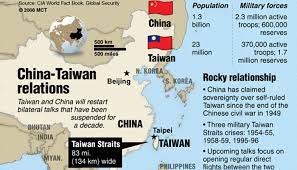
Trouble in Taiwan
Taiwan is not a country. Taiwan is an island off the coast of China much like Santa Catalina is an island off the coast of California. No one disputes that Santa Catalina is part of the United States, just as no one disputes that Taiwan is a part of China. The issue was settled long ago, and the US agrees with the results of that settlement. For all practical purposes, the issue has been resolved.
The United Nations does not recognize Taiwan’s independence nor do the 181 countries that have established diplomatic relations with China. In fact, the UN adopted a General Assembly Resolution back in 1971 acknowledging the “People’s Republic of China as the sole legal government representing the whole of China.”
The One-China policy explicitly relates to the status of Taiwan. Taiwan is part of China, that’s what the One-China policy means. Nations that want to have relations with China must agree on the status of Taiwan; it is the foundational principle upon which all relations with China are based. The issue is not debatable. One can either accept that ‘Taiwan is an inalienable part of China’s territory’ or take their business elsewhere. There is no third option.
The United States claims that it is committed to the One-China policy. In their recent visits to Beijing, all three senior-level officials from the Biden Administration (Anthony Blinken, Janet Yellen and John Kerry) publicly stated their unwavering support for the One-China policy. This is an excerpt from an article at Forbes:

Secretary of State Antony Blinken reiterated the U.S.’ position on its One China policy as he met with China’s leader Xi Jinping Monday, saying it does not support Taiwanese independence and that containing China’s economy was not an American goal….
Blinken said the U.S. held a “One China” policy and does not support Taiwanese independence, but is concerned about China’s “provocative actions” along the Taiwan Strait. Blinken Tells Xi Jinping U.S. Does Not Support Taiwanese Independence, After Meeting To Quell Tensions, Forbes
President Joe Biden has also stated his support for the One-China principle on many, many occasions, which is what you would expect since it is the official position of the United States government. Here’s a short recap on the issue from China’s Ministry of Foreign Affairs:
The US made the following commitments to China regarding the one-China principle in the three China-US joint communiqués.
In the Shanghai Communiqué released in 1972, the US explicitly stated that “The United States acknowledges that all Chinese on either side of the Taiwan Strait maintain there is but one China and that Taiwan is a part of China. The United States Government does not challenge that position”.
In the Joint Communiqué on the Establishment of Diplomatic Relations released in 1978, the US clearly stated that, “The Government of the United States of America acknowledges the Chinese position that there is but one China and Taiwan is part of China”.
In the August 17 Communiqué released in 1982, the US unequivocally stated that “In the Joint Communiqué on the Establishment of Diplomatic Relations on January 1, 1979, issued by the Government of the People’s Republic of China and the Government of the United States of America, the United States of America recognized the Government of the People’s Republic of China as the sole legal Government of China, and it acknowledged the Chinese position that there is but one China and Taiwan is part of China”, and that “it has no intention of infringing on Chinese sovereignty and territorial integrity, or interfering in China’s internal affairs, or pursuing a policy of ‘two Chinas’ or ‘one China, one Taiwan’”. (China’s Ministry of Foreign Affairs)
The western media would like their readers to think there is some “gray area” here and that the issue regarding China’s sovereign territory has not been settled. But—as we have shown—it has been settled. Taiwan is China. We must assume therefore that the media is being intentionally misleading in order to garner support for an “independence” movement that serves only one purpose; to legitimize the arming and training of US assets and insurgents that will be used in a bloody conflagration with China. In truth, the United States is laying the groundwork for a proxy-war on China, and Taiwan has been designated as the frontlines in that war. The independence movement is merely the cover Washington has chosen to conceal its real objectives.
This is why Taiwan has become a flashpoint in US-China relations. This is why numerous US-led delegations have visited Taiwan expressing their tacit support for Taiwan independence. This is why Congress has allocated millions of dollars to provide lethal weaponry for the Taiwanese military. This is why the US Navy has sent warships through the Taiwan Strait and conducted massive military drills on China’s perimeter. This is why Washington continues to provoke Beijing on the one issue that it is most sensitive. All of these incitements were conjured-up with one goal in mind: War with China. This is from Politico:
The Biden administration announced a $345 million weapons package for Taiwan on Friday, the first tranche in a total of $1 billion the U.S. has allotted to be transferred directly from Pentagon stockpiles to the island this year…..………………………………………………..
Repeat: “The move is sure to anger China.”
Indeed, the move was designed to anger China. That was clearly the point. But, why? Why is Washington challenging China on an issue on which there is virtually universal agreement?
- To goad China into overreacting and thus alienating itself from its allies and regional trading partners.
- To turn public opinion against China by portraying the country as a violent aggressor that poses a clear threat to its neighbors.
Here’s more from the World Socialist Web Site:
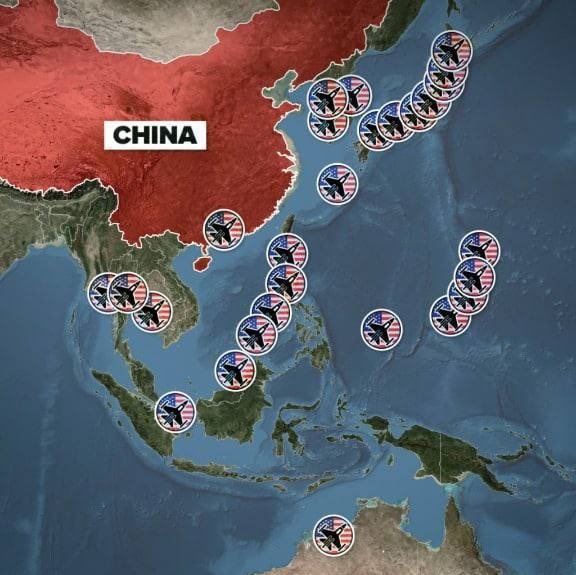
……………………………………………………………………………………………………………………………….. Preparing for war with China, US provides $345 million in arms to Taiwan,
Imagine if China sent millions of dollars of lethal weapons to a budding secessionist movement in Texas. ……………………………………………………………………………………………………………
And, ask yourself this: Haven’t we seen this drill before? Didn’t this same scenario unfold in Ukraine following the CIA-backed coup in 2014 after which the US armed and trained Ukrainian forces to dig-in and provoke hostilities with Russia?……………………………………………………………………………………………………………………………………………………………………………………
Let’s summarize:
- The Indo-Pacific is now America’s top foreign policy priority because that is the area that will experience the most growth
- The US will lead with its military and with the allies who share US interests
- “We will…modernize and strengthen our military” to prevail in our “strategic competition with major powers.”
- America’s Number 1 enemy is China; “the PRC presents America’s most consequential geopolitical challenge ….The PRC is the only competitor with both the intent to reshape the international order and, increasingly, the economic, diplomatic, military, and technological power to do it…”
- “The post-Cold War era is over” but the United States is prepared to preserve the “rules-based order” whatever the cost in blood and treasure.
This is America’s foreign policy in a nutshell. US leaders and their globalist allies are fully committed to prevailing in today’s great power struggle with Russia and China. They have a clear grasp of the objectives they want to achieve and they are prepared to risk anything, including nuclear war, to achieve them. Any developments in Taiwan must be seen through the lens of Washington’s geopolitical ambitions which are clearly driving events.…. more https://www.unz.com/mwhitney/target-china/
Japan claims that China and South Korea both pour radioactive waste-water , worse than Japan’s, into the oceans

Japan said Thursday that China and South Korea have both discharged liquid
waste containing high levels of tritium, a radioactive material, countering
Beijing’s criticism of Tokyo’s plan to release treated water from the
Fukushima nuclear power plant. Chief Cabinet Secretary Hirokazu Matsuno
also said Japan will explain to China “based on scientific perspectives”
the planned water discharge into the sea from the nuclear complex, crippled
by a devastating earthquake and ensuing tsunami in March 2011. Japan’s
standard for the release of tritium, at below 22 trillion becquerels per
year, is far stricter than that of other nations including its neighbors
China and South Korea, Matsuno, the top government spokesman, said at a
regular press conference.
In 2021, the Yangjiang nuclear plant in China
discharged around 112 trillion becquerels of tritium, while the Kori power
station in South Korea released about 49 trillion becquerels of the
radioactive material, Japan’s industry ministry said.
Japan Today 6th July 2023
Fukushima: China calls for suspension of Japanese plan to release radioactive water into sea.

Guardian, 4 July 23
Comments come as IAEA boss visits Japan to deliver results of safety report on planned discharge of nuclear-contaminated water
China has called for the suspension of a Japanese plan to begin releasing radioactive water from the tsunami-wrecked Fukushima nuclear plant into the sea, ahead of a UN report that is expected to give its approval to the scheme.
Beijing denounced the plan as “extremely irresponsible” when it was announced in 2021 and reiterated its opposition on Tuesday, as International Atomic Energy Agency (IAEA) chief, Rafael Grossi, begins a four-day visit in which he is set to deliver the results of the body’s safety review.
Through its embassy in Japan, China said the IAEA’s report cannot be a “pass” for the water release and called for it to be suspended.
Last week a spokesperson for the country’s foreign ministry said Beijing urged Japan to “take seriously both international and domestic concerns, stop forcibly proceeding with its ocean discharge plan” and “subject itself to rigorous international oversight”.
……… Local Japanese fishing communities have also objected to the plan, saying it will destroy more than a decade of work rebuilding their industry, with consumers likely to shun their catch and send prices plummeting.
Japan has not specified a date for the water release, which would take place over 30 to 40 years pending the IAEA’s final review and official approval from the national nuclear regulatory body for Tokyo Electric Power (Tepco). The regulatory body’s final word could come as early as this week………………… https://www.theguardian.com/world/2023/jul/04/fukushima-china-calls-for-suspension-of-japanese-plan-to-release-radioactive-water-into-sea
—
China joins the rush to market nuclear power to Turkey
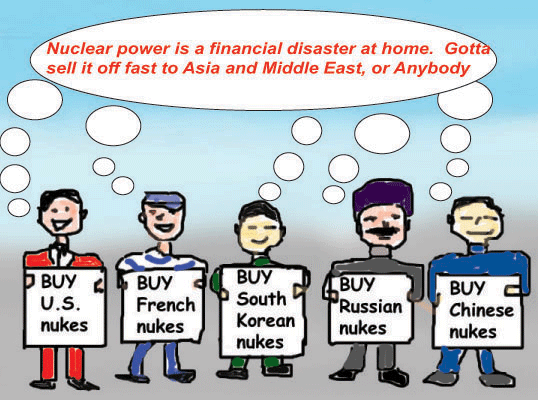
Türkiye in contact with China for planned 3rd nuclear plant’, BY DAILY SABAH WITH REUTERS, JUN 23, 2023
Türkiye is in contact with China regarding the construction of a planned third nuclear power plant (NPP) and is surveying sites for a fourth, a top ministry official said.
Russia’s Rosatom is building the country’s first nuclear power plant, Akkuyu NPP, in its southern Mersin province, with the first reactor expected to go online next year……………
Chinese astronauts install radiation-exposure experiment outside Tiangong space station
By Andrew Jones, 21 June 23, https://www.space.com/astronauts-install-radiation-experiment-china-tiangong-space-station
China plans to conduct radiation experiments on plant seeds, microorganisms and small animals.
China is running a biological radiation exposure experiment outside its space station.
The country’s Shenzhou 16 astronauts — Jing Haipeng, Zhu Yangzhu and Gui Haichao — installed the experiment outside the Tiangong space station‘s Mengtian science module on June 10, China’s National Space Science Center (NSSC) announced in a statement.
The experiment was deployed using Mentian’s dedicated payload airlock and attached to an external payload adapter using the space station’s small robotic arm.
The experiment payload contains 13 sample box units loaded with biomaterials. These are designed to study the impact of cosmic radiation and microgravity on organisms, the origin and evolution of life and the development of space radiation mutagenic resources.
The equipment can be used for in-orbit experiments on biological samples, including plant seeds, microorganisms and small animals, according to NSSC. The temperature inside each sample container unit can be adjusted to suit the organisms it is hosting.
On-orbit medical research involving space radiation biological exposure is of great significance to supporting China’s human spaceflight program. That program is ambitious, with plans to launch long-term crewed missions in Earth orbit and send people to the surface of the moon, the Chinese-language outlet Science and Technology Daily reported.
The experiment payload was developed jointly by the NSSC and Dalian Maritime University. It is intended to operate for five years and is planned to be used for several scientific projects.
The Shenzhou 16 crew arrived at Tiangong on May 30 and will remain aboard the space station until November.
Macao SAR to suspend Japanese food import after nuclear-contaminated wastewater discharge
An official at the Municipal Affairs Bureau (IAM) of the Government of Macao Special Administrative Region (SAR) said on Tuesday that it will immediately suspend food import applications from Japan’s nine prefectures, if the country releases nuclear-contaminated wastewater into the sea.
O Lam, acting chairman of the IAM, said in an interview that import suspension will be expanded to the country’s nine “highest-risk prefectures,” including Tokyo Metropolis and Chiba prefectures.
Products to be suspended will include aquatic products, vegetables and fruits.
Fresh and live food imported from other prefectures may be asked to attach a certificate on radiation monitoring and pass inspection before entering Macao SAR, she added…………………………more https://news.cgtn.com/news/2023-06-13/Macao-to-suspend-Japanese-food-import-after-nuclear-wastewater-release-1kBLwicliP6/index.html
2
China and Russia building most nuclear power plants, – the main goal is to market them to developing countries
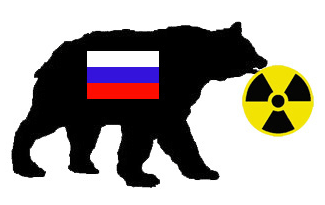
China and Russia account for 70% of new nuclear plants
Exports used as diplomatic card while Western nations fall behind
NAOYUKI TOYAMA, Nikkei staff writerJune 11, 2023
TOKYO — Russia and China are building up an outsized presence in the field of nuclear power, with the countries accounting for nearly 70% of reactors under construction or in planning worldwide.
…………………Notably, 33 of the reactors are being constructed or planned outside each respective country. Russia has the largest number of overseas reactors with 19, and despite growing opposition from Europe and the U.S. following its invasion of Ukraine, it maintains a strong global influence in nuclear power.
In April, Russian President Vladimir Putin participated remotely in a ceremony to mark the arrival of the first fuel at the under-construction Akkuyu nuclear power plant in Turkey………
Russia’s nuclear power diplomacy is extending to other countries as well. In May, Rosatom began full-scale construction on Unit 3 of the Dabaa nuclear plant in Egypt, the country’s first.
Hungarian Prime Minister Viktor Orban met with Rosatom officials this month to discuss the company’s plans to build a new nuclear power plant in the country’s south. Hungary opposes sanctions the European Union has imposed on Rosatom.
“Many developing countries take a positive view of Russia,” Kacper Szulecki of the Norwegian Institute of International Affairs told British scientific journal Nature Energy. Russia’s acceptance of spent nuclear fuel is also attractive to emerging countries.
Meanwhile, China is deepening its engagement with Pakistan………………………………..
China also plans to build a nuclear plant in Argentina…………………………………
The U.S., Japan and Europe are hoping to catch up using small modular reactors (SMRs), considered fourth-generation technology………………………………………..
Another issue is nuclear fuel. Uranium enrichment has become the weak link for Western nations. Enrichment facilities are limited, and Russia is the global leader for that process. In April, the U.S., the U.K., France, Canada and Japan formed a nuclear fuel alliance. While the aim is to shut out Russian fuel from Western reactors, doing so will not be easy.
https://asia.nikkei.com/Business/Energy/China-and-Russia-account-for-70-of-new-nuclear-plants
Hong Kong to ban seafood from high-risk regions near Fukushima if Japan dumps nuclear-contaminated water into ocean
Global Times, By GT staff reporters Jun 08, 2023
Hong Kong will ban seafood from high-risk regions near Fukushima at once if Japan starts to dump nuclear-contaminated water from its crippled Fukushima Daiichi nuclear power plant into the Pacific Ocean, said Hong Kong’s Environment and Ecology Bureau told the Global Times.
HK to ban seafood from high-risk regions near Fukushima if Japan dumps nuclear-contaminated water into ocean
Hong Kong will ban seafood from high-risk regions near Fukushima at once if Japan starts to dump nuclear-contaminated water from its crippled Fukushima Daiichi nuclear power plant into the Pacific Ocean, said Hong Kong’s environment chief on Thursday.
The Hong Kong Special Administrative Region has set up a special group to guarantee food security for residents, said Secretary for Environment and Ecology Tse Chin-wan, emphasizing that if Japan starts dumping the nuclear-contaminated wastewater, the government will take immediate measures to ban the import of aquatic products from high-risk regions along the Fukushima coast and to impose strict import controls on aquatic products from other risk regions in Japan…………………………………….more https://www.globaltimes.cn/page/202306/1292233.shtml
NATO official calls for transparency over nuclear weapons
By Greg Torode https://www.reuters.com/world/nato-official-calls-transparency-over-nuclear-weapons-2023-06-02/
Singapore, June 2 (Reuters) – A senior NATO official on Friday urged Beijing to be more open about its accelerating nuclear weapons build-up, saying that as a global power, China had a responsibility to improve transparency.
Angus Lapsley, the North Atlantic Treaty Organisation’s (NATO) Assistant Secretary General for Defence Policy and Planning, told the Shangri-La regional security conference in Singapore that NATO was willing to talk to China on the issue.
“As a global power it has a global responsibility to be more transparent,” Lapsley said, adding that the scale and pace of the Chinese build-up was “really striking”.
Lapsley said that NATO, with nuclear-armed members the United States, France and Britain, did not want to interfere in the region but wanted to engage, noting that China had a right to modernise and expand its arsenals.
“NATO is open to dialogue, but it can’t substitute dialogue between the U.S. and China,” he said.
Lapsley noted Pentagon reports that China’s arsenal is growing in size and sophistication, and U.S. officials have called for greater dialogue with China.
The Pentagon’s annual China report, released in November 2022, noted that Beijing’s nuclear programme had gathered pace and now has more than 400 operational nuclear warheads – a figure still far below U.S. and Russian stockpiles.
By 2035 – when China is aiming for its military to be fully modernised – China will likely possess a 1,500 nuclear warhead stockpile and an advanced array of missiles, the Pentagon says.
Although China was not represented on the panel, officers from the People’s Liberation Army in the audience questioned recent moves by the U.S. and its allies to provide nuclear-powered submarines to Australia and enhance South Korea’s protection.
One said estimates of its longer-term build-up were “imagination”.
A nuclear power since the early 1960s, China for decades maintained a small number of nuclear warheads and missiles as a deterrent under a “no first use” pledge that remains its official policy despite Beijing’s broader military modernisation under President Xi Jinping.
In a keynote speech of the three-day forum’s opening night, Australian Prime Minister Anthony Albanese said the ultimate goal of nuclear disarmament remained an important cause.
“The citizens of this region have shown an unflinching commitment to preventing the spread of these destructive, inhumane and indiscriminate weapons,” he said.
China swelters through record temperatures. And vulnerability of old people to heat waves

Temperatures across China reached or exceeded their records for the month
of May, the country’s National Climate Centre has said. Weather stations
at 446 sites registered temperatures that were the same as, or greater
than, the highest ever recorded for the month of May, deputy director of
the National Climate Centre Gao Rong said at a press briefing on Friday. On
Monday, the Shanghai Meteorology Bureau reported that the city had recorded
a temperature of 36.1 degrees Celsius. The previous record for May was
35.7C, which occurred in 2018. Over the next three days, most of southern
China is expected to be hit by temperatures of more than 35C, with
temperatures in some areas exceeding 40C, according to national forecasters
on Friday.
Guardian 2nd June 2023
New heatwave warnings could miss vulnerable older people who aren’t
online. Email alerts to warn public about dangers of hot weather will be
voluntary and will give advice on how to stay cool.
Telegraph 1st June 2023
https://www.telegraph.co.uk/news/2023/06/01/new-heatwave-warnings-not-nanny-state-health-officials/
1 This Month

of the week – Shut Down Drone Warfare!


Tell the Ukrainian Government to Drop Prosecution of Peace Activist Yurii Sheliazhenko

Petition to revoke the licensing of the Near Surface Nuclear Disposal Facility (NSDF) at Chalk River. https://www.ourcommons.ca/petitions/en/Petition/Details?Petition=e-7247
To see nuclear-related stories in greater depth and intensity – go to https://nuclearinformation.wordpress.com
-
Archives
- April 2026 (68)
- March 2026 (251)
- February 2026 (268)
- January 2026 (308)
- December 2025 (358)
- November 2025 (359)
- October 2025 (376)
- September 2025 (257)
- August 2025 (319)
- July 2025 (230)
- June 2025 (348)
- May 2025 (261)
-
Categories
- 1
- 1 NUCLEAR ISSUES
- business and costs
- climate change
- culture and arts
- ENERGY
- environment
- health
- history
- indigenous issues
- Legal
- marketing of nuclear
- media
- opposition to nuclear
- PERSONAL STORIES
- politics
- politics international
- Religion and ethics
- safety
- secrets,lies and civil liberties
- spinbuster
- technology
- Uranium
- wastes
- weapons and war
- Women
- 2 WORLD
- ACTION
- AFRICA
- Atrocities
- AUSTRALIA
- Christina's notes
- Christina's themes
- culture and arts
- Events
- Fuk 2022
- Fuk 2023
- Fukushima 2017
- Fukushima 2018
- fukushima 2019
- Fukushima 2020
- Fukushima 2021
- general
- global warming
- Humour (God we need it)
- Nuclear
- RARE EARTHS
- Reference
- resources – print
- Resources -audiovicual
- Weekly Newsletter
- World
- World Nuclear
- YouTube
-
RSS
Entries RSS
Comments RSS
 nuclear-news