China and Russia Issue Nuclear Warnings
CEPA. By Michael Sheridan, May 28, 2024
The leaders of Russia and China have jointly shifted their stance on nuclear weapons, signaling a move away from decades of cautious Chinese thinking.
The Chinese-Russian accord is significant because it was accompanied by a joint challenge to the West’s buildup of its alliances and military presence in the Asia-Pacific region.
While the nuclear element of the joint communique following the May 16 summit of Xi Jinping and Vladimir Putin was not trumpeted and received little media attention, the two countries spelled out points of agreement on issues of significance.
The backdrop is China’s accelerated expansion of its nuclear forces and new fields of missile silos, leading the Pentagon to predict it may more than triple its capability to 1,500 weapons by 2035.
While Beijing is believed to adhere to a historical pledge that it would not be the first to use nuclear weapons, its actual doctrine remains obscure, there is a worrying absence of military dialogue with its rivals and recent purges at the top of its nuclear forces add to the uncertainties.
Nonetheless, it is clear that President Xi sees nuclear weapons as pieces on the global chessboard in a way that no previous leader of the People’s Republic thought necessary or desirable. Mao Zedong himself dismissed the atomic bomb as “a paper tiger.”…………………………………………………………………………….
Xi and Putin expressed “serious concern” that the US “under the pretext of conducting joint exercises with its allies that are clearly aimed at China and Russia” was acting to deploy land-based intermediate-range missile systems in the Asia-Pacific region (possibly a reference to plans to sell 400 Tomahawk cruise missiles to Japan and defend the so-called first island chain that rings China’s coasts.)
They did not specify the systems referred to but warned the US and NATO against providing “extended deterrence” to individual allies. They also singled out the AUKUS pact tightening defense cooperation between the US, Britain, and Australia.
In unusually specific language, the two leaders warned against “building infrastructure in Australia, a signatory to the South Pacific Nuclear Free Zone Treaty, that could be used for US and British nuclear forces to conduct operations and to carry out US-UK-Australian nuclear submarine co-operation.”………………………………….. https://cepa.org/article/china-and-russia-issue-nuclear-warnings/
Rare spat shows China and North Korea still at odds on nuclear weapons
Japan Times, BY JOSH SMITH, SEOUL, May 29, 2024
North Korea’s rare swipe at China this week underscored how Beijing and Pyongyang do not entirely see eye-to-eye on the latter’s illicit nuclear weapons arsenal, despite warming ties in other areas, analysts and officials in South Korea said.
The North condemned China, Japan and South Korea on Monday for discussing denuclearization of the peninsula, calling their joint declaration after a summit in Seoul a “grave political provocation” that violates its sovereignty.
Even though Beijing helped tone down the statement by advocating mention of the peninsula rather than the North specifically, that was enough to raise its neighbor’s hackles, one analyst said.
“It is notable that North Korea criticized a joint statement that China had signed onto, even after Beijing helped water down the statement,” added Patricia Kim, of the Brookings Institution in the United States.
In their remarks, the three nations “reiterated positions on regional peace and stability, denuclearization of the Korean Peninsula” but unlike the last such statements in 2019 and earlier, did not commit to pursue denuclearization.
Since international talks with the United States and other countries stalled in 2019, North Korea has moved to reject the concept of ever giving up its nuclear weapons.
“This is about North Korea emphasizing its stance that any diplomatic rhetoric suggesting Pyongyang should eventually denuclearize is unacceptable,” said Tong Zhao, a nuclear expert at the Carnegie Endowment for International Peace.
“After enshrining its nuclear status in the constitution and reprimanding anyone who questions it, North Korea is raising demands for formal international recognition as a nuclear-armed country.”……………………………………… more https://www.japantimes.co.jp/news/2024/05/29/asia-pacific/politics/china-north-korea-nuclear-weapons/—
Xi outlines solution to Ukraine conflict
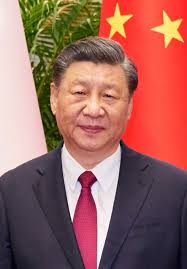
https://www.sott.net/article/491542-Xi-outlines-solution-to-Ukraine-conflict 19 May 24
Chinese President Xi Jinping has stressed that peace negotiations recognized by both Russia and Ukraine are the best way to end the ongoing conflict between the two nations.
Speaking during a meeting with Russian President Vladimir Putin on Thursday at the Chinese leader’s residential compound at Zhongnanhai, Xi argued that the entire global security architecture must be amended in order to end the fighting and avoid similar hostilities in the future, according to the Xinhua news outlet.
Putin is on his first state visit to China since he took office for the fifth time earlier this month.
Xi was cited as saying:
“China supports the timely convening of an international peace conference recognized by both Russia and Ukraine, with equal participation by all parties, and fair discussion of all options. Beijing is willing to aid in brokering the peace talks.”
“Global powers must address both the symptoms and the root cause [of the conflict], and we must consider both the present and the long term.
“The fundamental solution to the Ukraine crisis is to promote the construction of a balanced, effective, and sustainable new security architecture.”
Beijing has repeatedly rejected Western pressure to join in the condemnation of Russia over the Ukraine conflict. Since last year, China has been promoting a peace formula consisting of 12 points, including the cessation of hostilities and unilateral sanctions, mutual respect for national security concerns and the sovereignty of nations, and the rejection of a ‘Cold War’ mentality.
Kiev has rejected the formula as unrealizable because it does not demand a retreat of Russian forces from territories Kiev claims as its own. Ukraine has long insisted that a peace settlement can only be achieved on its terms, which include a return of all former Ukrainian territories, the withdrawal of Russian troops, and an international tribunal for Russian leaders.
Kiev’s Western backers plan to hold a summit on the Ukraine conflict in Switzerland next month, to which Russia has not been invited. Beijing has yet to officially confirm whether it will send a delegation.
Russia has welcomed China’s proposed peace formula from the start, having repeatedly stressed that it remains open to a political solution to the conflict. In an interview with Xinhua ahead of his visit to China, Putin said Beijing’s initiative showed “the genuine desire… to help stabilize the situation” in the region. He added that he would endorse the formula as it calls for a dialogue based on mutual consideration of the interests of all sides involved in the conflict, including Russia.
U.S. rejects China’s proposal to ban first use of nuclear weapons.
People’s World May 16, 2024 BY JOHN WOJCIK, MARK GRUENBERG AND BEN CHACKO
The U.S. has dismissed Chinese calls for a no-first-use treaty between nuclear weapons states, saying it has questions about China’s “sincerity.”
The outright dismissal of China’s proposal followed a major speech in which Biden announced radical tariffs of up to 100 percent, on steel imports from China. That speech follows months of U.S. military buildup in the waters off the coast of China, including the placement of additional nuclear submarines around the Korean peninsula, all in the name of “protecting” Taiwan, which is, of course, a part of China itself.
Undersecretary of State Bonnie Jenkins, the country’s top arms control official, told the Senate Foreign Relations Committee last night that the U.S. worried China had increased its number of nuclear warheads to over 500, might have 1,000 by 2030, and that this was proof that the country was not “sincere” about its proposal to ban first use of the apocalypse-engendering weapons.
The Biden administration’s claim that China had increased the number of its warheads to 500 is just that – an unverified claim. In addition, the U.S. has 12 times that number with an admitted 3,700 of such warheads.
The U.S. says China refuses to engage in nuclear disarmament talks with it. China actually has engaged in talks, first by discussing with the U.S. the need for the U.S. to reduce its outrageously large number of missiles, as compared to China’s number, to show it is serious about fairness. And now it has added to those talks with its proposal to ban the first use of the weapons.
China’s position is that it has an arsenal that is tiny in comparison with that of the United States and that the size of the arsenals has to be part of serious talks. China has also gotten India to sign a no-first-use deal between those two countries. While all these initiatives by China were underway the U.S. was busy unilaterally canceling nuclear arms deals between the U.S. and Russia and continuing to push expansion of NATO not just up to the borders of Russia but into the Pacific regions near China.
China also stores its warheads and delivery systems separately, to avoid the risk of launches by accident or misunderstanding, as almost happened in 1983, when Soviet lieutenant Stanislav Petrov recognized reports of incoming U.S. missiles as a system malfunction and prevented a retaliatory strike which could have begun World War III.
The new, highest-ever U.S. tariffs on Chinese products were announced by President Biden shortly before the Chinese peace initiatives were rejected by his administration. The tariffs would apply to government-subsidized Chinese steel, aluminum, solar cells, electric vehicles—rising to 100% tariffs this year—and their batteries, semiconductors, and some raw materials.
The Biden tariffs are much higher than the Trump tariffs that Biden opposed when Trump was president……………………………… more https://peoplesworld.org/article/u-s-rejects-chinas-proposal-to-ban-first-use-of-nuclear-weapons/—
China and Russia Disagree on North Korea’s Nuclear Weapons
Beijing and Moscow have different perspectives on – and different appetites for – Pyongyang’s nuclear program.
The Diplomat, By Wooyeal Paik, May 15, 2024
China has been ambivalent about North Korea and its strategic behaviors for the last few decades, leading scholars in China to describe North Korea as both “strategic asset” and “strategic liability.” North Korea, China’s sole military ally with an official treaty, the Sino-North Korean Treaty of Friendship, Cooperation, and Mutual Assistance, signed in 1961, has proved tough to handle, if not outright volatile, for its security and economic patron.
Nonetheless, North Korea’s geopolitical importance to China as a buffer state against the United States and its East Asian allies (South Korea and Japan) has not lessened. Even in the era of high-tech weapons such as missiles, military satellites, nuclear submarines, and fifth-generation fighter jets, all of which serve to reduce the strategic value of physical buffer zones, it is still effective and valuable for China not to confront the mighty hostile power, the United States, on its immediate land border. Ground forces are still the ultimate military presence, and sharing a border with a U.S. allied, unified Korea would also come at a psychological cost for China.
Beyond its role as a buffer state, North Korea’s value as leverage or a bargaining chip for China in Beijing’s relations with South Korea and the United States has been well recognized. In 2024, however, China may consider adding another layer to this leverage by supporting North Korea’s nuclear program, as Russia has done.
North Korea is a de facto nuclear state with a set of viable delivery mechanisms including intercontinental ballistic missiles (ICBMs) and submarine-launched ballistic missiles (SLBMs).
This nuclear element of the Kim regime has been regarded as the quintessential reason for an ever-growing regional security instability in Northeast Asia and beyond.
For China, North Korea – and particularly its nuclear program – is a strategic liability. China prioritizes stability in its neighborhood, but North Korea purposefully pursues instability right next to China. This conflict of interests between the treaty allies exacerbates Chinese national security concerns, particularly regarding the United States and its hub-and-spoke system in the Indo-Pacific area.
In response to North Korea’s rapid nuclear and missile developments, the United States has significantly ramped up its military presence on and around the Korean Peninsula, in consultation with its ally, South Korea. That includes the regular deployment of strategic (i.e., nuclear-capable) U.S. assets to the region, something China is not comfortable with.
Russia, however, takes a different view. Over the past year, Moscow has shifted its strategic approach to the North Korea’s nuclear capability and provocations, from viewing them as a nuisance that disrupts the Non-Proliferation Treaty (NPT) regime to a tactical countermeasure against the United States. From Russia’s perspective, distracting the U.S. – the primary military and economic presence as the NATO leader – is a goal unto itself, as Washington is a major obstacle to Russia’s desire to conquer Ukraine and influence the post-Soviet Central and Eastern Europe.
Russia has been importing North Korean weapons – 152 mm artillery ammunition,122 mm multiple rocket launcher ammunition, and other conventional weapons – for use against Ukraine. In return, it’s widely believed that North Korea receives Russia’s technical assistance for the research and development of advanced space and weapons technologies: nuclear-powered submarines, cruise and ballistic missiles, military reconnaissance satellites. North Korea also receives food and energy in addition to rare international support for its pariah regime.
Russia actively endorses North Korea as a nuclear state and supports its “legitimate” use of nuclear weapons for its self-defense and beyond. As Kim Jong Un embraces a lower nuclear threshold, Russian President Vladimir Putin and his ruling elites have also expressed their willingness to employ low-yield tactical nuclear weapons against Ukraine and European NATO countries.
Thus, North Korea has evolved into a double-layered tool for Russia, acting as both a buffer state and a nuclear threat against the United States in Northeast Asia and Europe. This accelerates the convergence of security between Indo-Pacific and Euro-Atlantic regions.
Despite Russia’s high-profile advances with North Korea, China is still thought to be the only nation with significant influence over Pyongyang. ……………………………………………………….. more https://thediplomat.com/2024/05/china-and-russia-disagree-on-north-koreas-nuclear-weapons/
China and the U.S. Are Numb to the Real Risk of War.

Like China, the United States is mired in jingoism and confusion. Like China, it has no idea what it would do if things go wrong.
With the 2024 U.S. presidential election heating up, the one thing every candidate, Democrat or Republican, has done is to show how tough they could get on China.
Like China, the United States is mired in jingoism and confusion. Like China, it has no idea what it would do if things go wrong. With the 2024 U.S. presidential election heating up, the one thing every candidate, Democrat or Republican, has done is to show how tough they could get on China.
The pair are dangerously close to the edge of nuclear war over Taiwan—again.
May 12, 2024, By Sulmaan Wasif Khan, the Denison chair of international history and diplomacy at Tufts University’s Fletcher School. https://foreignpolicy.com/2024/05/12/china-us-taiwan-strait-war-nuclear-weapons-military-biden-xi-history/
On the morning of April 5, 2023, Taiwan’s president, Tsai Ing-wen, met with then-U.S. House Speaker Kevin McCarthy in Simi Valley, California. This was a meeting Beijing had warned against in the strictest of terms. It was therefore a meeting that both sides found necessary to have. China had to be shown that it could not dictate whom either Taiwan or the United States met with. On this, both Taipei and Washington were agreed.
China delivered on its promised forceful response by engaging in military drills and sending warships and planes scudding around Taiwan. The median line and Taiwan’s air defense identification zone were breached. One aircraft carrier, the Shandong, entered the waters just south of Japan. Violations of the “One China” principle, Beijing had to make clear, were not going to be taken quietly. And in seeking to make that clear, it deepened the risk of war.
This article is adapted from The Struggle for Taiwan: A History of America, China, and the Island Caught Between by Sulmaan Wasif Khan,
Commentators dismissed Beijing’s response to the Tsai-McCarthy meeting as less intense than the one that had attended then-U.S. House Speaker Nancy Pelosi’s visit to Taiwan in 2022. But the dismissal itself highlighted the gravity of the problem. A certain level of military activity had become normalized. It was as though the world now took for granted the presence of missiles and aircraft carriers, the shows of force that demanded a response in kind. The week after the meeting in California, the United States and the Philippines launched their largest joint military exercise to date. It was a way of showing China that there were other militaries that could operate in the region. The new normal meant more ships and planes operating in close proximity to one another, mutual recrimination, and mutual suspicion.
Beijing and Washington have become desensitized to the risk these circumstances pose. But in the militarization of foreign policy and the failure to grasp the full significance of that militarization, the pair are one accident and a bad decision removed from a catastrophic war. Mathematicians speak of the “edge of chaos”: the final point separating order from doom. A system operating at this edge has no room for error. This is where the accumulated weight of the past has brought the United States, China, and Taiwan. They walked right up to the edge of a war that could go nuclear several times in the past: in 1954-55, 1958, and 1996. Now, they seem to be living on that edge permanently.
In recent years, China’s policy has alienated Taiwan completely. As China has bullied, threatened, and displayed force at home and abroad, it has made unification unacceptable to much of the Taiwanese electorate. And it has enjoyed only mixed success in trying to isolate Taiwan diplomatically. It has managed to buy off many of Taiwan’s erstwhile allies, but its conduct over COVID-19 and support for Russia despite the invasion of Ukraine have cost it friends, too—and those former friends have turned to the island across the strait.
Since at least 2021, Taiwan has had a seemingly endless parade of visitors, from Germany’s education minister to Liz Truss, the former U.K. prime minister. In November 2021, the European Parliament sent its first official delegation to the island; the head of the delegation, Raphaël Glucksmann, told Tsai, “We in Europe are also confronted with interference from authoritarian regimes and we came here to learn from you.” In October 2022, Tsai received lawmakers from Lithuania and Ukraine; the former had recently established a representative office in Taiwan despite Beijing’s anger, while the latter was making a gesture of solidarity with a country that, unlike China, had been sharp in its criticism of Moscow. A Japanese parliamentary delegation that arrived in December 2022spoke glowingly of Tsai’s defense plans and emphasized Japan’s own determination to keep the status quo in the region from being “changed by force or unilaterally.” China has warned against or condemned many of these visits.
Beijing has only itself to blame for Taiwan’s strengthened diplomatic position. Its wolf warrior nationalism and reluctance to break with Moscow have cost it European support. If visits from foreign politicians were to translate into condemnation of China at the United Nations, Beijing could veto a Security Council resolution. In this case, like Russia, China would find itself a pariah state—and unlike Russia, China cares about how it is seen by the world. China’s own corrosive nationalism has eaten into its body politic, too It has not torn itself apart in a bout of political bloodletting, but it has certainly let loose the kind of jingoism that would allow that to happen. What it will decide to do in a crisis is uncertain. Beijing itself does not know.
The United States, meanwhile, seems intent on reviving a defense treaty with Taipei that it once spent more than a decade trying to break. Taiwan has become a means of showing China just how tough the United States can get. Washington is not clear on how getting tough will alter Beijing’s conduct, but “deterrence” is the concept invoked most often. A show of force, the thinking goes, will deter China from aggression. But what if deterrence fails? What if the show of force backs China into a corner from which it feels it has no option but to lash out? To this, Washington has few answers beyond preparing for war.
Some U.S. pundits have waxed lyrical about how they would fight a war with China. Taiwan, they opined, will be turned into a “porcupine” with hardened defenses. One former defense official suggested the use of “low-yield tactical nuclear weapons” in the event of a conflict with China. (The bombs dropped on Hiroshima and Nagasaki qualify as low yield.) The possibility of Russian President Vladimir Putin using such weapons sent shock waves of horror through the world, but the idea of employing them in a war with China became normal in some circles. There was no guarantee that, once the nuclear taboo was breached, the weapons would stay “low yield.” But the question of what would happen if the two powers escalated to higher-yield arms and plunged the world into nuclear holocaust has been left unresolved.
It is as though the United States is being haunted by all the ghosts of its long past with China and Taiwan, forcing it to relive questions it had once thought resolved. U.S. military leader Douglas MacArthur wanted to wage war against China in 1950. President Dwight D. Eisenhower considered using nuclear weapons against China in 1955 and 1958. Today, Washington abides by the “One China” principle, but it wants Taiwan to enjoy “self-determination.” It vows that it does not dispute the formulation that Taiwan is a part of China, but it will help Taiwan resist Chinese coercion. It wishes to promote Taiwan’s presence in international organizations, but it remains unwilling to recognize Taiwan itself. The United States has shifted from pure ambiguity to ambiguity with a tilt in favor of Taiwan—and it has done so because it decided China is an enemy.
Like China, the United States is mired in jingoism and confusion. Like China, it has no idea what it would do if things go wrong. With the 2024 U.S. presidential election heating up, the one thing every candidate, Democrat or Republican, has done is to show how tough they could get on China. Republicans vying for the nomination got in on the act early; former President Donald Trump has denounced French President Emmanuel Macron for “kissing Xi’s ass,” referring to Chinese leader Xi Jinping. Joe Biden, with the power of the incumbent, has not stopped at rhetoric. Whether supporting a TikTok ban unless the app is sold or calling for increased tariffs on Chinese goods, his policies are calibrated to demonstrate toughness on China.
Taiwan’s own presidential elections, held on Jan. 13, showed just how deeply the island’s electorate had turned against unification. At first, William Lai, the candidate from Tsai’s Democratic Progressive Party (DPP), vowed not to alter the status quo, though he accused Beijing of doing so. Taiwan, he argued, was already sovereign. There was no need to change what worked. But his caution soon vanished. While campaigning, Lai defined success for Taiwan as its leaders being able to visit the White House. This was a gauntlet thrown down—Taiwanese officials are blocked from visiting Washington. The Biden administration immediately demanded an explanation. This was not, U.S. officials made clear, how the relationship worked. Where Tsai had been prudent, Lai was willing to push his luck.
The Kuomintang (KMT), the main opposition party, was not leaning toward Beijing, either. Its nominee, Hou You-yi, the mayor of New Taipei City, said that he would reject both “one country, two systems” and a formal move for independence, but that if Taiwan were attacked, he would face the challenge. Taiwan, according to Hou, needed to be ready to defend itself. On the crucial question of how to deal with China, there was little difference between the policies Lai and Hou espoused.
A third candidate, Ko Wen-je of the Taiwan People’s Party, was calculatedly vague on China policy. His campaign made clear that he was depending on votes from traditional KMT supporters: those who would have favored a closer relationship with China. He claimed that he would find the middle ground between the KMT’s appeasement of China and the DPP’s provocation of it; he would make Taiwan a bridge for Sino-American communication rather than a front in a Sino-American war. How he proposed to do all this was left undefined.
Lai eventually won the presidency, but it was not the ringing triumph Tsai had won four years earlier. Lai scraped through with a mere 40 percent of the vote, his victory made easier by the fact that Hou and Ko had failed to join forces. As he prepares to take office on May 20, Lai faces a deeply divided, volatile populace and a legislature in which the DPP is bereft of a majority.
This is a point China has been quick to underline. The DPP, it huffed after the election, is not representative of “majority public opinion.” What is lost on Beijing is that the other candidates made clear that unification was not something they were willing to countenance either. Hou had made a point of not inviting Ma Ying-jeou, the last KMT member to serve as Taiwan’s president, to his rallies; he knew that to associate himself with Ma’s embrace of China would have doomed his candidacy. Beijing still does not understand Taiwan. Meanwhile, the United States continues to disavow support for Taiwanese independence while making plans for further delegations to the island. With the U.S. presidential election going into fifth gear, the risk of miscalculation will only rise.
At the edge of chaos, a single choice can make the difference between order and catastrophe. More than 80 years on from the Cairo Declaration, which held that Taiwan would be “restored to the Republic of China” at the end of World War II, we can see that there were myriad moments that could have yielded different outcomes, for better or for worse. If President Franklin D. Roosevelt had insisted on self-determination for Taiwan after World War II, if the Korean War had not happened, if Beijing had made “one country, two systems” work, if Taiwan had developed a nuclear weapon, if Pelosi’s plane had indeed been shot at—if someone had made a different decision at any of those moments, the world would be a radically different place.
When deterrence, toughness, and pride drive policy, the room for error diminishes to virtually nil. China, Taiwan, and the United States are at a point where the choices they make could spell the difference between peace and nuclear holocaust. Those choices are best made with the historical record—and all its unrealized possibilities—firmly in mind.
A Closer Look at Two Operational Small Modular Reactor Designs
There are literally dozens of small modular reactor (SMR) and microreactor designs being developed by different companies around the world, and some of the work has been going on for decades. Yet, only two designs have actually been built and put into commercial operation. POWER takes a closer look at both of them.
Power, by Aaron Larson 1 May 24
Many nuclear power supporters have long thought small modular reactors (SMRs) would revolutionize the industry. Advocates expect SMRs to shorten construction schedules and bring costs down through modularization and factory construction. They often cite numerous other benefits that make SMRs seem like no-brainers, and yet, only two SMR designs have ever been built and placed in commercial operation.
The International Atomic Energy Agency (IAEA) publishes booklets biennially on the status of SMR technology. In the IAEA’s most recent booklet, it notes 25 land-based water-cooled SMRs and another eight marine-based water-cooled designs are under development globally. It also lists 17 high-temperature gas-cooled SMRs, eight liquid-metal-cooled fast-neutron-spectrum SMRs, 13 molten-salt SMRs, and 12 microreactors. If you do the math, that’s 83 SMR designs under development, but only the KLT-40S and HTR-PM are actually operational.
KLT-40S
The KLT-40S is a pressurized water reactor (PWR) that was developed in Russia. It is an advanced version of the KLT-40 reactor, which has been used in nuclear-powered icebreakers. The first KLT-40S units, and, to date, the only two of these units to enter commercial operation, were deployed in the Akademik Lomonosov—the world’s first purpose-built floating nuclear power plant (FNPP, Figure 1 on original).
Main Design Features.………………………………………………………………………………………………………….
Deployment Details.…………………………….
Construction and testing of the FPU was completed in 2017 at the Baltic shipyard. In May 2018, the vessel was towed 4,000 kilometers (km), around Finland and Sweden, to Murmansk, completing the first leg of its journey to Pevek. Fuel loading was completed in Murmansk in October 2018. First criticality was achieved in November 2018, then in August 2019, the vessel embarked on the second leg of its journey—a distance of 4,700 km—towed by two tugboats to the Arctic port town of Pevek, where it was connected to the grid on Dec. 19, 2019. Akademik Lomonosov was fully commissioned on May 22, 2020, and it currently provides heat to the town of Pevek and supplies electricity to the regional Chaun-Bilibino power system.
HTR-PM
On Dec. 6, 2023, China National Nuclear Corp. announced it had commenced commercial operation of the high-temperature gas-cooled modular pebble bed (HTR-PM) reactor demonstrator. The HTR-PM project was constructed at a site in Rongcheng, Shandong Province, roughly midway between Beijing and Shanghai in eastern China…………………………………
Main Design Features.…………………………………………………………………………………………………..
Deployment Details.……………………………………………………………………. The civil work for the nuclear island buildings was completed in 2016 with the first of two reactor pressure vessels installed in March that year. The fuel plant reached its expected production capacity in 2017. Startup commissioning and testing of the primary circuit were finished by the end of 2020. The HTR-PM achieved first criticality in September 2021, and was ultimately grid connected on Dec. 20, 2021.
Spotty Results at Best
While it is laudable that these SMRs—the KLT-40S and HTR-PM—have been placed in commercial operation, their performance since entering service has come under fire. In The World Nuclear Industry Status Report 2023 (WNISR), a Mycle Schneider Consulting Project, co-funded by the German Federal Ministry for the Environment, Nature Conservation, Nuclear Safety, and Consumer Protection, it says both designs have operated at low capacity factors recently.
Concerning the Chinese HTR-PM, the WNISR says, “Between January and December 2022, the reactors operated for only 27 hours out of a possible maximum of 8,760 hours. In the subsequent three months, they seem to have operated at a load factor of around 10 percent.” The Russian units’ performance has been nearly as dismal. “The operating records of the two KLT-40S reactors have been quite poor. According to the IAEA’s PRIS [Power Reactor Information System] database, the two reactors had load factors of just 26.4 and 30.5 percent respectively in 2022, and lifetime load factors of just 34 and 22.4 percent. The reasons for the mediocre power-generation performance remain unclear,” the report says.
Meanwhile, the promises of shortened timelines and lower costs were not borne out by these projects. “The experience so far in constructing these two SMRs as well as estimates for reactor designs like NuScale’s SMR show that these designs are also subject to the historical pattern of cost escalations and time overruns. Those cost escalations do make it even less likely that SMRs will become commercialized, as the collapse of the Carbon Free Power Project involving NuScale reactors in the United States illustrated,” the WNISR says………….. https://www.powermag.com/a-closer-look-at-two-operational-small-modular-reactor-designs/
Blinken threatens China over Russia ties (VIDEO)
https://www.sott.net/article/490922-Blinken-threatens-China-over-Russia-ties-VIDEO 26 Apr 24
The US Secretary of State says Washington is prepared to impose more sanctions on Beijing over the alleged transfer of military components.
Washington is ready to introduce more sanctions against China over its alleged transfer of dual-use goods and components, which can supposedly be used by the Russian military industrial complex, US Secretary of State Antony Blinken said on Friday.
Speaking at a press conference in Beijing following his meeting with Chinese President Xi Jinping, the US official recalled that Washington has already imposed sanctions against more than 100 Chinese entities and is “fully prepared to act” and “take additional measures.”
Blinken claimed that China’s alleged support for the Russian defense industry raises concerns not only about the situation in Ukraine, but also about a “medium to long-term threat that many Europeans feel viscerally that Russia poses to them.”
Earlier this week, the Wall Street Journal had also reported that the US was drafting sanctions that could cut off some Chinese banks from the global financial system unless Beijing severs its economic ties with Russia.
Earlier this week, the Wall Street Journal had also reported that the US was drafting sanctions that could cut off some Chinese banks from the global financial system unless Beijing severs its economic ties with Russia.
The outlet claimed that US officials believe trade with China has allowed Russia to rebuild its military industrial capacity and could help it defeat Ukraine in a war of attrition.
Beijing has vehemently rejected accusations of “fueling” the Ukraine conflict and has instead blamed NATO for instigating the crisis by continuing its expansion in Europe and refusing to respect Russia’s national security concerns.
Following his meeting with Blinken, President Xi suggested that the US and China “should be partners, not rivals” and should strive towards achieving “mutual success and not harm each other.”
“I proposed three major principles: mutual respect, peaceful coexistence, and win-win cooperation. They are not only a summary of past experience, but also a guide to the future,” the Chinese leader was quoted as saying.
Beijing has maintained a policy of neutrality on the Ukraine conflict, with Chinese officials repeatedly stating that the country is not selling weapons to either Russia or Ukraine. Earlier this month, Chinese Foreign Ministry spokesman Mao Ning insisted that China “regulates the export of dual-use articles in accordance with laws and regulations,” urging “relevant countries” not to “smear or attack the normal relations between China and Russia.”
In December last year, US President Joe Biden issued a decree which enabled sanctions on foreign financial institutions that continue to deal with Russia. It targeted lenders outside US and EU jurisdictions that help Russia source sensitive items, which reportedly include semiconductors, machine tools, chemical precursors, ball bearings, and optical systems.
Tens of thousands evacuated from massive China floods
Authorities have evacuated nearly 60,000 people from their homes in
Guangdong, as days of heavy rain caused massive flooding in China’s most
populous province. Eleven people have gone missing, while no casualties
have been reported so far.
Footage on state media and online show large
swathes of land inundated by the floods and rescuers ferrying people on
lifeboats in waist-deep water. Several major rivers have burst their banks,
and authorities are closely monitoring “dangerously high” water levels.
They had warned that the level of a river in northern Guangdong could hit a
“once in 100 years” peak on Monday morning, though this had yet to
materialise by noon.
BBC 22nd April 2024
The short march to China’s hydrogen bomb
Bulletin, April 11, 2024. (very lengthy historic and technical detail. Good graphics)
On December 28, 1966, China successfully conducted its first hydrogen bomb test—only two years and two months after the successful explosion of its first atomic bomb. In so doing, China became the fastest among the five initial nuclear-weapon states (the United States, Russia, China, the United Kingdom, and France, collectively known as P5) to pass from its first atomic bomb explosion to a first hydrogen bomb detonation.
There is still very limited knowledge in Western literature about how China built its first H-bomb. Based on newly available information—including Chinese blogs, memoirs, and other publicly available publications—this account reconstructs the history of how China made a breakthrough in understanding hydrogen bomb principles and built its first H-bomb—without foreign help.
Beyond the previously untold story of China’s early exploration of the hydrogen bomb theory, the article also explores in detail the so-called “100 days in Shanghai”—a milestone of China’s hydrogen bomb development—and describes the efforts that led to a series of three nuclear tests that happened in 1966 and 1967 and that are often called “the trilogy” of the H-bomb development in China.
Early explorations
Moscow’s broken promise
China officially started its nuclear weapon program on January 15, 1955.[1] About two years later, China and the Soviet Union signed the New Defense Technical Accord in Moscow. Under that agreement, Moscow would provide Beijing with a prototype of an atomic bomb model and relevant technical materials. In June 1959, however, as many major relevant facilities in the Chinese nuclear weapon program were at the peak of construction, Soviet-Sino relations deteriorated,[2] and Moscow sent a letter to Beijing formally announcing it would not provide the promised model and data. From the second half of 1959 onward, the Second Ministry of Machine Building Industry—China’s government ministry overseeing the nuclear industry—followed central government policy and relied on the country’s own capabilities to complete the task of developing the atomic bomb.[3]
In early 1960, the weaponeers of the Beijing institute of nuclear weapon research—called the Ninth Institute and placed under the leadership of the Second Ministry[4]—started to explore atomic bomb science and technology. As those weaponeers started working hard on the atomic bomb program, then-Minister of the Second Ministry Liu Jie began considering ways to conduct the nation’s hydrogen bomb development. ……………………………………………………………………………………………………………………………………………………………………………………………………………………………
On January 7, 1965, Liu Jie delivered a speech at the meeting of the Second Ministry, conveying Mao’s new instructions to the audience: “If we have hydrogen bombs and missiles, wars may not be fought, and peace will be more secure. We make the atomic bombs but will not be too many. It will be used to scare [enemies] and embolden [ourselves].” Mao also said that “it still needs three years to have the hydrogen bomb, which is too slow.” [23]
……………………………………… On February 3, 1965, the Second Ministry set the goal of testing the first hydrogen bomb device in 1968.[25]………………………………………………
…………………From February 1965 onward, the weaponeers tried different routes and proposed different ideas, but none was successful. ………………………………………………………………………
Gathering in Shanghai
In late September 1965, Yu Min and over 50 researchers gathered in Shanghai for what may have been the most intense period in the development of the hydrogen bomb………………….
……………………………….For nearly 100 days—and nights—all the physicists, mathematicians, and research assistants gathered in Shanghai would arrange shifts and take turns in the computer room around the clock to solve problems.[43]
…………………………………………………………………………….The group in Shanghai also continued the optimization design work of the boosted three-phase hydrogen aerial bomb.
Finally, in early January 1966, the researchers returned to Beijing with the new hydrogen bomb principle they had sought so hard for nearly 100 days and nights in Shanghai.
Testing the Bomb
………………………………………………..A new two-year plan included preparations for three nuclear tests that aimed for a breakthrough in confirming the H-bomb principle.
………………………….Low-yield hydrogen bomb (device 629).………………………………………………………………………………………………On December 28, 1966, the hydrogen bomb device 629-1 successfully exploded.[70]
………………..Third test: Full-yield hydrogen bomb (device 639)
…………………………………………………………………………………………..On June 17, 1967, China successfully conducted its first hydrogen bomb (device 639) air-burst test, which was coded operation 21-73……………………………..
more https://thebulletin.org/2024/04/the-short-march-to-chinas-hydrogen-bomb/?utm_source=Newsletter&utm_medium=Email&utm_campaign=MondayNewsletter04152024&utm_content=NuclearRisk_ChinaHydrogenBomb_04112024
There Is No Grudge That Cannot Be Resolved, China’s Xi Jinping Tells Former Taiwan President Ma Ying-jeou in Momentous Beijing Meeting
“[There is] [n]o problem that cannot be talked through. And there are no forces that can separate us,” Xi Jinping said.
By Diego Ramos ScheerPost, https://scheerpost.com/2024/04/10/there-is-no-grudge-that-cannot-be-resolved-chinas-xi-jinping-tells-former-taiwan-president-ma-ying-jeou-in-momentous-beijing-meeting/
In a historic meeting marking mainland China’s first reception of a former or serving Taiwanese president, President Xi Jinping and former Taiwanese president Ma Ying-jeou engaged in a dialogue of peace and unity in Beijing on April 10.
Amidst heightened tensions between China and Taiwan, mentions of war are commonplace but according to Ma, “If there’s war, it would be unbearable to the Chinese nation, and the two sides of the [Taiwan] strait have the wisdom to handle their disputes peacefully.”
This echoes Xi’s assertion that the two governments can converse and resolve issues: “Compatriots on the two sides are both Chinese. There is no grudge that cannot be resolved. No problem that cannot be talked through. And there are no forces that can separate us.”
Xi, alluding to reunification, also made reference to “foreign interference,” which, according to him, could not get in the way of a “family reunion.”
The meeting comes a month before William Lai Ching-te, current Taiwanese vice president and president-elect, is set to step into office. Despite being part of the independence-favoring Democratic Progressive Party, the South China Morning Post (SCMP) reports that Beijing does not see significance in the party’s electoral victory.
Zhu Songling, a Taiwan affairs specialist at Beijing Union University, told SCMP that the talks came at a favorable time, citing president-elect Lai’s approaching inauguration. Songling also said Ma’s reception in Beijing signaled the Chinese government’s willingness and resolve to peacefully settle the cross-strait issues.
“Since Ma is not in office, many of his ideas may not be implemented in concrete terms, but in general this [meeting] is still of great significance,” Zhu said, mentioning Ma’s continued influence in the Beijing-friendly Kuomintang (KMT) party.
Towards the end of Ma’s “journey of peace,” another KMT leader, former mayor of Taipei Hau Lung-bin, also plans to visit mainland China, with the possibility of meeting with Xi as well.
Hau is set to visit Zhengzhou and take part in the annual cultural spectacle that pays tribute to the Yellow Emperor. The tribute honors Chinese ancestry and heritage and Hau said his visit “emphasise[s] the fact that the people from both sides of the Taiwan Strait share the same root, the same origin, and the same historical and cultural backgrounds, which should go beyond political differences.”
“It would be unreasonable for the cross-strait relations to end up in a military crisis or dangerous war caused by political manipulation,” Hau also mentioned.
China’s quiet energy revolution: the switch from nuclear to renewable energy
By Derek Woolner and David Glynne Jones, Apr 6, 2024 https://johnmenadue.com/chinas-quiet-energy-revolution-the-switch-from-nuclear-to-renewable-energy/
There is now a policy dispute about the roles of nuclear and renewable energy in future Australian low emission energy systems. The experience of China over more than a decade provides compelling evidence on how this debate will be resolved. In December 2011 China’s National Energy Administration announced that China would make nuclear energy the foundation of its electricity generation system in the next “10 to 20 years”. Just over a decade later China has wound back those ambitious targets and reoriented its low emission energy strategy around the rapid deployment of renewable solar and wind energy at unprecedented rates.
Australia has seen a campaign against the use of renewable energy technologies and for the benefits of nuclear energy in developing Australia’s future low emission energy systems. The Federal Opposition has now adopted this position as their policy. The recent experience of China provides a compelling commentary on this decision.
In December 2011 China’s National Energy Administration (NEA) announced that China would make nuclear energy the foundation of its electricity generation system in the next “10 to 20 years”, adding as much as 300 gigawatts (GWe) of nuclear capacity over that period.
This was followed by a period of delay as China undertook a comprehensive review of nuclear safety in the aftermath of the Fukushima nuclear disaster.
Subsequently, moderated nuclear energy targets were established, aiming for a nuclear energy contribution of 15% of China’s total electricity generation by 2035, 20-25% by 2050 and 45% in the second half of the century.
However by 2023 it was becoming clear that China’s nuclear construction program was well behind schedule. The target for 2020 had not been achieved, and targets for subsequent 5-year plans were unlikely to be achieved.
In September 2023 the China Nuclear Energy Association (CNEA) reported that China was now aiming to achieve a nuclear energy contribution of 10% by 2035, increasing to around 18% by 2060.
The CNEA also indicated that ‘greenlighting’ of new construction would now be at the rate of 6-8 large nuclear power reactors per year – not the 10 per year previously targeted for 2020-2035 and beyond. This will result in new nuclear generation increasing by 60-80 terawatt-hours (TWh) annually.
Meanwhile the deployment of renewable energy (primarily solar and wind energy) was dramatically accelerated in 2023, with the installation of 217GWe of new solar capacity and 70GWe of new wind capacity.
This represents an increase of around 400TWh in annual low emission generation – the quantitative equivalent of 40 large nuclear power reactors, or four times the average annual output of the Three Gorges Dam hydroelectric system (the world’s largest power station).
In 2023 energy analysts started reporting that China was now expected to achieve or exceed its 2030 target of 1200GWe for the total installed capacity of solar and wind energy by 2025, and was now planning to triple the 2030 objective, to reach 3900GWe.
Previously China expected that its energy emissions would peak in 2030, but revised forecasts are now indicating that this could happen as early as 2024, 5-6 years ahead of target.
By the end of 2023 it was clear that nuclear energy was no longer going to be the foundation of China’s future electricity generation system, and that this task had shifted to renewable energy.
So what has happened? There’s no single answer, but two key factors appear to be at play.
The first is the emergence of renewable energy technologies at competitive scale and cost since 2011.
Between 2011 and 2022, the cost of solar PV modules declined by 85%, wind energy costs by 60-70%, and battery costs by 90%.
China now dominates the global production of solar PV panels, wind turbines and batteries, with costs expected to continue to decline significantly for the foreseeable future while performance improves.
The consequence is that renewable energy generation can now be deployed economically at rates five to eight times faster than nuclear energy, which is constrained by logistical and regulatory capability, safety, site availability and other factors.
The second is the slow delivery of new nuclear generation which contributed to continued ‘greenlighting’ of new coal-fired generation to underwrite energy security, as it became clear that deployment rates for new low emission electricity generation were insufficient to blunt demand from provincial governments for new coal-fired generators, even though many existing plants are operating at uneconomically low capacity factors
By 2035, under the original plan, combined nuclear, solar and wind generation would have been comparable to current coal generation but insufficient to meet significantly increased new electricity demand.
Under the new plans, combined solar, wind and nuclear generation is likely to match current coal generation and meet new demand, with solar and wind energy contributing around 85% of this low emission generation.
By 2030 another factor will come into play, with China’s battery giant CATL developing long duration utility battery systems that will provide dispatchable electricity from renewable sources at competitive or lower costs than either coal or nuclear generated electricity.
The central message here is that even in China – the world’s largest industrial economy and preeminent builder of advanced civil infrastructure in the 21st century – nuclear energy cannot compete with renewable energy to deliver low emission electricity generation at the deployment rates needed to meet mid-century emission targets.
1
Xi Jinping’s Thoughts on China’s Nuclear Weapons

Xi noted the increased readiness those new silos might provide was necessary to prepare to respond to foreign military intervention. That sounds more defensive than aggressive. ……………….. China’s long-standing commitment not to use nuclear weapons first at any time or under any circumstances.
UCS is concerned about the future direction of Chinese nuclear weapons policy. We agree with Gen. Cotton that “the PRC’s long-term nuclear strategy and requirements remain unclear.” We urge influential US voices, including the media, to refrain from encouraging the public, and especially US decision-makers, to jump to conclusions the available evidence does not support. We also urge the Biden administration, and the US Congress, to wait until they have a clearer understanding of Chinese nuclear thinking before making precipitous decisions about the future of the US nuclear arsenal.
April 1, 2024, Gregory Kulacki, China Project Manager, This blog was co-authored with UCS China analyst Robert Rust. https://blog.ucsusa.org/gregory-kulacki/xi-jinpings-thoughts-on-chinas-nuclear-weapons/
Last month UCS published a critique of a New York Times article that claimed Chinese military strategists, “are looking to nuclear weapons as not only a defensive shield, but as a potential sword — to intimidate and subjugate adversaries.” We examined the evidence and found it did not support that claim.
However, there was one piece of evidence in the article we could not examine; a speech by Chinese leader Xi Jinping to China’s Second Artillery in December of 2012. It operates China’s conventional and nuclear missiles and was renamed the People’s Liberation Army Rocket Force in 2016. We’ve since obtained a copy of that speech and found it doesn’t support the New York Times claim either. There is no language in Xi’s speech that suggests he thinks about the purpose of China’s nuclear arsenal differently than his predecessors.
We posted the original Chinese text with an English translation. It is classified as an “internal publication” that should be “handled with care.” It was printed and distributed to all Chinese military officers at the regimental level and above by the General Political Department of the People’s Liberation Army (PLA) in February 2014.
Why is this speech worth reading?
UCS first learned about the speech ten years ago when a Chinese colleague drew our attention to language in a commentary on the speech by generals Wei Fenghe and Zhang Haiyang, the commander and party secretary of the Second Artillery at the time. Our colleague noticed it contained new language describing the alert level of Chinese missiles. He thought the two officers might be trying to influence Xi’s thinking. UCS took note of that the new language in our 2016 report on a possible change in China’s nuclear posture.
That report concluded China may shift some of its nuclear forces to what is called a “launch on warning” or “launch under attack” alert status that would give Chinese leaders the option to launch those nuclear missiles quickly before they could be destroyed by an incoming attack. Traditionally, China kept its nuclear missile force off-alert, and the Second Artillery trained to launch a retaliatory nuclear strike only after being struck first. Currently, China is believed to keep most of its nuclear warheads in storage, separated from the missiles that carry them, to prevent an accidental or unauthorized launch.
Although China may still be moving to a launch on warning posture, the full text of Xi’s December 2012 speech, and the phrase it contains related to alert levels, reveals Xi did not discuss nuclear strategy or announce an intention to put Chinese nuclear forces on alert. He addresses more general concerns about the combat readiness, ideological orientation, and human qualities of Chinese military officers. Every Chinese head of state since 1842, when the United Kingdom defeated Imperial China in the Opium War, shared the same concerns. Xi did not say anything new, specific, or surprising. There is no language in his speech that justifies the suggestion he communicated aggressive new nuclear ambitions that day.
What did Xi say?
Continue readingJapan confirms experts met in China to ease concerns over discharge of treated radioactive water
Japan said Sunday its experts have held talks with their Chinese
counterparts to try to assuage Beijing´s concerns over the discharge of
treated radioactive wastewater from the wrecked Fukushima Daiichi nuclear
power plant into the sea. The discharges have been opposed by fishing
groups and neighboring countries especially China, which banned all imports
of Japanese seafood. China´s move has largely affected Japanese scallop
growers and exporters to China. During the talks held Saturday in the
northeastern Chinese city of Dalian, Japanese officials provided
“science-based” explanation of how the discharges have been safely carried
out as planned, according to the Japanese Foreign Ministry.
Daily Mail 31st March 2024
Experts from Japan and China held talks on treated radioactive wastewater
Experts from Japan and China held talks on treated radioactive wastewater
being released from the Fukushima No. 1 nuclear power plant, the Foreign
Ministry in Tokyo said late Saturday, in the first public announcement of
such a meeting.
The two Asian powerhouses have faced off over the issue
since Japan began releasing the water into the Pacific Ocean last August,
with Beijing — a major importer of Japanese seafood — slapping a ban on
all such products immediately after.
Japan Times 31st March 2024
https://www.japantimes.co.jp/news/2024/03/31/japan/politics/fukushima-china-japan-experts
1 This Month

of the week – Shut Down Drone Warfare!


Tell the Ukrainian Government to Drop Prosecution of Peace Activist Yurii Sheliazhenko

Petition to revoke the licensing of the Near Surface Nuclear Disposal Facility (NSDF) at Chalk River. https://www.ourcommons.ca/petitions/en/Petition/Details?Petition=e-7247
To see nuclear-related stories in greater depth and intensity – go to https://nuclearinformation.wordpress.com
-
Archives
- April 2026 (57)
- March 2026 (251)
- February 2026 (268)
- January 2026 (308)
- December 2025 (358)
- November 2025 (359)
- October 2025 (376)
- September 2025 (257)
- August 2025 (319)
- July 2025 (230)
- June 2025 (348)
- May 2025 (261)
-
Categories
- 1
- 1 NUCLEAR ISSUES
- business and costs
- climate change
- culture and arts
- ENERGY
- environment
- health
- history
- indigenous issues
- Legal
- marketing of nuclear
- media
- opposition to nuclear
- PERSONAL STORIES
- politics
- politics international
- Religion and ethics
- safety
- secrets,lies and civil liberties
- spinbuster
- technology
- Uranium
- wastes
- weapons and war
- Women
- 2 WORLD
- ACTION
- AFRICA
- Atrocities
- AUSTRALIA
- Christina's notes
- Christina's themes
- culture and arts
- Events
- Fuk 2022
- Fuk 2023
- Fukushima 2017
- Fukushima 2018
- fukushima 2019
- Fukushima 2020
- Fukushima 2021
- general
- global warming
- Humour (God we need it)
- Nuclear
- RARE EARTHS
- Reference
- resources – print
- Resources -audiovicual
- Weekly Newsletter
- World
- World Nuclear
- YouTube
-
RSS
Entries RSS
Comments RSS
 nuclear-news