China keen to market nuclear technology overseas
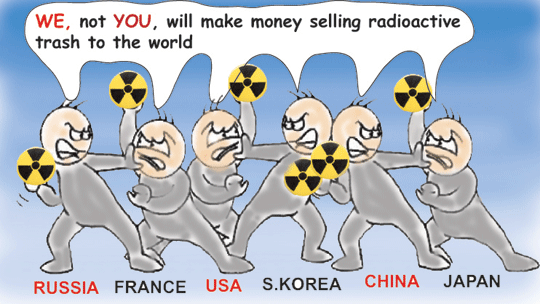
 Eyeing future exports China aims to become world’s top nuclear power producer by 2030 TETSUYA ABE, Nikkei staff writer BEIJING, 10 October 15 — Chinese President Xi Jinping’s government is poised to greatly expand the country’s nuclear power generation, with plans to build six to eight new reactors a year over the next five years.
Under its 13th five-year national development plan, which starts in 2016, China will invest 500 billion yuan ($78.7 billion) to introduce domestically developed reactors. The new five-year plan is to be formally adopted at next spring’s annual session of the National People’s Congress, China’s parliament……….
According to the China Nuclear Energy Association, there are 25 nuclear reactors operating in the country and a further 26 under construction. Under its current five-year plan, China has frozen new nuclear projects, in principle, in the wake of the 2011 nuclear disaster at Japan’s Fukushima Daiichi nuclear power plant.
In addition to unfreezing new projects, China will lift a ban on nuclear projects in inland areas and promote the introduction of domestically developed reactors under its next five-year plan. China hopes to make nuclear reactors a major infrastructure export in the future, along with high-speed trains. http://asia.nikkei.com/Politics-Economy/Policy-Politics/China-aims-to-become-world-s-top-nuclear-power-producer-by-2030
Nuclear power building – UK’s worry of China’s poor health and safety record

 nuclearnews No 2 nuclear power Oct 15 ..…….. it is China’s poor health and safety record which is most worrying. With the power of the Chinese Government and the UK Government’s enthusiasm for Chinese money the concern is that the UK’s nuclear regulators will be sidestepped.
China’s health and safety standards have been thrust into the spotlight this year by a series of chemical explosions. An explosion at a chemical plant in the eastern Chinese province of Shandong shortly before midnight on 31st August 2015 was the second to occur at a chemical plant in Shandong province in a matter of days.
Although no casualties were reported, the blast happened about a fortnight after explosions in the port city of Tianjin, northern China, which killed over 145 people. In the wake of the Tianjin blast, the Communist Party has sacked the head of China’s safety regulator, who was previously the vice mayor of the city. Shortly after, 12 government officials and company executives were detained. (6)
 According to Ben Chu, author of ‘Chinese Whispers: Why Everything You’ve Heard About China is Wrong, the disaster in Tianjin was the latest consequence of a system that places personal profit before public safety. He says in China today behind every industrial accident lies a reeking morass of corruption.
Chinese state media reported that the son of a former local police chief was secretly a joint owner of the Tianjin warehouse that went up in a devastating fireball last week, killing 145 people, injuring 674 and damaging some 17,000 homes. He used his official connections to obtain licences for the warehouse, even though it flagrantly breached regulations prohibiting the storage of hazardous chemicals (sodium cyanide in this case) near residential areas. (7)
Serious questions about China’s involvement in Britain’s new nuclear power projects
 Serious issues for George Osborne on China’s role in the UK’s nuclear future The Conversation, Jeffrey Henderson Professor of International Development, University of Bristol October 5, 2015 George Osborne will address the Conservative party conference on Monday fresh from a sales trip to Beijing. His efforts to drive more trade between the two nations saw Chinese state-owned companies invited to participate in the development of nuclear generating plants in Britain. They will have the chance to work with French state-owned company, EDF at Hinkley Point, Somerset and will be the sole operators at Bradwell, Essex. The move has already attracted doubts but there are other vital issues that have yet to be aired. These can be crystallised into five clear questions that Osborne and his government must answer.
Safety concerns
Two Chinese companies are involved with Hinkley Point: China National Nuclear Corporation (CNNC) and China General Nuclear Power Corporation (CGN). The latter was responsible, under its previous guise (China Guangdong Nuclear Power) for building and running China’s first nuclear station, Daya Bay, near Hong Kong. It was initially improperly built – with reinforcement rods missing from the concrete base under the reactor – and there have since been reports of minor leakages of radioactive materials (though this is difficult to check, given China’s lack of transparency).
The deeply corrupt environment in which many Chinese companies operate compounds the possibility of these companies being lax on safety measures and it’s simply not good enough to say that Britain has one of the tightest nuclear safety regimes in the world. Confronted with the power of the Chinese government and the British government’s enthusiasm for unceasing flows of Chinese investment, the risk must be that the regulatory agency will be sidestepped or unable to cope………
Who builds what and with which workers?
The public needs to know whether Chinese construction companies will be involved in building Hinkley Point and other power stations and, if so, whether they will seek to use workers from China. ……..
One of the companies involved at Hinkley Point – China National Nuclear – produces China’s nuclear weapons. This means that as well as the Communist Party, CNNC is almost certainly controlled by the People’s Liberation Army (as all Chinese military-related companies are). Given geopolitical uncertainty (with rising tensions between China, Japan and the US over China’s territorial claims in the East and South China Seas), allowing such a company anywhere near Britain – not to mention in an industry as strategic as power generation – verges on the insane. Has MI5 been consulted on this, and if it has, what was its advice?
At its heart, the question of Chinese state (and thus Communist Party) involvement in Britain’s power generation, is a matter of national security. In its desire to help financial services (the only economic sector it privileges) penetrate the Chinese market, the government’s nuclear quid pro quo means it is set to embark on a potentially very dangerous path. Had this deal been negotiated by Jeremy Corbyn as prime minister, the media would have been wondering if he were in the pay of the Chinese government. But George Osborne? Surely not.
Osborne may address some of these concerns in Monday’s speech, but it seems unlikely. In any case, before any binding commitments are made, it’s vital that the government’s proposal be opened up to public debate and subject to parliamentary scrutiny. https://theconversation.com/serious-issues-for-george-osborne-on-chinas-role-in-the-uks-nuclear-future-48541
USA nuclear weapons department helping China develop thorium reactors, despite their military uses
 The U.S. government lab behind China’s nuclear power push HONG KONG |REUTERS Dec 20, 2013 Scientists in Shanghai are attempting a breakthrough in nuclear energy: reactors powered by thorium, an alternative to uranium.
The project is run by the Chinese Academy of Sciences, a government body with close military ties that coordinates the country’s science-and-technology strategy. The academy has designated thorium as a priority for China’s top laboratories. The program has a budget of $350 million. And it’s being spearheaded by the influential son of a former Chinese president.
But even as China bulks up its military muscle through means ranging from espionage to heavy spending, it is pursuing this aspect of its technology game plan with the blessing – and the help – of the United States. China has enlisted a storied partner for its thorium push: Oak Ridge National Laboratory. The U.S. government institute produced the plutonium used for the Manhattan Project and laid important groundwork for the commercial and military use of nuclear power.
The Tennessee lab, as it happens, helped pioneer thorium reactors. The Pentagon and the energy industry later sidelined this technology in favor of uranium……..
Thorium’s chief allure is that it is a potentially far safer fuel for civilian power plants than is uranium. But the element also has possible military applications as an energy source in naval vessels. A U.S. congressman unsuccessfully sought to push the Pentagon to embrace the technology in 2009, and British naval officers are recommending a design for a thorium-fueled ship.
In a further twist, despite the mounting strategic rivalry with China, there has been little or no protest in the United States over Oak Ridge’s nuclear-energy cooperation with China……..
Although it does not yield byproducts that can be readily used to make weapons, thorium does have military applications.
The fuel could be used to power Chinese navy surface warships, including a planned fleet of aircraft carriers. China’s nuclear submarine fleet has struggled with reactor reliability and safety, according to naval commentators, and thorium could eventually become an alternative.
Top British naval engineers last year proposed a design for a thorium reactor to power warships. Compact thorium power plants could also be used to supply reliable power to military bases and expeditionary forces.
Thorium also has military potential for the United States, experts say……..
China and UK joining in promoting new nuclear technology
China, UK to fund nuclear research centre http://www.world-nuclear-news.org/NN-China-UK-to-fund-nuclear-research-centre-25091502.html 25 September 2015
China and the UK will work together to co-fund a £50 million ($78 million) nuclear research centre, to be headquartered in the UK. Chinese vice premier Ma Kai and British chancellor George Osborne announced the plan on 21 September during the 7th UK-China Economic and Financial Dialogue summit in Beijing.
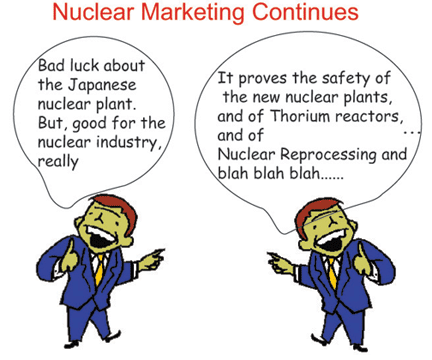
The Chancellor also announced a regional collaboration agreement between Cumbria and Sichuan Province, deepening commercial ties between the province and the north west of England’s expertise in nuclear decommissioning and waste management. These developments followed a landmark announcement by Osborne the same day that the UK government would provide up to £2 billion ($3 billion) in support for the planned Hinkley Point C nuclear power plant, which China may participate in.
The UK’s National Nuclear Laboratory (NNL) said on 22 September that it will jointly lead the new UK-China Joint Research and Innovation Centre (JRIC) with the China National Nuclear Corporation (CNNC).
The JRIC – which will incorporate projects in a number of different areas of work across the whole nuclear fuel cycle – will “act as a portal to allow UK companies and academic organizations and their Chinese counterparts to work together on areas of mutual benefit and will support the development of Subject Matter Experts and others with higher level skill in both countries,” NNL said.
Over the coming months NNL and CNNC will work together to establish a program of work for the JRIC and to develop links with other UK bodies including the Nuclear Advanced Manufacturing Research Centre (NAMRC), the National Skills Academy for Nuclear (NSAN), the Nuclear Innovation and Research Advisory Board (NIRAB) and key UK universities working in the nuclear sector.
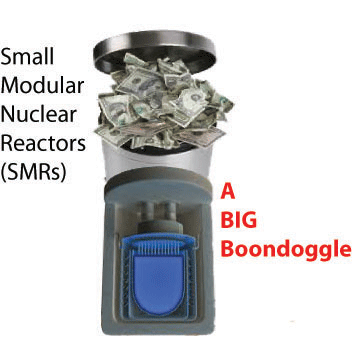 Professor Andrew Sherry, chief scientist at NNL, wrote in a blog on the Department of Energy and Climate Change’s website that there is a strong case for exploring the potential of next generation nuclear technologies. “There is scope for developing new reactor concepts including small and modular reactors, which can provide both electricity and potentially heat, and also for considering even more advanced reactors which can be powered with reprocessed spent fuel to make more efficient use of the uranium fuel, and generate less nuclear waste,” he said. “These advances will need targeted research across the UK, drawing together universities, national laboratories and industry and linking effectively with the international community.“
Britain uncomfortably close to Chinese control of nuclear power system
 The China syndrome, Economist, 25 Sept 15 Britain’s nuclear plans look over-expensive and over-reliant on China “…….. Already the £24.5 billion project to build a nuclear power station called Hinkley Point C in Somerset is expected to finish over-budget and beyond the projected start date of 2023, if it ever starts at all. But on September 21st, after unveiling in Beijing a £2 billion inducement to China to help finance Britain’s first reactor in 20 years, George Osborne exposed himself to further criticism. The country should lead the way on nuclear power as it did in the 1950s, he said. But the implication was, it could only do it with China’s help (see Bagehot).
Critics say this reveals a whiff of desperation about the government’s bet on a nuclear renaissance, ………
Analysts say Mr Osborne is engaged in a complex manoeuvre to ensure that two Chinese firms help finance EDF. The £2 billion guarantee is one inducement. Another is an offer for China to build a reactor of its own at Bradwell in Essex. That has set off further alarm bells, though. Not only would it test confidence in Britain’s Office for Nuclear Regulation, it would also put a critical part of the nuclear industry and the national grid into Chinese hands.
Roland Vetter of CF Partners, an energy trader, doubts a go-ahead for the China project will come soon; licensing new nuclear technology in Britain takes years. It could be a strategic gambit, though. EDF’s boss in Britain, Vincent de Rivaz, notes that British and French companies are keen to help China, which has an ambitious programme of its own to build nuclear power plants. Mr Osborne may also calculate that Hinkley Point will create numerous jobs and building opportunities, the economic benefits of which would accrue quickly.
The costs, meanwhile, would not become apparent until the plant is completed and bills rise. Future governments would reap the fallout, not this one. http://www.economist.com/news/britain/21667932-britains-nuclear-plans-look-over-expensive-and-over-reliant-china-china-syndrome
Anxieties in China over the safety of the nation’s nuclear power programme
 China resumes nuclear power plant construction after a four-year freeze By Zhang Yu Source:Global Times Published: 2015-6-15“…China recently ended its pause for approvals of nuclear power plants put into place after the 2011 nuclear accident in Japan. This year, as many as eight nuclear power plants may be launched in China. Some experts are warning that this is going too fast with controversial technology…….
Since 2004, China has been approving projects using advanced nuclear power reactors, including US-based Westinghouse’s AP1000 and France-based Areva’s EPR (Evolutionary Power Reactor), many of which are now under construction. Dubbed generation III reactors, they are designed to withstand the crisis that damaged the Japanese nuclear plant.
Construction of these projects has not been smooth. Sanmen Nuclear Power Station in Zhejiang Province was expected to be the first nuclear power plant in the world that uses AP1000 technology. The first of the two reactors was scheduled to finish construction and start operation in November 2013, but construction is now over 18 months behind schedule. The plant won’t start operation until 2016 at the earliest, an official from China’s State Nuclear Power Technology, the company building the power plant, said in January.
The company has struggled to keep its schedule because of constant changes in design and new problems that emerged during tests, previous reports said.
In a statement by the economic planner of Zhejiang Province in 2013, its energy department said the delay has slowed down the province’s nuclear development and affected the power supply plan in Zhejiang. It has also undermined China’s overall plan to make AP1000 its major technology in new nuclear plants……..
She said hydroelectricity and other new energy means should be developed in inland areas. “Nuclear shouldn’t play an important role in China’s energy structure,” she said.
“The rapid speed of China’s nuclear expansion, and the direction it is expanding – to the most populous inland areas – is unprecedented…Besides, China’s nuclear industry has a tendency to exaggerate its achievements to the central government, so as to gain more funding,” He told the Global Times.
He also warns of a nuclear accident when the total number of nuclear power plants reaches 50 – the total number of nuclear plants built and under construction in China.
“According to past experiences, the likelihood of a disaster rises sharply after a country runs over 50 nuclear power plants, as is the case in the US and Japan,” he said……..http://www.globaltimes.cn/content/927146.shtml
UK govt on brink of sealing Hinkley and Sizewell nuclear deal with China
David Cameron gives go ahead to build Chinese nuclear reactor in ESSEX http://www.express.co.uk/news/uk/603390/China-nuclear-reactor-Essex-nuclear-power
DAVID Cameron is poised to sign a landmark deal next month to allow China to build a prototype nuclear reactor in Bradwell, Essex – which would become the first Chinese-operated facility in the West.
 The plant is the price Beijing wants in return for its agreement to help pay for two new plants to be built by France’s EDF Energy – one at Hinkley Point in Somerset and the other at Sizewell, Suffolk.
EDF has admitted that Hinkley Point – Britain’s first atomic power station in almost two decades – is already facing delays. It was originally scheduled to open in 2017, but disputes over how it will be funded have held up the start of work – with EDF admitting it would not open before 2024. Problems with the EPR reactor design have also halted progress.
However, David Cameron is adamant to get the project off the ground – which is at the core of the Government’s drive to replace Britain’s ageing fossil fuel plants with low-carbon alternatives.
A similar EDF plant in Flamanville, France, has gone three times over budget and fallen six years behind schedule.
Hinkley Point, which will be twice as big, is on course to become the world’s most expensive power station.
The Chinese – who are currently have 26 nuclear power reactors in operation – are vital to Britain’s low-carbon initiative.
Whitehall officers are said to be hammering out the final details of an agreement under which two of Beijing’s state power companies – China General Nuclear and China National Nuclear Corporation – will take a large minority stake in Hinkley Point. They would also become junior partners, and cover part of the costs for a follow-on plant at Sizewell.
The construction and operation of both sites would be led by EDF.
In return for Beijing’s support on those plants, EDF would sell its right to a development site it owns at Bradwell.
The French, who would become a minority partner, would assist the Chinese through Britain’s approval process for a new reactor design – which the Chinese would use as a selling point as it bids to become the world leader in nuclear technology.
The Chinese design is expected to be capable of producing one gigawatt of electricity – enough to power 1m homes.
Hinkley Point will comprise of two larger EPR reactors – each with a capacity of 1.6GW – which will generate seven per cent of Britain’s electricity needs.
However, the plans for the nuclear plant have stirred controversy because of the huge subsidies the Government has agreed to pay EDF and its Chinese partners – which will be tacked on to taxpayers’ household bills and pay out until 2060.
The starting rate of £92.50 per megawatt hour of power produced is more than double the current wholesale rate and will rise every year with inflation.
A growing number of critics have begun to lobby against Hinkley Point.
Tianjin explosion highlights need to prioritise environment over economic growth
 Tianjin blast must trigger real change in China, The Age, August 18, 2015 Hopefully, the thundering fireballs and devastation at Tianjin have shocked China’s authorities – and others in the world
China’s economic advances have come at a terrible cost to its environment.
The evidence is in its air, in the rivers and coastal waters, and in the vast tracts of farmlands so contaminated with heavy metals and pesticides that some senior offi- cials have warned they should never be used for food production. In 2014, a report by China’s Ministry of Environmental Protection noted almost 20 per cent of the country’s arable land is polluted.
Criminally lax regulations, corruption and widespread failures to enforce breaches of environmental laws add to the woes and fuel justifiable anger among Chinese people. But more than any other environmental disaster in China (and there have been far too many), the series of explosions that ripped through the major port of Tianjin last week galvanised attention on the awful risks of elevating profit goals and economic advancement above the environment and citizens’ safety……….. http://www.theage.com.au/comment/the-age-editorial/tianjin-blast-must-trigger-real-change-in-china-20150817-gj19t1.html#ixzz3jClGQ9na
China’s race to clear dangerous chemicals from Tianjin explosion site
China warehouse explosion: Tianjin workers race to clear site of deadly chemicals before it rains Fears potential showers could create clouds of toxic gas. Chinese officials face a race against time to clear toxic chemicals from the site of the Tianjin warehouse explosion, amid fears the blast may have released hundreds of tons of toxic gas into the air.
Soldiers have joined rescue workers in gas masks and hazard suits in the port city where the death toll from Wednesday’s massive explosion has risen to 112. Another 95, the majority of whom were firefighters, remained missing.
Officials confirmed the warehouse where the blast occurred was used to house more than 100 tons of sodium cyanide, a potentially deadly substance.
The presence of the chemicals was confirmed by Shi Luze, the chief of staff of the People’s Liberation Army’s Beijing Military Region.
He said workers were trying to clear the area before possible rain showers, which could create toxic gas……..http://www.independent.co.uk/news/world/asia/china-warehouse-explosion-tianjin-workers-race-to-clear-site-of-deadly-chemicals-before-rains-10457786.html
China censors Internet on Tianjin explosion news
China’s censors crack down on online chatter about the Tianjin explosions, Shanghaiist.com, 16 Aug 15 Aside from some wind-related misinformation leaking through, China’s censors have managed to maintain that tight control of the Chinese internet we have come to expect following disasters like the Tianjin explosions, liberally expunging thousands upon thousands of “dangerous” tweets.
Many Weibo posters have claimed that their posts on the disaster have “disappeared”. With just two days gone by since the blast and so little reliable information available, it is hard to discern if China’s PR team are simply deleting inaccurate and potentially harmful rumors—like that pollutants from the explosions will be blown to Beijing—or are harmonizing potentially inconvenient truths.
The top 10 most censored terms on Free Weibo, which captures all messages censored or deleted on the social media platform, are almost entirely made up of some combination of “Tianjin” and “explosion.”……..
China Digital Times has published Chinese media directives about how best to report/bury the disaster: “Remove news and images from the explosions from headlines.” Reporters are also forbidden to write posts about the explosions on their personal Weibo and WeChat accounts.

However, some conversations are still allowed to go on…….http://shanghaiist.com/2015/08/14/chinas-censors-crack-down-online-chatter-tianjin-explosion.php
France worried that China’s hasty nuclear power programme is unsafe
“the state of conservation” of large components like pumps and steam generators at Taishan “was not at an adequate level” and was “far” from the standards of the two other EPR plants, one in Finland and the other in Flamanville, France
in a rare public comment about safety concerns, China’s own State Council Research Office three years ago warned that the development of the country’s power plants may be accelerating too quickly.
Critics of China’s nuclear safety regime, including Albert Lai, chairman of The Professional Commons, a Hong Kong think tank, says that lack of information risks eroding confidence in safety controls in what’s set to be a 14-fold increase of atomic capacity by 2030.
“The workings of China’s atomic safety authority are a ‘‘total black box,’’ said Lai. ‘‘China has no transparency whatsoever.’’
 China Regulators ‘Overwhelmed’ as Reactors Built at Pace, Bloomberg Tara Patel, Benjamin Haas , June 20, 2014 (Bloomberg) — China is moving quickly to become the first country to operate the world’s most powerful atomic reactor even as France’s nuclear regulator says communication and cooperation on safety measures with its Chinese counterparts are lacking.
In the coastal city of Taishan, 100 miles (160 kilometers) from the financial hub of Hong Kong, Chinese builders are entering the final construction stages for two state-of-the-art European Pressurized Reactors. Each will produce about twice as much electricity as the average reactor worldwide.
France has a lot riding on a smooth roll out of China’s EPRs. The country is home to Areva SA, which developed the next-generation reactor, and utility Electricite de France SA, which oversees the project. The two companies, controlled by the French state, need a safe, trouble-free debut in China to ensure a future for their biggest new product in a generation. And French authorities have not hidden their concerns. Continue reading
Questions on the causes and effects of the Tianjin explosion
Tianjin explosions ignite barrage of questions, The Age, Philip Wen China correspondent for Fairfax Media, August 14, 2015 Tianjin: As fatalities continue to mount, so too have questions around the cause, response and potential health effects of the terrifying explosions at a toxic chemicals warehouse that tore through the port city of Tianjin, China, on Wednesday night.
Chinese authorities have dispatched more than 200 military nuclear and biochemical materials specialists to the site of the blast, as well as a team from the International Atomic Energy Agency’s Beijing environmental emergency response centre.
But some 36 hours after the explosions, municipal and environmental officials said they were still unable to determine the specific substances held in the warehouse which likely triggered the blast which killed dozens, injured hundreds, and ignited a fireball so large it was captured by orbiting satellites.
The owner of the warehouse, Ruihai International Logistics, is a firm which specialises in handling hazardous cargo, state news agency Xinhua said. It is licensed to handle dangerous and toxic chemicals including sodium cyanide, compressed natural gas, phosphoric acid, potassium nitrate and butanone – an explosive industrial solvent.
“So far, we are not able to provide the detail of type and amount of these dangerous items,” Gao Huaiyou, the deputy director of Tianjin’s work safety administration bureau, said on Thursday. “There is quite a big inconsistency with information provided by the company’s management and their customs declaration.”
Though a pungent smell and visible smog hung in the vicinity of the blast, officials said 17 emergency air monitoring stations indicated air quality in the city remained within a normal range, aided by easterly winds which blew toxic plumes from the fires out to sea.
Readings of cyanide and chemical oxygen demand – a measure of water quality – some three to eight times normal levels were detected near two underground discharge pipes, though officials said the pipes had been sealed off and posed no danger to health or the environment of the surrounding area.
Xinhua said 1000 firefighters and more than 140 fire trucks were struggling to contain the blaze in a warehouse which stored “dangerous goods”.
“The volatility of the goods means the fire is especially unpredictable and dangerous to approach,” it said….http://www.theage.com.au/world/tianjin-explosions-ignite-barrage-of-questions-20150814-gizjw9.html#ixzz3ir0wfaMy
Rare earths industries struggling with problems
 Most Chinese rare earth miners running at a loss — report, Mining.com Cecilia Jamasmie | August 12, 2015 About 90% of China’s rare earth producers are currently operating at a loss as prices for the coveted elements — used in high-tech sectors — continue to drop due to overcapacity and illegal mining.
According to the Association of China Rare Earth Industry, local companies have been losing money for months and many are expected to close up shop before year-end.
Chen Zhanheng, the group’s deputy secretary-general, told China Daily the main issues weighing on the market are oversupply and illegal mining.
Many companies rushed into rare earth mining and production business when prices were high, he told the paper, producing much more than what the market really needed.
“Rare earths are not as difficult to mine and process as many seem to think, so many illegal miners are bypassing regulations to dig and smelt the metals. This, in turn, has led to a glut in the market,” he said.
The situation has not only affected small producers. The country’s six largest rare earth miners are also feeling the pinch, according to Investorintel:
Xiamen Tungsten, for instance, reported a sharp drop in its net profit in the first half of 2015, the company’s rare earth business has suffered a loss of $11.5 million during the period, $8.8 million more than the year before. Guangdong Rising Nonferrous is forecast to lose $5 to $6 million, down about 600% when compared to the $1 million reported last year last year. China Minmetals Rare Earth expected its net profits in the first half to stand at up to $470,000.
End of a monopoly
Until 2010, China controlled around 97% of the supply of the coveted metals, used in advanced electronics, defense and renewable energy. But when it sought to impose export controls to give an advantage to domestic electronics producers, prices soared by up to 20 or 30 times previous levels.
Attractive prices encouraged investment in the sector in the U.S., Australia and other places outside China. But, at the same time, it fired up smuggling from the Asian nation and a consequent drop in prices.
Rare earths were further battered earlier this year, when China scrapped export tariffs, which had inflated international prices, after a World Trade Organization ruling.
Now market observers are saying that prices for the 17 sought-after elements should start picking up by year-end. However, they also warn that a glut of supplies, including from illegal mines and smuggling in China, could cause the market to crash back down.
Investment confidence has been badly hit by the poor performances of the two major producers outside China — Molycorp (NYSE:MCP-A) and Lynas Corp (ASX:LYC).
Canadian rare earth companies have also shed nearly all of their value in the last few years. Shares of Avalon Rare Metals (TSE:AVL) are down 96% from their 2011 high, while Quest Rare Minerals’ (TSE:QRM) stocks have dropped about the same, since March 2012.
Meanwhile, China continues to restrict the number of firms allowed to produce and export rare earths. This means there will remain a significant supply bottleneck that is likely to encourage smuggling as well as illegal production in the nation, with the feared consequences in prices. [excellent graph on original] http://www.mining.com/most-chinese-rare-earth-miners-running-at-a-loss-report/
Nuclear experts sent to test China’s Tianjin explosion site
Chemical, nuclear experts testing Tianjin blast site, Aljazeera America, Military has begun work on the ground in China’s northern port city where two explosions killed at least 55 dead August 14, 2015 China has sent chemical experts into Tianjin to test for toxic gases after a series of deadly explosions.
The team of nuclear and chemical experts is on the ground on Friday in the northern port city of Tianjin, the scene of two massive explosions that have left at least 55 people dead. Seventeen of the dead were from among the more than 1,000 firefighters sent to the mostly industrial zone to fight the ensuing blaze, China’s official Xinhua News Agency reported.

The chemical experts were testing the area for toxic gases, the official news agency Xinhua said, adding that the death toll had climbed to 55, with 701 admitted to hospital.
The team of 217 nuclear and biochemical materials specialists from the Chinese military began work at the site on Thursday.
The explosions at a warehouse for hazardous chemicals in the Chinese port of Tianjin on Wednesday raised questions about the whether the materials had been properly stored. Windows were shattered for miles around by the shockwaves, and the explosions were so big they were seen by satellites in space and registered on earthquake sensors.
Officials in Tianjin said they did not yet know what materials were at the hazardous goods storage facility where the explosions happened, or the cause of the blast.
But the Beijing News reported earlier that according to manufacturers, at least 700 ton of sodium cyanide were at the site, along with other substances, and the poisonous chemical had been detected in sewage samples in the area.
The report was no longer available on the newspaper’s website on Friday………..
ianjin is the 10th largest port in the world by container volume, according to the World Shipping Council, and the seventh-biggest in China. It handles vast amounts of metal ore, coal, steel, cars and crude oil.
Ships carrying oil and “hazardous products” were barred from the port Thursday, the Tianjin Maritime Safety Administration said on its official microblog. It also said vessels were not allowed to enter the central port zone, which is near the blast site.
State media said senior management of the company had been detained, and that President Xi Jinping demanded severe punishment for anyone found responsible for the explosions……..
As is customary during disasters, Chinese authorities tried to keep a tight control over information. Police kept journalists and bystanders away with a cordon about a mile from the site. On China’s popular microblogging platform of Weibo, some users complained that their posts about the blasts were deleted, and the number of searchable posts on the disaster fluctuated, in a sign that authorities were manipulating or placing limits on the number of posts.
The Tianjin government said that because of the blasts it had suspended online access to public corporate records. These records might be used to trace the ownership of Ruihai. It was not clear whether the blackout was due to technical damage related to the explosion. No one answered the phone at the Tianjin Market and Quality Supervision Administration or the Tianjin Administration for Industry and Commerce on Thursday.
Ruihai Logistics said on its website — before it was shut down — that it was established in 2011 and is an approved company for handling hazardous materials. It said it handles 1 million tons of cargo annually……..http://america.aljazeera.com/articles/2015/8/13/at-least-50-dead-and-hundreds-injured-in-chinese-warehouse-explosion.html
1 This Month
Chernobyl: The Lost Tapes – A good documentary on Chernobyl on SBS available On Demand for the next 3 weeks– https://www.sbs.com.au/ondemand/tv-program/chernobyl-the-lost-tapes/2352741955560

of the week–London Campaign for Nuclear Disarmament

Tell the Ukrainian Government to Drop Prosecution of Peace Activist Yurii Sheliazhenko
To see nuclear-related stories in greater depth and intensity – go to https://nuclearinformation.wordpress.com
-
Archives
- April 2026 (139)
- March 2026 (251)
- February 2026 (268)
- January 2026 (308)
- December 2025 (358)
- November 2025 (359)
- October 2025 (376)
- September 2025 (257)
- August 2025 (319)
- July 2025 (230)
- June 2025 (348)
- May 2025 (261)
-
Categories
- 1
- 1 NUCLEAR ISSUES
- business and costs
- climate change
- culture and arts
- ENERGY
- environment
- health
- history
- indigenous issues
- Legal
- marketing of nuclear
- media
- opposition to nuclear
- PERSONAL STORIES
- politics
- politics international
- Religion and ethics
- safety
- secrets,lies and civil liberties
- spinbuster
- technology
- Uranium
- wastes
- weapons and war
- Women
- 2 WORLD
- ACTION
- AFRICA
- Atrocities
- AUSTRALIA
- Christina's notes
- Christina's themes
- culture and arts
- Events
- Fuk 2022
- Fuk 2023
- Fukushima 2017
- Fukushima 2018
- fukushima 2019
- Fukushima 2020
- Fukushima 2021
- general
- global warming
- Humour (God we need it)
- Nuclear
- RARE EARTHS
- Reference
- resources – print
- Resources -audiovicual
- Weekly Newsletter
- World
- World Nuclear
- YouTube
-
RSS
Entries RSS
Comments RSS
 nuclear-news