Warning that a USA strike on North Korea would spark war with China
 US strike on North Korea would spark world war with China, think-tank warns https://www.thesun.co.uk/news/2090813/crushing-crazy-kims-nuke-bid-will-spark-war-with-china/
U.S. warned against nuking nutty North Korea because it risked war with neighbouring China BY PATRICK KNOX 1st November 2016,
China determined to export nuclear expertise: it all hangs on UK Hinkley project
 Xi says UK nuclear success is crucial, Shanghai Daily, Source: Agencies | November 1, 2016, PRESIDENT Xi Jinping said yesterday China and France should properly implement the Hinkley Point C nuclear project in Britain, the first new UK nuclear power plant for two decades.
Xi made the remarks when meeting with visiting French Foreign Minister Jean-Marc Ayrault.
Chinese and French companies signed the agreement to build an 18 billion pound (US$21.9 billion) nuclear power plant at Hinkley Point C during Xi’s state visit to Britain in October last year. The CGN-led Chinese consortium and French company EDF respectively take 33.5 percent and 66.5 percent stakes.
The Hinkley Point project finally got the go-ahead after Britain’s new prime minister Theresa May delayed the deal because of national security concerns.
As part of the agreement, EDF will help CGN to gain a license to build its own nuclear reactor, Hualong, in Britain, whose nuclear regulatory regime is seen as one of the most stringent in the world.
China is keen to establish itself as an exporter of nuclear expertise so successfully building a plant in the UK would open the door to other markets……..
France and China would set up a fund for joint investment in overseas projects, he said yesterday. “Hinkley Point is a very good example of what we’re going to do together, to win contracts in third markets and in all sectors.”
The project to build the UK nuclear power plant station was “a model that we support everywhere, including in Africa and Asia,” he said.
The new joint fund would be set up soon, he said, without giving further details……….
China and France also signed a social insurance agreement yesterday that will exempt company employees assigned to work in each other’s countries from the mandatory social insurance contributions. http://www.shanghaidaily.com/nation/Xi-says-UK-nuclear-success-is-crucial/shdaily.shtml
Meltdown in China’s Nuclear Power Plans
The challenge for the Chinese nuclear industry is to do what no other nuclear industry worldwide has been able to do; to bring the cost of nuclear generation down to levels at which it can compete with other forms of generation, particularly renewables.
If it is unable to do this, China cannot afford to carry on ordering nuclear plants and nuclear will retain a small proportion of the electricity mix. This leaves China’s nuclear export drive in a precarious position. If it is unable to do this, China cannot afford to carry on ordering nuclear plants.
China has had little export success so far

 China’s Nuclear Power Plans Melting Down http://thediplomat.com/2016/10/chinas-nuclear-power-plans-melting-down/ China may scale down plans for nuclear power because of slowing demand for electricity and construction setbacks. By Steve Thomas October 29, 2016 For China’s nuclear industry, 2016 has been a frustrating year. So far, construction has started on only one new plant, and its target of bringing 58 gigawatts of nuclear capacity in service by 2020 seems impossible to meet.
China’s plan for small floating nuclear reactors carries potentially devastating risks
Could China build the world’s smallest nuclear power plant and send it to the South China Sea?
Nuclear plant under development could fit into a shipping container and make a small island economically viable, CNBC, Stephen Chen, 11 Oct 16 SCMP A top mainland research institute is developing the world’s smallest nuclear power plant, which could fit inside a shipping container and might be installed on an island in the disputed South China Sea within five years.
Although the small, lead-cooled reactor could be placed inside a shipping container measuring about 6.1 metres long and 2.6 metres high, it would be able to generate 10 megawatts of heat, which, if converted into electricity, would be enough to power some 50,000 households……The research is partially funded by the People’s Liberation Army.

Researchers at the Chinese Academy of Sciences’ Institute of Nuclear Energy Safety Technology, a national research institute in Hefei, Anhui province, say they hope to be able to ship the first unit within five years.
“Part of our funding came from the military, but we hope – and it’s our ultimate goal – that the technology will eventually benefit civilian users,” Professor Huang Qunying,a nuclear scientist involved in the research, said.
The Chinese researchers admit their technology is similar to a compact lead-cooled thermal reactor that was used by the navy of the former Soviet Union in its nuclear submarines in the 1970s.
However, China would probably be the first nation to use such military technology on land.
While these “baby” reactors would able to generate large quantities of electricity and desalinate huge supplies of seawater for use as fresh water, they have also attracted serious environmental concerns.
If any one of them were to suffer a catastrophic problem, the radioactive waste would affect not only the countries nearby, but also spread around the world via the region’s strong sea currents…….
The lead-cooled reactor is part of China’s efforts to develop new-generation reactors for its rapidly expanding nuclear energy sector. Other technological approaches, such as molten salt reactors and high-temperature gas-cooled reactors, are also under rapid development thanks to generous government funding.
China also has been considering building small floating nuclear power plants using conventional technology to generate electricity for the South China Sea islands.
A marine environment researcher at the Ocean University of China, in Qingdao, Shandong province, has warned that the inevitable discharge of hot, radioactive water from a nuclear plant into the ocean might alter the ecological system of an entire region around an island.
“Many fish and marine creatures will not be able to deal with the dramatic change of environment caused by massive desalination and the rise of sea temperatures caused by a nuclear reactor,” said the researcher, who declined to be named.
“If a nuclear disaster happened in the South China Sea, it would not have an immediate effect on people living on the mainland owing to it being a great distance away,” the researcher said.
“But the radioactive waste would enter the bodies of fish and other marine creatures and likely end up on our dining tables. Sea currents could also carry the waste to distant shores,” she said.
Before putting any nuclear power plant on a remote South China Sea island, the Chinese government should consider not only its political, military or economic benefits, but also carry out comprehensive scientific evaluations on its potential environmental impact, the researcher said. http://www.cnbc.com/2016/10/11/could-china-build-the-worlds-smallest-nuclear-power-plant-and-send-it-to-the-south-china-sea.html
China going allout to market nuclear reactors to Asia, Europe, Africa and Middle East
China’s nuclear plant makers seek new markets along the ancient Silk Road into Asia, Europe, Africa and Middle East SCMP, 04 April, 2016
‘One belt, one road’ policy for financing and support for infrastructure projects is helping nuclear plant constructors expand into overseas markets………The policy was first proposed in 2013 to promote infrastructure construction deals overseas along with goods and services trade along the ancient Silk Road from China to Europe and along the ancient maritime trade route linking China to southeast Asia, the Middle East and Africa. The state is offering financing at a time when China’s economy grew at the slowest rate in 25 years and its industry faces severe overcapacity problems.
Beijing has encouraged local firms to become involved in infrastructure projects in southeast Asia, Europe and Africa. Chinese nuclear reactor builders are a growing force in the global nuclear industry.
“The export of nuclear reactors will become one of the key pillars for executing China’s one belt, one road strategy,” Zheshang Securities analyst Zheng Dandan said………
Three Chinese state-backed firms are actively pursuing opportunities to export their reactor construction expertise, especially in developing nations that do not have their own construction capabilities.
Beijing-based projects developer China National Nuclear Corp (CNNC) chairman Sun Qin was quoted by state media China News Service last month as saying that 80 per cent of the up to 300 new reactors projected to be built by 2030 globally could be in ‘one belt, one road’ nations.
CNNC wants to build 30 reactors in such nations, and will use Argentina as a base to develop the South American market, Algeria for reaching out to the greater African market and Pakistan where it is building a project to develop the Asian market, Sun was reported as saying.
State Power Investment, formed via the merger of one of the nation’s “big five” power generators China Power Investment and general contractor State Nuclear Power Technology last year, is also pursuing overseas projects.
It has partnered with the US nuclear technology powerhouse Westinghouse to negotiate a potential deal to build a nuclear power project in Turkey. It has also pursued opportunities in South Africa.
Shenzhen-based projects developer China General Nuclear Power is working towards winning potential projects in Britain, Kenya and southeast Asia. It won one bid to build a plant in Romania.
The mainland leadership has made the globalisation of Chinese firms a key part of its economic reform plans, looking to establish the nation as a major provider of value-added and high-end goods and services. In a series of articles this week, the South China Morning Post examines the key industries targeting overseas expansion, beginning with the nuclear power industry.
China’s huge top secret nuclear base now finally declassified
Top secret Chinese nuclear base opens to foreigners [good photos] , news.com.au , 6 Oct 15 IT’S A maze built to manufacture plutonium and house thousands of tonnes of explosives.
The 826 Nuclear Military Plant, a former top-secret Chinese base, is almost 20km wide, with 178 caves and more than 130 roads and tunnels.
The largest man-made cave in the world was commissioned in the 1960s, when Beijing feared an imminent nuclear attack from the Soviet Union.
More than 60,000 engineering soldiers participated in the construction, and at least 100 of them were reportedly killed during the process.
It’s hidden deep in the mountains of Fuling, in the Chongqing municipality of central China, and can reportedly withstand a magnitude 8.0 earthquake.
The largest cave is nearly 80m high, or roughly the height of a 20-storey building, and the tunnels are wide enough to drive through……..The huge undertaking took 17 years to build, and was nearly completed when it was abruptly cancelled due to changes in Cold War politics in 1984.
It’s just undergone an extensive renovation, and is now open to foreign visitors for the first time…….http://www.news.com.au/travel/world-travel/asia/top-secret-chinese-nuclear-base-opens-to-foreigners/news-story/2ab679cdfd44e04a7fdf01b1b3a1a61d
China’s graphite mining communities pay heavy health toll, to supply modern technological devices
Inhaling particulate matter can cause an array of health troubles, according to health experts, including heart attacks and respiratory ailments.
But it’s not just the air. The graphite plant discharges pollutants into local waters…

IN YOUR PHONE, IN THEIR AIR A trace of graphite is in consumer tech. In these Chinese villages, it’s everywhere.Washington Post, Story by Peter Whoriskey Photos by Michael Robinson Chavez Videos by Jorge Ribas October 2, 2016 At night, the pollution around the village has an otherworldly, almost fairy-tale quality.
“The air sparkles,” said Zhang Tuling, a farmer in a village in far northeastern China. “When any bit of light hits the particles, they shine.”
By daylight, the particles are visible as a lustrous gray dust that settles on everything. It stunts the crops it blankets, begrimes laundry hung outside to dry and leaves grit on food. The village’s well water has become undrinkable, too.
Beside the family home is a plot that once grew saplings, but the trees died once the factory began operating, said Zhang’s husband, Yu Yuan.
“This is what we live with,” Zhang said, slowly waving an arm at the stumps.
Zhang and Yu live near a factory that produces graphite, a glittery substance that, while best known for filling pencils, has become an indispensable resource in the new millennium. It is an ingredient in lithium-ion batteries.
Smaller and more powerful than their predecessors, lithium batteries power smartphones and laptop computers and appear destined to become even more essential as companies make much larger ones to power electric cars.
The companies making those products promote the bright futuristic possibilities of the “clean” technology. But virtually all such batteries use graphite, and its cheap production in China, often under lax environmental controls, produces old-fashioned industrial pollution.
At five towns in two provinces of China, Washington Post journalists heard the same story from villagers living near graphite companies: sparkling night air, damaged crops, homes and belongings covered in soot, polluted drinking water — and government officials inclined to look the other way to benefit a major employer.
After leaving these Chinese mines and refiners, much of the graphite is sold to Samsung SDI, LG Chem and Panasonic — the three largest manufacturers of lithium-ion batteries. Those companies supply batteries to major consumer companies such as Samsung, LG, General Motors and Toyota.
Apple products use batteries made by those companies, too Continue reading
In these Chinese villages – graphite IN THE AIR, IN THE WATER
IN YOUR PHONE, IN THEIR AIR A trace of graphite is in consumer tech. In these Chinese villages, it’s everywhere. Washington Post, Story by Peter Whoriskey Photos by Michael Robinson Chavez Videos by Jorge Ribas October 2, 2016 “………IN THE AIR, IN THE WATER
Despite the name, only a small portion of a lithium-ion battery consists of lithium. Graphite is used to make the negative electrode and represents about 10 to 15 percent of the cost of a typical lithium-ion battery, according to analysts.
The demand for graphite has risen in parallel with the demand for more-powerful laptops, tablets and phones.
Ten years ago, for example, the battery of the best-selling Motorola Razr had a capacity of 680 milliamp-hours. Today, the batteries in the best-selling smartphones have three or four times that.
Lyu Guoliang, senior engineer at the graphite business association in Jixi, said the demand for graphite rose very rapidly in 2010, driven by the demand for lithium-ion batteries.
Graphite for batteries must be refined to high levels of purity, and the flakes must be reformed into tiny spherical or potato-like particles. This extra refining means that the refined graphite is worth 10 times as much as the raw material, said Lyu, and that made the business particularly attractive.
But without proper controls, mining and refining can cause pollution in two ways — by air and by water.
Graphite powder can quickly become airborne dust, drifting for miles. Without systems of tarps and fans to keep it under control, the resulting fine-particle pollution can cause an array of breathing difficulties, such as aggravating lung disease or reducing lung function, and has been linked to heart attacks in people with heart disease, according to the U.S. Environmental Protection Agency.
Graphite operations can also lead to pollution because their chemicals leak into local waters. According to industry sources, the purifying process, especially in China, is commonly done with acids, often hydrofluoric acid, a highly toxic substance.
This method is cheaper than the one used in other countries, where the graphite is purified by “baking,” — that is, heating it up. Riddle, of Asbury Carbons, said refining graphite that way is better for the environment but adds about 15 percent to the price. He said that for the past 20 years his company has insisted on purchasing only graphite refined this way.
“We had hoped more companies and users would follow our lead, but this has not been the case,” Riddle said.
Tracing your battery’s graphite
The lithium-ion battery industry has a massively complicated supply chain. Each consumer company has dealt with multiple suppliers — and their suppliers have dealt with multiple suppliers. This shows some of the connections within the industry. See companies’ responses to Washington Post’s investigation.
WAR AGAINST POLLUTION’
The Chinese government has shown increasing concern about the nation’s environmental woes.
After decades of extraordinary economic growth, the country’s air has become an acute health danger. A million or more Chinese die prematurely every year because of outdoor air pollution, according to multiple estimates, including the report known as the Global Burden of Disease, part of a project run out of the University of Washington. One of the critical groups of pollutants in the Chinese air is “particulate matter” — dust, soot, smoke — a category that includes the air pollutants emitted from graphite plants.
Meanwhile, water quality in China has deteriorated, too. In 2015, the portion of the country’s groundwater supplies classified as “bad” or “very bad” stood at over 60 percent, according to China Water Risk, a nonprofit group that tallies figures from China’s Ministry of Environmental Protection. More than a quarter of China’s key rivers were deemed by the government as “unfit for human contact,” according to the group.
According to a report on graphite mining shown on state-run CCTV, the rivers in Jixi show levels of lead and mercury that are many times the national limit. Given the array of industry in the area, however, it is impossible to say how much of the lead and mercury come from the graphite industry.
“We will resolutely declare war against pollution as we declared war against poverty,” Premier Li Keqiang announced in 2014.
About three years ago, the country’s environmental efforts focused on the graphite industry, and records indicate that more than a dozen companies were issued citations by provincial and city officials, mostly in Heilongjiang and Shandong provinces, where most of China’s graphite business is done.
For example, Aoyu, which operates the plants near Lyu Shengwen and Liu Fulan in Mashan, was cited for not controlling the dust and the water pollution. It was fined roughly $7,500 for those infractions and asked to make improvements, according to a database of government records kept by the Institute of Public and Environmental Affairs (IPE), a Beijing-based nonprofit.
Likewise, BTR faced similar enforcement efforts for air and water pollution.
So, too, has Hensen, a graphite producer in Shandong province that sells to BTR, according to its manager, who did not respond to emailed questions regarding the water pollution.
Guo, the BTR spokeswoman, said that the plant in question has been improved and won the approval of the local government. She attributed the complaints to the fact that BTR is an environmental leader within the industry. As a result, she said, “we think it is normal . . . that someone attacks BTR by improper means. . . . BTR will talk with local people. . . . We would like to prove to them that BTR doesn’t make pollution on the water and crops.”
An Aoyu official hung up on a reporter seeking comment about the pollution.
But not all of the graphite factories appear to have been targeted by the crackdown. For two of the five factories visited by Post journalists, no records of any government citations could be found in the IPE database.
And even at those places where polluters were cited by the government, neighbors said that if any improvements were made, they were short-lived or not substantial enough to clean up the problem. Villagers said some factories employ pollution prevention measures — such as tarps to keep graphite from flying away, or actions to prevent toxic sewage from flowing into local waters — only when the environmental officials are present.
“It was worse last year, but it’s still bad,” Li Jie said in Liumao. “Everything is mai tai.” The trouble, residents and some industry representatives said, is that while the government wants to protect the environment, they also want to protect the jobs at the graphite factories.
Hou Lin, 30, works at the Aoyu plant in Mashan as a safety manager. He walked by as some farmers were complaining to reporters about the pollution.
“The company pollutes a lot,” he agreed. “But people need to have jobs.”……………..Story by Peter Whoriskey. Photos by Michael Robinson Chavez. Videos by Jorge Ribas. Graphics by Lazaro Gamio andTim Meko. Design by Matt Callahan, Emily Chow and Chris Rukan. https://www.washingtonpost.com/graphics/business/batteries/graphite-mining-pollution-in-china/
Chinese villagers intimidated by graphite plant owners in collusion with local authorities
IN YOUR PHONE, IN THEIR AIR A TRACE OF GRAPHITE IS IN CONSUMER TECH. IN THESE CHINESE VILLAGES, IT’S EVERYWHERE. WASHINGTON POST, STORY BY PETER WHORISKEY PHOTOS BY MICHAEL ROBINSON CHAVEZ VIDEOS BY JORGE RIBAS OCTOBER 2, 2016 “…….BEING WATCHED
One of the main obstacles in clearing the pollution, villagers said, is the powerful alliance between local government officials and the owners of the graphite plants. The officials, the villagers said, protect the factories from environmental complaints.
At three of the five villages visited by Post journalists in May and June, a village official either tried to attend interviews or soon after inquired of the interviewees what had transpired in the interviews. Moreover, plant managers and party officials sometimes discouraged journalists from speaking with villagers.
After Post journalists visited the Haida Graphite plant in Pingdu, for example, a plant employee jumped in a car to follow their taxi off the property and through the village streets.
The taxi stopped twice in the village so The Post could interview more people. At each stop, the driver of the Haida car approached to within a few feet and blared the car horn continuously, making talking to villagers impossible. The driver relented only when The Post’s taxi left the area. Asked to comment later about the pollution complaints, a Haida official accused a Post reporter of “espionage” and refused to answer questions.
Similarly, after The Post visited a BTR graphite factory in Jixi, two cars with several men inside began following the reporters’ taxi. Three times, over several miles, the taxi pulled over to let them pass. Each time, the following cars pulled over and stopped behind the Post taxi. Confronted, the men in the cars told reporters that it was just a coincidence that they had stopped at the same time that the taxi did. The men said they were mapping out a bicycle race.
The intimidation has an effect on villagers.
Not far from the Hensen graphite plant in Laixi is a small factory that makes women’s underwear. Han Wenbing, 48, is the owner. A large man, proud of his workshop, he was eager to talk about the graphite pollution.
He readily invited reporters into his home, showing the dust quickly gathering on his kitchen table and showing how his well water, which had been fine for drinking, now is topped with a gray film.
But as he made his case against the graphite plant, his wife grew nervous — and then angry. To speak out would only cause trouble with the plant manager and village officials, she warned her husband.
“Yes, there is absolutely an impact [from the graphite], but we don’t want to be on TV,” she said. “This could offend the boss of the company, which could affect our lives. You [reporters] wash your hands and walk away, but we live here.”
Han nevertheless wanted to make his complaints known. Once his wife acquiesced, he offered to point out a field that showed some of the worst effects of the pollution. The field had been used by small farmers, he said, but industrial runoff had affected the soil so much that “not even the weeds can grow.”………Story by Peter Whoriskey. Photos by Michael Robinson Chavez. Videos by Jorge Ribas. Graphics by Lazaro Gamio andTim Meko. Design by Matt Callahan, Emily Chow and Chris Rukan. https://www.washingtonpost.com/graphics/business/batteries/graphite-mining-pollution-in-china/
Rising demand for lithium, and the pollution resulting from this
IN YOUR PHONE, IN THEIR AIR A TRACE OF GRAPHITE IS IN CONSUMER TECH. IN THESE CHINESE VILLAGES, IT’S EVERYWHERE. WASHINGTON POST, STORY BY PETER WHORISKEY PHOTOS BY MICHAEL ROBINSON CHAVEZ VIDEOS BY JORGE RIBAS OCTOBER 2, 2016 “……DEMAND RAMPS UP
While U.S. consumers may seem uninvolved in — and untouched by — the Chinese pollution, the truth is more complicated.
The U.S. demand for cheap goods helps keep the Chinese factories going. More than a quarter of the emissions of two key pollutants in China — sulfur dioxide and nitrogen oxides — arose from the production of goods for export, according to research published in 2014 in the Proceedings of the National Academy of Sciences. The largest share of exports goes to the United States.
Moreover, the same researchers found that some of the pollution in China reaches the United States — the air pollution drifts across the ocean and raises ozone levels in the western part of the country, according to the study.
“Outsourcing production to China does not always relieve consumers in the United States . . . from the environmental impacts of air pollution,” according to the authors of the study, which was conducted by a consortium of scientists from China and the United States.
Now the rise of the electric-car industry promises a huge surge in the lithium-ion battery business.
Making batteries big enough to power cars will cause a daunting leap in demand. A laptop requires just a handful of the familiar, thin, cylindrical lithium-ion batteries known as “18650s.” A smartphone requires even less. But a typical electric car requires thousands of times the battery power.
Today, the best known “gigafactory” for electric-car batteries is the one being built by Tesla in the Nevada desert — a plant the company says will produce 500,000 electric-car batteries annually. But it’s just one of many. About a dozen other battery gigafactories are being planned around the world.
This is “not just a Tesla story,” said Simon Moores, managing director of Benchmark Mineral Intelligence, a firm that tracks demand and assesses prices for raw materials in the industry. “The demand is rising everywhere, especially in China.” Todd C. Frankel and Yanan Wang in Washington and Xu Jing contributed to this report.
China’s growing nuclear waste problem
waste levels are growing rapidly. The government-backed China Nuclear Energy Association said that by the end of 2020, the nation’s nuclear plants will have to get rid of more than 1,000 tonnes of spent fuel each year……
The Tianwan facility as well as the Daya Bay nuclear plant complex in the southern city of Shenzhen have nearly run out of room for on-site waste storage, said Mr Chai Guohan, chief engineer at the Ministry of Environmental Protection’s Nuclear and Radiation Safety Centre.
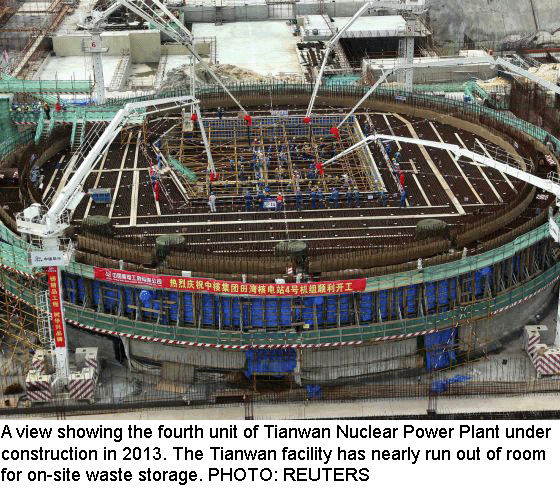
 Spent-fuel issues cloud China’s nuclear expansion Questions raised over country’s ability to handle radioactive waste as storage space runs out, Today, BEIJING , 2 Oct 16— A Chinese nuclear power plant construction programme has been on a fast track ever since the government’s four-year moratorium on building such facilities was lifted this year.
Now, five years after Japan’s 2011 Fukushima disaster led to the moratorium, China is fully engaged in an expansion that is scheduled to add 24 new reactor units to the nation’s existing 32.
But nuclear plant construction projects have stirred controversy in China, particularly due to questions surrounding incomplete plans for handling a dangerous by-product of nuclear energy — radioactive waste.
In August, hundreds of people took to the streets to protest a government plan to build a nuclear waste recycling facility in the Jiangsu province city of Lianyungang. The protest prompted the local authorities to suspend work on a feasibility study that would have moved the project forward.
Indeed, public scepticism about nuclear power in China has persisted ever since an earthquake-induced tsunami destroyed the Fukushima plant.
Some analysts have linked that scepticism to a lack of transparency among government agencies that oversee nuclear power plants and the energy companies that build them.
In the wake of the Lianyungang protests, for example, neither the central nor local government authorities have said when work on the feasibility study might resume, nor whether officials might consider building the plant elsewhere.
The proposed Lianyungang recycling plant would be built by state-owned China National Nuclear Corporation and French energy company Areva under an agreement they signed in 2013…….
China plans to open a permanent storage facility for high-level radioactive waste, perhaps in the remote west, by 2020. Waste reprocessing and recycling, which have the potential for squeezing energy out of spent fuel, are also part of the equation.
Radioactive waste generated by reactors at existing nuclear plants across the country is currently being stored at each plant site.
Moreover, medium and low-level wastes are currently stored at sites in Gansu province and Guangdong province. Plans call for opening five additional facilities for this kind of waste by 2020……
Medium and low-level waste can be safely stored at near-ground-level storage facilities, according to Mr Zhao Chengkun, a former director of the National Nuclear Safety Administration.
But waste levels are growing rapidly. The government-backed China Nuclear Energy Association said that by the end of 2020, the nation’s nuclear plants will have to get rid of more than 1,000 tonnes of spent fuel each year……
The controversial plan for a Lianyungang recycling centre was drafted due to rising demand for a new place to put waste from the Tianwan nuclear complex near the city. The complex includes two operating reactors and two that are now under construction.
The Tianwan facility as well as the Daya Bay nuclear plant complex in the southern city of Shenzhen have nearly run out of room for on-site waste storage, said Mr Chai Guohan, chief engineer at the Ministry of Environmental Protection’s Nuclear and Radiation Safety Centre.
The proposed Lianyungang facility, with a capacity for treating 800 tonnes of spent fuel every year, was originally slated to be up and running before 2030.
China has for years been looking at reprocessing spent fuel using a system commonly used in other countries called “plutonium uranium redox extraction” (Purex). The Lianyungang plant would use this system.
Dr Ma Yuefeng, a researcher from the China Institute for Radiation Protection, said that although Purex can reduce the amount of nuclear waste on hand, public health can be threatened by chemical pollutants that are by-products of the process……..http://www.todayonline.com/chinaindia/china/spent-fuel-issues-cloud-chinas-nuclear-expansion
China wants its nuclear industry to grow dauntingly fast
The Economist Sep 24th 2016 | LIANYUNGANG UPON learning (via a terse government statement) that their bustling port city in eastern China had been tipped as the likely site of a plant to recycle used nuclear fuel, residents of Lianyungang took to the streets last month in their thousands. Police, whose warnings against demonstrations were ignored, deployed with riot gear in large numbers but only scuffled with the protesters, who rallied, chanted and waved banners in the city centre for several days. “No one consulted us about this,” says one woman who participated in the protests. “We love our city. We have very little pollution and we don’t want a nuclear-fuel plant anywhere near us. The government says it is totally safe, but how can they be sure? How can we believe them?” she asks.Such scepticism is shared by many in Lianyungang, which already hosts a nuclear-power plant , and elsewhere in China, where the government plans to expand nuclear power massively. ……
Canada’s SNC Lavalin marketing nuclear reactors to China
 SNC-Lavalin to build Candu nuclear reactor for China, BERTRAND MAROTTE, MONTREAL — The Globe and Mail, Sep. 22, 2016 SNC-Lavalin Group Inc. is closing in on its goal of becoming a major player in China’s thriving nuclear-energy industry with an agreement for the development in that country of the next generation of Candu reactors.
The Montreal-based global engineering giant said on Thursday it has an agreement in principle for a joint venture with state-owned atomic-power and weapons company China National Nuclear Corp. and manufacturing conglomerate Shanghai Electric Group Co. Ltd. to design, market and build the Advanced Fuel Candu Reactor (AFCR).
SNC signed an initial memorandum of understanding with CNNC to pursue power generation, mining and nuclear-related environmental projects around the world more than two years ago.
SNC bought the Candu unit from Ottawa for $15-million in 2011. But Candu has had a poor track record of selling its technology abroad and questions have also been raised over its cost-effectiveness.
China, however, appears to have endorsed the concept of building reactors that run on recycled uranium…….
The proposed joint venture follows the signing of a framework agreement in 2014 and is subject to government and regulatory approvals, SNC said. http://www.theglobeandmail.com/report-on-business/industry-news/energy-and-resources/snc-lavalin-strikes-deal-to-build-nuclear-reactors-in-china/article32000350/
Further nuclear power development in China will need local public consent
China nuclear developers must seek public consent: draft rules, http://www.reuters.com/article/us-china-nuclear-safety-idUSKCN11Q18K (Reporting by David Stanway; editing by Jason Neely), 20 Sept 16 China’s nuclear developers must seek the consent of local stakeholders before going ahead with new projects, according to draft rules published by the country’s cabinet on Monday.
Developers will need to assess the impact a nuclear project will have on social stability and solicit public opinion through hearings or announcements, the Legislative Affairs Office of the State Council said.
China is in the middle of a rapid nuclear reactor building program and aims to have 58 gigawatts (GW) of capacity in full commercial operation by the end of 2020, up from 30.7 GW at the end of July.
But despite a strong safety record at existing plants, the government has struggled to convince the public about the safety of nuclear power.
Protests in the eastern coastal city of Lianyungang last month led to the cancellation of a proposed $15 billion nuclear waste processing plant.
“Japan’s Fukushima accident once again created doubt about the safety of nuclear power among the public, and also caused feelings of fear and opposition to occur from time to time,” the Legislative Affairs Office said in a statement.
It said the new draft rules would improve information disclosure and allow the public to participate more actively in the construction and supervision of nuclear projects.
The Legislative Affairs Office has made the draft guidelines available to the public and will accept suggestions until Oct. 19, it said in a notice posted on its website (www.chinalaw.gov.cn).
A team of experts from the International Atomic Energy Agency said this month that China’s “unparalleled” nuclear expansion would pose challenges for its regulators, and more work needed to be done in areas such as waste management and the handling of ageing reactors.
China’s nuclear marketing plan gets a big boost from Theresa May’s decision to go ahead on Hinkley project
British Project May Clear Way for China’s Nuclear Exports to the West VOA, Saibal Dasgupta, 20 Sept 16 BEIJING —
There’s a whole lot more in British Prime Minister Theresa May’s decision to allow a Chinese company to invest in the Hinkley Point C nuclear plant than mere business.
Chinese investment is limited to investing funds in the $24 billion project, which will use two French reactors supplied by Electricity de France. But the project could clear the way for Chinese involvement in a more crucial project at Bradwell, east England, which would allow China to export its nuclear technology to the Western world, analysts say.
China General Nuclear Corporation, the investor in Hinkley Point, already has signed a pre-feasibility agreement for the Bradwell project……..
Only a few developing countries like Pakistan are using Chinese reactors. These countries are not known to have the kind of strict regulatory control seen in the West.
The Bradwell B project could be a game changer. Getting regulatory approval in Britain for its reactors is crucial for China because it can open the doors for Chinese nuclear exports to the West……..
But there’s many a slip between May’s lip and China’s cup of hope. Britain already is in the midst of fierce debate with critics voicing concern about security issues. Critics question a provision in the contract that provides for a fixed electricity rate for 35 years at a time when energy prices are falling, and are expected to be much lower in the future……..
For Beijing, British approval for the Hinkley Point project is a major image booster, analysts say. Chinese business is seen in the West as an acquirer of property and trader of low-tech, unbranded goods, they point out…….http://www.voanews.com/a/british-project-china-nuclear-exports-west/3517485.html
1 This Month
Chernobyl: The Lost Tapes – A good documentary on Chernobyl on SBS available On Demand for the next 3 weeks– https://www.sbs.com.au/ondemand/tv-program/chernobyl-the-lost-tapes/2352741955560

of the week–London Campaign for Nuclear Disarmament

Tell the Ukrainian Government to Drop Prosecution of Peace Activist Yurii Sheliazhenko
To see nuclear-related stories in greater depth and intensity – go to https://nuclearinformation.wordpress.com
-
Archives
- April 2026 (126)
- March 2026 (251)
- February 2026 (268)
- January 2026 (308)
- December 2025 (358)
- November 2025 (359)
- October 2025 (376)
- September 2025 (257)
- August 2025 (319)
- July 2025 (230)
- June 2025 (348)
- May 2025 (261)
-
Categories
- 1
- 1 NUCLEAR ISSUES
- business and costs
- climate change
- culture and arts
- ENERGY
- environment
- health
- history
- indigenous issues
- Legal
- marketing of nuclear
- media
- opposition to nuclear
- PERSONAL STORIES
- politics
- politics international
- Religion and ethics
- safety
- secrets,lies and civil liberties
- spinbuster
- technology
- Uranium
- wastes
- weapons and war
- Women
- 2 WORLD
- ACTION
- AFRICA
- Atrocities
- AUSTRALIA
- Christina's notes
- Christina's themes
- culture and arts
- Events
- Fuk 2022
- Fuk 2023
- Fukushima 2017
- Fukushima 2018
- fukushima 2019
- Fukushima 2020
- Fukushima 2021
- general
- global warming
- Humour (God we need it)
- Nuclear
- RARE EARTHS
- Reference
- resources – print
- Resources -audiovicual
- Weekly Newsletter
- World
- World Nuclear
- YouTube
-
RSS
Entries RSS
Comments RSS
 nuclear-news