China Announces Deployment of New Long Range Nuclear Missile, Popular Mechanics. 24 Jan 17
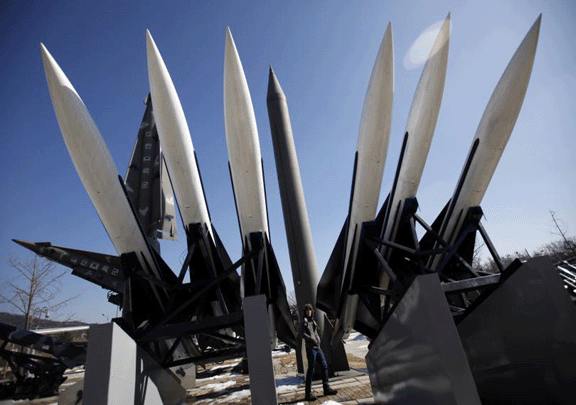
The target—at least of the announcement—is Trump. In a rare move, China has publicly announced the deployment of a new intercontinental ballistic missile (ICBM). The Dong Feng (“East Wind”) -41 missile, or DF-41, can carry up to a dozen nuclear warheads and China claims it has the longest range of any nuclear missile in the world. The announcement of the missiles is likely a warning to U.S. President Donald Trump, who is known for sharply worded anti-Chinese rhetoric and has announced plans for a new ballistic missile system.
According to China’s Global Times newspaper, the People’s Liberation Army has deployed its newest intercontinental ballistic missile to Heilongjiang Province. The article cited eyewitness photos culled from Chinese social media by news media in Taiwan and Hong Kong. The photos showed heavy missile launchers, also known as transporter/erector/launchers (TELs) moving through Daqing City in Heilongjiang.
The DF-41 is described by Global Times as the most advanced ICBM in the world. It reportedly has a range of 8,699 miles, enough to hit any target on Earth with the exception of South America and parts of Antarctica. It can carry up to 12 nuclear warheads, and travels on China’s nationwide network of roads to make it difficult to track down and destroy.
The location of the missiles and the timing of the release are notable. Heilongjiang Province is in Northern China, near the country’s long border with Russia. The DF-41’s long range, if accurate, means it could be based anywhere and still hit any useful target on Earth, but the implication is that China considers Russia a friendly country.
While China tends to be low-key regarding nuclear weapons and nuclear deterrence, this seems like a deliberate move to make a subtle threat. After all, it was probably completely unnecessary to move strategic nuclear weapons through a city of 2.9 million people, unless you want to get the word out. President Donald Trump, meanwhile, has been talking tough about China as well as enhancing America’s ballistic missile shield. If China wanted to overwhelm the shield with more missiles, the DF-41 would be the way to do it………http://www.popularmechanics.com/military/weapons/a24893/china-announces-deployment-long-range-nuclear-missile/
Is China Going To War? Nuclear Missiles Deployed To Russian Border, Putin’s Kremlin Responds http://www.ibtimes.com/china-going-war-nuclear-missiles-deployed-russian-border-putins-kremlin-responds-2480325BY CHRIS RIOTTA@CHRISRIOTTAON 01/24/17 The Chinese government reportedly deployed nuclear missiles to the Russia-China border in the northeast Heilongjiang province, an act Russian President Vladimir Putin’s government described as a nonissue Tuesday, Russian and Chinese media reported. The ballistic missiles, called the Dongfeng-41 Intercontinental Ballistic Missile, are capable of traveling up to 15,000 kilometers and was successfully tested with dummy warheads by the Chinese government in the South China Sea in April last year.
Unverified photos and videos of the massive ballistic missiles being deployed in the Chinese suburb made waves online as they spread across social media throughout this month. The footage had not been reported on until Tuesday, when the Kremlin’s Spokesperson Dmitry Peskov said “[Russia doesn’t] see the military disposition of China as a threat to our country,” the Moscow Times reported Tuesday.
A video posted to Twitter shows officials guiding a large vehicle along a highway as it carried what appeared to be the DF-41 intercontinental missile.
China’s Xi calls for a world without nuclear weapons, SCMP, 19 Jan 17,Chinese President Xi Jinping called for a world without nuclear weapons at the UN on Wednesday and urged a multilateral system based on equality among nations large and small.
His speech at the United Nations in Geneva came at the end of a diplomatic tour that included a landmark address at the World Economic Forum in Davos, just days before Donald Trump is sworn in as the 45th president of the United States.
Some experts have seen Xi’s Swiss tour as a bid to capture the mantle of global leadership at a time when Washington is clouded by uncertainty with an unpredictable political novice about to take charge.
“Nuclear weapons should be completely prohibited and destroyed over time to make the world free of nuclear weapons,” Xi said, according to an official translation.
China has been a nuclear power since 1964.
In an address that stretched beyond 45 minutes, Xi also sought to make the case for a global governance system that strives for a level playing field among countries where interventionist tendencies are resisted……..
China Is Building Britain ANOTHER Nuclear Reactor, Daily Caller ANDREW FOLLETT Energy and Science Reporter 12 Jan 17 Britain’s nuclear regulators are considering whether another Chinese-funded and designed nuclear reactor should be built in Bradwell, Essex.
The reactor would be funded and designed by the state-controlled China General Nuclear Power Corporation (CGN) and the French power company Électricité de France (EDF). It could take British authorities up to four years to formally approve or reject the new reactor.
“The robust independence of the UK’s regulators is seen across the world as a key strength for nuclear in Britain,” Zhu Minhong, General Manager of CGN in Britain, told Reuters. “CGN and EDF will bring to this enterprise their joint experience in China, Britain and France over many years.”
The U.K.’s previous attempt to build a nuclear power plant with the exact same Chinese company didn’t got well.
British Prime Minister Theresa May almost cancelled a previous China-backed nuclear power plant at Hinkley Point due to its high costs and environmentalist opposition. The U.S. charged the Chinese company behind the Hinkley Point plant with nuclear espionage in August.
A columnist for a Chinese state-run media outlet called May’s reluctance to approve of the Hinkley Point nuclear power project a result of “China-phobia.” CGN agreed to pay about $8 billion of the reactor’s $24 billion dollar cost.
China’s ambassador to Great Britain issued an ultimatum over the delay earlier in August, pointing out Chinese companies have invested more in the U.K. over the past five years than in France, Germany and Italy combined.
China cementing global dominance of renewable energy and technology It now owns five of the world’s six largest solar-module manufacturing firms and the largest wind-turbine manufacturer, Guardian, Michael Slezak. 6 Jan 17, China is cementing its global dominance of renewable energy and supporting technologies, aggressively investing in them both at home and around the globe, leaving countries including the US, UK and Australia at risk of missing the growing market.
A report by the Institute for Energy Economics and Financial Analysis (Ieefa) found China’s dominance in renewables is rapidly spreading overseas, with the country accelerating its foreign investment in renewable energy and supporting technologies.
Analysing Chinese foreign investments over US$1bn, Ieefa found 13 in 2016, worth a combined $32bn. That represented a 60% jump over similar investments in 2015.China was already widely recognised as the largest investor in domestic renewable energy, investing $102bn in 2015, according to Bloomberg New Energy Finance – more than twice that invested domestically by the US and about five times that of the UK.
The big foreign investments in 2016 included two in Australia, two in Germany and two in Brazil, as well as deals in Chile, Indonesia, Egypt, Pakistan and Vietnam.
In Australia, China Light & Power struck a $1.1bn deal, buying power from wind and solar farms.
In Chile, Tianqi Lithium spent $2.5bn acquiring a 25% stake of a lithium miner and processor. (Lithium is essential for lithium batteries used in electric vehicles and home battery storage.)
In Germany, Beijing Enterprises Holdings Ltd spend $1.6bn on a Waste to Energy development.
The report noted the global expansion cements China’s total domination of renewable energy growth globally. China now owned:
Five of the world’s six largest solar-module manufacturing firms
The investment will create over 13 million jobs in the sector, the National Energy Administration (NEA) said in a blueprint document that lays out its plan to develop the nation’s energy sector during the five-year 2016 to 2020 period.
The NEA said installed renewable power capacity including wind, hydro, solar and nuclear power would contribute to about half of new electricity generation by 2020.
China’s Green Energy Push
The agency did not disclose more details on where the funds — which equate to about $98 billion each year — would be spent.
The investment reflects Beijing’s continued focus on curbing the use of fossil fuels, which have fostered the country’s economic growth over the past decade, as it ramps up its war on pollution.
Last month, the National Development and Reform Commission (NDRC), the country’s economic planner, said in its own five-year plan that solar power would receive 1 trillion yuan of spending, as the country seeks to boost capacity by five times.
The spending comes as the cost of building large-scale solar plants has dropped by as much as 40 per cent since 2010. China became the world’s top solar generator last year.
Pak should have privileges as India in nuclear development: Chinese state media Hindustan Times, Jan 05, 2017 India has “broken” UN limits on nuclear arms and long-range missiles and Pakistan should also be accorded the same “privilege”, state-run Chinese media said on Thursday as it criticised New Delhi forcarrying out Agni-4 and 5 missile tests whose range covers the Chinese mainland.
“India has broken the UN’s limits on its development of nuclear weapons and long-range ballistic missile,” the ruling Communist Party-run tabloid Global Times said in its editorial.
“The US and some Western countries have also bent the rules on its nuclear plans. New Delhi is no longer satisfied with its nuclear capability and is seeking intercontinental ballistic missiles that can target anywhere in the world and then it can land on an equal footing with the UN Security Council’s five permanent members,” it said.
………At this time, Pakistan should have those privileges in nuclear development that India has,” it said, indicating that China which shared all-weather ties with Islamabad will back it if it develops long-range missiles.
“In general, it is not difficult for India to produce intercontinental ballistic missiles which can cover the whole world. If the UN Security Council has no objection over this, let it be. The range of Pakistan’s nuclear missiles will also see an increase. If the world can adapt to these, China should too,” it said.
China is also seeking market dominance in clean energy technology.
The nation’s ambient air pollution and its greenhouse gas emissions would both decline if China could produce more electricity using clean renewables rather than relying on coal. It has been the largest producer of solar photovoltaic cells in the world since 2007, and overtook Germany as the nation with the largest installed photovoltaic capacity in 2015.
As the price of renewable power equipment declines, the law of demand predicts that more U.S. companies will go green.
In mid-November, while Americans were preoccupied with election returns, China sent some of its clearest signals yet that it will continue to pursue an international leadership role on issues including climate.At an international climate change summit in Marrakech, the Chinese government reasserted its commitment to reduce its greenhouse gas emissions. The government announced that its aggregate emissions will peak by 2030 or earlier, and that its emissions per dollar of economic output will decline sharply.
For 25 years I have taught my economics students that climate change represents the ultimate “free rider problem.” To slow global climate change, we need to reduce aggregate global emissions.
Yet each individual nation’s efforts are too small to “solve” the problem, so it has only weak incentives to take costly mitigation actions, and strong incentives to “free ride” on the benefits of emission reductions by other countries.
Why, then, is China is pressing ahead with low-carbon initiatives?
My research suggests several motives. Chinese leaders want to improve the quality of life in their nation’s cities by reducing air pollution; win large shares of promising export markets for green technologies; and increase China’s “soft power” in international relations.
Taking aggressive action to cut carbon emissions helps China in all three areas.
Reducing Coal’s Cruel Impacts
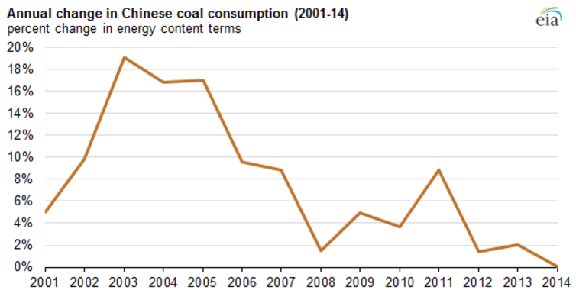
Much of the staggering rise in China’s carbon dioxide emissions in recent decades came from burning coal to produce electricity for the nation’s industrial sector. While this growth has created millions of jobs and wealth for the nation, coal-fired power plants are major sources of greenhouse gases and conventional air pollutants that affect millions of people.
Using data from around the world, economists have found that when countries develop economically they move up an “energy ladder.”
The richer a country grows, the more likely it is to swap out cheap polluting fuels in favor of cleaner, more expensive fuels. A natural experiment that occurred in Turkey as natural gas pipelines were built throughout the nation between 2001 and 2014 showed as people gained access to natural gas, air quality improved and mortality rates declined.
China has more coal than natural gas resources, but as its citizens grow wealthier, their willingness to pay to avoid pollution increases. This trend will encourage substitution toward cleaner fuels. As such, China’s political leaders will likely prioritize policies that substitute natural gas for coal, which should reduce air pollutants and greenhouse gas emissions……….
China is also seeking market dominance in clean energy technology.
The nation’s ambient air pollution and its greenhouse gas emissions would both decline if China could produce more electricity using clean renewables rather than relying on coal. It has been the largest producer of solar photovoltaic cells in the world since 2007, and overtook Germany as the nation with the largest installed photovoltaic capacity in 2015.
U.S industrial regulators have accused China of engaging in predation and dumping low-cost solar panels that compete with U.S products.
But environmentalists should cheer that potential buyers in importing nations now face lower prices — especially global companies like Wal-Mart which are pledging to shrink their carbon footprints. As the price of renewable power equipment declines, the law of demand predicts that more U.S. companies will go green.
There is a key synergy between electric vehicles and green power generation.
For decades, the world’s media have portrayed China as a bully and trade cheat abroad and a repressive power at home. In cutting carbon emissions, the Communist Party seeks to boost its own political legitimacy in the international arena as well as with the Chinese people.
By committing to pursue ambitious environmental goals, Chinese leaders hope to signal to both domestic constituents and international actors that China is an international leader and cares about its own people. A “leading nation” plays an active role in international relations, helps to keep the peace and promotes global public goods.
Inside 404: Video footage reveals abandoned buildings inside once-busy nuclear city, news.com.au, DECEMBER 28, 2016CHILLING footage has emerged showing the abandoned remains of a Chinese city used to build nuclear bombs known only as ‘404’.
The video shows buildings which have fallen into disrepair with whole streets remaining empty and overgrown by weeds in the town that was built in 1958.
Error 404: Chinese secret nuclear city lies abandoned like a ghost town
The secret location in northwestern China’s Gansu province near the Gobi desert is reportedly missing from any map, with the facility established to become China’s base for building nuclear bombs.
It was reportedly home to up to one million people in the 1990s, many of whom where top nuclear experts recruited to work there. It was named after a company owned by the China National Nuclear Corporation, The Mirror reports but has since been abandoned with residents moving to another city close by.
A statue of former Communist Party Chairman Mao Zedong dominates the town square and it also contains former apartments, a railway line, shops and a zoo.
http://www.breakbulk.com/dome-installed-china-nuclear-plant/A 300-ton containment dome has been installed at China’s first, domestically designed nuclear power plant in Fujian province, marking a key development for an effort to export the nation’s nuclear technology worldwide.
The successful lift project at the Fuqing nuclear complex construction site was announced via a news report on state-run CCTV television Nov. 26.
The plant, slated to open in 2020, is one of two being built at Fuqing with the China-designed Hualong One reactor. Two power plants at the Fangchenggang complex in Guangxi province will also use the reactor.
When completed, the report said, the Hualong reactor plants – called Fuqing 5 and Fuqing 6 – will be “significantly larger” than four other plants at the complex sporting reactors jointly designed by China and the French company Areva.
For safety, the report said, the 48-meter-diameter dome installed at Fuqing 5 was built with concrete and a steel alloy that’s six times stronger than regular steel.
Fuqing’s builder China National Nuclear Corp. and Fangchenggang’s builder China General Nuclear Corp. have been marketing the Hualong reactor worldwide. Customers so far include Britain, Pakistan and Argentina.
China eyes nuclear project in Bulgariahttp://www.euractiv.com/section/energy/news/china-eyes-nuclear-project-in-bulgaria/ A delegation from the China National Nuclear Corporation (CNNC), the country’s largest state energy company, visited Sofia and met with Bulgarian Prime Minister Boyko Borissov, to possibly resuscitate a shelved nuclear power plant project.The Belene nuclear power plant, situated near the Danube, was frozen in 2012, reportedly due to a lack of funds.
China, U.S. agree on new sanctions to punish North Korea for nuclear test, but Russia ‘trying to hold it up’, National Post Michelle Nichols, Reuters | November 24, 2016 UNITED NATIONS — The United States and China have agreed on new U.N. sanctions to impose on North Korea over the nuclear test it conducted in September, but Russia is delaying action on a draft resolution, a senior Security Council diplomat said on Wednesday.
The diplomat, who spoke on condition of anonymity, believed China could persuade Russia to agree to the new sanctions and that the 15-member Security Council could vote on the draft resolution as early as next week.
Since North Korea’s fifth and largest nuclear test on Sept. 9, the United States and China, a close ally of North Korea, have been negotiating a new draft Security Council resolution to punish Pyongyang.
That draft text was recently given to the remaining three permanent council veto powers, Britain, France and Russia.
Unlike many other developing countries, around 99% of all Chinese households already have access to the grid.
Solar PV can help China’s poorest, China Dialogue Suzanne Fisher Murray 23.11.2016 中文版本In Anhui villages are hooking up to the grid to generate income and power, writes Suzanne Fisher-Murray The residents of Yuexi county, a mountainous area in eastern China, must have thought it was their lucky day when they heard they had been selected for China’s new solar poverty alleviation project.
The 382,000 residents are some of the poorest in the country, living below the poverty line of 2,300 yuan (about US$1 per day). This was the key criteria for their selection in the project, which is part of China’s 13th Five-Year-Plan, the roadmap for the nation’s development from 2016 to 2020.
The project is being piloted in Yuexi county, Anhui province before being rolled out across the country. Villagers identified as living below the poverty line will have rooftop solar panels rated at 3-5 kilowatts installed on their roofs and become shareholders in village solar power stations with a generating capacity of around 60-100 kilowatts. The aim is for the solar panels to earn each family 3,000 yuan (around US$430) in extra income each year. Local farmers could also earn additional income by leasing out non-arable lands or maintaining the solar farms.
So far, 182 villages (with 30,000 residents) in the county have been identified as eligible for the project. Construction has begun at a staggering pace: 57 solar parks were built in 2015, with the remaining 125 expected to be finished this year.
Unlike many other developing countries, around 99% of all Chinese households already have access to the grid.
Each household will use the solar electricity generated for their own purposes. This will reduce energy bills and any surplus electricity will be sold back to the grid. Families will also have shared ownership of the solar parks, splitting 40% of the profits between them, with the remaining 60% going to pay back loans and park construction fees. This means that once the solar panels are installed, households and villagers could begin to see the benefits quickly.“It will take more time before we know the impact of the project,” warned Yixiong Kang from China Carbon Futures Asset Management Company, which is overseeing the financial and technical aspects of the project.
“But it could have a huge impact. We are talking about the poorest families. They basically have nothing in their houses that use electricity [because they can’t afford to pay the bills].” The extra income they’ll earn could change that. “If you want to change the living standards of people, sometimes it’s not enough to just give them electricity. Electricity – that’s just a power supply. They need greater help,” he added.
Aside from the direct profits, the villagers would also likely benefit from subsidies paid to solar generation projects in China. The rates are set to go down in 2017 due to a solar power generation surplus, but, if paid, will also help increase the villagers’ profits. The village level solar stations will also be part of a Chinese emissions trading programme which is currently being established. The village solar stations that have certified emissions reductions certificates could trade 1000 kWh of their clean energy to replace one tonne of carbon dioxide emissions on the carbon trading scheme.
China starts to build its first floating nuclear power reactor for deployment off coast, Times of India, Reuters | Updated: Nov 7, 2016, BEIJING: China has started to build its first floating nuclear power reactor, which it plans to deploy off its coast by the end of the decade.
State-controlled China General Nuclear Power Group (CGN) has begun construction of the ACPR50S reactor, and will acquire the reactor pressure vessel that encloses the reactor core from Dongfang Electric, CGN said in a statement on Friday.
Energoatom expands cooperation with CNNP, NASA and IDOM Nuclear Services, WNN 08 November 2016 Ukrainian nuclear power plant operator Energoatom has agreed to enhance its cooperation with Chinese, Argentinian and Spanish companies – respectively, China National Nuclear Power (CNNP), Nucleoeléctrica Argentina SA (NASA) and IDOM Nuclear Services………
Energoatom, which is also state-owned, operates four nuclear power plants – Zaporozhe, Rovno, South Ukraine and Khmelnitsky – which comprise 15 nuclear reactors, including 13 VVER-1000s and two VVER-440s with a total capacity of 13,835 MWe. In July last year, the Ukrainian government approved a pilot project, named the “energy bridge”, to transfer electricity from unit 2 of the Khmelnitsky plant to the European Union.







 nuclear-news