China’s display of conventional and nuclear weapons might
Chinese military displays conventional, nuclear missiles at parade, Economic Times, Jul 30, 2017, BEIJING: Chinese military today showcased five models of its homemade conventional and nuclear missiles in a massive military parade, marking the 2.3-million strong People’s Liberation Army’s 90th founding anniversary.
Also on display were two types of solid-fuel inter- continental strategic nuclear missiles, which rumbled on top of long-bed missile launchers, state-run Xinhua news agency reported.
The equipment and soldiers driving the mobile launch vehicles came from the PLA’s Rocket Force, which was established in December 2015 as part of the PLA’s extensive military structural reform. …
Besides Doklam, China is also concerned by the situation in North Korea and the deployment of Terminal High Altitude Area Defence (THAAD) missile by the US in South Korea much to the opposition of Beijing. http://economictimes.indiatimes.com/news/defence/chinese-military-displays-conventional-nuclear-missiles-at-parade/articleshow/59831588.cms
China’s marketing strategy – Poland and Britain as springboards for China’s nuclear marketing
 CGN eyes Poland for China’s nuclear exports By Zheng Xin | China Daily : 2017-07-26 China General Nuclear Power Corp is eyeing Poland as a potential destination for nuclear exports, as part of its expansion in Europe apart from the United Kingdom, the Czech Republic and Romania.
Polish authorities have been consulting with CGN, China’s largest nuclear operator, on cooperating and building the country’s first nuclear power station, according to a statement on the CGN website on Monday.
“CGN attaches substantial significance to the Polish nuclear power market and is willing to become a long-term strategic partner of the country,” said Shu Guogang, vice-president of CGN.
The two parties signed a Memorandum Of Understanding on cooperation on civil nuclear energy use earlier this month, which Shu said would bring mutual benefits to both countries.
According to Poland’s Energy Ministry, the visit to China earlier this month was to explore the possibility of cooperation between the Polish and Chinese nuclear sectors……..
The Memorandum Of Understanding is yet more evidence that the drive by Chinese electric power industry to diversify abroad is gradually expanding, said Joseph Jacobelli, a senior analyst of Asian utilities and infrastructure at Bloomberg Intelligence.
“CGN’s experience and financing capability and capacity means the company should be able to lock in one or more overseas deals in the next few quarters, despite the fact that whether the company can nail more deals in Eastern Europe is difficult to say at this stage because of the complex nature,” said Jacobelli.
“Nuclear investments take a long time to complete as they are more complex, while projects may also create local social backlashes and have security considerations.”
According to Jacobelli, CGN’s cooperation with the British government is more of a springboard for the company to reach other destinations in the European continent.
CGN signed an agreement on the Hinkley Point C power plant with French utility EDF and the British government last September, which has been hailed as a gateway to promote Chinese nuclear technology.
“The UK is the perfect base from a logistics perspective. It is a perfect springboard for development,” he said. http://www.chinadaily.com.cn/business/2017-07/26/content_30248171.htm
Conflict in remote Himalayan plateau could lead to war between India and China
Warnings of a ‘chance of war’ between India and China as nuclear rivals face off JULY 17, 2017 ASK most people to name a current crisis between nuclear armed states and North Korea and the US’ rapidly worsening relations would come to mind.
But there’s another skirmish happening between two nuclear nations and both have far more fully functioning missiles, poised and ready to fire, than Kim Jong-un could even dream off.
Ten thousand feet above sea level, in the sub zero cold of the Himalayas, things could be about to turn hot.
Since mid-June, Chinese and Indian soldiers have lined up “eyeball to eyeball” on the remote Doklam plateau. In recent days, more troops have been sent to the frontline.
Currently it’s a nonlethal battle of platitudes at altitude, but commentators in China have warned, “there could be a chance of war”.
And that’s not a great prospect, given India is thought to have more than 100 nuclear tipped missiles while China’s warheads could total more than 250.
The flashpoint between the two seems mundane ——the building of a new road on the Chinese controlled, but disputed, plateau. But the last time the two went to war, half a century ago, it was also over a road.
There is now said to be “complete stalemate” in the confrontation.
CONFLICT AT THE CHICKEN NECK
The current anger kicked off in an area close to what India calls the “chicken neck” — a thin stretch of land that is the only direct link to country’s isolated north east……..
LINE OF ACTUAL CONTROL
“The failure to demarcate the China-India border has led to overlapping perceptions of where the so-called Line of Actual Control lies, guaranteeing rival border patrols will run into each other and force the issue,” Tsering Topgyal, an international relations expert at the University of Birmingham wrote in The Conversation in 2014.
On Tuesday, the Times of India said around 300-400 Indian troops were “eyeball to eyeball” with China in a “non-aggressive confrontation” but thousands more soldiers from both sides are close by. A further 2500 Indian troops has now been stationed in India’s Sikkim province, the province next to the tri point……..http://www.news.com.au/world/asia/warnings-of-a-chance-of-war-between-india-and-china-as-nuclear-rivals-face-off/news-story/325ace8a2957aeb6a3634db44a4c12e9
The international nuclear industry in financial meltdown
 Global Meltdown? Nuclear Power’s Annus Horribilis, Jim Green, New Matilda, 9 July 2017 https://newmatilda.com/2017/07/09/global-meltdown-nuclear-powers-annus-horribilis/
This year will go down with 1979 (Three Mile Island), 1986 (Chernobyl) and 2011 (Fukushima) as one of the nuclear industry’s worst ever ‒ and there’s still another six months to go, writes Dr Jim Green.
Two of the industry’s worst-ever years have been in the past decade and there will be many more bad years ahead as the trickle of closures of ageing reactors becomes a flood ‒ the International Energy Agency expects almost 200 reactor closures between 2014 and 2040. The likelihood of reactor start-ups matching closures over that time period has become vanishingly small.
In January, the World Nuclear Association anticipated 18 power reactor start-ups this year. The projection has been revised down to 14 and even that seems more than a stretch. There has only been one reactor start-up in the first half of the year according to the IAEA’s Power Reactor Information System, and two permanent reactor closures.
The number of power reactors under construction is on a downward trajectory ‒ 59 reactors are under construction as of May 2017, the first time since 2010 that the number has fallen below 60.
Pro-nuclear journalist Fred Pearce wrote on May 15: “Is the nuclear power industry in its death throes? Even some nuclear enthusiasts believe so. With the exception of China, most nations are moving away from nuclear ‒ existing power plants across the United States are being shut early; new reactor designs are falling foul of regulators, and public support remains in free fall. Now come the bankruptcies…. The industry is in crisis. It looks ever more like a 20th century industrial dinosaur, unloved by investors, the public, and policymakers alike. The crisis could prove terminal.”
Pro-nuclear lobby groups are warning about nuclear power’s “rapidly accelerating crisis“, a “crisis that threatens the death of nuclear energy in the West“, and noting that “the industry is on life support in the United States and other developed economies“.
United States
The most dramatic story this year has been the bankruptcy protection filing of US nuclear giant Westinghouse onMarch 29. Westinghouse’s parent company Toshiba states that there is “substantial doubt” about Toshiba’s “ability to continue as a going concern”. These nuclear industry giants have been brought to their knees by cost overruns ‒estimated at US$13 billion ‒ building four AP1000 power reactors in the U.S.
The nuclear debate in the US is firmly centred on attempts to extend the lifespan of ageing, uneconomic reactors with state bailouts. Financial bailouts by state governments in New York and Illinois are propping up ageing reactors, but a proposed bailout in Ohio is meeting stiff opposition. The fate of Westinghouse and its partially-built AP1000 reactors are much discussed, but there is no further discussion about new reactors ‒ other than to note that they won’t happen.
Six reactors have been shut down over the past five years in the US, and another handful will likely close in the next five years. How far and fast will nuclear fall? Exelon ‒ the leading nuclear power plant operator in the US ‒ claims that “economic and policy challenges threaten to close about half of America’s reactors” in the next two decades. According to pro-nuclear lobby group ‘Environmental Progress‘, almost one-quarter of US reactors are at high risk of closure by 2030, and almost three-quarters are at medium to high risk. In May, the US Energy Information Administration released an analysis projecting nuclear’s share of the nation’s electricity generating capacity will drop from 20 per cent to 11 per cent by 2050.
There are different views about how far and fast nuclear will fall in the US ‒ but fall it will. And there is no dispute that many plants are losing money. More than half in fact, racking up losses totalling about US$2.9 billion a year according to a recent analysis by Bloomberg New Energy Finance. And a separate Bloomberg report found that expanding state aid to money-losing reactors across the eastern US may leave consumers on the hook for as much as US$3.9 billion a year in higher power bills.
Japan
Fukushima clean-up and compensation cost estimates have doubled and doubled again and now stand at US$191 billion. An analysis by the Japan Institute for Economic Research estimates that the total costs for decommissioning, decontamination and compensation could be far higher at US$443‒620 billion.
Only five reactors are operating in Japan as of July 2017, compared to 54 before the March 2011 Fukushima disaster. The prospects for new reactors are bleak. Japan has given up on its Monju fast breeder reactor ‒ successive governments wasted US$10.6 billion on Monju and decommissioning will cost another US$2.7 billion.
As mentioned, Toshiba is facing an existential crisis due to the crippling debts of its subsidiary Westinghouse. Toshibaannounced on May 15 that it expects to report a consolidated net loss of US$8.4 billion for the 2016‒2017 financial year which ended March 31.
Hitachi is backing away from its plan to build two Advanced Boiling Water Reactors in Wylfa, Wales. Hitachi recentlysaid that if it cannot attract partners to invest in the project before construction is due to start in 2019, the project will be suspended.
Hitachi recently booked a massive loss on a failed investment in laser uranium enrichment technology in the US. A 12 May 2017 statement said the company had posted an impairment loss on affiliated companies’ common stock of US$1.66 billion for the fiscal year ended 31 March 2017, and “the major factor” was Hitachi’s exit from the laser enrichment project. Last year a commentator opined that “the way to make a small fortune in the uranium enrichment business in the US is to start with a large one.”
France
The French nuclear industry is in its “worst situation ever” according to former EDF director Gérard Magnin. France has 58 operable reactors and just one under construction.
French EPR reactors under construction in France and Finland are three times over budget ‒ the combined cost overruns for the two reactors amount to about US$14.5 billion.
Bloomberg noted in April 2015 that Areva’s EPR export ambitions are “in tatters“. Now Areva itself is in tatters and is in the process of a government-led restructure and another taxpayer-funded bailout. On March 1, Areva posted a €665 million net loss for 2016. Losses in the preceding five years exceeded €10 billion.
In February, EDF released its financial figures for 2016: earnings and income fell and EDF’s debt remained steady at €37.4 billion. EDF plans to sell €10 billion of assets by 2020 to rein in its debt, and to sack up to 7,000 staff. The French government provided EDF with €3 billion in extra capital in 2016 and will contribute €3 billion towards a €4 billioncapital raising this year. On March 8, shares in EDF hit an all-time low a day after the €4 billion capital raising was launched; the share price fell to €7.78, less than one-tenth of the high a decade ago.
Costs of between €50 billion and €100 billion will need to be spent by 2030 to meet new safety requirements for reactors in France and to extend their operating lives beyond 40 years.
EDF has set aside €23 billion to cover reactor decommissioning and waste management costs in France ‒ just over half of the €54 billion that EDF estimates will be required. A recent report by the French National Assembly’s Commission for Sustainable Development and Regional Development concluded that there is “obvious under-provisioning” and that decommissioning and waste management will take longer, be more challenging and cost much more than EDF anticipates.
In 2015, concerns about the integrity of some EPR pressure vessels were revealed, prompting investigations that are still ongoing. Last year, the scandal was magnified when the French Nuclear Safety Authority (ASN) announced that Areva had informed it of “irregularities in components produced at its Creusot Forge plant.” The problems concern documents attesting to the quality of parts manufactured at the site. At least 400 of the 10,000 quality documents reviewed by Areva contained anomalies. Work at the Creusot Forge foundry was suspended in the wake of the scandal and Areva is awaiting ASN approval to restart the foundry.
French environment and energy minister Nicolas Hulot said on June 12 that the government plans to close some nuclear reactors to reduce nuclear’s share of the country’s power mix. “We are going to close some nuclear reactors and it won’t be just a symbolic move,” he said.
India
Nuclear power accounts for just 3.4 percent of electricity supply in India and that figure will not rise significantly, if at all. In May, India’s Cabinet approved a plan to build 10 indigenous pressurized heavy water reactors (PHWR). That decision can be read as an acknowledgement that plans for six Westinghouse AP1000 reactors and six French EPR reactors are unlikely to eventuate.
The plan for 10 new PHWRs faces major challenges. Suvrat Raju and M.V. Ramana noted: “[N]uclear power will continue to be an expensive and relatively minor source of electricity for the foreseeable future…. The announcement about building 10 PHWRs fits a pattern, often seen with the current government, where it trumpets a routine decision to bolster its “bold” credentials. Most of the plants that were recently approved have been in the pipeline for years. Nevertheless, there is good reason to be sceptical of these plans given that similar plans to build large numbers of reactors have failed to meet their targets, often falling far short.”
South Africa
An extraordinary High Court judgement on April 26 ruled that much of South Africa’s nuclear new-build program is without legal foundation. The High Court set aside the Ministerial determination that South Africa required 9.6 gigawatts (GW) of new nuclear capacity, and found that numerous bilateral nuclear cooperation agreements were unconstitutional and unlawful. President Jacob Zuma is trying to revive the nuclear program, but it will most likely be shelved when Zuma leaves office in 2019 (if he isn’t removed earlier). Energy Minister Mmamoloko Kubayi said on June 21 that South Africa will review its nuclear plans as part of its response to economic recession.
South Korea
South Korea’s new President Moon Jae-in said on June 19 that his government will halt plans to build new nuclear power plants and will not extend the lifespan of existing plants beyond 40 years. President Moon said: “We will completely re-examine the existing policies on nuclear power. We will scrap the nuclear-centred polices and move toward a nuclear-free era. We will eliminate all plans to build new nuclear plants.”
Since the presidential election on May 9, the ageing Kori-1 reactor has been permanently shut down, work on two partially-built reactors (Shin Kori 5 and 6) has been suspended pending a review, and work on two planned reactors (Shin-Hanul 3 and 4) has been stopped.
Taiwan
Taiwan’s Cabinet reiterated on June 12 the government’s resolve to phase out nuclear power. The government remains committed to the goal of decommissioning the three operational nuclear power plants as scheduled and making Taiwan nuclear-free by 2025, Cabinet spokesperson Hsu Kuo-yung said.
UK
Tim Yeo, a former Conservative politician and now a nuclear industry lobbyist with New Nuclear Watch Europe, saidthe compounding problems facing nuclear developers in the UK “add up to something of a crisis for the UK’s nuclear new-build programme.”
The lobby group noted delays with the EPR reactor in Flamanville, France and the possibility that those delays would flow on to the two planned EPR reactors at Hinkley Point; the lack of investors for the proposed Advanced Boiling Water Reactors at Wylfa; the acknowledgement by the NuGen consortium that the plan for three AP1000 reactors at Moorside faces a “significant funding gap”; and the fact that the Hualong One technology which China General Nuclear Power Corporation hopes to deploy at Bradwell in Essex has yet to undergo its generic design assessment.
The only reactor project with any momentum in the UK is Hinkley Point, based on the French EPR reactor design. The head of one of Britain’s top utilities said on June 19 that Hinkley Point is likely to be the only nuclear project to go ahead in the UK. Alistair Phillips-Davies, chief executive officer of SSE, an energy supplier and former investor in new nuclear plants, said: “The bottom line in nuclear is that it looks like only Hinkley Point will get built and Flamanville needs to go well for that to happen.”
There is growing pressure for the obscenely expensive Hinkley Point project to be cancelled. The UK National Audit Office report released a damning report on June 23. The Audit Office said: “The Department for Business, Energy and Industrial Strategy’s deal for Hinkley Point C has locked consumers into a risky and expensive project with uncertain strategic and economic benefits… Today’s report finds that the Department has not sufficiently considered the costs and risks of its deal for consumers…. Delays have pushed back the nuclear power plant’s construction, and the expected cost of top-up payments under the Hinkley Point C’s contract for difference has increased from £6 billion to £30 billion.”
Writing in the Financial Times on May 26, Neil Collins said: “EDF, of course, is the contractor for that white elephant in the nuclear room, Hinkley Point. If this unproven design ever gets built and produces electricity, the UK consumer will be obliged to pay over twice the current market price for the output…. The UK’s energy market is in an unholy mess… Scrapping Hinkley Point would not solve all of [the problems], but it would be a start.”
And on it goes. Hinkley Point is one of the “great spending dinosaurs of the political dark ages” according to The Guardian. It is a “white elephant” according to an editorial in The Times.
EDF said on June 26 that it is conducting a “full review of the costs and schedule of the Hinkley Point C project” and the results will be disclosed “soon”. On July 3, EDF announced that the estimated cost of the two Hinkley reactors has risen by €2.5 billion (to €23.2 billion, or €30.4 billion including finance costs). In 2007, EDF was boasting that Britons would be using electricity from Hinkley to cook their Christmas turkeys in December 2017. But in its latestannouncement, EDF pushes back the 2025 start-up dates for the two Hinkley reactors by 9‒15 months.
Oliver Tickell and Ian Fairlie wrote an obituary for Britain’s nuclear renaissance in The Ecologist on May 18. Theyconcluded: “[T]he prospects for new nuclear power in the UK have never been gloomier. The only way new nuclear power stations will ever be built in the UK is with massive political and financial commitment from government. That commitment is clearly absent. So yes, this finally looks like the end of the UK’s ‘nuclear renaissance’.”
Switzerland
Voters in Switzerland supported a May 21 referendum on a package of energy policy measures including a ban on new nuclear power reactors. Thus Switzerland has opted for a gradual nuclear phase out and all reactors will probably be closed by the early 2030s, if not earlier.
Germany will close its last reactor much sooner than Switzerland, in 2022.
Sweden
Unit 1 of the Oskarshamn nuclear power plant in Sweden has been permanently shut down. Unit 2 at the same plant was permanently shut down in 2015. Ringhals 1 and 2 are expected to be shut down in 2019‒2020, after which Sweden will have just six operating power reactors. Switzerland, Germany and Taiwan have made deliberate decisions to phase out nuclear power; in Sweden, the phase out will be attritional.
Russia
Rosatom deputy general director Vyacheslav Pershukov said in mid-June that the world market for the construction of new nuclear power plants is shrinking, and the possibilities for building new large reactors abroad are almost exhausted. He said Rosatom expects to be able to find customers for new reactors until 2020‒2025 but “it will be hard to continue.”
China
With 36 power reactors and another 22 under construction, China is the only country with a significant nuclear expansion program. However nuclear growth could take a big hit in the event of economic downturn. And nuclear growth could be derailed by a serious accident, which is all the more likely because of China’s inadequate nuclear safety standards, inadequate regulation, lack of transparency, repression of whistleblowers, world’s worst insurance and liability arrangements, security risks, and widespread corruption.
Dr Jim Green is the national nuclear campaigner with Friends of the Earth, Australia, and editor of the World Information Service on Energy’s Nuclear Monitor newsletter.
China calls for calm and restraint on North Korea
China calls for calm after North Korea claims first successful launch of ICBM that can ‘strike any place in the world’ If this type of missile becomes fully operational, it could potentially deliver a nuclear warhead to the US mainland http://www.scmp.com/news/asia/east-asia/article/2101193/north-korea-says-it-has-successfully-tested-icbm, Agence France-Presse, Reuters, Associated Press 05 July, 2017,
The United States on Tuesday requested an emergency meeting of the UN Security Council after North Korea declared that it had successfully tested its first intercontinental ballistic missile, the US mission said. The meeting is expected to take place on Wednesday.
US Ambassador Nikki Haley on Tuesday spoke by phone with China’s Ambassador Liu Jieyi, who holds the council presidency this month, to convey the US request for an urgent meeting.
North Korea’s announcement Tuesday came after the launch of a ballistic missile in the morning. It flew about 39 minutes and reached an altitude of 2,802 kilometres, before landing in waters within Japan’s exclusive economic zone, according to the announcement.
North Korea’s claims the missile reached that altitude could not be verified. However Japan’s Defence Ministry said it reached an altitude that “greatly exceeded” 2,500 kilometres.
A test-launch of an intercontinental ballistic missile, if confirmed, would be considered a game-changer by countries looking to check North Korea’s push for a nuclear-armed missile that can reach anywhere in the United States.
The test still may be the North’s most successful yet; a weapon analyst says missile could be powerful enough to reach Alaska. The “landmark” test of a Hwasong-14 missile was overseen by leader Kim Jong-un, an emotional female announcer said. It flew 933 kilometres, she added. The North was “a strong nuclear power state” and had “a very powerful ICBM that can strike any place in the world” she said.
There are still doubts whether the North can miniaturise a nuclear weapon sufficiently to fit it onto a missile nose cone, or whether it has mastered the technology needed for it to survive the difficult re-entry into the Earth’s atmosphere.
In his New Year’s address, Kim said his country had reached the final stage of preparing to test-launch the long-range missile.
Officials from South Korea, Japan and the United States said the missile landed in Japan’s Exclusive Economic Zone (EEZ) after being launched near an airfield in Panghyon, about 100 km northwest of the North’s capital, Pyongyang.
Japan said on Monday the United States, South Korea and Japan will have a trilateral summit on North Korea at the G20. China’s leader Xi Jinping will also be at the July 7-8 meeting in Hamburg, Germany.
Trump, responding to the latest launch, wrote on Twitter: “North Korea has just launched another missile. Does this guy have anything better to do with his life?” an apparent reference to North Korean leader Kim Jong-un. “Hard to believe South Korea and Japan will put up with this much longer. Perhaps China will put a heavy move on North Korea and end this nonsense once and for all!”, Trump said in a series of tweets.
North Korea has conducted nuclear and missile tests to show defiance in the face of international pressure and to raise the stakes when Pyongyang sees regional powers getting ready for talks or sanctions, analysts say.
White House officials said Trump was briefed on the latest launch, which took place hours before Independence Day celebrations in the United States. North Korea has previously fired missiles around this holiday.
Pyongyang has conducted missile-related activities at an unprecedented pace since the start of last year, but analysts had thought it was years away from having a nuclear-tipped ICBM. capable of hitting the United States.
North Korea is also trying to develop intermediate-range missiles capable of hitting US bases in the Pacific. The last North Korean launches before Tuesday were of land-to-sea cruise missiles on June 8.
David Wright, co-director of the Global Security Programme at the US-based Union of Concerned Scientists, said the assessments of the flight time and distance suggest the missile might have been launched on a “very highly lofted” trajectory of more than 2,800 km.
The same missile could reach a maximum range of roughly 6,700 km on a standard trajectory, Wright said in a blog post.“That range would not be enough to reach the lower 48 states or the large islands of Hawaii, but would allow it to reach all of Alaska,” he said.
South Korea’s President Moon said on Monday in a meeting with former US president Barack Obama that North Korea now faces its “last opportunity” to engage in talks with the outside world.
North Korea has conducted four missile tests since Moon took office in May, vowing to use dialogue as well as pressure to bring Pyongyang’s nuclear and missile programmes under control.
Earlier this week, North Korea was a key topic in phone calls between Trump and the leaders of China and Japan. Leaders of both Asian countries reaffirmed their commitment to a denuclearised Korean Peninsula. Trump has recently suggested he was running out of patience with China’s modest steps to pressure North Korea.
Russia and China propose negotiation plan to lessen North Korea tensions

 Russia, China offer plan to ease N.Korea tension, abc news, 4 July 17 Russia and China have proposed that North Korea declare a moratorium on nuclear and missile tests while the United States and South Korea refrain from large-scale military exercises.
The call was issued in a joint statement by the Russian and Chinese foreign ministries on Tuesday following talks between Russian President Vladimir Putin and Chinese President Xi Jinping.
The statement came after North Korea tested a missile that flew higher and longer than previous ones, sparking concerns around the world.
Moscow and Beijing suggested that if North Korea halts nuclear and missile tests while the U.S. and South Korea freeze military maneuvers, the parties could sit down for talks that should lead to obligations not to use force and to refrain from aggression………..
North Korea says its latest missile test reached a height of 2,802 kilometers (1,740 miles) and flew 933 kilometers (580 miles) for 39 minutes before falling into the sea.
The country’s Academy of Defense Science said Tuesday in a statement that it was a successful test of an intercontinental ballistic missiles called Hwasong-14.
The statement was distributed by North Korea’s KCNA news service.
The reported trajectory was similar to that announced earlier by U.S., South Korean and Japanese officials, though the U.S. judged it to be an intermediate-range missile.
Either way, it would be a longer and higher flight than similar tests previously reported.
The U.S military says it tracked a North Korean missile for 37 minutes before it landed in the Sea of Japan.
The Hawaii-based U.S. Pacific Command said in a statement Tuesday that an intermediate-range ballistic missile was launched from near an airfield in North Korea.
NORAD, or the North American Aerospace Defense Command, said the missile did not pose a threat to North America.
South Korean and Japanese officials reported the North Korean missile launch earlier Tuesday. It is part of a string of recent tests as the North works to build a nuclear-tipped missile that could reach the United States………http://abcnews.go.com/International/wireStory/latest-north-korea-height-distance-missile-48430348
———
Russia and China came close to nuclear war in 1969
Forgotten Fact: Russia and China Almost Started a Nuclear War in 1969, National Interest, Kyle Mizokami, 2 Jul 17, In 1969 the two pillars of the communist bloc, the Soviet Union and the People’s Republic of China, nearly went to full-scale war. Years of deteriorating ties between the two countries, once the staunchest of allies, finally led to skirmishing on the long mutual border between the two countries. While tensions were eventually de-escalated, what if the two countries had gone to war?
On March 2, 1969 Soviet troops patrolling Damansky Island (Zhenbao) on the Ussuri River came under fire from Chinese troops. The attack, just 120 miles from the major Soviet city of Khabarovsk, killed fifty Soviet troops and wounded many more. The Moscow believed that the attack was premeditated, with Beijing bringing in a special combat unit to ambush Soviet forces. Alleged atrocities against wounded Soviet troops made the Soviet leadership furious.
The de-escalation of the Sino-Soviet crisis in 1969 avoided what could have been yet another large, destructive war of the twentieth century. The current friendship between Moscow and Beijing is a reflection of that crisis and the realization that it’s much better for both countries to be allies than enemies. This is particularly in Moscow’s interests: given Beijing’s rapid military and economic progress over the past thirty years, next time, the Kremlin may find the tables turned. http://nationalinterest.org/blog/the-buzz/forgotten-fact-russia-china-almost-started-nuclear-war-1969-21398
China’s Taishan nuclear reactors would have the same safety defects as France’s Flamanville reactor
BFM TV 29th June 2017 [Machine Translation] The manufacturing defects encountered in France also
exist on the two reactors of Taishan, in the south-east of China. The
decision of the nuclear safety authority prompts China to emulate it.
Barely the problem of Flamanville settled, the looks turn to China. The CGN
industrialist built in Taishan, in the south-east of the country, two EPRs
with EDF. These two tanks were manufactured in France, in the factory of Le
Creusot, like those of Flamanville. And obviously have the same
manufacturing defects.
“The same parts are concerned and have been
manufactured with the same process, explained the ASN president,
Pierre-Franck Chevet, but it is the responsibility of the Chinese to
decide. For two years, they have been associated with all the tests and
works of the French authority. On Monday and Tuesday, the representatives
of the Chinese authority and the industrialist CGN were in Paris to follow
the conclusions on the Flamanville EPR. They will have to decide whether
they also impose changes to the lids of the Taishan EPRs. These two
reactors must start between the end of 2017 and the end of 2018.
http://bfmbusiness.bfmtv.com/entreprise/apres-flamanville-la-surete-des-epr-chinois-en-question-1197282.html
China “looks to small nuclear reactors” – but it’s not really a very good look
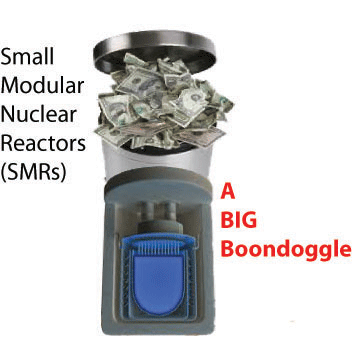
 This article is surely meant as a promotional boost for small nuclear reactors, SMRs. BUT – it doesn’t quite read that way. We learn that only the most enthusiastically pro-nuclear nations are interested in SMRs.
Another giveaway is that remarkable confession at the end – that success of SMRs hinges on investors seeing new large-scale plants coming online and building on those successes.
Well, seeing that large nuclear reactors projects are now stalling, all over the place, with delays, safety problems, and ballooning costs – those successes are looking very unlikely. Which leaves SMRs very much in the fantasy world – waiting for investors who never appear.
China looks to small nuclear reactors, news.com.au, JUNE 27, 2017. David Stanway, Reuters China is betting on new, small-scale nuclear reactor designs that could be used in isolated regions, on ships and even aircraft as part of an ambitious plan to wrest control of the global nuclear market.
Within weeks, state-owned China National Nuclear Corporation (CNNC) is set to launch a small modular reactor (SMR) dubbed the “Nimble Dragon” with a pilot plant on the island province of Hainan, according to company officials.
 …..But these so-called “third-generation” reactors have been mired in financing problems and building delays, deterring all but the most enthusiastically pro-nuclear nations.
The challenges of financing and building large, expensive reactors contributed to the bankruptcy of Toshiba Inc’s nuclear unit, Westinghouse, and to the financial problems that forced France’s Areva to restructure.
SMRs have capacity of less than 300 megawatts (MW) – enough to power around 200,000 homes – compared to at least 1 gigawatt (GW) for standard reactors.
China aims to lift domestic nuclear capacity to 200 GW by 2030, up from 35 GW at the end of March, but its ambitions are global.
CNNC designed the Linglong, or “Nimble Dragon” to complement its larger Hualong or “China Dragon” reactor and has been in discussions with Pakistan, Iran, Britain, Indonesia, Mongolia, Brazil, Egypt and Canada as potential partners.
“The big reactor is the Hualong One, the small reactor is the Linglong One – many countries intend to co-operate with CNNC’s ‘two dragons going out to sea’,” Yu Peigen, vice-president of CNNC, told a briefing in May.
…….The success of new small-scale reactors hinges on investors seeing new large-scale plants coming online and building on those successes, said Christopher Levesque, Terrapower’s president.
“We’re not competing with those folks, we’re rooting for them,” he told an industry forum in Shanghai last month. http://www.news.com.au/finance/business/breaking-news/china-looks-to-small-nuclear-reactors/news-story/fa30465507d75bb2efef3bb1de827eca
China sets up 3 nuclear companies in Britain, hopes to market its nukes worldwide
 China Daily 15th June 2017, China’s CGN a step closer to bringing its nuclear technology to UK: China’s
goal of boosting its nuclear technology sector took a big step forward on Wednesday with the creation of three new companies in the UK by China General Nuclear Power Corporation. The new entities are: Bradwell Power
Corp, which will be responsible for the 100 percent Chinese-built Bradwell B nuclear plant; General Nuclear System Ltd, which will shepherd China’s Hualong technology through the exacting five-year UK approval process; and General Nuclear International, which will manage CGN’s projects in the UK.
He Yu, CGN chairman, said: The unveiling of three companies is a solid step forward for CGN to expand its operation in the UK. With its new subsidiaries unfolding, the company is confident that it will grow steadily in the field of nuclear technology in Britain.”
The United Kingdom will formally assess the Hualong One technology as part of a deal reached last year, in which Chinese investment will help build the Hinkley Point C nuclear plant, in which France’s EDF is a major participant, and which will
feature French technology. CGN and EDF have been working together for more than 30 years on nuclear development and construction in China.
Under last year’s agreement, CGN and EDF will collaborate on three UK nuclear plants: Hinkley Point C, in Somerset; Sizewell C, in Suffolk; and Bradwell, in Essex.
CGN intends to use Hualong One technology at Bradwell, which could be the first nuclear plant in a developed economy to use Chinese technology. The companies will seek to get the Hualong One technology approved in the UK via an assessment known as the Generic Design Assessment process. It usually takes about five years to complete.
China hopes that UK approval of its technology will open the door to its use in other countries because the UK’s appraisal regime is considered by industry experts to be the strictest in the world. The proposed Bradwell project is in an early
pre-planning stage, something that is likely to continue for many years, via investigative work and public consultation, before detailed proposals will be produced, allowing a planning application to be made.
http://europe.chinadaily.com.cn/world/2017-06/15/content_29748140.htm
A joint commitment to fight climate change – European Union and China

 Times 2nd June 2017 China and the European Union will announce a new joint commitment to combat global warming today, making a clear break from President Trump after he withdrew the United States from the Paris climate accord.
Critics said that Mr Trump’s promise to revive the coal industry could not be fulfilled. He was surrendering America’s leadership role on the world stage, they added – and China would step in. Nigel Purvis, a US climate negotiator under President Clinton, said: “Trump just handed the 21st century to China. It’s an opportunity for China to rebrand itself as the global leader.”
Mr Trump went against the advice of Rex Tillerson, his secretary of state; Gary Cohn, his chief economic adviser; his daughter, Ivanka; and the Pope. Tim Cook, the chief executive of Apple, had called the White House on Wednesday to urge the president to rethink. Elon Musk, the Silicon Vally billionaire who leads Tesla, the electric car company, said that he would leave the two White House councils on which he served as an adviser. “Climate change is real. Leaving Paris is not good for America or the world,” Mr Musk said.
“If I were a Chinese policymaker I’d be baffled as to why Trump had offered us an open goal,” said John Ashton, who spent years negotiating with China as the Foreign Office’s special envoy for climate change. Other countries may respond by redoubling thei r commitment to the accord, as China and Europe are doing, or by seeking to water down their pledges, as some fear that developing giants such as India and Brazil will do. https://www.thetimes.co.uk/edition/world/eu-and-china-forge-climate-alliance-and-turn-back-on-trump-27pqqzz0s
China suspends permits for new coal plants
China suspends permits for new coal plants as overcapacity policy bites, Energy Desk, May 16, 2017 by Zachary Davies Boren @zdboren The Chinese government has ordered the vast majority of its provinces to stop permitting new coal power projects.
After all these years, sill no model of the European Pressurised Reactor in operation
Dave Toke’s Blog 27th May 2017 It’s now the middle of 2017 and still, after 12 years of trying to build the French European Pressurised Reactor, there is still no model in operation. Even in China, which has, according to some of its domestic critics, let us say a more relaxed attitude to safety requirements compared to western agencies, the EPR at Taishan is still not generating electricity.
It was 16 months ago that the constructors announced that ‘cold start’ tests had been successful and that the whole of the plant (including two sets) would be fully functional this year (2017). Now they say that this will not happen, although one set ‘will’ be running sometime in the second half of this year. But then the plant, which begun construction in 2009, was supposed to be finished in 2013. This failure does present the question of how it is that other nuclear plant built in
China have not been subject to this much delay.
How can we explain this? The obvious reason is that the EPR is a turkey that is widely regarded as bordering on, if not actually, ‘unconstructable’. The difference with other nuclear plant built in China may simply be that the EPR was designed to suit western safety standards.
It’s an easy guess to say what this means for Chinese plans to build nuclear power plant in the UK! In France
construction at the EPR at Flamanville began in 2007 and completion by 2019 seems possible but uncertain. The other EPR at Olkiluoto started in 2005 and is about, so they say. to undergo ‘cold tests’. On the basis of what has happened in Taishan this doesn’t mean that it is about the generate electricity, though. http://realfeed-intariffs.blogspot.co.uk/2017/05/more-delays-in-epr-signals-more.html
In China now online: THE WORLD’S LARGEST FLOATING SOLAR POWER PLANT
THE WORLD’S LARGEST FLOATING SOLAR POWER PLANT JUST WENT ONLINE IN CHINA https://www.digitaltrends.com/cool-tech/china-floating-solar-power-plant/ By Dallon Adams — May 23, 2017 China has announced that the largest floating photovoltaic (PV) facility on earth has finally been completed and connected to the local power grid. Long reviled for its carbon emission record, this is the Chinese government’s latest achievement in its ongoing effort to lead the world in renewable energy adoption.

Located in the city of Huainan in the Anhui province, the 40-megawatt facility was created by PV inverter manufacturer Sungrow Power Supply Co. Ironically, the floating grid itself was constructed over a flooded former coal-mining region.
Floating solar farms are becoming increasingly popular around the world because their unique design addresses multiple efficiency and city planning issues. These floating apparatuses free up land in more populated areas and also reduce water evaporation. The cooler air at the surface also helps to minimize the risk of solar cell performance atrophy, which is often related to long-term exposure to warmer temperatures.
This is just the first of many solar energy operations popping up around China. In 2016, the country unveiled a similar 20MW floating facility in the same area. China is also home to the Longyangxia Dam Solar Park, a massive 10-square-mile, land-based facility touted as the largest solar power plant on earth.
This transition to solar is in large part due to the rapidly plummeting cost of the technology itself. By 2020, China could reduce prices offered to PV developers by more than a third with solar power plants projected to rival coal facilities within a decade. The nation has also announced plans to increase its use of non-fissile fuel energy sources by 20 percent.
An annual report released by NASA and NOAA determined that 2016 was the warmest year on record globally, marking the third year in a row in which a new record was set for global average surface temperatures. That said, if we as a species hope to reverse this dire trend, initiatives like this and others will need to be adopted around the globe.
China installs giant containment dome on new nuclear reactor
China installs heavy containment dome on nuclear plant, Financial Express China today successfully installed the heavy containment dome for its first domestically developed third-generation reactor design which may also be used at the Karachi nuclear plant where Beijing is building two 1100 mw reactors. By: PTI | Beijing: May 26, 2017 The hemispherical dome, weighing 340 tonnes and measuring 46.8 metres in diametre, was installed by crane on the No 5 unit of China National Nuclear Corporation (CNNC) in Fuqing City, state-run Xinhua news agency reported. The installation marks the completion of construction work on the pilot project and the beginning of the assembly stage, said Yu Peigen, deputy general manager of CNNC at the site of installation.

The dome will be used for protection against nuclear accidents under extreme conditions, and both its design and installation are very demanding processes, the report said. The design may be replicated in Karachi plant in Pakistan where China is building two 1100 mw reactors at a cost of USD 6.5 billion. “The installation is much more difficult than that of traditional nuclear reactors because the whole weight of the dome and the ropes is more than 500 tonnes,” said Yang Jianguo, the lifting commander at the site. http://www.financialexpress.com/world-news/china-installs-heavy-containment-dome-on-nuclear-plant/687878/
1 This Month
Chernobyl: The Lost Tapes – A good documentary on Chernobyl on SBS available On Demand for the next 3 weeks– https://www.sbs.com.au/ondemand/tv-program/chernobyl-the-lost-tapes/2352741955560

of the week–London Campaign for Nuclear Disarmament

Tell the Ukrainian Government to Drop Prosecution of Peace Activist Yurii Sheliazhenko
To see nuclear-related stories in greater depth and intensity – go to https://nuclearinformation.wordpress.com
-
Archives
- April 2026 (126)
- March 2026 (251)
- February 2026 (268)
- January 2026 (308)
- December 2025 (358)
- November 2025 (359)
- October 2025 (376)
- September 2025 (257)
- August 2025 (319)
- July 2025 (230)
- June 2025 (348)
- May 2025 (261)
-
Categories
- 1
- 1 NUCLEAR ISSUES
- business and costs
- climate change
- culture and arts
- ENERGY
- environment
- health
- history
- indigenous issues
- Legal
- marketing of nuclear
- media
- opposition to nuclear
- PERSONAL STORIES
- politics
- politics international
- Religion and ethics
- safety
- secrets,lies and civil liberties
- spinbuster
- technology
- Uranium
- wastes
- weapons and war
- Women
- 2 WORLD
- ACTION
- AFRICA
- Atrocities
- AUSTRALIA
- Christina's notes
- Christina's themes
- culture and arts
- Events
- Fuk 2022
- Fuk 2023
- Fukushima 2017
- Fukushima 2018
- fukushima 2019
- Fukushima 2020
- Fukushima 2021
- general
- global warming
- Humour (God we need it)
- Nuclear
- RARE EARTHS
- Reference
- resources – print
- Resources -audiovicual
- Weekly Newsletter
- World
- World Nuclear
- YouTube
-
RSS
Entries RSS
Comments RSS
 nuclear-news
China has called for calm and restraint after North Korea claimed to have test-launched its first intercontinental ballistic missile that is capable of hitting anywhere in the world.