As US military prepares for war on China, Silicon Valley tech oligarchs are profiting
Hegseth is a far-right theocratic extremist. He published a book in 2020 called “American Crusade”, in which he proudly declared that the US right is in a “holy war” against the international left, China, and Islam.
Hegseth revealed that the US military is making “real war plans” for China, over Taiwan.
The US military is preparing for war on China. It has missile systems in the Philippines aimed at major Chinese cities. Defense Secretary Pete Hegseth says the USA is turning “Japan into a war-fighting headquarters”. Silicon Valley Big Tech oligarchs are making hugely profitable investments.
By Ben Norton, https://geopoliticaleconomy.com/2025/04/28/us-military-war-china-silicon-valley/
Evidence grows showing that the US military is setting the stage for war on China.
A leaked memo obtained by the Washington Post reveals that the US Department of Defense has made preparing for war with China into its top priority, giving it precedence over all other issues.
The Pentagon is concentrating its resources in the Asia-Pacific region as it anticipates fighting China in an attempt to exert US control over Taiwan.
US Defense Secretary Pete Hegseth, a fundamentalist self-declared “crusader” who called for overthrowing the Chinese government, took a trip in March to Japan and the Philippines, where he repeatedly threatened Beijing and boasted of US “war-fighting” preparations and “real war plans”.
In 2024, the US military installed its Typhon missile system in the northern Philippines. This has a range of 1,240 miles (roughly 2,000 kilometers), and can hit most major cities on the Chinese mainland.
The United States has access to at least nine military bases in the Philippines.
The Wall Street Journal reported that this “new U.S. missile system deployed in the Philippines puts key Chinese military and commercial hubs within striking distance”.
The newspaper added that it “is the first time since the Cold War that the U.S. military has deployed a land-based launching system with such a long range outside its borders”.
This blatant US provocation has caused outrage in Beijing, which sees the Pentagon’s move as a significant escalation of Washington’s new cold war on China.
Cold War Two
Cold War Two has more and more parallels to Cold War One.
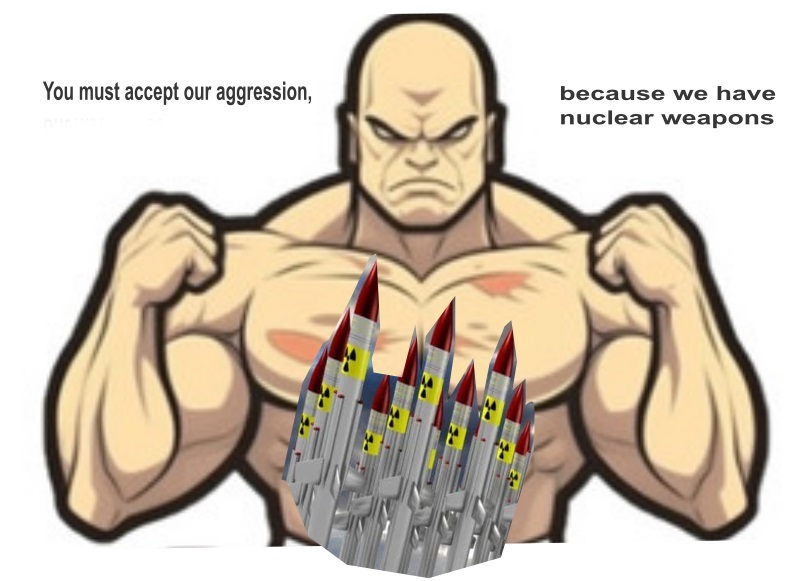
Students in US schools are often taught that the Soviet Union’s deployment of nuclear weapons to Cuba in the 1962 missile crisis was an act of “aggression”. Their classes usually omit the fact the United States first put nuclear weapons in NATO member Turkey in 1959, provoking Moscow.
Today, Washington is provoking Beijing in many domains.
Donald Trump launched a unilateral, aggressive trade war on China in 2018, during his first term.
Trump’s Democratic successor, Joe Biden, not only continued this trade war but expanded it further, adding more tariffs and export restrictions in an attempt to strangle China’s high-tech sector.
Now in his second term, Trump has waged a nuclear trade war on China, threatening tariffs of 245%.
This new cold war has become a lucrative enterprise for some US oligarchs.
Silicon Valley oligarchs hope to profit from US war on China
Big Tech capitalists in Silicon Valley have poured money into new weapons systems, hoping to profit off of war on China.
The Wall Street Journal published an article in 2024 titled “Tech Bros Are Betting They Can Help Win a War With China”. It featured an interview with right-wing billionaire Palmer Luckey, a former Facebook executive who founded the arms manufacturer Anduril Industries.
Anduril has established itself as a significant Pentagon contractor, with its work developing advanced autonomous weapons.
The Wall Street Journal wrote (emphasis added):
These weapons, Luckey argues, are needed for a potential conflict with China, which the Pentagon two years ago announced is the greatest danger to U.S. security. The U.S. military, Luckey and others say, needs large numbers of cheaper and more intelligent systems that can be effective over long stretches of ocean and against a manufacturing and technological power like China.
Anduril is so focused on a conflict with Beijing, Luckey says, that many teams inside the company are building only weapons that can be completed by 2027—the year Chinese President Xi Jinping has said his country should be prepared to invade Taiwan. The fictional sword for which Anduril is named [from the Lord of the Rings] is also called the “Flame of the West.”
“We keep our eyes on the prize, which is great-power conflict in the Pacific,” Luckey said.
The newspaper highlighted how the US military-industrial complex has become increasingly privatized.
There has been a rapid influx of venture capital funds into weapons corporations in recent years. The Wall Street Journal reported (emphasis added):
Anduril is part of one of the largest shifts to take place in the defense sector since World War II: the flow of venture-capital funding into defense-technology companies.
For decades, the U.S. government funded defense companies, like Lockheed Martin, to develop new weapons, ranging from stealth aircraft to spy satellites. But as the private-sector money available for research and development has outstripped federal-government spending, particularly in areas like AI, a new cohort of defense startups is using private capital to develop technology for the Pentagon.
The amount of private capital flowing into the venture-backed defense-tech industry has ballooned, with investors spending at least 70% more on the sector each of the past three years than any prior year. From 2021 through mid-June 2024, venture capitalists invested a total of $130 billion in defense-tech startups, according to data firm PitchBook. The Pentagon spends about $90 billion on R&D annually.
A major investor in Anduril is Founders Fund, the Silicon Valley venture capital firm co-founded by Peter Thiel.
Thiel is a far-right billionaire oligarch who has strongly supported Donald Trump and has funded Republican politicians. He even previously employed US Vice President JD Vance, and bankrolled his successful 2022 Senate campaign.
A former FBI informant, Thiel co-founded another major Pentagon contractor, Palantir, which the CIA helped to fund.
Thiel is also an extreme anti-China hawk. He openly defends monopolies, arguing “competition is for losers”, and wants to ban Chinese competitors to US Big Tech monopolies.
Like Thiel, Anduril founder Palmer Luckey is staunchly pro-Trump. He is from the same community of far-right Silicon Valley oligarchs.
The Financial Times reported that Thiel’s Palantir, Luckey’s Anduril, and Elon Musk’s SpaceX sought to create a “consortium” — or, rather, a cartel — to jointly bid for US government contractors.
US Defense Secretary Pete Hegseth wages “holy war” on China, from Japan and the Philippines
Trump has surrounded himself with a team of war hawks, including neoconservative Secretary of State Marco Rubio, National Security Advisor Mike Waltz, and Defense Secretary Pete Hegseth.
Hegseth personally signed the Pentagon document obtained by the Washington Post that showed that the number one priority of the US military is preparing for war with China over Taiwan.
In this memo, which is officially known as the “Interim National Defense Strategic Guidance”, the Pentagon wrote, “China is the Department’s sole pacing threat, and denial of a Chinese fait accompli seizure of Taiwan — while simultaneously defending the U.S. homeland is the Department’s sole pacing scenario”.
The Washington Post revealed that several parts of this document were copied word-for-word from a vehemently anti-China report published by the Heritage Foundation, a right-wing Washington, DC-based think tank that is funded by large corporations and conservative billionaires.
The oligarch-backed Heritage Foundation organized the notorious Project 2025, which crafted a detailed policy program for the Trump administration to implement.
Hegseth is a far-right theocratic extremist. He published a book in 2020 called “American Crusade”, in which he proudly declared that the US right is in a “holy war” against the international left, China, and Islam.
“Communist China will fall—and lick its wounds for another two hundred years”, Hegseth pledged in the book. He wrote, “If we don’t stand up to communist China now, we will be standing for the Chinese anthem someday”.
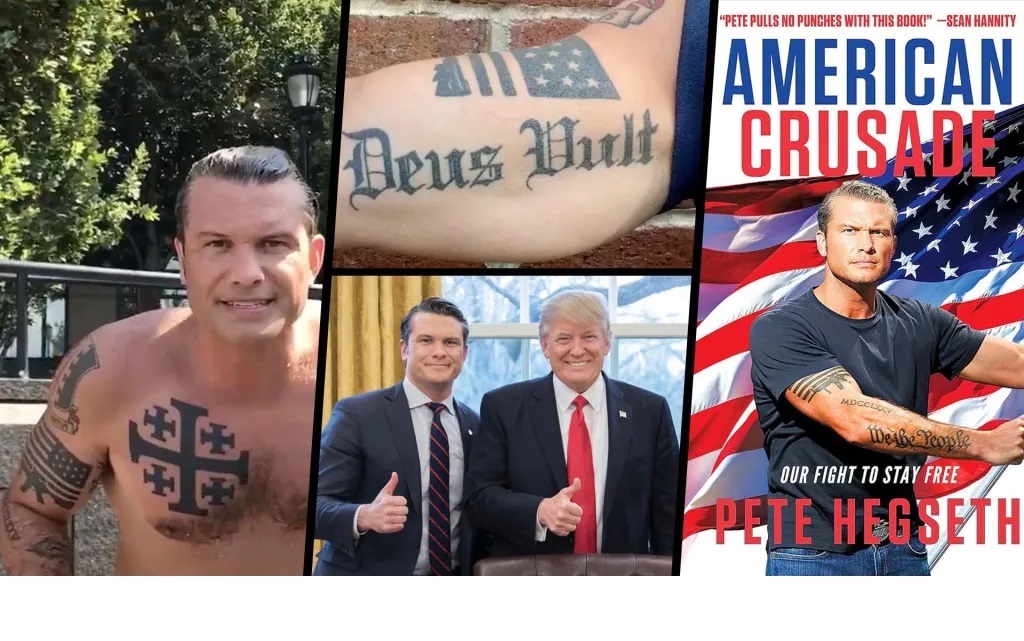
In March 2025, Hegseth traveled to Asia to pressure US allies to join Washington in its new cold war on China. The Wall Street Journal summarized his trip with the headline “Hegseth Tells Asian Allies: We’re With You Against China”.
When he spoke in Japan, Hegseth vowed to “strengthen our bilateral bonds and deepen our operational cooperation” against Beijing.
The US defense secretary stated that the Pentagon is turning “Japan into a war-fighting headquarters”.
Japan previously colonized China. The Japanese empire, which later allied with Nazi Germany and Fascist Italy, killed tens of millions of people in China and other parts of Asia in the 1930s and ’40s.
“America and Japan stand firmly together in the face of aggressive and coercive actions by the Communist Chinese”, Hegseth asserted, fearmongering about “the severe nature of the threat”.
“Those who long for peace must prepare for war”, the US defense secretary said. “We must be prepared. We look forward to working closely together as we improve our war-fighting capabilities, our lethality, and our readiness”.
Hegseth articulated “three pillars” of the Trump administration’s Pentagon strategy: “Reviving the warrior ethos, rebuilding our military, and restoring deterrence”.
The US defense secretary made similarly aggressive comments in the Philippines, blasting what he called “communist China’s aggression in the region”.
Hegseth revealed that the US military is making “real war plans” for China, over Taiwan.
At a press conference in the Philippines, Hegseth spoke of Admiral Samuel Paparo, the commander of the US Indo-Pacific Command. He said (emphasis added):
It’s not my job to determine where the Seventh Fleet goes. I defer to Admiral Paparo and his war plans. Real war plans. Admiral Paparo understands the situation, understands the geographic significance, understands the urgency, and is prepared to work with those in the region to ensure we are leaning forward in our posture. Not waiting for events to develop, not retrograding to places further from the front, but deploying capabilities forward, posturing and creating dynamics and strategic dilemmas for the Communist Chinese, that help them reconsider whether or not violence or action is something they want to undertake.
During the first cold war, the US hosted a military base on Taiwan, where it stored nuclear weapons.
In the second Taiwan Strait crisis in 1958, top US military officials wanted to attack the Chinese mainland with nuclear bombs, but President Dwight D. Eisenhower preferred conventional weapons.
China, Russia may build nuclear plant on moon to power lunar station, official says
China is considering building a nuclear plant on the moon to power the
International Lunar Research Station (ILRS) it is planning with Russia, a
presentation by a senior official showed on Wednesday. China aims to become
a major space power and land astronauts on the moon by 2030, and its
planned Chang’e-8 mission for 2028 would lay the groundwork for
constructing a permanent, manned lunar base.
Reuters 23rd April 2025, https://www.reuters.com/business/energy/china-led-lunar-base-include-nuclear-power-plant-moons-surface-space-official-2025-04-23/
Hegseth Orders Pentagon To Focus on Preparing for War With China Over Taiwan
In an internal memo, Hegseth called China the ‘sole pacing threat’
by Dave DeCamp March 30, 2025 , https://news.antiwar.com/2025/03/30/hegseth-orders-pentagon-to-focus-on-preparing-for-war-with-china-over-taiwan/
Secretary of Defense Pete Hegseth distributed a memo in mid-March ordering the Pentagon to put its focus on preparing for a war with China, a nuclear-armed power, by “assuming risk” in Europe and other parts of the world, The Washington Post reported on Saturday.
The Post didn’t publish the full memo, known as the Interim National Defense Strategic Guidance, but said it “outlines, in broad and sometimes partisan detail, the execution of President Donald Trump’s vision to prepare for and win a potential war against Beijing and defend the United States from threats in the ‘near abroad,’ including Greenland and the Panama Canal.”
The Pentagon has considered China the top “threat” facing the US since the first Trump administration, but the Post report said the memo is “extraordinary in its description of the potential invasion of Taiwan as the exclusive animating scenario that must be prioritized over other potential dangers — reorienting the vast US military architecture toward the Indo-Pacific region beyond its homeland defense mission.”
The report said that the guidance from Hegseth says the Pentagon’s force planning construct “will consider conflict only with Beijing when planning contingencies for a major power war” and leave the “threat from Moscow largely attended by European allies.”
Hegseth wrote that China “is the Department’s sole pacing threat, and denial of a Chinese fait accompli seizure of Taiwan — while simultaneously defending the US homeland is the Department’s sole pacing scenario.”
The memo reflects the Trump administration’s policy toward Europe and calls for NATO allies to take a “far greater” burden sharing. The document says that the US is unlikely to provide substantial support to Europe if Russia’s military advances in the region, saying the US will only provide nuclear deterrence.
The memo also calls for the US to pressure Taiwan to increase military spending “significantly.”
For years now, the US military has been openly preparing for war with China despite the risk of nuclear escalation. It has done this by expanding military bases in the Asia Pacific, building alliances, and increasing support for Taiwan. While being done in the name of deterrence, these steps have only increased tensions in the region, making conflict more likely.
The Post report says that Hegseth’s plans to prepare a “denial defense” of Taiwan include “increasing the troop presence through submarines, bombers, unmanned ships, and specialty units from the Army and Marine Corps, as well as a greater focus on bombs that destroy reinforced and subterranean targets.” His memo also calls for increasing the defenses of US troop positions in the region and establishing more weapons stockpiles.
Hegseth Circulated Secret Pentagon Memo On Preparing For War With China
by Tyler Durden, Tuesday, Apr 01, 2025, https://www.zerohedge.com/geopolitical/hegseth-circulated-secret-pentagon-memo-preparing-war-china
Over the weekend The Washington Post revealed that Secretary of Defense Pete Hegseth distributed a memo in mid-March which ordered the Pentagon to prioritize its war-planning focus on potential future conflict with China.
The memo, called the Interim National Defense Strategic Guidance “outlines, in broad and sometimes partisan detail, the execution of President Donald Trump’s vision to prepare for and win a potential war against Beijing and defend the United States from threats in the ‘near abroad,’ including Greenland and the Panama Canal.”
It’s nothing new that the Pentagon considers China a ‘top pacing threat’ – but it does confirm that the Trump administration would likely be willing to go to war in the event of a mainland invasion of the self-ruled island.
The memo interestingly presented a strategy of “assuming risk” in Europe and other parts of the world, to refocus efforts on top nuclear-armed rivals.
The Pentagon’s force planning and new focus “will consider conflict only with Beijing when planning contingencies for a major power war” and leave the “threat from Moscow largely attended by European allies” – according to the report.
Hegseth wrote that China “is the Department’s sole pacing threat, and denial of a Chinese fait accompli seizure of Taiwan — while simultaneously defending the US homeland is the Department’s sole pacing scenario.”
The memo urges NATO allies take on a “far greater” burden-sharing on defense, and puts Europe on notice in the event of greater threats from Russia:
Hegseth’s guidance acknowledges that the U.S. is unlikely to provide substantial, if any, support to Europe in the case of Russian military advances, noting that Washington intends to push NATO allies to take primary defense of the region. The U.S. will support Europe with nuclear deterrence of Russia, and NATO should only count on U.S. forces not required for homeland defense or China deterrence missions, the document says.
A significant increase in Europe sharing its defense burden, the document says, “will also ensure NATO can reliably deter or defeat Russian aggression even if deterrence fails and the United States is already engaged in, or must withhold forces to deter, a primary conflict in another region.”
As for Taiwan specifically, it lays out ways the Pentagon intends to help its ally bolster defenses, short of outright entering any direct conflict.
WaPo and others have said the Heritage Foundation think tank is the driving force behind the strategic ideas presented in the memo.
Hegseth’s plans specify a “denial defense” of Taiwan – according to the memo – which will include “increasing the troop presence through submarines, bombers, unmanned ships, and specialty units from the Army and Marine Corps, as well as a greater focus on bombs that destroy reinforced and subterranean targets.”
China calls for strict, long-term international supervision over Fukushima wastewater discharge: spokesman

2025-03-26, https://www.bastillepost.com/global/article/4690031-china-calls-for-strict-long-term-international-supervision-over-fukushima-wastewater-discharge-spokesman?fbclid=IwY2xjawJSuCVleHRuA2FlbQIxMQABHRXbhJz-aEa94Wd_9BghnsxtDEzzaxDZiiCBsWn9LWkvzinWWdeZIhe3Zg_aem_9apdp3Teicc2HwmyoEjwCw
Guo made the statement at a press conference in Beijing in response to a media query about Japan’s wastewater discharge.
China calls for strict and long-term international supervision over Japan’s discharge of nuclear-contaminated wastewater from the crippled Fukushima Daiichi Nuclear Power Plant into the ocean, Chinese Foreign Ministry spokesman Guo Jiakun said on Wednesday.
“I would like to emphasize that China opposes Japan’s unilateral discharge of nuclear-contaminated wastewater into the ocean, and this position remains unchanged. Since last year, Chinese experts have visited Japan twice to independently collect samples and announced the relevant test results in a timely manner. On the basis that Japan has fulfilled its commitments and the test results haven’t shown any abnormalities, the General Administration of Customs of China held in Beijing on March 12 technical exchanges with Japan over the safety of Japanese aquatic products,” Guo said.
“China will continue to work with the rest of the international community to urge Japan to earnestly fulfill its commitments and ensure that the discharge of Fukushima nuclear-contaminated wastewater into the sea is always under strict international supervision,” said the spokesman.
Hit by a magnitude-9.0 earthquake and an ensuing tsunami on March 11, 2011, the Fukushima Daiichi nuclear power plant suffered core meltdowns in three reactors that released radiation, resulting in a level-7 nuclear accident, the highest on the International Nuclear and Radiological Event Scale.
The plant then generated a massive amount of wastewater tainted with radioactive substances from cooling down the nuclear fuel in the reactor buildings.
Disregarding domestic and foreign questioning and protests, the Japanese government decided in April 2021 to “filter and dilute” the nuclear contaminated wastewater from the plant and started the ocean discharge of the radioactive wastewater on August 24, 2023. This process is expected to last 20 to 30 years, until the nuclear power plant is scrapped.
China, Russia back Iran as Trump presses Tehran for nuclear talks

By Ryan Woo, Xiuhao Chen and Laurie Chen, March 14, 2025,
- Summary
- China, Russia, Iran say talks should be based on mutual respect
- They say ‘unlawful’ unilateral sanctions should be lifted
- China, Russia urge respect for Iran’s right to peaceful uses of nuclear energy
BEIJING, March 14 (Reuters) – China and Russia stood by Iran on Friday after the United States demanded nuclear talks with Tehran, with senior Chinese and Russian diplomats saying dialogue should only resume based on “mutual respect” and all sanctions ought to be lifted.
In a joint statement issued after talks with Iran in Beijing, China and Russia also said they welcomed Iran’s reiteration that its nuclear programme was exclusively for peaceful purposes, and that Tehran’s right to peaceful uses of nuclear energy should be “fully” respected………………………………………………… https://www.reuters.com/world/asia-pacific/china-iran-russia-kick-off-talks-beijing-over-irans-nuclear-issues-2025-03-14/
Chinese nuclear weapons, 2025
Bulletin, By Hans M. Kristensen, Matt Korda, Eliana Johns, Mackenzie Knight | March 12, 2025
The modernization of China’s nuclear arsenal has both accelerated and expanded in recent years. In this issue of the Nuclear Notebook, we estimate that China now possesses approximately 600 nuclear warheads, with more in production to arm future delivery systems. China is believed to have the fastest-growing nuclear arsenal among the nine nuclear-armed states; it is the only Party to the Treaty on the Non-Proliferation of Nuclear Weapons that is significantly increasing its nuclear arsenal. The Nuclear Notebook is researched and written by the staff of the Federation of American Scientists’ Nuclear Information Project: director Hans M. Kristensen, associate director Matt Korda, and senior research associates Eliana Johns and Mackenzie Knight.
………………………………………………………………………………………………………………………………………………………………………… more https://thebulletin.org/premium/2025-03/chinese-nuclear-weapons-2025/
As China and the U.S. Race Toward A.I. Armageddon, Does It Matter Who Wins?

it doesn’t matter if the U.S. has no real enemies. The military industrial complex must continue to unceasingly grow, according to the logic of the Megamachine. It will invent enemies in order to justify that growth. That’s why we now have thousands of nuclear bombs and a sprawling, AI-driven, globally networked satellite and base infrastructure that encases the Earth like an iron maiden.
Koohan Paik-Mander CounterPunch , 7 Feb 25
A longstanding Sinophobia in the U.S. goes back to the 19th century, with the Chinese Exclusion Act, the tax on Chinese miners during the Gold Rush, and the exclusion from being able to testify in court.
Evidence of this entrenched history lingers today, in the trade sanctions against China, belligerent rhetoric from both Republicans and Democrats that led to a rash of violence against elderly Asian-Americans on American streets, as well as billions of dollars spent to fortify overseas bases in preparation for a U.S.-China war.
And the refusal to cooperate meaningfully with China on anything. As a result, the U.S. is thick in the midst of an AI arms race with China that is predicated on both nations’ dangerous faith in techno-salvation.
Thanks to the legacy of Sinophobia, it takes a whole lot to elicit an overwhelming embrace of China from average Americans, even if temporarily. But that’s what’s happened twice in the last month. The first time was the TikTok fiasco, when millions of distraught TikTok users had had their favorite platform snatched from them like a pacifier from a baby’s mouth. They found solace not in Meta nor X (as had been the plan), but rather, in the Chinese social media platform, Xiaohongshu, also known as “RedNote.”
The second instance was the debut of DeepSeek AI, which came on the heels of one of the most pompous pageants of delusional grandeur ever seen. It was Trump’s inauguration ceremony for his second term. Shortly thereafter, a press conference was held. Three tech oligarchs and the president bloviated about their Stargate AI project. It would cost $500 billion. That’s what they say is needed to stay ahead of the Chinese. (For some reason, the excuse of “staying ahead of the Chinese” seems to justify any astronomical expense.)
In the mean time, thousands of people have been left homeless due to wild fires in L.A., flooding in North Carolina, and even to this day, people from Lahaina, Maui are still without a place to call home. But none of these Americans got a press conference.
Instead, it was the oligarchs who took the stage. Oracle’s Larry Ellison, Masayoshi Son of Starbank, and Open AI founder Sam Altman described Stargate’s plans to build clusters of gigantic data centers across the country from sea to shining sea, each one bigger than any Walmart Superstore. It’s Manifest Destiny for data.
No one at the press conference mentioned that many of the data centers would be built on federal lands, would collectively use as much power as small European nations, require massive volumes of water, or would require a network of nuclear reactors. They did make the dubious promise their AI would cure cancer and heart disease. I think the guys who got wampum for Manhattan got a better deal.
A few days afterward, as if on cue, a Chinese company called DeepSeek that no one had ever heard of dropped their bombshell. The Chinese firm had released its own AI that was open-source, used fifty times less energy, performed on par with all the American AIs, and cost a gazillion times less to produce. Suddenly, the mirage of Silicon Valley’s invincibility faded away to reveal an overvalued industry that had gotten too fat, lazy and full of itself to innovate anything except marketing promises to investors. The very next day, a veritable trillion dollars peeled like a banana off the U.S. stock exchange tech sector. The story everywhere was that Chinese AI had officially “caught up” with the U.S.
When people cheered the scrappy Chinese underdog, it was as much a middle finger to the overblown hubris of the tech oligarchs as it was an embrace of Chinese innovation. It was motivated largely by the same class anger that rose up to lionize Luigi Mangione for killing a health insurance CEO with three inscribed bullets. People had been galled by the consolidated display of the broligarchy on the dais at the Trump inauguration, similar to the royals waving at the minions from the balcony at Buckingham Palace. Their message was unequivocal: We own you.
DeepSeek has been described as a Robin Hood of tech, taking from the rich to give AI to the poor. Sentiments of class anger buoyed admiration for the unknown company from China. They disregarded, for once, the stubborn stains of Sinophobia.
What was also overlooked in the midst of DeepSeek’s dazzling display of stock market disruption was responsible restraint around technology. As both China and the U.S. go hurtling ever faster toward Armageddon in the race to dominate in AI, they have both bought into techno-utopian ideologies, lock, stock and barrel………………………………………………………………….
China and the U.S. are entangled in a geopolitical rivalry, with existential stakes. Sure, it’s satisfying to enjoy the smarting blow that newcomer DeepSeek landed to the capitalist Goliath — China one, U.S. zero. But it’s not a boxing match. Such narrow framing loses sight of the fact that the race for accessible AI is a race for Mutually Assured Destruction (MAD).
………………………………………………………………………………………………………………The weapons industry wouldn’t tolerate the thought of degrowth, just like Microsoft, Google, Meta, Amazon et al. can’t bear it today. The war industry dealt with it by instead aggressively manufacturing enemies and reasons for war faster than it could manufacture more weapons. Now, forty years after the end of the Cold War with Russia, the war budget has increased every year and is now up to one trillion dollars, Los Alamos has begun manufacturing nukes for the first time in decades last year, we’ve got 800 bases around the world, rocket launchpads in wilderness areas, and thousands of satellites in the heavens.
It’s hard to get one’s bearings, especially in the midst of the engineered political maelstrom of the current moment. Fortunately, the books haven’t been burned (yet), so we can turn to the thinkers of the recent past for guidance.
The technology critics of the 20th century, such as Jacques Ellul, Lewis Mumford and Chellis Glendinning, urged us to conceptualize technology not just as a single artifact, such as a laptop, or just AI, or just a satellite, or just a nuclear weapon, but rather, as a whole way of thinking, a way of organizing society, our institutions, a way of being. Technology is not a one-off. It is systemic. Lewis Mumford called all of our technological society the Megamachine.
Every project, technology, organization, and endeavor is an expression of the Megamachine where the economic-growth imperative reigns supreme. It is all of a piece. It doesn’t matter if DeepSeek uses less energy. The growth imperative must be met……
Likewise, it doesn’t matter if the U.S. has no real enemies. The military industrial complex must continue to unceasingly grow, according to the logic of the Megamachine. It will invent enemies in order to justify that growth. That’s why we now have thousands of nuclear bombs and a sprawling, AI-driven, globally networked satellite and base infrastructure that encases the Earth like an iron maiden.
The poster child for the Megamachine in the digital age is Amazon. Former chair of the Federal Trade Commission Lina Khan’s seminal essay “Amazon’s Anti-trust Paradox,” tracks the logic of the behemoth’s growth over its history. She brilliantly unravels how Amazon decisively prioritized sheer growth over profit for its first eight years. The goal was to entrench a broad-spanning networked infrastructure that would guarantee a monopoly and continue to consolidate market dominion. They forwent profits for almost a decade expressly in order to monopolize the market. Again, the imperative for growth and global domination trumps decent common sense.
Former chair of the Federal Trade Commission Lina Khan’s seminal essay “Amazon’s Anti-trust Paradox,” tracks the logic of the behemoth’s growth over its history. She brilliantly unravels how Amazon decisively prioritized sheer growth over profit for its first eight years. The goal was to entrench a broad-spanning networked infrastructure that would guarantee a monopoly and continue to consolidate market dominion. They forwent profits for almost a decade expressly in order to monopolize the market. Again, the imperative for growth and global domination trumps decent common sense.
……………………………………………………………The sooner that the U.S. and China treat one another as fellow members of humankind, rather than adversaries, the real work of cooperation can begin. Both nations are home to millions of indigenous peoples who carry the know-how for surviving and thriving for generations into the future. Their wisdom is more precious than any AI. There’s no shortage of problems that our combined brilliance can improve if not solve: climate, nuclear weapons, species extinction, toxic waste clean-up, housing, microplastics, and last but not least, dangerous unregulated technologies. None of these colossal crises can be addressed as long as we are pointing fingers while locked in the downward spiral of a competition for global hegemony that the U.S. can never win.
Some of us remember the shining moment in history when the U.S. and Soviet Union built trust and signed a raft of nuclear arms control agreements. They modeled what ratcheting down tensions and the path to peace looks like. It would behoove the U.S. and China to follow their lead today, not only with nukes but also with AI and other emerging technologies. https://www.counterpunch.org/2025/02/07/as-china-and-the-u-s-race-toward-a-i-armageddon-does-it-matter-who-wins/
China AI startup rattles US new nukes plan
January 30, 2025, https://beyondnuclear.org/china-ai-startup-rattles-us-new-nuke-plan/
Innovative computer modelling with AI doesn’t need the most expensive and dangerous energy from nukes
The much touted second-coming of a “nuclear renaissance” in the United States fueled by the projected soaring global demand to power artificial intelligence (AI) just got a major setback with the surprise January 20, 2025 overnight emergence of an apparently more competitive and efficient Chinese AI startup company, DeepSeek. The US stock market plummeted for the S&P 500 nuclear power companies that have been financially scaling up as the most reliable 24/7 electricity supply for a massive expansion of energy intensive data centers. China’s surprise rollout of DeepSeek and sudden rise to international acclaim at the start of 2025 has seriously disrupted the US claim to global dominance in cloud computing, networking and data storage services powered by extravagantly expensive atomic energy.
US-based AI technology firms, including Nvidia, which lost nearly $600 billion in the January 27th record breaking single day’s largest stock selloff, have led the way in rebranding nuclear power as the preferred choice as the 24/7 power supplier for a massive AI surge. The sudden emergence of DeepSeek, only two months in the making, is being compared to a “sputnik moment” for the US AI market, referencing the former Soviet Union’s launch of the first artificial satellite into orbit in 1959 that triggered a US technological panic and launched America into a “space race” with Russia. DeepSeek has just as suddenly now laid claim to competitively take the technological lead to advance mere computer modelling to an innovative era of computer reasoning.
Starting in 2023 and swelling in 2024, there was sort of a “gold rush” of fast money that sprang up to finance AI deals with new reactor licensing and construction of still unproven Small Modular Reactor (SMR) designs as well as repowering uneconomical, permanently closed reactors like Three Mile Island Unit 1. The Big Tech corporate promotion was primarily driven by the leading hyperscalers including Google, Amazon, MicroSoft, Meta Platforms (aka Facebook) and Oracle. A series of deals have since been cut with the established S&P 500 nuclear corporations led by Constellation Energy, Vistra, and the usual suspects of nuclear start-ups including Oklo Power, NuScale, Talen Energy Corp and TerraPower.
However, like a bolt from the blue, the US nuclear industry has been rattled on the stock market. The S&P 500 nuclear power giants Constellation Energy (CEG) and Vistra (VST) are under scrutiny as international energy analysts reevaluate the energy needs of AI data centers along with that same host of nuclear power start-ups.
DeepSeek: how a small Chinese AI company is shaking up US tech heavyweights.
DeepSeek’s models and techniques have been released under the free MIT License, which means anyone can download and modify them.
https://www.sydney.edu.au/news-opinion/news/2025/01/29/deepseek-ai-china-us-tech.html January 28, 2025
Chinese artificial intelligence (AI) company DeepSeek has sent shockwaves through the tech community, with the release of extremely efficient AI models that can compete with cutting-edge products from US companies such as OpenAI and Anthropic.
Founded in 2023, DeepSeek has achieved its results with a fraction of the cash and computing power of its competitors.
DeepSeek’s “reasoning” R1 model, released last week, provoked excitement among researchers, shock among investors, and responses from AI heavyweights. The company followed up on January 28 with a model that can work with images as well as text.
What DeepSeek did
In December, DeepSeek released its V3 model. This is a very powerful “standard” large language model that performs at a similar level to OpenAI’s GPT-4o and Anthropic’s Claude 3.5.
While these models are prone to errors and sometimes make up their own facts, they can carry out tasks such as answering questions, writing essays and generating computer code. On some tests of problem-solving and mathematical reasoning, they score better than the average human.
V3 was trained at a reported cost of about US$5.58 million. This is dramatically cheaper than GPT-4, for example, which cost more than US$100 million to develop.
DeepSeek also claims to have trained V3 using around 2,000 specialised computer chips, specifically H800 GPUs made by NVIDIA. This is again much fewer than other companies, which may have used up to 16,000 of the more powerful H100 chips.
On January 20, DeepSeek released another model, called R1. This is a so-called “reasoning” model, which tries to work through complex problems step by step. These models seem to be better at many tasks that require context and have multiple interrelated parts, such as reading comprehension and strategic planning.
The R1 model is a tweaked version of V3, modified with a technique called reinforcement learning. R1 appears to work at a similar level to OpenAI’s o1, released last year.
DeepSeek also used the same technique to make “reasoning” versions of small open-source models that can run on home computers.
This release has sparked a huge surge of interest in DeepSeek, driving up the popularity of its V3-powered chatbot app and triggering a massive price crash in tech stocks as investors re-evaluate the AI industry. At the time of writing, chipmaker NVIDIA has lost around US$600 billion in value.
How DeepSeek did it
DeepSeek’s breakthroughs have been in achieving greater efficiency: getting good results with fewer resources. In particular, DeepSeek’s developers have pioneered two techniques that may be adopted by AI researchers more broadly.
The first has to do with a mathematical idea called “sparsity”. AI models have a lot of parameters that determine their responses to inputs (V3 has around 671 billion), but only a small fraction of these parameters is used for any given input.
However, predicting which parameters will be needed isn’t easy. DeepSeek used a new technique to do this, and then trained only those parameters. As a result, its models needed far less training than a conventional approach.
The other trick has to do with how V3 stores information in computer memory. DeepSeek has found a clever way to compress the relevant data, so it is easier to store and access quickly.
What it means
DeepSeek’s models and techniques have been released under the free MIT License, which means anyone can download and modify them.
While this may be bad news for some AI companies – whose profits might be eroded by the existence of freely available, powerful models – it is great news for the broader AI research community.
At present, a lot of AI research requires access to enormous amounts of computing resources. Researchers like myself who are based at universities (or anywhere except large tech companies) have had limited ability to carry out tests and experiments.
More efficient models and techniques change the situation. Experimentation and development may now be significantly easier for us.
For consumers, access to AI may also become cheaper. More AI models may be run on users’ own devices, such as laptops or phones, rather than running “in the cloud” for a subscription fee.
For researchers who already have a lot of resources, more efficiency may have less of an effect. It is unclear whether DeepSeek’s approach will help to make models with better performance overall, or simply models that are more efficient.
China Is Not Our Enemy
So I coordinate our CODEPINK’s China is our enemy campaign, and the campaign was created in response to this rise in recent years of anti-China sentiments and the actions that our government has been taking to accelerate the new Cold War offensive against Beijing, and that includes spending billions of dollars militarizing Asia Pacific region, utilizing military economic coercion to push US interests outright labeling China an enemy, demonizing essentially anything China does, and all of which has led to a rise in Asian American hate around the country.
So the campaign seeks to do two things. The first is to educate the public how their minds are being shaped for war. And we do this by teaching our audience about China, dismantling the lies being told by the media, by politicians, and then also informing on all the tax dollars being spent preparing for war with China. And the second thing that we try to do is redirect all that energy into a push for peace. And that’s why we emphasize the need for friendship and cooperation with China for working together on climate justice, nuclear disarmament and other extremely important issues today.
SCHEERPOST, 10 Jan 25, Robert Scheer interviews Megan Russell, a writer, academic and CODEPINK’s China is Not Our Enemy Campaign Coordinator.
…………………………………………………………………………………………………………………………………. in the past 50 or so years, you know, China has accomplished an incredible amount of progress, something they don’t talk about enough, in my opinion, is how China managed to eradicate extreme poverty. And that’s not just a minimum income level. It also means access to food, to clothes, health care, clean housing, free education, you know, means infrastructure, means functioning systems and and through the past half a century, you know, through market reforms, rural collectivization and other poverty alleviation programs, China was ultimately successful in its in its mission. And by 2021, I believe the last 100 million people were taken out of extreme poverty, which was nearly 900 million people total. And many UN officials call it the greatest anti-poverty achievement in history, which it is. That’s 1.4 billion people without extreme poverty. That’s about the entire continent of Africa or the US and Europe combined.
…………………………………………….This turn toward China, and this new narrative that China is some sort of existential threat to us, even though China has never threatened war or even invaded or intervened in a nation for 50 years, which is a sharp contrast to US history, which is very heavily involved in overseas conflicts. But, you know, China’s been focused on its internal growth and accomplishing its own goals. And non interventionism, of course, is one of its foundational policy pillars.
The American saber-rattling against China has been increasing almost as fast as China’s own development in the past few years. China’s economic prosperity and international influence is undeniable yet American politicians continue to treat their rise as a threat to their global hegemony. Joining host Robert Scheer on this episode of Scheer Intelligence is Megan Russell, a writer, academic and CODEPINK’s China is Not Our Enemy Campaign Coordinator.
Scheer is quick to point out the intergenerational dynamic between his own work on China as a fellow in the Center for Chinese Studies at the University of California, Berkeley in the 1960s and Russell’s recent experience living in China and studying in Shanghai. Both witnessed and experienced the American perspective of China and how it has continued to undermine it. Scheer and Russell focus on her latest article, which calls out New York Times columnist Thomas Friedman for his portrayal of China and how his deficient op-ed mirrors the broader perception of China in the United States. While many may think that China is an authoritarian country with people living under the heel of Xi Jinping, the actual material conditions of its population are often left out.
“Something [people] don’t talk about enough, in my opinion, is how China managed to eradicate extreme poverty. And that’s not just a minimum income level, it also means access to food, to clothes, healthcare, clean housing, free education. It means infrastructure, means functioning systems,” Russell says.
People also point to working conditions and the outsourcing of American jobs to China as a means of attacking them. To this, Russell explains, “All China has done is use the system in place to develop and try to provide opportunities to its incredibly vast population, while still maintaining its proto-socialist policies. It’s us that has exported the production of all our goods to make a few more dollars.”
In the end, the US stands to lose, not only in a trade war, but also in the climate aspect, since China has also made great strides towards combatting the climate crisis. Russell cites their plan of reaching carbon neutrality by 2060 and tells Scheer, “China has really undergone this internal green energy revolution, doing far more than any other country to combat climate change.”
………………………………………………………………………………………………………………………………………….. Megan Russell
…………………………………………………………………………………..Megan Russell
Yeah, you know, a lot of times the first thing people ask me when they hear that I lived in China was that was “Was it scary?” Did I feel threatened and watched? Someone actually just asked me that yesterday, and it’s very real to them, though it always sounds a little silly to me, because I actually felt very safe in China more than I felt in most other countries, I would say, maybe all of them. And that’s, you know, my honest answer. You know, crime rates are very low in China. I never had any safety issues. I lived there a year. I traveled extensively by myself to many provinces on all sides of the country. I never felt unsafe. I never worried about pickpockets. I never worried about being robbed. I never felt the discomfort of being a woman alone. You know, everyone has a different experience, but this was my experience,
……………………………………………………………………………………………………… the success of China is, you know, very triggering to this idea of Western exceptionalism. You know that any form of socialism could actually improve the lives of the people, could actually obtain any measure of success. And this exceptional exceptionalism is based on ideals, right on this imagined perfection of free markets and democracy, yes, but also on colonial racist doctrines. And that’s really, you know, at the root of it, a lot of this negativity as well. Unfortunately, though, it’s, you know, often disguised or dressed up like something else. It’s at the root of it, a dehumanization of China and Chinese people that they are worth less, that they aren’t deserving of of jobs or opportunities or of success. And I think this manifests itself very easily into a global system that is, you know, inherently based on a division of humanity that we have been forced to accept as normal and and that doesn’t just go for China, of course, but the entire Global South……………………………………………………………………………..
Robert Scheer…………………………………………………………………… you know, we need to manufacture consent for militarization, for war, because it’s far easier with public support, and it helps maintain internal stability here as well. And this is why you’ve seen, you know, this steady rise of anti-China messaging and and fear mongering. You know, just last fall, the House passed a bill to fund $1.6 billion to anti-China propaganda around the world. You know, that’s $1.6 billion of going to information warfare. Because, you know, in order to pursue this agenda, you need to convince the rest of the world that, or at least the United States, that China is a threat and and many people aren’t, you know, convinced enough. And also, along with that, you know, there was a whole China week where they passed 25 anti China bills, including the propaganda Bill, you know, all with the end goal of countering the influence of the Communist Party of China………………………………………………………………………………………………………………………………………………………………… more https://scheerpost.com/2025/01/10/china-is-not-our-enemy/
Can Trump Trump China (or Vice Versa)?
When Washington granted diplomatic recognition to China in 1979, it “acknowledged” that Taiwan and the mainland were both part of “one China” and that the two parts could eventually choose to reunite. The U.S. also agreed to cease diplomatic relations with Taiwan and terminate its military presence there.
For decades, one president after another reaffirmed the “one China” policy while also providing Taiwan with increasingly powerful weaponry.
the bind Trump will inevitably find himself in when it comes to Taiwan this time around.
Trump Confronts a Rising China
Can He Manage U.S.-China Relations Without Precipitating World War III?
By Michael Klare, December 17, 2024, https://scheerpost.com/2024/12/19/trump-confronts-a-rising-china/
Gaza, Haiti, Iran, Israel, Lebanon, Russia, Syria, Ukraine, and Venezuela: President-elect Donald Trump will face no shortage of foreign-policy challenges when he assumes office in January. None, however, comes close to China in scope, scale, or complexity. No other country has the capacity to resist his predictable antagonism with the same degree of strength and tenacity, and none arouses more hostility and outrage among MAGA Republicans. In short, China is guaranteed to put President Trump in a difficult bind the second time around: he can either choose to cut deals with Beijing and risk being branded an appeaser by the China hawks in his party, or he can punish and further encircle Beijing, risking a potentially violent clash and possibly even nuclear escalation. How he chooses to resolve this quandary will surely prove the most important foreign test of his second term in office.
As Waltz and others around Trump see it, China poses a multi-dimensional threat to this country’s global supremacy. In the military domain, by building up its air force and navy, installing military bases on reclaimed islands in the South China Sea, and challenging Taiwan through increasingly aggressive air and naval maneuvers, it is challenging continued American dominance of the Western Pacific. Diplomatically, it’s now bolstering or repairing ties with key U.S. allies, including India, Indonesia, Japan, and the members of NATO. Meanwhile, it’s already close to replicating this country’s most advanced technologies, especially its ability to produce advanced microchips. And despite Washington’s efforts to diminish a U.S. reliance on vital Chinese goods, including critical minerals and pharmaceuticals, it remains a primary supplier of just such products to this country.
Fight or Strike Bargains?
For many in the Trumpian inner circle, the only correct, patriotic response to the China challenge is to fight back hard. Both Representative Waltz, Trump’s pick as national security adviser, and Senator Marco Rubio, his choice as secretary of state, have sponsored or supported legislation to curb what they view as “malign” Chinese endeavors in the United States and abroad.
What such a deal might look like is anyone’s guess, but it’s hard to see how Trump could win significant concessions from Beijing without abandoning some of the punitive measures advocated by the China hawks in his entourage. Count on one thing: this complicated and confusing dynamic will play out in each of the major problem areas in U.S.-China relations, forcing Trump to make critical choices between his transactional instincts and the harsh ideological bent of his advisers.
Trump, China, and Taiwan
Of all the China-related issues in his second term in office, none is likely to prove more challenging or consequential than the future status of the island of Taiwan. At issue are Taiwan’s gradual moves toward full independence and the risk that China will invade the island to prevent such an outcome, possibly triggering U.S. military intervention as well. Of all the potential crises facing Trump, this is the one that could most easily lead to a great-power conflict with nuclear undertones.
When Washington granted diplomatic recognition to China in 1979, it “acknowledged” that Taiwan and the mainland were both part of “one China” and that the two parts could eventually choose to reunite. The U.S. also agreed to cease diplomatic relations with Taiwan and terminate its military presence there. However, under the Taiwan Relations Act of 1979, Washington was also empowered to cooperate with a quasi-governmental Taiwanese diplomatic agency, the Taipei Economic and Cultural Representative Office in the United States, and provide Taiwan with the weapons needed for its defense. Moreover, in what came to be known as “strategic ambiguity,” U.S. officials insisted that any effort by China to alter Taiwan’s status by force would constitute “a threat to the peace and security of the Western Pacific area” and would be viewed as a matter “of grave concern to the United States,” although not necessarily one requiring a military response.
For decades, one president after another reaffirmed the “one China” policy while also providing Taiwan with increasingly powerful weaponry. For their part, Chinese officials repeatedly declared that Taiwan was a renegade province that should be reunited with the mainland, preferably by peaceful means. The Taiwanese, however, have never expressed a desire for reunification and instead have moved steadily towards a declaration of independence, which Beijing has insisted would justify armed intervention.
As such threats became more frequent and menacing, leaders in Washington continued to debate the validity of “strategic ambiguity,” with some insisting it should be replaced by a policy of “strategic clarity” involving an ironclad commitment to assist Taiwan should it be invaded by China. President Biden seemed to embrace this view, repeatedly affirming that the U.S. was obligated to defend Taiwan under such circumstances. However, each time he said so, his aides walked back his words, insisting the U.S. was under no legal obligation to do so.
The Biden administration also boosted its military support for the island while increasing American air and naval patrols in the area, which only heightened the possibility of a future U.S. intervention should China invade. Some of these moves, including expedited arms transfers to Taiwan, were adopted in response to prodding from China hawks in Congress. All, however, fit with an overarching administration strategy of encircling China with a constellation of American military installations and U.S.-armed allies and partners.
From Beijing’s perspective, then, Washington is already putting extreme military and geopolitical pressure on China. The question is: Will the Trump administration increase or decrease those pressures, especially when it comes to Taiwan?
That Trump will approve increased arms sales to and military cooperation with Taiwan essentially goes without saying (as much, at least, as anything involving him does). The Chinese have experienced upticks in U.S. aid to Taiwan before and can probably live through another round of the same. But that leaves far more volatile issues up for grabs: Will he embrace “strategic clarity,” guaranteeing Washington’s automatic intervention should China invade Taiwan, and will he approve a substantial expansion of the American military presence in the region? Both moves have been advocated by some of the China hawks in Trump’s entourage, and both are certain to provoke fierce, hard-to-predict responses from Beijing.
Many of Trump’s closest advisers have, in fact, insisted on “strategic clarity” and increased military cooperation with Taiwan. Michael Waltz, for example, has asserted that the U.S. must “be clear we’ll defend Taiwan as a deterrent measure.” He has also called for an increased military presence in the Western Pacific. Similarly, last June, Robert C. O’Brien, Trump’s national security adviser from 2019 to 2021, wrote that the U.S. “should make clear” its “commitment” to “help defend” Taiwan, while expanding military cooperation with the island.
Trump himself has made no such commitments, suggesting instead a more ambivalent stance. In his typical fashion, in fact, he’s called on Taiwan to spend more on its own defense and expressed anger at the concentration of advanced chip-making on the island, claiming that the Taiwanese “did take about 100% of our chip business.” But he’s also warned of harsh economic measures were China to impose a blockade of the island, telling the editorial board of the Wall Street Journal, “I would say [to President Xi]: if you go into Taiwan, I’m sorry to do this, I’m going to tax you at 150% to 200%.” He wouldn’t need to threaten the use of force to prevent a blockade, he added, because President Xi “respects me and he knows I’m [expletive] crazy.”
Such comments reveal the bind Trump will inevitably find himself in when it comes to Taiwan this time around. He could, of course, try to persuade Beijing to throttle back its military pressure on the island in return for a reduction in U.S. tariffs — a move that would reduce the risk of war in the Pacific but leave China in a stronger economic position and disappoint many of his top advisers. If, however, he chooses to act “crazy” by embracing “strategic clarity” and stepping up military pressure on China, he would likely receive accolades from many of his supporters, while provoking a (potentially nuclear) war with China.
In January 2018, the first Trump administration imposed tariffs of 30% on imported solar panels and 20%-50% on imported washing machines, many sourced from China. Two months later, the administration added tariffs on imported steel (25%) and aluminum (10%), again aimed above all at China. And despite his many criticisms of Trump’s foreign and economic policies, President Biden chose to retain those tariffs, even adding new ones, notably on electric cars and other high-tech products. The Biden administration has also banned the export of advanced computer chips and chip-making technology to China in a bid to slow that country’s technological progress.
Accordingly, when Trump reassumes office on January 20th, China will already be under stringent economic pressures from Washington. But he and his associates insist that those won’t be faintly enough to constrain China’s rise. The president-elect has said that, on day one of his new term, he will impose a 10% tariff on all Chinese imports and follow that with other harsh measures. Among such moves, the Trump team has announced plans to raise tariffs on Chinese imports to 60%, revoke China’s Permanent Normal Trade Relations (also known as “most favored nation”) status, and ban the transshipment of Chinese imports through third countries.
Most of Trump’s advisers have espoused such measures strongly. “Trump Is Right: We Should Raise Tariffs on China,” Marco Rubio wrote last May. “China’s anticompetitive tactics,” he argued, “give Chinese companies an unfair cost advantage over American companies… Tariffs that respond to these tactics prevent or reverse offshoring, preserving America’s economic might and promoting domestic investment.”
But Trump will also face possible pushback from other advisers who are warning of severe economic perturbations if such measures were to be enacted. China, they suggest, has tools of its own to use in any trade war with the U.S., including tariffs on American imports and restrictions on American firms doing business in China, including Elon Musk’s Tesla, which produces half of its cars there. For these and other reasons, the U.S.-China Business Council has warned that additional tariffs and other trade restrictions could prove disastrous, inviting “retaliatory measures from China, causing additional U.S. jobs and output losses.”
As in the case of Taiwan, Trump will face some genuinely daunting decisions when it comes to economic relations with China. If, in fact, he follows the advice of the ideologues in his circle and pursues a strategy of maximum pressure on Beijing, specifically designed to hobble China’s growth and curb its geopolitical ambitions, he could precipitate nothing short of a global economic meltdown that would negatively affect the lives of so many of his supporters, while significantly diminishing America’s own geopolitical clout. He might therefore follow the inclinations of certain of his key economic advisers like transition leader Howard Lutnick, who favor a more pragmatic, businesslike relationship with China. How Trump chooses to address this issue will likely determine whether the future involves increasing economic tumult and uncertainty or relative stability. And it’s always important to remember that a decision to play hardball with China on the economic front could also increase the risk of a military confrontation leading to full-scale war, even to World War III.
And while Taiwan and trade are undoubtedly the most obvious and challenging issues Trump will face in managing (mismanaging?) U.S.-China relations in the years ahead, they are by no means the only ones. He will also have to decide how to deal with increasing Chinese assertiveness in the South China Sea, continued Chinese economic and military-technological support for Russia in its war against Ukraine, and growing Chinese investments in Africa, Latin America, and elsewhere.
In these, and other aspects of the U.S.-China rivalry, Trump will be pulled toward both increased militancy and combativeness and a more pragmatic, transactional approach. During the campaign, he backed each approach, sometimes in the very same verbal outburst. Once in power, however, he will have to choose between them — and his decisions will have a profound impact on this country, China, and everyone living on this planet.
China sanctions US defense firms
https://www.rt.com/news/610080-china-sanctions-us-defense-firms/ 27 Dec 24
Beijing has placed restrictions on Washington’s military assistance to Taiwan, the foreign ministry has said.
Beijing has imposed sanctions on seven US defense companies and their executives in response to Washington’s sale of arms to Taiwan in violation of the One-China principle, the Chinese Foreign Ministry announced on Friday.
The move comes after outgoing US President Joe Biden last week authorized a $571.3 million military aid package to Taiwan.
Washington’s actions “interfere in China’s internal affairs, and undermine China’s sovereignty and territorial integrity,” the Chinese Foreign Ministry said as it announced the restrictions.
The companies targeted by the sanctions include Insitu Inc., Hudson Technologies Co., Saronic Technologies, Inc., Raytheon Canada, Raytheon Australia, Aerkomm Inc., and Oceaneering International Inc.
The ministry said “relevant senior executives” of the companies had also been blacklisted, without providing any names.
The sanctions will freeze “movable and immovable” assets belonging to US firms and their executives within China, and ban organizations and individuals in the country from trading or collaborating with them, the ministry stated.
The restrictions, which will contribute to already strained relations between Beijing and Washington, were announced after Biden approved a record $895 billion defense budget, which surpassed last year’s allocation by $9 billion.
The bill does not refer to Ukraine aid, however, it contains measures aimed at strengthening the US presence and defense capabilities in the Indo-Pacific region, primarily to “counter China.” Beijing has already condemned the bill, citing its “negative content on China” and attempts to play up the ‘China threat’ narrative.
Beijing has repeatedly stressed that it considers the self-governing island of Taiwan to be an inalienable part of the country under the One-China principle. It has denounced Washington’s arms sales to Taipei, accusing the US of fomenting tensions over Taiwan.
‘We need to be prepared’: China adapts to era of extreme flooding

“The Chinese leadership tends to see the long game,” Li said. “To demonstrate their far-sight and to prevent further risks, more should be done to prepare for the impacts of climate change systematically.”
While some residents take to building houses in trees, officials recognise need for national response to climate disasters
Amy Hawkins , Guardian 24th Dec 2024, https://www.theguardian.com/world/2024/dec/24/we-need-to-be-prepared-china-adapts-to-era-of-extreme-flooding
Every summer, Dongting Hu, China’s second-largest freshwater lake, swells in size as flood water from the Yangtze River flows into its borders. Dams and dikes are erected around the lake’s edges to protect against flooding. But this year, not for the first time, they were overwhelmed.
For three days in early July, more than 800 rescue workers in Hunan province scrambled to block the breaches. One rupture alone took 100,000 cubic metres of rock to seal, according to Zhang Yingchun, a Hunan official. At least 7,000 people had to be evacuated. It was one of a series of disasters to hit China as the country grappled with a summer of extreme weather. By August, there had been 25 large floods, the biggest number since records began in 1998, reported state media.
Xi Jinping, China’s president, “urged all-out rescue and relief work” to safeguard the people affected by the flooding in Hunan, state media reported.
One of those people was Ren Benxin, an archaeologist who lives on a small, forested island in the upper tributaries of Dongting Hu. He calls his idyllic home Soultopia. As well as carrying out archaeological research, he provides accommodation for travellers and looks after the herd of stray cats and dogs that he has adopted over the years.
On 5 July, his home was flooded. “First, I rescued the animals. Then, I rescued the supplies,” he said. “It was the first time in 10 years that I’d experienced something like this.”
The wooden huts in Ren’s corner of the islet were nearly completely submerged in muddy water. Chickens used the remnants of destroyed buildings as rafts to avoid drowning. Ren traversed the island in a small plastic dinghy. One of his dogs, Eason, fell ill after drinking dirty flood water, and died a few days later.
“Two years ago, we had a severe drought, and this year it’s been floods. I think we need to be prepared for anything,” Ren said.
Experiences like Ren’s are becoming more common in China, as
global heating makes extreme weather events more likely, as well as undermining communities’ defences against those disasters.
Dongting Hu exemplifies these challenges. It was once China’s largest freshwater lake. But decades of agricultural development meant that huge swathes of its land were reclaimed for farming, reducing the lake’s storage capacity. Both droughts and floods are becoming more serious and severe.
At least six Chinese provinces experienced major flooding in 2024. As well as the floods in Hunan, heavy rainfall in Guangdong, China’s most populous province, forced more than 110,000 people to relocate. After years of treating weather disasters as isolated incidents that require a local response, Chinese officials are becoming increasingly aware of the need to adapt to extreme weather events on a national scale.
“The harsh reality is here: the lack of climate action will cost China and present a social security threat,” said Li Shuo, director of the China Climate Hub at the Asia Society Policy Institute.
At the Cop29 UN climate crisis conference in November, China published an action plan for climate adaptation, vowing to establish a technical platform to monitor and forecast extreme weather events and to share its knowledge of improving early warning mechanisms.
It marked a shift the country which has long acknowledged the science of the climate crisis, but has focused its environmental cleanup efforts on issues such as air pollution – rather than severe but relatively rare floods and droughts.
“The Chinese leadership tends to see the long game,” Li said. “To demonstrate their far-sight and to prevent further risks, more should be done to prepare for the impacts of climate change systematically.”
For flooding victims like Ren, an official recognition of – and compensation for – the damage wrought by the climate crisis cannot come soon enough. The repair work cost him more than 70,000 yuan (£7,600), although the authorities did send some relief workers to help.
For now, Ren is developing his own ways to adapt to climate breakdown. He shuns electrical appliances after his were destroyed in the flood, and uses wood burners for cooking and heating. He plans to build a new home suspended in trees, so as to be safe from floods.
“I think extreme weather is more frequent now. So I have to be prepared for anything. If I like the place, I’ll stay.”
Additional research by Chi-hui Lin and Jason Tzu Kuan Lu
China not part of nuclear arms race, says envoy

US, with largest arsenal, called on to stop misrepresenting nation’s policy
By MINLU ZHANG at United Nations and SHAO XINYING in Beijing | CHINA DAILY 2024-10-21 https://www.chinadaily.com.cn/a/202410/21/WS671596c9a310f1265a1c88ef.html
A Chinese arms control official called on the United States on Friday to “stop misrepresenting China’s nuclear policy” and said that China “has not, and will not, engage in a nuclear arms race”.
A representative of the US told the First Committee of the United Nations General Assembly on Friday that Russia is violating the New START Treaty and employing “irresponsible nuclear rhetoric” amid the Ukraine crisis. The representative also claimed that China has not fully disclosed the extent of its nuclear weapons modernization.
Shen Jian, China’s ambassador for disarmament affairs, told the committee that China’s no-first-use policy “requires maintaining a certain level of ambiguity regarding its nuclear arsenal to ensure the survivability of its limited nuclear forces”.
“As long as no country uses nuclear weapons against China, it will not face a nuclear threat from China. This is the most meaningful form of transparency,” Shen said.
He said the US possesses the largest and most advanced nuclear arsenal, adding that it adheres to “the policy of preemptive nuclear strikes, and even tailors nuclear deterrence strategies for other countries”.
“The transparency of the US display of nuclear power is nothing more than a ‘muscle show’ that will not make other countries feel safe,” he said.
“China has consistently maintained its nuclear forces at the minimum level required for national security and has not, and will not, engage in a nuclear arms race,” the Chinese envoy said.
He said China must “appropriately” modernize its nuclear forces to “ensure the safety, reliability and survivability of its minimum nuclear deterrent”, as “China’s external security environment continues to deteriorate”, noting that certain countries are developing global missile defense systems and other weapons that “impact strategic stability”.
He urged the US to “stop misrepresenting China’s nuclear policy”. For 60 years, China has adhered to a no-first-use policy with a high degree of stability, consistency and predictability, he said. Recently, China again formally proposed that nuclear-armed states negotiate a “No First Use Treaty” or issue a joint political statement on the matter as soon as possible.
China has engaged in arms control and nonproliferation dialogues with many countries around the world, including the US, Shen said. As the current coordinator of the P5 mechanism, China is also actively promoting dialogue and cooperation among the five nuclear-weapon states.
The P5 mechanism is a dialogue process among the five permanent members of the UN Security Council: China, France, Russia, the United Kingdom and the US.
Shen said that the US should stop projecting its logic that “power inevitably seeks dominance “onto China.
China not part of nuclear arms race, says envoy
US, with largest arsenal, called on to stop misrepresenting nation’s policy
By MINLU ZHANG at United Nations and SHAO XINYING in Beijing | CHINA DAILY | Updated: 2024-10-21 07:48
A Chinese arms control official called on the United States on Friday to “stop misrepresenting China’s nuclear policy” and said that China “has not, and will not, engage in a nuclear arms race”.
A representative of the US told the First Committee of the United Nations General Assembly on Friday that Russia is violating the New START Treaty and employing “irresponsible nuclear rhetoric” amid the Ukraine crisis. The representative also claimed that China has not fully disclosed the extent of its nuclear weapons modernization.
Shen Jian, China’s ambassador for disarmament affairs, told the committee that China’s no-first-use policy “requires maintaining a certain level of ambiguity regarding its nuclear arsenal to ensure the survivability of its limited nuclear forces”.
“As long as no country uses nuclear weapons against China, it will not face a nuclear threat from China. This is the most meaningful form of transparency,” Shen said.
He said the US possesses the largest and most advanced nuclear arsenal, adding that it adheres to “the policy of preemptive nuclear strikes, and even tailors nuclear deterrence strategies for other countries”.
“The transparency of the US display of nuclear power is nothing more than a ‘muscle show’ that will not make other countries feel safe,” he said.
“China has consistently maintained its nuclear forces at the minimum level required for national security and has not, and will not, engage in a nuclear arms race,” the Chinese envoy said.
He said China must “appropriately” modernize its nuclear forces to “ensure the safety, reliability and survivability of its minimum nuclear deterrent”, as “China’s external security environment continues to deteriorate”, noting that certain countries are developing global missile defense systems and other weapons that “impact strategic stability”.
He urged the US to “stop misrepresenting China’s nuclear policy”. For 60 years, China has adhered to a no-first-use policy with a high degree of stability, consistency and predictability, he said. Recently, China again formally proposed that nuclear-armed states negotiate a “No First Use Treaty” or issue a joint political statement on the matter as soon as possible.
China has engaged in arms control and nonproliferation dialogues with many countries around the world, including the US, Shen said. As the current coordinator of the P5 mechanism, China is also actively promoting dialogue and cooperation among the five nuclear-weapon states.
The P5 mechanism is a dialogue process among the five permanent members of the UN Security Council: China, France, Russia, the United Kingdom and the US.
Shen said that the US should stop projecting its logic that “power inevitably seeks dominance “onto China.
Shen said that over the past 20 years, the US has withdrawn from the Anti-Ballistic Missile Treaty, the Intermediate-Range Nuclear Forces Treaty and the Iran nuclear deal, and these moves undermine the international arms control regime.
According to The New York Times, amid ongoing global conflicts, the US plans to allocate an estimated $1.7 trillion over the next 30 years to modernize its arsenal.
Shen noted that while some countries have criticized China and Russia with regard to their nuclear arsenals, they made “no mention of other nuclear-weapon states upgrading their arsenals”. He called this a “double standard “and emphasized that such actions, which “draw lines based on ideology and stir up bloc confrontation”, will not advance nuclear disarmament.
Wang Zhen, a researcher of international politics at the Shanghai Academy of Social Sciences’ Institute of International Relations, told China Daily that “the US’ misrepresenting of China’s nuclear development serves mainly to justify its upgrading of its nuclear arsenal, and the so-called ‘China nuclear threat’ is used as an excuse to adjust its nuclear strategy”.
He said that the US, despite its huge nuclear arsenal, clings to a first-use nuclear deterrence policy, which “underscores its pursuit of nuclear hegemony”.
1 This Month

of the week – Shut Down Drone Warfare!


Tell the Ukrainian Government to Drop Prosecution of Peace Activist Yurii Sheliazhenko

Petition to revoke the licensing of the Near Surface Nuclear Disposal Facility (NSDF) at Chalk River. https://www.ourcommons.ca/petitions/en/Petition/Details?Petition=e-7247
To see nuclear-related stories in greater depth and intensity – go to https://nuclearinformation.wordpress.com
-
Archives
- April 2026 (57)
- March 2026 (251)
- February 2026 (268)
- January 2026 (308)
- December 2025 (358)
- November 2025 (359)
- October 2025 (376)
- September 2025 (257)
- August 2025 (319)
- July 2025 (230)
- June 2025 (348)
- May 2025 (261)
-
Categories
- 1
- 1 NUCLEAR ISSUES
- business and costs
- climate change
- culture and arts
- ENERGY
- environment
- health
- history
- indigenous issues
- Legal
- marketing of nuclear
- media
- opposition to nuclear
- PERSONAL STORIES
- politics
- politics international
- Religion and ethics
- safety
- secrets,lies and civil liberties
- spinbuster
- technology
- Uranium
- wastes
- weapons and war
- Women
- 2 WORLD
- ACTION
- AFRICA
- Atrocities
- AUSTRALIA
- Christina's notes
- Christina's themes
- culture and arts
- Events
- Fuk 2022
- Fuk 2023
- Fukushima 2017
- Fukushima 2018
- fukushima 2019
- Fukushima 2020
- Fukushima 2021
- general
- global warming
- Humour (God we need it)
- Nuclear
- RARE EARTHS
- Reference
- resources – print
- Resources -audiovicual
- Weekly Newsletter
- World
- World Nuclear
- YouTube
-
RSS
Entries RSS
Comments RSS
 nuclear-news