China’s plans to expand in the South China Sea with a floating nuclear power plant continue, news.com.au, News Corp Australia Network DECEMBER 26, 2017 CHINA’S expansion in the South China Sea continues with plans for a floating nuclear plant. But that’s not all. They’re also using ‘magical machines’.AFP CHINA’S large-scale land reclamation around disputed reefs and shoals in the South China Sea is “moving ahead steadily”, state media has reported, and is on track to use giant “island-builders” to transform even more of the region.
Beijing claims nearly all of the sea and has been turning reefs in the Spratly and Paracel chains into islands, installing military facilities and equipment in the area where it has conflicting claims with neighbours……….The report noted that with last month’s introduction of the new super-dredger Tianjing, a “magical island building machine”, and other “magical machines” soon to come, “the area of the South China Sea’s islands and reefs will expand a step further”.
China is also building a floating nuclear power plant, the report said, to provide power for those living in the Sansha city area……. http://www.news.com.au/technology/innovation/chinas-plans-to-expand-in-the-south-china-sea-with-a-floating-nuclear-power-plant-continue/news-story/bdc1bf6f6b556daf097b3199b5690182
December 27, 2017
Posted by Christina Macpherson |
China, technology |
Leave a comment
‘North Korea is a time bomb’: government advisers urge China to prepare for war, http://www.scmp.com/news/china/diplomacy-defence/article/2124613/north-korea-time-bomb-government-advisers-urge-chinaThe risk of conflict on the Korean peninsula is the highest its been in decades and Beijing must mobilise resources for fallout, observers say, SCMP, Wendy Wu, China must be ready for a war on the Korean peninsula, with the risk of conflict higher than ever before, Chinese government advisers and a retired senior military officer warned on Saturday.
Beijing, once seen as Pyongyang’s key ally with sway over its neighbour, was losing control of the situation, they warned.
“Conditions on the peninsula now make for the biggest risk of a war in decades,” said Renmin University international relations professor Shi Yinhong, who also advises the State Council, China’s cabinet.
Shi said US President Donald Trump and North Korean leader Kim Jong-un were locked in a vicious cycle of threats and it was already too late for China to avert it. At best, Beijing could stall a full-blown conflict.
“North Korea is a time bomb. We can only delay the explosion, hoping that by delaying it, a time will come to remove the detonator,” Shi said on the sidelines of a Beijing conference on the crisis.
Addressing the conference, Wang Hongguang, former deputy commander of the Nanjing Military Region, warned that war could break out on the Korean peninsula at any time from now on until March when South Korea and the United States held annual military drills.
“It is a highly dangerous period,” Wang said. “Northeast China should mobilise defences for war.”
Yang Xiyu, a senior fellow at the China Institute of International Studies affiliated with China’s foreign ministry, said conditions on the peninsula were at their most perilous in half a century.
“No matter whether there is war or peace, regretfully, China has no control, dominance or even a voice on the issue,” he said.
China might already be preparing for the worst.
Last week, Jilin Daily, the official newspaper of the province bordering North Korea, published a full page of advice for residents on how to respond to a nuclear attack.
A document purportedly from telecom operator China Mobile about plans to set up five refugee camps in Jilin’s Changbai county also surfaced online last week.
Wang said the Jilin Daily article was a “signal to the country to be prepared for a coming war”.
He said China was also worried about the threat North Korea’s frequent nuclear tests were posing to unstable geological structures in the region.
Nanjing University professor Zhu Feng said that no matter how minor the possibility, China should be prepared psychologically and practically for “a catastrophic nuclear conflict, nuclear fallout or a nuclear explosion”.
“Why do we always act like ostriches? Why do we always believe a war won’t occur?” Zhu said.
“What China needs is a sense of urgency about its declining influence in strategy related to the peninsula and the way it brings down China’s status and role in East Asian security issues.”
He also said Kim’s failure to meet Chinese envoy Song Tao during his trip to Pyongyang last month was a “humiliation” for China.
Meanwhile at the United Nations in New York, US Secretary of State Rex Tillerson called on China and Russia to increase their efforts to halt Pyongyang’s nuclear programme.
Tillerson also backtracked on his previous unconditional offer for talks by saying that Washington would not negotiate with Pyongyang until it stopped “threatening behaviours”.
North Korean ambassador to the UN Ja Song-nam accused the United States, Japan and the United Nations Security Council of waging a hostile campaign to stop Pyongyang from gaining nuclear weapons that it saw as necessary to defend itself.
Renmin University professor Shi said hopes for peace could not rest on Kim and Trump, and China and Russia should work together to argue against war.
In a meeting with South Korean President Moon Jae-in in Beijing, Chinese President Xi Jinping said war on the peninsula was not acceptable.
December 20, 2017
Posted by Christina Macpherson |
China, North Korea, politics international, weapons and war |
Leave a comment
Why Chinese province is warning citizens of nuclear war, Nikkei Asian REview, China up close, Newspaper’s what-to-do list hints that Beijing is running out of options, KATSUJI NAKAZAWA, Nikkei senior staff writer , December 18, 2017 TOKYO — A Chinese Communist Party newspaper in Jilin, a northeastern province on the border with North Korea, has published a full-page instructional package warning residents to prepare for a possible nuclear strike.
The Dec. 6 splash on page 5 of the Jilin Daily titled “Knowledge about and protection from nuclear weapons,” has since reverberated across China. It tells readers how they can shelter themselves in case of a nuclear attack or radiation exposure…..
There is no explicit mention of North Korea on the page. However, two historical events involving Japan and the U.S. are discussed, giving readers valuable insight into the current security situation surrounding Jilin and other parts of China. Reading the package, it would be easy to conclude that a crisis is imminent……. https://asia.nikkei.com/Features/China-up-close/Why-Chinese-province-is-warning-citizens-of-nuclear-war
December 18, 2017
Posted by Christina Macpherson |
China, weapons and war |
Leave a comment
 Times 14th Dec 2017, A French-designed nuclear reactor ordered by Britain is facing further
scrutiny after the disclosure that defects were detected in one of the same models under construction in China. The revelation adds to the string of setbacks that have hit the European Pressurised Reactor (EPR) designed by Areva, the French nuclear group.
Britain has ordered two of those reactors for Hinkley Point C. They are being built by EDF, the French state energy
giant, and China General Nuclear Power Corporation at a cost of £19.5 billion.
China General Nuclear Power Corporation, which is building two reactors in a joint venture with EDF near Macau in southern China, said it had found “local defects” in the Taishan 1 reactor. It said that welding in the deaerator, which is used to remove oxygen from water circuits, was defective. The parts had been replaced, it said.
Taishan 1 is due to come on stream this month to become the world’s first functioning example of the
European reactor. The second Chinese reactor, Taishan 2, is due to come online next year. The $8.7 billion project was initially due to be completed last year, but was delayed by safety concerns.
The problems in China pale by comparison with those affecting other projects. Work on a similar reactor at Olkiluoto in Finland began in 2005 and was supposed to finish in 2009. It is now expected to be in action from 2019. EDF is also
building a reactor at Flamanville in Normandy which was due to begin operating in 2012, but won’t be working until the end of next year. The reactors at Hinkley Point were originally due to be operational in 2025 but EDF said this summer that they were likely to be 15 months late.
https://www.thetimes.co.uk/edition/business/new-defects-in-hinkley-type-reactor-tjj0cprhz
December 16, 2017
Posted by Christina Macpherson |
China, safety |
Leave a comment
China building network of refugee camps along border with North Korea https://www.theguardian.com/world/2017/dec/12/china-refugee-camps-border-north-korea Document suggests at least five camps are being set up as Beijing prepares for possible influx of refugees should Kim Jong-un’s regime collapse, Guardian, Tom Phillips , 12 Dec 17, China is quietly building a network of refugee camps along its 880-mile (1,416km) border with North Korea as it braces for the human exodus that a conflict or the potentially messy collapse of Kim Jong-un’s regime might unleash.
The existence of plans for the camps, first reported in English by the Financial Times last week, emerged in an apparently leaked internal document from a state-run telecoms giant that appears to have been tasked with providing them with internet services.
The China Mobile document, which has circulated on social media and overseas Chinese websites since last week, reveals plans for at least five refugee camps in Jilin province.
The document, which the Guardian could not independently verify, says: “Due to cross-border tensions … the [Communist] party committee and government of Changbai county has proposed setting up five refugee camps in the county.”
It gives the names and locations of three such facilities: Changbai riverside, Changbai Shibalidaogou and Changbai Jiguanlizi. The New York Times reportedthat centres for refugees were also planned in the cities of Tumen and Hunchun.
A spokesman for China’s foreign ministry declined to confirm the camps’ existence at a regular press briefing on Monday but did not deny they were being built. “I haven’t seen such reports,” Lu Kang told reporters.
The question was purged from the foreign ministry’s official transcript of the briefing, as regularly happens with topics raised by foreign journalists that are considered politically sensitive or inconvenient.
North Korea fortifies part of border where defector escaped
The leaked document contains the name and telephone number of a China Mobile employee who drafted it but calls to that number went unanswered on Tuesday. The construction of the camps appears to reflect growing concern in Beijing about the potential for political instability – or even regime collapse – in North Korea.
Cheng Xiaohe, a North Korea specialist from Renmin University in Beijing, said while he could not confirm whether the document was genuine, it would be irresponsible for China not to make such preparations.
“Tensions are high on the Korean peninsula … it is on the brink of war. As a major power and a neighbouring country, China should make plans for all eventualities.”
Jiro Ishimaru, a Japanese documentary maker who runs a network of citizen journalists inside North Korea and on the Chinese side of the border, said a contact in Changbai county had recently told him that while they had not seen signs of camps being built there, they “had heard there are plans to build a facility”.
Tensions on the Korean peninsula have soared this year as the US president, Donald Trump, has stepped up pressure on his North Korean counterpart and Pyongyang has accelerated its nuclear and ballistic missile programmes.
Trump has baited Kim with the nickname “Little Rocket Man” and threats of military action, while Kim has responded with insults of his own, and a succession of nuclear and missile tests that have brought two new rounds of UN sanctions.
Following its latest intercontinental ballistic missile test on 29 November, Pyongyang claimed the ability to strike anywhere on US soil.
‘Quite backwards’: Chinese tourists gawk at impoverished North Koreans
In an interview with the Guardian in Beijing on Monday, Dennis Rodman, the NBA star turned would-be peacemaker, played down fearsof a catastrophic nuclear conflict and denied Kim, whom he calls his friend, was “going to try and bomb or kill anyone in America”.
“We ain’t gonna die, man, come on, no … It’s not like that,” Rodman insisted, urging Trump to use him as an intermediary to engage with Kim. He described the verbal war between Trump and Kim as “a chess game” that should not be taken too seriously.
Beijing seems less certain. Last week one official newspaper in Jilin, the Chinese province closest to North Korea’s nuclear test site, hinted at that nervousness with a full-page article offering tips on how to react to a nuclear incident.
Iodine tablets, masks and soap were useful allies in the event of such a catastrophe, readers of the Jilin Daily learned.
Additional reporting by Wang Zhen and Justin McCurry in Tokyo.
December 12, 2017
Posted by Christina Macpherson |
China, North Korea, politics international |
Leave a comment

 China Optimistic Diplomacy Will Solve North Korea Nuclear Issue. https://www.bloomberg.com/news/articles/2017-11-19/china-optimistic-diplomacy-will-solve-north-korea-nuclear-issue Sarah Jones, November 19, 2017
China’s Ambassador to the U.K. Liu Xiaoming says he’s “cautiously optimistic” that a diplomatic solution can be found to stop North Korea from developing further nuclear weaponry.
Liu, who was China’s ambassador to North Korea for more than three years, said that his government “had done everything” it could to persuade the country to halt its nuclear program. He spoke in a television interview with ITV.
“I am still cautiously optimistic,” Liu said in the interview that was broadcast on Sunday. “I still believe that if all parties engage with each other and we encourage North Korea to return to the negotiating table, we can still find a diplomatic solution to this problem.”
Chinese President Xi Jinping recently sent Song Tao, head of the Communist Party’s International Liaison Department, to North Korea a week after hosting U.S. President Donald Trump, stoking speculation that Song may carry a message from the Xi-Trump talks. South Korea’s Yonhap News Agency reported there was a good chance that the Chinese envoy would meet leader Kim Jong Un on Sunday, citing unidentified diplomats in Beijing.
Liu said Sunday that North Korea had “legitimate concerns” about trust and security and blamed South Korea’s close relationship with the U.S. as the “root cause” of the problem. While China “strictly abides” by United Nations sanctions against North Korea, resolutions must also be about negotiations, he told ITV.
November 19, 2017
Posted by Christina Macpherson |
China, North Korea, politics international |
Leave a comment
 China’s nuclear spaceships will be ‘mining asteroids and flying astronauts to the moon’ as it aims to overtake US in space race State media publishes Chinese scientists’ ambitious plans to revolutionise space travel and exploration in coming decades, South China Morning Post, Stephen Chen: Friday, 17 November, 2017 China is on course to develop nuclear-powered space shuttles by 2040, and will have the ability to mine resources from asteroids and build solar power plants in space soon after, according to state media. The ambitious claims, made by the China Academy of Launch Vehicle Technology – the country’s leading rocket developer and manufacturer – were published on the front page of People’s Daily on Friday.
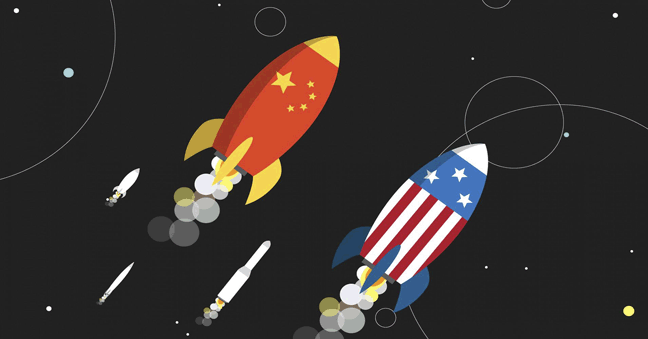
According to the report, a new “nuclear fleet” of carrier rockets and reusable hybrid-power carriers will be ready for “regular, large scale” interplanetary flights, and carrying out commercial exploration and exploitation of natural resources by the mid-2040s.
China will catch up with the United States on conventional rocket technology by 2020, it said. In 2025, it is expected to launch a reusable suborbital carrier and start suborbital space tourism.
By 2030, it aims to put astronauts on the moon and have the capabilities to bring samples back from Mars. In the 2040s, a nuclear-powered fleet will be ready to carry out mining operations on asteroids and planets, the report said…..
“The nuclear vessels are built to colonise the solar system and beyond,” Wang Changhui, associate professor of aerospace propulsion at the School of Astronautics at Beihang University in Beijing, said…..
A nuclear spaceship would have a reactor loaded with radioactive fuel for fission – the splitting of atoms that produces large amounts of energy.
That energy could be used to generate a driving force as well as electricity for the craft’s on-board equipment….
During the cold war, dozens of satellites equipped with various types of nuclear reactors were launched by the former Soviet Union and the United States..
But the nuclear space race was eventually postponed, partly due to its threat to humanity. In 1978, Russian spy satellite Kosmos 954 crashed and sprayed radioactive waste over an area of 124,000 square kilometres in Canada.
More than 30 dead nuclear satellites are still drifting in space and could fall to earth at any time over the next few thousand years.
“Safety issues will be the top challenge for the Chinese nuclear fleet,” Wang said. “If they come down, it will cause a global nuclear disaster.”
According to China’s space authorities, the nuclear shuttles would be docked at a transport hub that would orbit the earth. Reusable spacecraft would be used to transport people and cargo to and from the shuttles.
But even if they were permanently in space, the nuclear-powered vessels were still at risk of being hit by meteorites or even colliding with one another, Wang said.
Regardless of those concerns, a mainland space expert said the targets given in the People’s Daily report would be almost impossible to achieve…….http://www.scmp.com/news/china/policies-politics/article/2120425/chinas-nuclear-spaceships-will-be-mining-asteroids
November 18, 2017
Posted by Christina Macpherson |
China, technology |
Leave a comment
China will send a high-level diplomatic envoy to North Korea, Business Insider, Michael Martina and Ben Blanchard, Reuters, Nov. 15, 2017 BEIJING — A senior Chinese diplomat will visit North Korea on Friday as a special envoy of Chinese President Xi Jinping, Beijing said, though it did not say the envoy was planning to discuss North Korea’s nuclear and ballistic missile programs.
China has repeatedly pushed for a diplomatic solution to the crisis but in recent months has had only limited high-level exchanges with North Korea. The last time China’s special envoy for North Korea visited the country was in February 2016.
In a brief dispatch, China’s Xinhua news agency said Song Tao, who heads the ruling Communist Party’s external-affairs department, would leave for North Korea on Friday.
He will “inform the DPRK of the 19th CPC National Congress and visit the DPRK,” Xinhua said on Wednesday, using an acronym for the North’s official name and referring to China’s recently concluded Communist Party congress at which Xi further cemented his power…..http://www.businessinsider.com/china-sends-high-level-diplomatic-envoy-to-north-korea-2017-11?IR=T
November 17, 2017
Posted by Christina Macpherson |
China, politics international |
Leave a comment
China Wants a Nuclear Space Shuttle by 2040 http://www.popularmechanics.com/space/rockets/a13788331/chinas-future-space-plans/ China’s primary space contractor reveals its roadmap for the next few decades. By Avery Thompson Nov 17, 2017, Don’t sleep on the Chinese space program. China has already launched two space stations into orbit, and according to a recently released roadmap, the country is looking to build a reusable rocket, a massive cargo rocket, and a nuclear-powered space shuttle over the next few decades.
The roadmap was released by the China Aerospace Science and Technology Corporation (CASC), China’s primary space contractor. CASC is the company that builds China’s successful Long March family of rockets, and its roadmap sets the company’s goals from the end of this year all the way out to 2045.
The first goal is to have the next-gen Long March 8 rocket ready by 2020. This rocket is currently in development and designed to be a low-cost, light payload rocket that can carry small satellites to orbit.
Then, in 2025, CASC plans to have developed a reusable space plane that can take off and land horizontally. This space plane would be a two-stage-to-orbit spacecraft primarily used for space tourism. The company hopes to improve on this design and complete a single-stage-to-orbit plane by 2030.
This plan is, in a word, ambitious. While a few single-stage-to-orbit aircraft have been considered in the past, none have made it to the prototype stage and all have been abandoned as impractical. But CASC’s plan is not done there.
By 2035 the company wants to make its entire line of rockets reusable, and by 2040 it hopes to have an entirely new line of launch vehicles. These will include a nuclear-powered space plane and other vehicles capable of “multiple interstellar round-trips, exploiting space resources through asteroid mining and constructing megaprojects such as a space-based solar power station,” whatever that means.
Of course, just because CASC puts these ambitious goals in a roadmap doesn’t mean any of them will actually happen, but it does show that the Chinese space community is confident about what they think they’ll achieve over the next few decades. We’ll just have to wait and see if that confidence will pay off.
November 17, 2017
Posted by Christina Macpherson |
China, technology |
1 Comment
 China calls for stronger co-op with US in next-generation nuclear technology
The announcement came from Chinese premier Li Keqiang ahead of US President Donald Trump’s visit to China. Trump is scheduled to hold talks with President Xi Jinping. Hindustan Times Nov 05, 2017 Press Trust of India, Beijing
November 6, 2017
Posted by Christina Macpherson |
business and costs, China, USA |
Leave a comment
 China to take centre stage at Bonn climate talks amid vacuum left by Trump https://www.ft.com/content/f6015c21-2ed8-3154-a0b5-3f255c048d3e OCTOBER 31, 2017 by Emily Feng China is positioning itself to take a lead role at next week’s climate talks as it moves to fill the leadership vacuum left by the US, said the country’s top climate negotiator Tuesday. “To deal with differences in the negotiation process, China will propose its ‘bridge building plan’ at the upcoming summit,” said Xie Zhenhua, China’s climate policy representative, told reporters at a state press conference. Despite previous contributions from the US in combating climate change, “after the establishment of the new government, the announcement to withdraw from the Paris Agreement definitely impacted the international community’s confidence to deal with climate change,” said Mr Xie.
“All other countries have approached the [Paris] process with great confidence and determination. We see this trend as irreversible.” His comments are the latest in China’s move to cast itself as the new leader in the push to slow down the pace of global warming as numerous countries prepare to attend the World Climate Conference in the western German city of Bonn. Once known as one of the most polluted countries in the world, China has stepped up its commitments to combating climate change this year after US president Donald Trump decided to withdraw from the Paris climate accords in June. President Xi Jinping referred to China as a “torchbearer” in environmental protection during a landmark three-hour speech a crucial Communist Party congress in October. “Now the tone from the top has been set straight,” said Greenpeace senior advisor Li Shuo. “China is transforming its domestic energy system and embarking on an ambitious diplomatic mission to drive the global climate agenda.”
China is expected to unveil a national carbon trading scheme next year modeled after the European Union’s carbon marketplace. However, Lin Gao, a climate policymaker at China’s top state planning body, admitted on Tuesday that there were still “problems” that needed to be fixed before the “very complex” scheme could be implemented nationwide. The climate talks in Bonn are set to overlap with President Trump’s visit to Beijing, which begins November 8. Asked whether President Trump and Xi would discuss climate change at Trump’s trip to China next week, Mr Xie told the Financial Times: “That is up to them to decide.”
November 6, 2017
Posted by Christina Macpherson |
China, climate change |
Leave a comment

 China’s nuclear power play falters in Britain http://www.atimes.com/article/chinas-nuclear-power-play-falters-britain/ Beijing’s planned investment in UK’s civil nuclear program, part of its One Belt One Road initiative, is on increasingly shaky ground, By RICHARD COOK NOVEMBER 4, 2017 When it recently emerged that China General Nuclear Power Corporation (CNG) had refused to give a visiting team of UK government inspectors the security details for one its reactors, a slew of negative headlines followed in UK media about Chinese involvement in Britain’s power supply.
The inspectors, from the UK’s Office for Nuclear Regulation, had traveled to China to examine Fangchenggang’s Unit 3 nuclear power plant and its Hualong One third-generation pressurized reactor.
The Hualong One design is earmarked for a planned Chinese-built nuclear power plant at Bradwell on England’s east coast and the inspectors were in China to start a complex four-year Generic Design Assessment [GDA] process that will end, the Chinese hope, with the reactor’s approval for use in Britain.
China is the world’s fastest expanding nuclear power producer and has been clear about its desire to be a leading exporter, too. Exporting nuclear power is an objective of Xi Jinping’s Belt and Road initiative and nuclear is included as a core energy component in the country’s latest Five-Year Plan. At the center of this ambition is the Hualong One.
Developed though a state-led agglomeration of China’s main industry players and initially adapted in the 1990s from a French design, the Hualong One has since 2014 been packaged — along with a package of enticements comprising construction expertise, training support, competitive pricing and financing options — as China’s flagship power brand.
CNG says more than 20 countries have shown interest in the nuclear plant. While the first working Hualong One reactors will be in China, in what are revealingly described as “demonstration units,” two are currently under construction in Pakistan while an Argentinian one reported to be worth US$9 billion is due in 2020. After that should come Bradwell.
The UK has not commissioned a nuclear power station for almost 30 years, but now has plans for six sites. China currently has involvement in three, but that could become four after the bankruptcy of Toshiba’s nuclear arm.
The first two, Hinkley Point C and Sizewell, only saw Chinese involvement after the French state-owned Électricité de France (EDF) voiced concern about growing costs. China agreed to help with finance as long as it got to build a Hualong One at Bradwell, which will be the first wholly Chinese-designed reactor to be built in a western country.
Is this a good investment for China?” asks nuclear risk expert Jerzy Grynblat. “It is very hard to say because, as it comes from the Chinese government, some of the sums will remain hidden. But what is perhaps more important to ask is why the Chinese state wants to invest when no western government will?”
For Grynblat – who, before retiring in early 2017, was Nuclear Business Director at safety assurance consultancy Lloyd’s Register – it is “purely an expansion of political power.”
Grynblat explains that the UK is currently the only western country with a nuclear power program. “They needed to add capacity and replace existing capacity… In terms of power security, the UK was in a bad position and they had to do something.” That gave China an opportunity, says Grynblat. “Bradwell presented the Hualong One with an important foothold in the West.”
The design of the Hualong One, Grynblat believes, is reminiscent of a Swedish reactor from the 1980s. “It surprised me a little,” he says. “It really is quite old fashioned. I am not saying this makes it unsafe, certainly not, but what it does is make use of well known technology. And this makes approvals more straightforward… And the GDA process that they are starting now in the UK is crucial to them. They will be able use this all over the world.”
Antony Froggatt, senior research fellow at think-tank Chatham House and co-author of The World Nuclear Industry Status Reports, agrees. “It’s a first” says Froggatt. “It creates an important benchmark for China and it’s an important sales pitch. The GDA process alone brings kudos.”
Yet Froggatt is not convinced that Bradwell itself will be built. “The industry is changing rapidly. Even since China first got involved in the UK in 2015, the price of offshore wind and solar has got much cheaper. There is also recognition in the UK government that the Hinkley contract cannot be repeated at Sizewell because it has made the cost of the power so expensive… Hinkley is happening but very slowly. They originally said it would be built by 2018. Now they are saying 2025… As such, I am now thinking that Sizewell will not happen.”
“And Bradwell,” says Froggatt, “is a different story again…. It is a new reactor, it’s Chinese and there are the security issues.” He asks: “Will the Chinese ever be able to open up the design specifications?”
The UK’s inspectors were quick to brush off their access issues in China and instead praised CNG’s “high level of expertise and commitment.” But it is not the first time there has been negativity around the China-UK power deal.
Last year, amid rising public opposition, Prime Minister Teresa May felt compelled to suspend the Hinkley project while a “security review” was carried out. Nick Timothy, May’s joint chief of staff at the time, had bluntly warned that the Chinese might be able to “build weaknesses into computer systems which will allow them to shut down Britain’s energy production at will.”
There is a lot at stake here, for both China and the UK. And, much like a nuclear reactor, it looks like this story will run and run.
November 6, 2017
Posted by Christina Macpherson |
China, marketing, UK |
Leave a comment
 South Korea and China move to normalize relations after THAAD dispute, WP, By Adam Taylor October 31 ,SEOUL — After a year of frosty diplomacy and economic pressure, South Korea and China announced Tuesday that they would put aside their differences out of a joint desire to denuclearize the Korean Peninsula.
South Korea’s Foreign Ministry said the two countries will resume normal relations. “The two sides attach great importance to the Korea-China relationship,” a statement from the ministry said.
In its own coordinated statement, China’s Foreign Ministry said the two nations would work to put their relationship back on a normal track “as soon as possible.”
China and South Korea have historically deep ties and over the past few decades had enjoyed a close relationship. However, that relationship was deeply damaged last July when Seoul agreed to install the U.S.-owned Terminal High Altitude Area Defense (THAAD) missile defense platform on its land.
Though both Seoul and Washington argued the THAAD system had only defensive capabilities, Beijing was concerned about U.S. encirclement as well as the system’s sophisticated radar capabilities…….
South Korea’s Foreign Ministry acknowledged that the THAAD dispute had not been fully resolved. “The two sides agreed to engage in communication on THAAD-related issues about which the Chinese side is concerned through communication between their military authorities,” it said in a statement.
For its part, China confirmed Tuesday that its position on THAAD had not changed.
And on Sunday, South Korea’s military chief met with his American and Japanese counterparts, as part of a growing three-way dialogue……..https://www.washingtonpost.com/world/south-korea-and-china-move-to-normalize-relations-after-thaad-conflict/2017/10/31/60f2bad8-bde0-11e7-af84-d3e2ee4b2af1_story.html?utm_term=.f20c0
November 2, 2017
Posted by Christina Macpherson |
China, politics international, South Korea |
Leave a comment
 CHINA’S CHILLING MESSAGE TO DONALD TRUMP AND THE WORLD COMMUNITY, InQUISTR, Alan Ewart, 19 Oct 17, “…..The prospect of USA vs, North Korea war is terrifying. According to Global Firepower, the hermit nation has a standing army almost one million strong. North Korea also has a trained military reserve that is 5.5 million strong, and which could engage the U.S. in a Vietnam style guerrilla war for decades.
This leads some to think that a preemptive nuclear strike against North Korea would be the only effective way of waging war against a nation that is building a nuclear arsenal. Therein lies the danger, one which could easily tip the world into a nuclear World War 3. A nuclear attack on North Korean capital Pyongyang would kill millions and would be very likely to draw China into World War 3.
As you can see from the World Time and Date calculator, Pyongyang is just over 100 miles from Dandong, a Chinese city of almost one million people. Dandong would, therefore, be well within the fallout zone that would be caused by a nuclear strike on Pyongyang. Something that Chinese premier Xi Jinping will not tolerate.
As reported by the Daily Star, Xi Jinping has issued a chilling warning to the international community. In a speech at the 19th National Congress of the Communist Party President Xi warned that the Chinese army will be able to “prevail in both conventional and new theatres of operation.” China has the worlds biggest standing army with over 2.5 million regular troops. President Xi is currently pouring billions into new military hardware and boosting troop numbers.
China is North Korea’s main trading partner and only real ally, and there are real fears that Beijing would join any war on the side of Pyongyang. Chinese leaders have repeatedly told Donald Trump to “cool it” over North Korea as they try to find a peaceful resolution to the Korean conflict.
Trump is due to meet President Xi next month when he visits Asia. Let’s hope that the leaders can find a way to resolve the issue without the world being plunged into World War 3. https://www.inquisitr.com/4565345/world-war-3-china-chilling-message-donald-trump-news-world-community/
October 21, 2017
Posted by Christina Macpherson |
China, politics international, weapons and war |
2 Comments
Renew Economy 18th Oct 2017, China is on track to install a record-smashing 50GW of solar PV in 2017,
with latest data showing that the nation has so far installed around 42GW,
taking its total installed PV capacity to around 120GW. According to the
latest report from Asia Europe Clean Energy Consultants (AECEA), China
needs to add just under 3GW of new solar in each remaining month of 2017 to
reach 50GW, and deliver a second consecutive record breaking year.
http://reneweconomy.com.au/china-set-add-50gw-new-solar-pv-2017/
October 20, 2017
Posted by Christina Macpherson |
China, renewable |
Leave a comment





 nuclear-news