China and UK to work together on promoting the nuclear industry to universities etc
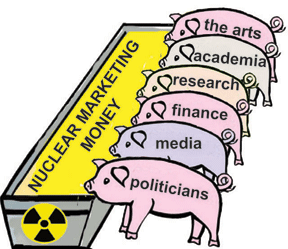
Energy Live News 29th June 2018 , China’s largest nuclear power producer has signed a Memorandum of
Understanding (MOU) with the UK Nuclear Advanced Manufacturing Research
Centre (Nuclear AMRC) to help deepen its links with Britain’s supply
chain.
CGN, the developer of the Bradwell B project, hopes to develop its
expertise and knowledge, as well as improve commercial and academic
connections. The wide-ranging deal includes working out how UK businesses
and universities can prepare themselves to participate in the project and
how these organisations can add value to CGN’s nuclear operations in
China and elsewhere.
https://www.energylivenews.com/2018/06/29/cgn-signs-mou-to-deepen-links-with-uks-nuclear-supply-chain/
U.S. Secretary of State Mike Pompeo urges China to enforce sanctions on North Korea
Pompeo tells China continued North Korea sanctions enforcement needed David Brunnstrom WASHINGTON (Reuters) 29 June 18 – U.S. Secretary of State Mike Pompeo has stressed to China the importance of continued enforcement of sanctions on North Korea to press it to give up its nuclear weapons, after warning of signs of backsliding by Beijing.
The State Department said Pompeo had spoken to his Chinese counterpart Wang Yi on Thursday and discussed efforts “to achieve our shared goal of the complete, verifiable, and irreversible denuclearization of the Korean Peninsula.”
Pompeo reiterated that North Korea would have a bright future if it denuclearized and emphasized “the continued importance of full enforcement of all relevant UN Security Council resolutions related to North Korea,” the department said in a statement.
It said this was especially important when it came to preventing North Korea’s illegal export of coal and imports of refined petroleum through ship-to-ship transfers prohibited by the United Nations.
……… Pompeo also spoke with South Korean Foreign Minister Kang Kyung-wha on Thursday to discuss the next steps on engagement with North Korea, the State Department said. It said they agreed on the need to maintain pressure until North Korea denuclearizes.
On Thursday, the Financial Times quoted U.S. officials as saying that Pompeo plans to travel to North Korea next week for talks, but the State Department has declined to confirm this…….https://www.reuters.com/article/us-northkorea-usa-china/pompeo-tells-china-continued-north-korea-sanctions-enforcement-needed-idUSKBN1JP2OA
Chinese firm Ocean Nuclear, links to former UK Prime Minister, on a fund-raising roadshow in London


 City AM 1st June 2018 Energy investment firm Ocean Nuclear today announced the launch of a $5bn (£3.8bn) nuclear energy industry fundraising roadshow in London. The Chinese company has negotiated nuclear infrastructure projects in more than
20 countries and will use 144 meetings at the roadshow to raise money for the programmes.
Ocean Nuclear has backing from firms including Silk Road Energy, which aims to raise $80m, and has been backed by the Belt and Road initiative, which has links to former Prime Minister David Cameron.
http://www.cityam.com/286792/chinese-firm-launches-5bn-london-nuclear-energy-industry
Terra Power’s Traveling Wave Nuclear Reactor sounds great – BUT!
TerraPower’s Nuclear Reactor Could Power the 21st Century. The traveling-wave reactor and other advanced reactor designs could solve our fossil fuel dependency IEEE Spectrum, By In a world defined by climate change, many experts hope that the electricity grid of the future will be powered entirely by solar, wind, and hydropower. Yet few expect that clean energy grid to manifest soon enough to bring about significant cuts in greenhouse gases within the next few decades. Solar- and wind-generated electricity are growing faster than any other category; nevertheless, together they accounted for less than 2 percent of the world’s primary energy consumption in 2015, according to the Renewable Energy Policy Network for the 21st Century.
To build a bridge to that clean green grid of the future, many experts say we must depend on fission power. ………several U.S. startups are pushing new reactor designs they say will address nuclear’s major shortcomings. In Cambridge, Mass., a startup called Transatomic Power is developing a reactor that runs on a liquid uranium fluoride–lithium fluoride mixture. In Denver, Gen4 Energy is designing a smaller, modular reactor that could be deployed quickly in remote sites.
 In this cluster of nuclear startups, TerraPower, based in Bellevue, Wash., stands out because it has deep pockets and a connection to nuclear-hungry China. Development of the reactor is being funded in part by Bill Gates, who serves as the company’s chairman. And to prove that its design is viable, TerraPower is poised to break ground on a test reactor next year in cooperation with the China National Nuclear Corp. …….
It also releases plenty of energy; after all, Pu-239 is the primary isotope used in modern nuclear weapons. But Levesque says the creation of Pu-239 doesn’t make the reactor a nuclear-proliferation danger—just the opposite. Pu-239 won’t accumulate in the TWR; instead, stray neutrons will split the Pu-239 into a cascade of fission products almost immediately.
In other words, the reactor breeds the highly fissile plutonium fuel it needs right before it burns it, just as Feinberg imagined so many decades ago. Yet the “traveling wave” label refers to something slightly different from the slowly burning, cigar-style reactor. In the TWR, an overhead crane system will maintain a reaction within a ringed portion of the core by moving pins into and out of that zone from elsewhere in the core, like a very large, precise arcade claw machine.
To generate electricity, the TWR uses a more complicated system than today’s reactors, which use the core’s immense heat to boil water and drive a steam turbine to generate usable electricity. In the TWR, the heat will be absorbed by a looping stream of liquid sodium, which leaves the reactor core and then boils water to drive the steam turbine.
 But therein lies a major problem, says Makhijani. Molten sodium can move more heat out of the core than water, and it’s actually less corrosive to metal pipes than hot water is. But it’s a highly toxic metal, and it’s violently flammable when it encounters oxygen. “The problem around the sodium cooling, it’s proved the Achilles’ heel,” he says.
China’s nuclear weapons – many less than USA’s and Russia’s
China’s Nuclear Weapons: Everything You Always Wanted to Know National Interest, Steve Weintz, 25 May 18,
With its first nuclear test on October 16, 1964, China joined the other victorious allies of World War II in the nuclear club, both cementing and unsettling the postwar order. Hard experience of the American nuclear threat during the Korean War and the divorce from the Soviet Union, propelled China towards the bomb in ways familiar to those observing North Korea’s current quest. Mao Zedong himself said in 1956, “…if we don’t want to be bullied, we have to have this thing.”
But China for all its size has made itself a limited nuclear power. It has demonstrated its ability to build very big bombs but chose to test and make few of them. The size of China’s arsenal is a highly guarded state secret, but estimates put it in the several hundreds, not thousands. Beijing can hold armies and cities at risk, but not make the rubble bounce several times over…………
One H-bomb test nearly went horribly wrong. When test pilot Yang Guoxiang lined up his Q-5A fighter-bomber for its drop maneuver and pulled the weapon release, the bomb failed to drop. After three attempts Yang returned to base with a live hydrogen bomb slung beneath his plane. The whole airbase – all 10,000 crew – sheltered in underground tunnels while a lonely Yang carefully climbed out of his cockpit and awaited assistance. All ended well this time and Yang later successfully carried out his mission.
China’s last big blast, a one-megaton warhead test in October 1980, ended the era of atmospheric testing. No nuclear-weapons state has tested above ground since. But nuclear testing never ends, really, not when they were conducted not far from populated areas. As with natives to the Pacific atolls and Russian steppes, the Gobi Desert and its peoples will bear the long-term impact of radiation from those nuclear tests for a long time. http://nationalinterest.org/blog/the-buzz/chinas-nuclear-weapons-everything-you-always-wanted-know-25980
Uncertainty about China’s nuclear power future
“……….Uncertainties for Nuclear Power, Carnegie Endowment, Mark Hibbs, 14 MAY 18
China’s nuclear power wager might not indefinitely pay high dividends. Until now, the state has boosted the nuclear power industry with incentives that, in the future, may come under pressure. The electric power system is subject to reform in the direction of more transparent oversight and pricing that might disadvantage nuclear investments. President Xi Jinping supports state control of strategic economic sectors, but he also advocates market reforms that have helped lead Western nuclear power industries into crises.
The nuclear sector must withstand what Xi calls “new normal” conditions: a gradual slowing down of China’s economy, characterized by diminishing returns on capital goods investments and translating into rising debt and overcapacity. Nuclear investments may be affected by demographics, changes in electricity load profile, and technology innovations including emergence of a countrywide grid system able to wheel bulk power anywhere.
There is also political risk. Public support for nuclear power in China is volatile and may be low. Concerns since the Fukushima Daiichi accident in Japan have prompted Beijing not to proceed with long-established plans to build most of China’s future nuclear plants on inland sites. Should this policy continue into the 2020s, prospects for China’s nuclear construction sector will decline; indefinitely continuing nuclear construction at eastern coastal sites (where nearly all of China’s nuclear power is generated) may encounter resistance on economic, capacity, and political grounds.
Under Xi, China’s globalization continues but the state is assuming ever-greater liability. Political decisionmaking and corporate culture may not support an indefinite increase in the risk presented by more nuclear power investments. Some quasi-official projections before Fukushima that China by 2050 might have 400 or more nuclear power plants have been cut in half. Beijing’s risk calculus may reflect that China’s population would blame the Communist Party and the state for a severe nuclear accident. In a country with a patchy track record for industrial safety, said one Chinese planning expert in 2016, “The more reactors we have, the greater our liability.”
…….. If China merely replicates others’ collective past experience, it will reinforce the view that fast reactors and their fuel cycles are too risky, complex, and expensive to generate large amounts of electricity.
- If China merely replicates others’ collective past experience, it will reinforce the view that fast reactors and their fuel cycles are too risky, complex, and expensive to generate large amounts of electricity.
- ……. ……..Whether China succeeds or fails, the global repercussions will be significant. …..https://carnegieendowment.org/2018/05/14/future-of-nuclear-power-in-china-pub-76311
China lands nuclear strike bombers on South China Sea islands
Prepared for battle: China lands nuclear strike bombers on South China Sea islands CHINA raised global fears after sending nuclear bombs and warplanes above the South China Sea as part of a simulated training exercise with air force officials declaring the country is “preparing for battle”. Express UK, By LATIFA YEDROUDJ May 20, 2018 Air force personnel confirmed it had ”organised multiple bombers” to conduct “take-off and landing training” along islands and reefs in the South China Sea, as practise in light of a full-scale war.
EDF pinning its hopes for EPR nuclear reactor on the Taishan reactor, China
The French stress test for nuclear power, Ft.com 18 May 18
Years late and billions over budget the first European Pressurised Reactor is set to become operational. Its success is critical for France Andrew Ward in London and David Keohane in Paris MAY 17, 2018 “….. fuel loading at Taishan — one of the last steps before it starts producing electricity — carries wider significance beyond China. Taishan, operated by China General Nuclear Power Corp, the state-owned energy company, is on course to become, within months, the first plant in the world to operate a European Pressurised Reactor — the Franco-German technology plagued by delays and cost overruns since it was designed in the 1990s. “The Taishan 1 fuel loading is a very important milestone,” says Xavier Ursat, head of new nuclear projects for EDF, the French state-backed utility which owns 30 per cent of the project. “It will bring a new image to the EPR.”
China marketing nuclear power to Uganda
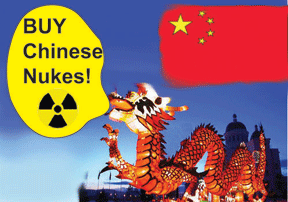 China to help Uganda build nuclear power plants, Reuters Staff, 17 May 18 KAMPALA (Reuters) – China will help Uganda build and operate nuclear power plants under a deal signed last week.
Uganda has some uranium deposits and President Yoweri Museveni has said his government was keen to exploit them for potential nuclear energy development.
Eight potential sites have been identified in the country’s central, southwest and northern regions that could potentially host nuclear power plants, the government said on Thursday. It signed a deal with Russia last year to cooperate on nuclear power.
China is already a major investor in Ugandan infrastructure projects and China National Nuclear Corporation (CNNC) signed a memorandum of understanding on May 11 to help Uganda build capacity “in the use of atomic energy for peaceful purposes”, Uganda’s energy ministry said in a statement issued on Thursday……
Co-operation between CNNC and Uganda will involve the development of nuclear power infrastructure including the design, construction and operation of nuclear power plants.
In June last year Uganda signed a similar memorandum of understanding with Russian State Atomic Energy Cooperation (ROSATOM) to facilitate the two countries’ cooperation on nuclear power.
Reporting by Elias Biryabarema; Editing by Susan Fenton https://www.reuters.com/article/us-uganda-energy/china-to-help-uganda-build-nuclear-power-plants-idUSKCN1II219
China ‘supports North Korean shift from nuclear to economy’
Foreign Minister Wang Yi backs plans announced by Kim Jong-un as China expresses wish for cooperation, despite its support of UN sanctions Laura Zhouhttps://twitter.com/laurachouSCMP, 03 May, 2018 Beijing will support North Korea’s efforts to rebuild its economy, China’s foreign minister has said as the North pledged to suspend nuclear testing and prioritise economic growth.
Wang Yi said in his meeting with North Korean counterpart Ri Yong-ho that the two allies would strengthen strategic communications and China would “continue to play a due and positive role in the political process for political settlement of the peninsula issues”, a statement by the Chinese foreign ministry said.
On the first day of his two-day visit to Pyongyang on Wednesday, Wang reaffirmed the pledge to deepen traditional relations between the neighbours, made by President Xi Jinping and North Korean leader Kim Jong-un during Kim’s visit to Beijing in March.
“Traditional friendship between China and North Korea is the mutual good fortune of the two sides, and it is a strategic choice to inherit and develop the traditional friendly relations,” Wang was quoted as saying.
“China would work together with North Korea … to enhance communications and coordination between the political and diplomatic departments of the two sides, and push forward practical cooperation on economy and trade.”
Ri told Wang that Kim values the traditional friendship with China, and that North Korea would like to keep close communication with China on denuclearisation and the peace process on the peninsula, according to the statement by the Chinese foreign ministry.
The visit by Wang has come at a time when Beijing and Pyongyang have been working to repair the relations that were strained by Kim’s repeated nuclear tests and Beijing’s support for a series of stringent UN sanctions.
…….
Lu Chao, a Korean affairs expert at Liaoning Academy of Social Sciences, said that China’s support of economic development in North Korea was in response to Kim’s pledge to give up nuclear weapons and shift to economic development.
“This is not contradicting the UN sanctions, because the support, as well as the recent improvement in the bilateral relations between China and North Korea, only came on condition that North Korea agrees to give up its nuclear weapon programme and move to develop its economy,” Lu said.
“So far, the bans remain effective and China would follow the sanctions.” http://www.scmp.com/news/china/diplomacy-defence/article/2144485/china-supports-north-korean-shift-nuclear-economy
The heavy health and environmental toll of rare earths mining in China
Rare-earth mining in China comes at a heavy cost for local villages https://www.theguardian.com/environment/2012/aug/07/china-rare-earth-village-pollution Pollution is poisoning the farms and villages of the region that processes the precious minerals, Guardian, Cécile Bontron, 7 Apr 18,
From the air it looks like a huge lake, fed by many tributaries, but on the ground it turns out to be a murky expanse of water, in which no fish or algae can survive. The shore is coated with a black crust, so thick you can walk on it. Into this huge, 10 sq km tailings pond nearby factories discharge water loaded with chemicals used to process the 17 most sought after minerals in the world, collectively known as rare earths.
The town of Baotou, in Inner Mongolia, is the largest Chinese source of these strategic elements, essential to advanced technology, from smartphones to GPS receivers, but also to wind farms and, above all, electric cars. The minerals are mined at Bayan Obo, 120km farther north, then brought to Baotou for processing.
The concentration of rare earths in the ore is very low, so they must be separated and purified, using hydro-metallurgical techniques and acid baths. Chinaaccounts for 97% of global output of these precious substances, with two-thirds produced in Baotou.
 The foul waters of the tailings pond contain all sorts of toxic chemicals, but also radioactive elements such as thorium which, if ingested, cause cancers of the pancreas and lungs, and leukaemia. “Before the factories were built, there were just fields here as far as the eye can see. In the place of this radioactive sludge, there were watermelons, aubergines and tomatoes,” says Li Guirong with a sigh.
It was in 1958 – when he was 10 – that a state-owned concern, the Baotou Iron and Steel company (Baogang), started producing rare-earth minerals. The lake appeared at that time. “To begin with we didn’t notice the pollution it was causing. How could we have known?” As secretary general of the local branch of the Communist party, he is one of the few residents who dares to speak out.
Towards the end of the 1980s, Li explains, crops in nearby villages started to fail: “Plants grew badly. They would flower all right, but sometimes there was no fruit or they were small or smelt awful.” Ten years later the villagers had to accept that vegetables simply would not grow any longer. In the village of Xinguang Sancun – much as in all those near the Baotou factories – farmers let some fields run wild and stopped planting anything but wheat and corn.
A study by the municipal environmental protection agency showed that rare-earth minerals were the source of their problems. The minerals themselves caused pollution, but also the dozens of new factories that had sprung up around the processing facilities and a fossil-fuel power station feeding Baotou’s new industrial fabric. Residents of what was now known as the “rare-earth capital of the world” were inhaling solvent vapour, particularly sulphuric acid, as well as coal dust, clearly visible in the air between houses.
Now the soil and groundwater are saturated with toxic substances. Five years ago Li had to get rid of his sick pigs, the last survivors of a collection of cows, horses, chickens and goats, killed off by the toxins.
The farmers have moved away. Most of the small brick houses in Xinguang Sancun, huddling close to one another, are going to rack and ruin. In just 10 years the population has dropped from 2,000 to 300 people.
Lu Yongqing, 56, was one of the first to go. “I couldn’t feed my family any longer,” he says. He tried his luck at Baotou, working as a mason, then carrying bricks in a factory, finally resorting to selling vegetables at local markets, with odd jobs on the side. Registered as farmers in their identity papers, the refugees from Xinguang Sancun are treated as second-class citizens and mercilessly exploited.
The farmers who have stayed on tend to gather near the mahjong hall. “I have aching legs, like many of the villagers. There’s a lot of diabetes, osteoporosis and chest problems. All the families are affected by illness,” says He Guixiang, 60. “I’ve been knocking on government doors for nearly 20 years,” she says. “To begin with I’d go every day, except Sundays.”
By maintaining the pressure, the villagers have obtained the promise of financial compensation, as yet only partly fulfilled. There has been talk of new housing, too. Neatly arranged tower blocks have gone up a few kilometres west of their homes. They were funded by compensation paid by Baogang to the local government.
But the buildings stand empty. The government is demanding that the villagers buy the right to occupy their flat, but they will not be able to pass it on to their children.
Some tried to sell waste from the pond, which still has a high rare-earth content, to reprocessing plants. The sludge fetched about $300 a tonne.
But the central government has recently deprived them of even this resource. One of their number is on trial and may incur a 10-year prison sentence.
This article originally appeared in Le Monde
China expanding its nuclear marketing overseas, with the help of Bill Gates
Chinese nuclear giant continues to expand overseas cooperation, 2018-03-03 Editor: Xiang Bo BEIJING, March 3 (Xinhua) — China National Nuclear Corporation (CNNC), one of the country’s two leading nuclear power companies, is stepping up its overseas cooperation, the chairperson said Saturday.
Progress is being made in cooperation with CNNC’s local partners in countries like Pakistan, Argentina, Saudi Arabia, Ghana and the United States, CNNC chairperson Wang Shoujun said on the sidelines of the annual session of the country’s top political advisory body…….
Last year, the CNNC signed a joint venture agreement with TerraPower, LLC to form the Global Innovation Nuclear Energy Technology Co., Ltd. to work together on the Travelling Wave Reactor technology, marking a new stage in China-U.S. nuclear cooperation, Wang added. ……http://www.xinhuanet.com/english/2018-03/03/c_137013831.htm
China’s progress in nuclear power is not as sure as it used to be
Is China losing interest in nuclear power? China Dialogue Feng Hao 19.03.2018 Slowing demand for  electricity and competition from renewables have halted new reactor approvals.Globally, the outlook for new, large nuclear reactors is gloomy, according to the International Energy Agency’s (IEA) World Energy Outlook. A lot of countries have backed away from nuclear power in recent years due to concerns over public safety, cost and the complex challenge of getting plants built.
This year, five reactors are expected to come online in China, with the IEA predicting that by 2030 the country will overtake the United States as the world’s biggest generator of nuclear power.
Pushing nuclear
Increasingly, China’s decision to move ahead with new nuclear seems at odds with other countries that are abandoning the technology in favour of other low carbon options, such as wind and solar.
Xu Jiangfeng is a researcher at the Planning Research Centre of the China National Offshore Oil Corporation’s Research Institute. He told chinadialogue that the government’s concern with energy security has resulted in a diverse mix of energy resources and technologies being pursued, including nuclear……….
Policymakers may cite various strategic reasons for backing nuclear power but there is a question mark hanging over the sector’s future growth.
China has 20 gigawatts of nuclear power capacity under construction but plans for additional capacity are being delayed. A 2020 target of 58 gigawatts of installed nuclear capacity now looks out of reach.
The National Energy Administration did not approve any new nuclear plants between 2016 and 2017. In 2017, only three new reactors started operating.
Reasons for the shift, according to Shi, include mixed attitudes towards new nuclear power within government, and the over-supply that’s affecting China’s power generation sector.
As China’s economic growth has eased, so too has the growth in electricity demand. In 2015, electricity consumption rose just 0.5%, the lowest in 40 years.
“Work out supply and demand and you can see that the market is unable to absorb any more nuclear power,” Kang Junjie, chief engineer with Dongdian Wanwei Technology (Beijing) told chinadialogue.
This leaves little room for expansion of electricity generation, meaning fierce competition between nuclear, solar, wind and hydropower. Globally, solar and wind are replacing nuclear power as the first choice for new power generation. This is true in China, too.
Cost is a key factor: the earlier nuclear power plants are now in the mid-to-late stages of their lifecycle, with operational and maintenance costs rising, according to Kang Junjie. Meanwhile, renewables are in the ascendant, with costs continuing to fall.
Analysis by Bloomberg New Energy Finance predicts that the cost of power from China’s onshore wind and solar will drop below that of coal in 2019 and 2021, respectively, suggesting that the cost advantage of nuclear power over renewables will only last a few more years…………. https://www.chinadialogue.net/article/show/single/en/10506-Is-China-losing-interest-in-nuclear-power-?mc_cid=e08503abda&mc_eid=da6e209b80
China to develop its first nuclear-powered aircraft carrier
Defense News, , 2 Mar 18 MELBOURNE, Australia — One of China’s largest shipbuilders has revealed plans to speed up the development of China’s first nuclear-powered aircraft carrier, as part of China’s ambition to transform its navy into a blue-water force by the middle of the next decade.
1 This Month

of the week – Shut Down Drone Warfare!


Tell the Ukrainian Government to Drop Prosecution of Peace Activist Yurii Sheliazhenko

Petition to revoke the licensing of the Near Surface Nuclear Disposal Facility (NSDF) at Chalk River. https://www.ourcommons.ca/petitions/en/Petition/Details?Petition=e-7247
To see nuclear-related stories in greater depth and intensity – go to https://nuclearinformation.wordpress.com
-
Archives
- April 2026 (103)
- March 2026 (251)
- February 2026 (268)
- January 2026 (308)
- December 2025 (358)
- November 2025 (359)
- October 2025 (376)
- September 2025 (257)
- August 2025 (319)
- July 2025 (230)
- June 2025 (348)
- May 2025 (261)
-
Categories
- 1
- 1 NUCLEAR ISSUES
- business and costs
- climate change
- culture and arts
- ENERGY
- environment
- health
- history
- indigenous issues
- Legal
- marketing of nuclear
- media
- opposition to nuclear
- PERSONAL STORIES
- politics
- politics international
- Religion and ethics
- safety
- secrets,lies and civil liberties
- spinbuster
- technology
- Uranium
- wastes
- weapons and war
- Women
- 2 WORLD
- ACTION
- AFRICA
- Atrocities
- AUSTRALIA
- Christina's notes
- Christina's themes
- culture and arts
- Events
- Fuk 2022
- Fuk 2023
- Fukushima 2017
- Fukushima 2018
- fukushima 2019
- Fukushima 2020
- Fukushima 2021
- general
- global warming
- Humour (God we need it)
- Nuclear
- RARE EARTHS
- Reference
- resources – print
- Resources -audiovicual
- Weekly Newsletter
- World
- World Nuclear
- YouTube
-
RSS
Entries RSS
Comments RSS
 nuclear-news