Chinese involvement in Sizewell nuclear plant the ‘next Huawei
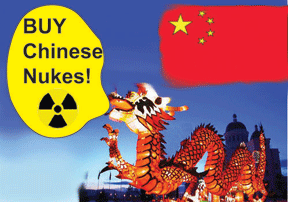 Telegraph 27th May 2020, Chinese involvement in Sizewell nuclear plant the ‘next Huawei’, MPs warn.
Call for energy policy and how the UK interacts with China to be reviewed.
Chinese involvement in the Sizewell C nuclear power station will be the
“next Huawei,” MPs have warned, as they called for an entire overhaul
of the energy policy.
It comes after EDF, the French energy company on
Wednesday submitted an application to build the next nuclear power plant in
Suffolk, which it intends to develop with the state-owned energy company,
China General Nuclear Power Group (CGN).
However Sir Iain Duncan Smith, the
former Conservative leader, warned the power plant was “the next
Huawei”. “It is another major manifestation of the problem we face
having set out on the wrong path with China years ago,” Sir Iain told The
Daily Telegraph.
The way that China plans its nuclear weapons strategy
|
The role of nuclear weapons in China’s national defence, The Strategist,
27 May 2020, Fiona S. Cunningham At the end of April, two upgraded Chinese Type-094 nuclear-powered ballistic missile submarines (SSBNs) reportedly went into service. But China’s SSBN capability is a far less important component of its nuclear deterrent than its land-based missile force. And that nuclear deterrent plays an important but limited role in China’s national defence. Absent major strategic change, the role of nuclear weapons in China’s national defence strategy is unlikely to expand. And absent major technological change, the relative importance of China’s sea-based deterrent is also unlikely to grow.
Although the commander of US Strategic Command, Admiral Charles A. Richard, recently stated that he could ‘drive a truck through China’s nuclear no first use policy’, that policy has played a critical role in China’s nuclear force development since 1964. China’s nuclear force structure is optimised to ride out an adversary’s nuclear strike and then retaliate against an adversary’s strategic targets, rather than credibly threaten first use. China’s operational doctrine for its nuclear forces doesn’t include plans for the first use, or threat of first use, of nuclear weapons in a conventional conflict. While Chinese leaders and strategists have debated changes to the no-first-use policy from time to time, there’s no sign that China plans to abandon it. The policy was most recently reaffirmed in China’s 2019 defence white paper.
China’s top leaders in the politburo and Central Military Commission exercise strict control over both the formulation of nuclear strategy and the authority to alert or use nuclear weapons. To ensure they’re not used accidentally, mistakenly or without authorisation, nuclear weapons are kept off alert in peacetime and warheads are stored separately from delivery systems in a central depot deep in the country’s interior. There are two potential changes to the threat environment that could prompt Beijing to rethink its restrained nuclear posture: a dramatic increase in the intensity of the US threat China faces and a radical technological change that weakens its retaliatory-only policy.
If Chinese leaders concluded that a future conflict with the US posed an existential threat rather than a limited war, they could look to nuclear weapons as insurance against a conventional defeat that eliminated the Chinese state. But such a change is by no means a given. Chinese strategists stress a number of reasons for the country’s restrained nuclear strategy, including the difficulty of controlling nuclear escalation and geography. China’s large size provides it with non-nuclear options for defeating a conventional military threatening its survival. An increase in US hostility wouldn’t remove these incentives for restraint.
A breakthrough in the development of counterforce technology is also unlikely to change China’s retaliatory nuclear posture, unless it were so radical that it made that posture unviable. Those changes would have to enable the US to credibly threaten to destroy most of China’s retaliatory force. It would also have to render China’s other options for ensuring a survivable nuclear force futile, such as expanding its arsenal size or shifting to a launch-on-warning alert status. Such radical technological change is unlikely, despite persistent US efforts to improve its counterforce capabilities. Regardless of whether either of these situations come to pass, China’s land-based missile force is unlikely to be displaced by its sea-based deterrent as the primary leg of its retaliatory nuclear capability, for four reasons………..
This piece was produced as part of the Indo-Pacific Strategy: Undersea Deterrence Project, undertaken by the ANU National Security College. This article is a shortened version of chapter 7, ‘The role of nuclear weapons in China’s national defence’, as published in the 2020 edited volume The future of the undersea deterrent: a global survey. Support for this project was provided by a grant from Carnegie Corporation of New York. https://www.aspistrategist.org.au/the-role-of-nuclear-weapons-in-chinas-national-defence/
|
|
Government-owned Chinese company wants to build Sizewell nuclear plant
 State-owned Chinese company bids to build second UK nuclear plant, SMH, By Latika Bourke May 27, 2020 —A Chinese state-owned company blacklisted in the United States has applied to build a second nuclear plant in Britain amid growing concern in the UK government’s ranks about Chinese investment in critical infrastructure.China General Nuclear Power Group’s application creates a new headache for UK Prime Minister Boris Johnson, who is already facing a backbench revolt over his approval of Chinese firm Huawei to supply Britain’s 5G networks. State-owned Chinese company bids to build second UK nuclear plant, SMH, By Latika Bourke May 27, 2020 —A Chinese state-owned company blacklisted in the United States has applied to build a second nuclear plant in Britain amid growing concern in the UK government’s ranks about Chinese investment in critical infrastructure.China General Nuclear Power Group’s application creates a new headache for UK Prime Minister Boris Johnson, who is already facing a backbench revolt over his approval of Chinese firm Huawei to supply Britain’s 5G networks.
The UK does not have an investment review process like Australia’s Foreign Investment Review Board. However, Johnson has flagged a tightening of foreign investment rules in the wake of the pandemic and subsequent alarm about dependence on China. CGN, on Wednesday, submitted its planning application to build the Sizewell reactor in Suffolk, England with its French partner EDF. The project, estimated to cost at least £20 billion ($A37 billion) would be financed through private investment and construction would begin by the end of 2021 if approvals are given. CGN’s initial stake in the project would be 20 per cent compared to EDF’s 80 per cent. The same consortium was approved to build Britain’s Hinkley Point power station in 2016. The then prime minister Theresa May temporarily halted the project over concerns about Chinese investment in critical infrastructure but eventually gave the project the go-ahead. However, in August last year the Trump Administration placed CGN on the US entity list accusing it of acting contrary to the United States’ national security. The US has accused the Chinese company of stealing US nuclear technology for military use.
Sizewell’s approval process is expected to take at least 18 months at the same time as the government is being urged to tighten foreign investment rules. Former Conservative party leader and backbench MP Iain Duncan Smith told The Sydney Morning Herald and The Age that China must not be allowed to make any further inroads into the UK’s critical infrastructure. “We simply cannot go further down the road of becoming more dependant on China,” he said…….. https://www.smh.com.au/world/europe/state-owned-chinese-company-bids-to-build-second-uk-nuclear-plant-20200527-p54x37.html |
|
Increased tensions between USA and China, as U.S. accuses China of secret nuclear tests
Times 17th April 2020, Relations between China and the United States have plunged to a new low
after the release of a report that suggests Beijing may have conducted
secret nuclear tests, in contravention of arms treaties. Compiled by the US
state department, it says that extensive excavations have been carried out
in the desert of Lop Nur, northwest China, along with the construction of
“explosive containment” chambers. The work coincided with the blocking
of transmissions from sites that monitor levels of radiation and seismic
activity, it added.
Daily Mail 16th April 2020, China accuses the U.S. of ‘confounding black and white’ with a ‘fabricated’
report after State Department warned Beijing might be conducting small
nuclear bomb tests.
https://www.dailymail.co.uk/news/article-8224941/China-accuses-U-S-confounding-black-white-fabricated-nuclear-test-claims.html
Nuclear power plant shut down by host of tiny shrimp clogging filters

 Masses of tiny shrimp shut down nuclear power plant in southern China twice in one week, 1 Apr 2020,The Star, By Holly Chik The Power-Generating Units Of A Nuclear Plant In Southern China Were Shut Down Twice Last Week After Its Water Filters Were Blocked By Masses Of Small Shrimp, The Safety Regulator Said.
Big shoals of the tiny acetes – krill-like shrimp that are just a few centimetres long – flooded the seawater diversion channel and circulating water pumping stations of the Yangjiang Nuclear Power Station in Guangdong on March 24, the National Nuclear Safety Administration said in a statement.
They crippled the water pumping stations and caused one of the nuclear plant’s six power-generating units to go into automatic safe shutdown, while the other five units ran at 80 per cent of capacity. The unit that shut down was powered up again the next day after station staff cleared the acetes and cleaned the filters.
But soon after on March 25, the same thing happened, with large shoals of acetes again finding their way into the pumping stations and causing four power-generating units to shut down automatically. The station shut off the other two units for safety reasons. …….
The Hong Kong Nuclear Society also noted that similar incidents had happened before.
“Similar events have occurred at nuclear power plants using seawater as a coolant for their power-generating units [including non-nuclear ones] throughout the world, including China,” said Luk Bing-lam, chairman of the society.
Coronovirus, bats, and the Climate Change connection
 The Wuhan Coronavirus, Climate Change, and Future Epidemics…...TIME, 10 Feb 2020,
The reasons behind China’s No First Use nuclear weapons policy
|
Why China Says It Will Never Use Nuclear Weapons First in a Major War
Never ever? National Interest, 2 Feb 2020, by David Axe Follow @daxe on TwitterL Key point: China knows that it has enough nuclear weapons to destroy anyone who attacked them.
This fact gives Beijing enough security to declare it doesn’t need to strike first to deter its enemies.
China has reaffirmed its policy of never being the first in a conflict to use nuclear weapons. Experts refer to this policy as “no first use,” or NFU.
The NFU policy reaffirmation, contained in Beijing’s July 2019 strategic white paper, surprised some observers who expected a more expansive and aggressive nuclear posture from the rising power. Notably, the United States does not have a no-first-use policy. “Retaining a degree of ambiguity and refraining from a no first use policy creates uncertainty in the mind of potential adversaries and reinforces deterrence of aggression by ensuring adversaries cannot predict what specific actions will lead to a U.S. nuclear response,” the Pentagon stated.
Chinese state media posted the government’s white paper in its entirety. “Nuclear capability is the strategic cornerstone to safeguarding national sovereignty and security,” the paper asserts. “This is standard language,” explained David Santoro, a nuclear expert with the nonprofit Pacific Forum. “China’s nukes serve to prevent nuclear coercion and deter nuclear attack.” Then the surprise. “China is always committed to a nuclear policy of no first use of nuclear weapons at any time and under any circumstances, and not using or threatening to use nuclear weapons against non-nuclear-weapon states or nuclear-weapon-free zones unconditionally,” the white paper adds……. It would be difficult to compose a more emphatic rejection of claims that China’s no-first-use policy is changing. The statement also indicates it is not Chinese policy to use nuclear weapons first to forestall defeat in a conventional military conflict with the United States. China does not have an “escalate to de-escalate” nuclear strategy.
China is not preparing to fight a nuclear war with the United States. It does not have “battlefield” or “tactical” or “non-strategic” nuclear weapons. Chinese nuclear strategists don’t think a nuclear war with the United States is likely to happen. And they seem sure it won’t happen as long as the U.S. president believes China can retaliate if the United States strikes first. That’s not a high bar to meet, which is why China’s nuclear arsenal remains small and, for the time being, off alert.
China sees its comparatively modest nuclear modernization program as a means to convince U.S. leaders that a few Chinese ICBMs can survive a U.S. first strike and that these survivors can penetrate U.S. missile defenses. Chinese nuclear planners might be willing to slow or scale back their nuclear modernization efforts if the United States were willing to assure China’s leaders it would never use nuclear weapons first in a military conflict with China. Chinese experts and officials have been asking the United States to offer that assurance for decades. U.S. experts and officials consistently refuse……
Given the impassioned attack on constructive U.S.-China relations currently sweeping U.S. elites off their feet, along with the continued proliferation of misinformation about Chinese nuclear capabilities and intentions, many U.S. commentators are likely to brush aside the new white paper’s reiteration of China’s longstanding nuclear no-first-use policy.
David Axe serves as Defense Editor of the National Interest. He is the author of the graphic novels War Fix, War Is Boring and Machete Squad. This first appeared earlier in 2019.https://nationalinterest.org/blog/buzz/why-china-says-it-will-never-use-nuclear-weapons-first-major-war-119021
|
|
New report: China soon to join countries where renewables are cheaper than coal
Oil Price 19th Jan 2020, In September of last year Oilprice reported an incredible milestone for renewable energy when solar and wind power became cheaper than coal in most of the world. Now, a new report released this week by Wood Mackenzie Power and Renewables has heralded another milestone: China will soon be added to that list of countries in which coal is no longer more economical than renewable energy.
Further debunking of the conspiracy nonsense about a nuclear explosion in the South China Sea
 A nuclear detonation in the South China Sea? No, more Twitter conspiracy nonsense, Bulletin of the Atomic Scientists, By Matt Field, November 25, 2019 The Twitter account @IndoPac_Info pushes out news at a relentless pace; it’s a seemingly good feed to follow for those interested in military issues in Asia. By Friday afternoon last week, the account had posted dozens of tweets over a 36-hour-or-so period linking to stories from outlets such as Reuters and Foreign Policy on topics ranging from US naval activity in contested waters to Pentagon drone policy. Oh yeah, and then there was the one about a nuclear detonation in the South China Sea.
The big news that China had perhaps exploded a tactical nuclear weapon in the ocean originated with a man labeled by the Southern Poverty Law Center as a former federal convict, white supremacist, and FBI informant named Hal Turner. Turner posted the story on his website and touted the supposed scoop further on his nighttime AM radio show, attributing the information to military sources. On Friday, a Pentagon spokesperson called Turner’s article “silly fiction.” And the man behind @IndoPac_Info himself—he describes himself as a Spanish man living in Vietnam—now seems to agree. “Without further evidence or independent corroboration of Hal Turner’s article, it may not be credible at this point,” he tweeted. “Apologies.”
A laudable course correction, no doubt, but it came after one of @IndoPac_Info’s tweets on the Turner story was retweeted almost 2,000 times. And in an age when online disinformation campaigns like the Russian government effort to sway the 2016 US presidential election are a major feature of public discourse, it’s an open question: Could an online conspiracy theory about nuclear weapons gain traction and have a real-world impact?
The @IndoPac_Info account helped give Turner traction, but as far as impact goes, the radio host’s nuclear story failed to launch, in part because it was so easily debunked.
The idea that a 10 to 20 kiloton explosion, possibly a nuclear one, could have occurred in the busy and contested South China Sea and not been widely observed was laughable to Bulletin of the Atomic Scientists’ Science and Security Board chair Bob Rosner. The physicist and former director of the Argonne National Laboratory told Gizmodo, “There is so much surveillance that it would be stunning if no one had noticed that.”……..
Despite Turner’s serious dearth of credibility, he was able to piggyback on @IndoPac_Info’s. That account, after all, is followed, by journalists, academics, and others from reputable organizations like Reuters and the University of Pennsylvania. Indeed, the @IndoPac_Info account user was concerned that he’d helped promote Turner’s wild story. “I was not aware of his record,” he said.
“A follower sent me his story and I went with it.” https://thebulletin.org/2019/11/a-nuclear-detonation-in-the-south-china-sea-no-more-twitter-conspiracy-nonsense/
Gizmodo thoroughly debunks the false story of a nuclear explosion in the South China Sea
 No, China Did Not Secretly Detonate A Nuke In The South China Sea To Signal The Start Of WWIII, Gizmodo Tom McKay, Nov 22, 2019, The Chinese government has almost certainly not secretly detonated a tactical nuclear weapon in the South China Sea to send a warning signal to the United States, experts told Gizmodo, regardless of widespread claims to the contrary on social media.
The source of this particular rumour appears to be Hal Turner, a far-right New Jersey radio host and former FBI informant considered a white supremacist by the Anti-Defamation League and the Southern Poverty Law Centre (and who once was sentenced to over nearly three years in prison for calling for the murder of three federal judges). A post on Turner’s website claimed that unidentified “military sources” had said that around 6:22 p.m. ET on Wednesday, a nuclear explosion of some kind 50 meters below the surface of the South China sea had “caused an underwater shock wave of such sudden presence, and of such strength, that the explosion itself ‘had to be between 10 and 20 Kilotons.’” Later, the article on Turner’s website was updated to claim that the uRADMonitor Global Environmental Monitoring Network had detected “significant” radiation readings on the southern coast of China near Zhangjiang and Hong Kong, as well as Taiwan.
Turner speculated that the Chinese government had detonated a nuclear weapon to quietly send a signal to the U.S. government that it was fed up with intervention against Chinese oppression of pro-democracy protests in Hong Kong, the ongoing U.S.-China trade war, or perhaps simply to suggest that World War III was around the corner:
Did China detonate a small, tactical, nuclear device to send a warning to the United States over the US Senate and US House approving the Hong Kong Democracy Act, which China views as an “assault” upon China’s internal affairs?
Has China had enough of US “freedom of navigation” exercises in the South China Sea?
Is China feeling the sting of economic downturn from its Trade War with the USA, and are they “upping-the-ante” signalling actual war?
This is normally the kind of thing that reasonable people would simply ignore. But thanks in part to a series of tweets from an account using the official-sounding handle “IndoPacific_SCS_Info” and others, Turner’s claims gathered the attention of thousands on Twitter. [Numerous Twitter examples given]
It should come as no surprise that this is hot bullshit. For one, the uRADMonitor site itself pegs the supposedly gigantic radiation spike at 0.24 microsieverts per hour. That’s about the same as in South India, parts of the southwestern U.S., and Mexico—and it is an absolutely negligible amount of radiation. For comparison, the World Nuclear Association estimates the global average of naturally occurring background radiation at 0.17-0.39 microsieverts per hour, according to Reuters. If one were exposed to 0.24 microsieverts per hour, that would equate to around 2,100 microsieverts a year, or just over two millisieverts. The U.S. defines the upper boundary of safe occupational exposure at 50 millisieverts per year.
One university radiation safety specialist, who spoke anonymously with Gizmodo because they were not authorised to talk to the media, confirmed that the supposedly ominous uRADMonitor readings appeared to reflect normal background radiation levels and called the claims “unsupported wild-arse speculation.” (That specialist also warned that uRADMonitor was not a reliable source.) Readings of airborne radioactive particles posted on the Environmental Protection Agency’s RadNet Honolulu page, as well as the Institute for Information Design Japan’s Japan Radiation Map, also seemed to show nothing out of the ordinary (other than elevated levels in the area of the 2011 Fukushima Daiichi nuclear disaster).
That’s generously assuming that those readings even matter in the context of a covert underwater Chinese nuclear explosion, which Gizmodo has it on good authority they don’t
Gizmodo spoke with Robert Rosner, a former Department of Energy scientist and current University of Chicago theoretical physicist who chairs the Bulletin of the Atomic Scientists’ Science and Security Board. Rosner laughed at the idea that anyone would be able to identify an underwater nuclear test from ground-based detectors, or that anyone would be stupid enough to conduct such a test in the South China Sea.
“I would be amazed if there had been an event that somebody would then identify as an event based on a radioactive signature,” Rosner told Gizmodo via phone. “That’s unbelievably unlikely.”
Rosner added that the primary way of detecting such an event would be seismic; the first underwater nuclear tests in the world, the 23-kiloton Baker nuke at Bikini Atoll in 1945, set off seismographs the world over. There’s been no such indication that any kind of similar event happened on Wednesday……..
In addition to security concerns, Rosner said, the region is also monitored for seismic events because of “really deadly tsunamis” like the 2004 Indian Ocean earthquake and tsunami. Rosner said that a 10-20 kiloton blast would “definitely be notable” on that scale, noting that the nuclear bombs dropped on Hiroshima and Nagasaki were of similar magnitude.
In other words: You should not believe a racist radio host who says completely unremarkable background radiation readings are evidence that China is about to start World War III……..https://www.gizmodo.com.au/2019/11/no-china-did-not-secretly-detonate-a-nuke-in-the-south-china-sea-to-signal-the-start-of-wwiii/
China’s $2.5bn renewables investment in Inner Mongolia
|
China’s nuclear power company plans $2.5bn renewables investment in Inner Mongolia http://www.globalconstructionreview.com/news/chinas-nuclear-power-company-plans-25bn-renewables/, 22 November 2019 | By GCR Staff
China General Nuclear Power Group (CGN) is preparing to invest $2.5bn in renewables generation capacity in its northern province of Inner Mongolia, including a 1GW solar facility and a 2GW wind farm, according to a report in PV Magazine. The investment aims to capitalise on the climate of the region, which combines strong and steady winds with up to 3,400 hours of sunshine a year. CGN was founded in 1994 to operate nuclear power plants, but has since built up a domestic portfolio of renewable assets, including 9.1GW of wind capacity and 1.7GW of solar. The wind turbines are to be installed near the city of Ulanchabu, which will also make the turbines. Administrative work will be carried out in the first half of next year with construction scheduled to begin in August and complete in 2021. The Inner Mongolia Solar Energy Industry Association says the transmission lines required to bring the electricity from the sparsely populated north have already been built. At the beginning of this year, the State Power Investment Corporation (Spic), one of China’s top five energy generators, announced plans to build a 6GW windfarm close to China’s border with Mongolia. Spic announced that is has received planning approval for its project from the Ulanqab Municipal Development of Inner Mongolia. If it goes ahead, it would install turbines across an area of 3,800 square kilometres, roughly the same size as the UK county of Suffolk, at a construction cost of about $6.8bn. |
|
|
China General Nuclear Power Group to invest $2.5 billion into a huge solar project – plus 2 GW of wind turbines
China’s nuclear operator to develop 1 GW solar field https://www.pv-magazine.com/2019/11/15/chinas-nuclear-operator-to-develop-1-gw-solar-field/
China General Nuclear Power Group is reportedly preparing to invest almost $2.5 billion into a huge solar project – plus 2 GW of wind turbines – in the autonomous province of Inner Mongolia. Local authorities say the massive project will be complete in 2021.
NOVEMBER 15, 2019 VINCENT SHAW Sources in Beijing have told pv magazine the state-owned China General Nuclear Power Group (CGN) is preparing to invest RMB17 billion ($2.43 billion) in renewables generation capacity in northern China, including 1 GW of solar panels.
The nuclear power company is also planning 2 GW of onshore wind capacity, with all the facilities to be built in the Inner Mongolian city of Ulanchabu.
The authorities in Ulanchabu say compliance reviews and administrative procedures will be carried out in the first half of next year with construction due to start on the massive renewables project by August, ready for completion in 2021.
Having been founded in 1994 in Guangdong province to operate China’s first nuclear power station – the Daya Bay plant – CGN has long since diversified into solar and wind power. The company claims to operate a 4.4 GW solar portfolio and 12.7 GW of wind facilities across all provinces of its homeland after funding more than 300 clean energy projects. The nuclear company also claims to have a 13.4 GW overseas renewable energy project pipeline.
The autonomous region of Inner Mongolia boasts excellent sunshine resources and the Inner Mongolia Solar Energy Industry Association said the construction of ultra-high voltage transmission lines in the province has enabled the authorities to set a curtailment target of near zero for solar electricity, and of 10% for wind power.
China Rejects Policy of Nuclear Launch on Warning of an Incoming Attack
Cong also asked nuclear weapons states to take additional steps to diminish the role of nuclear weapons in their national security doctrines, including joining China in publicly committing to never use nuclear weapons first.
The Chinese Foreign Ministry’s criticism of launch on warning comes less than two weeks after Russian president Vladimir Putin announced China was cooperating with Russia “to model a national early warning system.” At present only the United States and Russia have systems that allow them to detect missile launches.
Those systems give both nuclear-armed nations the option to launch a retaliatory response as soon as the system warns them of an incoming missile attack. Russia and the United States keep their missiles on high alert so they are ready for rapid launch on warning.
Both the Russian and the US early warning systems have a history of generating false warnings. The practice of combining those systems with preparations for rapid launch creates the danger that either country could start a nuclear war by mistake.
China’s current policy is to wait to retaliate until after being struck first. It protects its small nuclear force of several hundred nuclear capable missiles from an enemy first strike by hiding them in a large network of underground tunnels. The missiles are kept off alert and the warheads are stored separately. They would be brought together and mated with the missiles only after the Chinese leadership gave the order to prepare for a launch.
Some Chinese officials are concerned recent improvements to US satellite reconnaissance, forward-based radars, precision guidance systems and ballistic missile defenses might lead US decision makers to believe China’s nuclear forces could be neutralized, allowing the United States to strike China first without fear of nuclear retaliation. Recent improvements to Chinese nuclear forces, in particular the development of a longer range intercontinental ballistic missile that can carry multiple warheads, are intended to convince US decision-makers not to take that risk.
Several years ago researchers at the Chinese Academy of Military Science (AMS) suggested China could eliminate concerns about the vulnerability of its nuclear forces by moving to a launch on warning posture. Fu Cong responded to a question about the AMS suggestion by stating that in his view a launch on warning posture would be incompatible with China’s long-standing promise not to use nuclear weapons first under any circumstances.
Cong also said he was unaware of Putin’s statement on cooperation on an early warning system, but that the existence of such a project did not imply that China would change its nuclear policy and shift to a launch on warning posture. Such a change would also require China to keep its missiles on constant alert with warheads attached so that they could be launched quickly. A former director of China’s nuclear weapons lab told me privately that the cooperative project with Russia on warning technology would increase China’s overall situational awareness but would not lead to a change China’s nuclear doctrine, policy or practice.
China Calls for Maintaining Global Strategic Stability and Reducing Nuclear Conflicts Risks
|
China Calls for Maintaining Global Strategic Stability and Reducing Nuclear Conflicts Risks https://www.fmprc.gov.cn/mfa_eng/wjbxw/t1708327.shtml–2019/10/16 The 16th PIIC Beijing Seminar on International Security was held in Shenzhen, China on the 16th October, 2019. It is organised by China Arms Control and Disarmament Association (CACDA), Program for Science and National Security Studies (PSNSS),and Nuclear Threat Initiative (NTI). Scholars and experts from China, the U.S., Russia, the U.K.,Germany, Italy, Belgium, Japan, South Korea, Mongolia and other countries participated in this seminar. The Director-General of the Department of Arms Control of the Foreign Ministry Fu Cong attended the opening ceremony and made a keynote speech, calling for maintaining global strategic stability and reducing risks of nuclear conflicts. Fu Cong said that the global strategic security situation has dramatically worsened over the past few years. Unilateralism and hegemonism is rising in international relations, posing major threats to the international order based upon international law. Returning to the cold war mentality, the U.S. has withdrawn from or renegaded on a host of multilateral arms control agreements, with the aim of seeking unilateral and overwhelming military superiority. With these actions, mutual trust and cooperation between major powers have been severely eroded, the global strategic stability is being seriously undermined, the international norms and multilateral regimes are under severe stress, and the deficit of global security governance is becoming more prominent. Fu Cong emphasized that continued erosion of global strategic stability would inevitably lead to a relapse of nuclear arms race. And the risks of nuclear conflicts would increase. All nuclear-weapon States should take measures to diminish the role of nuclear weapons in their national security doctrines. Nuclear-weapon States should provide unconditional and unambiguous security assurances to non-nuclear-weapon States. Countries should exercise restraint in building and deploying strategic capabilities. Nuclear disarmament should be pursued in a reasonable and pragmatic manner. Nuclear-weapon States should enhance dialogue on nuclear doctrines and strategies. Nuclear non-proliferation issues should be resolved through political and diplomatic means. And the challenges created by emerging technologies should be properly addressed. Fu Cong said that China expresses its deep regret over the U.S.’s withdrawal from the INF Treaty. It is of China’s view that the U.S. withdrawal will have a direct negative impact on global strategic stability, on peace and security in Europe and Asia-Pacific region, as well as the international arms control regime. The fact that the U.S. has conducted a ground-based intermediate-range cruise missile test less than three weeks after its withdrawal from the Treaty shows that its withdrawal was meant to free its hands in developing advanced weaponry in order to seek unilateral military advantage. . China firmly opposes the U.S. deployment of ground-based intermediate-range missiles in the Asia-Pacific region. The U.S. missiles, if deployed in the region against others’ expectations, would be virtually on China’s doorsteps. Should that happen, China would have no choice but to take necessary countermeasures in defence of its national security. China urges the U.S. and other countries concerned to exercise restraint and prudence on this matter. Fu Cong also briefed on China’s efforts in maintaining global strategic stability, including China’s “no first use” policy, and stressed that China has shown maximum transparency in its nuclear strategy, exercised the utmost restraint on the development of its nuclear force, and adopted an extremely prudent attitude toward the use of nuclear weapons. China will remain committed to peaceful development and continue to advocate for multilateralism. And China will always be a positive force for international arms control and disarmament efforts and a contributor to the lofty cause of safeguarding peace and security of the mankind. |
|
1 This Month

To see nuclear-related stories in greater depth and intensity – go to https://nuclearinformation.wordpress.com
-
Archives
- September 2026 (194)
- August 2026 (330)
- July 2026 (355)
- June 2026 (287)
- May 2026 (306)
- April 2026 (356)
- March 2026 (251)
- February 2026 (267)
- January 2026 (308)
- December 2025 (358)
- November 2025 (359)
- October 2025 (375)
-
Categories
- 1
- 1 NUCLEAR ISSUES
- business and costs
- climate change
- culture and arts
- ENERGY
- environment
- health
- history
- indigenous issues
- Legal
- marketing of nuclear
- media
- opposition to nuclear
- PERSONAL STORIES
- politics
- politics international
- Religion and ethics
- safety
- secrets,lies and civil liberties
- spinbuster
- technology
- Uranium
- wastes
- weapons and war
- Women
- 2 WORLD
- ACTION
- AFRICA
- Atrocities
- AUSTRALIA
- Christina's notes
- Christina's themes
- culture and arts
- Events
- Fuk 2022
- Fuk 2023
- Fukushima 2017
- Fukushima 2018
- fukushima 2019
- Fukushima 2020
- Fukushima 2021
- general
- global warming
- Humour (God we need it)
- Nuclear
- RARE EARTHS
- Reference
- resources – print
- Resources -audiovicual
- Weekly Newsletter
- World
- World Nuclear
- YouTube
-
RSS
Entries RSS
Comments RSS
 nuclear-news