China’s huge unfinished underground nuclear facility
In the 1960s, at the height of the Cold War and amid rising tension between the Soviet and Chinese governments, the Chinese Communist Party began relocating its military installations inland, away from major targets in the large coastal cities. The 816 Nuclear Reactor was Communist China’s first foray into building its own nuclear reactor capable of producing weapons-grade plutonium without Soviet assistance.
To further protect against a nuclear attack, Premier Zhou Enlai approved a project that called for building the reactor underground, adding an extra layer of complexity to an already difficult engineering process. For the following 18 years, more than 60,000 workers were dispatched to an isolated base in the remote Sichuan mountains, at that time only reachable by boat. The tunnels were dug using only small drills, shovels, and dynamite, and official figures state that at least 100 workers died due to the harsh and dangerous working conditions, although it is suspected that the actual number is much higher.
Due largely to the changing circumstances of the Cold War, the project was abruptly called off in 1984, with construction of the doomed project only 85 percent completed. For 26 years, the site lay mostly abandoned, used for storage and as a fertilizer factory, before opening its doors to Chinese tourists in 2010………https://www.atlasobscura.com/places/816-underground-nuclear-plant
China buried nuclear waste in Sudan desert
 Official: China buried nuclear waste in Sudan desert, Dabanga November 12 – 2015 KHARTOUM, China has buried dozens of containers with toxic waste in the desert of Northern Sudan, according to a high-ranking official. The waste was most probably coming from nuclear plants in China.
According to the former director of the Sudan Atomic Energy Commission in Sudan, Mohamed Siddig, 60 containers have been brought to Sudan together with construction materials and machinery for the building of the Merowe Dam (Hamdab Dam) in the Northern part of Sudan. He did not mention the exact year of the import and the date the nuclear waste was disposed. China worked on the dam between 2004 and 2009.
During a conference held by the Sudanese Standards and Metrology Organisation (SSMO) in Khartoum on Tuesday, he disclosed how the Sudanese authorities allowed the import of the waste ‘without inspection’. He told the audience that 40 containers were buried in the desert not far from the Merowe Dam construction site. Another 20 containers were also disposed in the desert, though not buried. Mohamed Siddig was quoted by several local reporters, of whom some did not mention China, but ‘an Asian country’ instead. During the conference, titled ‘Raising awareness of the danger of chemicals’, Siddig said that a ‘number of Asian industrial countries’ had approached African countries to dispose their nuclear and other toxic waste…….https://www.dabangasudan.org/en/all-news/article/official-china-buried-nuclear-waste-in-sudan-s-desert?fbclid=IwAR1ScnDQ-6EcDBv2m2EhIqjnunbBnCpt5Ell_xuiNgFAhQapNqR0dF1ykMI
China might come to regret its gamble on a nuclear future
China’s gambling on a nuclear future, but is it destined to lose? By James Griffiths, CNN September 14, 2019 Hong Kong (CNN Business)Panicked shoppers thronged supermarket aisles, grabbing bags of salt by the armful. They queued six deep outside wholesalers. Most went home with only one or two bags; the lucky ones managed to snag a five-year supply before stocks ran out.
China’s plans for a nuclear-powered icebreaker ship
Checking in on China’s Nuclear Icebreaker, Speculation has trailed the news that China’s first nuclear-powered icebreaker ship was in the works. The Diplomat, By Trym Aleksander Eiterjord September 05, 2019 In June 2018, on the heels of China’s Arctic White Paper, The Diplomat reported on a tender issued by China National Nuclear Corporation (CNNC), the country’s largest nuclear operator, to build what would be China’s first nuclear-powered icebreaker.
Nuclear waste problem to be explored by China, in giant underground lab

China plans giant underground lab to research nuclear waste, By Julie Zaugg and Nanlin Fang, CNN, September 6, 2019 China is building a laboratory up to 560 meters (1,837 feet) underground in the middle of the Gobi desert to carry out tests on nuclear waste, officials have confirmed.
China grapples with problem of its growing nuclear wastes
China earmarks site to store nuclear waste deep underground
Researchers will conduct tests at the location in Gansu to see whether it will make a viable facility to store highly radioactive waste safely
Scientists say China has the chance to become a world leader in this field but has to find a way to ensure it does not leak, SCMP, Echo Xie September 06, 2019 China has chosen a site for an underground laboratory to research the disposal of highly radioactive waste, the country’s nuclear safety watchdog said on Wednesday.
Officials said work would soon begin on building the Beishan Underground Research Laboratory 400 metres (1,312 feet) underground in the northwestern province of Gansu.
Liu Hua, head of the National Nuclear Safety Administration, said work would be carried out to determine whether it was possible to build a repository for high-level nuclear waste deep underground. …….. [China] needs to find a safe and reliable way of dealing with its growing stockpiles of nuclear waste. …..
Despite broad scientific support for underground disposal, some analysts and many members of the public remain sceptical about whether it is really safe.
China is also building more facilities to dispose of low and intermediate-level waste. Officials said new plants were being built in Zhejiang, Fujian and Shandong, three coastal provinces that lack disposal facilities.
Chinese Academy of Sciences warns on the safety hazards of new nuclear
 Assessing the possible safety issues in the second nuclear era, by Bob Yirka , Phys.org 25 Aug 19, A team of researchers with the Chinese Academy of Sciences has carried out an assessment of possible safety issues tied to the rise of the second nuclear era. In their paper published in Proceedings of the National Academy of Sciences, the group describes the factors that led to the rise of a second nuclear era and possible safety concerns that need to be addressed……
More information: Yican Wu et al. Nuclear safety in the unexpected second nuclear era, Proceedings of the National Academy of Sciences(2019). DOI: 10.1073/pnas.1820007116– https://phys.org/news/2019-08-safety-issues-nuclear-era.html Journal information: Proceedings of the National Academy of Sciences
China dominates worldwide solar and wind energy generation
Nikkei Asian Review 17th Aug 2019 China has come to dominate worldwide solar and wind energy generation, in
terms of both its own capacity and its companies’ share of global markets,
leaving previous powerhouses — particularly the U.S. and Japan — to play
catch-up.
Solar power is now cheaper than grid electricity in cities across China
which could drive a surge in uptake, according to new research. Some
experts thought China would have to wait decades until solar generation
cost the same as electricity from the grid.
combination of technological advances and support from the government,
“grid parity” has already been reached. Scientists found that all of the
344 cities they looked at could have cheaper electricity powered by solar
energy, according to the study published in the journal Nature Energy.
Twenty-two per cent of cities could also have solar systems that would
generate lower cost electricity than coal, according to the researchers,
led by Jinyue Yan from the Royal Institute of Technology in Stockholm.
China’s nuclear policy
|
Paving the Way for a Shift? Evidences from China’s Nuclear Documents, International Policy Digest, The historical roots of the Chinese nuclear doctrine dates back to the traumatic experiences of the Korean War and the Taiwan Strait crises during the 1950s when the United States, then bound to South Korea and Taiwan, kept on the table a nuclear option against Beijing. After testing their first A-bomb in southern Xinjiang in October 1964, Beijing stated that, given the power of annihilation, “China will not at any time or under any circumstances employ atomic weapons first.” The no first use (NFU) policy is, then, congenitally rooted in China’s nuclear doctrine……… The main concern for the U.S. and its allies in Asia is whether China is modernizing its nuclear arsenal solely to secure a credible and effective second-strike capacity or if it is overhauling its nuclear policy toward a completely new approach. If the above-analyzed documents were meant to pave the way for more meaningful shift away from the traditional Chinese nuclear posture, then, Asia’s security environment would be significantly altered and global peace could be sorely tested. https://intpolicydigest.org/2019/08/09/paving-the-way-for-a-shift-evidences-from-china-s-nuclear-documents/
|
|
|
China buried nuclear waste in Sudan desert
According to the former director of the Sudan Atomic Energy Commission in Sudan, Mohamed Siddig, 60 containers have been brought to Sudan together with construction materials and machinery for the building of the Merowe Dam (Hamdab Dam) in the Northern part of Sudan. He did not mention the exact year of the import and the date the nuclear waste was disposed. China worked on the dam between 2004 and 2009.
During a conference held by the Sudanese Standards and Metrology Organisation (SSMO) in Khartoum on Tuesday, he disclosed how the Sudanese authorities allowed the import of the waste ‘without inspection’. He told the audience that 40 containers were buried in the desert not far from the Merowe Dam construction site. Another 20 containers were also disposed in the desert, though not buried…..
Mohamed Siddig was responsible for the Sudan Radioactive Waste Management programme that started in 1995, a central radioactive waste management facility was established in Soba near Khartoum. The Atomic Energy Committee is responsible for overseeing the safety in activities that involve the use of atomic energy in Sudan, and promoting the use of nuclear techniques.
Gold miners complain
In 2010, the government was already confronted by complaints of local gold diggers, according to the Sudanese newspaper El Tariq. Several gold workers approached the government complaining about many of the worker suffering from cancer and skin diseases. The Sudan authorities downplayed the questions saying the waste they dug up were remnants from earlier times. However witnesses told El Tariq that 500 sealed barrels were discovered in the El Atmur desert area in River Nile State…….https://www.dabangasudan.org/en/all-news/article/official-china-buried-nuclear-waste-in-sudan-s-desert
China absolutely clear on its policy of No First Use of Nuclear Weapons
|
China Holds Firm on No First Use of Nuclear Weapons https://allthingsnuclear.org/gkulacki/china-holds-firm-on-no-first-use-of-nuclear-weapons
GREGORY KULACKI, CHINA PROJECT MANAGER AND SENIOR ANALYST | JULY 24, 2019, Ever since I took this job 17 years ago US colleagues of all political and intellectual persuasions have been telling me that sooner or later China would alter, adjust, amend or qualify the policy that China will never, under any circumstances, use nuclear weapons first. Yesterday, the Chinese Ministry of Defense released a much-anticipated new white paper on China’s national defense policies. Here’s what it says about nuclear weapons:
China is always committed to a nuclear policy of no first use of nuclear weapons at any time and under any circumstances, and not using or threatening to use nuclear weapons against non-nuclear-weapon states or nuclear-weapon-free zones unconditionally. China advocates the ultimate complete prohibition and thorough destruction of nuclear weapons. China does not engage in any nuclear arms race with any other country and keeps its nuclear capabilities at the minimum level required for national security. China pursues a nuclear strategy of self-defense, the goal of which is to maintain national strategic security by deterring other countries from using or threatening to use nuclear weapons against China. It would be difficult to compose a more emphatic rejection of claims that China’s no first use policy is changing. The statement also indicates it is not Chinese policy to use nuclear weapons first to forestall defeat in a conventional military conflict with the United States. China does not have an “escalate to de-escalate” nuclear strategy. China is not preparing to fight a nuclear war with United States. It does not have “battlefield” or “tactical” or “non-strategic” nuclear weapons. Chinese nuclear strategists don’t think a nuclear war with the United States is likely to happen. And they seem sure it won’t happen as long as the US president believes China can retaliate if the United States strikes first. That’s not a high bar to meet, which is why China’s nuclear arsenal remains small and, for the time being, off alert. China sees its comparatively modest nuclear modernization program as a means to convince US leaders that a few Chinese ICBMs can survive a US first strike and that these survivors can penetrate US missile defenses. Chinese nuclear planners might be willing to slow or scale back their nuclear modernization efforts if the United States were willing to assure China’s leaders it would never use nuclear weapons first in a military conflict with China. Chinese experts and officials have been asking the United States to offer that assurance for decades. US experts and officials consistently refuse. In the absence of a no first use commitment from the United States, Chinese nuclear strategists believe continued improvements to their nuclear arsenal are needed to assure China’s leaders their U.S. counterparts won’t take the risk of attacking China with nuclear weapons. Chinese experts know US efforts to develop a working ballistic missile defense system are not going well, but they still feel the need to hedge against continued US investment in the system with incremental improvements in the quality and quantity of China’s small nuclear force. Given the impassioned attack on constructive US-China relations currently sweeping US elites off their feet, along with the continued proliferation of misinformation about Chinese nuclear capabilities and intentions, many US commentators are likely to brush aside the new white paper’s reiteration of China’s longstanding nuclear no first use policy. It doesn’t fit in the emerging US story about a new Cold War. That’s unfortunate, especially as the US Congress threatens to ramp upa new nuclear arms race its supposed adversary has no intention to run. |
|
China faces up to the pollution and radioactive waste problems of rare earths mining and processing
“To us as an environmental group, we hope that the environmental damage can stop and that these external [pollution costs] could be internalized in the cost” of products, Ma Jun, a leading Chinese environmentalist and director of the Institute for Public and Environmental Affairs, said in a phone interview.
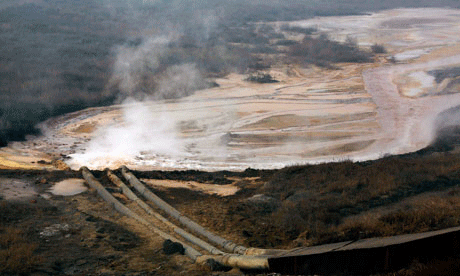
China Wrestles with the Toxic Aftermath of Rare Earth Mining https://e360.yale.edu/features/china-wrestles-with-the-toxic-aftermath-of-rare-earth-mining,
China has been a major source of rare earth metals used in high-tech products, from smartphones to wind turbines. As cleanup of these mining sites begins, experts argue that global companies that have benefited from access to these metals should help foot the bill.
World security needs nuclear New Start agreement – USA-Russia, not a distraction about China
|
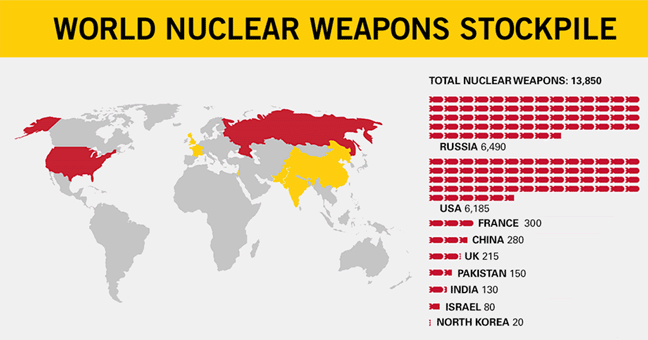
Nobody wins a nuclear war — especially not two nuclear behemoths. https://thehill.com/opinion/international/453576-nobody-wins-a-nuclear-war-especially-not-two-nuclear-behemoths BY DANIEL R. DEPETRIS,— 07/17/19 U.S. and Russian officials met this week in Geneva for what one hopes will be new strategic arms reduction talks. Trump administration officials are cautiously optimistic the discussions could lead to a more substantive negotiation about capping — and perhaps even decreasing — the number of nuclear weapons both countries have in their stockpiles. This matters for U.S. and global security because these two nations possess more than 90 percent of all nuclear weapons. President Trump, however, wants to go further than a simple extension of the 2010 The New Strategic Arms Reduction Treaty (START) agreement or a new bilateral treaty with the Russians. Instead, he is prodding China to join a trivariate arrangement. But in prefacing or linking an extension of New START to a fresh accord that includes the Chinese, the administration is increasing the possibility of ending up with neither. For one, pushing Beijing to into a three-way deal is like pushing on a locked door. The Chinese have shown no interest in a three-way deal, in large measure because their nuclear arsenal is a fraction (roughly 2 percent) of the globe’s entire inventory. At roughly 290 warheads, Beijing’s nuclear weapons program is minuscule when compared to the thousands of combined warheads Washington and Moscow have stockpiled. Indeed, China stockpile is less than 1/20th the size of the United States and about 1/22th the size of Russia’s. To expect the Chinese to participate in a new arms control negotiation with two nuclear superpowers when the numbers are so steadily stacked against them is a fool’s errand. Beijing’s no-first use nuclear policy, in place since its first ever nuclear explosive test in 1964, was recently reaffirmed just last year. An offensive nuclear strike is not something U.S. officials in Washington have to worry about. To focus on a U.S.-Russia-China nuclear agreement at the expense of keeping an already existing New START accord alive is the wrong priority. New START, signed in April 2010, was a win-win, pragmatic arms control agreement for both sides. The pact cut the U.S. and Russian stockpiles byaround one-third; capped the amount of nuclear warheads on deployed intercontinental ballistic missiles at 1,550; limited the number of deployed and non-deployed ICBM launchers to 800; and allowed each country to verify compliance with the treaty, including on-site inspections, information exchanges and advanced notices. Unlike the Intermediate Range Nuclear Forces Treaty, inspectors have verified Moscow’s compliance with the letter of the deal. For two countries that possess a combined 12,675 nuclear weapons, New START is a critical enforcing mechanism for nuclear parity and a stable balance of power. It is now the only functional arms control accord preventing the U.S. and Russia from entering another costly, risky arms race. The deal expires in February 2021 but could be extended for another five years if both Presidents Trump and Putin agree to do so. Putin has already expressed his interest. Trump, someone who considers himself a transactional pragmatist, shouldn’t waste any more time before doing the same. An extension of New START, however, is not only important for strategic stability between the two nuclear superpowers (without New START, there is nothing stopping either the United States or Russia from building and deploying more and better nuclear warheads). but also valuable for stabilizing the entire U.S.-Russia relationship in desperate need of improvement. For this reason, a constructive relationship with Moscow is unquestionably a good thing for U.S. security. Extending New START is a no-brainer and indeed could very well be an opportunity to mend relations. It’s not hyperbole to describe U.S.-Russia relations as being at their lowest since the land-based missile build-up in Europe in the early 1980s. From Syria and Ukraine to NATO and cybersecurity, Washington and Moscow are often on opposite sides of the issue. Even though both nations share some interests, including arms control and countering terrorism, Washington has become the epicenter of anti-Russia sentiment, where condemning Putin and advocating for sanctions is sport. Good politics, however, doesn’t necessarily correspond with good statecraft or foreign policy. Talking with adversaries, rivals, or competitors is a critically important component of effective foreign policy. We must engage with the world as it is, not as we wish it to be. Simply ignoring the Russians, pretending they don’t exist, or believing that using the stick unreservedly against Moscow will force it to cry uncle and change its policies to our liking makes conflict between nuclear superpowers more likely. Giving New START another five years of life is perhaps the only issue Washington and Moscow can agree on in today’s political climate. It’s perhaps the most important reason the U.S. and Russia must find a way to co-exist. Ensuring New START survives should be pursued aggressively for the sake of U.S. and global security Nobody wins a nuclear war — especially especially not two nuclear behemoths with thousands of warheads apiece. Daniel R. DePetris is a fellow at Defense Priorities, a foreign policy think tank focused on promoting security, stability and peace. |
|
|
China’s new solar thermal power plan to reduce carbon dioxide emissions by 350,000 metric tonnes yearly
 Energy Live News 21st June 2019 China’s first 100MW molten salt solar thermal power plant has
successfully hit its maximum power levels. Built by Beijing Shouhang IHW
Resources Saving Technology, the three billion yuan (£345m) project in
Dunhuang uses 12,000 mirrors to concentrate sunlight onto a receiver, which
is then used to heat the molten salt. It is capable of generating 390
million kWh of clean power each year, enough to reduce carbon dioxide
emissions by 350,000 metric tonnes – engineers at the facility say it has
already reached or exceeded its designed values.
1 This Month

of the week – Shut Down Drone Warfare!


Tell the Ukrainian Government to Drop Prosecution of Peace Activist Yurii Sheliazhenko

Petition to revoke the licensing of the Near Surface Nuclear Disposal Facility (NSDF) at Chalk River. https://www.ourcommons.ca/petitions/en/Petition/Details?Petition=e-7247
To see nuclear-related stories in greater depth and intensity – go to https://nuclearinformation.wordpress.com
-
Archives
- April 2026 (79)
- March 2026 (251)
- February 2026 (268)
- January 2026 (308)
- December 2025 (358)
- November 2025 (359)
- October 2025 (376)
- September 2025 (257)
- August 2025 (319)
- July 2025 (230)
- June 2025 (348)
- May 2025 (261)
-
Categories
- 1
- 1 NUCLEAR ISSUES
- business and costs
- climate change
- culture and arts
- ENERGY
- environment
- health
- history
- indigenous issues
- Legal
- marketing of nuclear
- media
- opposition to nuclear
- PERSONAL STORIES
- politics
- politics international
- Religion and ethics
- safety
- secrets,lies and civil liberties
- spinbuster
- technology
- Uranium
- wastes
- weapons and war
- Women
- 2 WORLD
- ACTION
- AFRICA
- Atrocities
- AUSTRALIA
- Christina's notes
- Christina's themes
- culture and arts
- Events
- Fuk 2022
- Fuk 2023
- Fukushima 2017
- Fukushima 2018
- fukushima 2019
- Fukushima 2020
- Fukushima 2021
- general
- global warming
- Humour (God we need it)
- Nuclear
- RARE EARTHS
- Reference
- resources – print
- Resources -audiovicual
- Weekly Newsletter
- World
- World Nuclear
- YouTube
-
RSS
Entries RSS
Comments RSS
 nuclear-news