EDF denies that China has increasingly big role in UK’s Hinkley Point nuclear project
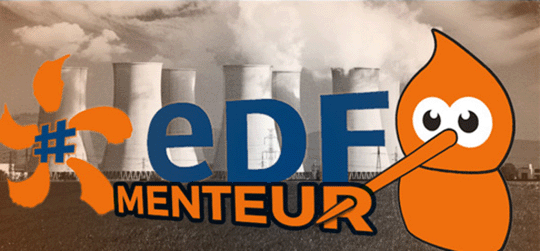 EDF Denies Rising Chinese Influence at U.K. Nuclear Site, Bloomberg, By Corinne Gretler, July 26, 2020,
- Chinese partner’s role bigger than disclosed, Telegraph said
- EDF said allegations are ‘untrue,’ CGN’s role not increasing
Electricite de France SA denied a media report that China General Nuclear Power Corp.’s role at a U.K. nuclear site is increasing, underlining the growing tensions about China’s involvement in critical infrastructure.
The company understated the number of Chinese personnel on site and leaned heavily on CGN’s expertise in planning and construction, the Sunday Telegraph reported, citing company documents and unidentified sources. The newspaper also said Chinese engineers proposed a way to lift a concrete dome onto the reactor at Hinkley Point C that would’ve involved dangling the heavy structure above workers, before it was deemed too dangerous…………
EDF owns about two-thirds of the Hinkley Point program while CGN holds the rest. The project was approved in 2016. The Tories have demanded a review of the plant, the Telegraph said, citing former Conservative leader Sir Iain Duncan Smith saying ministers were misled when they approved China’s role as just a financial partner in the project. https://www.bloomberg.com/news/articles/2020-07-26/dalio-warns-of-u-s-china-capital-war-that-would-hit-dollar
China’s government-run nuclear institutions are experiencing a brain drain.
 Mass resignations at state-run nuclear institute alarms China https://www.wionews.com/world/mass-resignations-at-state-run-nuclear-institute-alarms-china-315515 Mass resignations at state-run nuclear institute alarms China https://www.wionews.com/world/mass-resignations-at-state-run-nuclear-institute-alarms-china-315515
WION Beijing, China Jul 23, 2020, Edited By: Palki Sharma
STORY HIGHLIGHTSReportedly, ‘China’s best minds’ had access to extremely sensitive information and their sudden resignation has raised many conspiracies and theories regarding the exodus. A crisis has erupted in a major Chinese research institute in the form of mass resignation of 90 nuclear scientists. The Communist Party has launched an investigation after calling it ”brain drain”. However, the incident has become a major concern because of the massive number that have tendered their resignation. ”China’s best minds” reportedly had access to extremely sensitive information and their sudden resignation has raised many conspiracy theories regarding the exodus. The scientists of the Institute of Nuclear Energy Safety Technology(INEST) in China’s eastern city of Hefei are now in the headlines. This institute is part of the Hefei institutes of physical science that’s under the state-run Chinese Academy of Sciences – China’s top research body. INEST specialises in advanced nuclear energy and safety technology which participates in more than 200 national and international projects. It has about 600 members and 80 per cent of the researchers have PhD degrees. Last year, INEST was in the news for developing a virtual nuclear power planet, something that can be used for safety assessment. However, the tables have turned and some serious systemic issues have come to light due to this year’s incident. In June, INEST employees clashed with the staff of their parent institute. Reports say they fought over who gets to control access to their facilities. As per a theory, the institute was unable to get big projects due to lack of funding and the researchers were poached by private companies. China’s Vice Premier Liu He has announced that a team will be sent to investigate the mass resignations. The seriousness of event can also be assessed by the fact that 90 out of the 500 members have left. Last year, the figure had dropped to 200, it is now believed that only 100 researchers work there. The fact is that scientific research in China is largely in the hands of state-run universities and research institutes. While outwardly the premise of research and innovation is the freedom to explore, it is controlled by Beijing and managed by the Communist Party of China. The jobs at state-run institutes promised stability, better benefits but young researchers are now more than willing to give up these jobs and move to the private sector for more money and more freedom. The state run institutions are the like brain trust of China and now they are witnessing a brain drain. |
|
Britain’s Conservatives anxious to review UK’s nuclear build co-operation with China
Tory hawks press button on nuclear power battle with China, After Huawei, energy sector looks set to be next flashpoint in Sino-British relations, Ft.com, Jim Pickard, Daniel Thomas and Nathalie Thomas-20 July 20
CGN, which has already invested £3.8bn in the UK nuclear sector, is a junior funding partner for the new Hinkley Point power station in Somerset being built by France’s EDF, and is also involved with the French company’s other proposed plant at Sizewell in Suffolk.
Why did over 90 nuclear safety scientists resign en masse from an institute under the Chinese Academy of Sciences (CAS)?

 90 CAS nuclear scientists who resigned were allegedly ‘poached’
Source: Global Times 2020/7 More than 90 nuclear safety scientists with an institute under the Chinese Academy of Sciences (CAS) resigned enmasse according to media reports, with the unusual high number of resignation drawing public attention, considering the essential service the scientists provide.
An employee at the Institute of Nuclear Energy Safety Technology (INEST) under The Hefei Institutes of Physical Science (CASHIPS) of CAS said the more than 90 researchers who voluntarily left their jobs were “poached” and the resignations were part of “normal staff turnover,” the Shanghai-based news website thepaper.cn reported Thursday.
The employee didn’t identify which company or institute may have recruited the researchers.
INEST, located in Hefei, capital of Central China’s Anhui Province, a hub of China’s scientists, has about 600 members and 80 percent of researchers have PhD degrees, according to the institute’s website………Earlier media reports show the resignations were triggered by a conflict with new security staff hired in mid-June at INEST.
According to the official website, INEST was established in September 2011. It is devoted to the design and R&D of advanced nuclear energy and safety technology, and also an independent nuclear safety assessment center with the aim of promoting the sustainable development of nuclear science and technology.
The employee said the 90-plus researchers submitted their resignations in June. https://www.globaltimes.cn/content/1194812.shtml
UK Ministers losing enthusiasm for small nuclear reactors developed with China
DBD, a Cheshire-based engineering firm, was working with China’s Institute of Nuclear and New Energy Technology to build a fleet of gas-cooled small reactors, and had hoped to win government funds. However, ministers have awarded £10m each to three rival projects — including an experimental plan for a fusion reactor. A version of the DBD reactor has already been built in China. DBD declined to comment……. (subscribers only) https://www.thetimes.co.uk/article/ministers-cool-on-chinese-nuclear-reactors-k2m8j76qf
Britain’s nuclear future in trouble, aging reactors, and not enough money without China’s help
Britain’s Nuclear Future Uncertain as Relations With China Fray, https://business.financialpost.com/pmn/business-pmn/britains-nuclear-future-uncertain-as-relations-with-china-fray Rachel Morison and William Mathis, Bloomberg) 8 July 20, — Britain’s fraying relationship with China has the potential to undo a decade of mixed efforts to keep nuclear power flowing as an aging generation of plants drop out of service.
Once the heart of the U.K.’s energy plans, nuclear has been sidelined by spiraling costs and cheaper renewables. It also finds itself at the center of a diplomatic row spanning trade and human rights that threatens to undermine how the sector is financed.
Relations between China and the U.K. have been strained as the row over Huawei Technologies Co. intensified. When sweeping new national security laws were introduced in Hong Kong Prime Minister Boris Johnson offered its citizens the right to live and work in Britain.
China warned the U.K. Monday it’ll face “consequences” if it chooses to be a “hostile partner” after it emerged the government is planning to phase out the company’s equipment in the U.K.’s 5G telecommunications networks.
For nuclear, the sticking point has become the once-feted relationship with China General Nuclear Power Corp. that’s supposed to deliver the next generation of large nuclear plants. That link has come into sharp focus as the U.K. scrambles to find a funding model for projects that aren’t getting any cheaper.
Without CGN, its money and its technology, the U.K. will be left with a huge funding gap that other investors don’t seem willing to fill. It’ll also leave the country’s nuclear plans in disarray.
Equity funding for nuclear power stations is very difficult for private actors,” said Rob Gross, director of the U.K. Energy Research Centre. The risks are significant, timescales long and individual projects are very large. That’s why governments have always played a role in nuclear power, he said.
CGN’s involvement in Britain’s nuclear industry started in 2016 when a deal was signed with Electricite de France SA to cooperate on a trio of reactors totaling 8.7 gigawatts starting with Hinkley Point C in southwest England.
Nuclear remains important for the British government but it’s becoming increasingly pushed to the margins of energy policy as cheaper wind and solar have taken center stage.
Nuclear power has traditionally been seen as a low-carbon way of supplementing renewables — and as such a key part of the future energy mix envisioned in a net zero world.
Losing nuclear power probably wouldn’t pose a threat to the U.K.’s ability to generate enough power. The gap could be filled by gas, batteries or small modular reactors that can provide back-up to renewable energy and keep the lights on.
The sector is also important to the country as a way of building a large, skilled workforce and creating a supply chain using British companies.
False Starts
In 2017, ministers envisioned building 18 gigawatts of new projects but one by one each project folded, unable to negotiate the financing, leaving just EDF and CGN.
The government’s offer in 2018 to Hitachi to take a third of the equity at the Wylfa nuclear project wasn’t enough to keep the company interested.
How best to finance the technology, which costs billions, has become the latest hump in the road for policymakers. The Hinkley Point reactors – expected to start producing power by 2025 – have been hit by delays and cost overruns.
“The precise funding model for nuclear is up to the government to decide,” an EDF spokesman said.
That project will now cost as much as 22.5 billion pounds ($28.1 billion), taking into account inflation, and the guaranteed price of power is significantly higher than the latest round of offshore wind projects. Sizewell-C, still in the planning process, is slated to cost 20 billion pounds.
EDF is struggling and can’t afford to finance Sizewell on its own. The utility has cut costs and jobs, and pared investments setting out a plan to divest at least 10 billion euros of assets from 2015 to 2020 to help fund its share of Hinkley Point.
* CGN’s investment is in the planning and development stage only for Sizewell whereas it is involved in the construction of Hinkley.
The industry favors paying for the massive projects through a Regulated Asset Base model, a proven success on other infrastructure projects. The previous Conservative government was thought to back the financing option but the idea looks to be losing traction.
“If the Chinese pull out, then Sizewell will still go ahead but EDF will be unable to take on another major project,” Elchin Mammadov, a Bloomberg Intelligence analyst, said “So, Bradwell will be dead or put on hold for another decade.”
The debate has gone quiet following a consultation on the RAB model which closed in October.
RAB likely wouldn’t transfer enough risk from the project’s backers — EDF and CGN. The government would have to offer some kinds of guarantee on the project in order to get private investors to finance it.
One option would be for the government to take either a majority or minority stake in Sizewell C..
I wouldn’t be surprised if what is adopted is either a model with many of the characteristics of RAB, or potentially consideration of a more direct stake. This is about reducing the cost of capital.” said Tom Greatrex, chief executive officer of the Nuclear Industry Association.
But despite the long delays, there’s no indication that the government’s made up its mind how it will proceed.
“We are currently considering responses to inform the best approach to the financing of future nuclear projects,” a spokesperson for the Department for Business, Energy & Industrial Strategy said.
As much as 80% of electricity will be produced from low carbon sources by 2030, according to scenarios modeled by the U.K.’s Committee on Climate Change.
“With all but one of the nuclear fleet set to retire by 2030, and uncertainty over the scale of the new build program, it is likely that more electricity from renewable sources will be needed,” said Jonathan Marshall, head of analysis at the Energy and Climate Intelligence Unit.
Fukushima radioactive reference layer found in Northern glaciers as they thaw

 Terrawatch: unearthing snow’s ‘Fukushima layer’ https://www.theguardian.com/science/2020/jun/30/terrawatch-unearthing-snows-fukushima-layer
Chinese glaciologists have found the freeze-thaw process has concentrated discharge from the disaster Kate Ravilious, @katerav Wed 1 Jul 2020 The Fukushima nuclear accident has added a distinctive signature to snow and ice across the northern hemisphere, new research published in Environmental Research Letters shows. Triggered by the Tōhoku earthquake and tsunami off the coast of Japan on 11 March 2011, the disaster resulted in a month-long discharge of radioactive material into the atmosphere, ocean and soil.Feiteng Wang from the Tian Shan glaciological station in Lanzhou, China, and colleagues collected snow samples in 2011 and 2018 from a number of glaciers (spanning a distance of more than 1,200 miles (2,000km) in north-western China. They expected the Fukushima signature to have faded away by 2018, but to their surprise the freeze-thaw processing had made it more concentrated, creating a strong and lasting reference layer in the ice.
Many reference layers from the last 50 years (such as the Chernobyl nuclear disaster) have melted away in recent warming events, making it difficult to date the upper layers of ice cores. “Reference layers are crucial and a prerequisite for telling the story of the ice core,” says co-author Jing Ming. “The Fukushima layer will be useful for dating ice in one or two decades when the snow transforms to ice,” he adds.
Many experts question Trump’s claim on China’s nuclear weapons buildup
- When negotiators from the United States and Russia met in Vienna last week to discuss renewing the last major nuclear arms control treaty that still exists between the two countries, American officials surprised their counterparts with a classified briefing on new and threatening nuclear capabilities — not Russia’s, but China’s.
….. Many outside experts question whether China’s buildup — assessed as bringing greater capability more than greater numbers — is as fast, or as threatening, as the Trump administration insists.
The United States conducted more nuclear tests during the Cold War than the rest of the world combined. Over decades of experimentation, and more than 1,000 tests, its bomb designers learned many tricks of extreme miniaturization as well as how to endow their creations with colossal destructive force. Compared with the atomic bomb that leveled Hiroshima, the nation’s first explosive test of a hydrogen bomb, in 1954, produced a blast 1,000 times as powerful.
Because of that history, many nuclear experts now argue that if Mr. Trump begins a new wave of global testing, it would aid American rivals more than the United States.
For years, some Republicans have urged preparations for a test and poured money into the effort. One instrument now being prepared for the Nevada complex costs $800 million; it would test the behavior of plutonium.
Today, Republicans are still urging more upgrades and speedups, including at the Nevada complex. This month, Senator Tom Cotton, Republican of Arkansas, offered an amendment to a defense bill that would add at least $10 million to “carry out projects related to reducing the time required to execute a nuclear test.”
Top Democrats in the House told the Pentagon and the Energy Department in a recent letter that the idea of a renewal in nuclear testing was “unfathomable,” as well as “shortsighted and dangerous.”
But Mr. Billingslea thinks he succeeded in getting the Russians to think about what is happening in China, not in the Nevada desert. During his meeting last week, the Russians were taking copious notes on China’s buildup, while reviewing classified slides. He insists they want to sit down and talk more later in the summer.
They will do so without the Chinese….https://www.nytimes.com/2020/06/30/us/politics/trump-russia-china-nuclear.html
FAIR exposes the false claims about China and COVID-19
 Debunking Trump and Corporate Media’s WHO/China Coverup Conspiracy Theories FAIR
The Trump administration suspended funding to WHO in April—the UN’s primary infectious disease–fighting body—accusing it of “severely mismanaging and covering up the spread of the coronavirus,” and of taking China’s allegedly deceptive claims about its handling of Covid-19 at “face value.” But corporate media had already been boosting these same talking points.
The Wall Street Journal’s “The World Health Organization Draws Flak for Coronavirus Response” (2/12/20) effectively accused WHO of being “too deferential to China in its handling of the new virus,” and criticized WHO Director-General Tedros Ghebreyesus for “bending to Beijing” after lauding China’s unquestionably effective swift quarantine of 60 million people, and for declaring that “China is actually setting a new standard for outbreak response” and identifying the virus in “record time.” The Journal further expounded the conspiracy theory of a seemingly omnipotent China having WHO under its thumb:
Over its decades of battling epidemics, the WHO has rarely had to deal with an entity as politically and economically powerful as China today. It can’t afford to alienate the country’s leadership, whose clout and financial largess it aims to attract to global health causes. It needs Beijing’s cooperation in preventing a full-blown pandemic—and this may not be the last time. China is the source of many emerging pathogens, which jump from animals to humans in its teeming live markets and can cause deadly epidemics.
According to the Journal’s logic, when WHO praises China for an effective response containing Covid-19 and giving the rest of the world ample time to take health precautions, it is “compromising its own epidemic response standards, eroding its global authority, and sending the wrong message to other countries that might face future epidemics.” When Dr. Bruce Aylward—a Canadian medical expert with 30 years of experience combating polio, Ebola and other global health emergencies—concluded that he “didn’t see anything that suggested manipulation of numbers,” after leading a team of experts visiting China for WHO, that can’t be an accurate observation. For corporate journalists, it can only be because he was duped by the devious Chinese government “underreporting both total cases and deaths it’s suffered from the disease” (Bloomberg, 4/1/20).
The Journal flimsily explained that China wields such formidable control over the WHO because China is a “future source of funds and a partner with which to tackle the biggest global health problems,” and not as a “current donor.” That would be because a cursory examination of WHO’s funding would reveal that the US donated more than 10 times more money to WHO ($893 million) than China ($86 million), despite the US having almost $200 million in arrears before suspending payments (Axios, 4/15/20).
Neither does the Journal explain how or why WHO could possibly withhold information from Western nations even if it wanted to, when its leadership is stacked with Americans and Europeans, and 15 US officials were embedded with the WHO in Geneva, given that the US is the most “politically and economically powerful” nation on Earth. This makes the Trump administration’s declaration of the US terminating its membership in WHO after threats to permanently cut funding especially egregious.
Nor can the Journal explain the source of China’s fearsome influence over independent and prestigious medical journals like Nature (5/4/20), Science (3/28/20) and the Lancet (3/7/20), which also credited the effectiveness and transparency of China’s response for saving thousands of lives (CGTN, 5/1/20, 5/10/20). Does China’s mysterious and awe-inspiring influence extend over Western medical journals as well?
When Foreign Policy (5/12/20) reported on the exclusive scoop of a leaked dataset of coronavirus cases and deaths from the Chinese military’s National University of Defense Technology, it confirmed that the leaked information “matches” the publicly available numbers the Chinese government posts online—which poses an inconvenience to those spouting conspiracy theories of a Chinese government coverup. Corporate media accounts of Chinese deception and fake statistics also fail to explain how the Chinese government possesses the fantastical ability to deceive governments and independent medical experts around the world, even if it wanted to. As FAIR’s Jim Naureckas (4/2/20) pointed out earlier:
The reality is that it’s very hard to hide an epidemic. Stopping a virus requires identifying and isolating cases of infection, and if you pretend to have done so when you really haven’t, the uncaught cases will grow exponentially. Maintaining a hidden set of real statistics and another set for show would require the secret collusion of China’s 2 million doctors and 3 million nurses—the kind of improbable cooperation that gives conspiracy theories a bad name…. If China is merely pretending to have the coronavirus under control, the pathogen will rapidly surge as people resume interacting with their communities. Once international travel is restored, it will be quite obvious which countries do and don’t have effective management of Covid-19.
Countries revising their figures upon receiving new information is to be expected, and is not necessarily evidence of deceit, as plenty of nations besides China revise their data upwards. Yet only China is singled out as being exceptionally deceptive. For example, in the same week New York revised its death toll upwards by nearly 3,800, China’s adding almost 1,300 dead to its Wuhan data was presented as a possible coverup (Politico, 4/14/20; Guardian, 4/17/20). The Moon of Alabama blog (4/1/20) explained some of the complexities in reporting numbers during a pandemic in real-time:
Does one include co-morbids or not in the count? What about casualties of a car accident that also test positive for Covid-19 when they die? What about those who died with Covid-19 symptoms but could not be tested for lack of test kits? Are the tests really working reliably?… What about asymptomatic cases that test positive. Are these false positives, or do these people really have the virus? One can only know that by testing them a month later for antibodies………
this manipulation of public opinion by the US government and corporate media appears to be working. According to a recent Ipsos survey, more than 30% of Americans have witnessed someone blaming Asian people for the coronavirus pandemic (even though new research indicates that travel from New York City was the primary source of the US outbreak, with New York’s outbreak originating in Europe). Pew Research (4/21/20) found that around two-thirds of Americans have an unfavorable view of China, which is the most negative rating for the country since Pew began asking the question in 2005. This suggests that public opinion has been turned against China, despite it being the first to detect the virus, alert the world and provide a model for containing it.https://fair.org/home/debunking-trump-and-corporate-medias-who-china-coverup-conspiracy-theories/
Explaining the India-China conflict
|
Nuclear powers, a disputed border and an uneasy truce: Explaining the India-China conflict A border clash between the two nuclear armed neighbors has drawn the world’s gaze to a disputed region in the Himalayas NBC News, June 20, 2020, By Saphora Smith High up in the Himalayas, Indian and Chinese armed forces warily eye each other across a disputed border region that has become the scene of a tense standoff between the two nuclear powers. The conflict in the remote Galwan Valley that spans their shared border sparked into life Monday with the killing of 20 Indian soldiers, the first reported deaths in 45 years. China has not disclosed whether its forces suffered any casualties, according to a report in its state-run newspaper, the Global Times. The deaths have drawn the world’s gaze to a region that the two most populous countries have been contesting for decades. The implications go far beyond the lonely snowcapped mountains of this geopolitically complex region.
………Thousands of troops have been camped either side of the Galwan Valley, in the mountainous region of Ladakh, for weeks.
The tense standoff started in early May, when Indian officials said Chinese soldiers crossed the boundary in Ladakh at three different points, erecting tents and guard posts and ignoring verbal warnings to leave, according to The Associated Press. That triggered shouting matches, stone-throwing and even fistfights between the two sides, much of it replayed on television news channels and social media, the news agency reported……. Among the reasons raised by analysts include China’s objection to India’s construction of a road through the Galwan Valley connecting the region to an airstrip, New Delhi’s increasing close alliance with Washington, and Beijing’s support for Pakistan in its dispute with India over the Kashmir region. ……… https://www.nbcnews.com/news/world/nuclear-powers-disputed-border-uneasy-truce-explaining-india-china-conflict-n1231310 |
|
|
U.S. – China talks may cover North Korea nuclear issue
 North Korea nuclear issue may be on the agenda at US-China SCMP, 17 June 20
Stephen Biegun, the US special representative for North Korea, will join the talks in Hawaii on Wednesday.
, suggesting the stalemate in nuclear disarmament negotiations with Pyongyang could be on the agenda.
and threatened military action against the South……….
The Hawaii meeting comes as relations between the world’s two largest economies are at their lowest point in decades and facing off on many fronts – from trade and technology to Hong Kong and the South China Sea. US officials, including President Donald Trump and Pompeo, have blamed Beijing for the coronavirus pandemic, while Beijing has accused Washington of trying to pass the buck to hide its own failings in dealing with Covid-19 in the US.
t also comes as tensions on the Korean peninsula are again escalating after Pyongyang demolished a four-storey liaison office set up near the border with South Korea in 2018 after the first summit between North Korean leader Kim Jong-un and South Korean President Moon Jae-in. A major setback for the detente in the region, observers said the move reflected Pyongyang’s growing frustration over its stalled nuclear talks with Washington.
Chinese Foreign Ministry urges US to avoid nuclear testing
BEIJING, June 8. /TASS/. China urges the United States to abide by its international obligations and abandon plans to carry out nuclear tests, Chinese Foreign Ministry Spokesperson Hua Chunying said at a briefing on Monday.
“We insist that the United States should strictly abide by its obligations to end nuclear testing… and we hope that it will listen to the international community,” the Chinese diplomat pointed out. “The US should abandon plans that could undermine global stability and strategic order,” she added……… https://tass.com/world/1165339
China is reconsidering building nuclear reactors in Britain
|
China poised to pull plans for UK nuclear plants https://www.straitstimes.com/world/europe/china-poised-to-pull-plans-for-uk-nuclear-plants 5 June 20 LONDON (BLOOMBERG) – China’s ambassador to the UK said that Prime Minister Boris Johnson’s plans to seek alternatives to Huawei Technologies Co Ltd in the 5G network could spoil plans for Chinese companies to build nuclear power plants and the HS2 high-speed rail network, the Sunday Times reported.Mr Liu Xiaoming signalled that Beijing is viewing the decision over Huawei as “a litmus test of whether Britain is a true and faithful partner of China”, the newspaper reported the ambassador telling business leaders, saying that the words were “interpreted as a threat by those listening”.
China General Nuclear Power Corp plans to build its own nuclear reactor at Bradwell in Essex, according to the newspaper report. China has a minority share in nuclear power plants at Hinkley Point in Somerset and Sizewell C in Suffolk, both in partnership with EDF of France. |
|
China’s nuclear power ambitions face delays, waste problems, and the growing success of renewables
 It’s a pity that nuclear energy is so easily described as “climate-friendly”. Yes, the actual nuclear reactor can be said to be cutting carbon emissions. But why does everyone ignore the huge carbon emissions from the entire nuclear fuel chain, from uranium mining through to burial of radioactive wastes? Why ignore the emissions of ionising radiation, another unseen, but dangerous pollutant?
And why ignore climate change’s effects on nuclear power? Far from nuclear energy stopping global heating, it’s more likely that global heating will stop nuclear power. Nuclear is highly water-guzzling, so most reactors are perched neat the sea, or near rivers – meaning in danger of sea level rise, as well as other extremes such as hurricanes. The water requirements mean that nuclear is affected by extreme heat – and plants have to cut down, or even shut down.
China to Dominate Nuclear as Beijing Bets on Homegrown Reactors
China probably won’t hit its nuclear energy target this year, but that’s unlikely to derail a broader ambition to become the planet’s chief proponent of the climate-friendly [what!!] fuel
Bloomberg, 1 June 20
Chinese involvement in Sizewell nuclear plant the ‘next Huawei
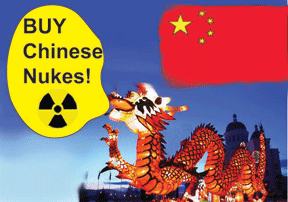 Telegraph 27th May 2020, Chinese involvement in Sizewell nuclear plant the ‘next Huawei’, MPs warn.
Call for energy policy and how the UK interacts with China to be reviewed.
Chinese involvement in the Sizewell C nuclear power station will be the
“next Huawei,” MPs have warned, as they called for an entire overhaul
of the energy policy.
It comes after EDF, the French energy company on
Wednesday submitted an application to build the next nuclear power plant in
Suffolk, which it intends to develop with the state-owned energy company,
China General Nuclear Power Group (CGN).
However Sir Iain Duncan Smith, the
former Conservative leader, warned the power plant was “the next
Huawei”. “It is another major manifestation of the problem we face
having set out on the wrong path with China years ago,” Sir Iain told The
Daily Telegraph.
1 This Month

of the week – Shut Down Drone Warfare!


Tell the Ukrainian Government to Drop Prosecution of Peace Activist Yurii Sheliazhenko

Petition to revoke the licensing of the Near Surface Nuclear Disposal Facility (NSDF) at Chalk River. https://www.ourcommons.ca/petitions/en/Petition/Details?Petition=e-7247
To see nuclear-related stories in greater depth and intensity – go to https://nuclearinformation.wordpress.com
-
Archives
- April 2026 (68)
- March 2026 (251)
- February 2026 (268)
- January 2026 (308)
- December 2025 (358)
- November 2025 (359)
- October 2025 (376)
- September 2025 (257)
- August 2025 (319)
- July 2025 (230)
- June 2025 (348)
- May 2025 (261)
-
Categories
- 1
- 1 NUCLEAR ISSUES
- business and costs
- climate change
- culture and arts
- ENERGY
- environment
- health
- history
- indigenous issues
- Legal
- marketing of nuclear
- media
- opposition to nuclear
- PERSONAL STORIES
- politics
- politics international
- Religion and ethics
- safety
- secrets,lies and civil liberties
- spinbuster
- technology
- Uranium
- wastes
- weapons and war
- Women
- 2 WORLD
- ACTION
- AFRICA
- Atrocities
- AUSTRALIA
- Christina's notes
- Christina's themes
- culture and arts
- Events
- Fuk 2022
- Fuk 2023
- Fukushima 2017
- Fukushima 2018
- fukushima 2019
- Fukushima 2020
- Fukushima 2021
- general
- global warming
- Humour (God we need it)
- Nuclear
- RARE EARTHS
- Reference
- resources – print
- Resources -audiovicual
- Weekly Newsletter
- World
- World Nuclear
- YouTube
-
RSS
Entries RSS
Comments RSS
 nuclear-news