Nuclear pollution in China – the Uighur people pay the health and environmental price
A third of the PRCs uranium for nuclear energy comes from extortion in the Yili basin of Xinjiang. This is also home to a great population of Uighurs.
Today, China has one of the world’s largest nuclear energy development programmes. During the Cold War era, there did not exist a political or economic motivator for commercialising nuclear energy as coal-fired power stations and hydroelectric energy dominated the system. However, after 2005, China has been able to reinvent this narrative. Notably, what this resurrected was a reassertion of spaces of injustice for their minorities. Their lands were first grounds for nuclear weapons’ testing and now used for energy rather than warfare purposes, thus continuing a historical subjugation to nuclear imperialism. This nuclear imperialism situates itself within an already prevalent cyclic violence against China’s far western frontier region of Xinjiang’s ethnic minorities, the predominantly Muslim Uighurs, ever since the establishment of the People’s Republic of China (PRC) in 1949.
Given the inherent differentiation between the Uighurs and the Chinese dominant ethnicity, the Hans, the former’s identity was always up for scrutiny. The government came down particularly hard on the Uighurs after the events of 9/11 initiated the Global War on Terror (GWOT), as well as the Ürümqi riots on 5 July 2009 which saw clashes between protesting Uighurs, Han people, and China’s People’s Armed Police, leaving nearly 200 people dead in Xinjiang. The Chinese government has attributed security concerns with the certain ‘terrorist’ acts committed by a handful of them. Taking what some might perceive as an opportunist stand, China was able to claim being victim to global terrorism, to justify crackdown on the minority group. What this terrorist narrative in turn ushered in was a transnational territory of uncontrolled spaces where ‘dangerous populations’ need not be afforded legal protections and therefore be made to quarantine; containing their actions that often correspond to security threats. The antagonism was not restricted to the few Uighurs rioters. Instead the entire Uighur community as a single biological group was treated as the Homo Sacer.
………….. The systematic discrimination of the Uighur feeds into a larger understanding of necro-politics of Uighur lives having become too consequential juxtaposed with a system which is ready to dispense with this minority population. The emphasis here is on China’s first nuclear weapons test in Lop Nor, and the legacy it has translated onto the present day context through states sponsored uranium mining in the Yili Basin, underscoring a new kind of imperialism.
Nuclear weapon testing began in the mid-1960s. Soon a kind of nuclear imperialism started to take root in the existing Han colonisation of Uighur spaces. The latter revolved around a combination of contestation over the sovereignty of the Uighur homeland and the resource-rich soils they inhabited. The aftermath of the Sino-Soviet split meant a collapse in PRCs nuclear relationship with China which acted as a driver for hastening and furthering their ambitious nuclear programmes. The PRC became the fifth nation to develop nuclear weapons during the Cold War. They formally established the 10,000 km sq. Lop Nor Nuclear Test base in 1956. It still stands as the largest site of its kind in the world………
Professor Jun Takada conducted a study explaining how peak levels of radioactivity from large yield tests might have had prolonged consequences in the biological makeup of the generations to come observing congenital defects and cancer incidents in some. The cancer incidents in the region were approximately 35% higher than the rest of the state. Uighur traditional medicine could not cope with these cases. In short, a biopolitical regime protected the state from liability, meanwhile for the Uighurs, contestation around state assurance and health risks posed a blurring in the causation between sickness and exposition.
The Uighurs who were affected by the Lop Nor test therefore have been given no compensation or recognition from the state. Many Hans on the other hand were given assurance from the state especially in terms of healthcare on various occasions. This only furthered the resentment and tension between the Hans and the Uighurs of Xinjiang in the years to come.
Following this, peaceful protests sprung up. In November 1985, protests led by students in Beijing against nuclear weapon tests were met with brute state coercion. In 1993, Uighurs gathered at Log Nor and demanded the ban of nuclear testing but were interrupted by PLA forces, some protestors were shot in the process. The Tigers of Lop Nor were an organisation that even managed to send tanks inside nuclear spaces and blew up planes in protest. Moreover, enveloped in this environment, the Uighur identity that already clashed with Han nationalism was simply made starker; the anti-nuclear movement began to echo separatist tendencies.
Today, a third of the PRCs uranium for nuclear energy comes from extortion in the Yili basin of Xinjiang. This is also home to a great population of Uighurs. The PRC has placed a moratorium on the manufacturing of fissile material for deterrence purposes, transforming Xinjiang into the primary hub for the nuclear energy industry. The NINT continues to partake in nuclear research, to the north of the Lop Nor test site. There is no state system in place to ensure the safety of those dwelling the Yili. What this reflects is a revival of a past narrative of nuclear imperialism as uranium energy extraction seems to have overtaken nuclear testing. There appears to be no incentive from the ends of the government; a lacking in enforceable nuclear legislations and regional systems of monitoring and regulating nuclear activity. …….
. China now possesses over 44 nuclear reactors in operation and 18 others under construction and is striving towards ensuring that 1/5th of their energy comes from their power plants by 2030. Activism from the minorities in the region is often counted by officials as acts of Islamism or cultural protests rather than a legacy of activities against the nuclear industry which is another layer of discrimination that has been recognised by the Uighurs.
More anti-nuclear activism seems to be entering the eastern provinces of Shandong, Jiangsu, and Guangdong as a result of general community concerns against an unprotected nuclear policy. Online petitions and active media are slowly entering the scene to influence and mobilise public opinion. However, it is only perhaps a matter of time before the PRC silences them too.
Censorship is often used to subdue this kind of opposition online. What is worse is that the Uighurs of Xinjiang lack the agency to voice their grievances while practitioners in the east who are often familiar with the political systems and often well-educated are able to make negotiations with the state in terms of the relocation of nuclear power plants. ……… https://www.orfonline.org/expert-speak/nuclear-imperialism-china-xinjiang/
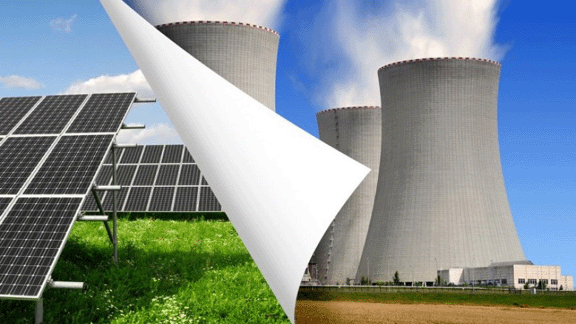
China’s world-leading push for solar and wind energy
capacity each year than any other country, with over 760GW installed so
far. By contrast, the EU has only managed 500GW, the USA 250 GW.
capacity additions in China are expected to fall by over 16% to 19 GW from
2020 to 2021, given the Chinese government’s decision to end subsidies,
say analysts Wood Mackenzie.
250 GW of wind capacity to be added, with repowering opportunities onshore
and growth potential offshore. Indeed, some see the latter booming
dramatically. So, while wind subsidies will fall by 3.2%, wind capacity
will still grow, and PV solar seem likely to do even better: incentives for
PV will rise by 14%, with some seeing solar as the major growth area longer
term, helping China get 62% of its power from non-fossil sources by 2030.
https://renewextraweekly.blogspot.com/2020/10/china-renewables-to-expand-even-more.html
China backs Iran nuclear deal, calls for new MidEast forum
China backs Iran nuclear deal, calls for new MidEast forum Bangkok Post, : 11 OCT 2020 BEIJING: China’s foreign minister Wang Yi has called for a new forum to defuse tensions in the Middle East after a meeting with his Iranian counterpart where he reiterated Beijing’s support for Tehran.
Wang and Javid Zarif also reaffirmed their commitment to Iran’s 2015 nuclear deal with world powers, according to the Chinese foreign ministry, an implicit rebuke of the United States for abandoning the accord during their Saturday meeting in China’s southwestern Tengchong city.
Iran has been locked in an acrimonious relationship with Saudi Arabia, the other major Middle Eastern power, over the war in Yemen, Iranian influence in Iraq and Saudi support for Washington’s sanctions on Tehran.
“China proposes to build a regional multilateral dialogue platform with equal participation of all stakeholders,” said the Chinese foreign ministry statement. …… https://www.bangkokpost.com/world/2000307/china-backs-iran-nuclear-deal-calls-for-new-mideast-forum
China’s plan for dramatic switch to climate action and renewable energy
|
|
|
Near to flaspoint – disputes between India, Pakistan,China
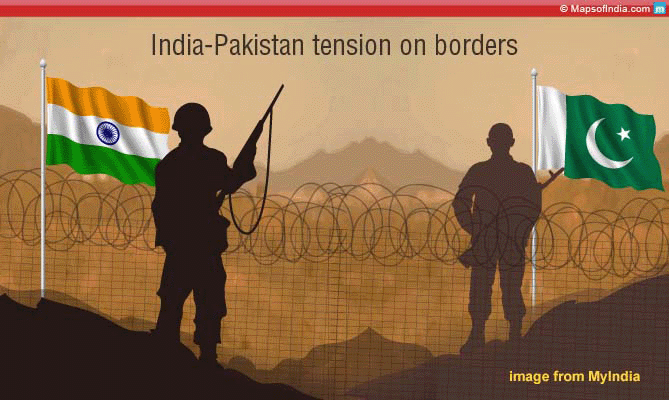 Tensions between 3 nuclear-armed powers are rising toward the boiling point ABBY POKRAKA, RESPONSIBLE STATECRAFT Tensions between 3 nuclear-armed powers are rising toward the boiling point ABBY POKRAKA, RESPONSIBLE STATECRAFT
SEP 30, 2020,
For decades, India and Pakistan have clashed over Kashmir, the mountainous region both countries claim. But to make matters more complicated, China has a stake in the area, too. The Aksai Chin region — located between Kashmir and Tibet — is under Chinese control and has been a source of conflict between India and China since 1962.
The borderlands between these three nuclear-armed states is increasingly a flashpoint for conflict. The international community ignores these growing challenges at its peril and should be looking for ways to help manage potential crises in the region. And while the United States can play a role, in this particular instance, direct US involvement is probably not the best way forward…………. China was drawn into a dispute between India and Pakistan when India revoked Kashmir’s autonomy in August 2019 and wanted to incorporate parts of “Xinjiang and Tibet into its Ladakh union territory,” which China believes violates its dominion due to its occupation of Tibet. It appears that over the last year the situation in Kashmir has not gotten better. ……It seems clear that after decades of poor relations, the tensions in this part of the world may reach a boiling point. Finding a solution to these half-century conflicts seems daunting, but it is necessary. While many nations have fought throughout history, a conflict between nuclear-armed states carries an unbearable risk of escalation. To start, these countries can take small steps to stabilise the security of the region and pave the way for better relations. Starting a dialogue, bilateral or trilateral, can improve communication in the longer term, which can help reduce the likelihood of conflict. Establishing crisis communications was an important step the United States and the Soviet Union took in the wake of the Cuban Missile Crisis, and de-escalation practices the two countries implemented in the early 1960s remained in place through the end of the Cold War. A third party could help facilitate regional discussions. Given its history in the region, the United States might have seemed like a good option for such facilitation, but that is not the case at this time……. This week, President Trump took aim at China before the United Nations, blaming it for the global COVID pandemic. At this point, there is no reason China would see the United States as a desirable mediator for any regional conflict…… friction among China, India, and Pakistan continues to grow. The only way to diffuse the tension and prevent destructive escalation is through diplomacy. Other countries need to step up and work to reduce the hostilities. Make no mistake, a large-scale, regional conflict among nuclear-armed states would have global consequences. https://www.businessinsider.com.au/httpsresponsiblestatecraftorg20200925india-china-pakistan-three-nuclear-powers-hurtling-towards-the-boiling-point-2020-9 |
|
It’s important to dispel three persistent myths about China’s nuclear weapons
 THE DANGEROUS MYTHS ABOUT CHINA’S NUCLEAR WEAPONS, War on the Rocks, DAVID LOGAN, SEPTEMBER 18, 2020
……….While the Cold War superpowers engaged in arms racing, China committed to building a “lean and effective” force. Since obtaining a nuclear weapons capability, China has publicly claimed a categorical no-first-use policy and has asserted that “China does not engage in any nuclear arms race with any other country and keeps its nuclear capabilities at the minimum level required for national security.”
Misplaced Attention: The Real Risks of Beijing’s Nukes
Misplaced Attention: The Real Risks of Beijing’s Nukes………..
Addressing the Risks
These myths can exacerbate dangerous nuclear dynamics between China and the United States. The belief that China’s no-first-use policy is a sham increases the risk of Washington misidentifying a Chinese signal of resolve as preparations for a nuclear strike………
The myths can also hobble efforts to address more legitimate risks. Many of these risks, particularly those rooted in different perceptions, could be mitigated through formal dialogue. Beijing and Washington can share and refine understandings about escalation dynamics or their aims in a crisis or conflict. But misperception and miscommunication, sometimes rooted in the very myths discussed above, can make it difficult carry out such dialogues…………
Perhaps most significantly, a misguided focus on the myths could, perversely, make those myths realities. ……….
fixating on poorly sourced or unfounded claims makes any dialogue both less likely to occur and less effective if it does happen. There are enough real concerns about China’s nuclear modernization that need to be addressed without being distracted by myths. https://warontherocks.com/2020/09/the-dangerous-myths-about-chinas-nuclear-weapons/

IAEA and China helping Saudi Arabia with its nuclear ambitions
China and IAEA are helping Saudi Arabia achieve its nuclear ambitionsAlthough Saudi Arabia has pledged that its nuclear program is strictly peaceful, Crown Prince Mohammed Bin Salman said the kingdom would develop a bomb if Iran did so. The Print JONATHAN TIRONE 16 September, 2020 Vienna: The United Nations nuclear watchdog has been working in parallel with Chinese officials to help Saudi Arabia exploit uranium — the key ingredient for nuclear power and weapons — despite its inspectors being frozen out of the kingdom.
The International Atomic Energy Agency published a document ahead of its annual conference next week showing the Vienna-based organization assisting Saudi efforts to make nuclear fuel. An institute in Beijing affiliated with the IAEA has been prospecting for uranium in Saudi Arabia……..
The Saudis have stepped up their pursuit of nuclear technologies in recent years, piquing the interest of companies from South Korea to Russia and the U.S. The kingdom is nearing completion of its first reactor, a low-powered research unit being built with Argentina’s state-owned INVAP SE. It has repeatedly pledged that its nuclear program is strictly for peaceful purposes, but Crown Prince Mohammed Bin Salman said the kingdom would develop a bomb if its regional rival Iran did so.
Nuclear non-proliferation experts have long warned that without adequate safeguards, IAEA technical cooperation can unwittingly help countries develop weapons capabilities………
While Saudi Arabia has been open about its ambitions to generate nuclear power, less is known about the kinds of monitoring the kingdom intends to put in place. President Donald Trump’s administration sent a letter to Saudi Arabia a year ago setting requirements to access U.S. atomic technology. The baseline for any agreement is tougher IAEA inspections that include a so-called Additional Protocol — the same monitoring standard applied in Iran and more than 130 other nations, which allows inspectors wider access to sites including uranium mines.
The kingdom is among only 31 countries worldwide that still applies an old set of IAEA regulations that don’t allow inspections. On Monday, the agency said it was beginning a new initiative to roll back those rules because they can’t provide adequate assurance that all activity is for exclusively peaceful purposes.
“I’m approaching them, telling them that in 2020 this is no longer adequate,” Grossi said. “We have to be up to a minimum standard.”
The IAEA provided financial and technical aid to develop Pakistan’s uranium mines and improve plutonium-producing reactors even after the country tested a nuclear weapon in 1998 in defiance of a non-proliferation treaty. While that aid was intended for civilian nuclear power, scientists involved in those projects said Pakistan used uranium mined with agency help for weapons.
The IAEA similarly helped North Korea develop its uranium mines before it kicked inspectors out in 2003. Syria, under investigation since 2007 for allegedly building a secret atomic-weapons reactor, used an IAEA-built lab to produce uranium ……..https://theprint.in/world/china-and-iaea-are-helping-saudi-arabia-achieve-its-nuclear-ambitions/503674/#:~:text=The%20International%20Atomic%20Energy%20Agency,for%20uranium%20in%20Saudi%20Arabia.
China ditches US nuclear technology in favour of home-grown alternative
China ditches US nuclear technology in favour of home-grown alternative. The US-developed AP1000 technology was once the basis of China’s third-generation nuclear power, SCMP, Echo Xie, 14 Sep, 2020
But China’s Hualong One is now the preferred option
China has switched from American nuclear power technology to a domestically developed alternative as worries over energy security and geopolitical uncertainties increase.
The AP1000 technology, designed by America’s Westinghouse Electric Company, was once the basis of China’s third-generation nuclear power, but now the country has more third-generation reactors based on its own Hualong One technology under construction or approved, than it does AP1000 reactors.
A total of 12 nuclear reactors in China – either under construction or going through the approval process – use Hualong One technology. In contrast, no new AP1000 reactors have been approved for more than a decade. The last US reactors – in Zhejiang and Shandong provinces – went into commercial operation in 2018………
However, China’s bet on nuclear power comes at a time when some European countries are phasing out its use and development in the US has stagnated. …….. https://www.scmp.com/news/china/society/article/3101304/china-ditches-us-nuclear-technology-favour-home-grown
Effective nuclear arms control engagement with China – the View from Beijing
Carnegie–Tsinghua Center for Global Policy 11 Sept 20, Effective nuclear arms control engagement with China will likely require confidence-building measures by the United States and greater support from the international community.
The United States will have to keep its public voice down while offering China concrete proposals to address the two countries’ asymmetric capabilities. If they’re to be taken seriously, these proposals should show a willingness by the United States to limit its own capabilities, particularly in areas of U.S. superiority such as air- and sea-launched missile systems and space-based capabilities.
Given China’s deep skepticism and outsider status in the arms control arena, engagement will require transparency and time to build confidence. One valuable starting point could be a reset of fundamental terms: China may be more eager to discuss “strategic ability” than “arms control.” Identifying cooperative measures for nuclear risk reduction would be a useful topic for initial discussions.
India and China both have a nuclear no-first-use policy- nuclear war between them is less likely
India–China border dispute: the curious incident of a nuclear dog that didn’t bark, Bulletin of the Atomic Scientists, By Ramesh Thakur, Manpreet Sethi, September 7, 2020 On June 15, nuclear-armed China and India fought with fists, rocks, and clubs along the world’s longest un-demarcated and contested boundary. Twenty Indian soldiers were killed; Indian estimates put the Chinese dead at around 40. The two countries remain in a state of military standoff.
Like the case of the dog that didn’t bark, which interested the great fictional detective Sherlock Holmes, the nuclear dimension of the recent border clashes was conspicuous by its invisibility. This may be in part because of the nuclear no-first-use policy expressed in the official nuclear doctrines of both countries. At a time when geopolitical tensions are high in several potential nuclear theaters, the nuclear arms control architecture is crumbling, and a new nuclear arms race is revving, there is a critical need to look for ideas that can prevent potential crises from escalating. Other nuclear powers can learn from China’s and India’s nuclear policies.
The normalization of nuclear threats. Over the last few years, leaders of many of the nuclear weapons states have taken to nuclear bluster. After the outbreak of the Ukraine crisis and annexation of Crimea in 2014, facing hostile Western criticism, Russian President Vladimir Putin pointedly remarked, “Russia is one of the most powerful nuclear nations”—a subtle but clear nuclear warning to the West. In July 2016, asked in Parliament if she would be prepared to authorize a nuclear strike that could kill 100,000 people, British Prime Minister Theresa May unwaveringly answered, “Yes.” And who can forget the tit-for-tat exchange of belligerent rhetoric by US President Donald Trump and North Korean leader Kim Jong-un in 2017 before the blossoming of their bromance in 2018?
In February 2019, after an attack on Indian paramilitary forces at Pulwama led to a clash between the air forces of India and Pakistan, Pakistan’s Prime Minister Imran Khan warned of the possibility of a nuclear war. Indian Prime Minister Narendra Modi, caught in the heat of an election campaign, responded that India’s nukes were not reserved for celebrating the fireworks festival of Diwali. After India revoked Kashmir’s autonomous status that August, Khan reiterated that nuclear war was a real risk. His foreign minister repeated the warning in Geneva later that same year.
This rhetoric, besides being dangerous, has given rise to another problem. The more the leaders of the nuclear armed states revalidate the role of nuclear weapons in their national security, the more they embolden calls of nuclear weapons acquisition in other countries like Germany, Japan, South Korea and Australia.
China and India’s nuclear reticence. This is where China and India, in the midst of a military crisis, provide a striking contrast. Neither side has drawn attention to its nuclear weapons in the 2020 border clashes. Nor have many analysts across the globe expressed alarm that the prolonged state of disquiet between the two could spiral out of control into a nuclear exchange……….
China, India, and no first use. An important dimension, however, that has been underestimated in explaining the two countries’ apparent nuclear sobriety is the similarity in their approach to nuclear weapons and deterrence.
They are the only two of the nine nuclear armed states with the stated commitment to a no-first-use policy, and the force postures to match. …….
In 2014, China and India called for negotiations on a no-first-use convention among the world’s nuclear powers. It might be time for the United States and other countries to give it a serious look. Indeed, the China–India border standoff demonstrates the practical utility of a nuclear policy centered on no-first-use and merits wider international attention. https://thebulletin.org/2020/09/india-china-border-dispute-the-curious-incident-of-a-nuclear-dog-that-didnt-bark/
“Super Swarm” drones- weaponry as destructive as nuclear weapons
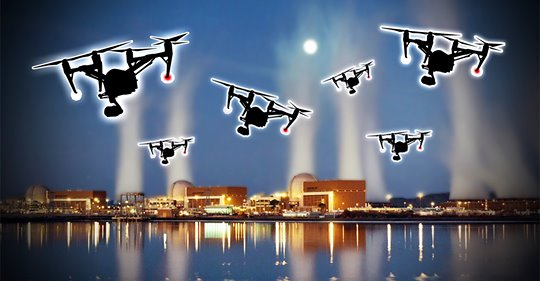
US, China Developing “Super Swarm” Drones With Destruction Power Equivalent To Nuclear Weapons, https://eurasiantimes.com/us-china-developing-super-swarm-drones-with-destruction-power-equivalent-to-nuclear-weapons/ August 28, 2020, EurAsian Times Global Desk
With the US and China leading the development of swarming drone capabilities, they are now looking at not just swarming techniques but also counter swarming tactics. Experts have argued that some drones that are under development are capable of sufficient destructive power to count as Weapons of Mass Destruction.
According to Isaac Kaminer, an engineering professor at the U.S. Naval Postgraduate School who is an expert in the subject of swarming and counter swarming tactics, large-scale adversarial swarms are already an imminent threat. He suggested that stopping a swarm is not simply a matter of driving enough missiles or bullets at it; instead, the swarm has to be outsmarted.
“A swarm with 10,000 or more drones must have extremely high levels of autonomy,” said consultant Zak Kallenborn talking to the Forbes. “No human being could handle the amount of information necessary to make decisions.“
Kaminer defines a ‘Super Swarm’ with large numbers and multiple modes like air, surface, and subsurface threats. The US Navy has already performed offensive swarm operations with its LOCUST drone swarm developed by Raytheon.
According to the developer of LOCUST drone swarm, dozens of small unmanned aircraft systems fly together, filling the sky. Some are collecting information. Some are identifying ground targets. Others might attack the same targets.
“They fly together like a flock of birds, tracking their positions and maintaining their relative positions in the air. Human operators are not needed for every flying drone; instead, they direct the flock as one.”
Currently, the drones are controlled remotely by humans which limits the capabilities both due to the demand for personnel and bandwidth restrictions. Only a few numbers can be used. However, if swarming algorithms are developed it would allow the drones to control itself and hence much larger number can be used increasing its lethality.
It works similar to a swarm of birds or insects. Every member adheres to the same rules to follow cohesion without colliding with each other. This will allow it to work without any central control.
David Hambling, who is also the author of ‘Swarm Troopers: How small drones will conquer the world’, wrote that such a swarm can be defeated by taking advantage of its internal rules – if these can be figured out.
“For example, an entire swarm whose members all have a collision-avoidance rule can be ‘herded’ by a few outsider drones or may be fooled into running into each other. If the members of the swarm are all programmed to attack what they see as the highest-value target in range, then they can all be decoyed into attacking the same dummy.”
The biggest challenge for the US comes from China who is also developing swarming capability as a means of asymmetric warfare, to counterpoise the US advantage in aircraft carriers. Last year, satellite images posted on the Chinese internet displayed a lineup of several drones including the Sharp Sword stealth drone and the Wing Loong Reaper.
Considering the fast pace of development of such technologies it is important to have international laws in place. “The opportunity to develop global norms and treaties around drone swarms and other autonomous weapons is now, “ says Kallenborn. “Collective limits on the number of armed drones in a swarm would reduce the risk to civilians and national security.”
The Chinese viewpoint on nuclear deterrence and cyberattacks
|
Nuclear deterrence needed to prevent cyberattacks from paralyzing China’s nuclear response https://www.globaltimes.cn/content/1198665.shtml
By Qin An Source: Global Times 2020/8/24 The US’ maximum pressure campaign against China now has extended to cyberspace. After the Trump administration’s ban of TikTok and the Clean Network program that aims at Chinese companies, news on Sunday said that TikTok plans to sue the Trump administration over its executive order banning the app. As the game goes viral, there are concerns about whether the US will launch a cyberattack against China. Will China and the US actually cut off the network connection between them?
Such concerns do not come from nowhere. In 2019 alone, there were three major cyberattacks related to the US. In March 2019, Venezuela’s national power grid collapsed. The country’s president denounced the attack as a well planned cyberattack by the US. This indicates that cyberwarfare has become a new mode of undeclared warfare – an invisible invasion of sorts. In June 2019, Trump announced retaliation against Iran with a cyberattack too. This showed that cyberwarfare has moved from the backstage to the front lines, from covert warfare to a declaration of war, and from auxiliary fighting to mainstream combat. On November 4, 2019, the US invited a number of countries to hold the first ever joint cyberattack and defense exercise with the island of Taiwan. It undertook cyberattack scenarios as a new approach to go beyond beach landings and targeting financial systems. It focused on persistent and chaotic destructive attacks on key infrastructure and economic systems. This indicates that the US has crossed the bottom line of the one-China principle in cyberspace. From late June to mid-July this year, some “mysterious explosions” occurred in Iran’s strategic facilities causing more than 100 casualties at power plants, nuclear facilities, chemical plants and ammunition depots. Cyber sabotage from Israel and the US were believed to be involved. This series of actions and events show that the US has not only the ability to paralyze a society through cyberattacks but also the proven will to do so. Will the US use this ability against China? It’s completely possible. But the two countries might not disconnect their network. Although US Secretary of State Mike Pompeo has listed the “clean networks,” the US’ are the ones who are the most unclean. At present, the Chinese enterprises subject to unilateral sanctions by the US are innocent, and their technologies and products are safe as well. The US is fully aware of this. Besides for the US, disconnecting the network with China will actually cut off the easy path to attack China. However, China must consider how to deal with “disconnection” and take primary precautions mainly in three aspects. First, it must strengthen the awareness of network crisis. With the advent of the internet age, the international structure is experiencing subversive changes. Sovereign states have entered into an era of “stabilizing and governing with big data.” The network’s characteristics have increasingly made this concept more prominent: The internet can be used to kill people and overthrow a country. Second, we must optimize the power structure. Cyberspace has become the fifth dimensional battlefield besides land, sea, sky and space. Although ordinary users form the frontline of defense in cyberspace, cyberwarfare cannot mainly rely on “militia.” The sustainable development of a “regular cyber army” has become an important option for the construction of a country powerful in cyberspace. Third, cyber deterrence needs to be showcased. China not only needs to be capable of launching counterattacks in cyberspace, but also must consider special situations in which other countries’ cyberattacks might affect our ability of a nuclear counterattack. We must keep nuclear deterrence to the cyberattacks that aim to paralyze our network. Russia’s latest updated nuclear deterrence strategy lists four conditions that would trigger its implementation of nuclear strikes. In one situation, if the attack undermines its nuclear force response actions, Russia would contemplate using nuclear weapons. Cyberattacks may lead to such situation, therefore Russia’s nuclear deterrence takes cyberattacks into consideration. The author is head of the Beijing-based Institute of China Cyberspace Strategy. opinion@globaltimes.com.cn |
|
UK relations with China at a low point; bad news for nuclear power projects
|
UK nuclear power: The next Huawei? DW, 21 Aug, 20Once a key part of the UK’s energy plans, nuclear power faces rising costs, cheaper renewables and domestic opposition. It also finds itself at the center of a row between London and Beijing that could prove fatal.
London’s relations with China — hailed as entering a “golden era” only four years ago — have deteriorated badly over Hong Kong, hitting a nadir when the UK finally bowed to US pressure to ditch Huawei’s involvement in its new-generation internet (5G) rollout. In late 2019, the US published a list of companies linked to the Chinese military, and after Huawei came the China General Nuclear Power Group (CGN). The state-owned Chinese firm has invested 3.8 billion pounds (€4.1 billion, $4.3 billion) in Britain to date, mainly in the Hinkley Point nuclear plant under construction in Somerset, southwest England, and the Sizewell plant in eastern England. It is also seeking UK regulatory approval to build its own nuclear reactor at Bradwell in Essex, east of London. China warned the UK it would face “consequences if it chooses to be a hostile partner” after London announced its Huawei’s decision. Liu Xiaoming, the Chinese ambassador to the UK, reportedly said China could cut its backing for UK nuclear plants altogether. Years of Chinese involvement in UK nuclear industryCGN’s involvement in the UK nuclear industry began in 2016 when a deal was signed with French state-owned utility Electricite de France (EdF) to collaborate on three reactors totaling 8.7 gigawatts (GW) of power generation, starting with Hinkley Point. The agreement spoke of CGN’s “progressive entry” into the UK’s “resurgent” nuclear ambitions. The UK currently has 15 operational nuclear reactors at seven locations. At its height in 1997, 26% of the country’s power was generated from nuclear, but this has slipped since to 19%. In the Sizewell and Hinkley projects, CGN is providing cash, holding 66% stakes, but with Bradwell it wants to build the reactor itself, using its own technology, and it wants to operate it. Observers say Bradwell is the prize CGN is really seeking: the first Chinese-built nuclear plant outside China. In May, EdF outlined its plans to start work on Sizewell by the end of next year. The project would create 25,000 jobs, it said. But EdF’s continued involvement could be thrown into doubt if no other investor came forward to replace CGN. This is especially troubling given the project is also expected to result in cost overrun. Hinkley Point now costs about 3 billion pounds more than the 20 billion pounds originally planned. Sizewell is also slated to cost 20 billion pounds. “Several projects were planned but only Hinkley Point will likely go ahead,” Jonathan Marshall, Energy and Climate Intelligence Unit (ECIU), told DW. “Bradwell would be a Chinese project, but is now unlikely for political reasons.” Bradwell looks surplus to requirements for the reasons the National Infrastructure Assessment (NIC), a government advisory body, outlined in its most recent long-term assessment: “Given the balance of cost and risk, a renewables-based system looks a safer bet at present than constructing multiple new nuclear power plants,” it read. Financing of nuclear plans unclear“Sizewell is not dependent on CGN investment,” a spokesman from the the Department for Business, Energy and Industrial Strategy (BEIS) said. But not many agree. “Equity funding for nuclear power stations is very difficult for private actors,” Rob Gross, director of the UK Energy Research Centre, told DW. The government’s offer in 2018 to Hitachi to take a third of the equity at the Wylfa nuclear project wasn’t enough to keep the company interested, for example. As Paul Dorfman of University College London’s energy institute and founder of the Nuclear Consulting Group told environmental news platform electrictyinfo.org, it was hard to see who else might invest in Sizewell if the Chinese pull out. “The market won’t touch nuclear with a barge pole. You only see nuclear being built in command-and-control economies, like China and Russia, and a few outliers,” he said. One option would be for the government to take either a majority or minority stake in Sizewell. Another option is a Regulated Asset Base (RAB) model, where consumers are charged a fixed price to cover infrastructure costs. But this would hike energy prices in the long term and make it politically hard to justify. …….https://www.dw.com/en/uk-nuclear-power-the-next-huawei/a-54631808 |
|
China feels India’s nuclear weapons programme driven by prestige: US report
China feels India’s nuclear weapons programme driven by prestige: US reportThe Carnegie report stressed China’s views on the issue are largely unknown
The Chinese state-run media continues to play up deployment of new artillery and other weapon systems near the border with India. However, despite the tension, references to nuclear weapons have been subdued in both nations.
A US think tank, the Carnegie Endowment for International Peace, on August 19 published a report on the Chinese perspective on nuclear weapons in the context of ties with India.
The Carnegies report noted while India’s perspectives on nuclear weapons are “relatively well documented,” China’s views on the issue are largely unknown.
The Carnegie report is based on interviews with “dozen Chinese academics, researchers, and military officers who work either on South Asia or on nuclear policy” and review of Chinese literature published in the last decade……..
Nukes for prestige?
On the issue of India’s nuclear weapons, the Chinese experts interviewed in the Carnegie report felt the systems are “for general deterrence and not for actual employment”……….
The experts interviewed in the Carnegie study felt a border conflict between India and China was unlikely to escalate into a nuclear exchange. Both India and China have declared ‘no first use’ of nuclear weapons.
………. The US factor
A point of concern expressed by the Chinese analysts was the possibility of India and the US strengthening strategic ties.
“While Chinese analysts largely dismiss India’s homegrown development of new military capabilities, they express concern about the prospect of US-India collaboration on defence projects. Chinese experts are particularly wary of US-India missile defence cooperation and the possibility that it could create a networked system. If such a system was to emerge, they would see India as a de facto security ally of the United States,” the Carnegie report noted. https://www.theweek.in/news/world/2020/08/19/china-feels-indias-nuclear-weapons-programme-driven-by-prestige-us-report.html
USA’s nuclear weapons – not the best way to protect Taiwan
|
Do US Nuclear Weapons Help Protect Taiwan?, Union of Concerned Scientists
GREGORY KULACKI, CHINA PROJECT MANAGER AND SENIOR ANALYST | AUGUST 17, 2020, In an earlier post I explained there is a risk the United States and China could go to war over Taiwan. The United States is prepared to use nuclear weapons to win that war. Some believe that helps protect Taiwan. But does it?
Shall we play a game?At the end of the 1983 movie War Games, a massive US Department of Defense computer plays out every possible nuclear war scenario looking for a way to win. All of them lead to the same dismal end; a global nuclear holocaust. The computer concludes nuclear war is “a strange game” where “the only winning move is not to play.” Six months after the movie was released, US President Ronald Reagan told a joint session of Congress, “A nuclear war cannot be won and should never be fought.” He repeated it many times afterwards, including in a speech at Fudan University in Shanghai. Unfortunately, US war gamers never let go of the idea that a nuclear war can be won, especially if the adversary is China. I can understand why. China has a few hundred nuclear weapons. The United States has thousands. The United States also has what are called tactical, non-strategic or low-yield nuclear weapons that China does not have. Some US officials argue if the United States used these low-yield nuclear weapons it would be difficult for China to retaliate without risking escalation to a full scale nuclear war: a war China would lose because its arsenal is so small. They seem to believe China would be unwilling to take that risk even though China has promised to retaliate if attacked with any type of nuclear weapon. Limited nuclear warThe reason the US war planners think about using nuclear weapons in a Taiwan war is because the United States might lose a conventional fight. They worry China’s conventional forces cannot be stopped without nuclear weapons. This isn’t a new concern. President Eisenhower faced a similar choice during the Taiwan Strait Crisis of the 1950s. …….
Past and prologueToday, the rapid deterioration of US-China relations, disturbing changes in Chinese policy towards Hong Kong and a provocative visit of a US official to Taiwan suggest a new crisis is brewing. As talk of a new Cold War with China increases, a careful look back at the old one may be helpful. ……..
history suggests more nations may be willing to support a US military effort to defend Taiwan if the United States took the option to start a nuclear war off the table. It may seem counterintuitive, but canceling plans to reintroduce US tactical nuclear weapons into Asia and declaring the United States would never use nuclear weapons first, under any circumstances, may be the best way to strengthen Taiwan’s defense. https://allthingsnuclear.org/gkulacki/do-us-nuclear-weapons-help-protect-taiwan
|
|
|
1 This Month

of the week – Shut Down Drone Warfare!


Tell the Ukrainian Government to Drop Prosecution of Peace Activist Yurii Sheliazhenko

Petition to revoke the licensing of the Near Surface Nuclear Disposal Facility (NSDF) at Chalk River. https://www.ourcommons.ca/petitions/en/Petition/Details?Petition=e-7247
To see nuclear-related stories in greater depth and intensity – go to https://nuclearinformation.wordpress.com
-
Archives
- April 2026 (68)
- March 2026 (251)
- February 2026 (268)
- January 2026 (308)
- December 2025 (358)
- November 2025 (359)
- October 2025 (376)
- September 2025 (257)
- August 2025 (319)
- July 2025 (230)
- June 2025 (348)
- May 2025 (261)
-
Categories
- 1
- 1 NUCLEAR ISSUES
- business and costs
- climate change
- culture and arts
- ENERGY
- environment
- health
- history
- indigenous issues
- Legal
- marketing of nuclear
- media
- opposition to nuclear
- PERSONAL STORIES
- politics
- politics international
- Religion and ethics
- safety
- secrets,lies and civil liberties
- spinbuster
- technology
- Uranium
- wastes
- weapons and war
- Women
- 2 WORLD
- ACTION
- AFRICA
- Atrocities
- AUSTRALIA
- Christina's notes
- Christina's themes
- culture and arts
- Events
- Fuk 2022
- Fuk 2023
- Fukushima 2017
- Fukushima 2018
- fukushima 2019
- Fukushima 2020
- Fukushima 2021
- general
- global warming
- Humour (God we need it)
- Nuclear
- RARE EARTHS
- Reference
- resources – print
- Resources -audiovicual
- Weekly Newsletter
- World
- World Nuclear
- YouTube
-
RSS
Entries RSS
Comments RSS
 nuclear-news