Why the US seeks War with China by 2025
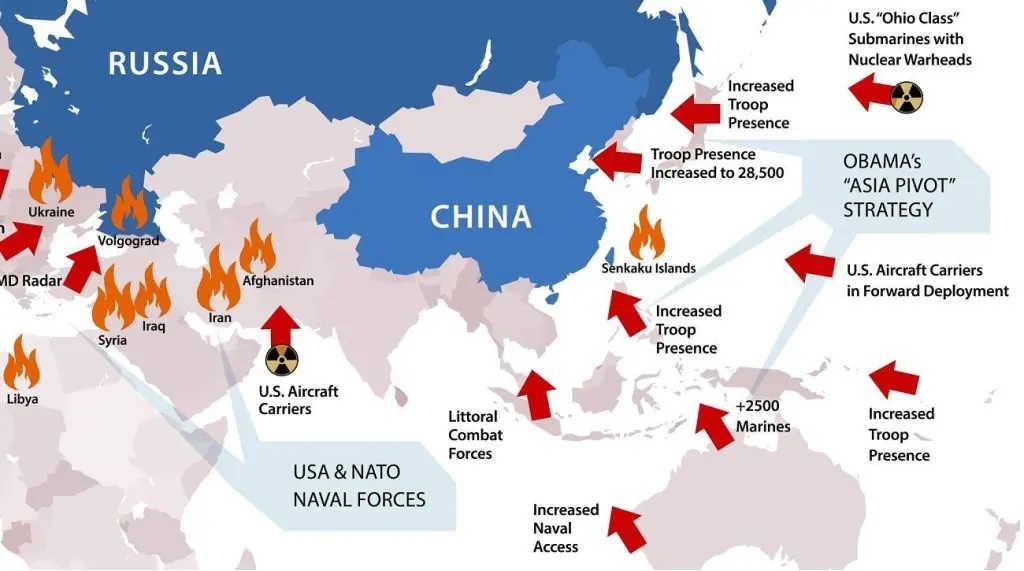
A clash between the United States and China over Taiwan would be the result of the United States willfully going to war with China over a matter the United States officially recognizes as China’s internal political affairs.
The current US State Department’s website regarding “U.S. Relations With Taiwan” admits that officially, “we do not support Taiwan independence.”

The US has also poured billions of dollars’ worth of weapons into Taiwan, just as the US did in Ukraine from 2014 onward. The weapons are clearly intended for a Ukraine-style proxy war with China
.
New Eastern Outlook, : Brian Berletic 8 Feb 23
In recent weeks there has been a build-up of talk regarding a US war with China. Not because of any actual provocation from Beijing, but instead because of a collective resignation to its supposed inevitability.
This is best illustrated by comments made by US Air Force General Michael Minihan. In TIME Magazine’s article, “U.S. General’s Prediction of War With China ‘in 2025’ Risks Turning Worst Fears Into Reality,” General Minihan is quoted as saying:
Worst of all is the small but growing presence of US military activity on Taiwan itself.
Even as the US State Department claims it does not support Taiwan independence, in 2021 Voice of America in its article, “US Nearly Doubled Military Personnel Stationed in Taiwan This Year,” admits that not only are there US troops on Taiwan, the number is increasing.
The article explains:……………………………
“My gut tells me we will fight in 2025.”
The article goes on to claim:
“I hope I am wrong,” Minihan, who heads the Air Force’s Air Mobility Command, wrote in an internal memo, which circulated on social media, to the leadership of its 110,000 members. Chinese President Xi Jinping, he explains, “secured his third term and set his war council in October 2022. Taiwan’s presidential elections are in 2024 and will offer Xi a reason. United States’ presidential elections are in 2024 and will offer Xi a distracted America. Xi’s team, reason, and opportunity are all aligned for 2025.”
Yet nothing General Minihan says explains why the United States itself would conceivably find itself at war with the United States. Instead, General Minihan is more or less admitting that the US will go to war with China over Chinese actions regarding Taiwan. In fact, the article goes on to admit:
Minihan’s comments are merely the most immediate of a worrying, emerging consensus that the U.S. and China are destined to clash over Taiwan, the self-ruling island of 23 million that Beijing claims as its sovereign territory.
A clash between the United States and China over Taiwan would be the result of the United States willfully going to war with China over a matter the United States officially recognizes as China’s internal political affairs.
The current US State Department’s website regarding “U.S. Relations With Taiwan” admits that officially, “we do not support Taiwan independence.”
If the US does not support Taiwan independence then by extension the US acknowledges Taiwan is not independent and therefore Washington, officially, recognizes Beijing’s sovereignty over Taiwan. This is what defines the “One China” policy Washington and virtually every other nation on Earth has agreed to in order to establish diplomatic relations with the People’s Republic of China in Beijing.
At a time when Washington regularly lectures Moscow about “violating sovereignty,” Washington’s stance toward Beijing and Taiwan should be a simple matter of respecting Chinese sovereignty. Yet it is not because of the double-game the United States plays both internationally and with China specifically.
Washington’s Deliberate Provocations
TIME Magazine and other Western media publications attempt to depict Beijing as the aggressor, omitting any discussion of either the “One China” policy or the US State Department’s own official declaration of supposedly upholding it.
Instead, Western audiences are led to believe that Taiwan somehow is independent and that Beijing is “bullying” it. The inevitable clash between the US and China is supposedly driven by America’s desire to “stand up” for Taiwan and its inferred sovereignty. In reality, a potential clash between the US and China would be the result of Washington once again violating the sovereignty of another nation thousands of miles from its own shores.
Washington’s double game of officially recognizing Chinese sovereignty over Taiwan while openly and deliberately trampling that sovereignty is best illustrated by former US Speaker of the House Nancy Pelosi’s visit to Taiwan utilizing an official US Air Force aircraft against the protests of Beijing. Pelosi’s trip to Taiwan is only one of many made by US representatives who openly use visits like this in an attempt to goad Beijing……….
Looking at any map of US military deployments in the “Indo-Pacific” region reveals China as virtually surrounded by the US military by way of South Korea, mainland Japan, Okinawa, and with new basing agreements in the works with Manila, potentially the Philippines as well.
This puts US troops, naval assets, and hundreds of warplanes within striking distance of China, including Taiwan from north, east, and potentially the south.
The US has also poured billions of dollars’ worth of weapons into Taiwan, just as the US did in Ukraine from 2014 onward. The weapons are clearly intended for a Ukraine-style proxy war with China.
Worst of all is the small but growing presence of US military activity on Taiwan itself.
Even as the US State Department claims it does not support Taiwan independence, in 2021 Voice of America in its article, “US Nearly Doubled Military Personnel Stationed in Taiwan This Year,” admits that not only are there US troops on Taiwan, the number is increasing.
The article explains:………………………………….
One could only imagine the reaction in Washington if Beijing and a government in, say San Juan, revealed the presence of Chinese forces in Puerto Rico. Yet as is the case in many instances regarding international relations, American “exceptionalism” not only absolves the US from any penalty for blatant violations of another nation’s sovereignty, it transfers the blame to the nation being targeted itself, in this case, China.
Why US War with China by 2025?
Despite serial provocations, Beijing has exercised exemplary patience and restraint. China has invested heavily in its military and is indeed preparing for conflict with the United States, not because it seeks to wage war with the United States but because the United States has placed its military on China’s doorstep, very clearly seeking war with China.
Taiwan’s full reintegration with the rest of China is inevitable. Already its economy is heavily dependent on access to markets across the rest of China. Harvard University’s Atlas of Economic Complexity reveals that nearly 50% of all exports from Taiwan go to the rest of China. The rest of China also accounts for the largest amount of imports to the island. Many of these imports are crucial inputs for Taiwan’s semiconductor and electronic component production which constitutes, by far, Taiwan’s largest industry.
Only through Washington’s persistent and extensive interference in Taiwan’s local political affairs has gradual reintegration been suspended. Before the US-backed Democratic Progressive Party (DPP) came to power in 2016, the incumbent Kuomintang (KMT) party was on track to sign a trade agreement with the mainland that would have increased already extensive economic integration even further.
Ironically, as the US captured Ukraine politically in 2014, it was also backing opposition protests in Taiwan dubbed the “Sunflower Movement,” paving the way for the DPP’s ascent into power 2 years later. Just like the US-installed client regime in Kiev, the DPP immediately set a course for self-destruction, irrationally rolling back ties with the mainland at the expense of the people living on Taiwan.
More recently, local elections in Taiwan saw the DPP fare poorly, serving as an unofficial referendum rejecting the DPP’s separatist platform, the damage it has consistently done to the local economy, and the instability it has created across the strait with the mainland. However, just as was the case in Ukraine where public sentiment sought peace, Washington and its client regime have every intention of overriding that sentiment in Taiwan, and pushing the island closer still to yet another US-engineered proxy war.
It is clear that it is not China rushing for war with the United States, but precisely the other way around. Time, economics, and proximity favor China. In 10 years, China will be economically and militarily stronger while the US will continue its slow decline. At that point the window of opportunity will have closed for the United States to wage any type of military conflict with China and obtain anything close to resembling “victory.”
Some could argue that the window has already closed.
The Center for Strategic and International Studies (CSIS) recently published the outcome of “wargames” regarding a theoretical Chinese “invasion” of Taiwan in a paper titled, “The First Battle of the Next War: Wargaming a Chinese Invasion of Taiwan.”The paper concludes:
In most scenarios, the United States/Taiwan/Japan defeated a conventional amphibious invasion by China and maintained an autonomous Taiwan. However, this defense came at high cost. The United States and its allies lost dozens of ships, hundreds of aircraft, and tens of thousands of servicemembers. Taiwan saw its economy devastated. Further, the high losses damaged the U.S. global position for many years.
Regarding China, it says:
China also lost heavily, and failure to occupy Taiwan might destabilize Chinese Communist Party rule. Victory is therefore not enough. The United States needs to strengthen deterrence immediately.
In essence, the US will suffer unprecedented military losses and Taiwan itself will be scoured clean of its industry and infrastructure. While CSIS claims that the Chinese amphibious landing was successfully foiled in its wargames thus preserving Taiwan’s political existence, the cost is Taiwan’s physical existence.
Both the CSIS paper together with public comments made by the Pentagon about their own classified wargames indicate disparity between the US and China militarily is narrowing quickly. If there is to be a conflict between the US and China, the sooner it takes place the better chance the US has of achieving a favorable outcome. It is therefore the US racing eagerly toward war, not China. China’s military posture reflects the close proximity of US forces to Chinese territory and their obvious intent to menace China in its own territory, not a China expanding its military capabilities to threaten the United States. In fact, the CSIS paper made a specific note about China’s ability to attack the US “homeland.”
The paper claims:
Because the United States will be striking the Chinese homeland, the base case assumes that the U.S. homeland is not a sanctuary. However, the ability of the Chinese to conduct strikes against the U.S. homeland and thereby affect operations in the Western Pacific is extremely limited. A few special forces might infiltrate and attack a small number of high-value targets but not enough to materially affect military operations in the Western Pacific.
Thus, even in a war between the US and China where the US is conducting strikes on Chinese territory, CSIS admits that China has very limited means to likewise strike at the US. This reveals that US policymakers are not concerned about any real threat China poses to the US, but instead to US “interests” thousands of miles from its own shores and, in fact, within the sovereign territory of China itself.
Potential war between the US and China, if it takes place, will merely be the most recent example of US military aggression in pursuit of global hegemony targeting and attempting to undermine another nation’s sovereignty in violation of international law, not as a means to uphold it. As the US often does, the lead up to this potential war sees the US projecting its own menace toward international law, peace and stability onto the very target of US military aggression, in this case China.
Brian Berletic is a Bangkok-based geopolitical researcher and writer, especially for the online magazine “New Eastern Outlook”.
Checking Back in on China’s Nuclear Icebreaker
Over four years after the project was announced, updates remain scarce on China’s first nuclear icebreaker.
The Diplomat, By Trym Eiterjord 13 Feb 23
In 2018, it became known that the state-owned China National Nuclear Corporation (CNNC) was embarking on a project to develop nuclear-powered icebreakers…………….
Over four years later, information about the project remains scarce, but a handful of patents recently filed by engineers at the CNNC Marine subsidiary would seem to indicate that development is moving forward. The content of these patents may give some insight into what is potentially China’s first nuclear-powered surface vessel.
The patents filed so far are concerned mainly with nuclear engineering. ……………………
Finally, the new subsidiary has filed a patent titled simply “A nuclear-powered icebreaker,”………………..
This is more or less the extent of new information to have come out since the project was first revealed in 2018……………………………….
The People’s Liberation Army Navy has also seemingly become interested in nuclear propulsion for polar-going icebreakers…………………….. more https://thediplomat.com/2023/02/checking-back-in-on-chinas-nuclear-icebreaker/
China’s spy balloon can help deflate US nuclear tensions with Beijing
Defense News, By David Gompert and Hans Binnendijk 8 Feb 23
The row over China’s surveillance balloon could, once the dust settles, present a chance to begin lessening the risk of nuclear war between the two superpowers.
While the United States is right to charge China with violating its airspace in an apparent attempt to spy on America’s strategic missile systems in Montana, this episode reminds us that the two nations have no mechanism to exchange views and clear up misconceptions on the purpose of their respective nuclear arsenal.
Consequently, suspicions abound.
It is understandable that this infamous spy balloon has riled up the American body politic. Yet, it is important to keep the strategic situation in mind. The United States and China are in a stable state of mutual deterrence, meaning that neither power could launch a nuclear first strike on the other without inviting devastating retaliation. That said, the greater the mutual suspicions about intent, the greater the danger that this stability could fail.
The absence of a way to build mutual confidence between the United States and China regarding nuclear weapons and nuclear war is potentially dangerous. The United States is unsure what to make of China’s build-up of its nuclear arsenal, and China is fearful that the United States seeks the capability to deny China a credible deterrent. What makes this situation increasingly perilous are the rising tensions in Sino-U.S. relations in the Pacific and the growing risks of escalating crises and even war there.
In an article in the journal Survival to be published soon, we spell out the case and agenda for a process whereby the superpowers could clarify why they have nuclear weapons and the doctrines governing their use.
Specifically, we recommend direct and candid bilateral strategic stability talks on nuclear doctrines, forces, intentions, and worries. This would be coupled with confidence-building measures such as providing prior notifications of missile testing, clarifying the purpose of new weapons, and managing disconcerting intelligence.
This could reduce suspicions, such as Chinese fears that the United States aspires to have a first-strike capability and American fears that China will relentlessly expand its capability to target U.S. deterrent forces. Each nation would of course continue independent intelligence-gathering. But “worst-case” interpretation of intelligence could be mitigated by dialogue.
These strategic stability talks might include implementing a bold concept: a bilateral US-Chinese pledge not to use nuclear weapons first against each other or against the other nation’s treaty allies……………………………. more https://www.defensenews.com/opinion/commentary/2023/02/07/chinas-spy-balloon-can-help-deflate-us-nuclear-tensions-with-beijing/
Renewables In China Trend Upward While Nuclear Trends Flat.

The blue line at the bottom is nuclear, and not particularly sharp eyes will note that it’s trending to flat. The red line at the top is wind, water, and solar cumulative additions to annual TWh of electricity flowing into China’s grid, and not particularly sharp eyes will note it’s curving upwards.
The natural experiment of renewables vs nuclear continues in China, and it continues to unfold in renewables’ favor.
Clean Technica, ByMichael Barnard, 7 Feb 23,
I’ve been publishing assessments of the poor performance of nuclear compared to wind and solar in China for years (2014, 2019, 2021, 2022). My premise nine years ago was a first principles assertion with limited empirical results that wind and solar would radically outstrip nuclear in China. Why? Modularity reducing long-tailed risks, as Professor Bent Flyvbjerg, global expert and go to person for megaprojects, puts it in his new book How Big Things Get Done, where he includes my assessment of the natural experiment.
Subsequent assessments found that was true. Every year, the combination of wind and solar, and usually both individually, outstripped new nuclear generation, both in raw nameplate capacity and in additional TWh of annual generation. But as Professor Mark Z. Jacobson likes to remind us, it’s not WS, it’s WWS, that is wind, water, and solar. And so, today I spent a bit of time looking at hydroelectric generation capacity additions around the world since 2000, which turned out to be almost entirely in China. Of the 132.5 GW of new big hydroelectric projects connected to the grid in the world since 2000, 113 GW were in China. Unsurprising to anyone paying the slightest attention, but still, big numbers.
But what does that mean when added to wind and solar and compared to nuclear, leveraging the 2010 to 2022 data set I already had?…………………………………….
there is an interesting question about all forms of electrical generation, which is what capacity factors they are operating at. China’s wind and solar were historically curtailed by transmission connection challenges, which have been being resolved every year. Last year’s bumper crop of offshore wind, of course, were connected with HVDC to the grid without challenges.
What about hydro? It has different challenges for capacity factors, typically having a spring spate with often far too much water to use for generation, and a fall lull where generation is low. In the case of China, the best data I have at present is from the International Hydropower Association (IHA) which lists 1,355 TWh of electrical generation from 370,160 MW of capacity in 2020. That’s a 42% capacity factor, which I used for the generation.
I was somewhat surprised by this, and would be interested in better data, should anyone have some at hand. What it does mean is that while nuclear added a total of about 243 TWh of net new electrical generation from 2010 through 2022, hydro only added about 229 TWh of new generation. It was an interesting result which I’ll spend a little time assessing in a bit. Of course, wind energy added about 711 TWh of new generation annually over that period and solar added about 474 TWh. Both outstripped nuclear and hydro.
For purposes of wind, solar, and nuclear, I’d been simply presenting the new TWh of generation added each year. But in adding water to the data set, it seemed reasonable to make it cumulative.
In the graph above , the blue line at the bottom is nuclear, and not particularly sharp eyes will note that it’s trending to flat. The red line at the top is wind, water, and solar cumulative additions to annual TWh of electricity flowing into China’s grid, and not particularly sharp eyes will note it’s curving upwards.
Poking at the disparity between additions of actual TWh by renewable generation source a bit more, there are a few things to note.
The first, of course, is that wind and solar siting is much simpler than major hydroelectric siting. They just need flattish areas with good wind and sun, and wind likes ridge lines where flat bits can be made. Big hydro needs a big river with a reasonably significant drop along its length and at least one place where it’s carved a big valley. Meandering rivers like the Mississippi need not apply, although they are much better for inland shipping. The combination means that it’s typically easier to get materials and workers for wind and solar farms to the sites, easier to move construction vehicles around them and the like.
And hydroelectric reservoirs have another reality: you can’t live or work where they are. Unlike solar farms which can simply be built around existing buildings or roads, or wind farms where turbines can be built in the non-productive corners of farm fields, hydroelectric reservoirs displace everybody and everything where they exist. …………………………………
Still, China has managed to construct and attach 16 of them [hydro-electric dams] to the grid since 2000. I was aware of the Three Gorges Dam, of course, but was unaware that it was a small portion of the hydroelectric China had constructed. And while each project’s cost and schedule results vs plans are unavailable, China did succeed in building them.
The natural experiment of renewables vs nuclear continues in China, and it continues to unfold in renewables’ favor. https://cleantechnica.com/2023/02/06/renewables-in-china-trend-upward-while-nuclear-trends-flat/
China expresses dissatisfaction and protest over US shooting down civilian airship; US sets bad precedent
The Pentagon earlier said on Friday that the balloon did not pose a “military or physical” threat.
It’s widely known that US aircraft, appearing in civilian or military purposes, operate around China much more frequent than Chinese aircraft do around the US
Global Times, By Chen Qingqing and Liu Xuanzun, Feb 05, 2023
China expressed strong dissatisfaction and protest on Sunday against the US’ move to shoot down a non-threatening Chinese airship for civilian use, calling the US’ move an overreaction and vowing to reserve the right to take necessary actions. By turning an unintentional accident into an incident that has been hyped by the US officials and media, Washington is adding new uncertainties into the already-intense relations with China, creating a bad precedent for blurring the line between civilian and military uses, experts said.
The Chinese Foreign Ministry expressed strong dissatisfaction and protested against the US’ use of force to shoot down a Chinese civilian unmanned airship, urging the US to properly handle the incident.
The Chinese side has verified the situation and communicated with the US side multiple times, saying the unintended entry of the airship into US airspace was due to force majeure and the incident was totally an accident, the ministry said.
The US military on Saturday local time shot down a “suspected Chinese spy balloon” off the Carolina coast following an authorization of the Biden administration after the airship has been flying over the US for days. The action was hailed by the US President Joe Biden as “a success,” according to US media reports.
The “balloon episode” went viral on the US social media. A number of US hawks on China-related matters have been hyping the use of balloon for spying purpose and deliberately distorted it as “a direct assault on the US national sovereignty.”
“The US attack on Chinese civilian unmanned airship by force is an obvious overreaction,” Senior Colonel Tan Kefei, a spokesperson at China’s Ministry of National Defense, said in a statement on Sunday.
China will reserve the right to take necessary measures in dealing with similar situations, Tan said.
Tan’s remarks mean that if a foreign airship accidentally enters the Chinese airspace, the Chinese forces could also shoot it down in a similar manner, observers said.
Biden was first briefed on the balloon Tuesday and has been receiving updates from his national security team, CNN said. The Pentagon earlier said on Friday that the balloon did not pose a “military or physical” threat………………………………………….
Overreaction, bad precedent
The US shooting down the Chinese civilian balloon is also considered an overreaction from a technical point of view, said military aviation experts.
Despite admitting that the balloon did not pose a military or physical threat, an F-22 fighter of the US Air Force fired an AIM-9X air-to-air missile and shot down the balloon, supported by F-15 fighters, tankers and warships, the Pentagon said on the day on its website.
The missile was fired from the F-22 from an altitude of 58,000 feet (17,678 meters) when the balloon was 60,000 and 65,000 feet, the Pentagon said.
This is like shooting a mosquito with a cannon, which is not only overreacting but also impractical, a Chinese military expert who requested anonymity told the Global Times on Sunday.
Compared with an unmanned balloon that flies with the wind, the US interception method that featured an advanced stealth fighter jet and fired a missile is too costly………………………………….
It’s widely known that US aircraft, appearing in civilian or military purposes, operate around China much more frequent than Chinese aircraft do around the US, Lü noted. …………
more https://www.globaltimes.cn/page/202302/1284857.shtml
China marketing nuclear reactors to Pakistan
Pakistani Prime Minister Shehbaz Sharif has inaugurated the third unit of
the Karachi Nuclear Power Plant (KANUPP), which has 1.1GW of power
generating capacity. Built with an investment of $2.7bn, the K-3 nuclear
unit is expected to ease Pakistan’s ongoing energy crisis, according to
Bloomberg.
It is the second Chinese-designed Hualong One reactor to be
deployed at KANUPP, having been built with the Chinese Government’s
assistance under the China-Pakistan Economic Corridor (CPEC) initiative. At
the inauguration ceremony, Prime Minister Sharif said Pakistan ‘badly
needs’ clean and cheap sources of energy, be they nuclear, hydropower or
other renewables.
Power Technology 3rd Feb 2023
https://www.power-technology.com/news/pakistan-karachi-nuclear-power-plant/
China objects to more nuclear sub talks among UK, U.S, Australia
BEIJING, Feb 3 (Reuters) – China “firmly objects” to further cooperation between Britain, U.S. and Australia on nuclear submarines, its foreign ministry said in a regular briefing on Friday.
Chinese foreign ministry spokesperson Mao Ning said, “China is gravely concerned about this and firmly objects to it,” in response to a question that cited a media report saying British Prime Minister Rishi Sunak’s visit to the United States in March may yield announcements on more nuclear submarine cooperation…………. Reporting by Yew Lun Tian and Joe Cash ; Writing by Liz Lee; Editing by Christian Schmollinger https://www.reuters.com/world/china-objects-more-nuclear-sub-talks-among-uk-us-australia-2023-02-03/
Can Talks with China about Nuclear Weapons Be Constructive?
January 26, 2023 Gregory Kulacki https://blog.ucsusa.org/gregory-kulacki/can-talks-with-china-about-nuclear-weapons-be-constructive/
Politico reported US Secretary of State Antony Blinken is “under pressure” to “raise administration concerns” about the size of China’s nuclear arsenal when he travels to Beijing in early February.
Constructive conversations on nuclear weapons policy are urgently needed. Both governments are upgrading their nuclear capabilities. Chinese military planners worry about US preparations to use nuclear weapons first to forestall defeat in a conventional war, as well as US efforts to undermine China’s ability to retaliate. US military planners are concerned about the construction of new Chinese missile silos, which will significantly increase the probability and magnitude of Chinese nuclear retaliation if the United States uses nuclear weapons first.
The nuclear aspect of what some US observers describe as a new Cold War with China is different than the US nuclear contest with the Soviet Union. It’s not about numbers. Chinese leaders don’t express interest in numerical parity. President Biden’s remarks on China’s nuclear weapons policy suggest he thinks they do. That’s unfortunate. If a desired outcome of Blinken’s visit is to start a dialogue on nuclear weapons, he will need to focus less on the numbers and more on why Chinese leaders built the silos.
What Chinese leaders want – what they have wanted since they decided to develop nuclear weapons in 1955 – is to be able to use conventional military force without undue concern the United States will use nuclear weapons to stop them. Being able to credibly threaten to use nuclear weapons to prevent or defeat Chinese conventional military initiatives has been a cornerstone of US defense policy in East Asia since the Korean War.
Chinese efforts to negate US first use threats are an important part of Chinese nuclear strategy. Chinese leaders believe if they can convince US decision-makers they will retaliate, then they can safely ignore US threats to use nuclear weapons first.
Chinese military planners have always been concerned their comparatively small nuclear force could tempt US decision makers to try to wipe it out at the beginning of a war. Continued US investment in ballistic missile defense creates additional doubt about US respect for China’s ability to retaliate.
The bulk of China’s current nuclear force consists of missiles launched from trucks. Recent technological advances increase the possibility the United States could destroy or disable those missiles with conventional munitions. Switching to silos makes that far less likely.
Current US projections of a large increase in the size of China’s nuclear force assume the new silos are an addition, not a replacement. They also assume everyone of those silos will contain a new missile and every one of those missiles will carry multiple warheads. But China does not need that many warheads to achieve its strategic objective. Even if the silos sit empty, US military planners must assume they’re not, and US decision-makers must assume China can retaliate if the United States uses nuclear weapons first.
If Secretary Blinken’s only objective is to talk about numbers, his Chinese interlocutor can tell China’s leaders their decision to build the silos was a strategic success. It is hard to see how that makes the United States or its Asian allies safer.
It would be wiser if Blinken said the United States no longer needs to threaten to use nuclear weapons first to keep the peace. Instead of handing Chinese leaders a strategic victory, he would convey a surprising US confidence in its conventional forces. That’s more likely to restrain Chinese leaders than what they continue to see as empty US threats to start a nuclear war; threats revolutionary leader Mao Zedong famously described as a “paper tiger.”
As paradoxical as it may seem to a US strategic culture obsessed with size, forgoing the option to use nuclear weapons first may be the best way to get Chinese leaders to respect the ability of the United States to defend its allies, and to begin a constructive conversation about nuclear weapons.
China deploys ships and jets near Taiwan — Taipei
The move comes hours after US warships sailed past the self-governed island
https://www.rt.com/news/561681-taiwan-china-strait-tensions/ 28 Aug22,
A sizable group of Chinese military vessels and aircraft has been detected around Taiwan amid heightened tensions in the region, the self-governed island’s Defense Ministry claimed on Sunday.
According to the ministry, eight Chinese Navy vessels and 23 aircraft were detected in Taiwan’s vicinity. Ten planes, it stated, “had flown on the east part of the median line of the Taiwan Strait,” which in practice serves as an unofficial barrier between mainland China and the island.
The Taiwanese military added that local combat air patrol has been given relevant instructions, and that Beijing’s activities are being closely monitored.
The apparent Chinese deployment comes a day after the US sent two warships to the Taiwan Strait, in what the Navy called a “routine” transit mission, meant to “demonstrate the United States’ commitment to a free and open Indo-Pacific.”
Beijing responded by putting its military on high alert and signaling its readiness “to stop any provocations in a timely manner.” Earlier, China also castigated the US, branding it “the destroyer of peace and stability in the Taiwan Strait.”
Tensions in the region have been running high since the controversial visit by US House Speaker Nancy Pelosi to Taipei in early August, which sent relations between Washington and Beijing into a tailspin and triggered a flurry of Chinese military activity in the area. At the time, Chinese Defense Ministry said it had conducted drills simulating a “blockade” of the island, as well as amphibious assaults and the striking of ground targets.
Beijing considers the self-governing island its own territory, and views visits by high-ranking US officials as attacks on its sovereignty and a violation of the ‘One China’ principle. The Taiwan Strait, which separates the self-governed island from mainland China, has been a source of military tension since 1949, when Chinese nationalists fled to the island after losing the Civil War to the Communists.
The Chinese non-threat
China relies on something called soft power discovered by the Chinese long before the rest of us.
https://johnmenadue.com/the-chinese-non-threat/ Pearls and Irritations, By Gregory Clark, Aug 23, 2022
Our resident non-Chinese speaking, non-Chinese informed but bitterly ‘China is expansionist-aggressive’ commentators in the mainstream media in Australia don’t have,or even want to have, any idea about China.
China is accused of aggressive expansionism, over Taiwan and towards its neighbours in general.
It is a curious charge. Almost all of the 178 nations recognising China have formally recognised that legally Taiwan belongs to China. In the recently proclaimed ‘rules based international order’ such formal recognition by so many nations would seem to have some weight.
Yet Beijing has still done little to claim this promised recognition. On the contrary, it still accepts Taiwan’s control over a number of islands in the South China Sea, including some occupied by the Taiwan military a stone’s throw from China’s coast.
Nor is it only Taiwan that enjoys Beijing’s territorial tolerance.
It has done nothing to follow up on China’s strong historical clam to much of Russia’s Far East. Even at the height of China’s strong tensions with Moscow in the 1960’s and ’70’s it barely moved despite constant invitations to do so by Western hawks.
(Taiwan too had criticised Beijing’s inaction).
Amazingly Beijing has done nothing to try to dominate, let alone attack, the vast areas of a Mongolia with rich resources needed by China and with only 3 million people to defend its 4,600 kilometre with China (Taiwan insists Mongolia is China’s territory and strongly criticises Beijing’s inaction.)
The same is true for Kazakstan, Kyrgyzstan, Tajikistan and Afghanistan, central Asian nations which border China and have at times harboured militants that have attacked into China.(Taiwan again criticises Beijing’s inaction.)
Moving down to Pakistan and India, we find Beijing has tolerated borders (the MacMahon Line and in much of Ladakh) imposed by aggressive19th century UK colonial advances far into China’s then nominally controlled, Tibetan-populated Himalayan territories.
True, there have since been disputes with India which took over from the British the large Tibetan populated areas in northern Assam and Ladakh, and wants more. Only when the Indians under Nehru’s forward policy went too far and moved into Tibet across even the UK arbitrarily imposed MacMahon Line did Beijing finally take action.
Even then, and having taught the Indians a lesson, it retreated to the MacMahon Line (a retreat which Taiwan protested, of course).
(As China desk officer in Canberra at the time I know for a fact that the first dispute in 1962 was due to India trying illegally to seize territory north of the MacMahon Line.The Chinese gave us the maps to prove it. The Indians gave nothing.)
Moving further east we find that Beijing, unlike Taiwan, accepts a border with Myanmar that allows Kokang, a large Mandarin Chinese speaking community, to remain in eastern Myanmar. (Taiwan objects to Beijing’s generosity, of course.)
Beijing did nothing to support the many pro-Beijing, Chinese speakers in Sarawak, fighting a losing battle with British and Australian troops while seeking to prevent their 1960’s forcible incorporation into the artificial construct of Malaysia.
Beijing did nothing to maintain the now disappeared 2,000 year colony of Chinese in western Borneo – the Laifang Republic. And as we know tragically it did nothing to protect the one million Chinese and leftwing Indonesian massacred in 1958. Nor did it try to protect resident Chinese from subsequent brutal Indonesian pogroms there .
And finally we come to the alleged Chinese claims against sone minuscule Japanese claimed islands -the Senkaku Islands – in the east China sea. The claims were in fact made by Taiwan, not China; they are supported by China. The islands have no Japanese name; they were discovered and named by Chinese and British explorers. Geographically they are part of Taiwan and lie on the Chinese continental shelf.
Even the US does not recognise Japanese sovereignty.
One wonders whether our resident non-Chinese speaking, non-Chinese informed but bitterly ‘China is expansionist-aggressive’ commentators in the mainstream media have, or even want to have, any idea of any of these details.
By comparison, while China has been doing little in recent decades, the US was quickly trying to take over by force large territories of France, Mexico, Spain (including the Philippines) and even Canada plus a host of islands belonging to other people in both the Atlantic and the Pacific.
In shameful collusion with the UK the US expelled the population of the Diego Garcia island and used it for the bombing of much of the Middle East.
China’s long acceptance of British and Portuguese colonies on its border (India was far less tolerant), its delay in taking over Taiwan (a right granted by every nation recognising Beijing, including the US and Australia), its toleration of Taiwan still occupying militarily the Offshore Islands etc suggests almost a dislike of military action.
Instead it relies on something called soft power discovered by the Chinese long before the rest of us. Convinced of the attractiveness of its culture it long believed with it can automatically draw people to its side without force of arms.
That was before it came up against us militaristic Westerners, happy to invade China and vandalistically destroy the symbols of that culture.
GREGORY CLARK
Gregory Clark began his career in Australia’s Department of External Affairs, with postings to Hong Kong and Moscow. Resigning in 1964 to protest at Australia’s participation in the Vietnam War he moved to Japan, becoming emeritus president of Tama University in Tokyo and vice-president of the pioneering Akita International University. He continues to live in Japan and has established himself as a commentator/academic. Between 1969-74 he was correspondent for The Australian in Tokyo.
More on http://www.gregoryclark.net
China’s record-breaking heatwave, threatening water resources

The southwestern Chinese regions of Chonqging and Sichuan were battling
fires on Tuesday as they awaited a long-anticipated drop in temperatures
over the next week, but the country’s important autumn harvest remained
under serious threat. Officials warned this month that temperatures were
rising faster in China than in the rest of the world and a record-breaking
heatwave has raised concern about its ability to adapt to rapid climate
change and conserve already scarce water resources.
Reuters 23rd Aug 2022
The only thing keeping US and China from war is running dangerously thin
Washington’s ambiguous Taiwan policies are edging towards conflict, but Beijing wants to exhaust peaceful options first.
A US policy at war with itself
What emerges from this amalgam of policy statements and positions is a US policy that is inherently at war with itself, unable to fully commit either to the finality of a “one China” policy or walk away from the sale of weapons to Taiwan. The US disguises this inherent inconsistency by referring to it as “strategic ambiguity.” The problem is this policy stew is neither strategic in vision, nor ambiguous.
radical departure from stated US policy by the Biden administration helped launch a Congressional trifecta of hubris-laced ignorance, which saw the dispatch of three consecutive delegations that threaten to propel China down the path toward a war with Taiwan it doesn’t want to wage, and which the world (including the US) is not prepared to suffer the consequences of.
Despite the clear evidence of a marked departure [by USA] from past policy regarding Taiwan and weapons sales, China continues to believe that there is a non-violent solution to the one China problem.
https://www.rt.com/news/561182-china-taiwan-us-war/ Scott Ritter, 22 Aug 22,
American relations with China in regards to Taiwan have been dictated by years of ambiguous statements and commitments. Now this rhetoric is breaking down and armed conflict seems closer than ever – but is Washington ready to fight over Taiwan, or capable of winning?
Assurances and commitments
Officially, US policy toward Taiwan is guided by three US-China Joint Communiques issued between 1972 and 1982, the Taiwan Relations Act of 1979, and the so-called “Six Assurances” issued in 1982. In the Shanghai Communique of 1972, China asserted that “the Taiwan question is the crucial question obstructing the normalization of relations between China and the United States,” declaring that “the Government of the People’s Republic of China is the sole legal government of China,” that Taiwan is a province of China, and that “the liberation of Taiwan is China’s internal affair in which no other country has the right to interfere.”
The US responded by acknowledging that “all Chinese on either side of the Taiwan Strait maintain there is but one China and that Taiwan is a part of China,” something the US government did not challenge. The US also reaffirmed its interest “in a peaceful settlement of the Taiwan question by the Chinese themselves.”
Before that, on January 1, 1979, the US and China had issued a “Joint Communique of the Establishment of Diplomatic Relations” in which the US undertook to recognize “the Government of the People’s Republic of China as the sole legal Government of China,” noting that, within the context of that commitment, “the people of the United States will maintain cultural, commercial, and other unofficial relations with the people of Taiwan.”
President Jimmy Carter, in announcing the communique, went out of his way to ensure the people of Taiwan “that normalization of relations between our country and the People’s Republic will not jeopardize the well-being of the people of Taiwan,” adding that “the people of our country will maintain our current commercial, cultural, trade, and other relations with Taiwan through nongovernmental means.”
Carter’s move to establish diplomatic relations with China did not sit well with many members of Congress, who responded by passing the Taiwan Relations Act of 1979, in which it was declared that it is US policy “to preserve and promote extensive, close, and friendly commercial, cultural, and other relations between the people of the United States and the people on Taiwan, as well as the people on the China mainland,” and “to make clear that the United States decision to establish diplomatic relations with the People’s Republic of China rests upon the expectation that the future of Taiwan will be determined by peaceful means.”
In this regard, the Taiwan Relations Act underscored that the US would “consider any effort to determine the future of Taiwan by other than peaceful means, including by boycotts or embargoes, a threat to the peace and security of the Western Pacific area and of grave concern to the United States,” and “to provide Taiwan with arms of a defensive character.” Finally, the Act declared that the US would maintain the capacity “to resist any resort to force or other forms of coercion that would jeopardize the security, or the social or economic system, of the people on Taiwan.”
The emphasis on arms sales contained in the Taiwan Relations Act led to the third joint communiqué between the US and China, released on August 17, 1982, which sought to settle differences between the two nations regarding US arms sales to Taiwan. The communique was basically a quid-pro-quo agreement where China underscored that it maintained “a fundamental policy of striving for a peaceful reunification” with Taiwan, over which it claimed sovereignty. For its part, the US declared that it “understands and appreciates the Chinese policy of striving for a peaceful resolution of the Taiwan question,” and, with that in mind, the US declared that it did not seek to carry out a long-term policy of arms sales to Taiwan, and that it would gradually reduce its sale of arms to Taiwan while working for a final resolution to reunification.
To mollify Taiwanese concerns about the third communique, the US agreed to what have become known as “the Six Assurances” between the US and Taiwan. These are 1) the US has not set a date for ending arms sales to Taiwan, 2) the US has not agreed to prior consultations with China about arms sales to Taiwan, 3) the US has not agreed to any mediation role between China and Taiwan, 4) the US has not agreed to revise the Taiwan Relations Act, 5) the US has not taken a position regarding the sovereignty of Taiwan, and 6) that the US would never put pressure on Taiwan to negotiate with China.
There was an unwritten corollary to the third communique—an internal memorandum signed by President Ronald Reagan in which he declared that “the US willingness to reduce its arms sales to Taiwan is conditioned absolutely upon the continued commitment of China to the peaceful solution of the Taiwan-PRC [People’s Republic of China] differences,” adding that “it is essential that the quantity and quality of the arms provided Taiwan be conditioned entirely on the threat posed by the PRC.”
A US policy at war with itself
What emerges from this amalgam of policy statements and positions is a US policy that is inherently at war with itself, unable to fully commit either to the finality of a “one China” policy or walk away from the sale of weapons to Taiwan. The US disguises this inherent inconsistency by referring to it as “strategic ambiguity.” The problem is this policy stew is neither strategic in vision, nor ambiguous.
From the moment President Reagan issued the “Six Assurances,” US-China policy was strained over the issue of weapons sales, with China making the case that the US was not serious about either the peaceful reunification of Taiwan with China, or the elimination of arms sales to Taiwan. Arms sales increased exponentially from the Reagan administration to that of George H. W. Bush and Bill Clinton, with the US providing Taipei F-16 fighters, Patriot surface-to-air missiles, and other advanced weapons. In 1997, House Speaker Newt Gingrich visited Taiwan as part of a Pacific tour that included China. Gingrich claims he told his Chinese hosts that, if China were to attack Taiwan, the US “will defend Taiwan. Period.”
In 2005, in response to US backsliding when it came to arms sales and Taiwan, China adopted legislation known as the “Anti-Secession Law” which stated firmly that Taiwan “is part of China.”
Continue readingChina Reaffirms Support for ASEAN’s Nuclear Weapon-Free Zone
https://jakartaglobe.id/news/china-reaffirms-support-for-aseans-nuclear-weaponfree-zone BY :JAYANTY NADA SHOFA. JULY 11, 2022
Jakarta. China recently pledged to take its ties with ASEAN to greater heights, among others, by backing the Southeast Asian bloc’s nuclear-weapon-free treaty.
China reaffirmed its readiness to ink the protocol to the treaty when its senior diplomat Wang Yi visited the ASEAN Secretariat in Jakarta on Monday.
“We will continue to support ASEAN’s efforts in building a nuclear-weapon-free zone and reaffirm that China is ready to sign the protocol to the Treaty of Southeast Asia Nuclear-Weapon-Free Zone at any time,” Wang Yi said at the ASEAN Secretariat.
According to Wang Yi, over the past years, China has made several historic milestones in its ties with ASEAN, among others, in regard to the country’s support to help keep the Southeast Asian region free of nuclear arms.
“[China was] the first to publicly express its willingness to sign the protocol to the Southeast Asia nuclear-weapon-free zone,” Chinese Foreign Minister Wang Yi said.
In 1995, the ten ASEAN member states, including Indonesia, agreed to a nuclear weapons moratorium treaty known as the Bangkok Treaty.
The protocol for this treaty is open for signature by the five nuclear-weapon states recognized by the Non-Proliferation Treaty, namely China, France, the UK, the US, and Russia.
The protocol obliges its signatories not to use or threaten to use nuclear weapons within the zone or against any state party to the treaty. To date, none of the nuclear-weapon states has penned the protocol.
Chinese President Xi Jinping has pledged to sign the protocol as early as possible. Xi Jinping made this commitment at last year’s China-ASEAN Special Summit, which marked the 30th anniversary of dialogue relations between the two sides.
Amid Iran nuclear impasse, China calls out US for AUKUS ‘double standards’

AUKUS pact’s negative impact on political, diplomatic settlement of Iran nuclear issue cannot be undone, says Chinese envoy
AA Riyaz ul Khaliq |01.07.2022 ISTANBUL
Calling for an “early and positive outcome” in ongoing talks on the Iran nuclear deal, China has urged the US to “abandon double standards” on non-proliferation of nuclear weapons.
Referring to the AUKUS pact between the US, UK and Australia, China’s UN envoy Zhang Jun told a Security Council session: “(It) is the first time since the NPT (Treaty on the Non-Proliferation of Nuclear Weapons) was concluded that a nuclear weapon state has openly transferred nuclear weapon materials to a non-nuclear weapon state.”
Under the AUKUS deal signed last year, Australia will build nuclear-powered submarines with the US and UK.
“Regardless of how the three countries may choose to name their nuclear submarine cooperation, the very essence of their nuclear proliferation behavior cannot be concealed,” Zhang said during a UNSC session on the Iran nuclear deal on Thursday.
“Its negative impact on the political and diplomatic settlement of the Iranian nuclear issue cannot be undone, the risk it poses to regional peace and stability is a reality that cannot be changed.”…………….
Welcoming the indirect talks between Washington and Tehran held in Qatar’s capital Doha this week, Zhang said: “The future of the Iranian nuclear issue is critical to the international nuclear non-proliferation regime, regional stability, and international peace and security.”
The meeting in Doha, however, concluded without any concrete progress.
Zhang said adhering to “the overarching goal of a political solution” will keep the “resumed Iranian nuclear talks on the right track with a view to an early and positive outcome.”
The Chinese ambassador also called for “eliminating interference in the negotiation process.”……………….. https://www.aa.com.tr/en/asia-pacific/amid-iran-nuclear-impasse-china-calls-out-us-for-aukus-double-standards/2628064
China Says It Does Not Want To See Another North Korean Nuclear Test
NDTV
China’s UN Ambassador Zhang Jun has urged Washington to ease unilateral sanctions on North Korea and end joint military exercises with South Korea in a bid to revive talks with Pyongyang.
WorldReuters: June 10, 2022 United Nations:
China’s U.N. envoy said on Thursday that Beijing does not want to see North Korea carry out a new nuclear test, which is partly why China vetoed a U.S.-led bid to impose new U.N. sanctions on Pyongyang over renewed ballistic missiles launches.
But Ambassador Zhang Jun warned against making presumptions on how Beijing might react at the United Nations if North Korea goes ahead with its first nuclear test since 2017. Washington has warned such a test could happen at “any time” and it would again push for more U.N. sanctions.
Let’s see what will happen, but I think we should not prejudge what will happen with a nuclear test,” Zhang told Reuters, two weeks after China and Russia vetoed imposing more U.N. Security Council sanctions on North Korea.
“The denuclearization is one of the key goals of China,” Zhang said. “We do not want to see another test.”
The double veto publicly split the 15-member Security Council for the first time since it started punishing Pyongyang in 2006. The body has steadily – and unanimously – ratcheted up sanctions over the years in a bid to cut off funding for North Korea’s nuclear weapons and ballistic missile programs.
However, in recent years China and Russia have been pushing for an easing of sanctions on humanitarian grounds – and in the hope that North Korea can be convinced to return to negotiations with the United States on giving up its nuclear weapons………………….. https://www.ndtv.com/world-news/china-says-it-does-not-want-to-see-another-north-korean-nuclear-test-3054324
1 This Month

of the week – Shut Down Drone Warfare!


Tell the Ukrainian Government to Drop Prosecution of Peace Activist Yurii Sheliazhenko

Petition to revoke the licensing of the Near Surface Nuclear Disposal Facility (NSDF) at Chalk River. https://www.ourcommons.ca/petitions/en/Petition/Details?Petition=e-7247
To see nuclear-related stories in greater depth and intensity – go to https://nuclearinformation.wordpress.com
-
Archives
- April 2026 (68)
- March 2026 (251)
- February 2026 (268)
- January 2026 (308)
- December 2025 (358)
- November 2025 (359)
- October 2025 (376)
- September 2025 (257)
- August 2025 (319)
- July 2025 (230)
- June 2025 (348)
- May 2025 (261)
-
Categories
- 1
- 1 NUCLEAR ISSUES
- business and costs
- climate change
- culture and arts
- ENERGY
- environment
- health
- history
- indigenous issues
- Legal
- marketing of nuclear
- media
- opposition to nuclear
- PERSONAL STORIES
- politics
- politics international
- Religion and ethics
- safety
- secrets,lies and civil liberties
- spinbuster
- technology
- Uranium
- wastes
- weapons and war
- Women
- 2 WORLD
- ACTION
- AFRICA
- Atrocities
- AUSTRALIA
- Christina's notes
- Christina's themes
- culture and arts
- Events
- Fuk 2022
- Fuk 2023
- Fukushima 2017
- Fukushima 2018
- fukushima 2019
- Fukushima 2020
- Fukushima 2021
- general
- global warming
- Humour (God we need it)
- Nuclear
- RARE EARTHS
- Reference
- resources – print
- Resources -audiovicual
- Weekly Newsletter
- World
- World Nuclear
- YouTube
-
RSS
Entries RSS
Comments RSS
 nuclear-news