Delayed freezing of Arctic sea due to continued freakish warm weather

|
Alarm as Arctic sea ice not yet freezing at latest date on record
Delayed freeze in Laptev Sea could have knock-on effects across polar region, scientists say, Guardian, jonathan Watts Global environment editor @jonathanwatts, Thu 22 Oct 2020 For the first time since records began, the main nursery of Arctic sea ice in Siberia has yet to start freezing in late October. The delayed annual freeze in the Laptev Sea has been caused by freakishly protracted warmth in northern Russia and the intrusion of Atlantic waters, say climate scientists who warn of possible knock-on effects across the polar region. Ocean temperatures in the area recently climbed to more than 5C above average, following a record breaking heatwave and the unusually early decline of last winter’s sea ice. The trapped heat takes a long time to dissipate into the atmosphere, even at this time of the year when the sun creeps above the horizon for little more than an hour or two each day. Graphs of sea-ice extent in the Laptev Sea, which usually show a healthy seasonal pulse, appear to have flat-lined. As a result, there is a record amount of open sea in the Arctic. “The lack of freeze-up so far this fall is unprecedented in the Siberian Arctic region,” said Zachary Labe, a postdoctoral researcher at Colorado State University. He says this is in line with the expected impact of human-driven climate change. 2020 is another year that is consistent with a rapidly changing Arctic. Without a systematic reduction in greenhouse gases, the likelihood of our first ‘ice-free’ summer will continue to increase by the mid-21st century,’ he wrote in an email to the Guardian. This year’s Siberian heatwave was made at least 600 times more likely by industrial and agricultural emissions, according to an earlier study. The warmer air temperature is not the only factor slowing the formation of ice. Climate change is also pushing more balmy Atlantic currents into the Arctic and breaking up the usual stratification between warm deep waters and the cool surface. This also makes it difficult for ice to form……… https://www.theguardian.com/world/2020/oct/22/alarm-as-arctic-sea-ice-not-yet-freezing-at-latest-date-on-record?CMP=twt_a-environment_b-gdneco&fbclid=IwAR1qZzerjnAanadMi942h7N8XdCf6Drz_-UIO5mECgAzvXqgiIYjuh6BETc |
|
Climate change: Arctic Circle teens call for help to save their homes
Climate change: Arctic Circle teens call for help to save their homes
Teenagers living in remote Arctic communities say they’re worried about the effects of climate change. Scientists warn that melting ice and warming temperatures show rapid climate change is taking place.
Rarely heard young people from multiple countries within the Arctic Circle say their way of life is at risk and governments must act. https://www.bbc.com/news/av/science-environment-54572400
Global heating is unravelling the Arctic, much faster than expected
 The Arctic is in a death spiral. How much longer will it exist?
The region is unravelling faster than anyone could once have predicted. But there may still be time to actThe great thaw: global heating upends life on Arctic permafrost – photo essay, Guardian,
Gloria Dickie, Tue 13 Oct 2020 At the end of July, 40% of the 4,000-year-old Milne Ice Shelf, located on the north-western edge of Ellesmere Island, calved into the sea. Canada’s last fully intact ice shelf was no more.On the other side of the island, the most northerly in Canada, the St Patrick’s Bay ice caps completely disappeared.
Two weeks later, scientists concluded that the Greenland Ice Sheet may have already passed the point of no return. Annual snowfall is no longer enough to replenish the snow and ice loss during summer melting of the territory’s 234 glaciers. Last year, the ice sheet lost a record amount of ice, equivalent to 1 million metric tons every minute.
The Arctic is unravelling. And it’s happening faster than anyone could have imagined just a few decades ago. Northern Siberia and the Canadian Arctic are now warming three times faster than the rest of the world. In the past decade, Arctic temperatures have increased by nearly 1C. If greenhouse gas emissions stay on the same trajectory, we can expect the north to have warmed by 4C year-round by the middle of the century.
There is no facet of Arctic life that remains untouched by the immensity of change here, except perhaps the eternal dance between light and darkness. The Arctic as we know it – a vast icy landscape where reindeer roam, polar bears feast, and waters teem with cod and seals – will soon be frozen only in memory.
A new Nature Climate Change study predicts that summer sea ice floating on the surface of the Arctic Ocean could disappear entirely by 2035. Until relatively recently, scientists didn’t think we would reach this point until 2050 at the earliest. Reinforcing this finding, last month Arctic sea ice reached its second-lowest extent in the 41-year satellite record………
At outposts in the Canadian Arctic, permafrost is thawing 70 years sooner than predicted. Roads are buckling. Houses are sinking. In Siberia, giant craters pockmark the tundra as temperatures soar, hitting 100F (38C) in the town of Verkhoyansk in July. This spring, one of the fuel tanks at a Russian power plant collapsed and leaked 21,000 metric tons of diesel into nearby waterways, which attributed the cause of the spill to subsiding permafrost.
This thawing permafrost releases two potent greenhouse gases, carbon dioxide and methane, into the atmosphere and exacerbates planetary warming.
The soaring heat leads to raging wildfires, now common in hotter and drier parts of the Arctic. In recent summers, infernos have torn across the tundra of Sweden, Alaska, and Russia, destroying native vegetation………..
The Northwest Passage through the Canadian Arctic Archipelago could soon yield another shortcut. And in Greenland, vanishing ice is unearthing a wealth of uranium, zinc, gold, iron and rare earth elements. In 2019, Donald Trump claimed he was considering buying Greenland from Denmark. Never before has the Arctic enjoyed such political relevance………….
Stopping climate change in the Arctic requires an enormous reduction in the emission of fossil fuels, and the world has made scant progress despite obvious urgency. Moreover, many greenhouse gases persist in our atmosphere for years. Even if we were to cease all emissions tomorrow, it would take decades for those gases to dissolve and for temperatures to stabilize (though some recent research suggests the span could be shorter). In the interim, more ice, permafrost, and animals would be lost.
“It’s got to be both a reduction in emissions and carbon capture at this point,” explains Stroeve. “We need to take out what we’ve already put in there.”………..
Reopening of a Cold-War era submarine base, as USA struggles to beat Russia to control the Arctic.
Olavsvern will also be used to house submarines for NATO amid increased concerns over Russia’s activity in the region.
The base is located 220 miles from the Russia border and thus offers an ideal outpost for Western allies to quickly contain, and defend against any aggression from the state.
Modifications will now be made to the base in order for it to house America’s nuclear attack submarine, the USS Jimmy Carter.
The announcement of the base comes as the UK’s First Sea Lord, Admiral Tony Radakin, warned China and Russia could soon exploit the Arctic Sea.
Due to climate change, he claimed the once-frozen passages are now thawing thus opening up potential naval routes.
With these routes now appearing, Chinese and Russian ships could now have gateways through to the UK.
He added the Royal Navy was essential in stopping these ships from trespassing in the UK’s waters but also policing the vital global trade routes………..
The undersea world matters. “Because this one remaining stealth medium is also the home to our nuclear deterrent. ”…… https://www.express.co.uk/news/world/1346694/world-war-3-russia-cold-war-Norway-submarine-base-arctic-Vladimir-Putin
Daunting task of removal of Russia’s spent nuclear fuel rods from Andreeva Bay
One-third of all nuclear waste removed from Cold War dump site https://thebarentsobserver.com/en/nuclear-safety/2020/10/one-third-all-nuclear-waste-removed-cold-war-dump-site
Another 12 special design casks with spent nuclear fuel from Cold War submarines are soon to be shipped out of Andreeva Bay on Russia’s Arctic Barents Sea coast. ByThomas Nilsen October 02, 2020
About 35% of the 21,000 spent uranium fuel elements originally stored in three rundown tanks is so far lifted out, repacked and sent to Russia’s reprocessing plant at Mayak in the South-Urals, informs Aleksandr Krasnoshchekov, director of the SevRAO’s branch in Andreeva Bay. SevRAO is the federal enterprise for handling radioactive waste in the northwestern region.
The company has a staff of 100 in Andreeva Bay in the Litsa fjord, a closed-for-civilians fjord near the border to Norway where the Northern Fleet has two basing points for nuclear submarines.
Here, the navy started to store casks with highly radioactive spent uranium fuel from its first nuclear-powered in the 1960s. First in rusty containers outdoor, later in a pool-building that broke down. In the 1980s, the elements were moved over to three concrete tanks in very poor conditions.
After nearly 20 years of improving the infrastructure, securing the site from leakages and building a new crane at the port, the first shipment with nuclear waste left Andreeva Bay in 2017.
Neighboring Norway has spent more than €30 million to support the cleanup of the nuclear dump located only about 50 km from its border.
Also Sweden, Great Britain, Italy and the European Commission have contributed. Italy, as an example, paid for building the “Rossita”, a special purpose ship sailing in shuttle from Andreeva Bay to Atomflot in Murmansk where the containers are reloaded to rail wagons. According to director Krasnoshchekov, the ongoing work is done based on contracts with these countries, he says in an interview with Vesti Murman.
Most of the work done so far concerns the elements easy to lift out.
Way more challenging times are ahead, as the damaged elements in the third tank, 3A, are to be secured and lifted out.
Take a closer look at the photo below to understand the scoop of the challenge. Some of these rusty, partly destroyed steel pipes contain fuel rods where the uranium will fall out if lifted straight up.
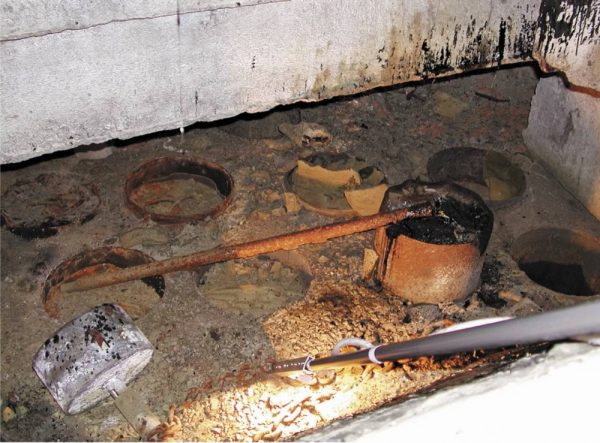
The work on tank 3A is scheduled to start in 2023, after tank 2A and 2B is completed. The experts are don’t want to start the most risky work before as much as possible of the other waste elements are removed. A criticality accident in Andreeva Bay is worst-case scenario.
As previously reported by The Barents Observer, the total radionuclide inventory in the three tanks is estimated to be equal to the remains of Rector No. 4 inside the Chernobyl sarcophagus in Ukraine. This according to a study by the British nuclear engineering company Nuvia.
The original 22,000 spent fuel elements dumped in Andreeva Bay are coming from 90-100 reactor cores powering the Soviet Union’s Cold War submarines sailing out from the naval bases along the coast of the Kola Peninsula from the late 1950s to 1982.
The first reactor cores of the November class submarines were reloaded in the early 1960s.
Additional to the spent fuel elements, some 10,000 cubic meters of solid radioactive waste from Andreeva Bay are shipped to the regional handling and storage facility in Saida Bay, a few hours sailing to the east on the Kola Peninsula. Huge piles of solid radioactive waste were stored outdoor summer and winter in the same area. Now, a building is erected to protect the boxes from rain and snow, before being repacked and shipped to the Saida Bay.
Accelerating rate of ice sheet loss from Greenland
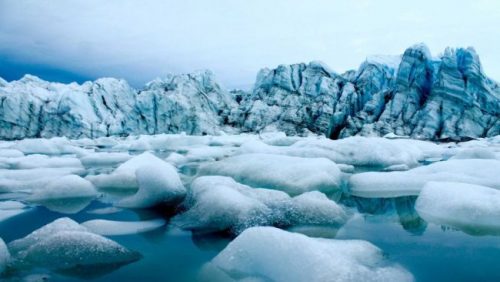 Greenland ice sheet loss already ‘unprecedented’ and set to accelerate Greenland ice sheet loss already ‘unprecedented’ and set to accelerate
Given our lag in getting emissions down since then, Professor Steffen said he doesn’t think 1.5C is still realistically achievable, but keeping warming below 2C is. ABC Science By environment reporter Nick Kilvert, 30 Sept, 20
Melting of the Greenland ice sheet has hit a rate unmatched in the last 12,000 years and is accelerating, scientists have confirmed. Key points:
Research published in Nature today predicts that the Greenland ice sheet will be melting by as much as six times its current rate by the end of the century if we don’t get emissions down. On the flipside, if we can achieve the best-case emissions reduction scenario forecast by the IPCC we can limit its increasing melt rate to around 40 per cent greater than its present rate. While he is cautiously optimistic, Professor Steffen said what is equally important is how they get there. Currently China are responsible for about a quarter of the world’s greenhouse gas production, and if they begin rapidly cutting emissions from today right through until 2060, then that is significant, he said. But if they continue burning fossil fuels and make rapid cuts at the last minute, the damage will already be done. “We use what’s called the carbon budget approach to estimate how much temperature is going to rise — that is the cumulative emissions between now and net-zero [emissions],” Professor Steffen said. “If [China] get their emissions down really quickly, say by 2040, that’s a big difference between whether they coast to 2050 and then cut them over a decade.” On the flipside, if we can achieve the best-case emissions reduction scenario forecast by the IPCC we can limit its increasing melt rate to around 40 per cent greater than its present rate…. As the earth emerged from the last Ice Age around 11,000 years ago, the Arctic experienced a warm period or thermal maximum between about 10,000 and 7,000 years before present. Researchers presumed that the rate of melting of the Greenland ice sheet in that period was higher than it is today. Instead, they found that over the last 20 years, the southwestern Greenland ice sheet where this research was focussed, has been losing ice at an rate of about 6,100 billion tonnes per century on average — around 100 billion tonnes more than at its previous historical peak, according to author Jason Briner from the University of Buffalo. “Our results suggest that yes, this century we will experience ice-loss rates not just similar to those in the past but exceeding those of the past, even under strict carbon emissions scenarios,” Professor Briner said. Worst-case scenario would see 600% increase in melting this centuryAs well as comparing present-day melting with the past, they looked at how different global greenhouse gas emissions trajectories would impact melting over the coming century. They modelled the IPCC’s best-case emissions scenario, called Representative Concentration Pathway (RCP) 2.6, and the worst-case emissions scenario called RCP 8.5. Under RCP 2.6, emissions are drastically reduced starting now and we achieve net-negative emissions this century. That is, we get our emissions to zero and also draw greenhouse gases from the atmosphere through technology or by boosting natural sinks like forests and blue carbon. Under RCP 2.6 we limit global average warming to within 2 degrees Celsius by 2100. On the other hand, under RCP 8.5 we continue burning fossil fuels as per usual, making no substantial efforts to reduce our greenhouse gas emissions through to 2100. Under the RCP 2.6 scenario, their models forecast that melting of the southwestern Greenland ice sheet would increase to around 8,800 billion tonnes per century on average by 2100 — about a forty per cent increase on today’s rate. But under the worst-case RCP 8.5 scenario, they forecast the southwestern Greenland ice sheet could be losing up to 35,900 billion tonnes per century — an increase of nearly 600 per cent on today’s melting rate. Although their study area didn’t encompass the entire ice sheet, Professor Briner said Greenland tends to melt fairly uniformly. “Based on reconstructions of ice sheet changes over the past several decades, it has been shown that when the ice sheet loses mass in our study area, it loses mass across its entire surface,” he said.
The study is an important demonstration of the difference that we can make by cutting emissions, according to David Etheridge from the CSIRO’s Climate Science Centre. “The range of predictions shows a high sensitivity to emissions scenarios with the possibility to limit ice loss with low emissions,” Dr Etheridge said. ‘We still have time’ to slow down sea level riseModelling sea level rise was outside the bounds of this study, but the researchers tentatively suggest that the worst-case scenario melting from the southwestern Greenland ice sheet would add around 10 centimetres to sea levels this century. If that was scaled to the entire ice sheet, that would likely be “doubled or tripled”, Professor Briner said. And that’s without accounting for any melting from the Antarctic ice sheet. Research published earlier this month in Nature found that the Antarctic ice sheet will add 1.3 metres to sea level for every degree of warming up to 2 degrees Celsius above pre-industrial levels. That research found that we have locked in at least two-and-a-half metres of sea level rise from Antarctica, regardless of what happens with our emissions from now on. But it’s the rate at which the melting happens that we have some control over and is the crucial issue, according to Will Steffen from the ANU’s Climate Change Institute. “We can still influence the rate at which Greenland melts and thus the rate that sea level rises. That’s the important message,” Professor Steffen said.
Rather than needing to adapt and shift coastal communities over decades, we can buy ourselves a century or more if we act to get emissions down immediately, Professor Steffen said. When countries signed up to the Paris Agreement in 2015, the aim was to keep warming to 1.5C. Given our lag in getting emissions down since then, Professor Steffen said he doesn’t think 1.5C is still realistically achievable, but keeping warming below 2C is. |
|
The Arctic Has Entered A New Climate State


The Arctic Has Entered A New Climate State, Radio Ecoshock 25 Sept 20 Ice is rapidly disappearing from both Poles. Two polar ice experts report latest science. From the U.S. National Center For Atmospheric Research in Colorado, Arctic scientist Laura Landrum: in 2020, the Arctic has reached a new climate state. Thomas Slater from Leeds University UK reports ice loss from glaciers has surpassed the worst case scenarios. Manhattan-size chunks falling away, other ice shelves shatter in unnatural heat and warmed-up seas.
Listen to or download this Radio Ecoshock show ………..
The new water added to the ocean runs away to every country with a sea coast. It runs up estuaries, eats away coastlines, and piles up in every hurricane, high tide and storm. Slater agrees with NASA that in some cases, there is no way to stop these mountains of ice from becoming sea water. This massive change has happened. The tipping point for a grand melting of the world’s second biggest pile of ice, Greenland, was 20 years ago. Like light from the stars, rising seas just take a while to reach us.
Hot in the cold news, this: the Arctic’s largest remaining ice shelf lost a very large chunk of ice, like the volume of mountains, broken away in North Eastern Greenland – floating off into the Atlantic are new melting ice islands twice the size of Manhattan. I won’t try to pronounce the complicated Nordic name. Scientists also call it “79N”. According to satellite images, a portion of the shelf about 110 square kilometers – that’s 42 square miles of thick glacier – just shattered. It fell apart this summer.
This follows absolute record hot summers in the Arctic in 2019 and 2020, on top of the whole region warming around 3 degrees C since 1980. The far north has already gone past 3 degrees C of warming, way beyond the supposed safe line of 1.5 or even 2 degrees C. demanded by the Intergovernmental Panel on Climate Change, and agreed by most governments under the Paris Accord of 2015. The Arctic is already soaring into dangerous warming, and the ice is responding at rates older scientists would never have believed possible. ………….
the change in sea ice cover is, Dr. Laura Landrum, scientist NCAR says, the single largest driver of big climate changes not just in the Arctic, but around the world. Of course our emissions are forcing that change in sea ice cover, by warming not just the atmosphere, but the seas as well.
Now in the Arctic, the traditional expectations for the seasons no longer work. Aboriginal people can no longer hunt at the same times, and animals are confused or spending energy adapting as they can. Plant life will shift. So will insects.
Plus: changes in the Arctic will alter teleconnections to cycles, weather and variability further south. The “new Arctic climate” does not stay in the Arctic. Already we have observations, from Jennifer Francis at Rutgers, that reduction of Arctic sea ice and dramatic changes to the behavior of the Jet Stream further south may be linked. Dr. Landrum agrees. Another scientist on Radio Ecoshock, Dr. Ivana Cvijanovic found evidence of a teleconnection between changes in the Arctic and rainfall in California. …….
There is no going back to the old Arctic. Summer sea ice will not return to levels seen in the 1950’s, when a crossing of the Northwest passage was a major newsworthy expedition requiring ice-breakers. Now individuals in yachts travel across the Canadian Arctic by themselves, while tankers and freighters move in the Arctic Ocean above Siberia, significantly shortening the route from China to Europe. From shipping to hope for more oil and gas, big business is betting the new Arctic climate is here to stay.
Will the growing season in the Tundra, formerly about 60 days, get longer? Could the Boreal forests begin to extend into the Arctic? In Siberia, Northwest Canada, and Alaska the treeline extends into the Arctic Circle, (about 66 degrees North). Also, if winters get shorter, that could mean an increase in Arctic wildfires. Even “more” rain does not necessarily mean more rain in the fire season. Rain may not stop wildfires, especially as Mike Flannigan told us that thin northern soils can dry out and be ready to burn just 3 sunny days after a rainfall. ……
THOMAS SLATER – GLACIER MELT HIGHER THAN WORST CASE SCENARIO, Dr. Thomas Slater, University of Leeds We are trying to look forward in time, to see what the force of rising seas will do. For me, one of the clearest examples comes with higher storm surges, like the dramatic flooding of lower Manhattan during Hurricane Sandy in October of 2012. Are we already at a point where Polar ice loss is bringing more intense disasters?
Discussing an article in Nature published August 13, Grace Palmer in scitechdaily quotes scientist Marco Tedesco saying the percentage contribution of Greenland to sea level rise could increase from 20 to 25 percent now, to 30 or 40 percent by the end of the century.
We begin our state-of-the-glaciers talk with the sad example of the Okjökull Glacier (simple known as Ok) in Iceland. It is the first world glacier declared “dead” due to climate change. On that site is a plaque reading:
A letter to the future
Ok is the first Icelandic glacier to lose its status as a glacier.
In the next 200 years all our glaciers are expected to follow the same path.
This monument is to acknowledge that we know
what is happening and what needs to be done.
Only you know if we did it.
……….. , our climate situation is even worse than the best scientists thought. NASA has a mas balance graphic showing Greenland Ice Loss 2002-2016. That graphic reveals a steady staircase down in the balance of Greenland ice.
THE BIG TWO ON SEA LEVEL RISEWhen it comes to sea level rise, two key points:
1. more sea level rise is now coming from glacial meltwater than thermal expansion of warming seas
2. about 60% of that added sea level is coming from Greenland – more than from Antarctica……. https://www.ecoshock.org/2020/09/the-arctic-has-entered-a-new-climate-state.html
Arctic pollution is worse than expected – tree rings studies reveal this
 Tree rings show scale of Arctic pollution is worse than previously thought, EUREKALERT, UNIVERSITY OF CAMBRIDGE, Research News 28 Sept 20, The largest-ever study of tree rings from Norilsk in the Russian Arctic has shown that the direct and indirect effects of industrial pollution in the region and beyond are far worse than previously thought.An international team of researchers, led by the University of Cambridge, has combined ring width and wood chemistry measurements from living and dead trees with soil characteristics and computer modelling to show that the damage done by decades of nickel and copper mining has not only devastated local environments, but also affected the global carbon cycle. Tree rings show scale of Arctic pollution is worse than previously thought, EUREKALERT, UNIVERSITY OF CAMBRIDGE, Research News 28 Sept 20, The largest-ever study of tree rings from Norilsk in the Russian Arctic has shown that the direct and indirect effects of industrial pollution in the region and beyond are far worse than previously thought.An international team of researchers, led by the University of Cambridge, has combined ring width and wood chemistry measurements from living and dead trees with soil characteristics and computer modelling to show that the damage done by decades of nickel and copper mining has not only devastated local environments, but also affected the global carbon cycle.
The extent of damage done to the boreal forest, the largest land biome on Earth, can be seen in the annual growth rings of trees near Norilsk where die off has spread up to 100 kilometres. The results are reported in the journal Ecology Letters. Norilsk, in northern Siberia, is the world’s northernmost city with more than 100,000 people, and one of the most polluted places on Earth. Since the 1930s, intensive mining of the area’s massive nickel, copper and palladium deposits, combined with few environmental regulations, has led to severe pollution levels. A massive oil spill in May 2020 has added to the extreme level of environmental damage in the area. Not only are the high level of airborne emissions from the Norilsk industrial complex responsible for the direct destruction of around 24,000 square kilometres of boreal forest since the 1960s, surviving trees across much of the high-northern latitudes are suffering as well. The high pollution levels cause declining tree growth, which in turn have an effect of the amount of carbon that can be sequestered in the boreal forest……. The researchers used a process-based forward model of boreal tree growth, with and without surface irradiance forcing as a proxy for pollutants, to show that Arctic dimming since the 1970s has substantially reduced tree growth. Arctic dimming is a phenomenon caused by increased particulates in the Earth’s atmosphere, whether from pollution, dust or volcanic eruptions. The phenomenon partially blocks out sunlight, slowing the process of evaporation and interfering with the hydrological cycle. Global warming should be expected to increase the rate of boreal tree growth, but the researchers found that as the pollution levels peaked, the rate of tree growth in northern Siberia slowed. They found that the pollution levels in the atmosphere diminished the trees’ ability to turn sunlight into energy through photosynthesis, and so they were not able to grow as quickly or as strong as they would in areas with lower pollution levels. “What surprised us is just how widespread the effects of industrial pollution are – the scale of the damage shows just how vulnerable and sensitive the boreal forest is,” said Büntgen. “Given the ecological importance of this biome, the pollution levels across the high-northern latitudes could have an enormous impact on the entire global carbon cycle.” https://www.eurekalert.org/pub_releases/2020-09/uoc-trs092420.php |
|
Russia’s nuclear-powered ice-breakers lead towards military domination of the Arctic
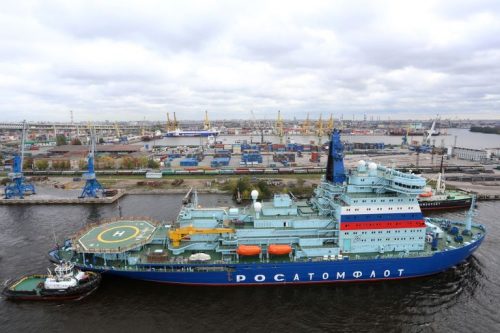
Russia’s Nuclear-Powered Icebreaker Is a Step Toward Military Domination
The country is fast becoming an icebreaking superpower. BY KYLE MIZOKAMI, SEP 24, 2020 Russia’s newest icebreaker, the nuclear-powered Arktika, is headed to its new homeport in St. Petersburg, Russia. The ship, painted in the colors of the Russian state flag, will operate north of the Arctic Circle in anticipation of a year-round shipping route across the icy far north. Arktika is part of Moscow’s emerging policy of exploiting a warming arctic region—and protecting its stake in the region from competitors.
- Russia’s first new nuclear-powered icebreaker in decades, Arktika, is joining the country’s large fleet of icebreaking ships.
- Arktika is capable of smashing through ice that’s nearly 10 feet thick.<
- Millions of Russians live above the Arctic Circle, and warming ocean temperatures could create ice-free shortcuts between Asia and Europe.Russia’s newest icebreaker, the nuclear-powered Arktika, is headed to its new homeport in St. Petersburg, Russia. The ship, painted in the colors of the Russian state flag, will operate north of the Arctic Circle in anticipation of a year-round shipping route across the icy far north. Arktika is part of Moscow’s emerging policy of exploiting a warming arctic region—and protecting its stake in the region from competitors.
<Arktika is the first of a new class of nuclear-powered icebreakers. Construction began at the Baltic Shipyards in St. Petersburg in 2012 with a scheduled launch in 2017, but delays pushed the completion back to 2020. This past February, a short circuit damaged one of the ship’s three 300-ton electric motors, disabling one of the three propellers. Russian authorities ordered the ship to continue, however, and the ship is currently moving on just two propellers.
In 2019, Russian President Vladimir Putin announced the country would ultimately have a fleet of 13 icebreakers, the majority of them nuclear-powered. …………..
Iceabreakers like Arktika could also allow Russia to militarily dominate the Northern Sea Route, smashing a route for Russian warships and transports full of Russian Marines. Warming temperatures will mean other countries, such as Canada and the U.S., will likely move to unlock natural resources previously trapped under sheets of sea ice, and Russia will be in a position to threaten oil, gas, and mineral exploration and exploitation…………. https://www.popularmechanics.com/military/navy-ships/a34128219/russia-nuclear-powered-icebreaker-arktika/
Global heating is disrupting the ground in Siberia
|
Bizarre Bumps come up in Siberia, The tundra climate of Siberia and Russia have been the victim of climate change and the bumps on the grounds bear its scars https://www.outlookindia.com/outlooktraveller/travelnews/story/70633/siberias-ground-bumps, Trinetra Paul, September 20 , 2020 Over the past few decades, climate change and global warming has had a string of adverse effects on the planet. And the signs of damage are increasing day by day. Siberia has been facing the wrath of this global phenomenon over the years. Now, the ground bears the scars of climate change. The Siberian permafrost (or frozen organic ground) is slowly thawing and this is resulting in huge, bizarre bumps on the ground. Many of the craters formed in between these bumps have been filled with melting water and have transformed into small lakes. The alarming rate at which the ground is thawing is a cause for major concern. The permafrost has frozen grass and shrubs and is a reservoir of greenhouse gases. When the layer thaws, these gases are directly emitted into the atmosphere. The Siberian city of Yakutsk has been standing on a permafrost, the depletion of which will not only be a hazard for the city but also for Siberian climate and weather. Siberia, and most parts of Russia, has witnessed a huge rise in temperatures, heat waves and an early summer with temperatures reaching almost 35 degrees. A large part of it is due to global warming, oil spills, factory leakages as well as increase in eco-tourism. Yes, even friendlier modes of tourism and travel too play a pivotal role in increasing the temperature. The COVID-19 pandemic too has had its share in this. With lack of proper maintenance, devastating Siberian wildfires in May proved to be deadly due to reduced workforce, and gave out large volumes of greenhouse gases. Though eco-tourism is beneficial in creating awareness about indiginous culture, and in creating employment among locals, it also leads to modernisation and artificial (often damaging) development of a place. Nature-based adventures, trails and extreme offbeat destinations are often held accountable for destruction of untramelled areas. Experts says that there must be conscious efforts in de-escalating these ventures. Such tourism must be curtailed, and introduced with buffers like controlling daily visitor numbers, maintaining a tab over timings, and consulting environmental organisations about the best measures to protect the vulnerable areas. Sometimes that may mean not allowing any tourists at all. |
|
Arctic sea ice becomes a sea of slush

|
Sea of Slush: Arctic sea ice lows mark a new polar climate regime Reporting by Natalie Thomas in the Arctic Ocean and Cassandra Garrison in Buenos Aires; Editing by Katy Daigle and Lisa Shumaker By Natalie Thomas, Cassandra Garrison ARCTIC OCEAN (Reuters) 14 Sept 20, – At the edge of the ice blanketing part of the Arctic Ocean, the ice on Monday looked sickly. Where thick sheets of ice once sat atop the water, now a layer of soft, spongey slush slid and bobbed atop the waves. From the deck of a research ship under a bright, clear sky, “ice pilot” Paul Ruzycki mused over how quickly the region was changing since he began helping ships spot and navigate between icebergs in 1996. “Not so long ago, I heard that we had 100 years before the Arctic would be ice free in the summer,” he said. “Then I heard 75 years, 25 years, and just recently I heard 15 years. It’s accelerating.” As if on cue, scientists on Monday said the vast and ancient ice sheet sitting atop Greenland had sloughed off a 113 square kilometer chunk of ice last month. The section of the Spalte Glacier at the northwest corner of the Arctic island had been cracking for several years before finally breaking free on Aug. 27, clearing the way inland ice loss to the sea, the Geological Survey of Denmark and Greenland bit.ly/2Rq5Mw2 reported. With climate change driving up Arctic temperatures, the once-solid sea ice cover has been shrinking to stark, new lows in recent years. This year’s minimum, still a few days from being declared, is expected to be the second-lowest expanse in four decades of record-keeping. The record low of 3.41 million square kilometers – reached in September 2012 after a late-season cyclonic storm broke up the remaining ice – is not much below what we see today. “We haven’t gone back at all to anything from 30 to 40 years ago,” said climatologist Julienne Stroeve at the National Snow and Ice Data Center in Boulder, Colorado. And as climate change continues, scientists say the sea ice is unlikely to recover to past levels. In fact, the long-frozen region is already shifting to an entirely new climate regime, marked by the escalating trends in ice melt, temperature rise and rainfall days, according to new research published Monday in the journal Nature Climate Change. Those findings, climate scientist Laura Landrum said, were “unnerving.” All three variables – sea ice, temperatures and rainfall – are now being measured well beyond the range of past observations. That makes the future of the Arctic more of a mystery……… https://www.reuters.com/article/us-climate-change-arctic-sea-ice/sea-of-slush-arctic-sea-ice-lows-mark-a-new-polar-climate-regime-idUSKBN2652UL |
|
Rapid climate change has made Greenland lose a record amount of ice
|
Greenland glacier loses 110 square kilometres’ worth of ice, ABC, 14 Sept 20, A chunk of Greenland’s ice cap estimated to be
Scientists say the incident is evidence of rapid climate change. The glacier section broke off the fjord called Nioghalvfjerdsfjorden, which is about 80 kilometres long and 20 kilometres wide, the National Geological Survey of Denmark and Greenland (GEUS) reported. The glacier is at the end of the north-east Greenland ice stream, where it flows off land into the ocean. Annual end-of-melt-season changes for the Arctic’s largest ice shelf in the region are measured by optical satellite imagery. GEUS showed area losses for the past two years each exceeded 50 square kilometres. “We should be very concerned about what appears to be progressive disintegration at the Arctic’s largest remaining ice shelf,” GEUS professor Jason Box said……. In August, a study showed that Greenland lost a record amount of ice during an extra-warm 2019, with the melt massive enough to cover the US state of California in more than 1.25 metres of water. https://www.abc.net.au/news/2020-09-14/chunk-of-greenlands-ice-cap-has-broken-off/12663510 |
|
|
Russian nuclear submarines ‘hunted’ by NATO forces in the Barents sea
NATO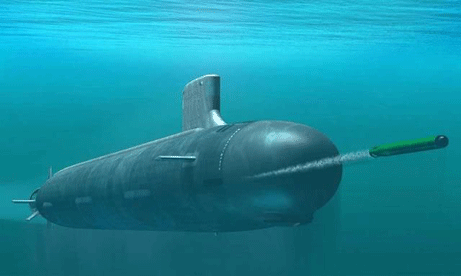 forces organized ‘a hunt’ of a nuclear Russian submarine in the Barents , Military, By Boyko Nikolov On Sep 13, 2020 MOSCOW, (BM) – NATO ships made an attempt to “take the pincers” of the Russian submarine in the waters of the Barents Sea, according to the Nation-news resource on September 12, learned BulgarianMilitary.com.
It is noted that the Russian submarine, which was “hunted” by NATO forces, is equipped with nuclear warheads and means of delivering them with Poseidon torpedoes. The American submarine, in turn, has Harpoon torpedoes and Tomahawk cruise missiles in its arsenal.
A similar incident is also reported in May 2020 in waters belonging to the Northern Sea Route. And also about the flight of a group of NATO bombers over the waters of the East Siberian Sea.
Such actions are assessed by the National Center for Defense Management of the Russian Federation as provocative.
US and British Navy maneuvers into Barents Sea are a signal to Moscow
For the first time since the mid-80s, under the supervision of the Russian fleet, four American and one British ship entered the Barents Sea, which indicates a growing intensity of the confrontation between the great powers in the Arctic, writes The Washington Times.
According to the newspaper, the purpose of this operation was to send a signal to Moscow, as well as to check the readiness of the Navy for action in any weather conditions.
Meanwhile, Norwegian officials refused to participate in this British-American operation – which speaks of its “provocative essence.”
According to officials of the US Navy, these exercises are necessary in order for the US armed forces to be ready to operate in various climatic conditions, including in the Arctic. However, the Trump administration does not particularly hide its intentions to repulse other states – mainly Russia, but also assertive China – that are trying to establish control over strategically important Arctic territories.
As expected, Moscow was not happy about the joint British-American operation. Russian media reported that the Northern Fleet is actively monitoring American and British ships in the Barents Sea.
So far, there have been no reports of close contact between Russian and American ships – as well as news of high-profile statements by senior Russian officials. However, as The Washington Times notes, recalling that it carefully monitors what is happening, Moscow sent a clear signal that it considers this Arctic territory to be its own.
According to American officials, on May 1, they notified Russia of an impending operation in order to avoid an “unintentional exacerbation.”According to officials of the US Navy, these exercises are necessary in order for the US armed forces to be ready to operate in various climatic conditions, including in the Arctic. However, the Trump administration does not particularly hide its intentions to repulse other states – mainly Russia, but also assertive China – that are trying to establish control over strategically important Arctic territories.
As expected, Moscow was not happy about the joint British-American operation. Russian media reported that the Northern Fleet is actively monitoring American and British ships in the Barents Sea.
So far, there have been no reports of close contact between Russian and American ships – as well as news of high-profile statements by senior Russian officials. However, as The Washington Times notes, recalling that it carefully monitors what is happening, Moscow sent a clear signal that it considers this Arctic territory to be its own.
According to American officials, on May 1, they notified Russia of an impending operation in order to avoid an “unintentional exacerbation.”………….. https://bulgarianmilitary.com/2020/09/13/nato-forces-organized-a-hunt-of-a-nuclear-russian-submarine-in-the-barents-sea/
Climate change and the loss of sea otters
Loss of sea otters accelerating the effects of climate change, New research published in Science reveals that the influence of a key predator governs the pace of climate impacts on Alaskan reefs EurekAlert, BIGELOW LABORATORY FOR OCEAN SCIENCES , 13 Sept 20, The impacts of predator loss and climate change are combining to devastate living reefs that have defined Alaskan kelp forests for centuries, according to new research published in Science.
“We discovered that massive limestone reefs built by algae underpin the Aleutian Islands’ kelp forest ecosystem,” said Douglas Rasher, a senior research scientist at Bigelow Laboratory for Ocean Sciences and the lead author of the study. “However, these long-lived reefs are now disappearing before our eyes, and we’re looking at a collapse likely on the order of decades rather than centuries.”
The coral-like reefs, built by the red alga Clathromorphum nereostratum, are being ground down by sea urchins. Sea urchins exploded in number after their predator, the Aleutian sea otter, became functionally extinct in the 1990’s. Without the urchins’ natural predator to keep them in check, urchins have transformed the seascape – first by mowing down the dense kelp forests, and now by turning their attention to the coralline algae that form the reef.
Clathromorphum produces a limestone skeleton that protects the organism from grazers and, over hundreds of years, forms a complex reef that nurtures a rich diversity of sea life. With kelp gone from the menu, urchins are now boring through the alga’s tough protective layer to eat the alga – a process that has become much easier due to climate change.
“Ocean warming and acidification are making it difficult for calcifying organisms to produce their shells, or in this case, the alga’s protective skeleton,” said Rasher, who led the international team of researchers that included coauthors Jim Estes from UC Santa Cruz and Bob Steneck from University of Maine. “This critical species has now become highly vulnerable to urchin grazing – right as urchin abundance is peaking. It’s a devasting combination.”………..
The results of the experiment confirmed that climate change has recently allowed urchins to breach the alga’s defenses, pushing this system beyond a critical tipping point.
“It’s well documented that humans are changing Earth’s ecosystems by altering the climate and by removing large predators, but scientists rarely study those processes together,” Rasher said. “If we had only studied the effects of climate change on Clathromorphum in the laboratory, we would have arrived at very different conclusions about the vulnerability and future of this species. Our study shows that we must view climate change through an ecological lens, or we’re likely to face many surprises in the coming years.”……..https://www.eurekalert.org/pub_releases/2020-09/blfo-los090420.php
Climate change causing major changes in Arctic insect communities
Climate change recasts the insect communities of the Arctic, EurekAlert, UNIVERSITY OF  HELSINKI Research News 12 Sept 20, Through a unique research collaboration, researchers at the University of Helsinki have exposed major changes taking place in the insect communities of the Arctic. Their study reveals how climate change is affecting small but important predators of other insects, i.e. parasitoids.”Predators at the top of the food web give us a clue to what is happening to their prey species, too. These results increase our understanding of how global warming is changing nature. At the same time, they suggest new inroads for finding answers to big questions in the field of ecology,” says Professor Tomas Roslin from the University of Helsinki and the Swedish University of Agricultural Sciences (SLU).
The researchers’ main discovery was that clear traces of climate change can already be seen in arctic insect communities.
“In areas where summers are rapidly warming, we find a higher proportion of cold-sensitive predators than we might expect based on the previous climate,” Roslin notes.
The study joined research teams working in Greenland, Canada, Russia, Norway, Finland and Iceland, which together compared regions where the climate has changed at different rates and in different ways in recent decades.
Parasitoids are fierce predators but sensitive to changes in climatic conditions
“The climate of the Arctic is currently changing about twice as fast as the global average. Therefore, the Arctic region provides an important laboratory when we try to understand the effects of climate change on nature,” says Tuomas Kankaanpää, lead author of the study and active at the Faculty of Agriculture and Forestry, University of Helsinki.
“To distinguish the key consequences of climate change, we have focused on some of the most important predators in the Arctic, parasitoid wasps and flies. These parasitoids are predators whose larvae develop on or within a single host individual and usually kill it in the process. And now we have found that climate change is dramatically affecting the relative dominance of different types of parasitoids.”………..https://www.eurekalert.org/pub_releases/2020-09/uoh-ccr091020.php
1 This Month

of the week – Shut Down Drone Warfare!


Tell the Ukrainian Government to Drop Prosecution of Peace Activist Yurii Sheliazhenko

Petition to revoke the licensing of the Near Surface Nuclear Disposal Facility (NSDF) at Chalk River. https://www.ourcommons.ca/petitions/en/Petition/Details?Petition=e-7247
To see nuclear-related stories in greater depth and intensity – go to https://nuclearinformation.wordpress.com
-
Archives
- April 2026 (57)
- March 2026 (251)
- February 2026 (268)
- January 2026 (308)
- December 2025 (358)
- November 2025 (359)
- October 2025 (376)
- September 2025 (257)
- August 2025 (319)
- July 2025 (230)
- June 2025 (348)
- May 2025 (261)
-
Categories
- 1
- 1 NUCLEAR ISSUES
- business and costs
- climate change
- culture and arts
- ENERGY
- environment
- health
- history
- indigenous issues
- Legal
- marketing of nuclear
- media
- opposition to nuclear
- PERSONAL STORIES
- politics
- politics international
- Religion and ethics
- safety
- secrets,lies and civil liberties
- spinbuster
- technology
- Uranium
- wastes
- weapons and war
- Women
- 2 WORLD
- ACTION
- AFRICA
- Atrocities
- AUSTRALIA
- Christina's notes
- Christina's themes
- culture and arts
- Events
- Fuk 2022
- Fuk 2023
- Fukushima 2017
- Fukushima 2018
- fukushima 2019
- Fukushima 2020
- Fukushima 2021
- general
- global warming
- Humour (God we need it)
- Nuclear
- RARE EARTHS
- Reference
- resources – print
- Resources -audiovicual
- Weekly Newsletter
- World
- World Nuclear
- YouTube
-
RSS
Entries RSS
Comments RSS
 nuclear-news