Polar bears losing habitat as sea ice melting earlier, and refreezing later
 Polar bears losing crucial sea ice: study, Guardian,14 Sept 16 Life-sustaining sea ice needed for hunting, resting and breeding is declining in all 19 regions of the Arctic inhabited by the species Polar bears are losing life-sustaining sea ice crucial for hunting, resting and breeding in all 19 regions of the Arctic they inhabit, a study warned on Wednesday.
As climate change pushes up Arctic temperatures, ice is melting earlier in spring and refreezing later in autumn, a team of researchers reported in the Cryosphere, a journal of the European Geosciences Union.
Satellite data revealed that the total number of ice-covered days across the 19 regions declined at a rate of seven to 19 days per decade from 1979 to 2014, the researchers said.
“Their dependence on sea ice means that climate warming poses the single most important threat to (polar bears’) persistence,” wrote the team……..
Scientists say the Arctic is warming at nearly double the global rate as a result of climate change fuelled by mankind’s burning of fossil fuels, a process that emits heat-trapping greenhouse gases.
With longer iceless periods, polar bears have to swim further and further to find solid ground.
Last year, the International Union for the Conservation of Nature (IUCN) said the creatures could see their numbers dwindle by nearly a third by mid-century…….https://www.theguardian.com/environment/2016/sep/14/polar-bears-losing-crucial-sea-ice-study-arctic
Huge volume of Greenland Ice Sheet lost each year, due to global warming
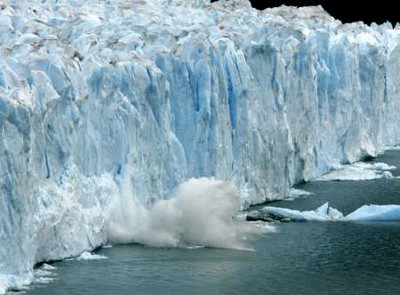 Global warming is melting the Greenland Ice Sheet, fast The Greenland Ice Sheet is losing 110 million Olympic size swimming pools worth of water each year, Guardian, John Abraham, 25 Aug 16 A new study measures the loss of ice from one of world’s largest ice sheets. They find an ice loss that has accelerated in the past few years, and their measurements confirm prior estimates.
As humans emit heat-trapping gases, we expect to see changes to the Earth. One obvious change to be on the lookout for is melting ice. This includes ice atop mountains, ice floating in cold ocean waters, and the ice within large ice sheets or glaciers. It is this last type of ice loss that most affects ocean levels because as the water runs into the oceans, it raises sea levels. This is in contrast to melting sea ice – since it is already floating in ocean waters, its potential to raise ocean levels is very small.
So measuring ice sheet melting is important, not only as a signal of global warming but also because of the sea level impacts. But how is this melting measured? The ice sheets on Greenland and Antarctica are huge and scientists need enough measurements in space and time to really understand what’s going on. That is, we need high-resolution and long duration measurements to fully understand trends.
In a very recent publication in the journal Geophysical Research Letters, an international team reported on a new high-resolution measurement of Greenland. The lead author, Malcolm McMillan from the Centre for Polar Observation and Modeling, and his colleagues mapped Greenland with incredibly high resolution (5 km distances).
They accomplished this mapping by obtaining data from the Cryosat 2satellite. This satellite uses a technique called radar altimetry to measure the height of surfaces. It is able to track the elevation of the ice sheets on Greenland with high precision. If the height of the ice sheet is growing, it means the ice is getting thicker. If the heights are decreasing, it means the ice layers are getting thinner.
A simplistic view would be that if ice sheets become taller, then they contain more frozen water. If they are shorter, they contain less water. But, this isn’t the entire story. Scientists also have to account for other changes, such as changes to density, surface roughness, and water content. When you realize that the Greenland Ice Sheet is thousands of meters thick, and the top layers include both snow and firn (which later get buried and compressed into ice), it becomes apparent that accounting for the constitution of the ice sheet is important when estimating how much water is being delivered to the ocean.
The authors of this study did such an accounting and they discovered that not only is Greenland losing a lot of ice, but the loss varies a lot depending on location and year. https://www.theguardian.com/environment/climate-consensus-97-per-cent/2016/aug/25/global-warming-is-melting-the-greenland-ice-sheet-fast
Australian uranium company meets stiff opposition from Inuit, to Greenland mine project
 Greenland Inuit oppose open-pit uranium mine on Arctic mountain-top http://www.theecologist.org/News/news_analysis/2988016/greenland_inuit_oppose_openpit_uranium_mine_on_arctic_mountaintop.html, Bill Williams ,17th August 2016
A collapse in the price of uranium has not yet stopped Australian mining company GME from trying to press ahead with a massive open-pit uranium mine on an Arctic mountain in southern Greenland, writes Bill Williams – just returned from the small coastal town of Narsaq where local people and Inuit campaigners are driving the growing resistance to the ruinous project.
Recently I was invited to assess an old Danish uranium exploration site in Kvanefjeld in southern Greenland.
Inuit Ataqatigiit – the opposition party in the national parliament – had asked me to talk to local people about the health implications of re-opening the defunct mine.
An Australian firm called Greenland Minerals and Energy (GME) has big plans to extract uranium and rare earth minerals here. It would be a world first: an open-pit uranium mine on an Arctic mountain-top.
From the top of the range above the mine site I looked down across rolling green farmland to the small fishing village of Narsaq. Colourful timber houses rested at the edge of a deep blue strait that the Viking Eric the Red navigated a thousand years ago. Hundreds of icebergs bobbed on its mirror-like surface. To the east, half way up the valley, a small creek tumbled into a deep rock pool.
Behind that saddle lies Lake Tesaq, a pristine Arctic lake that GME plans to fill with nearly a billion tonnes of waste rock. This part of the mine waste would not be the most radioactive, because the company plans to dump this material in a nearby natural basin, with the promise that an ‘impervious’ layer would prevent leaching into the surrounding habitat.
Left behind – all the toxic products of radioactive decay
These mine tailings would contain the majority of the original radioactivity – about 85% in fact – because the miners only want the uranium and the rare earth elements. They would mine and then leave the now highly mobile radioactive contaminants, the progeny from the uranium decay behind: thorium, radium, radon gas, polonium and a horde of other toxins.
Even at very low levels of exposure ionising radiation is recognised as poisonous: responsible for cancer and non-cancer diseases in humans over vast timespans.
This is why my own profession is under growing pressure to reduce exposure of our patients to X-Rays and CT scans in particular – making sure benefit outweighs risk. It’s also why ERA, the proprietors of the Ranger mine in Kakadu, Australia, are legally obliged to isolate the tailings for at least 10,000 years.
While this is hardly possible, the mere fact that it is required highlights the severity and longevity of the risk. My Inuit audience in Narsaq was particularly interested to hear the messages I brought from traditional owners in Australia like Yvonne Margarula, of the Mirarr people:
“The problems always last, but the promises never do.”
And Jeffrey Lee from Koongara:
“I will fight to the end and we will stop it, then it won’t continue on for more uranium here in Kakadu.”
So far in 2016, not a single new nuclear reactor has opened
Chemical and radioactive waste could be exposed as ice thaws over abandoned military site in Greenland
Melting ice sheet could expose frozen Cold War-era hazardous waste, Eureka Alert, YORK UNIVERSITY TORONTO, AUG. 4, 2016 –Climate change is threatening to expose hazardous waste at an abandoned camp thought to be buried forever in the Greenland Ice Sheet, new research out of York University has found.Camp Century, a United States military base built within the Greenland ice sheet in 1959, doubled as a top-secret site for testing the feasibility of deploying nuclear missiles from the Arctic during the Cold War. When the camp was decommissioned in 1967, its infrastructure and waste were abandoned under the assumption they would be entombed forever by perpetual snowfall.
“Two generations ago, people were interring waste in different areas of the world, and now climate change is modifying those sites,” said William Colgan, a climate and glacier scientist at York U and lead author of the new study. “It’s a new breed of climate change challenge we have to think about.”
The study was published today in Geophysical Research Letters, a journal of the American Geophysical Union.
Climate change has warmed the Arctic more than any other region on Earth and the new research has found that the portion of the ice sheet covering Camp Century could start to melt by the end of the century. If the ice melts, the camp’s infrastructure, as well as any remaining biological, chemical and radioactive waste, could re-enter the environment and potentially disrupt nearby ecosystems, say the study’s authors. The wastes would not remain encased in ice forever, as was assumed by both the US and Denmark when the camp was abandoned. Determining who is responsible for cleaning up the waste could also lead to political disputes not considered before, said Colgan.
The study’s team took an inventory of the wastes at Camp Century and ran climate model simulations. The researchers also analyzed historical US army engineering documents to determine where and how deep the wastes were buried and how much that part of the ice cap had moved since the 1960s. They found the waste at Camp Century covers 55 hectares, roughly the size of 100 football fields…….
International law is clear about responsibility for preventing future hazardous waste, but ambiguous about who is liable for waste already discarded, said Jessica Green, a political scientist specializing in international environmental law at New York University who was not connected to the study. Although Camp Century was a US base, it is on Danish soil, and although Greenland is a Danish territory, it is now self-governing, she said…….
Although the camp was built with Denmark’s approval, the missile launch program, known as Project Iceworm, was kept secret from the Danish government. Several years after the camp became operational, Project Iceworm was rejected by the Joint Chiefs of Staff and the camp was decommissioned. The Army Corps of Engineers removed the nuclear reaction chamber but left the camp’s infrastructure and all other waste behind, assuming the ice sheet would secure them forever. In the decades since, falling snow has buried the camp roughly 35 meters further underneath the ice. http://www.eurekalert.org/pub_releases/2016-08/yu-mis080416.php
Antarctic is being polluted by uranium mining in Australia
Climate scientists: Australian uranium mining pollutes Antarctic http://phys.org/news/2016-06-climate- scientists-australian-
uranium-pollutes.html June 30, 2016 by Beth Staples Uranium mining in Australia is polluting the Antarctic, about 6,000 nautical miles away. University of Maine climate scientists made the discovery during the first high-resolution continuous examination of a northern Antarctic Peninsula ice core.
Ice core data reveal a significant increase in uranium concentration that coincides with open pit mining in the Southern Hemisphere, most notably Australia, says lead researcher Mariusz Potocki, a doctoral candidate and research assistant with the Climate Change Institute.
“The Southern Hemisphere is impacted by human activities more than we thought,” says Potocki.
Understanding airborne distribution of uranium is important because exposure to the radioactive element can result in kidney toxicity, genetic mutations, mental development challenges and cancer.
Uranium concentrations in the ice core increased by as much as 102 between the 1980s and 2000s, accompanied by increased variability in recent years, says Potocki, a glaciochemist.
Until World War II, most of the uranium input to the atmosphere was from natural sources, says the research team.
But since 1945, increases in Southern Hemisphere uranium levels have been attributed to industrial sources, including uranium mining in Australia, South Africa and Namibia. Since other land-source dust elements don’t show similar large increases in the ice core, and since the increased uranium concentrations are enriched above levels in the Earth’s crust, the source of uranium is attributed to human activities rather atmospheric circulation changes.
In 2007, a Brazilian-Chilean-U.S. team retrieved the ice core from the Detroit Plateau on the northern Antarctic Peninsula, which is one of the most rapidly changing regions on Earth.
More information: Mariusz Potocki et al. Recent increase in Antarctic Peninsula ice core uranium concentrations, Atmospheric Environment (2016). DOI: 10.1016/j.atmosenv.2016.06.010 Journal reference:Atmospheric Environment  Provided by: University of Maine
Russia to dominate Arctic with huge ice-breakers
Russia floated its largest and most powerful nuclear-powered icebreaker last month, upping the ante in what is literally the coldest global gold rush.
The ice-smashing ship was Russia’s sixth reactor-driven polar vessel. The United States doesn’t have a single one.
Moscow’s dominance of the northern seas — courtesy of vast investments — has America and the West worried. Here’s why………http://www.nbcnews.com/news/world/russia-s-latest-nuclear-powered-icebreaker-extends-arctic-dominance-n602381
Russia’s massive nuclear-powered icebreaker to seek oil reserves in Arctic
Arktika is just one icebreaker in a class known as Project 22220. The other two — Sibir, which was laid down in May 2015, and Ural — are also planned. If completed, Sibir will reportedly have the propulsion power of 110 MW, almost twice as powerful as Arktika. Both ships are part of a $1.2 billion contract that Baltic Shipyards signed in 2014 with Rosatom State Nuclear Energy Corp.
Why would Russia need nuclear-powered icebreakers in the first place? Obviously, for defense. Icebreakers can clear a path for military ships, allowing for increased mobility and range for the Russian naval fleet.
Fast warming of Arctic region will mean many climate refugees
Obama administration warns of ‘climate refugees’ due to rapid Arctic warming
US Interior Secretary Sally Jewell has painted a stark picture of communities displaced by rising Arctic temperatures that are ‘washing away’ towns, Guardian, Oliver Milman @olliemilman Saturday 30 April 2016 The Obama administration has warned the US will need to deal with a wave of “climate refugees” as the Arctic continues to warm, joining with the Canadian government to express alarm over how climate change is affecting indigenous communities.
Sally Jewell, US secretary of the interior, painted a stark picture of communities relocating and lives disrupted in her first official visit to Canada. The Arctic, which is warming at twice the rate of the global average, has just recorded its lowest recorded peak ice extent after what’s been called a “warm, crazy winter”……..
Obama declares disaster as Marshall Islands suffers worst-ever drought….http://www.theguardian.com/environment/2016/apr/29/climate-change-refugees-arctic-obama-administration-warning
Russian nuclear submarine fires CRUISE MISSILE in Arctic
Russian nuclear sub fires CRUISE MISSILE in chilling footage of Arctic military drill, Mirror, BY JONATHAN SHARMAN, 30 APR 16 The 120-metre Severodvinsk submarine can be seen sinking slowly below the surface before its Kalibr missile erupts from the wave… [INCL VIDEO]…..
The Russian military said the cruise missile struck its target, in the Arkhangelsk region, “with high accuracy”.
A statement added: “A strike group of the flotilla has conducted firing drills using naval practice targets and hit them successfully.”
The Kalibr missile, which can carry nuclear or conventional payloads, travels at speeds up to Mach 2.9 – the same as a space shuttle during launch. The land-attack weapon has a range of up to 1,500 miles……..http://www.mirror.co.uk/news/world-news/russian-nuclear-sub-fires-cruise-7866647
Sea level rise has been underestimated – new ice studies suggest
Ice melt studies say we underestimate sea level rise, Independent Australia Peter Boyer 11 April 2016, Are melting polar ice sheets as stable as we think, or have we missed something? If a couple of new ice studies are only partly right, we face massive disruption from sea level rise within decades.
SCIENTIFIC DEBATE about this has picked up in the wake of the March publication of two major research papers by scientists from the U.S., France, Germany and China.
A paper by James Hansen and 18 other climatologists in the open-access science journal Atmospheric Chemistry and Physics, examined ancient climate change to assess how that compares with today’s melting of Greenland and Antarctic ice sheets.
It argues that during this century, ice sheet meltwater spreading over parts of the Southern Ocean and the North Atlantic will increase the temperature variation between these cooler parts and warming regions, resulting in more violent storms.
The meltwater layer also acts as a transparent lid on warming ocean waters undermining polar ice sheets sitting on bedrock below sea level. The paper’s startling prediction is that consequent disintegration could bring several metres of sea level rise within 150 years and possibly by 2070.
A paper published last week in the science journal Nature, also examining past rapid changes, looked at how the Antarctic ice sheet might react to warming of atmosphere as well as ocean, and reached similarly disturbing conclusions.
U.S. scientists Robert DeConto and David Pollard studied the puzzle of how the massive Antarctic ice sheet shed large amounts of ice over relatively short time-frames in prehistoric warming events.
Their modelling showed that if today’s high carbon emissions continue, warmer air would add to the impact of warming seas. Fracturing ice shelves and coastal cliffs would bring rapid ice loss and contribute ‘more than a metre of sea-level rise by 2100’………https://independentaustralia.net/environment/environment-display/ice-melt-studies-say-we-underestimate-sea-level-rise,8866
Strong opposition to uranium mining in Kuannersuaq, Greenland
We are strongly opposed to plans to exploit minerals with uranium reserves at Kuannersuaq, Narsaq http://arcticjournal.com/press-releases/2204/we-are-strongly-opposed-plans-exploit-minerals-uranium-reserves-kuannersuaq We are strongly opposed to plans to exploit minerals with uranium reserves at Kuannersuaq, Eric Jensen, Nuka David SørensenMarch 9, 2016 By The Arctic Journal Information to citizens concerning the plans for exploitation of mineral deposits with uranium and exploitation of uranimium by Kuannersuaq at Narsaq is not sufficient and we demand that there should be a referendum on the plans for exploitation of mineral resources with uranium content. Therefore we require that plans for exploitation of mineral resources with uranium content and exploitation of uranium and all the decisions concerning these must be stopped.
By requiring that plans for exploitation of mineral resources with uranium content and exploitation of uranmium by Kuannersuaq at Narsaq temporarily stopped, we have begun planning of demonstrations against these plans on April 8, 2016, from 12:00 in the towns of Narsaq, Qaqortoq, Nuuk, Tasiilaq , Ilulissat, Qeqertarsuaq and in the settlements Qassiarsuk and Narsarsuaq. We have the following arguments against the plans for the exploitation of mineral resources with uranium content and exploitation of uranium:
- No sufficient information has been submitted regarding the potential impacts on people, the environment and wildlife, if an open mine is to be opened at Kuannersuaq;
- Citizens are not informed with clear information printed in Greenlandic concerning the plans for the exploitation of mineral resources containing uranium and exploitation of uranium.
We require the following information from the Greenland Government on plans for use of mineral resources from Kuannersuit:
1. What impacts can an open pit mine on the top of Kunnersuaq have on people’s health and the environment?
2. How can dust with different radioactive substances from the exploitation of raw materials from the mountain all year round be avoided?
3. What plans are there to ensure that waste from the mine to be thrown in the lake does not pollute the environment?
4. What can the waste from the mine placed into the lake have of impacts?
5. Is there sufficient space to the amount of waste in the lake?
6. According to the latest survey, only very small amounts of uranium, how credible are these compared to Risø’s studies?
7. How will you ensure the credibility of the EIA report as yet been presented publicly?
8. How ready is Greenland to store waste / tailings containing uranium mining and exploitation for many years without polluting?
9. There are not taken into account the next coming generations who will inherit it all?
Everybody is welcome to participate in the demonstrations on April 8 from pm. 12:00 at the following towns Narsaq, Qaqortoq, Nuuk, Tasiilaq, Ilulissat, Qeqertarsuaq, Qassiarsuk, Narsarsuaq and possible. Elsewhere.
Russia now plans to store nuclear wastes on Arctic islands !
 Has the world gone crazy? Particularly Russia! What right do they have to impose this poisonous trash on Arctic islanders? And where radioactive pollution will further endanger the ocean? Have they not heard of climate change? Of rising sea levels? Have ANY nuclear powers ever entertained the thought of just stopping making radioactive trash for which there is no real solution?
Russia plans to build radioactive waste storage on Arctic islands of Novaya Zemlya http://tass.ru/en/economy/839293 November 25, 2015
 Until 1992, the waters off the coast of the archipelago of Novaya Zemlya had been the main area for sinking solid radioactive waste from the Soviet nuclear vessels based in the North ARKHANGELSK, November 25. /TASS/. Russia’s Rosatom state nuclear corporation intends to build a low-and medium-level radioactive waste disposal facility in the area of the Novaya Zemlya archipelago. Rosatom’s relevant request is to be considered on Wednesday by deputies of the Arkhangelsk regional assembly.
The press service of the regional assembly reported that before the session the lawmakers held a roundtable discussion to discuss the project. Deputy head of Rosatom department for work with regions Andrei Polosin said: “We do not plan to build this facility right now. We just need a permission to conduct additional studies.” “To get started, we need seven years. It’s a very big project, requiring many different approvals,” he added.
According to experts, about 50 tonnes of radioactive waste from the operation of nuclear-powered submarines in Severodvinsk have been accumulated in the Arkhangelsk region. The construction of a waste disposal facility on Novaya Zemlya would attract additional investment to the region and create new jobs.
Until 1992, the sea off the coast of the Arctic archipelago of Novaya Zemlya had been the main area for sinking solid radioactive waste from the Soviet military and civilian nuclear vessels based in the North. A total of about 17,000 containers with solid radioactive waste, as well as 16 nuclear reactors from submarines and icebreakers were sunk in the Arctic. In 1982, the K-27 emergency nuclear submarine with unloaded reactor was sunk in Stepovoi Bay. The radiation situation in these areas is regularly monitored by expeditions of the Emergency Situations Ministry and the Russian Academy of Sciences. According to their data, solid radioactive waste dumped during the Soviet years off the coast of Novaya Zemlya at present poses no threat to the environment, but requires constant monitoring
Russia’s militarisation of the Arctic, and the danger of its mini nuclear reactors

 Russia’s mini nuclear reactors plan causes concern http://thebarentsobserver.com/security/2015/11/russias-mini-nuclear-reactors-plan-causes-concern Norway’s radiation watchdog says the risk of accidents and releases of radioactive substances will increase in the Arctic. Thomas Nilsen November 07, 2015
A military plan building up to 30 small transportable nuclear reactors for the Arctic was announced earlier this week. The reactors will provide electricity to remote bases currently under development as part of Russia’s Arctic militarization.
“If these plans are given a go-ahead in the future, it will lead to an increased risk of accidents and releases of radioactive substances,” says Ingar Amundsen, Head of Section for international nuclear safety with the Norwegian Radiation Protection Authorities (NRPA). Amundsen was on inspection with three other Norwegian experts at Kola nuclear power when being contacted by the Independent Barents Observer about the Russian military plans.
Norway wants information
He says NRPA was not informed about the plans before reading about it in Russian media this week. “Norwegian authorities will bring up the issue with our Russian counterpart in those forums we have dialogue, to hear if there is realism in these plans,” Ingar Amundsen says.
Since 1995, Norway has co-financed a series of comprehensive nuclear safety projects in Northwest Russia, including decommissioning of Cold War submarines bringing their reactors into safe onshore long-term storage.
Amundsen elaborates on the risks involved in Russia’s announced new military reactors. “Nuclear power plants requires good access to needed infrastructure and a comprehensive control regime for safe operation, Ingar Amundsen says and continues: “This is important to avoid accidents and releases, but also to avoid unauthorized access by strangers to the facility and the nuclear material.” He believes that will be very difficult to achieve with mobile units in remote areas.
Arctic militarization
Russia current militarization of the Arctic includes new bases and re-opening of Cold War bases along the north coast of Siberia and on archipelagoes like the New Siberia Islands, Novaya Zemlya and Franz Josef Land. The aim of creating small nuclear reactors is to fly- or ship them in to the bases and produce electricity- and heat instead of diesel generators and steam boilers.
The reactors are so small they can be transported around by a KAMAZ truck, in a cargo plane, on a sledge or even carried by Russia’s huge Mi-26 cargo helicopters.
The first of the new mini reactors could be ready for testing before 2020, TASS reported on Wednesday.
Murmansk and Severodvinsk
Nothing is said about where to maintain the reactors Today, maintain- and uranium fuel replacement of naval reactors in northern Russia takes place at the submarine yard in Severodvinsk near Arkhangelsk and at icebreaker base Atomflot in Murmansk.
As previously reported by the Independent Barents Observer, small transportable nuclear reactors for use in remote corners of the Arctic is not a new invention.
Both the United States and the Soviet Union built several transportable reactors. In the Arctic, the U.S. military had a secret nuclear reactor in operation for some few years in the 60ies at Camp Century east of Thule airbase on Greenland’s northern ice-sheet. The reactor was then transported on the ice by a tractor with a sledge and placed under the ice to produce electricity and heat for a Arctic missile research facility.
Also in Antarctica, the United States operated a medium-size reactor in the 60ies and 70ies at the McMurdo research station.
In the Soviet Union, a two-megawatt reactor was built in 1961. The reactor was carried around on the chassis of a tank. Another smaller reactor, named NURKA, was located at one of the Northern fleet’s submarine bases on the coast of the Barents Sea, but it is unclear if this reactor ever was used. Several other types of mini-reactors were developed during Soviet-times.
For space, several series of lightweight ultrasmall reactors were use in satellites. http://thebarentsobserver.com/security/2015/11/russias-mini-nuclear-reactors-plan-causes-concern
Melting Arctic permafrost adds to the $300 trillion economic costs of climate change
Emissions from melting permafrost could cost $43 trillion, Science Daily September 21, Source: University of Cambridge
- Summary:
- New analysis of the effects of melting permafrost in the Arctic points to $43 trillion in extra economic damage by the end of the next century, on top of the more than the $300 trillion economic damage already predicted.
- New analysis of the effects of melting permafrost in the Arctic points to $43 trillion in extra economic damage by the end of the next century, on top of the more than the $300 trillion economic damage already predicted.Increased greenhouse gas emissions from the release of carbon dioxide and methane contained in the Arctic permafrost could result in $43 trillion in additional economic damage by the end of the next century, according to researchers from the University of Cambridge and the University of Colorado.
In a letter published today (21 September) in the journal Nature Climate Change, the researchers have for the first time modelled the economic impact caused by melting permafrost in the Arctic to the end of the twenty-second century, on top of the damage already predicted by climate and economic models.
The Arctic is warming at a rate which is twice the global average, due to anthropogenic, or human-caused, greenhouse gas emissions. If emissions continue to rise at their current rates, Arctic warming will lead to the widespread thawing of permafrost and the release of hundreds of billions of tonnes of methane and CO2 — about 1,700 gigatonnes of carbon are held in permafrost soils in the form of frozen organic matter.
Rising emissions will result in both economic and non-economic impacts, as well as a higher chance of catastrophic events, such as the melting of the Greenland and West Antarctic ice sheets, increased flooding and extreme weather. Economic impacts directly affect a country’s gross domestic product (GDP), such as the loss of agricultural output and the additional cost of air conditioning, while non-economic impacts include effects on human health and ecosystems.
The researchers’ models predict $43 trillion in economic damage could be caused by the release of these greenhouse gases, an amount equivalent to more than half the current annual output of the global economy. This brings the total predicted impact of climate change by 2200 to $369 trillion, up from $326 trillion — an increase of 13 percent……..http://www.sciencedaily.com/releases/2015/09/150921112731.htm
Barents Sea – the Arctic’s radioactive legacy of Soviet nuclear weapons testing
“The Barents Sea and the coast of Novaya Zemlya were turned into a dump for solid and liquid radioactive waste. A catastrophic situation has been created. A real threat has emerged, not only to sea mammals but everything in the ocean. The ecological and genetic consequences are unpredictable.”
Novaya Zemlya, an Arctic island twice as big as Switzerland, was cleared of its inhabitants in the 1950s to make way for nuclear weapons testing.
The frigid waters of the White and Barents seas were used as a dump for spent reactors from nuclear submarines and icebreakers.
 At top of the world, the Soviet legacy is pollution, Baltimore Sun April 19, 1992|By Kathy Lally | Kathy Lally,Moscow Bureau ARCHANGEL, Russia — Soviet power has disappeared here, but it has left a fatal legacy.
The march toward communism cost the people of Archangel their pure air, clean water and even the health of their children. This snowy expanse near the Arctic Circle seems fouled beyond all understanding.
The damage was thorough, unrelenting and so insidious that scientists have yet to determine its extent.
The latest victims are thousands of harp seals dying of cancer from the harm the former Soviet Union inflicted upon itself and its unsuspecting people as it moved to industrialization and superpower status. Scientists suspect that these beautiful animals with the large imploring eyes are being killed by years of irresponsible Soviet nuclear testing and dumping.
Once the seals were threatened only by hunters who club the pups to death for their luxurious, snow-white pelts. Now those that survive migrate through water so contaminated that environmentalists imagine it fairly crackles with radioactivity.
Scientists began taking blood and tissue samples from the seals two years ago, after more than a million dead starfish washed up along the White Sea coast.
They are still unsure of what killed the starfish, but the study of the seals has revealed blood pathologies consistent with long-term toxic or radioactive exposure.
“This is a problem so big and serious it goes beyond us,” says Yuri K. Timoshenko, director of the marine mammal laboratory at the Polar Scientific Research Institute here. Continue reading
1 This Month

of the week – Shut Down Drone Warfare!


Tell the Ukrainian Government to Drop Prosecution of Peace Activist Yurii Sheliazhenko

Petition to revoke the licensing of the Near Surface Nuclear Disposal Facility (NSDF) at Chalk River. https://www.ourcommons.ca/petitions/en/Petition/Details?Petition=e-7247
To see nuclear-related stories in greater depth and intensity – go to https://nuclearinformation.wordpress.com
-
Archives
- April 2026 (91)
- March 2026 (251)
- February 2026 (268)
- January 2026 (308)
- December 2025 (358)
- November 2025 (359)
- October 2025 (376)
- September 2025 (257)
- August 2025 (319)
- July 2025 (230)
- June 2025 (348)
- May 2025 (261)
-
Categories
- 1
- 1 NUCLEAR ISSUES
- business and costs
- climate change
- culture and arts
- ENERGY
- environment
- health
- history
- indigenous issues
- Legal
- marketing of nuclear
- media
- opposition to nuclear
- PERSONAL STORIES
- politics
- politics international
- Religion and ethics
- safety
- secrets,lies and civil liberties
- spinbuster
- technology
- Uranium
- wastes
- weapons and war
- Women
- 2 WORLD
- ACTION
- AFRICA
- Atrocities
- AUSTRALIA
- Christina's notes
- Christina's themes
- culture and arts
- Events
- Fuk 2022
- Fuk 2023
- Fukushima 2017
- Fukushima 2018
- fukushima 2019
- Fukushima 2020
- Fukushima 2021
- general
- global warming
- Humour (God we need it)
- Nuclear
- RARE EARTHS
- Reference
- resources – print
- Resources -audiovicual
- Weekly Newsletter
- World
- World Nuclear
- YouTube
-
RSS
Entries RSS
Comments RSS
 nuclear-news