Melting Arctic ice cap
Melting Arctic ice cap falls to well below average This summer’s minimum is the eighth lowest on record
Shrinking ice cap increasingly linked to extreme weather events around the world, say scientists, Guardian, Damian Carrington , 20 Sept 17, The Arctic ice cap melted to hundreds of thousands of square miles below average this summer, according to data released late on Tuesday.
Climate change is pushing temperatures up most rapidly in the polar regions and left the extent of Arctic sea ice at 1.79m sq miles at the end of the summer melt season.
This is the time when it reaches its lowest area for the year, before starting to grow again as winter approaches. The 2017 minimum was 610,000 sqmiles below the 1981-2010 average and the eighth lowest year in the 38-year satellite record……https://www.theguardian.com/environment/2017/sep/20/melting-arctic-ice-cap-falls-to-well-below-average
Global effects of rapid thaw of Greenland’s permafrost
Greenland: How rapid climate change on world’s largest island will affect us all The ice sheet is melting and permafrost is thawing. What’s happening in Greenland will speed up climate change across the world, The Independent, 7 Sept 17, Kathryn Adamson
Greenland is an important cog in the global climate system. The ice sheet, which covers 80 per cent of the island, reflects so much of the sun’s energy back into space that it moderates temperatures through what is known as the “albedo effect”. And since it occupies a strategic position in the North Atlantic, its meltwater tempers ocean circulation patterns.
But Greenland is especially vulnerable to climate change, as Arctic air temperatures are currently rising at twice the global average rate. Environmental conditions are frequently setting new records: “the warmest”, “the wettest”, “the driest”.
Despite its size, the fire itself represents only a snapshot of Greenland’s fire history. It alone cannot tell us about wider Arctic climate change.
But when we superimpose these extraordinary events onto longer-term environmental records, we can see important trends emerging.
The ice sheet is melting
Between 2002 and 2016 the ice sheet lost mass at a rate of around 269 gigatonnes per year. One gigatonne is one billion tonnes. One tonne is about the weight of a walrus.
During the same period, the ice sheet also showed some unusual short-term behaviour. The 2012 melt season was especially intense – 97 per cent of the ice sheet experienced surface melt at some point during the year. Snow even melted at its summit, the highest point in the centre of the island where the ice is piled up more than 3km above sea level………
In Greenland, like much of the Arctic, rising temperatures are thawing the permafrost. This means the active layer is growing by up to 1.5cm per year. This trend is expected to continue, seeing as under current IPCC predictions, Arctic air temperatures will rise by between 2.0°C and 7.5°C this century.
Arctic permafrost contains more than 1,500 billion tonnes of dead plants and animals (around 1,500 billion walrus equivalent) which we call “organic matter”. Right now, this stuff has been frozen for thousands of years. But when the permafrost thaws this organic matter will decay, releasing carbon and methane (another greenhouse gas) into the atmosphere.
If thawing continues, it’s estimated that by 2100 permafrost will emit 850-1,400 billion tonnes of CO₂ equivalent (for comparison: total global emissions in 2012 was 54 billion tonnes of CO₂ equivalent). All that extra methane and carbon, of course, has the potential to enhance global warming even further……..http://www.independent.co.uk/environment/greenland-how-rapid-climate-change-on-worlds-largest-island-will-affect-us-all-a7926006.html
Climate change threat: ALASKA’S PERMAFROST IS THAWING
ALASKA’S PERMAFROST IS THAWING, Alaska’s permafrost, shown here in 2010 [on original] , is no longer permanent. It is starting to thaw. The loss of frozen ground in Arctic regions is a striking result of climate change. And it is also a cause of more warming to come. By 2050, much of this frozen ground, a storehouse of ancient carbon, could be gone. NYT, AUG. 23, 2017 YUKON DELTA NATIONAL WILDLIFE REFUGE, Alaska — The Arctic is warming about twice as fast as other parts of the planet, and even here in sub-Arctic Alaska the rate of warming is high. Sea ice and wildlife habitat are disappearing; higher sea levels threaten coastal native villages.
But to the scientists from Woods Hole Research Center who have come here to study the effects of climate change, the most urgent is the fate of permafrost, the always-frozen ground that underlies much of the state.

Starting just a few feet below the surface and extending tens or even hundreds of feet down, it contains vast amounts of carbon in organic matter — plants that took carbon dioxide from the atmosphere centuries ago, died and froze before they could decompose. Worldwide, permafrost is thought to contain about twice as much carbon as is currently in the atmosphere.
Once this ancient organic material thaws, microbes convert some of it to carbon dioxide and methane, which can flow into the atmosphere and cause even more warming. Scientists have estimated that the process of permafrost thawing could contribute as much as 1.7 degrees Fahrenheit to global warming over the next several centuries, independent of what society does to reduce emissions from burning fossil fuels and other activities.
In Alaska, nowhere is permafrost more vulnerable than here, 350 miles south of the Arctic Circle, in a vast, largely treeless landscape formed from sediment brought down by two of the state’s biggest rivers, the Yukon and the Kuskokwim. Temperatures three feet down into the frozen ground are less than half a degree below freezing. This area could lose much of its permafrost by midcentury.
That, said Max Holmes, senior scientist and deputy director of the research center, “has all kinds of consequences both locally for this region, for the animals and the people who live here, as well as globally.”
“It’s sobering to think of this magnificent landscape and how fundamentally it can change over a relatively short time period,” he added.
But on this wide, flat tundra, it takes a practiced eye to see how Alaska is thawing from below.
At one of the countless small lakes that pepper the region, chunks of shoreline that include what had been permafrost have calved off toward the water.
Nearby, across a spongy bed of mosses and lichens, a small boggy depression most likely formed when the ice in the top layers of the permafrost below it melted to water……….
Beyond the local effects on plant and animal life, the landscape changes can have an important climate change impact, by altering the mix of carbon dioxide and methane that is emitted. Although methane does not persist in the atmosphere for as long as carbon dioxide, it has a far greater heat-trapping ability and can contribute to more rapid warming.
So the researchers devote much of their time to studying the flow of water and the carbon and nutrients it contains…….
Estimates vary on how much carbon is currently released from thawing permafrost worldwide, but by one calculation emissions over the rest of the century could average about 1.5 billion tons a year, or about the same as current annual emissions from fossil-fuel burning in the United States.
Already, thawing permafrost and warmer temperatures are being blamed for rising carbon emissions in the Alaskan tundra, both here and farther north. In a study earlier this year, researchers found that bacterial decomposition of thawed permafrost, as well as carbon dioxide produced by living vegetation, continues later into the fall because freezing of the surface is delayed.
The rise in emissions has been so significant, the researchers found, that Alaska may be shifting from a sink, or storehouse, of carbon, to a net source.
Dr. Holmes said that shift was not surprising given the climate trend, and he would expect that sub-Arctic parts of Siberia, Canada and other areas with permafrost may be undergoing similar changes.
“There’s a massive amount of carbon that’s in the ground, that’s built up slowly over thousands and thousands of years,” he said.
“It’s been in a freezer, and that freezer is now turning into a refrigerator.” https://www.nytimes.com/interactive/2017/08/23/climate/alaska-permafrost-thawing.html
For the first time, tanker crosses Arctic without icebreaker
 http://money.cnn.com/2017/08/25/news/arctic-ice-tanker-ship/index.html?sr=twCNN082517arctic-ice-tanker-ship0141PMStory, August 25, 2017:
Climate change is helping create new opportunities for shipping companies by melting the ice around the North Pole.
A Russian tanker carrying natural gas has become the first merchant ship to sail across the Arctic without the help of an icebreaker, finishing the journey in record time.
The ship, the Christophe de Margerie, traveled from Norway to South Korea in 19 days, about 30% quicker than the regular route through the Suez Canal, its Russian owner, Sovcomflot, said this week.
Thinner, younger sea ice — less than a year old — has become the majority across the Arctic. Young ice struggles to reach a thickness of 2 meters (6½ feet) during winter months and then is more likely to melt during the summer.
Related: Watch as old sea ice vanishes
It’s a huge concern. According to NASA, many global climate models predict that the Arctic will be ice-free for at least part of the year before the end of the 21st century. Some models predict an ice-free Arctic by midcentury. That would have a direct impact on weather patterns around the world.
The thinning ice also opens new paths for global trade, saving companies hundreds of thousands of dollars they would spend on longer journeys via more southerly routes.
“This is the paradox of climate change,” said Ben Ayliffe, a campaigner for Greenpeace. “The fossil fuels we’re burning are allowing access into areas that were previously protected by ice.” He expressed concern that increasing sea traffic in the inhospitable environment will bring new risks, such as a fuel spill that would be virtually impossible to clean up.
Shipping tankers making their way across the top of the world typically need to be accompaniedby massive, nuclear-powered Russian icebreakers to plow through patches of six-foot-thick ice.
But the Christophe de Margerie, named for a former CEO of French oil giant Total, is specially designed to sail independently through ice as thick as 2.1 meters (nearly 7 feet), its owner said.
That means it should be able to operate in the harsh Arctic waters year round rather than just the summer months.
Its recent journey ferrying liquified natural gas more than 2,000 nautical miles through ice as thick as 1.2 meters (4 feet) “demonstrates the economic potential of using the Northern Sea Route for large-capacity vessel transits,” Sovcomflot said.
Greenland’s melting ice will affect us all
 Greenland: how rapid climate change on world’s largest island will affect us all https://theconversation.com/greenland-how-rapid-climate-change-on-worlds-largest-island-will-affect-us-all-82675 Senior Lecturer in Physical Geography, Manchester Metropolitan University August 18, 2017 The largest wildfire ever recorded in Greenland was recently spotted close to the west coast town of Sisimiut, not far from Disko Island where I research retreating glaciers. The fire has captured public and scientific interest not just because its size and location came as a surprise, but also because it is yet another signpost of deep environmental change in the Arctic.
Despite its size, the fire itself represents only a snapshot of Greenland’s fire history. It alone cannot tell us about wider Arctic climate change.
But when we superimpose these extraordinary events onto longer-term environmental records, we can see important trends emerging.
The ice sheet is melting
Between 2002 and 2016 the ice sheet lost mass at a rate of around 269 gigatonnes per year. One gigatonne is one billion tonnes. One tonne is about the weight of a walrus. During the same period, the ice sheet also showed some unusual short-term behaviour. The 2012 melt season was especially intense – 97% of the ice sheet experienced surface melt at some point during the year. Snow even melted at its summit, the highest point in the centre of the island where the ice is piled up more than 3km above sea level.
In April 2016 Greenland saw abnormally high temperatures and its earliest ever “melt event” (a day in which more than 10% of the ice sheet has at least 1mm of surface melt). Early melting doesn’t usher in a period of complete and catastrophic change – the ice won’t vanish overnight. But it does illustrate how profoundly and rapidly the ice sheet can respond to rising temperatures.
Permafrost is thawing
Despite its icy image, the margins of Greenland are actually quite boggy, complete with swarms of mosquitoes. This is the “active layer”, made up of peaty soil and sediment up to two metres thick, which temporarily thaws during the summer. The underlying permafrost, which can reach depths of 100m, remains permanently frozen.
In Greenland, like much of the Arctic, rising temperatures are thawing the permafrost. This means the active layer is growing by up to 1.5cm per year. This trend is expected to continue, seeing as under current IPCC predictions, Arctic air temperatures will rise by between 2.0°C and 7.5°Cthis century.
Arctic permafrost contains more than 1,500 billion tonnes of dead plants and animals (around 1,500 billion walrus equivalent) which we call “organic matter”. Right now, this stuff has been frozen for thousands of years. But when the permafrost thaws this organic matter will decay, releasing carbon and methane (another greenhouse gas) into the atmosphere.
If thawing continues, it’s estimated that by 2100 permafrost will emit 850-1,400 billion tonnes of CO₂ equivalent (for comparison: total global emissions in 2012 was 54 billion tonnes of CO₂ equivalent). All that extra methane and carbon of course has the potential to enhance global warming even further.
With this in mind, it is clear to see why the recent wildfire, which was burning in dried-out peat in the active layer, was especially interesting to researchers. If Greenland’s permafrost becomes increasingly degraded and dry, there is the potential for even bigger wildfires which would release vast stores of greenhouse gases into the atmosphere.
Species are adapting to a changing ecosystem
Major changes in the physical environment are already affecting the species that call Greenland home. Just look at polar bears, the face of Arctic climate change. Unlike other bears, polar bears spend most of their time at sea, which explains their Latin name Ursus maritimus. In particular they rely on sea ice as it gives them a deep-water platform from which to hunt seals.
However, since 1979 the extent of sea ice has decreased by around 7.4% per decade due to climate warming, and bears have had to adjust their habitat use. With continued temperature rise and sea ice disappearance, it’s predicted that populations will decline by up to 30% in the next few decades, taking the total number of polar bears to under 9,000.
I have considered only a handful of the major environmental shifts in Greenland over the past few decades, but the effects of increasing temperatures are being felt in all parts of the earth system. Sometimes these are manifest as extreme events, at others as slow and insidious changes.
The different parts of the environmental jigsaw interact, so that changes in one part (sea ice decline, say) influence another (polar bear populations). We need to keep a close eye on the system as a whole if we are to make reliable interpretations – and meaningful plans for the future.
Extraordinarily high temperatures in 2016 in Arctic, Greenland and Alaska
The crazy climate records from 2016 you haven’t heard much about http://reneweconomy.com.au/crazy-climate-records-2016-havent-heard-much-12340/ [good graphics] By Andrea Thompson on 11 August 2017 Climate Central
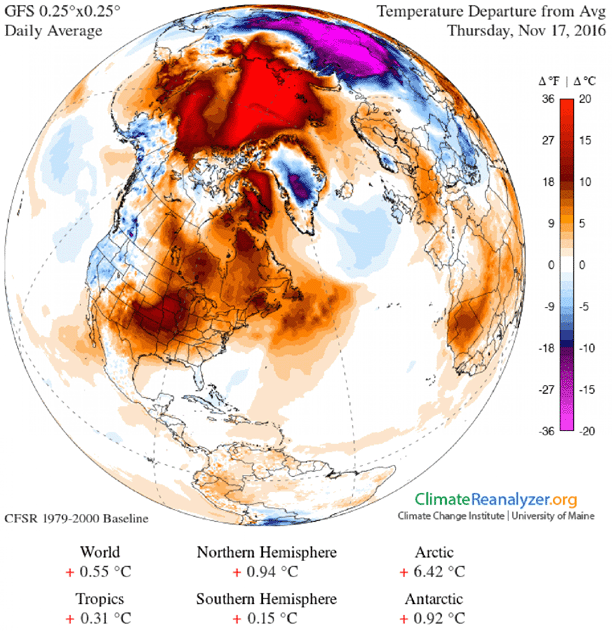
By now, we’ve all heard that 2016 was the hottest year on record, and that heat-trapping greenhouse gases hit their highest concentration ever, surpassing 400 parts per million for the first time in nearly 1 million years. But there are other climate change-related records that have flown more under the radar. Several of those records were highlighted Thursday in the annual State of the Climate report, released in the Bulletin of the American Meteorological Society:
For example, during August, ice-free areas of the Barents Sea (north of Norway and Russia) were up to 20°F (11°C) above average, a figure that stunned climate scientists.
The average land surface temperature for the Arctic was 3.6°F (2.0°C) above the 1981-2010 average — a 6.3°F (3.5°C) rise in temperatures since 1900. Record-high temperatures were measured below the surface of the permafrost, or permanently frozen ground, across the North Slope of Alaska.
“2016 was a year in the Arctic like we’ve never seen before,” Jeremy Mathis, director of the National Oceanic and Atmospheric Administration’s Arctic research program and an author of the report, said.
The rate of warming in the Arctic, which is happening at twice the rate of the rest of the globe, has major impacts on local ecosystems, but also further drives the warming of the planet, as the sea ice that would reflect the sun’s rays back to space is lost.
And for the 37th consecutive year, alpine glaciers retreated across the globe. These glaciers are a major source of water for local communities, and their loss has led to concerns about water security, particularly in places like Southeast Asia.
Climate change action subverted by Norway’s search for oil and gas in the Arctic
Guardian 10th Aug 2017, Norway’s plan to ramp up oil and gas production in the Arctic threatens
global efforts to tackle climate change, according to a new study.
The research says 12 gigatonnes of carbon could be added by exploration sites
in the Barents Sea and elsewhere over the next 50 years, which is 1.5 times
more than the Norwegian fields currently being tapped or under
construction.
The authors of the report from Oil Change International – an
NGO backed by Friends of the Earth, WWF and Greenpeace – say this
undermines the 2015 Paris agreement to cut worldwide emissions in order to
keep the planet’s temperature rise to between 1.5C and 2C.
The report highlights the “cognitive dissonance” between Norway’s progressive domestic
measures to comply with the Paris agreement on emissions cuts and its role
as Europe’s biggest exporter of fossil fuels.
https://www.theguardian.com/environment/2017/aug/10/norways-push-for-arctic-oil-and-gas-threatens-paris-climate-goals-study
Melting permafrost is contributing to unusual wildfires in Greenland
 ‘Unusual’ Greenland wildfires linked to peat, BBC News, By Matt McGrath9 August 2017
New images have been released of wildfires that continue to burn close to the Greenland ice sheet, on the country’s west coast.Fires are rare on an island where 80% of the land is covered by ice up to 3km thick in places.
However, satellites have observed smoke and flames north-east of a town called Sisimiut since 31 July.
Experts believe at least two fires are burning in peat that may have dried out as temperatures have risen.
A song of fire and ice? Researchers say that across Greenland there is now less surface water than in the past, which could be making vegetation more susceptible to fire. The latest satellite images show a number of plumes. Police have warned hikers and tourists to stay away from the region because of the dangers posed by smoke. There are also concerns that the fire will damage grazing for reindeer.
Scientists believe that instead of shrubs or mosses, the likely source is fire in the peaty soil, which can only burn when dry.
“Usually when a wildfire is smouldering like that it’s because there’s a lot of ground-level fuel, carbon organic matter; that’s why I assume that it’s peat,” wildfire expert Prof Jessica McCarty from Miami University, US, told BBC News.
“The fire line is not moving, the fire is not progressing like we’d see in a forest fire, so that means it’s burning whatever fuel is on the ground.”
Prof McCarthy believes that melting permafrost is likely to have contributed to this outbreak. She referred to studies carried out in the region that showed degraded permafrost around the town of Sisimiut.
Locals say that what they call “soil fires” have happened before, especially in the last 20-30 years. Researchers have been busily examining the satellite record to look for evidence of previous outbreaks.
“The only record I found is the MODIS active fire record. It’s a satellite that measures the temperature of the surface and can locate hotspots from fire,” said Dr Stef Lhermitte from Delft University in the Netherlands.
“I think that fires have been there before but what’s different is that this fire is big, in Greenlandic terms; that is unusual. It’s the biggest one we have in the satellite record.”
Dr Lhermitte’s analysis suggest that the satellite has detected more fires in 2017 alone in Greenland than in the 15 years it has been operating. A previous large outbreak was seen in 2015…….http://www.bbc.com/news/science-environment-40877099
NASA monitors Arctic sea ice loss
Sea levels, which were more or less constant for the past 2,000 years, have climbed at a rate of roughly 1.7mm a year in the past century; in the past 25 years, that rate has doubled to 3.4mm a year, already enough to create adverse effects in coastal areas. A conservative estimate holds that waters will rise roughly 0.9 metres (3ft) by the year 2100, which will place hundreds of millions of people in jeopardy.
even as we passed through this landscape, even as the lasers and radars took their deep gulps of data from the ice, I could hear expressions of anxiety from the data hunters. “At the same time that we’re getting better at gathering this data, we seem to be losing the ability to communicate its importance to the public,” one engineer told me four hours into a flight, during a transit between glaciers

Where global warming gets real: inside Nasa’s mission to the north pole For 10 years, Nasa has been flying over the ice caps to chart their retreat. This data is an invaluable record of climate change. But does anyone care? By Avi Steinberg, Guardian, 27 July 17
From the window of a Nasa aircraft flying over the Arctic, looking down on the ice sheet that covers most of Greenland, it’s easy to see why it is so hard to describe climate change. The scale of polar ice, so dramatic and so clear from a plane flying at 450 metres (1,500ft) – high enough to appreciate the scope of the ice and low enough to sense its mass – is nearly impossible to fathom when you aren’t sitting at that particular vantage point.
But it’s different when you are there, cruising over the ice for hours, with Nasa’s monitors all over the cabin streaming data output, documenting in real time – dramatising, in a sense – the depth of the ice beneath. You get it, because you can see it all there in front of you, in three dimensions…..
The crew of Nasa’s Operation IceBridge have seen this ice from every imaginable angle. IceBridge is an aerial survey of the polar regions that has been underway for nearly a decade – the most ambitious of its kind to date. It has yielded a growing dataset that helps researchers document, among other things, how much, and at what rate, ice is disappearing from the poles, contributing to global sea-level rises, and to a variety of other phenomena related to climate change.
Alternating seasonally between the north and south poles, Operation Icebridge mounts months-long campaigns in which it operates eight- to 12-hour daily flights, as often as weather permits…….
On each flight, I witnessed a remarkable tableau. Even as Arctic glaciers were losing mass right below the speeding plane, and even as raw data gleaned directly from those glaciers was pouring in on their monitors, the Nasa engineers sat next to their fact-recording instruments, sighing and wondering aloud if Americans had lost the eyes to see what they were seeing, to see the facts. What they told me revealed something about what it means to be a US federally funded climate researcher in 2017 – and what they didn’t, or couldn’t, tell me revealed even more……
Each of the 63 flight plans for this season in the Arctic was the result of months of meticulous planning. A team of polar scientists from across the US sets the research priorities, in collaboration with flight crews, who make sure the routes are feasible; the mission is managed from Nasa’s Goddard Space Flight Center in Maryland……
Sea levels, which were more or less constant for the past 2,000 years, have climbed at a rate of roughly 1.7mm a year in the past century; in the past 25 years, that rate has doubled to 3.4mm a year, already enough to create adverse effects in coastal areas. A conservative estimate holds that waters will rise roughly 0.9 metres (3ft) by the year 2100, which will place hundreds of millions of people in jeopardy.
Given the scale of sea- and ice-related questions, the vantage point that is needed is from the air and from space, and is best served through large, continuous, state-supported investments: hence Nasa. There is a lot we don’t know and a lot that the ice itself, which is a frozen archive of past climate changes, can tell us. But we need the eyes to see it……
polar snow and ice, precisely because it is white, with a quality known as high albedo, deflects solar energy back into space and helps keep earth’s climate cool; the loss of all this white material means more heat is absorbed and the earth warms faster. In a variety of other ways, including moderating weather patterns, the ice helps makes life on earth more livable. The extreme conditions of the poles, so useful for instilling fear in 19th-century readers, actually make the world more habitable……
even as we passed through this landscape, even as the lasers and radars took their deep gulps of data from the ice, I could hear expressions of anxiety from the data hunters. “At the same time that we’re getting better at gathering this data, we seem to be losing the ability to communicate its importance to the public,” one engineer told me four hours into a flight, during a transit between glaciers…….https://www.theguardian.com/environment/2017/jul/27/watching-ice-melt-inside-nasas-mission-to-the-north-pole
Greenland ice sheet might start to melt “faster and faster”
Independent 25th July 2017, Scientists are “very worried” that the Greenland ice sheet might start to
melt “faster and faster”, a leading scientist has said. The problem is that
the warmer weather is allowing more dark algae to grow on the ice. Because
ice is white, it reflects much of the sun’s energy, but dark algae absorb
the heat, increasing the rate of melting. The Greenland ice sheet is up to
3km thick and would raise sea levels by seven metres if it all melted into
the sea. The current rate of melting is adding about 1mm a year to the
global average sea level. http://www.independent.co.uk/environment/climate-change-scientists-greenland-ice-sheet-melt-faster-worried-algae-a7858876.html
Continuing loss of Arctic sea ice
Here’s how much Arctic sea ice has melted since the ‘80s, REneweconomy, By Andrea Thompson on 24 July 2017 Climate Central
Arctic sea ice has been melting at a steady clip this summer as it heads toward its annual low point. But a new chart shows that with nearly two months still left in the melt season, sea ice area is already below what would have been a yearly low in the 1980s.
The comparison shows the clear long-term decline of Arctic sea ice fueled by the global rise in heat-trapping greenhouse gases.
The dramatic shrinkage of sea ice over the past few decades is driving major changes, from the loss of crucial Arctic habitat to the potential influence of weather patterns around the world……http://reneweconomy.com.au/heres-much-arctic-sea-ice-melted-since-80s-55828/
Greenland ice melting – a big contributor to sea level rise
 Melting Greenland ice now source of 25% of sea level rise, researchers say, Japan Times, AFP-JIJI, JUN 27, 2017 PARIS– Ocean levels rose 50 percent faster in 2014 than in 1993, with meltwater from the Greenland ice sheet now supplying 25 percent of total sea level increase compared with just 5 percent 20 years earlier, researchers reported Monday.
The findings add to growing concern among scientists that the global watermark is climbing more rapidly than forecast only a few years ago, with potentially devastating consequences.
Hundreds of millions of people around the world live in low-lying deltas that are vulnerable, especially when rising seas are combined with land sinking due to depleted water tables, or a lack of ground-forming silt held back by dams.
Major coastal cities are also threatened, while some small island states are already laying plans for the day their drowning nations will no longer be livable.
“This result is important because the Intergovernmental Panel on Climate Change (IPCC)” — the U.N. science advisory body — “makes a very conservative projection of total sea level rise by the end of the century,” at 60 to 90 cm (24 to 35 inches), said Peter Wadhams, a professor of ocean physics at the University of Oxford who did not take part in the research.
That estimate, he added, assumes that the rate at which ocean levels rise will remain constant.
“Yet there is convincing evidence — including accelerating losses of mass from Greenland and Antarctica — that the rate is actually increasing, and increasing exponentially.”….
“This is a major warning about the dangers of a sea level rise that will continue for many centuries, even after global warming is stopped,” said Brian Hoskins, chair of the Grantham Institute at Imperial College London. http://www.japantimes.co.jp/news/2017/06/27/world/science-health-world/melting-greenland-ice-now-source-25-sea-level-rise-researchers-say/#.WVGy2lMrJAY
Vulnerable to Climate Change – Longyearbyen, Norway
From heatwaves to hurricanes, floods to famine: seven climate change hotspots
Global warming will not affect everyone equally. Here we look at seven key regions to see how each is tackling the consequences of climate change, Guardian, John Vidal, 23 June 17 “….
Longyearbyen, Norway
The temperature in Longyearbyen on the Svalbard archipelago about 650 miles from the North Pole, averaged about –4C in April. If that sounds cold, consider that it was nearly 8C warmer than the 30-year average for the time of year, and that April was no outlier. The average temperature for the whole of 2016 in Longyearbyen was near freezing. Usually it is –10C.
Thawing Arctic is turning oceans into graveyards
“No region on the planet is experiencing more dramatic climate change than the Arctic,” says Kim Holmén, international director of the Norwegian Polar Institute, who has lived on and off in Svalbard for 30 years. Although he is unsure precisely why temperatures are rising so fast there, he says, “make no mistake, there has never been a run of temperatures like this ever recorded.”
Holmén works at the Zeppelin research station at Ny-Ålesund, where 11 countries study climate change, air quality and ice. “Water temperatures on Svalbard have increased 10C or more in my time here,” he says. The fjord, which used to be covered with ice one-metre thick in winter, no longer freezes over. “We see temperatures changing, snow melting earlier, new species of fish. We are seeing big unexpected changes.”
Longyearbyen, home to some 2,100 people, is on borrowed time, Holmén says. “There have been two avalanches there in the last year, both defined as 1,000-year events. These are the types of events we expect to see increasing. A whole part of Longyearbyen may have to be abandoned.
The remote Norwegian archipelago of Svalbard brings a relatively warm stream of water from the south into the fjords and inlets which moderates the climate enough that coastal areas witness an explosion of green in the summer. In contrast, a cool ocean current keeps the eastern coasts cold and snowy even during the summer.“The changes taking place now will influence [many other places]. The global climate is clearly influenced by the Arctic. There will be ramifications everywhere. We already see more precipitation in northern Scandinavia and low pressure weather systems taking a more northerly route.”
Holmén is backed by Julienne Stroeve, professor of polar observation at University College London. I first met her in 2012 on a Greenpeace ship which steamed north from Longyearbyen to within 300 miles of the pole across a sea that would normally be iced over. She spoke from Cambridge Bay in the Canadian high Arctic.
“2017 is already setting records,” she says. “There was a record low [ice cover] for March this year, so that makes six months in a row with record [or near record] low ice conditions. There are many ways the Arctic is changing. You see it in melt season starting earlier than it used to and taking longer to freeze up, in the melting of the Greenland ice sheet and the Arctic glaciers, the warming of permafrost temperatures, in increased coastal erosion, the northward migration of the tree line and species, and in how local communities can no longer keep their food in the ground because the thaw increased.”
Could a £400bn plan to refreeze the Arctic before the ice melts really work?
Both Stroeve and Holmén are by nature cautious scientists, not given to dramatic statements. But both say they are astonished, even scared, by the speed at which the Arctic changes are happening.
“Given our current emission rates of 35 to 40 gigatons [of carbon dioxide] per year we should see ice-free conditions in September in about 20 years,” says Stroeve.
Longyearbyen residents are getting used to more extreme weather and coming to terms with what it means for them. The town has created a new risk assessment map and an avalanche warning system. Some parts of the town may be deemed unsafe and will have to be moved. Others may be protected by snow fences or walls.
“What is happening here is a very obvious case of climate change with consequences for animals, plants and humans,” says Holmén. It is happening across the Arctic much faster than we thought possible, and I expect now to see an ice-free Arctic in 20 or so years.”….https://www.theguardian.com/environment/2017/jun/23/from-heatwaves-to-hurricanes-floods-to-famine-seven-climate-change-hotspots?CMP=share_btn_tw
As Greenland Ice Sheet thaws, old nuclear missile site Camp Century is revealed
Mother Jones 12th June 2017, Over the last century, many glaciers have pulled back farther than humans
have ever previously witnessed. While the retreat of glaciers, and changes
in the cryosphere more generally (which includes ice sheets and
permafrost), can be seen as purely symbolic representations of the
unwavering march of climate change, they are shifting geography as they
melt and thaw, leaving dangerous implications behind.
Camp Century is only one such instance. Built underneath the surface of the Greenland Ice Sheet
in 1959 by the the US Army Corps of Engineers as part of Project Iceworm,
the project was designed to create a network of mobile nuclear missile
launch sites in Greenland. Intended to study the deployment and potential
launch of ballistic missiles within the ice sheet, the base was eventually
abandoned and decommissioned in 1967.
http://www.motherjones.com/environment/2017/06/camp-century-global-warming/
In Greenland, abandoned nuclear base could be unearthed by global warming
Climate Change Could Uncover An Abandoned Arctic Nuclear Base, HuffPost Canada | By Sarah Rieger, 05/25/2017
Climate change is causing record levels of ice to disappear from the Arctic, and the melt is unearthing something that was supposed to stay buried for centuries — an abandoned U.S. nuclear base.
The US army’s top secret arctic city Under the Ice! “Camp Century” Restored Classified Film
Camp Century was built in Greenland in 1959 during the peak of the Cold War. The subterranean base held between 85 and 200 soldiers year-round. The base was built under the pretense that it would be a centre for scientific experiments on the icecap and a space to test construction techniques in Arctic conditions.
The base was really part of “Project Iceworm,” a top secret U.S. army program that intended to build a network of missile launch sites under the ice sheet.
The camp was essentially a small town under the ice. When abandoned in 1967, the trenches and buildings — including houses, a town store and even a hospital — were left behind, too.
The engineers stationed there also abandoned a nuclear generator that was “minimally” decommissioned, as they assumed it would be “‘preserved for eternity‘ by perpetual snowfall,” according to a 2016 study by Geophysical Research Letters. Other than the nuclear reaction chamber, all of the infrastructure and nuclear waste at the site was left intact.
The researchers weren’t totally off-base with their belief that the site wouldn’t melt. The camp was established on what’s known as the “dry snow zone” of the Greenland ice sheet, where almost no surface melting was known to occur at the time.
According to NASA’s Earth Science Communications Team, geoscientists in the ’60s believed that the climate could only change on a large timescale, over thousands of years. It wasn’t until 1979 that it was proven that increased carbon dioxide in the atmosphere would result in significant negative changes to the earth’s climate.
Climate change is hitting the Arctic hard. Surface ice melt in Northern Canada grew by 900 per cent between 2005 and 2015, a recent study found, and melting glaciers have begun to release pollutants like DDT and PCBs into the environment.
If the ice melts at Camp Century, it will release an abundance of PCBs as well as other physical, chemical, biological and radiological wastes (including thousands of barrels of diesel) that could eventually be swept to Canada through the same Arctic currents that bring spectacular icebergs to Newfoundland’s coast every year……..http://www.huffingtonpost.ca/2017/05/23/climate-change-arctic_n_16792324.html
1 This Month

of the week – Shut Down Drone Warfare!


Tell the Ukrainian Government to Drop Prosecution of Peace Activist Yurii Sheliazhenko

Petition to revoke the licensing of the Near Surface Nuclear Disposal Facility (NSDF) at Chalk River. https://www.ourcommons.ca/petitions/en/Petition/Details?Petition=e-7247
To see nuclear-related stories in greater depth and intensity – go to https://nuclearinformation.wordpress.com
-
Archives
- April 2026 (91)
- March 2026 (251)
- February 2026 (268)
- January 2026 (308)
- December 2025 (358)
- November 2025 (359)
- October 2025 (376)
- September 2025 (257)
- August 2025 (319)
- July 2025 (230)
- June 2025 (348)
- May 2025 (261)
-
Categories
- 1
- 1 NUCLEAR ISSUES
- business and costs
- climate change
- culture and arts
- ENERGY
- environment
- health
- history
- indigenous issues
- Legal
- marketing of nuclear
- media
- opposition to nuclear
- PERSONAL STORIES
- politics
- politics international
- Religion and ethics
- safety
- secrets,lies and civil liberties
- spinbuster
- technology
- Uranium
- wastes
- weapons and war
- Women
- 2 WORLD
- ACTION
- AFRICA
- Atrocities
- AUSTRALIA
- Christina's notes
- Christina's themes
- culture and arts
- Events
- Fuk 2022
- Fuk 2023
- Fukushima 2017
- Fukushima 2018
- fukushima 2019
- Fukushima 2020
- Fukushima 2021
- general
- global warming
- Humour (God we need it)
- Nuclear
- RARE EARTHS
- Reference
- resources – print
- Resources -audiovicual
- Weekly Newsletter
- World
- World Nuclear
- YouTube
-
RSS
Entries RSS
Comments RSS
 nuclear-news