

With help from floating data-collectors, a new study reveals the impact greenhouse gas emissions and ozone depletion are having on the Southern Ocean. Inside Climate News, Sabrina Shankman SEP 24, 2018 The Southern Ocean around Antarctica is warming at an alarming rate—twice that of the rest of the world’s oceans. Now, researchers have developed more powerful evidence pointing to the human causes.
Scientists warn on the seriousness of the collapse of many insect species
|
Experts call for solutions to be enforced immediately to halt global population collapses, Guardian Damian Carrington Environment editor @dpcarrington, Thu 20 Feb 2020 .The “fates of humans and insects are intertwined”, scientists have said, with the huge declines reported in some places only the “tip of the iceberg”.The warning has been issued by 25 experts from around the world, who acknowledge that little is known about most of the estimated 5.5 million insect species. However, enough was understood to warrant immediate action, they said, because waiting for better data would risk irreversible damage. The researchers said solutions were available and must be implemented immediately. These range from bigger nature reserves and a crackdown on harmful pesticides to individual action such as not mowing the lawn and leaving dead wood in gardens. They also said invertebrates must no longer be neglected by conservation efforts, which tend to focus on mammals and birds…….https://www.theguardian.com/environment/2020/feb/20/fates-humans-insects-intertwined-scientists-population-collapse |
|
All wars are serious, but this climate war could have the direst consequences

THE ONE WAR THAT THE HUMAN SPECIES CAN’T LOSE The New Yorker, By Robin Wright, 20 Feb 2020 “……… For almost a half century, I’ve covered wars, revolutions and uprisings on four continents, many for years on end. I’ve always been an outside observer watching as others killed each other. I lamented the loss of human life—and the warring parties’ self-destructive practices—from an emotional distance. In Antarctica, I saw war through a different prism. And I was the enemy. “ “Humans will be but a blip in the span of Earth’s history,” Wayne Ranney, a naturalist and geologist on the expedition, told me. “The only question is how long the blip will be.”
Last week, the temperature in Antarctica hit almost seventy degrees—the hottest in recorded history. It wasn’t a one-day fluke. Famed for its snowscapes, the Earth’s coldest, wildest, windiest, highest, and most mysterious continent has been experiencing a heat wave. A few days earlier, an Antarctic weather station recorded temperatures in the mid-sixties. It was colder in Washington, D.C., where I live. Images of northern Antarctica captured vast swaths of barren brown terrain devoid of ice and with only small puddle-like patches of snow.
The problem is not whether a new record was set, “it’s the longer-term trend that makes those records more likely to happen more often,” John Nielsen-Gammon, the director of the Texas Center for Climate Studies at Texas A. & M. University, told me this week……
The iceberg that I watched break off from Antarctica was part of a process called calving. It’s normal and a necessary step in nature’s cycle, except that it’s now happening a lot faster and in larger chunks—with existential stakes. The ice in Antarctica is now melting six times faster than it did forty years ago, Eric Rignot, an Earth scientist at the University of California, Irvine, and a co-author of a major study of the continent’s ice health, told me.
This month, an iceberg measuring more than a hundred square miles—the size of the Mediterranean island of Malta, or twice the size of Washington, D.C.—broke off the Pine Island Glacier (lovingly known as pig, for short) in West Antarctica. It then broke up into smaller “pig-lets,” according to the European Space Agency, which tracked them by satellite. The largest piglet was almost forty square miles.
The frozen continent is divided into West Antarctica and East Antarctica. (The South Pole is in East Antarctica.) Most of the melting and much of the big calving has happened in the West and along its eight hundred-mile peninsula. But, in September, an iceberg measuring more than six hundred square miles—or twenty-seven times the size of Manhattan—calved off the Amery Ice Shelf, in East Antarctica. Calving has accelerated in startling style. Two other huge soon-to-be bergs are being tracked as their crevices and cracks become visible from space. One is from pig in the West, the other is forming off the Brunt Ice Shelf in the East……….
“By 2035, the point of no return could be crossed,” Matthew Burrows, a former director at the National Intelligence Council, wrote in a report last year about global risks over the next fifteen years. That’s the point after which stopping the Earth’s temperature from rising by two degrees Celsius—or 3.6 degrees Fahrenheit—will be extremely difficult, if not impossible, in turn triggering “a dangerous medley of global disasters.”
And that, in turn, goes back to ice and its role in fostering human civilization. “What’s coming—or is happening—is the end of the earth’s stability,” Glendon told me. “In human terms, that means a return to migration, but in a population of not just a few million, but several billion.”
Before I went to Antarctica, I checked in with Donald Perovich, a geophysicist at Dartmouth who tracks sea ice. We got to talking about wars. “You can argue that in all wars, there are winners and losers. Afterward, societies go on. There’s an opportunity to recover and move forward. If you approach climate change as a war, there are some really severe consequences across the board,” he told me. “This,” he added, “is the one war we can’t lose.” https://www.newyorker.com/news/dispatch/antarcticas-ice-the-one-war-that-the-human-species-cant-lose?source=EDT_NYR_EDIT_NEWSLETTER_0_imagenewsletter_Daily_ZZ&utm_campaign=aud-dev&utm_source=nl&utm_brand=tny&utm_mailing=TNY_Daily_022020&utm_medium=email&bxid=5bea00ac3f92a404693b7a69&cndid=46508601&esrc=&mbid=&utm_term=TNY_Daily
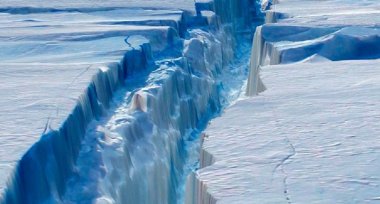
Giant iceberg ‘calves’ from Antarctic ice shelf
Shrinking Antarctic ice shelf Pine Island Glacier sheds giant iceberg, ABC News, Digital Story Innovation Team By Mark Doman 14 Feb 20, In one of the fastest-changing areas of the Antarctic ice sheet, satellites have captured the formation of a giant, 300-square-kilometre iceberg.
Researchers monitoring satellite imagery of the Pine Island Glacier (PIG), in west Antarctica, first noticed two large rifts forming in the shelf in 2019.
Over the next few months, as the glacier moved out towards the Amundsen Sea, the rifts expanded, eventually leading to the splitting of the iceberg from the glacier on February 9.
Within a day, the iceberg had broken up into smaller pieces.
Only one of the pieces was large enough to be named (B-49) and tracked by the United States National Ice Centre.
It comes just days after a station on the Antarctic Peninsula logged its hottest day on record, registering a temperature of 18.3 degrees Celsius.
The peninsula, which juts out to the north-east of the Pine Island Glacier, is among the fastest-warming regions on the planet. Temperatures there have increased almost 3C over the last 50 years, according to the World Meteorological Organisation.
Last month, scientists also recorded unusually warm water beneath the Thwaites Glacier, a neighbour to Pine Island.
While the calving of icebergs from shelves such as the Pine Island Glacier is a natural process in the life of a giant glacier, the rate at which this glacier and others in the region have been disintegrating is a cause of concern for scientists.
Previously the ice shelf calved once a decade. By the early 2000s, it started calving once every five years. But since 2013, the glacier has calved five times, according to Stef Lhermitte, a remote sensing scientist from the Delft University of Technology in the Netherlands……. https://www.abc.net.au/news/2020-02-13/antarctic-ice-shelf-pine-island-glacier-sheds-giant-iceberg/11957770
Antarctic ice sheets could be at greater risk of melting than previously thought
|
|
|
Radioactive chlorine from nuclear bomb tests still present in Antarctica
|
Radioactive chlorine from nuclear bomb tests still present in Antarctica, Phys Org, by Abigail Eisenstadt, American Geophysical Union 16 Oct 19, Antarctica’s ice sheets are still releasing radioactive chlorine from marine nuclear weapons tests in the 1950s, a new study finds. This suggests regions in Antarctica store and vent the radioactive element differently than previously thought. The results also improve scientists’ ability to use chlorine to learn more about Earth’s atmosphere. Scientists commonly use the radioactive isotopes chlorine-36 and beryllium-10 to determine the ages of ice in ice cores, which are barrels of ice obtained by drilling into ice sheets. Chlorine-36 is a naturally occurring radioactive isotope, meaning it has a different atomic mass than regular chlorine. Some chlorine-36 forms naturally when argon gas reacts with cosmic rays in Earth’s atmosphere, but it can also be produced during nuclear explosions when neutrons react with chlorine in seawater. Nuclear weapons tests in the United States carried out in the Pacific Ocean during the 1950s and the 1960s caused reactions that generated high concentrations of isotopes like chlorine-36. The radioactive isotope reached the stratosphere, where it traveled around the globe. Some of the gas made it to Antarctica, where it was deposited on Antarctica’s ice and has remained ever since. Other isotopes produced by marine nuclear bomb testing have mostly returned to pre-bomb levels in recent years. Scientists expected chlorine-36 from the nuclear bomb tests to have also rebounded. But new research in AGU’s Journal of Geophysical Research: Atmospheres finds the Vostok region of Antarctica is continuing to release radioactive chlorine into the atmosphere. Since naturally produced chlorine-36 is stored permanently in layers of Antarctica’s snow, the results indicate the site surprisingly still has manmade chlorine produced by bomb tests in the 1950s and in the 1960s……… https://phys.org/news/2019-10-radioactive-chlorine-nuclear-antarctica.html |
|
Surface melting causes Antarctic glaciers to slip faster towards the ocean
Direct link between surface melting and short bursts of glacier acceleration in Antarctica
- Date:
- September 20, 2019
- Source:
- University of Sheffield
- Summary:
- Study shows for the first time a direct link between surface melting and short bursts of glacier acceleration in Antarctica. During these events, Antarctic Peninsula glaciers move up to 100% faster than average. Scientists call for these findings to be accounted for in sea level rise predictions…….
https://www.sciencedaily.com/releases/2019/09/190920111355.htm
One million species at risk of extinction, UN report warns, and we are mostly to blame

ABC , By Lexi Metherell 6 May 19,
One million of the world’s species are now under threat of extinction, according to the biggest-ever review of the state of nature on Earth.
Key points:
- The report, which draws on 15,000 scientific and government sources, says human use of land and ea resources are mostly to blame
- The decline in nature is happening at rates that are unprecedented in human history, the UN report reveals
- More than 40 per cent of amphibian species, almost 33 per cent of reef-forming corals and more than a third of all marine mammals are threatened
The UN-backed report was three years in the making and was based on systematic reviews of 15,000 scientific and government sources.
Among a vast number of alarming findings is that the average population size of native species in most habitats on land has fallen by at least 20 per cent, mostly since 1900.
More than 40 per cent of amphibian species, almost 33 per cent of reef-forming corals and more than a third of all marine mammals are now under threat.
“We are eroding the very foundations of our economies, livelihoods, food security, health and quality of life worldwide,” said Sir Robert Watson, the chair of the Intergovernmental Science-Policy Platform on Biodiversity and Ecosystem Services (IPBES), which put together the report.
The IPBES has 132 nation-members and is known as the equivalent of the Intergovernmental Panel on Climate Change (IPCC), but for biodiversity.
Human expansion and exploitation of habitats to blame
The report says that human use of the land and sea resources are mostly to blame, followed by direct exploitation of animals, climate change, pollution and invasive species.
More than a third of the world’s land surface and nearly 75 per cent of freshwater resources are now devoted to crop or livestock production, while urban areas have more than doubled since 1992.
Meanwhile, 300-400 million tonnes of heavy metals, solvents, toxic sludge and other waste is dumped into the world’s waters every year.
The decline in nature is happening at rates that are unprecedented in human history.
“It’s like reading a paper that says the natural world is in catastrophic decline and there is a chance that this catastrophe will take us all down with it,” said Tim Beshara, federal policy director of Wilderness Society.
Humanity is causing a slow-motion apocalypse of the natural world and that’s getting faster and faster as time goes on.”…………
Next year is a big year for global conservation. The signatories to the Convention on Biological Diversity, which is the global treaty meant to safeguard biodiversity, are scheduled to meet and sign a new post-2020 strategic plan.
Professor Watson said it’s an opportunity to reset the clock and design a global deal for nature and biodiversity.
“The sad thing is Australia has gone missing in these negotiations, they haven’t even turned up to the last major international negotiations around this matter, and as you are seeing in the federal election, biodiversity is just not even mentioned,” he said.
“That’s a shame because Australia is one of the few mega-biodiverse countries around the world — we have more species than just about every other country.” https://www.abc.net.au/news/2019-05-06/biggest-global-assessment-of-biodiversity-sounds-dire-warnings/11082940
Antarctic ocean heating up – caused by greenhouse gas emissions and ozone depletion
 What’s Causing Antarctica’s Ocean to Heat Up? New Study Points to 2 Human Sources
Sea levels could rise by up to 30 feet, due to Antarctic melting

At this rate, Earth risks sea level rise of 20 to 30 feet, historical analysis shows New research finds that a vast area of Antarctica retreated when Earth’s temperatures weren’t much warmer than they are now, WP Chris Mooney, September 20 2018
Temperatures not much warmer than the planet is experiencing now were sufficient to melt a major part of the East Antarctic ice sheet in Earth’s past, scientists reported Wednesday, including during one era about 125,000 years ago when sea levels were as much as 20 to 30 feet higher than they are now.
“It doesn’t need to be a very big warming, as long as it stays 2 degrees warmer for a sufficient time, this is the end game,” said David Wilson, a geologist at Imperial College London and one of the authors of the new research, which was published in Nature. Scientists at institutions in Australia, New Zealand, Japan and Spain also contributed to the work.
The research concerns a little-studied region called the Wilkes Subglacial Basin, which is roughly the size of California and Texas combined and contains more than 10 feet of potential sea-level rise. Fronted by three enormous glaciers named Cook, Mertz and Ninnis, the Wilkes is known to be vulnerable to fast retreat because the ice here is not standing on land and instead is rising up from a deep depression in the ocean floor.
Moreover, that depression grows deeper as you move from the current icy coastline of the Wilkes farther inland toward the South Pole, a downhill slope that could facilitate rapid ice loss.
What the new science adds is that during past warm periods in Earth’s history, some or all of the ice in the Wilkes Subglacial Basin seems to have gone away. That’s an inference researchers made by studying the record of sediments in the seafloor just off the coast of the current ice front……..
Humans have caused about 1 degree Celsius (1.8 degrees Fahrenheit) of warming above the preindustrial planetary temperatures experienced before the year 1880 or so. The world has pledged to avoid a warming above 2 degrees Celsius, and even hopes to hold the warming to 1.5 degrees, but current promises made by countries are not nearly enough to prevent these outcomes.
n other words, we are already on a course that could heat the planet enough to melt some or all of the Wilkes Basin.
“We say 2 degrees beyond preindustrial, and we’re already beyond preindustrial,” Wilson said. “So this is potentially the kinds of temperatures we could see this century.”
The study cannot reveal, however, just how quickly ice emptied out of the Wilkes Basin. The past warm periods in question are thought to have been driven by slight variations in Earth’s orbit as it rotates around the sun, leading to stronger summer heat. That warmth was maintained for thousands of years.
…….. The new research “contributes to the mounting pile of evidence that East Antarctica is not as stable as we thought,” Isabella Velicogna, a glaciologist at the University of California at Irvine, said by email. Velicogna was not directly involved in the paper…….https://www.washingtonpost.com/energy-environment/2018/09/20/antarctica-warming-could-fuel-disastrous-sea-level-rise-study-finds/?utm_term=.7c426ea2a985
New Zealand’s Antarctic veterans are advised on effects of their exposure to nuclear radiation
New Zealand warns its Antarctic veterans about radiation risks from leaky US Navy reactor https://www.stripes.com/news/new-zealand-warns-its-antarctic-veterans-about-radiation-risks-from-leaky-us-navy-reactor-1.533546 By SETH ROBSON | STARS AND STRIPES June 19, 2018
The New Zealand government is warning personnel who worked in Antarctica in the 1960s and ‘70s about radiation from a leaky U.S. Navy reactor.
Alerts were posted online by the New Zealand Defence Force, Antarctica New Zealand and other government entities in January and reported by local media last month.
They advise people to contact the New Zealand Office of Radiation Safety or their doctor if they think they may have been exposed to radiation from the reactor used to power McMurdo Station, Antarctica, from 1962 to 1979.
The U.S. Department of Defense has assessed the risk of radiation exposure for those who worked near the power plant as low.
However, the Department of Veterans Affairs ruled in November that retired Navy veteran James Landy’s “esophageal, stomach, liver, and brain and spine cancers, [were] incurred in active duty service.”
Landy worked at McMurdo as a C-130 flight engineer from 1970 to 1974 and from 1977 to 1981 before dying at age 63 in 2012, said his widow, Pam Landy.
He had pain in his kidneys and went to the doctor and they sent him to an oncologist who said he had cancer from radiation exposure,” she said in a phone interview Monday from her home in Pensacola, Fla.
Veterans who served in Antarctica should have been warned about the radiation risk, Pam Landy said.
“The government knew that thing was there. If they had given people a heads up he could have been diagnosed early and might have a shot at being alive,” she said. “I got a payout from the VA, but it’s a pittance compared to a life.”
The McMurdo reactor had many malfunctions, but personnel might also have been exposed during its decommissioning when soil and rock from the site was trucked through the base to be shipped off the continent, she said.
Peter Breen, 64, was a New Zealand Army mechanic about 2 miles from McMurdo at Scott Base from 1981 to 1982. Rock and soil from the reactor site was taken to a wharf in open trucks, and Breen fears he could have been exposed to contaminated dust blown by the wind or on ice harvested from nearby cliffs.
He’s campaigning for New Zealand Antarctic veterans to be recognized with a medal and offered health checks.
“It is not compensation that guys are after,” he said in a phone interview from his home in Tauranga, New Zealand. “They want a health-check program.”
robson.seth@stripes.com
Twitter: @SethRobson1
Faster global warming predicted, with new Antarctic study
Climate Central By Mikayla Mace, Arizona Daily Star 10 June 18
A group of scientists, including one from the University of Arizona, has new findings suggesting Antarctica’s Southern Ocean — long known to play an integral role in climate change — may not be absorbing as much pollution as previously thought.
To reach their contradictory conclusion, the team used state-of-the-art sensors to collect more data on the Southern Ocean than ever before, including during the perilous winter months that previously made the research difficult if not impossible.The old belief was the ocean pulled about 13 percent of the world’s carbon dioxide — a greenhouse gas that contributes to climate change — out of the atmosphere, helping put the brakes on rising global temperatures.
Some oceanographers suspect that less CO2 is being absorbed because the westerlies — the winds that ring the southernmost continent — are tightening like a noose. As these powerful winds get more concentrated, they dig at the water, pushing it out and away.
Water from below rises to take its place, dragging up decaying muck made of carbon from deep in the ocean that can then either be released into the atmosphere in the form of CO2 or slow the rate that CO2 is absorbed by the water. Either way, it’s not good.
The Southern Ocean is far away, but “for Arizona, this is what matters,” said Joellen Russell, the University of Arizona oceanographer and co-author on the paper revealing these findings. “We don’t see the Southern Ocean, and yet it has reached out the icy hand.”
Oceans, rivers, lakes and vegetation can moderate extreme changes in temperature. Southern Arizona has no such buffers, leaving us vulnerable as average global temperatures march upward.
“Everybody asks, ‘Why are you at the UA?’” Russell said about studying the Southern Ocean from the desert at the University of Arizona. She said the research is important to Arizona and the university supports her work.
…….. scientists know less about the Southern Ocean than the rest of the world’s oceans. What they do know is mostly limited to surface CO2 levels in the summer, when it’s safer to take measurements by ships with researchers aboard. Shipboard sensors that directly measure CO2 are the accepted scientific standard in these types of studies.
Understanding CO2 levels within the air, land and sea and how it is exchanged between the three is necessary for making more accurate future climate predictions.
To fill the gap in knowledge, Russell and her team have deployed an array of cylindrical tanks, called floats, that collect data on carbon and more in the Southern Ocean year-round. Russell leads the modeling component of this project called Southern Ocean Carbon and Climate Observations and Modeling, or SOCCOM.
The floats drift 1,000 meters below the surface. Every 10 days, they plunge a thousand meters deeper, then bob up to the surface before returning to their original depth.
For three years, 35 floats equipped with state-of-the-art sensors the size of a coffee cup have been collecting data along the way and beaming it back to the researchers, like Russell in Tucson. Within hours, the data is freely available online.
They measure ocean acidity, or pH, and other metrics to understand the biogeochemistry of the elusive ocean, but not without controversy.
Making a splash
Alison Gray, an oceanographer at the University of Washington, is the lead author on the study. She said there are two reasons the study may contradict what has previously been thought of about the Southern Ocean: The lack of winter-time observations at the ocean by other researchers and the fact that ocean carbon levels might vary throughout the year.
So while SOCCOM is making it possible to get more data than ever before, others question her nontraditional methods. ………http://www.climatecentral.org/news/antarctic-ocean-discovery-warns-of-faster-global-warming-21865
Thorium nuclear power – not so great, really
Today, advocates of thorium typically point to a variety of advantages over uranium. These include fail-safe reactor operation, because most thorium reactor designs are incapable of an explosion or meltdown, as was seen at Chernobyl or Fukushima. Another is resistance to weapons proliferation, because thorium reactors create byproducts that make the fuel unsuitable for use in nuclear weapons.Other advantages include greater abundance of natural reserves of thorium, less radioactive waste and higher utilisation of fuel in thorium reactors. Thorium is often cast as “good nuclear”, while uranium gets to carry the can as “bad nuclear”.
Not so different
While compelling at first glance, the details reveal a somewhat more murky picture. The molten salt architecture which gives certain thorium reactors high intrinsic safety equally applies to proposed fourth-generation designs using uranium. It is also true that nuclear physics technicalities make thorium much less attractive for weapons production, but it is by no means impossible; the USA and USSR each tested a thorium-based atomic bomb in 1955.
Other perceived advantages similarly diminish under scrutiny. There is plenty of uranium ore in the world and hence the fourfold abundance advantage of thorium is a moot point. Producing less long-lived radioactive waste is certainly beneficial, but the vexed question remains of how to deal with it.
Stating that thorium is more efficiently consumed is the most mischievous of the claimed benefits. Fast-breeder uranium reactors have much the same fuel efficiency as thorium reactors. However, they weren’t economic as the price of uranium turned out to rather low.
Global warming is melting Antarctic ice from below
 Warming oceans melting Antarctic ice shelves could accelerate sea level rise, Guardian, John Abraham, 9 May 18, “……With global warming, both of the poles are warming quite quickly, and this warming is causing ice to melt in both regions. When we think of ice melting, we may think of it melting from above, as the ice is heated from the air, from sunlight, or from infrared energy from the atmosphere. But in truth, a lot of the melting comes from below. For instance, in the Antarctic, the ice shelves extend from the land out over the water. The bottom of the ice shelf is exposed to the ocean. If the ocean warms up, it can melt the underside of the shelf and cause it to thin or break off into the ocean.
A new study, recently published in Science Advances, looked at these issues. One of the goals of this study was to better understand whether and how the waters underneath the shelf are changing. They had to deal with the buoyancy of the waters. We know that the saltier and colder water is, the denser it is.
Around Antarctica, water at the ocean surface cools down and becomes saltier. These combined effects make the surface waters sink down to the sea floor. But as ice melt increases, fresh water flows into the ocean and interrupts this buoyancy effect. This “freshening” of the water can slow down or shut down the vertical mixing of the ocean. When this happens, the cold waters at the surface cannot sink. The deeper waters retain their heat and melt the ice from below.
The study incorporated measurements of both temperature and salinity (saltiness) at three locations near the Dalton Iceberg Tongue on the Sabrina Coast in East Antarctica. The measurements covered approximately an entire year and gave direct evidence of seasonal variations to the buoyancy of the waters. The researchers showed that a really important component to water-flow patterns were ‘polynyas.’ These are regions of open water that are surrounded by ice, typically by land ice on one side and sea ice on the other side.
When waters from the polynya are cold and salty, the waters sink downwards and form a cold curtain around the ice shelf. However, when the waters are not salty (because fresh water is flowing into the polynya), this protective curtain is disrupted and warm waters can intrude from outside, leading to more ice melt.
Based on this study, we may see increased ice loss in the future – sort of a feedback loop. That concerns us because it will mean more sea level rise (which is already accelerating), and more damage to coastal communities. I asked the lead author, Alesandro Silvano about this work:
We found that freshwater from melting ice shelves is already enough to stop formation of cold and salty waters in some locations around Antarctica. This process causes warming and freshening of Antarctic waters. Ocean warming increases melting of the Antarctic Ice Sheet, causing sea level to rise. Freshening of Antarctic waters weakens the currents that trap heat and carbon dioxide in the ocean, affecting the global climate. In this way local changes in Antarctica can have global implications. Multiple sources of evidence exist now to show that these changes are happening. However, what will happen in Antarctica in the next decades and centuries remains unclear and needs to be understood.
This is just another reason to take scientists seriously and act to slow down climate change before it is too late. https://www.theguardian.com/environment/climate-consensus-97-per-cent/2018/may/09/global-warming-is-melting-antarctic-ice-from-below
Drastic action on fossil fuels is needed, as the Poles melt – with unpredictable consequences
The Guardian view on Antarctica: the worrying retreat of the ice https://www.theguardian.com/commentisfree/2018/apr/05/the-guardian-view-on-antarctica-the-worrying-retreat-of-the-ice Editorial
The only thing more frightening than an advancing glacier may be one that is shrinking and raising sea levels round the world
Both the north pole and the south pole are situated in the middle of huge ice deserts which are melting around the edges under the influence of human activity. The difference that matters between them is that the ice of the Arctic floats: if it melted nothing much would happen to aggregate sea levels. The ice of Antarctica, like that of Greenland, rests on land. If it all were to melt, as it has done in the far distant past, sea levels could rise by as much as 60 metres. That is most unlikely to happen. What is possible, though, is that the smaller portion of the continent, west Antarctica, which is divided from the rest by a mountain range, could lose much of its ice. Even that would be catastrophic. A significant retreat in west Antarctica, as seems to be already under way, could raise sea levels by between one and three metres by the end of this century. Children now alive will see that happen across their lifetimes. That is what is meant by the urgency of global warming.
Previous surveys have concentrated on a few of the glaciers that are an obvious danger but the research released this week analysed satellite data covering the whole of the coastline of west Antarctica to reach its worrying conclusions. The problem is worsened by the shape of the seabed on which the glaciers now rest. It does not slope towards the deep ocean, but inwards, forming a bowl of which the far side is the mountain range that divides the continent. That means that the process of erosion will be working downhill as it moves inwards, with faster and less predictable results.
The present danger was discovered by measuring the thickness of the ice sheet from space and deducing from this the shape of the glacier beneath. This is much easier than knowing what to do. The contrast between the exquisite technological sophistication employed in the diagnosis of the problem and the lack of international coordination or political sophistication when it comes to solving it, illustrates the crisis of technological civilisation. As a species we have shown enough cleverness to disrupt the world’s climate, but may not have enough to remedy the damage that we’ve done. Things are of course made very much worse by the presence in the White House of an aggressively ignorant and anti-scienceadministration.
Predicting the future of these changes isn’t an exact science, which is one of the things which makes them so frightening, but neither is it entirely guesswork. Ignorance about the size of the threatened rise in sea levels is no excuse for inaction. We know it’s coming. We know it will be disruptive. We don’t know if it will be catastrophic. But the possibility must spur us into drastic action on fossil fuels. Keep them in the ground.
Warm water underneath Antarctica’s great ice sheet is eroding it
Antarctica retreating across the sea floor, EurekAlert , UNIVERSITY OF LEEDS , 3 April 18 Antarctica’s great ice sheet is losing ground as it is eroded by warm ocean water circulating beneath its floating edge, a new study has found.
Research by the UK Centre for Polar Observation and Modelling (CPOM) at the University of Leeds has produced the first complete map of how the ice sheet’s submarine edge, or “grounding line”, is shifting. Most Antarctic glaciers flow straight into the ocean in deep submarine troughs, the grounding line is the place where their base leaves the sea floor and begins to float.
Their study, published today in Nature Geoscience, shows that the Southern Ocean melted 1,463 km2 of Antarctica’s underwater ice between 2010 and 2016 – an area the size of Greater London.
The team, led by Dr Hannes Konrad from the University of Leeds, found that grounding line retreat has been extreme at eight of the ice sheet’s 65 biggest glaciers. The pace of deglaciation since the last ice age is roughly 25 metres per year. The retreat of the grounding line at these glaciers is more than five times that rate.
The biggest changes were seen in West Antarctica, where more than a fifth of the ice sheet has retreated across the sea floor faster than the pace of deglaciation……….https://www.eurekalert.org/pub_releases/2018-04/uol-ara032918.php
1 This Month


Tell the Ukrainian Government to Drop Prosecution of Peace Activist Yurii Sheliazhenko

Petition to revoke the licensing of the Near Surface Nuclear Disposal Facility (NSDF) at Chalk River. https://www.ourcommons.ca/petitions/en/Petition/Details?Petition=e-7247


of the week – STOP SMALL MODULAR REACTORS IN CANADA
To see nuclear-related stories in greater depth and intensity – go to https://nuclearinformation.wordpress.com
-
Archives
- March 2026 (183)
- February 2026 (268)
- January 2026 (308)
- December 2025 (358)
- November 2025 (359)
- October 2025 (376)
- September 2025 (258)
- August 2025 (319)
- July 2025 (230)
- June 2025 (348)
- May 2025 (261)
- April 2025 (305)
-
Categories
- 1
- 1 NUCLEAR ISSUES
- business and costs
- climate change
- culture and arts
- ENERGY
- environment
- health
- history
- indigenous issues
- Legal
- marketing of nuclear
- media
- opposition to nuclear
- PERSONAL STORIES
- politics
- politics international
- Religion and ethics
- safety
- secrets,lies and civil liberties
- spinbuster
- technology
- Uranium
- wastes
- weapons and war
- Women
- 2 WORLD
- ACTION
- AFRICA
- Atrocities
- AUSTRALIA
- Christina's notes
- Christina's themes
- culture and arts
- Events
- Fuk 2022
- Fuk 2023
- Fukushima 2017
- Fukushima 2018
- fukushima 2019
- Fukushima 2020
- Fukushima 2021
- general
- global warming
- Humour (God we need it)
- Nuclear
- RARE EARTHS
- Reference
- resources – print
- Resources -audiovicual
- Weekly Newsletter
- World
- World Nuclear
- YouTube
-
RSS
Entries RSS
Comments RSS
 nuclear-news