Antarctic sea ice ‘behaving strangely’ as Arctic reaches ‘below-average’ winter peak
Carbon Brief, AYESHA TANDON, 26 Mar 24,
Antarctic sea ice is “behaving strangely” and might have entered a “new regime”, the director of the US National Snow and Ice Data Centre (NSIDC) tells Carbon Brief.
Following an all-time low maximum in September 2023, Antarctic sea ice has been tracking at near-record-low extent for the past six months. Last month, it hit its 2024 minimum extent, tying with 2022 for the second-lowest Antarctic minimum in the 46-year satellite record.
Dr Mark Serreze, director of the NSIDC tells Carbon Brief that more warm ocean water is reaching the surface to melt ice and keep it from forming. He says that we “must wait and see” whether this is a “temporary effect” or whether the Antarctic has entered a “new regime”.
Meanwhile, Arctic sea ice has reached its maximum extent for the year, peaking at 15.01m square kilometres (km2) on 14 March. The provisional data from the NSIDC shows that this year’s Arctic winter peak, despite favourable winds that encouraged sea ice formation, was 640,000km2 smaller than the 1981-2010 average maximum.
This year’s maximum was the 14th lowest in the satellite record…………………………………………………………………………………………………………………………………………………..
Record-breaking Antarctic extent
Antarctic sea ice has been tracking at or near record-low levels for months.
The Antarctic set a record-low maximum on 10 September 2023, with an extent of 16.96m km2. This was “the lowest sea ice maximum in the 1979 to 2023 sea ice record by a wide margin”, and one of the earliest, the NSIDC says.
Antarctic conditions over 2023 were “truly exceptional” and “completely outside the bounds of normality”, one expert told Carbon Brief.
As 2023 progressed, Antarctic sea ice melt was “slower than average”, the NSIDC says. The total decline in Antarctic sea ice extent through October was 903,000km2, while the October average was 985,000km2.
Nevertheless, Antarctic sea ice extent continued to track at a record low. On 31 October 2023, Antarctic sea ice extent was still tracking at a record-low of 15.79m km2. This is 750,000km2 below the previous 31 October record low………….. more https://www.carbonbrief.org/antarctic-sea-ice-behaving-strangely-as-arctic-reaches-below-average-winter-peak/
New Research from Antarctica Affirms the Threat of the ‘DoomsdayGlacier,’ but Funding to Keep Studying It Is Running Out.
In a worst case scenario, rising global temperatures and marine heatwaves could melt enough of the Thwaites Glacier and other Antarctic ice to raise sea levels 10 feet by the early 2100s.

Inside Climate News, By Bob Berwyn, February 26, 2024
“………………………………………………………….. It took a whole day of sailing just to monitor and map the front of the Thwaites Glacier’s floating shelf, he said, with ice cliffs in some places towering several hundred feet above the water, marking the abrupt edge of an ice expanse about the size of Nebraska and averaging between 2,500 and 4,000 feet thick. If all the ice melts, it would raise average global sea level about 2 feet.
The sediment samples Kirkham and other scientists collected four years ago provided the data for a study published Monday in the Proceedings of the National Academies of Sciences that affirms one of the most serious concerns about Antarctica—that an irreversible meltdown of some of the frozen continent’s ice masses has already started.
“You just can’t ignore what’s happening on this glacier,” said lead author Rachel Clark, a University of Houston ice researcher who also works with the International Thwaites Glacier Collaboration, a team that has been trying to figure out just how fast the vulnerable ice will melt. But, she said the new study is important because it shows that the melting is not just random or limited to one glacier.
“It is part of a larger context of a changing climate,” she said.
Not Just Thwaites
After analyzing the chemistry and other characteristics of seafloor sediment grains from various depths and different locations near the floating edge of the glacier, the team’s members were able to show that the glacier had been relatively stable for nearly 10,000 years, since the end of the last ice age, but that it started to retreat in the mid-1940s.
Shifts in regional winds and associated changes in ocean currents are pushing more relatively warm water toward Antarctica’s frozen fringe, melting the ice and loosening it from rocky seafloor anchor points that have held the floating part of the glacier in place for thousands of years. As the ice melts away from the pinning points, it can float to sea and disintegrate faster, allowing the glacier behind it to accelerate toward the ocean. In the last 30 years, the amount of ice flowing out to sea from the Thwaites and Pine Island glacial areas and their associated floating ice shelves has doubled.
……………………………………the Thwaites Glacier, and the neighboring Pine Island Glacier, have kept retreating since the 1940s. …………………..
While the Thwaites Glacier has been identified as being among the most vulnerable to pinning point loss, a similar pattern of melting and retreat in many other Antarctic glaciers and ice shelves at least since the 1970s was documented in a separate study published Feb. 21 in Nature.
………………………………………………………… “We already seem to have pushed the climate and ice sheet system past certain irreversible thresholds, and need to observe and understand more about Thwaites, not less,” said Pam Pearson, founder and director of the International Cryosphere Climate Initiative. “Pleas of ignorance will be little comfort to future generations displaced by Antarctic sea-level rise that we could have stopped had we only acted in time.” https://insideclimatenews.org/news/26022024/new-research-from-antarctica-affirms-threat-of-doomsday-glacier-but-funding-is-running-out/
Antarctica sea ice reaches alarming low for third year in a row

The extent of ice floating around the continent has contracted to below 2m sq km for three years in a row, indicating an ‘abrupt critical transition’
Graham Readfearn, 25 Feb 24 https://www.theguardian.com/world/2024/feb/24/antarctica-sea-ice-reaches-alarming-low-for-third-year-in-a-row
For the third year in a row, sea ice coverage around Antarctica has dropped below 2m sq km – a threshold which before 2022 had not been breached since satellite measurements started in 1979.
The latest data from the US National Snow and Ice Data Center confirms the past three years have been the three lowest on record for the amount of sea ice floating around the continent.
Scientists said another exceptionally low year was further evidence of a “regime shift”, with new research indicating the continent’s sea ice has undergone an “abrupt critical transition”.
Antarctica’s sea ice reaches its lowest extent at the height of the continent’s summer in February each year.
On 18 February the five-day average of sea ice cover fell to 1.99m sq km and on 21 February was at 1.98m sq km. The record low was 1.78m sq km, set in February 2023.
Whether the current level represents this year’s minimum won’t be known for another week or two.
Antarctica sea ice reaches alarming low for third year in a row
The extent of ice floating around the continent has contracted to below 2m sq km for three years in a row, indicating an ‘abrupt critical transition’
Graham Readfearn @readfearnSun 25 Feb 2024
For the third year in a row, sea ice coverage around Antarctica has dropped below 2m sq km – a threshold which before 2022 had not been breached since satellite measurements started in 1979.
The latest data from the US National Snow and Ice Data Center confirms the past three years have been the three lowest on record for the amount of sea ice floating around the continent.
Scientists said another exceptionally low year was further evidence of a “regime shift”, with new research indicating the continent’s sea ice has undergone an “abrupt critical transition”.
Antarctica’s sea ice reaches its lowest extent at the height of the continent’s summer in February each year.
On 18 February the five-day average of sea ice cover fell to 1.99m sq km and on 21 February was at 1.98m sq km. The record low was 1.78m sq km, set in February 2023.
Whether the current level represents this year’s minimum won’t be known for another week or two.
“But we’re confident the three lowest years on record will be the last three years,” said Will Hobbs, a sea ice scientist at the University of Tasmania.
Antarctica’s sea ice reaches its peak each September, but last year’s maximum extent was the lowest on record, easily beating the previous record by about 1m sq km. Scientists were shocked at how much less ice regrew last year, falling well outside anything seen before.
Coverage appeared to recover slightly in December as the refreeze progressed, but then fell away again to the current levels.
There are no reliable measurements of how thick Antarctic sea ice is, but Ariaan Purich, a climate scientist specialising in Antarctica and the Southern Ocean at Monash University, said it was possible the ice that did regrow was thinner than usual.
“It seems plausible, and thinner sea ice could melt back more quickly,” she said.
Scientists are still investigating what is causing the decline in sea ice,, but they are concerned global heating could be playing a role – in particular by warming the Southern Ocean that encircles the continent.
Sea ice reflects solar radiation, meaning less ice can lead to more ocean warming.
Walt Meier, senior research scientist at the National Snow and Ice Data Center, said that since most of the ice melts completely each summer “much of the ice is only 1-2 metres [thick]” – and even less near the ice edge.
“With the very low maximum last September, the ice was probably thinner on average in many areas, but it’s hard to say how much of an effect it has had on the rate of melt and the approaching minimum,” he said.
Antarctica’s ecosystems are tied to the sea ice, from the formation of phytoplankton that can remove carbon from the atmosphere to the breeding sites of penguins.
Purich led research last year that said the continent’s sea ice could have undergone a “regime shift” that was probably driven by warming of the subsurface ocean about 100 metres down.
Research led by Hobbs and colleagues at the Australian Antarctic Program Partnership and other institutions has added evidence to support this claim.
In a paper published this month in the Journal of Climate scientists examined changes in the extent of sea ice and where it was forming each year.
Looking at two periods – 1979 to 2006 and 2007 to 2022 – the researchers found the amount of sea ice had become much more variable, or erratic, in the later period.
This change could not be explained by changes in the atmosphere – mostly winds – which have previously dictated most of the year-to-year variability of the ice.
The study concludes an “abrupt critical transition” has occurred in Antarctica, but Hobbs said they could not say why.
“We don’t know what the driver of change is. It could be ocean warming or a change in ocean salinity,” he said. But it was also possible the change was a natural shift.
Scientists have warned the loss of sea ice is just one of several major changes being observed in Antarctica that is likely to have global consequences – in particular, its loss is exposing more of the continent to the ocean, accelerating the loss of ice on the land, which can push up global sea levels.
Scientists have been increasingly vocal in calling for governments to take the Antarctic changes more seriously and have lamented the comparative lack of data from on and around the continent.
Hobbs said: “What we need is sustained measurements of ocean temperature and salinity underneath the sea ice. We need improvements in our climate models. And we need time.”
Antarctic sea ice at lowest winter level ever
Antarctic sea ice has reached a record low, with an area about seven times
the size of the UK effectively missing. The sea ice surrounding the
continent expands during the southern hemisphere’s winter, on average
peaking at almost 19 million sq km by September before beginning to melt
again.
This year, however, the ice reached 16.96 million sq km. Scientists
at the National Snow and Ice Data Center in the United States confirmed the
winter maximum. The new low is more than 1 million sq km below the previous
record set in 1986. “It is shocking to see, as a sea ice physicist,” Dr
Jeremy Wilkinson, from the survey, said.
Times 25th Sept 2023
https://www.thetimes.co.uk/article/antarctic-sea-ice-lowest-winter-level-ever-record-z9pbvxjvg
Antarctica could become ‘global radiator’ if ice loss continues at the current rate .
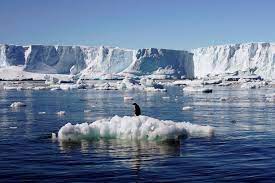
UK homes could be at risk of flooding if Antarctica becomes ‘global
radiator’ and ice melts. Scientists have warned that the Antarctic could
start to absorb solar heat rather than reflect it if ice loss continues at
the current rate, further accelerating global warming. Antarctica is at
risk of becoming a “global radiator”, with the current rate of ice loss
at the upper bounds of previous forecasts, scientists have warned. The
southern continent currently acts to cool the global climate by reflecting
large amounts of solar radiation with its pure white surface. The melting
of ice, and loss of that surface, means it could begin to absorb heat
instead. Melting ice also means that 16 million more people, including in
the UK, could be exposed to flooding every year. The warning came alongside
the publication of a major synthesis paper pulling together Antarctic
scientific research from the last several years to paint a continent-wide
picture.
iNews 8th Aug 2023
Times 8th Aug 2023
https://www.thetimes.co.uk/article/antarctica-global-warming-climate-change-effects-2023-6m7fstwmd
‘Virtually certain’ extreme Antarctic events will get worse without drastic action, scientists warn
It is “virtually certain” that future extreme events in Antarctica
will be worse than the extraordinary changes already observed, according to
a new scientific warning that stresses the case for immediate and drastic
action to limit global heating.
A new review draws together evidence on the
vulnerability of Antarctic systems, highlighting recent extremes such as
record low sea ice levels, the collapse of ice shelves, and surface
temperatures up to 38.5C above average over East Antarctica in 2022 – the
world’s largest ever recorded heatwave.
Guardian 8th Aug 2023
Antarctica ‘suffering’ because of burning fossil fuels, say scientists

Antarctica is “suffering” because of burning fossil fuels which is
causing extreme events that were unthinkable 30 years ago, scientists have
said. Sea ice around the frozen continent is currently at its lowest level
since satellites began observing it in 1979, beating the previous minimum
record set last year.
A winter heatwave in March 2022 saw temperatures soar
nearly 40C above the norm in East Antarctica, from around -50C to -10C, and
had it happened in summer it would have began melting the surface of the
ice sheets which scientists said they have never seen before.
Independent 8th Aug 2023
Scientists monitoring ‘doomsday’ glacier in Antarctic warn climate change happening faster than ever before.
Collapse of the Thwaites glacier and its accompanying ice sheet could lead to more than three metres of sea level rise. The British Antarctic Survey is hoping to find out how fast it might collapse
i news, By Daniel Capurro, Environment Correspondent, June 20, 2023
Antarctica is changing at “a pace that we’ve never seen before” with the potential collapse of key ice sheets threatening three metres of sea level rise in a century, the British Antarctic Survey (BAS) has warned.
Scientists at the BAS, which is launching a new 10-year strategy, are part of a multinational effort to monitor the Thwaites glacier, which has been dubbed the “doomsday glacier”.
The river of ice has retreated more than eight miles since the 90s and is already responsible for 4 per cent of global sea level rises. Were it to melt entirely, this would cause a rise in the sea level of 65 centimetres.
More worryingly, it is thought to be both the keystone and the “weak underbelly” of the West Antarctic Ice Sheet.
If Thwaites were to pass a tipping point and be lost completely, said the BAS, it could potentially lead other glaciers around it to rapidly disintegrate and eventually to the collapse of the entire ice sheet.
Were that to happen, global sea levels would rise by more than three metres, with Cambridge, the headquarters of the BAS, suddenly finding itself on the edge of saltwater marshes.
“There’s this common perception of sea level changes a few millimetres a year, and therefore we all relaxed thinking what are a few millimetres?” said Dr Dominic Hodgson, head of the Ice Sheets and Climate Change team at the British Antarctic Survey. “But when we look back at the historical record, we can see that in the past when ice sheets melted, they do in very non-linear jumps.”
There are periods of meltwater pulses, where essentially an ice sheet collapses and the sea level rises by several metres in the 100 years or so. It’s really rapid.”
BAS scientists are now racing to understand the composition of the bedrock beneath the glacier. Depending on how hard or soft it is could affect whether the glacier takes just five years to disappear or 500, although Dr Alex Brisbourne, who is part of the bedrock team, said the worst-case scenarios already appeared unlikely.
Even without such a collapse, the picture from the Polar regions is a troubling one. “We’ve seen extreme temperatures in Antarctica in the last couple of years, over 20°C, which is completely unsustainable for keeping ice,” said Dr Hodgson.
“We’ve got serious problems happening, starting in the polar regions and spreading out to the rest of the planet that we have to address now,” he said………….
more https://inews.co.uk/news/environment/scientists-racing-doomsday-glacier-change-faster-ever-2422082
Slowing ocean current caused by melting Antarctic ice could have drastic climate impact, study says
The Southern Ocean overturning circulation has ebbed 30% since the 90s, CSIRO scientist claims, leading to higher sea levels and changing weather
Donna Lu, Guardian, 26 May 23
A major global deep ocean current has slowed down by approximately 30% since the 1990s as a result of melting Antarctic ice, which could have critical consequences for Earth’s climate patterns and sea levels, new research suggests.
Known as the Southern Ocean overturning circulation, the global circulation system plays a key role in influencing the Earth’s climate, including rainfall and warming patterns. It also determines how much heat and carbon dioxide the oceans store.
Scientists warn that its slowdown could have drastic impacts, including increasing sea levels, altering weather patterns and depriving marine ecosystems of vital nutrients.
“Changes in the overturning circulation are a big deal,” said the study’s co-author, Dr Steve Rintoul, an oceanographer and expert on the Southern Ocean at the Australian government’s Commonwealth Scientific and Industrial Research Organisation (CSIRO)
It’s something that is a concern because it touches on so many aspects of the Earth, including climate, sea level, and marine life.”
The finding comes months after modelling, which Rintoul was involved in, that predicted a 40% slowdown in the circulation by 2050.
“The model projections of rapid change in the deep ocean circulation in response to melting of Antarctic ice might, if anything, have been conservative,” Rintoul said. “We’re seeing changes have already happened in the ocean that were not projected to happen until a few decades from now.”
………………………………………….. The study looked specifically at changes in overturning circulation in the Australian Antarctic basin, but the researchers believe a “circumpolar slowdown” is occurring.
………………………..
“We expect in the longer term that while there will be ups and downs related to sea ice formation, the overall trend is that Antarctica is losing more ice, is melting more, and that will gradually slow down this overturning circulation.
“Unless we act soon we will commit ourselves to changes that we’d really rather avoid,” he said. “We need to act to reduce emissions and we need to do everything we can as fast as we can.”
The study, whose first author is Kathryn Gunn of the CSIRO and the University of Southampton, was published in the journal Nature Climate Change. https://www.theguardian.com/science/2023/may/25/slowing-ocean-current-caused-by-melting-antarctic-ice-could-have-drastic-climate-impact-study-says
Maori workers exposed to radiation in cleaning up USA’s failed nuclear reactor in Antarctica
Detour: Antarctica – Kiwis ‘exposed to radiation’ at Antarctic power plant, https://www.nzherald.co.nz/travel/detour-antarctica-kiwis-exposed-to-radiation-at-antarctic-power-plant/NY5WTQ72JF4OFUW4F35ZSUCB6U/ 8 Jan, 2022 By Thomas Bywater, Thomas Bywater is a writer and digital producer for Herald Travel
In a major new Herald podcast series, Detour: Antarctica, Thomas Bywater goes in search of the white continent’s hidden stories. In this accompanying text series, he reveals a few of his discoveries to whet your appetite for the podcast. You can read them all, and experience a very special visual presentation, by clicking here. To follow Detour: Antarctica, visit iHeartRadio, or wherever you get your podcasts.
The Waitangi Tribunal will consider whether NZ Defence Force personnel were appropriately warned of potential exposure to radiation while working at a decommissioned nuclear reactor in Antarctica.
It’s among a raft of historic claims dating from 1860 to the present day before the Military Veterans Inquiry.
After an initial hearing in 2016, the Waitangi Tribunal last year admitted the Antarctic kaupapa to be considered alongside the other claims.
“It’s been a bloody long journey,” said solicitors Bennion Law, the Wellington firm representing the Antarctic claimants.
Between 1972 and the early 1980s, more than 300 tonnes of radioactive rubble was shipped off the continent via the seasonal resupply link.
Handled by US and New Zealand personnel without properly measuring potential exposure, the submission argues the Crown failed in its duty of care for the largely Māori contingent, including NZ Army Cargo Team One.
“This failure of active protection was and continues to be in breach of Te Tiriti o Waitangi,” reads the submission.
The rubble came from PM3A, a portable nuclear power unit on Ross Island, belonging to the US Navy. Decommissioned in 1972, its checkered 10-year operating history led it to be known as ‘Nukey Poo’ among base inhabitants. After recording 438 operating errors it was shut off for good.
Due to US obligations to the Antarctic Treaty, nuclear waste had to be removed.
Peter Breen, Assistant Base Mechanic at New Zealand’s Scott Base for 1981-82, led the effort to get similar New Zealand stories heard.
He hopes that NZDF personnel involved in the cleanup of Ross Island might get medallic recognition “similar to those who were exposed at Mururoa Atoll”. Sailors were awarded the Special Service Medal Nuclear Testing for observing French bomb sites in the Pacific in 1973, roughly the same time their colleagues were helping clear radioactive material from Antarctica.
A public advisory regarding potential historic radiation exposure at McMurdo Station was published in 2018.
Since 1975 the Waitangi Tribunal has been a permanent commission by the Ministry of Justice to raise Māori claims relating to the Crown’s obligations in the Treaty of Waitangi.
The current Military Veterans’ Kaupapa includes hearings as diverse as the injury of George Nepata while training in Singapore, to the exposure of soldiers to DBP insecticides during the Malayan Emergency.
Commenced in 2014 in the “centenary year of the onset of the First World War” the Māori military veterans inquiry has dragged on to twice the duration of the Great War.
Of the three claimants in the Antarctic veterans’ claim, Edwin (Chaddy) Chadwick, Apiha Papuni and Kelly Tako, only Tako survives.
“We’re obviously concerned with time because we’re losing veterans,” said Bennion Law.
Detour: Antarctica is a New Zealand Herald podcast. You can follow the series on iHeartRadio, Apple Podcasts, Spotify or wherever you get your podcasts.
Antarctica’s melting ice sheet could retreat much faster than previously thought
Antarctica’s melting ice sheet could retreat much faster than previously
thought, new research suggests. The evidence comes from markings on the
seafloor off Norway that record the pull-back of a melting European ice
sheet thousands of years ago.
Today, the fastest withdrawing glaciers in
Antarctica are seen to retreat by up to 30m a day. But if they sped up, the
extra melt water would have big implications for sea-level rises around the
globe. Ice losses from Antarctica caused by climate change have already
pushed up the surface of the world’s oceans by nearly 1cm since the 1990s.
The researchers found that with the Norwegian sheet, the maximum retreat
was more than 600m a day.
BBC 5th April 2023
The world returns to an era of nuclear angst
Russia’s suspension of its arms control treaty with the US augurs a new period of military deterrence, arms races and instability
EL PAIS, ÓSCAR GUTIÉRREZ, Madrid – FEB 27, 2023
Dmitry Medvedev is currently the deputy chairman of the Security Council of the Russian Federation (SCRF), a consultative body that supports Russian President Vladimir Putin’s decision-making on national security affairs. In April 2010, when the United States and Russia signed the New Strategic Arms Reduction Treaty (New START) in Prague, limiting the nuclear offensive capabilities of both countries, the man in charge in Moscow, at least on paper, was Medvedev, then the president of the country. In late February, Putin suspended the treaty that Obama and Medvedev signed almost 13 years ago. At the New START signing ceremony, Medvedev said, “This will turn a new page for cooperation between our two countries and will create safer conditions for life here and around the world.” Not anymore.
Medvedev is one of the best examples of how nuclear security has changed since the Cold War between the US and Russia. He now fervently supports suspending the treaty he signed in 2010
and said in a Telegram post, “If the US intends to defeat Russia [by providing military support to Ukraine], then we are on the brink of a global conflict. We have the right to defend ourselves with any weapon, including nuclear ones.”
EL PAÍS consulted four arms control and security policy experts on the consequences of Putin’s suspension of the New START treaty. They all concurred that both countries had been complying with limits on warheads, missiles and delivery systems and felt that controlling such weapons would become complicated and potentially lead to a new arms race. Moscow’s move is an attempt to curb Western support for Ukraine, and without New START, there will be more uncertainty, instability and potential nuclear miscalculations. These same words and scenarios defined the Cold War geopolitical tension that dominated US-Russian relations for 40 years after World War II.
“Without the treaty, [the US and Russia] can do whatever they want,” said Olga Oliker, an expert on Russian and Ukrainian security policy for the International Crisis Group. “They can build whatever strategic offensive weapons they feel like and can afford. They won’t be able to verify what the other is or isn’t doing. They will still have intelligence-collecting capabilities but not the inspections, data exchanges and consultations to ensure compliance. Theoretically, they could deceive each other more easily.” Oliker believes the most significant risk in suspending the treaty lies in the potential “misunderstandings” arising from a lack of information.
New START limits the number of immediately deployable nuclear weapons owned by the US and Russia, which account for 90% of the world’s nuclear arsenal. They can only have a maximum of 1,550 deployed warheads and 700 long-range missile delivery systems between ground launchers, submarines and bombers. According to the US State Department, as of September 2022, both countries were below those numbers. It was a drastic reduction compared to the 1991 treaty Ronald Reagan and Mikhail Gorbachev signed. New START also initiated a compliance mechanism that permitted up to 18 inspections a year, regular information exchange and a monitoring commission, all of which are now suspended.
Non-compliance with inspections
Todd Sechser is a professor at the University of Virginia (USA) and a scholar at the Carnegie Endowment for International Peace. “The treaty is important not only because it limits the number of strategic nuclear warheads,” said Sechser, “but because it provides a way for the two countries to build trust. This move undermines that trust.” ……………………………………………………………………….. more https://english.elpais.com/international/2023-02-27/the-world-returns-to-an-era-of-nuclear-angst.html—
‘Extreme situation’: Antarctic sea ice hits record low

Damian Carrington 16 Feb 23
https://www.theguardian.com/world/2023/feb/15/antarctic-sea-ice-hits-record-low-climate-crisis
The area of sea ice around Antarctica has hit a record low, with scientists reporting “never having seen such an extreme situation before”. The ice extent is expected to shrink even further before this year’s summer melting season ends.
The impact of the climate crisis in melting sea ice in the Arctic is clear in the records that stretch back to 1979. Antarctic sea ice varies much more from year to year, which has made it harder to see an effect from global heating.
However, “remarkable” losses of Antarctic sea ice in the last six years indicate that the record levels of heat now in the ocean and related changes in weather patterns may mean that the climate crisis is finally manifesting in the observations.
Scientists were already very concerned about Antarctic ice. Climate models suggested as far back as 2014 that the giant West Antarctic Ice Sheet (WAIS), which sits on the continent, was doomed to collapse due to the levels of global heating already seen then.
The increasing loss of sea ice exposes ice sheets and their glaciers to waves that accelerate their disintegration and melting, researchers warned. A recent study estimated that the WAIS would be tipped into gradual collapse – and four metres of sea level rise – with a global temperature rise as low as 1C, a point already passed.
“I have never seen such an extreme, ice-free situation here before,” said Prof Karsten Gohl, from the Helmholtz Centre for Polar and Marine Research in the Alfred Wegener Institute, Germany, and who first visited the region in 1994.
Gohl, on board the research vessel Polarstern in Antarctica, said: “The continental shelf, an area the size of Germany, is now completely ice-free. It is troubling to consider how quickly this change has taken place.”
Prof Christian Haas, also at the Helmholtz Centre, said: “The rapid decline in sea ice over the past six years is quite remarkable, since the ice cover hardly changed at all in the 35 years before.”
Scientists at the National Snow and Ice Data Center in the US have also said a new record low has been set. They said Antarctic sea ice extent fell to 1.91m square kilometres on 13 February, below the previous record set on 25 February 2022.
Sea ice melts away in the Antarctic summer before starting to grow again as autumn arrives. “In past years, the annual minimum has occurred between 18 February and 3 March, so further decline is expected,” the NSIDC researchers said. “Much of the Antarctic coast is ice free. Earlier studies have linked low sea ice cover with wave-induced stresses on the floating ice shelves that hem the continent, leading to break up of weaker areas.”
The German scientists said the “intense melting” could be due to unusually high air temperatures to the west and east of the Antarctic peninsula, which were about 1.5C above the long-term average. Furthermore, there have been strong westerly winds, which increase sea ice retreat. The result is “intensified melting of ice shelves, an essential aspect of future global sea-level rise”, the researchers said.
Historical records also show dramatic changes in Antarctica, they said. The Belgian research vessel Belgica was trapped in massive pack ice for more than a year in the Antarctic summer 125 years ago, in exactly the same region where the Polarstern vessel is now sailing in completely ice-free waters.
Prof Carlos Moffat, at the University of Delaware, US, and recently returned from a research cruise in the Southern Ocean, told Inside Climate News: “The extraordinary change we’ve seen this year is dramatic. Even as somebody who’s been looking at these changing systems for a few decades, I was taken aback by what I saw.”
Antarctic sea ice level now lowest on record.
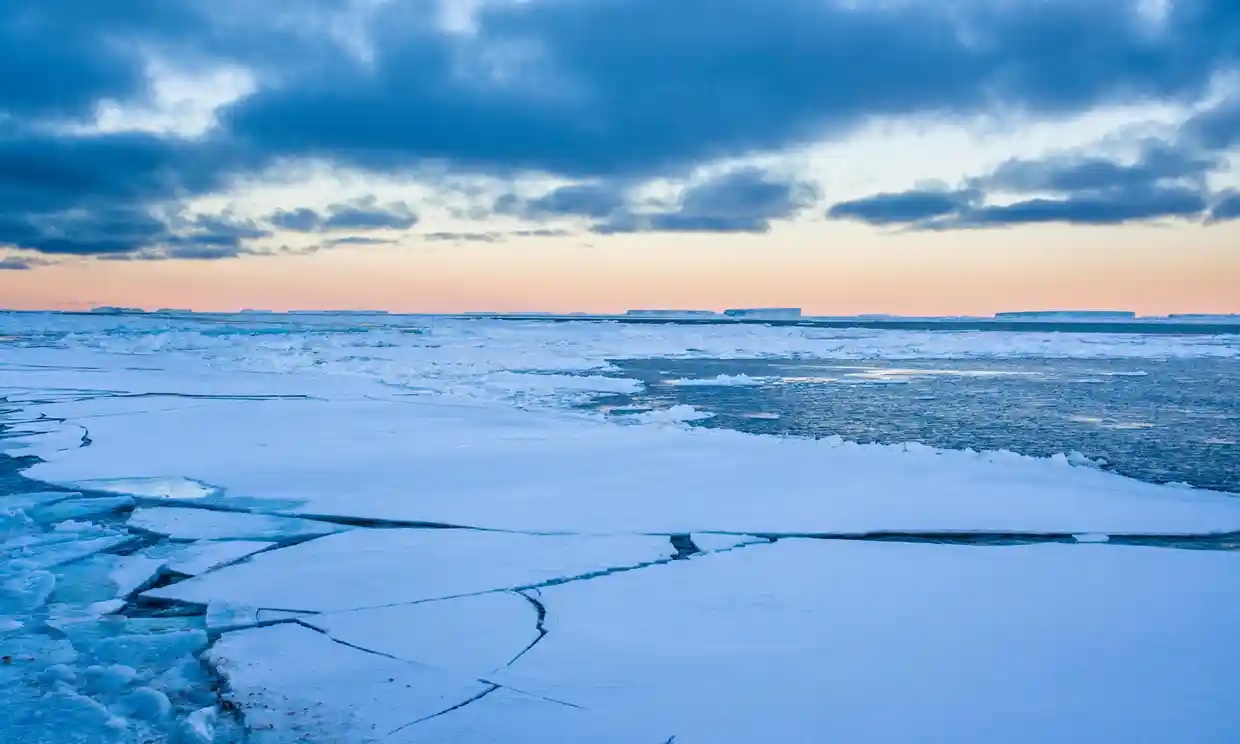
There is now less sea-ice surrounding the Antarctic continent than at any
time since we began using satellites to measure it in the late 1970s. It is
the southern hemisphere summer, when you’d expect less sea-ice, but this
year is exceptional, according to the National Snow and Ice Data Center.
Winds and warmer air and water reduced coverage to just 1.91 million square
km (737,000 sq miles) on 13 February. What is more, the melt still has some
way to go this summer.
BBC 17th Feb 2023
Antarctic “doomsday glacier” melting at faster rate than in past 5,500 years

Two Antarctic glaciers are now losing ice at a faster rate than any time
over the past 5,500 years, with “potentially disastrous” implications for
sea level rise, new research has found. The Thwaites Glacier, known as the
“Doomsday glacier”, due to the grave risk its melting poses to the world,
is around the size of Great Britain, and its neighbour, the Pine Island
Glacier is only slightly smaller. The two glaciers form part of the Western
Antarctic Ice Sheet, which is being impacted by warming temperatures due to
the climate crisis, and are already contributing to global sea level rise.
Independent 16th June 2022
https://www.independent.co.uk/climate-change/news/antarctica-doomsday-glacier-ice-melt-b2102698.html
1 This Month


Tell the Ukrainian Government to Drop Prosecution of Peace Activist Yurii Sheliazhenko

Petition to revoke the licensing of the Near Surface Nuclear Disposal Facility (NSDF) at Chalk River. https://www.ourcommons.ca/petitions/en/Petition/Details?Petition=e-7247


of the week – STOP SMALL MODULAR REACTORS IN CANADA
To see nuclear-related stories in greater depth and intensity – go to https://nuclearinformation.wordpress.com
-
Archives
- March 2026 (183)
- February 2026 (268)
- January 2026 (308)
- December 2025 (358)
- November 2025 (359)
- October 2025 (376)
- September 2025 (258)
- August 2025 (319)
- July 2025 (230)
- June 2025 (348)
- May 2025 (261)
- April 2025 (305)
-
Categories
- 1
- 1 NUCLEAR ISSUES
- business and costs
- climate change
- culture and arts
- ENERGY
- environment
- health
- history
- indigenous issues
- Legal
- marketing of nuclear
- media
- opposition to nuclear
- PERSONAL STORIES
- politics
- politics international
- Religion and ethics
- safety
- secrets,lies and civil liberties
- spinbuster
- technology
- Uranium
- wastes
- weapons and war
- Women
- 2 WORLD
- ACTION
- AFRICA
- Atrocities
- AUSTRALIA
- Christina's notes
- Christina's themes
- culture and arts
- Events
- Fuk 2022
- Fuk 2023
- Fukushima 2017
- Fukushima 2018
- fukushima 2019
- Fukushima 2020
- Fukushima 2021
- general
- global warming
- Humour (God we need it)
- Nuclear
- RARE EARTHS
- Reference
- resources – print
- Resources -audiovicual
- Weekly Newsletter
- World
- World Nuclear
- YouTube
-
RSS
Entries RSS
Comments RSS
 nuclear-news