Bill Gates-backed ‘Cowboy Chernobyl’ nuclear reactor races toward approval in Wyoming
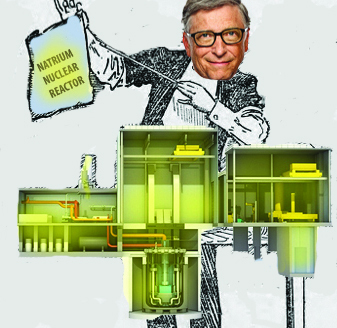
For longtime Wyoming resident Steve Helling, the risks outweigh the promises.
“Wyoming is being used as a guinea pig for this nuclear experiment,”
By Samantha Olander, Jan. 10, 2026
A Bill Gates-backed nuclear reactor dubbed “Cowboy Chernobyl” by critics is barreling toward approval in rural Wyoming, alarming residents and nuclear safety experts as regulators fast-track the project under a Trump-era order.
TerraPower, founded by the Microsoft guru, is seeking federal approval to build the western hemisphere’s first Natrium nuclear reactor in Kemmerer, a coal town of roughly 2,000 people near the Utah border and about two hours north of Salt Lake City.
The plant would use liquid sodium rather than water to cool the reactor, a design pitched as safer and more efficient.
Critics say it introduces new risks while cutting corners on containment.
The United States Nuclear Regulatory Commission completed its final safety evaluation in December, concluding there were no issues that would block issuance of a construction permit.
The five-member commission is expected to vote on the permit later this month. TerraPower still needs a separate operating license before the reactor can run.
Local residents say the fast pace has left them uneasy.
“We’re probably two hours away from that place when it comes to how long it takes the wind to get here,” Patrick Lawien of Casper told the Daily Mail. “Obviously, if anything goes wrong, it’s headed straight for us.”
TerraPower began building the non-nuclear portion of the 44-acre site in June 2024, near the retired Naughton coal plant, which shut down at the end of 2025.
The company says the reactor will generate 345 megawatts of power, with the ability to reach 500 megawatts during peak demand. It aims to have the plant operating by 2030………………………………………
uclear watchdogs say speed is the problem.
The Union of Concerned Scientists, a nonprofit science advocacy group, says TerraPower’s design omits the traditional concrete containment structure used at U.S. nuclear plants.
The company instead proposes “functional containment,” which relies on internal engineered systems to perform containment functions rather than a physical containment building.
“The potential for rapid power excursions and the lack of a real containment make the Kemmerer plant a true ‘Cowboy Chernobyl,’” said Edwin Lyman, the group’s director of nuclear power safety.
Lyman warned that if containment proves inadequate later, it would be nearly impossible to add a traditional containment structure once construction begins.
He also criticized the sodium cooling system.
“Its liquid sodium coolant can catch fire, and the reactor has inherent instabilities that could lead to a rapid and uncontrolled increase in power,” Lyman said….
Concerns intensified after the NRC wrapped up its review months ahead of its original schedule.
The accelerated timeline followed an executive order signed by Donald Trump in May directing federal agencies to fast-track advanced nuclear reactor approvals,
TerraPower applied for its construction permit in March 2024 and received preliminary approval in December, well ahead of its initial August 2026 target.
For longtime Wyoming resident Steve Helling, the risks outweigh the promises.
“Wyoming is being used as a guinea pig for this nuclear experiment,” Helling told the Daily Mail. “Wyoming has everything I could want, beauty, clean air, clean water, wildlife, abundant natural resources.”
He said he worries about the long-term cost of disposing of nuclear waste decades down the road, as the U.S. still lacks a permanent storage solution.
Some states, including California and Connecticut, prohibit new nuclear plant construction unless the federal government establishes a long-term solution for radioactive waste storage.
Ontario Power Generation seeks rate increase for electricity from nuclear plants
Matthew McClearn, 13 Jan, 26 https://www.theglobeandmail.com/business/article-ontario-power-generation-rate-increase-application-electricity-nuclear
The Pickering Nuclear Generation Station in January, 2020. In November the Ontario government approved the $26.8-billion refurbishment of four aging reactors at the station.
Ontario Power Generation is seeking a near-doubling of payments it receives for electricity produced by its nuclear power plants, a request that could lead to surging power bills.
In a rate application submitted to the Ontario Energy Board in December, OPG requested payments of nearly $207 dollars per megawatt hour produced by its nuclear power stations beginning Jan. 1, 2027, roughly double what it received as recently as last year. It seeks similar amounts for each year through 2031.
OPG spokesperson Neal Kelly said the sought rates would cause a typical residential customer’s payments to rise by roughly 2.4 per cent annually in each of the next five years.
Ontario has generated roughly half of its power in recent years from its Darlington, Pickering and Bruce nuclear stations. (The latter is operated by private power producer Bruce Power and is not part of OPG’s application.) Energy Minister Stephen Lecce is pursuing an aggressive expansion of the reactor fleet to meet an expected surge in demand for electricity between now and mid-century, which includes plans to build large new multi-reactor stations.
Chelsea McGee, a spokesperson for Mr. Lecce, referred an interview request from The Globe and Mail to the OEB and OPG.
The requested payment increases require the board’s approval. OEB spokesperson Tom Miller said it would be inappropriate to comment on OPG’s application because it is before a panel of commissioners. Mr. Miller said it will be adjudicated later this year.
Made in Canada: Inside an urban Toronto facility making uranium fuel for CANDU reactors
OPG is entering a period of intense capital spending. Last year, it began constructing the first of four new small modular reactors at its Darlington station, with an estimated cost of $20.9-billion. OPG said that project accounts for about one-quarter of the sought payment increases.
Far more consequential, at 60 per cent of the payment increase, is the $26.8-billion refurbishment of four aging reactors at Pickering station. The government approved that overhaul in November; it’s expected to wrap up in the mid-2030s.
OPG is also spending to refurbish many of its hydroelectric stations.
“Every investment in the application has been carefully evaluated, planned prudently and designed to provide long-term value to Ontarians,” Mr. Kelly wrote in a statement.
Mark Winfield, a professor at York University’s environmental faculty, said that because OPG’s projects have been approved by the government, the OEB has little room to disallow the payment increases sought by the utility.
“They can’t really say no to OPG,” he said.
“The system runs by political fiat, and all the agencies are basically mandated to fulfill the minister’s will.”
Ontario to spend $1.5-billion on underwater electricity cable from nuclear plant to Toronto
Ontario’s residential electricity rates previously increased 29 per cent on Nov. 1. The OEB attributed those hikes to “higher-than-expected generation costs” as well as increased spending on conservation programs, but it provided few additional details. Those rate hikes were largely offset by a 23.5-per-cent increase in the Ontario Electricity Rebate, a taxpayer-funded instrument the government uses to provide relief on residential power bills.
The Globe twice requested interviews with OEB officials in December to explore the role rising nuclear costs played in the Nov. 1 rate increases. Mr. Miller denied those requests but agreed to answer questions by e-mail. The Globe sent questions to the OEB on Jan. 5, but had not received responses by late Monday.
A report by Power Advisory LLC, a consultancy that performed work for the OEB related to the Nov. 1 rate increases, attributed them partly to “higher-than-expected nuclear generation.” That report noted payments for OPG’s nuclear generation rose to $123.76 per megawatt hour in 2026, as compared with $111.61 per megawatt hour last year.
The current trajectory for power rates has attracted concern from the Association of Major Power Consumers in Ontario, which represents industrial power users including automakers Ford Motor Co. and Toyota Motor Corp., and steel producers Stelco and ArcelorMittal Dofasco.
AMPCO president Brad Duguid said the province has no choice but to overhaul and expand its nuclear fleet – a decision he argued will preserve the provincial grid’s reliability. But he’s concerned that industrial power rates are already “skyrocketing” for AMPCO’s members – increases he mainly attributed to rising natural gas generation as reactors are taken offline for refurbishment.
“Over the next seven to 10 years, we’re seeing significant increases in the market energy rates to make up that difference,” he said.
“We’re talking about increases in the range of 165 per cent for the market rate over the next three years alone. That’s untenable. That’s an absolute threat to the competitiveness of our industrial sector and the hundreds of thousands of jobs it supports.”
Ottawa, Ontario pledge combined $3-billion for new nuclear reactors
Jack Gibbons, chair of the Ontario Clean Air Alliance, attributed the hikes directly to the government’s nuclear expansion and predicted the situation will only worsen.
“It’s just absurd to be investing in high-cost nuclear,” he said.
“It’s going to push up rates, make life less affordable for hard-working families and make Ontario’s businesses less competitive.”
York University’s Mr. Winfield said the government has four options to address the upward pressure on electricity rates. First, it can allow them to rise, but that would undermine affordability and could stall electrification of Ontario’s economy.
The government could also further increase subsidies such as the Ontario Energy Rebate. But at a total annual cost “of $8.5-billion per year, this has to be already at or near the limits of fiscal feasibility,” Mr. Winfield wrote in an e-mail.
Another option is to reconsider the province’s electricity plans to focus on lower-cost options. Finally, the government could conceal the additional costs as debt, a choice previous governments pursued.
Electricity rates are also rising sharply in many other jurisdictions across North America, including ones with little or no nuclear generation. According to the U.S. Energy Information Administration, average residential rates across the United States increased 5 per cent for the year ended Oct. 31, reaching nearly 18 US cents per kilowatt hour.
Senate Republicans edging toward War Powers Resolution to curb Trump’s crazed Venezuelan war

Walt Zlotow West Suburban Peace Coalition Glen Ellyn IL, 11 Jan 26
In a rare pushback to one of Trump’s many illegal wars, 5 Senate Republicans joined all 47 Democrats to advance a War Powers Resolution to prevent President Trump from launching another attack on Venezuela without congressional authorization.
The procedural vote allows passage of the Senate resolution next week by simple majority (no filibuster allowed). Once approved it will go to the House where it’s also likely to pass. Alas, it’s unlikely to receive a veto proof majority, meaning it’s sure to be vetoed by war loving Trump who made Venezuela the seventh country he’s bombed in his first year of term two.
However, it might make Trump pause. In 2019 Congress passed a War Powers Resolution against Trump’s support of Saudi Arabia’s war on Yemen. Tho Trump vetoed it, he did cease refueling Saudi bombers shortly thereafter. We can only hope it may give him pause on further Venezuelan military action.
The vote is significant because it reverses the Venezuelan War Powers Resolution that failed last November when only 2 Senate Republicans joined the 47 Democrats voting in favor of returning the war power responsibility to Congress.
Trump howled in protest, clamoring that all 5 Republicans who vote against unilateral presidential war making should never be reelected to Congress.
Let’s hope more Senate and House Republicans will pivot from giving Trump unchecked war making power. Hopefully, they understand that even their MAGA base is not enamored of endless, senseless warfare while the economy remains gloomy for everyone but the billionaire class
Sanctions, Strategy and Spin: Venezuela Lobbying Soars Under Trump.

By Emma Sullivan, January 12, 2026, https://www.opensecrets.org/news/2026/01/sanctions-strategy-and-spin-venezuela-lobbying-soars-under-trump
An analysis of lobbying filings shows that U.S. energy companies and organizations linked to the Venezuelan government increased their influence campaigns on issues related to the South American nation in 2025, as the Trump administration intensified military and financial pressure in the run-up to the Jan. 3 capture of President Nicolás Maduro.
After months of U.S. escalation – including strikes on Venezuelan vessels, the seizure of oil tankers, and an expanded military presence off the country’s coast – U.S. forces captured Maduro and his wife, Cilia Flores, on Saturday. Trump has said the United States would assume control over Venezuela’s vast oil reserves and enlist U.S. companies to invest billions in rebuilding the oil industry. Venezuela holds the world’s largest proven crude oil reserves — about 303 billion barrels, or roughly 17 percent of global reserves.
As U.S. policy toward Venezuela hardened over the course of the year, federal lobbying activity accelerated. Twenty-three organizations reported lobbying on issues related to Venezuela through the third quarter of 2025, according to an OpenSecrets analysis of lobbying disclosure reports. According to data going back to 2008, an average of 11 organizations have lobbied on Venezuela each year, with 2025 having the second highest number of clients (23) after 2019, during which lobbyists reported representing 34 clients on such issues. (Lobbyists must report their fourth-quarter activities by Jan. 20.)
Energy and oil companies accounted for much of the lobbying, pressing U.S. officials on Treasury licenses, sanctions implementation, and regulatory rules governing Venezuelan oil and gas activity. The 23 that lobbied on Venezuela issues during the first nine months of 2025 are:
- American Seniors Housing Association
- Americas Alliance for Liberty & Prosperity
- Amnesty International USA
- Blockchain Association
- CASA de Maryland
- Chevron Corporation
- Footwear Distributors & Retailers of America
- FP Advocacy
- Friends Committee on National Legislation
- Human Rights First
- Mare Finance Investment Holdings
- Maurel & Prom
- National Cattlemen’s Beef Association
- National Pork Producers Council
- PBF Energy
- Phillips 66
- Shell Plc
- Sisters of Good Shepherd National Advocacy Center
- Solana Policy Institute
- Texas Cattle Feeders Association
- Tiryaki Agro Gida Sanayi Ve Ticaret
- U.S. Chamber of Commerce
- Women In Need (New York)
U.S. energy companies ramp up lobbying efforts
In 2007, then-President Hugo Chávez moved to bring Venezuela’s foreign oil projects under state control, prompting ExxonMobil and ConocoPhillips to exit the country while Chevron remained as a minority partner in joint ventures with PDVSA, the state-owned oil company. During Trump’s first term, the United States imposed sweeping sanctions on PDVSA, effectively barring most U.S. firms from dealing in Venezuelan crude without Treasury Department authorization. Chevron is the only major U.S. oil company authorized to operate in Venezuela.
Chevron mentioned Venezuela 12 times in its 2025 lobbying filings, up from eight mentions in both 2023 and 2024, citing “Venezuela energy issues” and “Venezuela sanctions.” The company engaged Washington on sanctions and authorization issues tied to maintaining its joint ventures and ongoing operations under U.S. policy. Chevron’s ability to expand oil exports is limited under U.S. sanctions on PDVSA. With the Trump administration now seeking to redirect Venezuelan crude away from China and instead toward U.S. ports and increase sanctioned sales to U.S. refiners, Chevron may stand to benefit from higher volumes of Venezuelan oil flowing to the U.S. market, according to Reuters.
Shell USA, the U.S. subsidiary of Shell Plc, also lobbied U.S. officials in 2025 over its role in Dragon, a proposed gas project off the coasts of Venezuela and Trinidad and Tobago, that requires authorization under U.S. sanctions. Earlier in the year, the Treasury Department’s Office of Foreign Assets Control revoked licenses that had allowed Shell to advance the project, halting plans to extract Venezuelan gas and pipe it to Trinidad for processing, before later issuing a narrower authorization reopening limited negotiations and preparatory work.
Notably, Gulf Coast refiners Phillips 66 and PBF Energy each cited Venezuela in their 2025 lobbying filings after not mentioning it in 2023 or 2024, signaling renewed engagement with U.S. energy and sanctions policy. According to Reuters, refiners are structurally well-positioned to process heavy, high-sulfur Venezuelan crude – the type that dominated U.S. imports before sanctions – and analysts have noted that a resumption or expansion of Venezuelan exports to the United States could lower fuel production costs, allowing refiners to make greater use of existing capacity if sanctions are eased or reconfigured.
But lobbying is not the only form of influence. The oil and gas businesses collectively donated $25.8 million to Trump’s 2024 campaign and outside groups that supported his candidacy, ranking the industry among his biggest supporters. Chevron also donated $2 million to Trump’s second inauguration, and Shell gave $500,000.
Energy Secretary Chris Wright outlined U.S. plans for selling Venezuelan oil on Wednesday. Wright, who founded an oilfield services company in 2011, owned between $500,000 and $1 million worth of stock in Chevron before joining the administration, but he sold those shares in February 2025.
State-linked entities increase foreign agent spending
Oil and financial authorities linked to the Venezuelan government also ramped up spending in recent years to influence U.S. policy on sanctions, control of frozen assets, and which entities are recognized as authorized to manage Venezuela’s oil revenue.
In 2024, government-linked entities reported more than $3.5 million in foreign-agent spending — including $1.1 million from the Banco Central de Venezuela’s ad hoc board, a U.S.-recognized authority created to manage the country’s overseas assets, and $2.5 million from the opposition-appointed of PDVSA, according to OpenSecrets data. Through the first three quarters of 2025, government-linked organizations already exceeded 2024 totals, reportedly spending more than $4.1 million.
U.S. lobbying by Venezuelan entities
Through September, the Venezuelan government and businesses had spent $4.5 million on lobbying in the United States. With final 2025 lobbying reports due Jan. 20, the country is on pace to shatter its previous lobbying record of $4.9 million, set in 2022.
The Foreign Agents Registration Act, a federal law enacted in 1938, requires foreign agents engaged in lobbying in the United States to register with the Department of Justice and disclose information about their relationships, activities and compensation. FARA filings show that U.S. agents conducted direct outreach to Congress on behalf of the opposition-appointed and U.S.-recognized PDVSA board in 2025 and advised on the legislative process. Other filings show that, alongside legal work, U.S. lobbying firms carried out advocacy and public relations efforts aimed at U.S. officials as litigation over control of PDVSA assets intensified in 2024 and 2025, including the creation of U.S.-facing websites and strategic advice on government affairs and sanctions-related legal issues tied to asset disputes.
The surge in lobbying and foreign-agent spending reflects an intensifying scramble by U.S. energy firms and Venezuelan state-linked actors alike to shape U.S. policy before the Trump administration locks in the rules governing sanctions, oil flows and control of Venezuelan assets.
‘Uninvestable’: Oil execs rebuff Trump’s demands for $100bn investment in Venezuela
The US Energy Secretary denies ‘stealing’ Venezuelan oil, despite a plan to hold revenues in offshore accounts under US control
News Desk, JAN 10, 2026, https://thecradle.co/articles/uninvestable-oil-execs-rebuff-trumps-demands-for-100bn-investment-in-venezuela
At a meeting at the White House on 9 January, the CEOs of major US energy firms expressed skepticism about participating in President Donald Trump’s scheme to invest $100 billion to “revive” Venezuela’s sanctions-battered oil sector.
The meeting took place one week after US Special Forces abducted Venezuelan President Nicolas Maduro and his wife and transferred them to New York to stand trial on trumped-up “narco-terrorism” charges.
After abducting Maduro, Trump said the US would “take over” Venezuela’s oil reserves, which are considered the largest in the world.
“It’s uninvestable,” ExxonMobil CEO Darren Woods told White House officials after hearing Trump’s proposal to invest in the country.
“There are a number of legal and commercial frameworks that would have to be established to even understand what kind of returns we would get on the investment.”
CNN reported that other executives “expressed similar reluctance,” warning Trump would need to provide extensive security and financial guarantees before beginning a long-term effort to revive an oil sector battered by decades of US sanctions.
ConocoPhillips CEO Ryan Lance and Chevron Vice Chairman Mark Nelson attended. Executives from oil services providers Halliburton, Valero, and Marathon were also present, among others.
Trump wants US oil companies will spend at least $100 billion to rebuild Venezuela’s energy sector, saying that the US military will provide security and protection so “they get their money back and make a very nice return.”
After the CEOs of the major energy firms hesitated to commit to Trump’s plan, he claimed that other smaller oil firms want the opportunity.
“If you don’t want to go in, just let me know, because I’ve got 25 people that aren’t here today that are willing to take your place,” he told the executives.
In addition to security concerns, multiple executives expressed concern that Trump could not guarantee that any deals he strikes with companies will remain in force after he leaves office or in the event of a future regime change in Venezuela.
Trump sought to reassure the group that they would have “total safety, total security,” but did not provide details of how he would do so, or how he would pay for it.
Before the meeting, Trump claimed he would decide which oil companies would be allowed to enter Venezuela, and that the White House would “cut a deal with the companies” within a few days.
“One of the things the United States gets out of this will be even lower energy prices,” Trump claimed.
Venezuela is estimated to have the largest proven crude oil reserves in the world at 303 billion barrels or about 17 percent of the global total.
In the 1990s, Venezuela’s oil production was 3.5 million barrels per day (bpd). However, decades of US sanctions have left its oil industry in poor condition.
Currently, Venezuela’s output has dropped to about 800,000 bpd, based on data from energy consulting firm Kpler.
Chevron is the only US oil company currently operating in Venezuela through a joint venture with state oil company Petróleos de Venezuela (PDVSA)
Exxon and Conoco exited the country after former President Hugo Chavez nationalized their assets in 2007.
“We’ve had our assets seized there twice, and so you can imagine, to re-enter a third time would require some pretty significant changes from what we’ve historically seen,” Exxon’s Woods said.
After the meeting, Energy Secretary Chris Wright stated that the US has taken control of Venezuela’s oil exports to pressure the government in Caracas.
He said that Venezuela will ship tens of millions of barrels to the US, which the Trump administration will then sell, holding the proceeds in offshore, but US-controlled, accounts.
The US is not stealing Venezuela’s oil, the energy secretary claimed.
“We need to have that leverage and that control of those oil sales to drive the changes that simply must happen in Venezuela,” Wright said.
Trump said Wednesday that the revenue from the oil will be used to purchase US-made products.
Ralph Nader: Ex-Presidents and Democratic Leaders Silent on the Impeachment of Donald Trump
Events can move very fast. First, Trump is the most powerful contributor to his own Impeachment. Day after day, this illegal closer of long-established social safety nets and services is alienating tens of millions of frightened and angry Americans.

By Ralph Nader, January 9, 2026, https://nader.org/2026/01/09/ex-presidents-and-democratic-leaders-silent-on-the-impeachment-of-donald-trump/
The staggering cowardliness by four ex-Presidents vis-à-vis Tyrant Trump’s wrecking of America cannot escape history’s verdict. However, there is still an opportunity for vigorous redemption by George W. Bush – whose life-saving AIDS Medicine Program in Africa was shut down by Trump – Bill Clinton, Barack Obama, and Joe Biden, if they have any self-respect for their patriotic duty.
As of now, these former Presidents are living lives of luxury and personal pursuits. They are at the apex of the ‘contented classes’ (see my column “Trump and the Contented Classes”, November 14, 2025) who have chosen to be bystanders to Trump’s tax cuts for the wRight off, they can upend the public discourse that Trump dominates daily with phony personal accusations, stunningly unrebutted by the feeble Democratic Party leaders. This counterattack with vivid, accurate words will further increase the majority of people who want Trump “Fired.” Just from their own observations of Trump’s vicious, cruel destruction of large parts of our government and civil service, which benefits and protects the populace, should jolt the former presidents into action.ealthy, deregulation, and the doling out of Trump’s corporatist welfare giveaways.
Imagine, if you will, what would happen if these four wealthy politicians, who still have most of their voters liking them, decided to band together and take on Trump full throttle. Privately, they believe and want Trump to be impeached (for the third time in the House) and convicted in the Senate. This time, on many impeachable actions that Trump himself boasts about, claiming, “With Article II, I can do whatever I want as President.”
Right off, they can upend the public discourse that Trump dominates daily with phony personal accusations, stunningly unrebutted by the feeble Democratic Party leaders. This counterattack with vivid, accurate words will further increase the majority of people who want Trump “Fired.” Just from their own observations of Trump’s vicious, cruel destruction of large parts of our government and civil service, which benefits and protects the populace, should jolt the former presidents into action.
Next, the bipartisan Band of Four can raise tens of millions of dollars instantly to form “Save Our Republic” advocacy groups in every Congressional District. The heat on both Parties in Congress would immediately rise to make them start the Impeachment Drive. Congressional Republicans’ fear of losing big in the 2026 elections, as their polls are plummeting, will motivate some to support impeachment. Congressional Republicans abandoned President Richard Nixon in 1974, forcing his resignation with Impeachment on his political horizon.
Events can move very fast. First, Trump is the most powerful contributor to his own Impeachment. Day after day, this illegal closer of long-established social safety nets and services is alienating tens of millions of frightened and angry Americans.
Daily, Trump is breaking his many campaign promises. His exaggerated predictions are wrong. Remember his frequent promise to stop “these endless wars,” his assurance that he would not impair government health insurance programs (tell that to the millions soon to lose, due to Trump, their Medicaid coverage), his promise of lifting people into prosperity (he opposes any increase in the federal minimum wage of $7.25 per hour) and he has signed GOP legislation to strip tens of millions of Americans from the SNAP food support and take away the Obama subsidies for Obamacare. Many Trump voters are among the vast number of people experiencing his treachery, where they live and raise their families, will lose out here. The catalytic opportunities of these four ex-presidents and their skilled operating teams are endless.
Further, this Band of Presidents, discovering their patriotic duty, will recharge the Democratic Party leaders or lead to the immediate replacement of those who simply do not want or know how to throw back the English language against this Bully-in-Chief, this abuser of women, this stunning racist, this chronic liar about serious matters, this inciter of violence including violence against members of Congress, this invader of cities with increasingly violent, law breaking storm-troopers turning a former Border Patrol force into a vast recruitment program for police state operators.
Trump uses the word “Impeachment” frequently against judges who rule against him, and even mentions it in relation to it being applied to him. Tragically, Democratic Party leaders Chuck Schumer and Hakeem Jeffries have made talk of Impeachment a taboo, arguing the time is not yet ripe. How many more abuses of power do they need to galvanize the Democrats in the House and Senate against the most blatantly impeachable president by far in American history? He keeps adding to his list – recently, he has become a Pirate and killer on the High Seas, an unconstitutional war maker on Iran and Venezuela, openly threatening to illegally seize the Panama Canal, Greenland, and the overthrow of the Cuban government.
Constitutional scholar Obama can ask dozens of constitutional law professors the question: “Would any of the 56 delegates who signed our U.S. Declaration of Independence in 1776 and the 39 drafters who signed our U.S. Constitution in 1787, being told about Monarch King Donald Trump, oppose his immediate Impeachment and Removal – the only tool left he doesn’t control?” Not one, would be their studied response.
Trump, a serial draft dodger, pushes through another $150 billion to the Pentagon above what the Generals requested while starving well-being programs of nutrition for our children and elderly, and cutting services, by staff reductions, for American veterans, and stripmining our preparedness for climate violence and likely pandemics.
He promised law and order during the election and then betrayed it right after his inauguration, pardoning 1,500 convicted, imprisoned criminals, 600 of them violent, emptying their prison cells and calling them “patriots” for what they did to Congress on Jan. 6, 2021.
MR. EX-PRESIDENTS, JUST WHAT ARE YOU WAITING FOR? WHAT ARE YOUR ESCAPIST EXCUSES? Call your friends who are ranking members of the GOP controlled Committees of Congress and tell them to hold prompt SHADOW HEARINGS to educate the public through witnesses about the TRUMP DUMP, impeachable, illegal, and unconstitutional government. The media would welcome the opportunity to cover such hearings. Congressman Jamie Raskin thought this was “a good idea” before being admonished by his frightened Democratic leaders to bide his time and remain silent.
As more of Trump’s iron boots drop on people’s livelihoods, their freedoms, their worry for their children and grandchildren, their antipathy to more aggressive wars against non-threatening countries, and their demands at town meetings and mass marches for action against Trump’s self-enriching despotism, the disgraceful, craven cowardliness of our former presidential leaders will intensify. Unless they wake up to the challenge. With the mainstream media attacked regularly and being sued by Trump’s coercive, illegal extortion, the action by the Band of Four will bolster press freedom, press coverage, and their own redemption.
Send these four politicians, who are friendly with one another, petitions, letters, emails, satiric cartoons, or whatever communications that might redeem them from the further condemnation of history.
Rest assured, with Trump in the disgraced White House, THINGS ARE ONLY GOING TO GET WORSE, MUCH WORSE! For that is the predictable behavior from the past year and from his dangerously unstable, arrogant, vengeful, and egomaniacal personality
‘Vomiting blood’: Witness claims US used powerful mystery weapon during Maduro raid
January 11th, 2026, https://www.couriermail.com.au/technology/innovation/vomiting-blood-witness-claims-us-used-powerful-mystery-weapon-during-maduro-raid/news-story/598d8a6d39bc5a8dc5f9d129e6e0e80c
The US used a powerful mystery weapon that left Venezuelan soldiers “bleeding through the nose” and vomiting blood during the Maduro raid, a witness claims.
Don’t miss out on the headlines from Innovation. Followed categories will be added to My News.follow
The US used a powerful mystery weapon that brought Venezuelan soldiers to their knees, “bleeding through the nose” and vomiting blood during the daring raid to capture dictator Nicolas Maduro, according to a witness account posted Saturday on X by the White House press secretary.
In a jaw-dropping interview, the guard described how American forces wiped out hundreds of fighters without losing a single soldier, using technology unlike anything he has ever seen — or heard.
“We were on guard, but suddenly all our radar systems shut down without any explanation,” the guard said. “The next thing we saw were drones, a lot of drones, flying over our positions. We didn’t know how to react.”
Moments later, a handful of helicopters appeared — “barely eight”, by his count — deploying what he estimated were just 20 US troops into the area.
But those few men, he said, came armed with something far more powerful than guns.
“They were technologically very advanced,” the guard recalled. “They didn’t look like anything we’ve fought against before.”
What ensued, he said, was not a battle, but a slaughter.
“We were hundreds, but we had no chance,” he said. “They were shooting with such precision and speed — it felt like each soldier was firing 300 rounds per minute.”
Then came the weapon that still haunts him.
“At one point, they launched something — I don’t know how to describe it,” he said. “It was like a very intense sound wave. Suddenly I felt like my head was exploding from the inside.”
The effects were immediate and horrific.
“We all started bleeding from the nose,” he said. “Some were vomiting blood. We fell to the ground, unable to move. We couldn’t even stand up after that sonic weapon — or whatever it was.”
The White House did not immediately respond to a question regarding whether Karoline Leavitt’s sharing of the post — captioned, “Stop what you are doing and read this …” — indicated the administration was verifying the veracity of the eyewitness account.
An estimated 100 Venezuelan security forces were killed in the January 3 attack, according to the country’s Interior Ministry.
It is unclear if any of those were caused by the mystery weapon.
The outmatched defenders were helpless as the small US unit wiped them out, the guard said.
“Those 20 men, without a single casualty, killed hundreds of us,” he claimed. “We had no way to compete with their technology, with their weapons. I swear, I’ve never seen anything like it.”
The US has had so-called directed energy weapons technology for years, an ex-US intelligence source told The Post, noting that some systems have the capability to produce at least some of the symptoms, including “bleeding, inability to move or function, pain and burning”.
“I can’t say all of those symptoms. But yes, some,” the source said. “And we’ve had versions for decades.”
After the raid, the message couldn’t be more clear — don’t tread on Uncle Sam, the Maduro loyalist said.
“I’m sending a warning to anyone who thinks they can fight the United States,” he said. “They have no idea what they’re capable of. After what I saw, I never want to be on the other side of that again. They’re not to be messed with.”
The guard said the raid has already sent shockwaves across Latin America — especially after President Donald Trump recently warned that Mexico is now “on the list”.
“Everyone is already talking about this,” he said. “No one wants to go through what we went through. What happened here is going to change a lot of things — not just in Venezuela, but throughout the region.”
This article originally appeared on NY Post
HOW ONTARIO KEEPS THE TRUE COST OF NUCLEAR POWER OFF YOUR HYDRO BILL
Toronto Star, MARCO CHOWN OVED CLIMATE CHANGE REPORTER, 11 Jan 2026, https://www.pressreader.com/article/282007563777540
Electricity prices in Ontario have long proven to be politically toxic.
Rapid increases between 2009 and 2016 contributed to the downfall of the Liberal governments of Dalton McGuinty and Kathleen Wynne.
Doug Ford and his Progressive Conservatives were elected on a pledge to bring hydro bills down, and the rapid increases have since ended — though it’s not because power is cheaper. The true costs are now invisible to the consumer.
For 15 years, Ontarians saw the cost of nuclear power on their hydro bills each month. Between 2002 and 2017, there was a line item called the “debt retirement charge” that enlisted every ratepayer to chip away at more than $20 billion in debt left over from the splitup of Ontario Hydro — debt largely run up by construction overruns at the Darlington nuclear plant, which was completed in 1993. The nuclear debt was removed from bills in 2018 — but it didn’t disappear. Instead, it was added onto the provincial books, where it is now considered part of the general public debt. As of last year, more than 30 years after Darlington went online, there was still $11.9 billion in debt remaining.
The province also brought in the Ontario Electricity Rebate, which subsidizes power bills with taxpayer dollars. While the rebate was introduced under McGuinty, Ford recently nearly doubled it — with an estimated price tag of $8.5 billion annually — to absorb an almost 30 per cent hike to the price of electricity.
The Ford government has blamed rate increases on the previous Liberal government’s Green Energy Act, which paid a premium for renewable energy in an effort to kickstart a domestic wind and solar industry. The domestic renewables manufacturing sector failed to take off in the face of competition from China, but more than 33,000 renewable projects remain on the grid at inflated prices on 20year contracts. Today, these legacy contracts have pushed the cost of solar power up to the point that it’s the highest among all types of generation in Ontario, when measured by kilowatt hour (kWh) of electricity produced. Wind isn’t far behind.
But what the per kWh figures hide is that renewables make up such a small proportion of the energy production mix that they cannot be responsible for overall rate increases, according to a Star analysis of Ontario Energy Board and Independent Electricity System Operator data. Even though solar costs threeandahalf times more than nuclear per kWh, it only accounted for two per cent of the total cost of electricity in 2024 — too little to drive overall cost increases. Nuclear, by contrast, accounted for 56 per cent of Ontario’s total cost of electricity last year. And while the costs of legacy renewables are inflated, they’re fixed or even going down as their contracts expire and have been renewed at 30 per cent less than they were paid previously.
In contrast, nuclear costs keep going up. The refurbishment of the Pickering plant will cost three times more per kWh than the refurbishments of Darlington and four times more than Bruce. The costs of these refurbishments will start to be added to hydro bills when they return to service.
Because nuclear makes up such a large part of the electricity mix, even a little increase to the cost of nuclear will affect the price Ontarians pay for electricity — either via monthly bills or taxpayer funds.
Spending big on nuclear
Ontario is investing billions into reactors — even as the rest of the world turns to solar and wind. Is this the wrong bet?
Toronto Star, MARCO CHOWN OVED, 11 Jan 2026, https://www.pressreader.com/article/281865829856772
In the race to prepare for an electrified future of AI, data centres, EVs and heat pumps, Ontario has placed a big bet on nuclear.
With more than $73 billion committed to building new and refurbishing old reactors — and two more plants in the pipeline that could add tens of billions more — Ontario taxpayers are counting on nuclear energy to pay off for decades to come.
Widely hailed for its ability to provide massive amounts of stable, emissionsfree power that the province will need to electrify the economy, nuclear has emerged as a solution advocates say is crucial to avoid the worst effects of climate change — all while supporting a wellestablished local industry. A single nuclear plant can provide the same amount of power as tens of thousands of solar panels and wind turbines — even when the wind isn’t blowing, and the sun isn’t shining.
“Nuclear brings a set of attributes and characteristics that you really can’t find with any other generating source,” said Brendan Frank, Director of Policy and Strategy at Clean Prosperity, a climate policy think tank. It’s large scale, [?] clean and reliable with a small land footprint, he says. “There’s a lot to like about nuclear.”
But the promise of nuclear power is tempered by the potential for peril.
Critics say nuclear proponents have never been able to address existing reactors’ significant shortcomings, including decadelong construction timelines, consistently large cost overruns, and the tiny but nonzero risk of catastrophic accidents. The cost considerations alone risk undermining the fight against climate change by making clean power more expensive than burning fossil fuels.
“Baked right into the nuclear option is centralization, a reliance on technical elites, the need for longterm stewardship and paramilitary security, a low tolerance for failure, and the acceptance of uninsurable risks,” said Ralph Torrie, the head of research with Corporate Knights and a veteran energy analyst.
And unlike nuclear opponents of the 1980s, today’s critics have a ready alternative in renewable energy, which is being built at an unprecedented speed and scale all over the world. Last year, more than 90 per cent of new power brought online globally has been wind and solar. Meanwhile, the nuclear industry has been mired in a 25year decline with more reactors decommissioned than built, according to the International Atomic Energy Agency.
Nuclear power is yesterday’s technology, the critics say.
“Every dollar we spend on new nuclear plants or reconditioning 20thcentury nuclear steam generators drives up the cost of building a sustainable energy system in Ontario and puts us further behind in the energy transition that is a defining feature of successful 21stcentury economies,” Torrie said.
In the search for climate solutions, the debate over nuclear power is particularly acute. For proponents, global warming cannot be addressed without a nuclear renaissance. For opponents, nuclear is a trap that diverts resources from better solutions while committing us for decades to a technology that has never lived up to its promises.
And Ontario has already picked its side.
“We’re doubling down on nuclear,” Energy Minister Stephen Lecce told the Star in an interview.
“If you care about jobs for Canadians, if you care about an ethical supply chain using a clean grid, not a coalfired grid, if you care about human rights, the rule of law, fundamental Canadian values, and the economic advantages for the workers, for the women and men who work in this province, then you will unapologetically defend and promote Ontario’s nuclear advantage, which is now an envy of the world.”
Why nuclear is considered a `very expensive’ option
This June, the province laid out a 25year road map for the electricity system that relies overwhelmingly on nuclear. It projects a massive 75 per cent increase in demand for power, the equivalent of adding fourandahalf Torontos to the grid. While there have been some investments in battery storage and hydro, most of this energy will come from refurbishing the existing fleet of reactors and building new ones, including one in Wesleyville — on the shore of Lake Ontario to the east of the existing Pickering and Darlington plants — that would be the world’s biggest nuclear plant. In doing so, the province would triple its nuclear generation, exceeding the entire electricity system’s output today.
“Ontario is putting a lot of eggs in a very expensive basket,” said David Pickup, an energy analyst at the Pembina Institute and the author of a report highlighting the risks of the province’s nuclear build out……………………………………………………………………………………………………………………………………………………………………. https://www.pressreader.com/article/281865829856772
Top 15 US Billionaires Gained Nearly $1 Trillion in Wealth in Trump’s First Year.

The US has 935 billionaires, roughly a dozen of whom have jobs within the Trump administration.
By Sharon Zhang , Truthout, January 7, 2026, https://truthout.org/articles/top-15-us-billionaires-gained-nearly-1-trillion-in-wealth-in-trumps-first-year/
new analysis finds that the richest 15 billionaires in the U.S. saw their wealth skyrocket by nearly $1 trillion in the first year of President Donald Trump’s second term, which also contained one of the single largest cuts to welfare benefits in U.S. history.
The Institute for Policy Studies (IPS) report, citing data from Forbes, has found that U.S. billionaires’ assets surged by a whopping 21 percent in 2025.
The 935 billionaires in the U.S. now control $8.1 trillion in wealth, the analysis found — nearly double the amount of wealth held by the bottom 50 percent of Americans, which comprises over 170 million people. Roughly a dozen of these billionaires work in the Trump administration.
The very richest billionaires saw the biggest gains. The top 15 richest people in the U.S. gained 33 percent in wealth last year, with their wealth skyrocketing from $2.4 trillion to $3.2 trillion — a gain of roughly $800 billion, IPS found.
A significant portion of this gain was driven by the wealth accumulation of one person: Elon Musk, the richest man on earth. In 2025, Musk’s wealth rose from $421 billion to $726 billion, a gain of $305 billion.
With this amount of money, Musk could singlehandedly pay for Republicans’ newly enacted cuts to Medicare for the next decade, estimated to cost $536 billion. He could fund health benefits for tens of millions of Americans and still be left with nearly $200 billion to spare.
IPS points out that Musk’s net worth has increased by 2,800 percent since 2020, when he was valued at just under $25 billion.
Other billionaires and billionaire families saw gains of tens of billions of dollars last year, including Google cofounder Larry Page, Oracle cofounder Larry Ellison, and the Walton family.
“The affordability crisis is hitting ordinary Americans particularly hard as we head into the new year, but not everyone is feeling the pain: billionaires are raking in staggering profits off the backs of ordinary workers,” said Chuck Collins, who directs IPS’s Program on Inequality and the Common Good.
Regular Americans are indeed struggling. At the end of 2025, polls were already finding that an affordability crisis was spreading across the U.S., with roughly 30 percent of Americans saying they skipped medical care in the past year due to cost, according to surveys by Politico and GQR for The Century Foundation.
This is slated to become far worse as Republicans’ cuts to Medicaid and Affordable Care Act (ACA) subsidies kick in this year. Last week, on New Year’s Day, Affordable Care Act subsidies for tens of millions of Americans expired overnight, causing premiums to double on average as a result of cuts to the Republican budget bill. Meanwhile, the Congressional Budget Office has estimated that 16 million people will lose their health care benefits altogether due to the Medicaid and ACA cuts.
These cuts were enacted to pay for a massive tax cut for billionaires and the rest of the top richest Americans. The CBO estimated that the richest Americans would see a gain of $12,000 each year as a result of the bill, while the poorest 10 percent would see their wealth decrease by $1,600 yearly on average.
“It’s not just that U.S. billionaires are entering 2026 with record-breaking increases in extreme wealth: it’s that they are also paying far less in taxes compared to the huge amount of wealth they amass. Average taxpayers like you and I pay income tax at triple the rate of the wealthiest Americans,” said Omar Ocampo, inequality researcher for IPS, in a statement. “Not only are a small number of Americans holding more wealth than the rest of America, but they’re also not paying their fair share in taxes.”
‘We’ll Hit Them Very Hard’: Trump Threatens Iran Again as Protest Death Toll Rises

Critics pointed out that Trump has often endorsed violence against protesters when they opposed him.
Stephen Prager, Common Dreams, Jan 08, 2026
President Donald Trump doubled down on his threats to attack Iran on Thursday in response to its government’s increasingly violent crackdown on ongoing protests.
“If they start killing people, which they tend to do during their riots—they have lots of riots—if they do it, we’re going to hit them very hard,” he said.
Addressing the Iranian people, he added: “You must stand up for your right to freedom. There is nothing like freedom. You are a brave people. It’s a shame what’s happening to your country.”
The Norway-based Iran Human Rights (IHR) reported on Thursday that Iranian security forces have killed at least 45 protesters since demonstrations against the regime began in late December. Wednesday was the bloodiest day yet, with 13 people reportedly killed.
On Thursday, Iranian authorities shut down internet access for the population, which has limited the flow of information in and out of the country.
The protests kicked off in response to the sudden collapse in the value of Iran’s currency, the rial, which exacerbated the country’s already spiraling cost-of-living crisis, heightening inflation and putting many basic goods out of reach for many Iranians.
This economic crisis has been shifted into hyperdrive since Trump returned to office last year and re-implemented his “maximum pressure” strategy against Iran, including more severe economic sanctions and a 12-day war in June during which the US struck several Iranian nuclear sites. Over the past year, the average cost of food has increased by 70%, while the cost of medicine has increased by 50%……………………………………..
Iran has blamed the unrest on “interference in Iran’s internal affairs” by the United States. The nation’s president, Masoud Pezeshkian, has urged authorities to exhibit the “utmost restraint” in handling protesters. But earlier this week, Supreme Leader Ayatollah Ali Khameini said “rioters” must be “put in their place,” while a top judge accused demonstrators of being agents of the US and Israel.
The latest swell of protests began after Reza Pahlavi, the former crown prince and son of Iran’s former US-backed shah, called for demonstrators to take to the streets. On Thursday, Pahlavi, who has lived most of his life in the US after the royal family was run out of Iran during the 1979 revolution, met with Israeli leaders, including Prime Minister Benjamin Netanyahu and President Isaac Herzog.
On Thursday, Iranian authorities shut down internet access for the population, which has limited the flow of information in and out of the country.
The protests kicked off in response to the sudden collapse in the value of Iran’s currency, the rial, which exacerbated the country’s already spiraling cost-of-living crisis, heightening inflation and putting many basic goods out of reach for many Iranians.
This economic crisis has been shifted into hyperdrive since Trump returned to office last year and re-implemented his “maximum pressure” strategy against Iran, including more severe economic sanctions and a 12-day war in June during which the US struck several Iranian nuclear sites. Over the past year, the average cost of food has increased by 70%, while the cost of medicine has increased by 50%.
The rial has lost 95% of its value since 2018, when Trump withdrew the US from the nuclear agreement with Iran, which included sanctions relief.
Last Friday, just one day before he bombed Venezuela as part of an operation to overthrow its leader Nicolás Maduro and seize the nation’s oil reserves, Trump wrote on Truth Social that “if Iran shoots and violently kills peaceful protesters, which is their custom, the United States of America will come to their rescue. We are locked and loaded and ready to go.”
On Tuesday, US Sen. Lindsey Graham (R-SC), a leading proponent of regime change, warned Iran’s leaders that “if you keep killing your people who are demanding a better life—Donald J. Trump is going to kill you.” Just days before, Graham said that Iran’s “weakened” state was thanks in part to Trump’s efforts to “economically isolate” the country.
Iran has blamed the unrest on “interference in Iran’s internal affairs” by the United States. The nation’s president, Masoud Pezeshkian, has urged authorities to exhibit the “utmost restraint” in handling protesters. But earlier this week, Supreme Leader Ayatollah Ali Khameini said “rioters” must be “put in their place,” while a top judge accused demonstrators of being agents of the US and Israel.
The latest swell of protests began after Reza Pahlavi, the former crown prince and son of Iran’s former US-backed shah, called for demonstrators to take to the streets. On Thursday, Pahlavi, who has lived most of his life in the US after the royal family was run out of Iran during the 1979 revolution, met with Israeli leaders, including Prime Minister Benjamin Netanyahu and President Isaac Herzog.
Critics pointed out that Trump has often endorsed violence against protesters when they opposed him. Just a day before he issued his latest threat, he defended a federal immigration agent who fatally shot an unarmed mother in Minneapolis, while members of his administration falsely described her as a “domestic terrorist.”
He has previously advocated for the US military to be deployed to use force against protesters and threatened to invoke the Insurrection Act to quell peaceful protests, including the No Kings demonstrators who mobilized nationwide in October. https://www.commondreams.org/news/trump-hit-iran-protests
New owners of Canadian Nuclear Laboratories have extensive nuclear weapons connections.
| By hendricksonjones on January 10, 2026, https://concernedcitizens.net/2026/01/10/new-owners-of-canadian-nuclear-laboratories-have-extensive-nuclear-weapons-connections/ |
Nuclear weapons are an existential threat to life on Earth and need to be abolished.
Concerned Citizens and other civil society groups are concerned about the nuclear weapons connections of US-based multinational corporations contracted to operate Canadian Nuclear Laboratories. Some new facilities being built or proposed at Chalk River Laboratories are aimed at handling tritium and plutonium, both of which are key ingredients in nuclear warheads.
The current owner/operator of Canadian Nuclear Laboratories, “Nuclear Laboratory Partners of Canada,” assumed ownership in December 2025 under a 6-year, multibillion dollar contract with the Government of Canada. It consists of three US-based corporations: BWXT, Amentum, and Battelle. A fourth corporation, Kinectrics, was recently acquired by BWXT.
Here is what Perplexity Pro told us about nuclear weapons connections of BWXT, Amentum and Batelle.
BWXT
BWXT has significant connections to U.S. nuclear weapons programs through its work with government agencies and defense contracts.bwxt+1
Key Contracts
BWXT manages high-consequence nuclear operations for the U.S. Department of Energy (DOE) and National Nuclear Security Administration (NNSA), which oversees the U.S. nuclear weapons stockpile. In 2025, it secured a $1.5 billion contract from NNSA to build a uranium enrichment facility for defense applications, including tritium production—a key component in nuclear weapons.reuters+2
Naval and Defense Roles
The company manufactures nuclear reactor components for U.S. Navy submarines and aircraft carriers, including Virginia-class and Columbia-class vessels, under multi-billion-dollar contracts like a $2.6 billion award in 2025. BWXT holds licenses for depleted uranium fabrication for defense and has handled highly enriched uranium from down-blended nuclear weapon cores.reddit+3
Historical Context
BWXT was previously involved in tritium production for the U.S. nuclear arsenal. Subsidiaries like Nuclear Fuel Services support these government programs.dontbankonthebomb+1
Amentum
Amentum has substantial nuclear weapons connections through U.S. and UK defense contracts for weapons facilities, plutonium processing, tritium operations, and national security sites.amentum+2
U.S. Weapons Complex
Amentum manages the Pantex Plant (nuclear weapons assembly/disassembly) and Y-12 National Security Complex (uranium components for weapons) under a $28 billion NNSA contract via NPOne JV. It supports Los Alamos plutonium facilities, Savannah River pit production, and naval nuclear propulsion for ballistic missile submarines.amentum+3
Plutonium and Remediation
The company decommissions plutonium-contaminated facilities at U.S. sites like Hanford’s Plutonium Finishing Plant and UK’s Low Level Waste Repository, plus Portsmouth uranium enrichment for weapons.amentum+2
UK AWE (Atomic Weapons Establishment)Involvement
Amentum serves as Delivery Partner for AWE’s Enriched Uranium Components Programme at Aldermaston, handling enriched uranium for UK nuclear warheads, decommissioning gloveboxes, and program management.amentum+2
Battelle
Battelle Memorial Institute has deep historical and ongoing connections to nuclear weapons programs, including direct contributions to the Manhattan Project and management of key NNSA national laboratories involved in weapons research.battelle+2
Manhattan Project Role
During World War II, 400 Battelle researchers fabricated plutonium from uranium for atomic bomb cores. This work positioned Battelle as a leader in nuclear research, including extruding uranium fuel for early reactors at Oak Ridge.wikipedia+2
National Labs Management
Battelle manages or co-manages eight DOE national labs central to nuclear security, such as Los Alamos National Laboratory (plutonium pits for weapons via Triad National Security, LLC), Pacific Northwest National Laboratory, and Savannah River National Laboratory (nuclear materials management). These labs support stockpile stewardship, pit production, and nuclear deterrence under NNSA.battelle+4
Additional Ties
Battelle developed nuclear fuel rods for naval reactors like the USS Nautilus and provided Environment, Health and Safety support at Pantex Plant, the primary site for weapons assembly/disassembly. It oversees chemical weapons demilitarization and biodefense tied to nuclear security missions.battelle+3
References:
Whitewashing U.S. barbarism by smearing Russia and China
Finian Cunningham, January 10, 2026, https://strategic-culture.su/news/2026/01/10/whitewashing-us-barbarism-by-smearing-russia-and-china/
The Western media are doing what they usually do: minimizing and covering up the criminal aggression of the United States.
Trump’s blatantly illegal military attack on Venezuela, the kidnapping of its president, the murder of foreign nationals, and theft of the country’s vast oil resources are not being called out for the litany of grave crimes that such actions constitute. The aggression that the U.S. has carried out is the Nuremberg standard of “supreme crime”.
Yet the U.S. and European corporate-controlled news media fail to report or comment on all this. Britain’s BBC has banned its journalists from using the word “kidnap”.
Instead of a forthright condemnation of Trump’s multiple violations of the UN Charter and international law, the Western media have sought to distract with spurious smearing of Russia and China.
The New York Times, the US so-called paper of record, claimed: “President Trump’s audacious nighttime raid in Venezuela sent a message: If you’re strong enough, you can attack a country, topple its leader and perhaps get access to the resources you’re after. The leaders of China and Russia, who have long shared a vision that divides the world into spheres of influence dominated by major powers, will be drawing their own conclusions.”
How’s that for diversion of public attention? The United States has just committed war crimes and brought the whole international order into disrepute in the most flagrant way, and yet the New York Times endeavors to focus concern on what Russia and China might allegedly do.
The Daily Beast and the Guardian both used the line, “the Putinization of US foreign policy.”
They claim that Trump is now “emulating” Russian President Vladimir Putin.
These Western media outlets are trying to minimize U.S. criminality by making a false equivalence with Russia and China.
So, it is postulated, Trump is repeating what Russia’s Putin has done in Ukraine, while China’s leader, Xi Jinping, is now going to follow through with an invasion of Taiwan.
The Western media distortion is contradicted by Moscow and Beijing, vehemently condemning U.S. aggression towards Venezuela and the violation of the UN Charter.
The only person Trump is emulating is every previous U.S. president. All of them have repeatedly invaded countries in Latin America and all around the world to overthrow governments and steal natural resources.
The criminal record of the United States is incomparable with that of any other nation. Since the Second World War alone, the U.S. has launched regime-change operations in as many as 100 foreign nations and waged countless illegal wars and proxy conflicts on every continent.
During the past eight decades of this “American exceptionalism” of mayhem and barbarism, the Western media have covered up the criminality by peddling pretexts such as the Cold War, defending the free world from communism, protecting human rights, promoting democracy, eliminating weapons of mass destruction, and so on.
The prelude to the latest aggression against Venezuela involved five months of the U.S. and Western media laundering Trump’s absurd claims about combating narcoterrorism. Now that the criminal aggression has taken place, the baseless war propaganda has been dutifully dropped as Trump boasts of taking over the country’s oil industry.
The naked imperialism of the United States stands exposed for the whole world to see. But instead of shouting that the emperor has no clothes, the servile Western media must distract from their own propaganda complicity by diverting the narrative to claim that Trump is emulating Putin and Xi, or that Russia and China are supposedly relishing the prospect of an alleged free hand in their “spheres of influence”.
This is sheer conjuring by the Western media. Russia is involved in Ukraine because of a proxy war that the U.S.-led NATO bloc has provoked over several decades. As for China, Taiwan is a sovereign part of its territory under international law. Tensions have been incited by relentless U.S. interference in China’s internal affairs, primarily by selling massive weapons shipments to Taiwan.
Moscow and Beijing have repeatedly advocated respect for the UN Charter and a peaceful multipolar world order based on abiding by international law.
It is the United States and its lackey Western partners who have corroded international law and unleashed chaos by pursuing their imperialist objectives and violating countries at will.
Trump is essentially no different from every other preceding U.S. president in his presumption that might is right and resort to gunboat diplomacy. Previous presidents were politically obliged to use cynical pretexts to cover up the criminality. And the Western media, as a controlled propaganda system, always obliged with peddling the cover stories.
Trump is fast-moving to open barbarism and dispensing with fig leaf excuses. It’s raw imperialist violence. The lackey media are in a quandary. The ugly truth is obvious. But they can’t report that. So a conjuring trick is used to cover their abject complicity. Smear Russia and China.
Finian Cunningham is coauthor of Killing Democracy: Western Imperialism’s Legacy of Regime Change and Media Manipulation
Plunging Toward Armageddon: U.S. and Russia on the Brink of a New Nuclear Arms Race

Beginning on February 6th, Russian and American leaders will face no barriers whatsoever to the expansion of those arsenals or to any other steps that might increase the danger of a thermonuclear conflagration.
Both the United States and Russia have already committed vast sums to the “modernization” of their nuclear delivery systems
By Michael Klare. 8 Jan 26, https://tomdispatch.com/plunging-into-the-abyss/
Plunging Into the Abyss. Will the U.S. and Russia Abandon All Nuclear Restraints?
For most of us, Friday, February 6, 2026, is likely to feel no different than Thursday, February 5th. It will be a work or school day for many of us. It might involve shopping for the weekend or an evening get-together with friends, or any of the other mundane tasks of life. But from a world-historical perspective, that day will represent a dramatic turning point, with far-reaching and potentially catastrophic consequences. For the first time in 54 years, the world’s two major nuclear-weapons powers, Russia and the United States, will not be bound by any arms-control treaties and so will be legally free to cram their nuclear arsenals with as many new warheads as they wish — a step both sides appear poised to take.
It’s hard to imagine today, but 50 years ago, at the height of the Cold War, the U.S. and Russia (then the Soviet Union) jointly possessed 47,000 nuclear warheads — enough to exterminate all life on Earth many times over. But as public fears of nuclear annihilation increased, especially after the near-death experience of the 1962 Cuban Missile Crisis, the leaders of those two countries negotiated a series of binding agreements intended to downsize their arsenals and reduce the risk of Armageddon.
The initial round of those negotiations, the Strategic Arms Limitation Talks I, began in November 1969 and culminated in the first-ever nuclear arms-limitation agreement, SALT-I, in May 1972. That would then be followed in June 1979 by SALT-II (signed by both parties, though never ratified by the U.S. Senate) and two Strategic Arms Reduction Treaties (START I and START II), in 1991 and 1993, respectively. Each of those treaties reduced the number of deployed nuclear warheads on U.S. and Soviet/Russian intercontinental ballistic missiles, submarine-launched ballistic missiles, and long-range bombers.
In a drive to reduce those numbers even further, President Barack Obama and Russian President Dmitry Medvedev signed a New Strategic Arms Reduction Treaty (New START) in April 2010, an agreement limiting the number of deployed nuclear warheads to 1,550 on each side — still enough to exterminate all life on Earth, but a far cry from the START I limit of 6,000 warheads per side. Originally set to expire on Feb. 5, 2021, New START was extended for another five years (as allowed by the treaty), resetting that expiration date for February 5, 2026, now fast approaching. And this time around, neither party has demonstrated the slightest inclination to negotiate a new extension.
So, the question is: What, exactly, will it mean for New START to expire for good on February 5th?
Most of us haven’t given that a lot of thought in recent decades, because nuclear arsenals have, for the most part, been shrinking and the (apparent) threat of a nuclear war among the great powers seemed to diminish substantially. We have largely escaped the nightmarish experience — so familiar to veterans of the Cold War era — of fearing that the latest crisis, whatever it might be, could result in our being exterminated in a thermonuclear holocaust.
A critical reason for our current freedom from such fears is the fact that the world’s nuclear arsenals had been substantially diminished and that the two major nuclear powers had agreed to legally binding measures, including mutual inspections of their arsenals, meant to reduce the danger of unintended or accidental nuclear war. Together, those measures were crafted to ensure that each side would retain an invulnerable, second-strike nuclear retaliatory force, eliminating any incentive to initiate a nuclear first strike.
Unfortunately, those relatively carefree days will come to an end at midnight on February 5th.
Beginning on February 6th, Russian and American leaders will face no barriers whatsoever to the expansion of those arsenals or to any other steps that might increase the danger of a thermonuclear conflagration. And from the look of things, both intend to seize that opportunity and increase the likelihood of Armageddon. Worse yet, China’s leaders, pointing to a lack of restraint in Washington and Moscow, are now building up their own nuclear arsenal, only adding further fuel to the urge of American and Russian leaders to blow well past the (soon-to-be-abandoned) New START limits.
A Future Nuclear Arms Race?
Even while adhering to those New START limits of 1,550 deployed nuclear warheads, both Russia and the United States had taken elaborate and costly steps to enhance the destructive power of their arsenals by replacing older, less-capable intercontinental ballistic missiles (ICBMs), submarine-launched ballistic missiles (SLBMs), and nuclear bombers with newer, even more capable ones. As a result, each side was already becoming better equipped to potentially inflict catastrophic damage on its opponent’s nuclear retaliatory forces, making a first strike less inconceivable and so increasing the risk of precipitous escalation in a crisis.
The Russian Federation inherited a vast nuclear arsenal from the former Soviet Union, but many of those systems had already become obsolete or unreliable. To ensure that it maintained an arsenal at least as potent as Washington’s, Moscow sought to replace all of the Soviet-era weapons in its inventory with more modern and capable systems, a process still underway. Russia’s older SS-18 ICBMs, for example, are being replaced by the faster, more powerful SS-29 Sarmat, while its remaining five Delta-IV class missile-carrying submarines (SSBNs) are being replaced by the more modern Borei class. And newer ICBMs, SLBMs, and SSBNs are said to be in development.
At present, Russia possesses 333 ICBMs, approximately half of them deployed in silos and the other half on road-mobile carriers. It also has 192 SLBMs on 12 missile-carrying submarines and possesses 67 strategic bombers, each capable of firing multiple nuclear-armed missiles. Supposedly, those systems are currently loaded with no more than 1,550 nuclear warheads (enough, of course, to destroy several planets), as mandated by the New START treaty. However, many of Russia’s land- and sea-based ballistic missiles are MIRVed (meaning they’re capable of launching multiple independently targetable reentry vehicles) but not fully loaded, and so could carry additional warheads if a decision were ever made to do so. Given that Russia possesses as many as 2,600 nuclear warheads in storage, it could rapidly increase the number of deployed nuclear weapons at its disposal beginning on February 6, 2026.
Rather than confront such challenges, the leaders of both countries may instead choose to retain the New START limits voluntarily. Indeed, Vladimir Putin has already agreed to a one-year extension of this sort, if the United States is willing to do likewise. But pressures (which are bound to increase after February 5th) are also building to abandon those limits and begin deploying additional warheadsmost missile-tracking radars.
The United States is engaged in a comparable drive to modernize its arsenal, replacing older weapons with more modern systems. Like Russia, the U.S. maintains a “triad” of nuclear delivery systems — land-based ICBMs, submarine-launched SLBMs, and long-range bombers, each of which is now being upgraded with new warheads at an estimated cost over the next quarter century of approximately $1.5 trillion.
The existing New START-limited U.S. nuclear triad consists of 400 silo-based Minuteman-III ICBMs, 240 Trident-II SLBMs carried by 14 Ohio-class submarines (two of which are assumedly being overhauled at any time), and 96 strategic bombers (20 B-2s and 76 B-52s) armed with a variety of gravity bombs and air-launched cruise missiles. According to current plans, the Minuteman-IIIs will be replaced by Sentinel ICBMs, the Ohio-class SSBNs by Columbia-class ones, and the B-2s and B-52s by the new B-21 Raider bomber. Each of those new systems incorporates important features — greater accuracy, increased stealth, enhanced electronics — that make them even more useful as first-strike weapons, were a decision ever made to use them in such a fashion.
When initiated, the U.S. nuclear modernization project was expected to abide by the New START limit of 1,550 deployed nuclear warheads. After February 5th, however, the U.S. will be under no legal obligation to do so. It could quickly begin efforts to exceed that limit by loading all existing Minuteman-IIIs and future Sentinel missiles on MIRVed rather than single-warhead projectiles and loading the Trident missiles (already MIRVed) with a larger number of warheads, as well as by increasing production of new B-21s. The United States has also commenced development of a new delivery system, the nuclear-armed sea-launched cruise missile (SLCM-N), supposedly intended for use in a “limited” regional nuclear conflict in Europe or Asia (though how such a conflagration could be prevented from igniting a global holocaust has never been explained).
In short, after the expiration of the New START agreement, neither Russia nor the United States will be obliged to limit the numbers of nuclear warheads on their strategic delivery systems, possibly triggering a new global nuclear arms race with no boundaries in sight and an ever-increasing risk of precipitous nuclear escalation. Whether they choose to do so will depend on the political environment in both countries and their bilateral relations, as well as elite perceptions of China’s nuclear buildup in both Washington and Moscow.
The Political Environment
Both the United States and Russia have already committed vast sums to the “modernization” of their nuclear delivery systems, a process that won’t be completed for years. At present, there is a reasonably broad consensus in both Washington and Moscow on the need to do so. However, any attempt to increase the speed of that process or add new nuclear capabilities will generate immense costs along with significant supply-chain challenges (at a time when both countries are also trying to ramp up their production of conventional, non-nuclear arms), creating fresh political disputes and potential fissures.
Rather than confront such challenges, the leaders of both countries may instead choose to retain the New START limits voluntarily. Indeed, Vladimir Putin has already agreed to a one-year extension of this sort, if the United States is willing to do likewise. But pressures (which are bound to increase after February 5th) are also building to abandon those limits and begin deploying additional warheads.
In Washington, a powerful constellation of government officials, conservative pundits, weapons industry leaders, and congressional hawks is already calling for a nuclear buildup that would exceed the New START limits, claiming that a bigger arsenal is needed to deter both a more aggressive Russia and a more powerful China. As Pranay Vaddi, a senior director of the National Security Council, put it in June 2024, “Absent a change in the trajectory of the adversary arsenal, we may reach a point in the coming years where an increase from current deployed numbers is required, and we need to be fully prepared to execute if the president makes that decision.”
Those who favor such a move regularly point to China’s nuclear buildup. Just a few years ago, China possessed only some 200 nuclear warheads, a small fraction of the 5,000 possessed by both Russia and the U.S. Recently, however, China has expanded its arsenal to an estimated 600 warheads, while deploying more ICBMs, SLBMs, and nuclear-capable bombers. Chinese officials claim that such weaponry is needed to ensure retaliation against an enemy-first strike, but their very existence is being cited by nuclear hawks in Washington as a sufficient reason for the U.S. to move beyond the New START limits.
Russian leaders face an especially harsh quandary. At a moment when they are devoting so much of the country’s state finances and military-industrial capacities to the war in Ukraine, they face a more formidable and possibly expanded U.S. nuclear arsenal, not to mention the (largely unspoken) threat posed by China’s growing arsenal. Then there’s President Trump’s plan for building a “Golden Dome” missile shield, intended to protect the U.S. from any type of enemy projectile, including ICBMs — a system which, even if only partially successful, would threaten the credibility of Russia’s second-strike retaliatory capability. So, while Russia’s leaders would undoubtedly prefer to avoid a costly new arms buildup, they will probably conclude that they have little choice but to undertake one if the U.S. abandons New START.
Racing to Armageddon
Many organizations, individuals, and members of Congress are pleading with the Trump administration to accept Vladimir Putin’s proposal and agree to a voluntary continuation of the New START limits after February 5th. Any decision to abandon those limits, they argue, would only add hundreds of billions of dollars to the federal budget at a time when other priorities are being squeezed. Such a decision would also undoubtedly provoke reciprocal moves by Russia and China. The result would be an uncontrolled arms race and a rising risk of nuclear annihilation.
But even if Washington and Moscow were to agree to a one-year voluntary extension of New START, each would be free to break out of it at any moment. In that sense, February 6th is likely to bring us into a new era — not unlike the early years of the Cold War — in which the major powers will be poised to ramp up their nuclear war-fighting capabilities without any formal restrictions whatsoever. That comfortable feeling we once enjoyed of relative freedom from an imminent nuclear holocaust will also then undoubtedly begin to dissipate. If there is any hope in such a dark prognosis, it might be that such a reality could, in turn, ignite a worldwide anti-nuclear movement like the Ban the Bomb campaigns of the 1960s, 1970s, and 1980s. If only.
Marco Rubio, Senate Complicity, and the Open Return of Empire.

SCHEERPOST, January 8, 2026, By Joshua Scheer
The Oil Belongs to the United States?
Let’s begin—and end—with the thought that says everything about this moment: the oil belongs to the United States. It is a sentence so brazen, so logically bankrupt, that it barely disguises what U.S. policy toward Venezuela has become—a naked assertion of imperial entitlement dressed up as democracy promotion.
That logic was laid bare in a briefing delivered by Secretary of State Marco Rubio, who reportedly told senators: “We are going to take between 30 and 50 million barrels of oil. We’re going to sell it in the marketplace at market rates, not at the discounts Venezuela was getting.”
There it is.
Not liberation.
Not humanitarian concern.
Not international law.
Oil.
The Washington Post, in what can only be described as a puff piece for a war manager, crowned Rubio with a new title: “Viceroy of Venezuela.” The paper framed his role as his “most challenging yet,” admiring his command of details and his long-standing obsession with regime change in Caracas. What it did not seriously grapple with is the obvious question: since when does the United States appoint viceroys over sovereign nations in the 21st century?
An Insane Plan, Stated Out Loud
Democrats who attended classified briefings were far less impressed. Common Dreams captured the mood bluntly with its headline: “‘This Is an Insane Plan’: Democrats Fume After Briefing on Trump Plot to Steal Venezuela’s Oil.” After the session, Sen. Chris Murphy (D-Conn.) told reporters, “We learned a lot. I’m glad we had the briefing. But this is going to be a very rough ride for the United States.”
A rough ride—for whom? Venezuelans already crushed by sanctions? U.S. soldiers deployed without debate? Or lawmakers forced to defend the indefensible?
Sen. Tim Kaine (D-Va.) put it plainly: “We are four months into a sustained military operation. More than 200 ‘enemies’ have been killed. American troops have been injured. We have U.S. forces arranged around Venezuela. Yet neither the House nor the Senate have been willing to hold a single public hearing.”…………………………………………………………………………………………………………………………..
The question is why the president believes he has the authority to invade another country in the first place……………………..
Meanwhile, the answers—when they come—are evasive. Trump officials insist there are “no troops in Venezuela,” even as lawmakers describe sustained military operations and U.S. forces encircling the country. The contradictions pile up. The machine keeps moving.
Let’s be honest about what this is. The United States has run countless coups—successful and failed—across Latin America, including in Venezuela. What makes this moment different is not its morality, but its openness. This is not covert. This is not deniable. This is empire, stated plainly.
The Election Myth
Much is made—by Rubio and his allies—of a coming “transition” leading to free and fair elections, possibly headed by opposition figure María Corina Machado. But this talking point deserves scrutiny. Free elections are invoked ritualistically, even as economic strangulation, military pressure, and foreign interference define the political terrain.
Around the world, elections are shaped—often decisively—by outside investment, coercion, and information warfare. Venezuela is no exception. To pretend otherwise is political theater, not analysis.
A Viceroy, With Bipartisan Applause
Perhaps most disturbing is that Rubio’s ascent has not been rejected across party lines……………………
Ending Where We Began
The oil belongs to the United States. That is the assumption driving this policy. Strip away the rhetoric, the briefings, the editorials, and the bipartisan niceties, and what remains is an imperial presidency asserting control over another nation’s resources.
If democracy means anything, it cannot coexist with viceroys, resource seizures, and wars conducted without public consent. The question is no longer what is happening in Venezuela. It is whether anyone in Washington is willing to stop it.
There will be no shortage of briefings, no shortage of troubled statements, no shortage of bipartisan praise offered while the machinery of empire grinds forward. What is missing is friction—public, sustained, and impossible to ignore. Strikes, protests, calls to Congress—whatever it takes to break the insulation that allows empire to operate without consequence.
Empires do not end because their administrators lose confidence. They end when wars become politically unmanageable, when secrecy is shattered by demand, when hearings are forced, funding is contested, and silence is withdrawn.
History will not ask whether Marco Rubio was well briefed or whether senators expressed concern in private. It will ask who normalized this—and who refused to. On that question, quiet complicity will count as an answer. https://scheerpost.com/2026/01/08/marco-rubio-senate-complicity-and-the-open-return-of-empire/
1 This Month

Protect Sazan Island from the Trump family! https://secure.avaaz.org/campaign/en/protect_sazan_island_from_the_trump_family_loc/?bqFCVab&v=174511&cl=22707147157&_checksum=5e9dde668860e8231c33699735e16a1fbf22ab2cb01da50c999fe8732b9775ef&utm_source=email&utm_medium=blast_email&utm_campaign=174511
25 June- THE PUKE ON NUKES
Thursday, June 25, 2026
7pm Central Time (8pm ET, 6pm MT, 5pm PT) UTC – 5
From NRC & DOE Deregulation to Techno-Fascist Billionaires Going Nuclear, Plus a Few Songs from Atomic Cabaret REGISTER
26 June – Radiation Trainwreck at the NRC / Join the Protect Better Campaign – https://us02web.zoom.us/meeting/register/4ZlZ5_qLSHGiLSCg8FF6Bg#/registration


Cuba Is Not a Failed State – It Is a Besieged State
PETITION: “Global Appeal to Endorse Palestinian Right of Return of Refugees”
To see nuclear-related stories in greater depth and intensity – go to https://nuclearinformation.wordpress.com
-
Archives
- June 2026 (142)
- May 2026 (306)
- April 2026 (356)
- March 2026 (251)
- February 2026 (268)
- January 2026 (308)
- December 2025 (358)
- November 2025 (359)
- October 2025 (376)
- September 2025 (257)
- August 2025 (319)
- July 2025 (230)
-
Categories
- 1
- 1 NUCLEAR ISSUES
- business and costs
- climate change
- culture and arts
- ENERGY
- environment
- health
- history
- indigenous issues
- Legal
- marketing of nuclear
- media
- opposition to nuclear
- PERSONAL STORIES
- politics
- politics international
- Religion and ethics
- safety
- secrets,lies and civil liberties
- spinbuster
- technology
- Uranium
- wastes
- weapons and war
- Women
- 2 WORLD
- ACTION
- AFRICA
- Atrocities
- AUSTRALIA
- Christina's notes
- Christina's themes
- culture and arts
- Events
- Fuk 2022
- Fuk 2023
- Fukushima 2017
- Fukushima 2018
- fukushima 2019
- Fukushima 2020
- Fukushima 2021
- general
- global warming
- Humour (God we need it)
- Nuclear
- RARE EARTHS
- Reference
- resources – print
- Resources -audiovicual
- Weekly Newsletter
- World
- World Nuclear
- YouTube
-
RSS
Entries RSS
Comments RSS
 nuclear-news