Heavy resistance to Canada’s 1st nuclear waste repository, while Nuclear Waste Management Organization (NWMO) says it is safe.
Nuclear Waste Management Organization (NWMO) reaffirms safety of Canada’s 1st nuclear waste repository but there’s still heavy pushback
Preferred site, in either southern or northwestern Ontario, to be chosen by year’s end
Sarah Law · CBC News Mar 18, 2024
The body tasked with selecting the future storage site for Canada’s nuclear waste has reaffirmed its confidence in the project’s safety, but others remain concerned about the potential risks of burying spent nuclear fuel hundreds of metres below the earth’s surface.
By the end of this year, the Nuclear Waste Management Organization (NWMO) is expected to decide on its preferred site for the country’s first deep geological repository for used nuclear fuel.
The potential locations are:
- The Wabigoon Lake Ojibway Nation-Ignace area, about 250 kilometres northwest of Thunder Bay.
- The Saugeen Ojibway Nation-South Bruce area in southern Ontario, about 130 kilometres northwest of London.
Earlier this month, the NWMO released updated “Confidence in Safety” reports, which say both sites are suitable for the safe, long-term storage of spent nuclear fuel.
However, We the Nuclear Free North and the First Nations Land Defence Alliance, for example, remain concerned about what’s known as the Revell site in northwestern Ontario.
The alliance issued a letter to NWMO president and CEO Laurie Swami on March 5, saying: “Our Nations have not been consulted, we have not given our consent, and we stand together in saying ‘no’ to the proposed nuclear waste storage site near Ignace. We call on you to respect our decision.”
……. “They’re both good sites. We think that both of the sites would be safe,” said Paul Gierszewski, technical subject matter expert with the NWMO and lead author of the “Confidence in Safety” reports.
Brennain Lloyd is project co-ordinator with Northwatch, which is part of We the Nuclear Free North. Members of the organization feel less confident about the project’s safety, she said.
“I think this newest report from the NWMO tries to put the best face possible on a project which is absolutely loaded with risk and uncertainty, and uses a lot of language that’s difficult for the public, for non-technical leaders to work through,” Lloyd said.
“There are no resources available in any part of this process for the public to be able to get technical assistance from independent third-party peer reviewers.
While Gierszewski says the 2023 reports expand on the previous year’s findings, Lloyd questions whether they contain new information or airbrushed statements that “paint a better picture.” …………………………………
Demand for in-person meetings
Chief Rudy Turtle of Grassy Narrows First Nation, 250 kilometres northwest of Ignace, said no one from the NWMO has met with him in person to discuss the proposed nuclear waste site.
Grassy Narrows has a particular interest in which Ontario site is chose, given the First Nation’s experiences dealing with contaminated fish in the 1960s and ’70s. Mercury from a Dryden pulp and paper mill was dumped into the English Wabigoon River, upstream from the First Nation. Research indicates past mercury exposure continues to impact the health of people in the community.
In the case of a nuclear waste repository, Turtle said, “Should there be any leak or if the containment fails, there is the possibility that [toxic chemicals] can leak downriver again.”
Turtle would like to see a series of in-person meetings so people can better understand the safety measures being proposed and the potential risks………………………………………..
Chief Michele Solomon of Fort William First Nation said it is unlikely her community’s position against the site will change.
Band council passed a resolution last September calling for the Ontario government to adopt the proximity principle, which means nuclear waste would be stored at the point of generation and not transported elsewhere.
“Anything that has the potential to get into our waterway that would cause harm to the fish or to the animals or to our people … we take that very seriously,” Solomon said.
………………………………………………. https://www.cbc.ca/news/canada/thunder-bay/nuclear-waste-repository-safety-reports-1.7145240
—
Canada to expedite approval of new nuclear projects, energy minister says
Reuters, By Steve Scherer and Rod Nickel, March 1, 2024
OTTAWA, Feb 29 (Reuters) – Canada will expedite the approval process for new nuclear projects, but will not exclude them from the federal environmental review as requested by the province of Ontario, Energy and Natural Resources Minister Jonathan Wilkinson said.
All new major projects in Canada, including nuclear reactors, have to be reviewed under the Impact Assessment Act (IAA), which the government has promised to revise this spring after the Supreme Court last year ruled it overstepped into provincial jurisdiction.
Wilkinson said the legislative revisions to the IAA will be limited to addressing the concerns of the court because if the government does more than that, it would “have to open up large scale consultations that will take significant time.”
“That being said, we do have some ideas that as to how we can make the process more efficient and respond to the thoughts and aspirations of the provinces,” Wilkinson told Reuters in an interview on Wednesday, adding that accelerating the process will not come at the cost of addressing environmental concerns.
Canada is the world’s second-largest uranium producer, but the long regulatory process has resulted in miners like NexGen Energy having to wait seven years and counting to build the world’s largest uranium mine in Saskatchewan.
“It’s a very long process,” said NexGen CEO Leigh Curyer. “Government and industry working together to bring these projects online more expeditiously, that is absolutely key.”……………………..
Nuclear expansion faces opposition, however, over charges it already doesn’t adequately review risks.
The Sierra Club environmental group opposes development of nuclear fuels because of dangerous waste, high cost and links to weapons, said Sierra’s Canada programs director Gretchen Fitzgerald.
“Canada again and again has failed to create valid environmental assessment processes and arms-length regulation of the nuclear power industry – leaving communities at risk,” Fitzgerald said………………………………
OLD SITES VS NEW ONES
Last month, Ontario said would start work to refurbish aging nuclear reactors at Pickering, located about 45 km (28 miles) east of Toronto, to extend production by 30 years…………………………………………………………..
Ontario is developing what could be the first operating small modular reactor (SMR) in the Western world by the end of the decade, a technology that many countries are looking at as a way of replacing coal-fired plants, Wilkinson said.
Wilkinson said SMRs are “sort of carbon copies of each other” and so should not require repetitive engineering assessments.
The government is also reviewing its entire regulatory process to approve large industrial projects including nuclear by eliminating overlaps between the provincial and federal assessments, he said. The details of that review, which will have a particular impact on mining, will be released in the next few months, Wilkinson said……….https://www.reuters.com/business/energy/canada-expedite-approval-new-nuclear-projects-energy-minister-says-2024-02-29/
New Brunswick’s Point Lepreau nuclear plant ranked as poor performer among international peers
Consultant ranks Lepreau in ‘bottom quartile’ in multiple performance categories
Robert Jones · CBC News · Mar 20, 2024
Since 2014 the Point Lepreau nuclear generating station has been one of the poorest-performing reactors among dozens of similar facilities in five countries, a pair of unflinching reports commissioned by N.B. Power about the troubled plant suggest.
The U.S.-based energy consulting firm ScottMadden found N.B. Power spent less on upkeep at Lepreau since it completed a major refurbishment in 2012 than owners of more reliable reactors, and they provided evidence that Lepreau’s troubles may be connected to a failure to invest enough on maintenance.
The reports also suggest Lepreau’s performance may worsen in future years if amounts spent on keeping ahead of trouble are not increased significantly………………………………………………………..
Lepreau, originally commissioned in 1983, had a disappointing production record in its first 25 operational years that has continued over the last decade, despite a major overhaul of its reactor and nuclear components between 2008 and 2012.
In the 11 years from 2013 and 2023, Lepreau suffered 400 more days of downtime than originally projected, costing the utility up to $1 billion in lost production and repair costs that have been battering the utility’s finances…………………………………………………………………………. more https://www.cbc.ca/news/canada/new-brunswick/nb-power-point-lepreau-poor-1.7148879
Northwestern Ontario First Nations Chiefs Unite Against Nuclear Waste Proposal
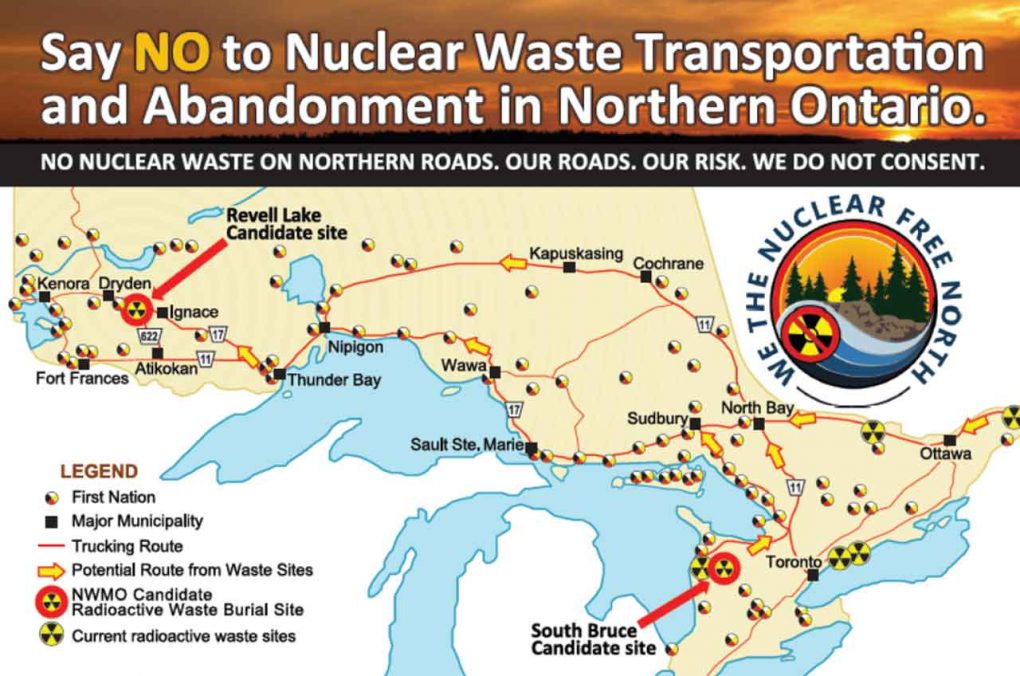
By NNL Digital News Update, March 14, 2024
Kitchenuhmaykoosib Inninuwug – Environment – Leaders from five First Nations communities in Northwestern Ontario have voiced a resolute opposition to the prospect of nuclear waste storage within their territories.
In a concerted message to the Nuclear Waste Management Organization (NWMO), these chiefs have articulated a clear rejection of any plans to introduce nuclear waste facilities into the region.
A Firm Stand on Environmental Protection
The stance against nuclear waste storage is captured in a letter addressed to Laurie Swami, President and CEO of the NWMO, an industry-funded body tasked with managing Canada’s nuclear waste. The letter outlines grave concerns about the potential for spills or leaks that could irreversibly harm the environment, disrupt the natural way of life, and have lasting impacts on future generations.
Letter to Nuclear Waste Management Organization
Signed by chiefs from Kitchenuhmaykoosib Inninuwug, Asubpeeschoseewagong (Grassy Narrows), Wapekeka, Neskantaga, and Onigaming, the letter embodies the collective apprehension of these communities.
These leaders, forming part of the First Nations Land Defence Alliance, are standing firm in their resolve to protect their lands and waters from the risks posed by nuclear waste.
Concerns Over Potential Environmental Impact Chief Donny Morris of Kitchenuhmaykoosib Inninuwug highlighted the risks associated with disturbing the Canadian Shield rock to construct an underground storage facility.
Morris emphasized the importance of environmental preservation over financial compensation and stressed the right of all regional First Nations to be involved in the consultation process.
Calls for Consideration of Alternative Sites In a pointed critique of the proposed locations for the nuclear waste repository, Steven Chapman, Kitchenuhmaykoosib Inninuwug’s lands and environment director, suggested that such facilities should first be considered in areas closer to Canada’s political centers, such as Toronto or Ottawa.
This suggestion underscores a broader call for equity and responsibility in the siting of facilities that pose environmental risks.
The NWMO has narrowed its search to two potential sites, one near Ignace and another in Southern Ontario, with a final decision expected later this year. The chiefs’ letter firmly states their lack of consultation and consent, urging the NWMO to respect their collective decision against the proposed site near Ignace.
Chiefs in the Ottawa region have also rejected the plans to store nuclear waste in their traditional territories.
As these communities stand united in their opposition, the debate over nuclear waste management in Canada continues to raise important questions about environmental stewardship, indigenous rights, and the principles of equitable decision-making in the context of national infrastructure projects.
Text of the Letter Written by Chiefs………………………………… https://www.netnewsledger.com/2024/03/14/northwestern-ontario-first-nations-chiefs-unite-against-nuclear-waste-proposal/
MOLTEX nuclear reactors: The whole thing is a scam, wasting tax payer money again.
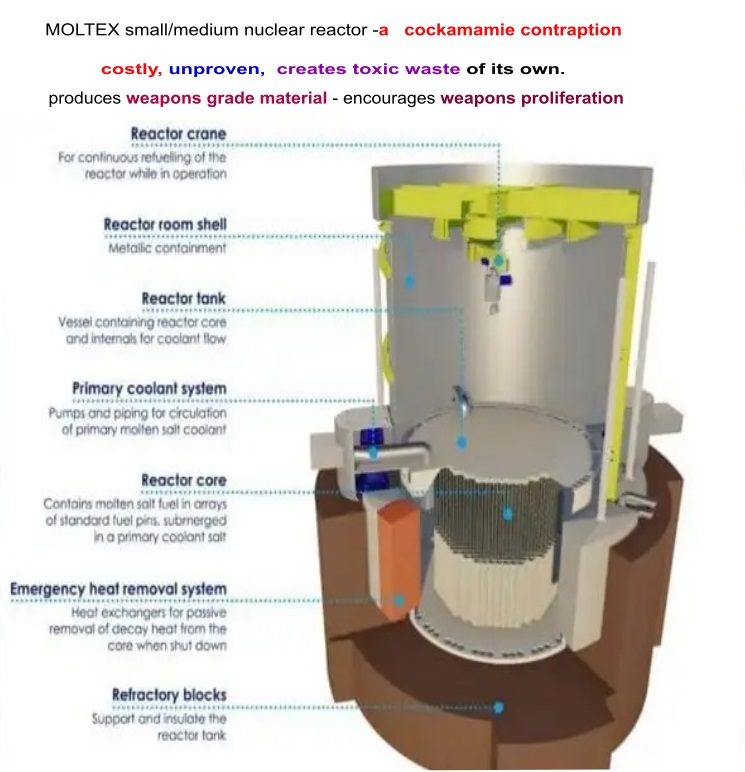

14 Mar 24
Why this pyro-reprocessing? Vitrification is the proven and researched method for reprocessed nuclear fuel waste. The U.S. NUCLEAR WASTE TECHNICAL REVIEW BOARD states, ” HLW is vitrified by mixing it with a combination of silica sand and other glass-forming chemicals, heating the mixture to very high temperatures [approximately 1,150°C (2,100°F)] until it melts, and pouring the molten material into stainless steel canisters where it cools to form a glass. Vitrification is used in several countries to immobilize HLW because it has advantages over other modes of treatment. It is a well-demonstrated technology resulting from more than 40 years of industrial experience, it can be used for a wide range of HLW compositions, it is a continuous process that can be applied to large volumes of HLW, and the resulting glass product is chemically durable in many geologic disposal environments.” https://www.nwtrb.gov/docs/default-source/facts-sheets/vitrified_hlw.pdf?sfvrsn=18
A soluble corrosive salt from pyro-reprocessing is not an acceptable wasteform.
It is important to realize even with glass vitrification there will still be an off gas waste stream containing the volatiles such as Tc99, I131 and C14, the major contributors to dose in the Seaborn EIS. There needs to be extensive research done on immobilization on the volatile off gas reprocessed waste stream.
Why is it that for reprocessed waste disposal the volatile, mobile, major contributors to dose consequence are ignored?
In fact the cost and feasibility of waste disposal and decommissioning in general is never properly accounted for in the development of nuclear reactors. New reactors are not designed to make decommissioning feasible without huge cost and extensive worker radiation exposure. This is short sighted madness that the nuclear industry is allowed to get away with.
Guess what? There is no nuclear waste, no nuclear proliferation and no possible nuclear meltdown from the much cheaper solar wind and deep geothermal power options. Is this not obvious? Yet government money (our money) is poured into nuclear energy. Did the public have a say in this? No expenditure without representation? Can we dump the reactors into Boston harbour?
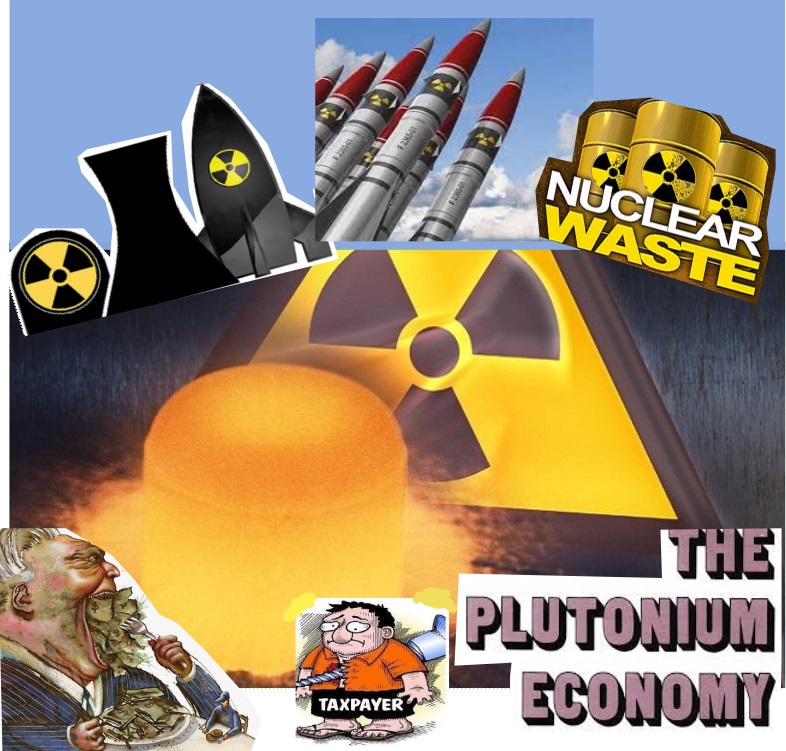
Nuclear industry wants Canada to lift ban on reprocessing plutonium, despite proliferation risks

The CANDU Owners Group is far from neutral or independent…………… First, Canadian Nuclear Laboratories is a private company owned by a consortium of multi-national companies: AtkinsRéalis (formerly SNC Lavalin), Fluor, and Jacobs. ……...has overseas members, including utilities from China, Pakistan, India, South Korea, Argentina, and Romania. The first three countries are nuclear weapons states that either possess reprocessing plants for military purposes (India and Pakistan) or reportedly divert plutonium extracted from commercial spent fuel for military purposes (China), while South Korea and Argentina have for decades flirted with the idea of reprocessing.
Bulletin, By Gordon Edwards, Susan O’Donnell | March 11, 2024
Plutonium is “the stuff out of which atomic bombs are made.” Plutonium can also be used as a nuclear fuel. Reprocessing is any technology that extracts plutonium from used nuclear fuel. In Canada, the nuclear industry seems determined to close the nuclear fuel cycle by pushing for a policy to permit reprocessing—thereby seeking to lift a 45-year-old ban.
In 1977, Canada tacitly banned commercial reprocessing of used nuclear fuel, following the lead of the Carter administration, which explicitly opposed reprocessing because of the possibility it could lead to increased proliferation of nuclear weapons around the world.[1] That unwritten policy in Canada has held sway ever since.[2] New documents obtained through Canada’s Access to Information Act reveal that, behind closed doors, the nuclear industry has been crafting a policy framework that, if adopted, would overturn the ban and legitimize the extraction of plutonium from Canada’s used commercial nuclear fuel.
For over two years, documents show that the Canadian government has held a series of private meetings with industry representatives on this subject, keeping such activities secret from the public and from parliament. This raises questions about the extent to which nuclear promoters may be unduly influencing public policymaking on such sensitive nuclear issues as reprocessing in Canada.[3] But, given the stakes for the whole society and even the entire planet, the public must have a say about nuclear policy decisions…………………………………………………………………………………………………………………………………………………..
Before the ban. Dreams of a plutonium-fueled economy were spawned in 1943-44 by British, French, and Canadian scientists working at a secret wartime laboratory in Montreal, which was part of the Anglo-American Project to build the first atomic bombs. Canada’s first heavy-water reactors were designed by the Montreal team, in part, to produce plutonium for weapons. The team also had hopes that after the war, plutonium might become a dream fuel for the future. They envisioned a “breeder reactor” that could produce more plutonium than it uses, thereby extending nuclear fuel supplies.
For 20 years after the war, Canada sold uranium and plutonium for US bombs. Two reprocessing plants were operated at Chalk River Nuclear Laboratories in Ontario. In addition, all the pilot work on plutonium separation needed to design Britain’s Windscale reprocessing plant was carried out at Chalk River.
After the ban. Although the 1977 ban scuppered AECL’s hopes for commercial reprocessing, plutonium remained the holy grail. In the decades that followed, AECL researchers studying the geologic disposal of high-level radioactive waste clandestinely carried out reprocessing experiments at the Whiteshell Nuclear Research Establishment in Manitoba. Instead of burying used nuclear fuel bundles, the scientists anticipated burying solidified post-reprocessing waste. Meanwhile, AECL scientists at Chalk River fabricated three tonnes of mixed-oxide fuel (MOX) in glove boxes, using plutonium obtained from CANDU fuel reprocessed overseas. In 1996, Prime Minister Jean Chrétien volunteered to import weapons-grade plutonium from dismantled US and Soviet warheads to fuel CANDU reactors. Facing fierce public opposition in Canada, the project never came to pass.
But the dream of a plutonium economy remained. In 2011, a sprawling mural on three walls of the Saskatoon Airport depicted the nuclear fuel chain, from mining uranium to the reprocessing of used fuel to recover “potential energy” before disposing of the leftovers. Although the word plutonium appeared nowhere, reprocessing was presented as the inevitable final step in this vision of a virtuous nuclear fuel cycle. The mural was commissioned by Cameco, the giant Canadian multi-national corporation that helped make the central Canadian province of Saskatchewan into the “Saudi Arabia of uranium.” At the time, Cameco co-owned the largest operating nuclear power station in the world, the eight-reactor Bruce complex beside Lake Huron bordering the United States.
Despite such hopes, it became fashionable to publicly downplay reprocessing as expensive and therefore economically unlikely.[5] But the technology stayed on the books as a possibility, especially in case future generations would want to extract plutonium from used nuclear fuel for re-use before disposing of the remaining radioactive waste.
Back to the future? New Brunswick has one 660-megawatt-electric CANDU reactor at Point Lepreau on the Bay of Fundy in eastern Canada. The plant has been operating for over 40 years. In March 2018, two start-up companies—UK-based Moltex Energy and US-based ARC Clean Technology—offered to build “advanced” (fast) reactors on the same site.
The Moltex design is a 300-megawatt-electric molten salt reactor called “Stable Salt Wasteburner.” It is to be fueled with plutonium and other transuranic elements extracted from CANDU used fuel already stored on that site. Accordingly, the Moltex proposal requires a reprocessing plant in tandem with the reactor. The ARC design is a 100-megawatt-electric liquid sodium-cooled reactor, inspired by the second Experimental Breeder Reactor (EBR-2) operated by the Argonne National Laboratory in Idaho between 1964 and 1994. Although the ARC-100 does not require reprocessing at the outset, its optimal performance requires that the used fuel be recycled, likely through reprocessing.
From the beginning, Moltex claimed its proposed molten salt reactor would “recycle” CANDU used fuel and “burn” it in its molten salt reactor. Moltex claims that this would virtually eliminate the need for a deep geologic repository by turning a million-year disposal problem into a roughly 300-year storage problem. This claim has been flatly rebuffed.[6] Only later did the public learn that the Moltex technology requires reprocessing CANDU used fuel to extract plutonium using an innovative process called “pyroprocessing.” (In pyroprocessing, used fuel is converted to a metal and immersed in molten salt, then the plutonium and other transuranic elements are recovered by passing a current through the salt and collecting the desired products on electrodes.)

ARC Clean Technology maintains that its reactor design is proven by the 30-year operating experience of the EBR-2 reactor, despite differences in size and fuel enrichment.[7] The company, however, says nothing about the intimate connection between breeder reactors and plutonium, nor does it mention the chequered history of liquid sodium-cooled reactors globally—including the Fermi Unit 1 reactor’s partial meltdown near Detroit, the commercial failure of France’s Superphénix, the conversion of a German breeder reactor into an amusement park, or the dismal performance of Japan’s Monju reactor.
For either of the proposed New Brunswick reactors to operate as intended, Canada would need to lift its 45-year-old ban on commercial reprocessing of used nuclear fuel.
Testing the limits. The first sign that Canada’s reprocessing ban might be lifted came in 2019, when the federal government’s Impact Assessment Act exempted specified projects from environmental assessment. The exemption included any reprocessing plant with a production capacity of up to 100 metric tons (of used nuclear fuel) annually—just above the reprocessing capacity required for the Moltex project.[8]
Public calls to explicitly ban reprocessing started shortly after March 2021, when the federal government gave 50.5 million Canadian dollars in funding for Moltex’s project. This project clearly requires reprocessing: Without the plutonium produced by CANDU reactors to fuel its proposed molten salt reactor, the Moltex project can go nowhere.
In addition, Moltex hopes to eventually export the technology or the fuel, or both. Many Canadians are alarmed at the prospect of normalizing the use of recycled plutonium as a nuclear fuel in Canada and abroad.
In 2021, in response to a recommendation by the International Atomic Energy Agency, the Canadian government conducted public consultations to develop a modernized policy on commercial radioactive waste management and decommissioning. Over 100 citizens groups participated, and many called for an explicit ban on reprocessing.
Public attention to the issue of reprocessing grew after nine US nonproliferation experts sent an open letter to Prime Minister Justin Trudeau in May 2021. The letter expressed concern that by funding a spent fuel reprocessing and plutonium extraction project, Canada would “undermine the global nuclear weapons nonproliferation regime that Canada has done so much to strengthen.” …………………..
A second letter sent to Trudeau in July 2021 refuted “misleading claims” that Moltex posted on-line in rebuttal to the first letter. Moltex’s rebuttal claims were quickly taken down. And a third letter authored by one of the US nonproliferation experts was sent in November 2021. None of the government responses to these three letters addressed the core issue, which is the request for an independent review of the proliferation implications of Canada’s funding of reprocessing.
The federal government released its draft policy for radioactive waste management and decommissioning in March 2022, hinting that reprocessing might be permitted in the future. Public interest groups made their opposition to that suggestion very clear. A national steering group coordinated by Nuclear Waste Watch, a Canada-based network of public interest organizations, released an alternative policy proposal that explicitly banned reprocessing. The Council of Canadians, a national advocacy group, sent out an action alert that generated 7,400 letters calling for the explicit prohibition of reprocessing.
The Canadian Nuclear Safety Commission, tasked with the job of licensing Moltex’s proposed reactor, declared that a policy framework for reprocessing is necessary and that such a policy must come from the federal government.[9] Moltex’s Chief Executive Officer, Rory O’Sullivan, observed that Canada was chosen by Moltex because the country had no explicit policy on reprocessing: “Moltex would likely not have come to Canada if a reprocessing policy had been mandated at the time.”
In November 2021, Canada’s Ministry of Natural Resources—the lead federal department on nuclear issues—issued an internal memo entitled “Policy Development on Reprocessing” that refers to a series of planned meetings on reprocessing with industry representatives starting December 1, 2021.[10] The CANDU Owners Group—a nonprofit corporation assembling utilities operating CANDU reactors, Canadian Nuclear Laboratories, and nuclear suppliers—was singled out by the ministry to prepare a policy paper on reprocessing.[11]
The CANDU Owners Group is far from neutral or independent.
First, Canadian Nuclear Laboratories is a private company owned by a consortium of multi-national companies: AtkinsRéalis (formerly SNC Lavalin), Fluor, and Jacobs. The company is currently constructing a government-funded facility with hot cells at Chalk River to conduct research, including on reprocessing and plutonium extraction. Canadian Nuclear Laboratories operates under a “government-owned contractor operated” agreement with Atomic Energy of Canada Limited, the same publicly owned corporation that pushed for commercial reprocessing in the late 1970s.
The CANDU Owners Group also has overseas members, including utilities from China, Pakistan, India, South Korea, Argentina, and Romania. The first three countries are nuclear weapons states that either possess reprocessing plants for military purposes (India and Pakistan) or reportedly divert plutonium extracted from commercial spent fuel for military purposes (China), while South Korea and Argentina have for decades flirted with the idea of reprocessing.
By all evidence, the government of Canada is currently enlisting private entities that favor reprocessing to assist in the development of an industry-friendly policy on reprocessing. And the government does this without involving the public, parliament, or outside experts—all of whom have expressed a keen interest—and repeatedly asked to participate—in plutonium policy discussions. In the process, misleading information about reprocessing is being forwarded to government officials with no other voices to correct the record.[12]
In the most recent move, a dozen US nonproliferation experts wrote again to Prime Minister Trudeau on September 22, 2023, after the release of documents obtained through an access to information request. In their letter, the experts reiterated their concerns that the Canadian government is funding a project that would lead to increase the availability—and therefore potential proliferation—of weapons-usable plutonium for civilian purposes in Canada and beyond.
Democratic deficit. Despite all these developments, there has been no public discussion or parliamentary deliberation about the implications of introducing civilian reprocessing into Canada’s nuclear fuel cycle. Absence of transparency and public debate means the democratic process is being ignored. Yet, the issue is of great public importance because of the taxpayer money invested, proliferation risks involved, and the long-term societal implications of the security measures needed to safeguard nuclear weapons usable materials.
This makes one wonder why it took a group of concerned citizens and an access to information request to find out that, behind closed doors, the nuclear industry has been drafting its own policy to permit commercial reprocessing, expecting its adoption by the government of Canada against all objective criteria of democracy.
n 1976, British nuclear physicist Brian Flowers authored a Royal Commission report to the UK parliament. He wrote: “We regard the future implications of a plutonium economy as so serious that we should not wish to become committed to this course unless it is clear that the issues have been fully appreciated and weighed; in view of their nature we believe this can be assured only in the light of wide public understanding.”
The same precept should apply to nuclear policy in today’s Canada.
Notes…………………………………………………………………. https://thebulletin.org/2024/03/nuclear-industry-wants-canada-to-lift-ban-on-reprocessing-plutonium-despite-proliferation-risks/
Canada, Sweden Restore UNRWA Funds as Report Accuses Israel of Torturing Agency Staff
“The work that UNWRA does cannot be overstated,” said Canadian lawmaker Salma Zahid. “It will save lives as we have seen the visuals of children dying of hunger in Gaza. The need for immediate aid is non-negotiable.”
JON QUEALLY, Mar 09, 2024 https://scheerpost.com/2024/03/09/canada-sweden-restore-unrwa-funds-as-report-accuses-israel-of-torturing-agency-staff/
The governments of Canada and Sweden have announced they will resume funding for the United Nation’s agency that provides humanitarian aide and protection to Palestinians living in Gaza and elsewhere—a move that other powerful nations, including Israel’s most powerful ally the United States, continue to refuse.
Calling the lack of humanitarian relief inside Gaza “catastrophic,” Canadian Minister of International Development Ahmed Hussen said Friday his nation would restore funding for the United Nations Relief and Works Agency for Palestine Refugees in the Near East (UNRWA) in order to help address the “dire” situation on the ground living.
Sweden made its announcement Saturday and said a $20 million disbursement would be made to help UNRWA regain its financial footing.
The restoration of funds follows weeks of global criticism and protest for the decision by many Western nations to withhold UNRWA funds after Israel claimed, without presenting evidence, that a few members of the agency—the largest employer in the Gaza Strip—had participated in the Hamas-led attacks of October 7.
As a result, UNRWA has said it’s ability to provide aid and services to Gaza—where over 100,000 people have been killed or wounded in five months of constant bombardment and blockade by the Israeli military—has been pushed to the “breaking point” as malnutrition and starvation has been documented among the displaced population of over 2 million people.
“Canada is resuming its funding to UNRWA so more can be done to respond to the urgent needs of Palestinian civilians,” Hussen said. “Canada will continue to take the allegations against some of UNRWA’s staff extremely seriously and we will remain closely engaged with UNRWA and the UN to pursue accountability and reforms.”
“I welcome Canada lifting the pause on funding for UNWRA,” said Canadian MP Salma Zahid, a member of the Liberal party representing Scarborough Centre in the House of Commons. “The work that UNWRA does cannot be overstated. It will save lives as we have seen the visuals of children dying of hunger in Gaza. The need for immediate aid is non-negotiable.”
Earlier this week, UNRWA Commissioner-General Philippe Lazzarini told a special meeting of the U.N. General Assembly the agency was “facing a deliberate and concerted campaign” by Israel “to undermine its operations, and ultimately end them.”
On Friday, Reutersreported on an internal UNRWA report that included testimony of employees who said they were tortured by Israeli officers while in detention to make false admissions about involvement in the October 7 attack.
The nuclear narrative.

What is a narrative? ……… In other words, it is about occupying public space to disseminate enchanting stories that give pride of place to industry, multinationals, investors, billionaires, each greener than the last.
Jean-François Nadeau, March 4, 2024, https://www.ledevoir.com/opinion/chroniques/808350/chronique-narratif
The future of the world, at least according to the head of the AtkinsRéalis firm, lies in nuclear power. This company, formerly known as SNC-Lavalin, has changed its name. The scandals that have affected her, she asserts, belong to the past.
For its campaign to promote atomic energy, AtkinsRéalis secured the services of two former prime ministers: Jean Chrétien and Mike Harris. In 2019, as revealed by Radio-Canada, Jean Chrétien had already gone so far as to propose, with astonishing lightness, storing foreign nuclear waste in Labrador. In a letter, the former prime minister wrote to a Japanese firm: “Canada has been the largest supplier of nuclear fuel for years, and I have always thought it would be appropriate for Canada to become, at the end of account, the steward and guarantor of the safe storage of nuclear waste after their first service cycle. »
No carbon neutrality without nuclear power , repeats the boss of AtkinsRéalis like an advertising slogan. We must replace fossil fuels, while doubling or tripling, thanks to nuclear power, the production of electricity, he pleads. There is no question, in this presentation, of rethinking a model of society based on an infinite expansion of consumption. Always more cars, as long as they are electric. Always more heating, regardless of the fact that our buildings are thermal sieves. In other words, what continues to matter is growth. And the increase in AtkinsRéalis’ turnover is largely due to nuclear power, as noted by Le Devoir .
Last week, Minister Pierre Fitzgibbon reiterated again that he was not closing the door to the return of nuclear power. Since the arrival of Michael Sabia at the head of Hydro-Québec , the signals pointing in the direction of this revival have multiplied. “I think that as a government, in the ministry, at home, we must stay on the lookout for what is happening in nuclear power,” the minister further affirmed in front of an audience of business people. To have such projects accepted, the minister specified that “you simply have to have a good narrative”. In Quebec, he laments, “we have not had any narrative on nuclear power” since the closure of Gentilly-2 .
What is a narrative? In 1928, Edward Bernays, the founding father of the public relations and advertising industry, called these language elements capable of manipulating public opinion propaganda . This word ended up, as we know, having unfavorable connotations. Others were therefore substituted. Here is the latest addition, used in all sauces: the narrative . In other words, it is about occupying public space to disseminate enchanting stories that give pride of place to industry, multinationals, investors, billionaires, each greener than the last.

Pierre Fitzgibbon shows interest in mini nuclear reactors. The boss AtkinsRéalis also praises this technology, which is far from wonderful. Nobody says too loudly that these types of plants produce more nuclear waste per megawatt. These mini power plants would produce up to thirty times more radioactive waste than conventional nuclear power plants.
In his “narrative”, the boss of AtkinsRéalis barely concedes that the management of radioactive materials constitutes a serious danger for humanity.
In Ontario, a large dump for radioactive waste was approved on January 9. Tons of heavy metals, dangerous radioactive elements, plutonium, uranium, etc. will pile up there for a century, not far from the Ottawa River. The whole thing promises to occupy, for eternity, an area equivalent to 70 National Hockey League ice rinks.
In France, 280 km of underground galleries are being built to store nuclear waste. To give an idea, the galleries of the Montreal metro total 71 km. This giant sarcophagus will be the largest construction site in Europe. In these galleries, the most dangerous waste will be able to spew radioactivity for 100,000 years.
So that the hydrogen and the fumes released from this collection of waste do not explode, it is necessary to continually ventilate. Which requires electricity. A power outage, if it lasts more than a week, could be catastrophic. Obviously, electrical problems, cataclysms, wars, terrorists, this will never happen in a hundred years. Not again in a thousand years, probably. Moreover, at the entrance to these sites, in what language should we warn future generations not to dig?
The speech of the boss of AtkinsRéalis is very similar to that which is also being given these days by the cereal manufacturer Kellogg’s. Gary Pilnick, its CEO, is sad to see the cost of food soaring. However, he does not recommend reviewing the profit margins on which the food giants are fattening, nor the exploitation system which governs this surge in prices. He simply suggests eating cereal at dinner, so that consumers can lower their bills and cereal manufacturers can make more money. At the bottom of the scale, this makes no difference to the misfortunes of the majority. Agricultural producers in Quebec, for example, find themselves this year with the lowest net incomes since 1938, they say.
Nuclear industries operate according to the same elastic logic which consists of making money at all costs. Our dependence on automobiles and energy-intensive lifestyles suits them. And it is enough, to hear them, to continue to rush forward, head down, to escape from a reality that is ruining the future. Their technologies promise to fix everything. As long as you are willing to swallow their narrative first, like soft cereal .
Setting the record straight on Canada’s arms exports to Israel
Canadian officials, including the Minister of Foreign Affairs, have recently claimed that Canada does not export weapons to Israel, and instead has only exported “non-lethal” equipment to that country. Moreover, the Prime Minister stated before Parliament on February 14, 2024, that no export permits have been issued for Canadian arms transfers to Israel since October 7, 2023.
The Foreign Minister’s statement is misleading. The Prime Minister’s is patently false.
Documents recently released by Global Affairs Canada show that Canadian officials authorized nearly $30-million in military goods to Israel since October 7, 2023. These recent arms export authorizations are in addition to the more than $140-million (constant CAD) in military goods Canada has transferred to Israel over the last decade.
Under Canada’s export control regime, there exists no category for “non-lethal” arms exports. The relevant question is whether Canada has authorized the export of controlled military goods to Israel – and it has.
Given that the Government of Canada recognizes all these proposed exports as military goods, the claim that Canada only exports “non-lethal” equipment to Israel is misleading. Technology does not need be lethal itself to otherwise enable lethal operations.
We urge the Government of Canada to clarify and rectify its messaging on this matter.
Project Ploughshares also reiterates its call for Canada to end the supply of military goods to Israel, as per its obligations under the Export and Import Permits Act and the United Nations Arms Trade Treaty.
“Tritium Removal”: A Report on the Proposed MCECE Facility at Chalk River.
Gordon Edwards, 2 Mar 24
As it happens, both heavy water (used in all Canadian CANDU reactors) and tritium (produced in great quantities as a radioactive pollutant from CANDU reactors) are sensitive materials from the point of view of nuclear weapons proliferation.
Heavy water can be used to produce nuclear-weapons usable plutonium without the need to buy enriched uranium, a carefully controlled material. And tritium, in a purified form, can be used to vastly increase the explosive yield of an atomic bomb by acting as a “booster”. As little as two grams of tritium can magnify the blast of an implosion-type nuclear bomb by a factor of ten.
These matters are briefly touched upon in this report, which is mainly focussed on the dangers of tritium as an environmental pollutant that can endanger the health and safety of humans and the environemnt, especially for pregnant women.
“Tritium Removal”: A Report on the Proposed MCECE Facility at Chalk River
Prepared for Keboawek First Nation by Gordon Edwards, Ph.D.
Executive Summary
In a letter to Keboawek First Nation dated February 2, 2024 (reference # 2), we read that “CNL is restoring and protecting Canada’s environment by reducing and effectively managing nuclear liabilities. Among these liabilities is Atomic Energy of Canada’s (AECL) large inventory of tritium- contaminated heavy water.” In an accompanying Fact Sheet (reference # 3) CNL states that “tritiated heavy water cannot be used, re-used or disposed of in its current form.”
The fact that tritium-contaminated heavy water cannot be used, re-used, or even disposed of in its present form is a testament to the considerable hazards posed by radioactive tritium. Nevertheless, tritiated heavy water can be safely stored, and kept out of the environment, as is being done at present. There is no reason given by CNL as to why such storage cannot be continued indefinitely, until the radioactive tritium has disintegrated to innocuous levels.
Instead, CNL plans to build a tritium removal facility called the Modernized Combined Electrolysis and Catalytic Exchange facility (MCECE) to extract the radioactive tritium in a gaseous form from the non-radioactive heavy water. In the above-mentioned letter from CNL, we learn that CNL expects tritium emissions into the environment from this facility. Some simple arithmetic reveals that up to 10.7 trillion becquerels of tritium will be dispersed into the environment per year from this facility. (In the letter, up to 2 curies per week of tritium gas (T2) and up to 5 curies per week of deuterium tritium (DT) will be released into the atmosphere, for a total of 259 billion becquerels of tritium per week. Assuming an 80 percent capacity factor, that’s 10.7 trillion becquerels of tritium released per year.)
It is concluded that there is no justification for the proposed facility in terms of “protecting the environment by reducing and effectively managing nuclear liabilities”. The proposed facility does nothing to reduce the amount of radioactive tritium, but it does provide a mechanism for dispersing trillions of becquerels of tritium into the environment every year. Tritium is not effectively managed to protect the environment. Evidently, indefinite safe storage of tritium- contaminated heavy water is the preferred option if protecting the environment is the goal.
“Tritium Removal” A Report on the Proposed MCECE nuclear Facility at Chalk River
“Tritium Removal” A Report on the Proposed MCECE Facility at Chalk
River by Gordon Edwards, Ph.D. for the Keboawek First Nation. In a letter
to Keboawek First Nation dated February 2, 2024 (reference # 2), we read
that “CNL is restoring and protecting Canada’s environment by reducing
and effectively managing nuclear liabilities.
Among these liabilities is
Atomic Energy of Canada’s (AECL) large inventory of tritium contaminated
heavy water.” In an accompanying Fact Sheet (reference # 3) CNL states
that “tritiated heavy water cannot be used, re-used or disposed of in its
current form.”
The fact that tritium-contaminated heavy water cannot be
used, re-used, or even disposed of in its present form is a testament to
the considerable hazards posed by radioactive tritium. Nevertheless,
tritiated heavy water can be safely stored, and kept out of the
environment, as is being done at present. There is no reason given by CNL
as to why such storage cannot be continued indefinitely, until the
radioactive tritium has disintegrated to innocuous levels.
Canadian Coalition for Nuclear Responsibility 27th Feb 2024
Burying nuclear waste the best of a bad bunch of options
A reader offers her opinion on what to do with nuclear waste as Saskatchewan considers small modular reactors for its future energy needs.
I share the concern that Dale Dewar expressed in the StarPhoenix of Feb. 20 about the long-term management of Canada’s used nuclear fuel.
However, my conclusion is that, while far from ideal, deep burial is the best of a bunch of bad available options. There are no good options. Even proposals to extract recyclable material from the used fuel will leave behind most of the waste to be somehow disposed of.
Dewar’s suggestion that the wastes should remain permanently on the surface, with a system of rolling stewardship that would be passed on from generation to generation, might work in a world that could be guaranteed to be permanently free of war, terrorism, natural disasters, negligence and political instability.
But that’s not the world we live in. We cannot assume that safe stewardship would be maintained in perpetuity. Leaving the wastes indefinitely on the surface would seem to create far greater risk than deep geological burial would.
Of course, it would have been nice if we had thought about this problem before we started creating these wastes.
Exploding Alberta’s Myths about Small Nuclear Reactors

Small nuclear reactors are unproven and years away from being in use. But the Alberta government is presenting them as a way to keep fossil fuels flowing.
The untested technology is more about greenwashing than about cutting emissions.
Tim Rauf 15 Feb 2024, The Tyee
Alberta’s government is really excited about nuclear power.
More specifically, about novel and unproven small modular nuclear reactors. It hopes to use these to help lower the province’s carbon emissions while letting the energy industry continue operating as usual — an enticing prospect to the government given its intention to increase oil and gas production, while still having the energy sector get to net zero by 2050.
Small modular nuclear reactors produce less than one-third of the electricity of a traditional reactor.
The premise is that small reactors are easier to place and build, and cheaper.
Alberta hitched its horse to this wagon with Ontario, New Brunswick and Saskatchewan in 2022, taking part in a strategic plan for small modular reactor development and deployment. Alberta Innovates, the province’s research body, had a feasibility study conducted for it by Pacific Northwest National Laboratory. The study focused on using the reactors for greenhouse-gas-free steam emissions for oilsands projects, electricity generation in our deregulated market and providing an alternative to diesel when supplying power to remote communities.
More recently, Ontario Power Generation and Capital Power out of Edmonton entered into an agreement to assess SMRs for providing nuclear energy to Alberta’s grid. Nathan Neudorf, Alberta’s minister of affordability and utilities, was gleeful. “This partnership represents an exciting and important step forward in our efforts to decarbonize the grid while maintaining on-demand baseload power,” he said of the announcement.
All of this buzz makes it seem like SMRs are just over the horizon, an inevitability that will allow the province to evolve to have a cleaner, modern energy landscape.
But small modular reactors are nowhere near ready for deployment, and won’t be in Alberta for about a decade. That means for 10 years, they’ll provide no GHG-free steam to mitigate emissions.
“It’s still in the design phase,” Kennedy Halvorson said, speaking about the reactors. Halvorson is a conservation specialist with the Alberta Wilderness Association. The reactors are “so far off from being able to be used for us,” Halvorson added. “The earliest projections would be 2030. And we need to be reducing our emissions before 2030. So, we need to have solutions now, basically.”
With SMRs unable to stem the emissions tide for years, it’s confusing as to how they could make enough of a difference to get Alberta to net zero by 2050 (in line with United Nations emissions reduction targets to keep global warming to no more than 1.5 degrees).
Capital Power made similar projections………………………………………………………………………..
Construction itself is only one piece. Adding to that is the need to build a regulatory framework, which Alberta doesn’t have for nuclear…………………………………………………….
Ontario’s nuclear troubles
Listening to these public voices is prudent. We can look east to see what happens when the government and power utilities sidestep the process of getting explicit consent from communities that stand to be affected.
With its status as the nuclear activity hub in Canada, we can use Ontario as a litmus test of sorts and gauge Canada’s track record of care with nuclear. The report card isn’t great. There have been multiple cases of improper consultation with Indigenous Peoples on whose lands the waste, production or extraction sites are placed………………………………………………………………………..
Small reactors face a critical economic challenge
Adding to the timeline troubles are questions as to whether small reactors truly offer that much of an economic advantage, if any, compared with their larger counterparts.
In a previous article Ramana wrote, he pointed to the first reactors as an indication of the answer.
The first reactors started off small. Their size, though, coupled with the exorbitant price tag of nuclear development, meant they couldn’t compete with fossil fuels.
The only thing they could do to reduce the disadvantage was to build larger and larger reactors, Ramana said.

A large reactor that could produce five times as much electricity didn’t cost five times as much to build, he said, improving the return from the investment.
Economically the SMR can’t seem to compete with its larger sibling. Adding this to the delays abundant with nuclear, controversies around construction and communities, and the misalignment of timelines for meeting climate commitments, we need to ask why we’re seeing such a fervent enthusiasm for small modular reactors.
Greenwashing by any other name
The answer is likely a simple one: The Alberta government wants to keep the taps on. Their friends in the energy industry do too. Like carbon capture and sequestration before it, SMRs are the next way to stave off pesky talk of divestment and transition…………………………………………………………….
Deflecting and delaying isn’t the only greenwashing happening either, Halvorson argued. She noted there’s a special kind of tactic that comes with nuclear and other “clean” technology, where only carbon dioxide and greenhouse gas offsets are counted.
“When we reduce it all to just how much CO2 something emits, we’re not getting the full picture of environmental impacts,” Halvorson said. She pointed to water use in nuclear as an example.

“Most nuclear technologies require a massive input of water to work. And as we know, right now we’re in a drought in Alberta. Our water resources are so precious. We already have industries that are using way too much water as is, in a way that’s not allowing our environments and ecosystems to replenish their reserves, like their water resources,” she said.
Despite the cheerleading for nuclear Alberta, where small nuclear reactors will let us enjoy the fruits of fossil fuels (and even produce more) in a cleaner way, the bones don’t read that way. The argument that we can keep on drilling so long as we have that newest silver bullet hasn’t stood up to scrutiny before, and it doesn’t now. https://thetyee.ca/Analysis/2024/02/15/Exploding-Alberta-Myths-Small-Nuclear-Reactors/
PM Trudeau dismisses Algonquin concerns over Chalk River nuclear waste dump

COMMENT. This is a sad day when we witness so clearly who Trudeau sides with in regard to nuclear waste, as well as the betrayal to Indigenous peoples about authentic reconciliation as per the violations related to UNDRIP.
Thank heavens that various news media, including CBC, are beginning to pay increasing attention to the folly of nuclear waste disposal and how the CNSC absolutely fails to protect human health and the natural environment.
Attention also must be solicited among the news media about the proposed NWMO DGR, because if it is not stopped at this autumn’s site selection stage, I have no faith or trust in what would follow, namely, a federal environmental assessment (EA), because the EA would be controlled by the CNSC.
Trudeau touts nuclear safety commission’s expertise as Bloc leader allies with First Nations
Brett Forester · CBC News · Feb 14, 2024
Algonquin leaders are finding the Canadian government largely unmoved, but they continue to fight construction of a radioactive waste dump on unceded territory near Deep River, Ont., roughly one kilometre from the Ottawa River.
First Nations chiefs have allied with Bloc Québécois and federal Green Party leaders, joined forces with concerned civil society groups, and launched a legal fight against the project. On Wednesday they all rallied on Parliament Hill to voice their united opposition.
“The time to act is now, for the sake of our environment, our communities and the principles enshrined in the United Nations Declaration on the Rights of Indigenous Peoples,” said Lance Haymond, chief of Kebaowek First Nation, at a news conference outside the House of Commons.
While legally non-binding, the UN declaration, or UNDRIP, outlines minimum human rights standards, including against storing hazardous materials in Indigenous territories without their consent.
Last month, the Canadian Nuclear Safety Commission (CNSC) authorized construction of a “near surface disposal facility” at the government-owned, Second World War-era Chalk River nuclear laboratory, about 190 kilometres northwest of Ottawa.
Kebaowek applied for judicial review of that decision earlier this month, relying largely on UNDRIP. Three citizens’ groups applied for judicial review the same day.
Later on Wednesday in question period, Prime Minister Justin Trudeau dismissed the concerns, swatting away questions from Bloc leader Yves-François Blanchet, who picked up the cause.
“This is not a political decision. On this side of the House, we trust our experts,” said Trudeau in French.
Trudeau touted the commission as an independent, science-driven, quasi-judicial expert panel that consults with First Nations. But Haymond suggested Trudeau, always keen to recognize how Parliament Hill sits on unceded Algonquin land, is failing to live up to his promises.
“Actions speak louder than words. Reconciliation is a series of actions, and not words,” Haymond told reporters.
“So if this government is serious about reconciliation with the Anishinaabe people, we’ve given him and his government a golden opportunity.”
Run by private sector
Regulatory filings describe the disposal facility as similar to a municipal landfill, with added features for hazardous material, such as a base liner, cover, leak-detection system and wastewater treatment plant.
Canadian Nuclear Laboratories (CNL), a private-sector consortium contracted to manage federal nuclear sites, intends to bury a million cubic metres of low-level radioactive waste in the giant hillside mound.
The commission concluded the project is not likely to cause significant adverse effects on the environment or Indigenous peoples, provided CNL implements mitigation and monitoring measures.
Ten out of 11 federally recognized Algonquin First Nations oppose the project, while the Algonquins of Pikwàkanagàn, roughly 150 kilometres northwest of Ottawa, is the lone community to consent.
Before hosting a rally outside, Haymond and other Algonquin leaders joined Green Party leader Elizabeth May, Bloc MP Sébastien Lemire, and Ole Hendrickson, spokesperson for the citizens’ groups that launched a court challenge.
May accused the government of ignoring UNDRIP in the interests of industry. She singled out AtkinsRéalis, a member of the CNL consortium better known by its former name SNC Lavalin, the engineering giant that pleaded guilty to fraud in a 2019 corruption scandal.
“They are the powerful corporate lobbying interest behind ignoring UNDRIP, ” May told reporters………………………
Tritium in Perch Lake
Hendrickson warned the mound “would release pollutants into the Ottawa River during and after operation, according to the proponent’s own study. This makes it an issue for millions of people.”…………………………………https://www.cbc.ca/news/indigenous/prime-minister-chalk-river-nuclear-waste-1.7115467
First Nations urge Environment Minister not to green light Chalk River nuclear waste dump.
MARIE WOOLF, OTTAWA, Globe and Mail, 15 Feb 24
Environment Minister Steven Guilbeault was urged by First Nations chiefs Wednesday not to issue a permit to allow a nuclear waste dump on a forested site northwest of Ottawa where a variety of wildlife, including “at risk” wolves, live.
Ten chiefs and members of First Nations in Quebec and Ontario travelled to Parliament to urge the federal government to halt the Chalk River Near Surface Disposal Facility (NSDF), which the Canadian Nuclear Safety Commission approved for construction last month.
First Nations, supported by environmentalists and Bloc Québécois and Green MPs, said the site of the Canadian Nuclear Laboratories’ planned nuclear waste dump is too near the Ottawa River, which supplies drinking water to the country’s capital. They fear it could be polluted with a radioactive substance running off the site.
Kebaowek First Nation last week filed a Federal Court application for a judicial review of the Jan. 9 decision by the Canadian Nuclear Safety Commission, alleging the government breached its duty to consult Indigenous people.
At a press conference, preceding a rally with First Nations on Parliament Hill, Kebaowek Chief Lance Haymond urged the Prime Minister to intervene and halt the project saying First Nations had not been properly consulted.
Chief Dylan Whiteduck of Kitigan Zibi Anishinabeg First Nation told The Globe and Mail that an inadequate assessment of the impact on plants and mammals – including black bears hibernating in dens on the site – was conducted before approval was given.
First Nations spent several months surveying the site and found it rich with wildlife, but he said they were not given long enough, and a more extensive survey is needed.
Mr. Haymond said if Mr. Guilbeault were to issue a permit under the Species at Risk Act (SARA) it would pre-empt an assessment his department is carrying out on upgrading to a threatened species eastern wolves that roam on the site………………………………………………………………
In 2015, the Committee on the Status of Endangered Wildlife in Canada reassessed the status of the eastern wolf as threatened.
If the wolves are classed as threatened, their habitat would need to be protected, which could put on hold plans to build the waste dump on territory where they roam.
The eastern wolf, also known as the Algonquin wolf, numbers between an estimated 236 and 1,000 adults, and is confined to forests in Central Ontario and Southwestern Quebec. It is currently listed as a species of special concern.
The federal government published the proposed uplisting of the eastern wolf to a threatened species in November last year, carrying out a month-long consultation. It has until August to make a decision.
The proposed order amends Schedule 1 to the Species at Risk Act “to support the survival and recovery of the eastern wolf in Canada by uplisting it from a species of special concern to threatened.”……………………… https://www.theglobeandmail.com/politics/article-first-nations-urge-environment-minister-not-to-green-light-chalk-river/
1 This Month
22 June – Virtual Event –Climate Change: New Data, New Debate

Monday, June 22, 2026 2:30 p.m. – 3:15 p.m. CT
YouTube. Register here

Protect Sazan Island from the Trump family! https://secure.avaaz.org/campaign/en/protect_sazan_island_from_the_trump_family_loc/?bqFCVab&v=174511&cl=22707147157&_checksum=5e9dde668860e8231c33699735e16a1fbf22ab2cb01da50c999fe8732b9775ef&utm_source=email&utm_medium=blast_email&utm_campaign=174511
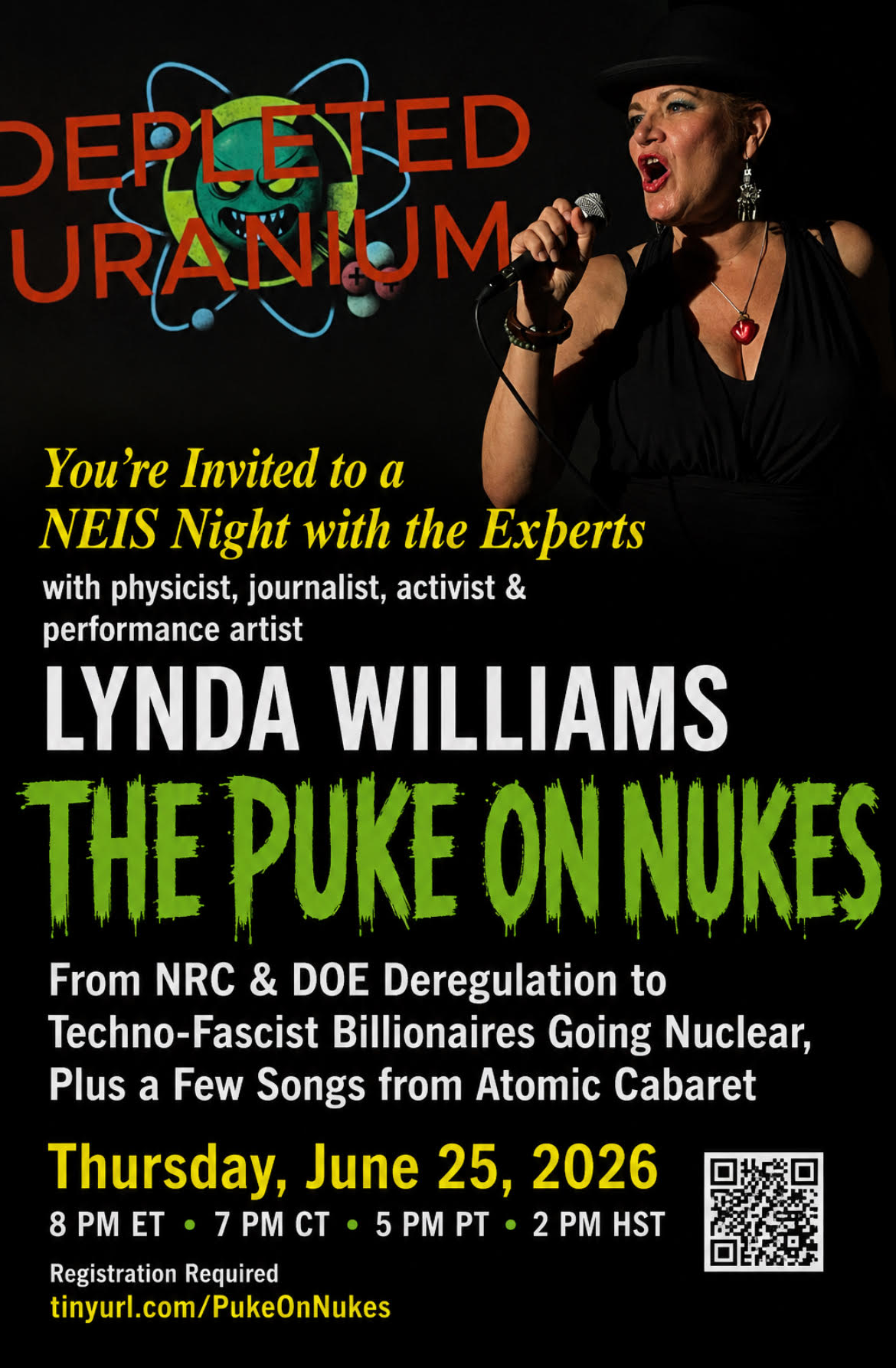
25 June- THE PUKE ON NUKES
Thursday, June 25, 2026
7pm Central Time (8pm ET, 6pm MT, 5pm PT) UTC – 5
From NRC & DOE Deregulation to Techno-Fascist Billionaires Going Nuclear, Plus a Few Songs from Atomic Cabaret REGISTER
26 June – Radiation Trainwreck at the NRC / Join the Protect Better Campaign – https://us02web.zoom.us/meeting/register/4ZlZ5_qLSHGiLSCg8FF6Bg#/registration
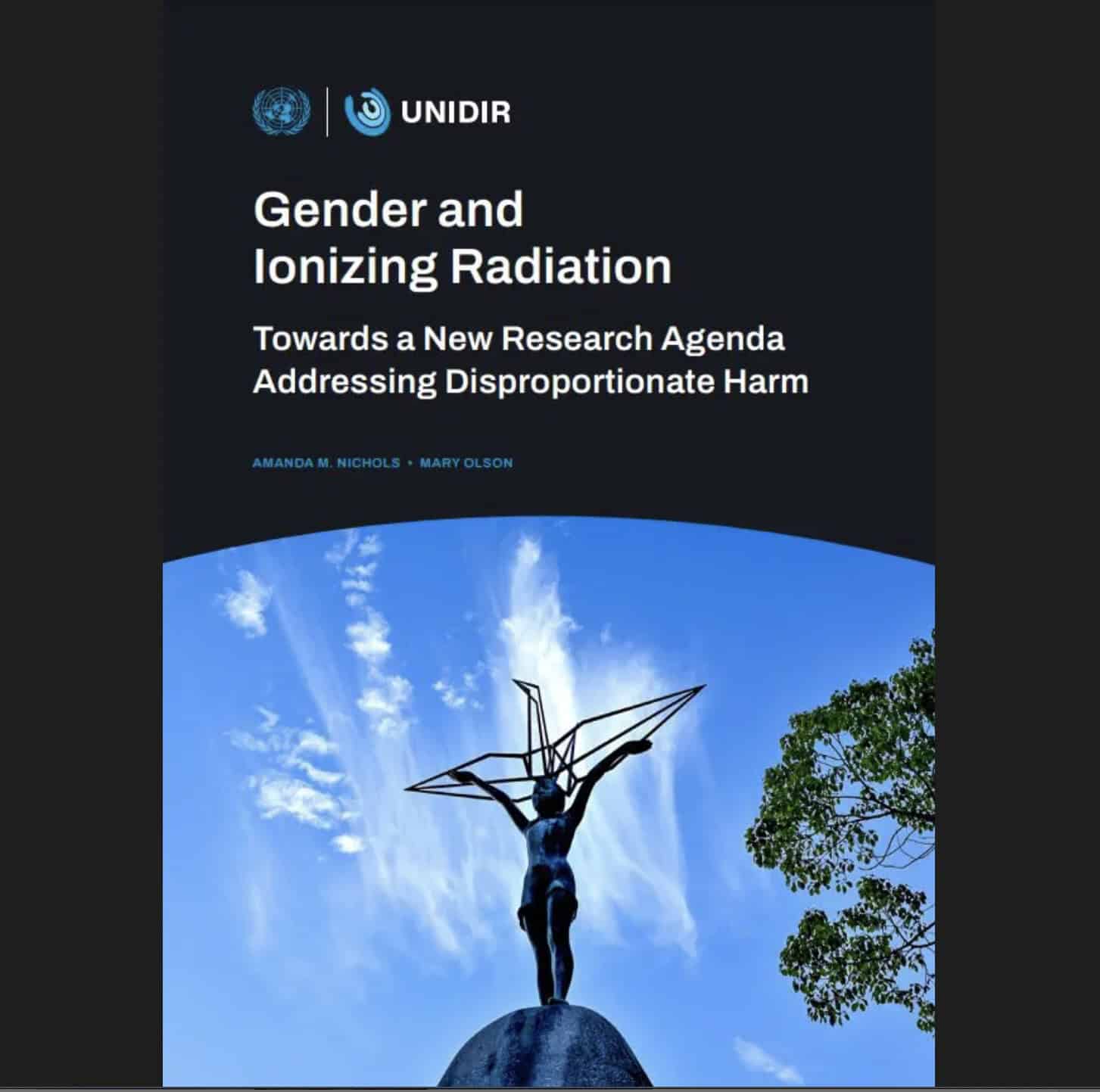

Cuba Is Not a Failed State – It Is a Besieged State
PETITION: “Global Appeal to Endorse Palestinian Right of Return of Refugees”
To see nuclear-related stories in greater depth and intensity – go to https://nuclearinformation.wordpress.com
-
Archives
- June 2026 (193)
- May 2026 (306)
- April 2026 (356)
- March 2026 (251)
- February 2026 (268)
- January 2026 (308)
- December 2025 (358)
- November 2025 (359)
- October 2025 (376)
- September 2025 (257)
- August 2025 (319)
- July 2025 (230)
-
Categories
- 1
- 1 NUCLEAR ISSUES
- business and costs
- climate change
- culture and arts
- ENERGY
- environment
- health
- history
- indigenous issues
- Legal
- marketing of nuclear
- media
- opposition to nuclear
- PERSONAL STORIES
- politics
- politics international
- Religion and ethics
- safety
- secrets,lies and civil liberties
- spinbuster
- technology
- Uranium
- wastes
- weapons and war
- Women
- 2 WORLD
- ACTION
- AFRICA
- Atrocities
- AUSTRALIA
- Christina's notes
- Christina's themes
- culture and arts
- Events
- Fuk 2022
- Fuk 2023
- Fukushima 2017
- Fukushima 2018
- fukushima 2019
- Fukushima 2020
- Fukushima 2021
- general
- global warming
- Humour (God we need it)
- Nuclear
- RARE EARTHS
- Reference
- resources – print
- Resources -audiovicual
- Weekly Newsletter
- World
- World Nuclear
- YouTube
-
RSS
Entries RSS
Comments RSS
 nuclear-news