UN security council fails to prevent ‘snapback’ nuclear sanctions on Iran
Iranian foreign ministry urges further diplomacy and says return to pre-2015 measures are unlawful and unfounded.
William Christou, 20 Sept 25, https://www.theguardian.com/world/2025/sep/20/un-security-council-fails-to-prevent-snapback-nuclear-sanctions-on-iran
Last month, France, Germany and the UK triggered the snapback provision of the deal after Iran refused to cooperate with International Atomic Energy Agency (IAEA) inspectors, which is tasked with monitoring implementation of the deal.
Two weeks later, Iran agreed to resume cooperation with the IAEA, but it has not yet been able to carry out all of its inspection activities and the body’s ability to operate in the country has been restricted for years.
Since the initiation of the snapback mechanism, intense diplomacy has taken place between mainly European powers and Iran to reach a deal to prevent the sanctions. Talks have not been fruitful, though the UK indicated on Friday after the vote that it was still open to diplomacy.
“The United Kingdom remains committed to a diplomatic solution. We are ready for further engagements diplomatically in the next week and beyond to seek to resolve differences,” said Barbara Woodward, the British ambassador to the UN.
The Iranian foreign ministry said in a Friday statement that it had consistently kept the path of diplomacy open and that it viewed the reimposition of sanctions as “unlawful, unfounded and proactive”.
Iran is still dealing with the impact of the 12-day Iran-Israel war, when Israel launched surprise attacks that it said was a pre-emptive move against the country’s nuclear programme. Iran insists that its nuclear programme is of a civilian nature and that it does not seek to create a nuclear bomb.
Iran withdraws resolution banning attacks on nuclear sites following US pressure
Iran decided at the last minute Thursday to withdraw a resolution
prohibiting attacks on nuclear facilities that it had put forward along
with China, Russia and other countries for a vote before an annual
gathering of the U.N. nuclear watchdog’s member nations.
Western diplomats,
who spoke on condition of anonymity to discuss internal deliberations, said
the U.S. has been heavily lobbying behind the scenes to prevent the
resolution from being adopted. The U.S. has raised the possibility of
reducing funding to the International Atomic Energy Agency if the
resolution was adopted and if the body moved to curtail Israel´s rights
within the agency, the diplomats said.
Daily Mail 18th Sept 2025, https://www.dailymail.co.uk/wires/ap/article-15112913/Iran-withdraws-resolution-banning-attacks-nuclear-sites-following-US-pressure.html
Iran, allies submit draft IAEA resolution to ban attacks on nuclear sites
Sep 16, 2025, https://www.iranintl.com/en/202509162278
Iran and five other countries have submitted a draft resolution to the International Atomic Energy Agency’s annual general conference calling for a ban on any attack or threat of attack against nuclear sites under UN safeguards, Iran’s foreign ministry said on Tuesday.
Foreign ministry spokesperson Esmaeil Baghaei said on X that the text, backed by China, Russia, Venezuela, Nicaragua and Belarus, was intended “to defend the integrity of the NPT” and reaffirmed the inalienable right to develop nuclear energy for peaceful purposes.
“All states must refrain from attacking or threatening to attack peaceful nuclear facilities in other countries,” Baghaei wrote. “These principles must be upheld; it is high time that the international community acted firmly to prevent the normalization of lawlessness.”
Draft resolution
The draft resolution condemns “the deliberate and unlawful attacks carried out in June 2025 against nuclear sites and facilities of the Islamic Republic of Iran,” calling them clear violations of the UN Charter and the IAEA Statute.
It says nuclear sites under IAEA safeguards “shall not be subject to any kind of attack or threat of attack,” adding that such actions pose serious risks to international peace and security, human health, the environment, and the credibility of the non-proliferation regime.
The document also recalls UN Security Council Resolution 487 of 1981, which condemned Israel’s bombing of Iraq’s Osirak reactor, and reaffirms previous IAEA decisions prohibiting attacks on safeguarded facilities.
It further stressed that all questions regarding nuclear programs should be resolved “exclusively through dialogue and diplomacy, as the only viable path.”
Israel launched a surprise military campaign on June 13 targeting Iranian nuclear and military sites, including senior commanders and nuclear officials in a conflict that lasted 12 days. On June 22, the United States joined the campaign, striking nuclear facilities in Fordow, Natanz and Isfahan. Washington brokered a ceasefire on June 24.
Iran’s nuclear chief Mohammad Eslami told the conference on Monday that Tehran’s atomic program “cannot be eliminated through military action,” accusing Israel and the United States of launching illegal strikes on Iranian sites in June.
“Despite our formal request, the agency did not condemn the attacks by the United States and Israel on the nuclear centers of the Islamic Republic,” Eslami said, calling the IAEA’s silence “a stain on the Agency’s history.”
Eslami said Tehran would use the conference to highlight what he called unlawful measures against its nuclear industry and to push for adoption of the draft.
The debate comes as Iran’s recent cooperation deal with IAEA chief Rafael Grossi awaits implementation and European powers press ahead with the UN “snapback” mechanism that could reinstate sanctions on Tehran by late September.
UN genocide report puts Starmer in the dock.
Declassified UK , 19 Sept 25.
This week, the UN commission of inquiry concluded on reasonable grounds that “the Israeli authorities and Israeli security forces have committed and are continuing to commit [acts] of genocide against the Palestinians in the Gaza Strip”. The acts include killing members of the group, causing serious bodily or mental harm, deliberately inflicting conditions of life calculated to bring about its physical destruction, and imposing measures intended to prevent births.UN member states are consequently urged to employ all means reasonably available to them to prevent genocide in Gaza, including the cessation of arms transfers and the facilitation of legal investigations into Israel’s actions. The commission of inquiry was set up four years ago by the UN human rights council, and is staffed by three independent experts. While it does not speak officially for the UN, it strongly reinforces the growing consensus around the genocidal nature of Israel’s war. So what are the implications for Britain? Perhaps most significantly, the commission flatly rejects the UK government’s argument that the duty to prevent genocide is only triggered when an international court has established that a genocide has taken place. “Since at least January 2024, when the International Court of Justice ordered its first provisional measures, all states… have been on notice of a serious risk that genocide was being or would be committed”, the report notes. |
The UK government, in other words, has misconstrued its obligations under the Geneva Convention to prevent and punish genocide. Indeed, how is it possible to prevent genocide if you wait until it has taken place? The report also notes how “Israeli security forces shot at and killed civilians, including children who were holding makeshift white flags”. Days before, a Dutch newspaper found that at least 114 Palestinian children had been hit with single gunshot wounds to the head or chest. The UK government is clearly aware this is occurring, but it has covered up its own evidence on Israel’s killing of minors. |
In June, the government’s lawyers refused to submit a research report to court on “Long-Range Shootings or Shootings of Minors”. Subsequent requests from MPs and the media for the report have been repeatedly refused.
And then there’s the Israeli president, Isaac Herzog, who was welcomed to London last week by prime minister Keir Starmer.
The report found that Herzog, alongside Israeli prime minister Benjamin Netanyahu and former defence minister Yoav Gallant, “incited the commission of genocide and that Israeli authorities… failed to take action against them to punish this incitement”.
These are serious findings, and they require a serious response from the UK government. Yet ministers, unsurprisingly, have largely shied away from talking about the report – perhaps unwilling to incriminate themselves further.
Saudi Arabia, nuclear-armed Pakistan sign mutual defence pact
Saudi Arabia and nuclear-armed Pakistan signed a formal mutual defense pact on Wednesday, in a move that significantly strengthens a decades-long
security partnership amid heightened regional tensions. The enhanced
defense ties come as Gulf Arab states grow increasingly wary about the
reliability of the United States as their longstanding security guarantor.
Israel’s attack on Qatar last week heightened those concerns.
Reuters 17th Sept 2025,
https://www.reuters.com/world/asia-pacific/saudi-arabia-nuclear-armed-pakistan-sign-mutual-defence-pact-2025-09-17/
Time is now for Iran to act on inspections agreement, IAEA chief says
International Atomic Energy Agency (IAEA) chief Rafael Grossi on Monday
urged Iran to immediately implement the agreement it signed with the UN
watchdog last week to resume inspections at the country’s bombed nuclear
sites.
Iran International 15th Sept 2025,
https://www.iranintl.com/en/202509154534
Iran hardliners reject IAEA deal, but IRGC outlet voices support
Iranian ultra-hardliners are criticizing Tehran’s recent agreement with
the IAEA in Cairo, despite its blessing by a top decision-making body
linked to the Supreme Leader, but an outlet linked to the Revolutionary
Guards offered support. The scrambled messaging suggests deep disagreement on Iran’s diplomatic path forward as renewed UN sanctions loom by months-end and arch-foe Israel continues to moot military attacks to
chasten Tehran.
Iran International 16th Sept 2025, https://www.iranintl.com/en/202509158464
China, Russia urge Europe to halt UN snapback after Iran-IAEA deal
Russia called on Britain, France and Germany on Tuesday to halt their move
to restore United Nations sanctions on Iran after Tehran and the
International Atomic Energy Agency (IAEA) announced an agreement to resume nuclear inspections suspended since June.
Iran International 10th Sept 2025, https://www.iranintl.com/en/202509103977
The future of Gaza as seen from the White House

the Gaza Strip would be “administered by the United States for at least 10 years while it is transformed into a glittering tourist resort and a center for high-tech manufacturing and technology.”
The future Gaza project, according to its real estate developers (the three professionals Jared Kushner, Donald Trump, and Steve Witkoff), is worthy of Dubai. Many transnational corporations have already joined forces.
by Thierry Meyssan, Voltaire Network | Paris (France) | 3 September 2025, https://www.voltairenet.org/article222723.html
This possible operation is in line with the vision of the “Jacksonians.” In 1830, President Andrew Jackson (1829-1837) enacted the Indian Removal Act. To end the Indian wars, he proposed assigning them reservations rather than continuing to massacre them. The transfer of the Indians was particularly deadly for the Cherokees (the “Trail of Tears” episode), but they accepted this form of peace, while almost all other Indian tribes rejected it. Two centuries later, only the Cherokee tribe has become wealthy and integrated, while all the other tribes have been marginalized. Without a doubt, Jackson’s method succeeded in ending the genocide of the Indians, but at what cost?
Trump’s plan, currently in development, is just as shocking to Palestinians as Jackson’s was to the Cherokee, but it offers a solution where no one else has. Will Palestinians, who have been fighting for generations to assert their rights, be satisfied with this? International law states that no people can be expelled from their own land. The United Nations General Assembly has consistently guaranteed the right of return for those who were forcibly expelled in 1948—UN General Assembly Resolution 194 (December 11, 1948) and UN Security Council Resolution 237 (June 14, 1967). Seven years ago, Palestinian civilians organized the “March of Return.” The Israel Defense Forces (IDF) fired on a peaceful crowd, killing at least 120 people and wounding 4,000. It is obviously illusory to believe that such a people will easily rally to this project.
So the participants at the White House meeting considered paying $23,000 per person to any family willing to go into exile. Contacts have already been made with Libya, Ethiopia, South Sudan, Indonesia, and Somaliland, although none of these states has confirmed this. The Trump team is considering voluntarily relocating a quarter of the Gaza population in this way.
According to the Financial Times, the Tony Blair Institute for Global Change (TIT) and the Boston Consulting Group (BCG) held joint working meetings on the Gaza Riviera project, known as The Gaza Reconstitution, Economic Acceleration and Transformation Trust (GREAT* Trust). It was during these preparatory meetings that the Gaza Humanitarian Foundation (GHF) project was born. During the summer, this Swiss-registered foundation distributed humanitarian aid in Gaza instead of the occupying authority, the United Nations, the International Red Cross, and various humanitarian associations. This certainly bypassed Hamas, but it also led to the IDF killing nearly a thousand civilians who had come to seek food aid. The GHF scandal was unanimously condemned, including by prominent Israeli Jews. In practice, the GHF was created by the Mikveh Yisrael Forum, bringing together Yotam HaCohen, strategic advisor to Benjamin Netanyahu and son of former General Gershon HaCohen, Liran Tankman, a former intelligence officer who switched to high-tech, and Michael Eisenberg, an Israeli-American venture capitalist. Most of the leaders of the Mikveh Yisrael Forum have joined the Coordinator of Government Activities in the Territories (COGAT), Ghassan Alian, convinced that the Netanyahu government is doing nothing to help the people of Gaza and that it is up to the Israelis to take action.
TRIAL International, a Swiss-based NGO, has filed two legal submissions asking the Swiss authorities to investigate the GHF’s compliance with Swiss law and international humanitarian law. The central issue raised by TRIAL International is whether humanitarian organizations can use private military companies. From the outset, GHF’s executive director, former US Marine Jake Wood, resigned. The “Foundation” then enlisted the services of Philip F. Reilly and his company Safe Reach Solutions. However, Reilly is a former soldier in the 7th Special Forces Group, which focused on counter-narcotics missions in Latin America. He became head of the CIA’s paramilitary branch, then known as the Special Activities Division but renamed the Special Activities Center. He was head of the CIA’s Afghan station around 2008 and 2009, as well as head of operations for the agency’s Counterterrorism Mission Center, which led the agency’s highly controversial drone strike program during the War on Terror. He then joined the private sector as senior vice president of special operations for the private military company Constellis, owner of the mercenary company formerly known as Blackwater. Finally, he worked for another private army, Orbis. While it is true that the IDF did not kill the Palestinian civilians who came to look for food, Philip F. Reilly’s men did.
The future Gaza project, according to its real estate developers (the three professionals Jared Kushner, Donald Trump, and Steve Witkoff), is worthy of Dubai. Many transnational corporations have already joined forces.
President Donald Trump, who had rebuffed Benjamin Netanyahu when he came to ask him to annex Gaza, is now preparing to take control of the Palestinian territory. While Tel Aviv is preparing to annex the entire Mandate of Palestine and, on the contrary, Egypt and Jordan are preparing to hand over the keys to the Palestinian Authority, a vast $100 billion real estate operation is being planned
In August 27, President Donald Trump convened a meeting at the White House to gather suggestions for the future of Gaza. In attendance were JD Vance, Vice President; Steve Witkoff, Special Envoy; Marco Rubio, Secretary of State; Jared Kushner, former advisor during the first term; Tony Blair, former British Prime Minister; and Ron Dermer, Israeli Minister of Strategic Affairs.
No statement was released after this consultation. However, according to the Washington Post, the Gaza Strip would be “administered by the United States for at least 10 years while it is transformed into a glittering tourist resort and a center for high-tech manufacturing and technology.” A colossal $100 million would be invested there.
To facilitate the regrouping of Gazans, Benjamin Netanyahu’s revisionist Zionist government has given instructions to create a tent city for 600,000 people in Rafah. They would have food and hospitals, but would not be able to leave.
Bezalel Smotrich, Minister of Finance, said at a conference on Jewish settlement in the occupied West Bank on May 14: “Civilians will be sent south to a humanitarian zone, and from there they will begin to leave in large numbers for third countries.”
The Prime Minister himself finally made the decision on August 13 on i24News in Hebrew. He claimed a “historic and spiritual mission,” assuring that he is ‘very’ attached to the vision of a “Greater Israel.” At 75, he publicly claims to be a follower of his father’s mentor, Vladimir Jabotinsky, the founder of “revisionist Zionism.”
At the same time, on July 23, the Knesset passed a non-binding law by 71 votes to 13, calling on the government to annex the West Bank before new permanent members of the UN Security Council fully recognize the State of Palestine.
In addition, the IDF reports that 618 settler attacks were recorded in the West Bank in 2024, compared to 404 in the first half of 2025.
Republican Mike Johnson, Speaker of the US House of Representatives, has expressed his support for annexation. He visited the Ariel settlement in early August 2025 and said he believed that “Judea and Samaria” belonged to the Jewish people and expressed his support for the extension of Israeli sovereignty over the West Bank. This was the first time that a US figure of this stature had visited Israeli settlements in the West Bank. The Trump administration is currently keeping a cautious distance from this movement, especially as it is focusing all its efforts on strengthening the Abraham Accords with Arab states.
According to a December 2024 survey by the Institute for National Security Studies, 34% of the Israeli public rejects the annexation of Palestinian territories, 21% supports annexing the current settlements, and 21% supports annexing everything.
For their part, Egypt and Jordan, unwilling to believe this, continue to train hundreds of young Palestinians loyal to Fatah to form a 10,000-strong private security force to put the Palestinian Authority in power in Gaza. Meanwhile, Saudi Arabia and France plan to fully recognize the State of Palestine at the UN General Assembly, which is preparing to proclaim its independence.
Main sources :………………………………….
Israel has officially moved on from destroying Hamas to erasing Palestine

By Murad Sadygzade, President of the Middle East Studies Center, Visiting Lecturer, HSE University (Moscow), 5 Sept 25, https://www.rt.com/news/624181-israel-hamas-erase-palestine/
Despite objections from across the world, Netanyahu’s government is redrawing the map with tank tracks.
In early August, Benjamin Netanyahu dispelled any lingering ambiguity. In a direct interview with Fox News, he made explicit what had long been implied through diplomatic euphemisms: Israel intends to take full military control of the Gaza, dismantle Hamas as a political and military entity, and eventually transfer authority to a “non-Hamas civilian administration,” ideally with Arab participation.
“We’re not going to govern Gaza,” the prime minister added. But even then, the formula of “seize but not rule” read more like a diplomatic veil for a much harsher course of action.
The very next day, Israel’s security cabinet gave formal approval to this trajectory, initiating preparations for an assault on Gaza City. The UN secretary-general responded swiftly, warning that such an operation risked a dangerous escalation and threatened to normalize what had once been an avoidable humanitarian catastrophe.
August exposed the war in its most unforgiving clarity. Strikes on Zeitoun, Shuja’iyya, Sabra, and operations in the Jabalia area became a part of the daily rhythm. The encirclement of Gaza City tightened slowly but relentlessly. Brigadier General Effi Defrin confirmed the launch of a new phase, with troops reaching the city’s outskirts. At the same time, the government called up tens of thousands of reservists in a clear signal that Israel was prepared to take the city by force, even if the window for a negotiated pause technically remained open.
In this context, talk of “stabilization” rings hollow. Infrastructure lies in ruins, the healthcare system is on the verge of collapse, aid lines often end under fire, and international monitoring groups are recording signs of impending famine. The conflict is no longer a conventional war between armies. It is taking on the contours of a managed disintegration of civilian life.
But Gaza is not the whole picture. On the West Bank, the logic of military control is being formalized both legally and spatially. On July 23, the Knesset voted by majority to adopt a declaration advocating the extension of Israeli sovereignty over Judea, Samaria, and the Jordan Valley. While framed as a recommendation, the move effectively normalizes institutionalizing the erosion of previously drawn red lines.
It is within this framework that the E1 plan of Israeli settlements in the West Bank must be understood as a critical link in the eastern belt surrounding Jerusalem. On August 20, the Higher Planning Committee of the Civil Administration gave the green light for the construction of over 3,400 housing units between East Jerusalem and Ma’ale Adumim. For urban planners, it’s about “filling in the gaps” between existing developments. For policymakers and military officials, it represents a strategic pivot.
First, E1 aims to create a continuous Jewish presence encircling Jerusalem and to merge Ma’ale Adumim into the city’s urban fabric. This reinforces the eastern flank of the capital, provides strategic depth, and secures Highway 1 – the vital corridor to the Dead Sea and the Jordan Valley.
Second, it severs East Jerusalem from its natural Palestinian hinterland. E1 physically blocks the West Bank’s access to the eastern part of the city, cutting East Jerusalem off from Ramallah in the north and Bethlehem in the south.
Third, it dismantles the territorial continuity of any future Palestinian state. Instead of a unified space, a network of isolated enclaves emerges – linked by bypass roads and tunnels that fail to compensate for the loss of direct access to Jerusalem, both symbolic and administrative.
Fourth, it seeks to shift the debate over Jerusalem’s status from the realm of diplomacy into the realm of irrevocable facts. Once the eastern belt is built up, the vision of East Jerusalem as the capital of a Palestinian state becomes almost impossible to realize.
Finally, E1 embodies two opposing principles: for Israelis, a “managed continuity” of control; for Palestinians, a “managed vacuum” of governance. One side gains an uninterrupted corridor of dominance, the other is left with a fragmented territory and diminished prospects for self-determination.
It is no surprise, then, that international reaction was swift and unambiguous from the UN and EU to London and Canberra. Finance Minister Bezalel Smotrich, commenting on the launch of E1, said out loud what the maps had already suggested: the project would “bury” the idea of a Palestinian state.
In an August broadcast on i24News, Netanyahu said he feels a “strong connection” to the vision of a “Greater Israel.” For Arab capitals this was a confirmation of his strategic maximalism. The military campaign in Gaza and the planning-led expansion in the West Bank aren’t two parallel tracks, but parts of a single, integrated agenda. The regional response was swift and uncompromising from Jordanian warnings to collective condemnation from international institutions.
The broader picture reveals deliberate design: In Gaza, forced subjugation without any credible or legitimate “handover of keys”; in the West Bank, a reconfiguration of political geography via E1 and its related projects, translating a diplomatic dispute into the language of roads, zoning, and demography. The language of “temporariness” and “no intention to govern” functions as cover, in practice, the temporary hardens into permanence, and control becomes institutionalized as the new normal.
As the lines converge in Gaza’s shattered neighborhoods, in the planning documents for East Jerusalem, and in statements from Israeli leadership, the space for any negotiated outcome narrows further. What began as a pledge to dismantle Hamas is increasingly functioning as a mechanism to erase the word ‘Palestine’ from the future map. In this framework, there is no “day after.” What exists instead is a carefully prearranged aftermath designed to leave no room for alternatives. The map is drawn before peace is reached, and in the end, it is the map that becomes the decisive argument, not a treaty.
The current military operation, referred to as Gideon’s Chariot 2, has not been officially declared an occupation. However, its character on the ground strongly resembles one. IDF armored units have reached Sabra and are engaged in ongoing combat at the Zeitoun junction, a strategic point where fighting has continued for over a week. Military descriptions of these actions as operations on the periphery increasingly resemble the opening phase of a full assault on Gaza City. In the last 24 hours, the pattern has only intensified. Artillery and airstrikes have been systematically clearing eastern and northern districts, including Zeitoun, Shuja’iyya, Sabra, and Jabalia, in preparation for armored and infantry advances.
The military effort is now reinforced by a large-scale mobilization of personnel. A phased conscription has been approved. The main wave, composed of 60,000 reservists, is expected to report by September 2, with additional groups to follow through the fall and winter. This is not a tactical raid but a prolonged urban combat campaign that will be measured not by military markers on a map but by the ability to sustain logistical flow and personnel rotations under intense conditions.
Diplomatic efforts are unfolding alongside the military campaign. On August 18, Hamas, through Egyptian and Qatari intermediaries, agreed to the outline of a ceasefire known as the Witkoff Plan. It proposes a 60-day pause, the release of ten living hostages, and the return of the remains of eighteen others in exchange for Israeli actions concerning Palestinian detainees and humanitarian access. The Israeli government has not officially agreed to the plan and insists that all hostages must be included. Nonetheless, Hamas’s offer is already being used by Israel as leverage. It serves more as a tactical pressure point than a genuine breakthrough.
This context gives meaning to Netanyahu’s latest directive calling for a shortened timeline to capture Hamas’s remaining strongholds. The accelerated ground campaign aims to pressure Hamas into making broader concessions under the framework of the proposed deal. If Hamas refuses, Israel will present a forceful seizure of Gaza City as a justified action to its domestic audience.
Observers close to the government interpret the strategy in exactly these terms. The objective is not only to dismantle Hamas’s infrastructure but also to escalate the stakes and force a binary choice between a truce on Israeli terms and a full military entry into the city. Even the most carefully designed military strategy eventually confronts the same dilemma: the challenge of the day after. Without a legitimate mandate and without a coherent administrative framework, even a tactical victory risks resulting in a managed vacuum. In such a scenario, control shifts hands on the map, but the underlying threat remains unresolved.
Ideology also plays a central role in shaping this campaign. . In August, Netanyahu publicly affirmed his strong personal identification with the vision of the Promised Land and Greater Israel. This statement provoked strong reactions in Arab capitals and further discredited Israel’s narrative that it seeks to control Gaza without governing it. The on-the-ground reality is more complex and sobering. After nearly two years of conflict, the IDF has not eliminated the threat. It has suffered significant losses, and there is no clear consensus within the officer corps on launching another ground offensive in Gaza.
According to reports by Israeli media, Israel’s top military leadership had warned that a complete takeover of Gaza would come with heavy casualties and heightened risks to hostages. For this reason, earlier operations deliberately avoided areas where hostages were likely being held. Leaked assessments suggest that the General Staff had proposed a strategy centered on encircling Gaza City and applying incremental pressure over time. However, the political leadership opted instead for speed and direct assault. The casualties already number in the hundreds, and major urban combat has yet to begin.
The domestic opposition has made its stance clear. After a security briefing, opposition leader Yair Lapid stated that a new occupation of Gaza would be a grave mistake and one for which Israel would pay a high price. Pressure on the government is mounting both internally, through weekly demonstrations demanding a hostage deal, and externally. Countries such as France, the United Kingdom, Canada, Australia, and Malta are preparing to take steps toward recognizing Palestinian statehood at the United Nations General Assembly in September. In the language of international diplomacy, this move signals a counterbalance to both Hamas’s hardline stance and Israel’s rightward territorial ambitions. The more forcefully Israel insists on capturing Gaza at all costs, the stronger the global response becomes in favor of formalizing Palestine’s status.
However, the situation now transcends local dynamics. Against the backdrop of worldwide instability, including regional conflicts, disrupted global trade routes and rising geopolitical risk, the Gaza campaign increasingly appears to be part of a broader, long-term war of attrition. Within Israel’s strategic thinking, the ultimate objective seems to be the closure of the Palestinian question altogether. This entails dismantling all political structures and actors that might, in any combination, threaten Israeli security. Under this logic, humanitarian consequences are not considered constraints.
A recent UN report illustrates the magnitude of the crisis. For the first time, the Food and Agriculture Organization officially declared catastrophic hunger in Gaza, reaching the fifth and highest level of the Integrated Food Security Classification, or IPC. By the end of September, more than 640,000 people are expected to face total food deprivation. Yet even this alarming assessment has not shifted the current trajectory. Western European declarations of intent to recognize Palestinian statehood have also failed to become decisive turning points.
Israel now faces a rare and difficult crossroads. One path leads through diplomacy. It includes a 60-day pause, an initial exchange of captives, and a broader acknowledgment that lasting security is achieved not only through military force, but also through institutions, legal rights, and legitimacy. The other path leads into a renewed spiral of urban warfare. It involves the deployment of more reservists, increasingly severe military orders, and objectives that grow less clearly defined with each passing day. In Sabra, the physical tracks of tanks are already visible before any clear political statement has been made. Ultimately, though, the outcome will be determined not by battlefield reports, but by legal, diplomatic, and institutional formulas. These will decide whether the fall of Gaza marks the end of the war or simply the beginning of a new chapter.
As assault plans are finalized, mobilization lists expand, and ideological rhetoric intensifies, the sense of inevitability grows stronger. This operation resembles less an isolated campaign and more a component of a much longer-term project to reconfigure geography and status. If that logic continues to dominate, the day after will already be written, and it will allow no room for alternatives. In that scenario, the map will carry more weight than any agreement. Facts on the ground will become the ultimate authority, overshadowing diplomatic recognitions, international reports, and humanitarian data alike.
Israeli Forces Bomb, Loot, Vandalize Our Homes in Gaza. We Long for Normal Life.
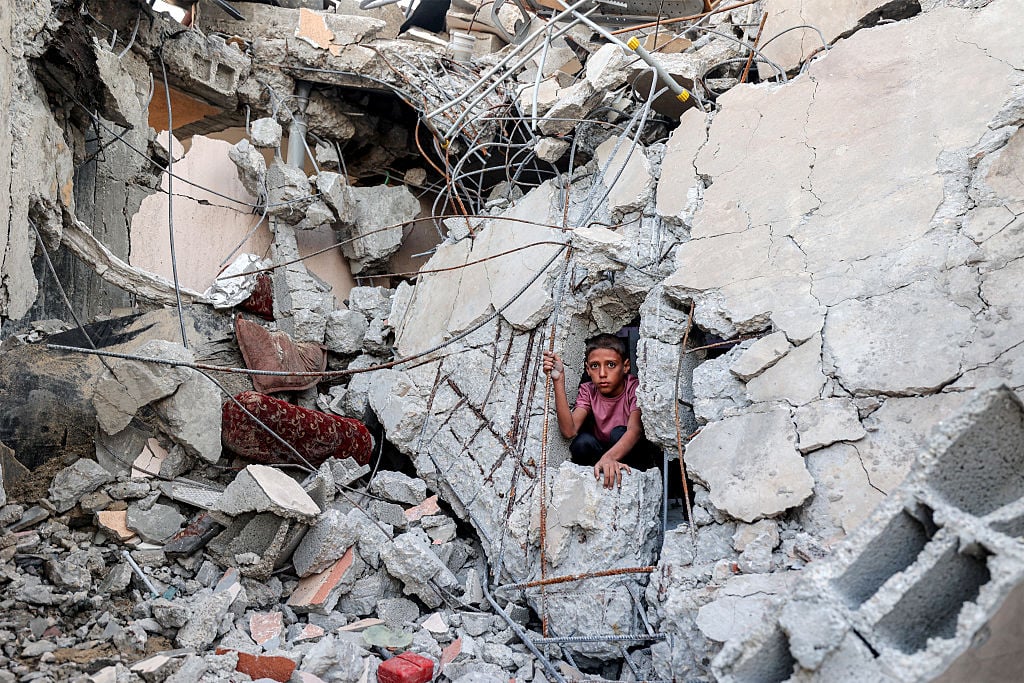
When a home is destroyed, entire worlds of safety, love, and identity crumble with it.
By Taqwa Ahmed Al-Wawi , Truthout, September 8, 2025
Your home is not just a building. It is a space carefully crafted by your family — a place that witnessed your first steps, heard your whispers, and held your laughter and tears. It is the place where your childhood lives.
Every room tells a tale. A nook holds old toys. There’s a window where the morning sun kissed your face, and the threshold you crossed thousands of times.
Imagine a peaceful neighborhood around your home — a narrow, quiet street shaded by olive trees whose branches stretch to cover the sidewalks. You have neighbors who are like family, exchanging greetings and stories. Children play and laugh in the alleys. Every evening, the scent of taboon bread fills the air, and the call to prayer echoes gently, giving the neighborhood a feeling of peace and timelessness.
This home, in the heart of this neighborhood, is more than just a shelter — it is a part of you.
Now imagine that in a single moment, it all turns to dust.
A Home in Nuseirat
Aya Adnan Ibrahim Al-Derawi is a 20-year-old medical laboratory student at the Islamic University of Gaza. Aya is my dear friend, and she shared with me this story of her family’s home.
Their house in Nuseirat had a small courtyard with a lemon tree, a rooftop where laundry swayed in the wind, and windows that caught the first light of morning. But on December 12, 2023, an Israeli airstrike reduced it to rubble and ashes………………………………………………………………….
A Home in Khan Younis
Islam Abu Mohsen, a 24-year-old civil engineering student from Khan Younis in southern Gaza, told me about his life before everything changed. He works as a digital content creator and is a professional trainer in barista skills — a young man trying to build a future amid the ruins.
He described his home in one of the most upscale neighborhoods in Khan Younis — a modern, beautifully designed house, with large windows that filled every room with sunlight. “The area was very lively,” he told me, “close to malls, restaurants, and schools. It was safe — relatively safe — and we lived surrounded by a warm family atmosphere, despite all the harsh conditions in Gaza.”
Islam shared how everyday life inside that home was stable and peaceful. “Each of us had our own daily routine. I was focused on my engineering studies, working on digital content, and training others in barista arts. Every day, we gathered around the dinner table — laughing, sharing stories, trying to hold on to a sense of normalcy. The house had a soul; it was a place of safety, comfort, and beautiful memories.”
Then came the devastating night of October 14, 2023. Islam described it vividly: “At 7:00 pm, suddenly the whole area was engulfed in a ring of fire. The smoke was suffocating; we literally felt like we were choking. We couldn’t understand what was happening. Ambulances couldn’t reach us — it was as if our neighborhood had vanished from the map.”
He described his family’s final moments in the house. “We were sitting at the dining table, cooking pasta, ready to eat — and then the bombing started. We never finished our meal,” he told me. “The pasta tray remained untouched for more than five months. When we finally returned, it was rotten.”
The losses went far beyond food. ………………………………………………………………………………………………………………….. https://truthout.org/articles/israeli-forces-bomb-loot-vandalize-our-homes-in-gaza-we-long-for-normal-life/?utm_source=Truthout&utm_campaign=26b80ce814-EMAIL_CAMPAIGN_2025_09_08_09_36&utm_medium=email&utm_term=0_bbb541a1db-26b80ce814-650192793
UK Labour must not award Elbit a £2 billion military deal
Why are Israel’s largest arms firm and a company mired in a corruption scandal even being considered for training British troops?
DECLASSIFIED UK, ANDREW FEINSTEIN, PAUL HOLDEN and JACK CINAMON, 28 August 2025
Britain’s Ministry of Defence might imminently award a 15 year contract, worth £2.5bn, to a consortium headed by the British subsidiary of the Israeli arms firm Elbit Systems and including the US management consultancy firm, Bain and Company.
If successful, Elbit’s consortium would be responsible for training as many as 60,000 members of the UK military.
The consortium seems well-placed to win the contract; it is, in fact, one of only two shortlisted and preferred bidders.
The Ministry of Defence has already given the consortium a £2m contract so that it can develop its proposals further.
This is unacceptable. And it is frankly unbelievable that this consortium is even in the running considering its track record.
Elbit Systems UK is the fully-owned subsidiary of Elbit Systems Limited. Elbit Systems Limited is headquartered in Tel Aviv and is listed on both the Israeli and US stock exchanges.
Elbit is one of the two largest Israeli weapons manufacturers and is central to the IDF’s operations, providing 85% of its drones. Elbit International is also a major contributor to the F-35 fighter jet program, bragging that it plays a ‘critical role’ in the ‘success of the world’s most advanced fighter jet.’
In July 2025, Francesca Albanese, the UN Special Rapporteur for the Occupied Palestine Territories, published an excoriating report setting out corporate complicity in Israel’s “plausibly” genocidal conduct in Gaza – for which she was subsequently sanctioned by Donald Trump.
Her report is clear that Elbit forms a central part of Israel’s military-industrial complex, which has become “the economic backbone of [Israel].”
“Elbit has cooperated closely on Israeli military operations, embedding key staff in the Ministry of Defence,” Albanese points out, further noting that Elbit provides “a critical domestic supply of weaponry.”
Bain
But we’re also deeply concerned about Elbit’s partner, Bain and Company.
Bain and Company (not to be confused with the mega hedge fund Bain Capital, which confirmed to us that it is not involved in the Elbit consortium) is a US-based management consultancy firm.
Bain’s inclusion in the consortium’s bid was first reported in 2023 by the UK military magazine, Shephard News, based on unpublished behind-the-scenes documents.
Bain has a sordid and shocking history. In August 2022, the Cabinet Office placed Bain and Company on a ‘blacklist’, preventing it from getting any Cabinet Office contracts. ………………………………………………………………………………………………
In July this year it was confirmed that Bain had shut down its South African consultancy operations, with the Financial Times reporting insiders saying that the company’s local reputation had been destroyed by the scandal.
The carcass of Bain’s South African business would be repurposed as a ‘hub’ to support Bain’s other international work.
These are the types of companies that the UK is poised to mainline into the very DNA of the British military and the British state: Elbit, its parent company one of the most important partners to the IDF in Gaza; and Bain and Company, only recently blacklisted for serious professional misconduct for its role in undermining the fabric of South Africa’s democracy.
The idea that the UK would award this consortium, and these companies, any sort of contract, never mind a 15 year contract of such importance, is an outrage. It must be stopped. https://www.declassifieduk.org/labour-must-not-award-elbit-a-2-billion-military-deal/
IAEA chief notes progress in Iran talks over nuclear site inspections
Head of the United Nations nuclear watchdog, Rafael Grossi, says he hopes for a ‘successful conclusion’ in the coming days.
Aljazeera, 8 Sept 25
Talks on resuming International Atomic Energy Agency (IAEA) inspections of Iran’s nuclear sites have made progress, but its chief warned that there was “not much” time remaining.
On Monday, the director general of the United Nations nuclear watchdog, Rafael Grossi, told the 35-nation IAEA Board of Governors in Vienna, Austria, that “Progress has been made”…….
He did not elaborate on what the timeframe meant exactly.
While Tehran allowed inspectors from the IAEA into Iran at the end of August, the Ministry of Foreign Affairs said no agreement had been reached on the resumption of full cooperation with the watchdog…….. ………………………….. https://www.aljazeera.com/news/2025/9/8/iaea-chief-notes-progress-in-iran-talks-over-nuclear-site-inspections
Is Israel quietly expanding its nuclear arsenal? Satellite images raise suspicion.
Given the secrecy of Israel’s programme, it remains difficult to estimate just how many nuclear weapons it possesses. The Bulletin of Atomic Scientists in 2022 put the number at around 90 warheads.
Israel is among nine countries confirmed or believed to have atomic weapons and among just four that have never joined the Nuclear Nonproliferation Treaty.
Construction work has intensified on a major new structure at a facility linked to Israel’s long-suspected atomic weapons programme, according to satellite images analysed by experts.
They say it could be a new reactor or a facility to assemble nuclear arms — but secrecy shrouding the programme makes it difficult to know for sure.
The work at the Shimon Peres Negev Nuclear Research Center near the city of Dimona will renew questions about Israel’s widely believed status as the Mideast’s only nuclear-armed state.
It could also draw international criticism, especially since it comes after Israel and the United States bombed nuclear sites across Iran in June over their fears that Tehran could use its enrichment facilities to pursue an atomic weapon.
Among the sites attacked was Iran’s heavy water reactor at Arak. Tehran has all along maintained that its nuclear programme is for civilian use only.
Long hidden secret
Reports on Israeli excavations at the facility, some 90 kilometers (55 miles) south of West Jerusalem, first emerged in 2021.
Then, satellite images only showed workers digging a hole some 150 metres (165 yards) long and 60 metres (65 yards) wide near the site’s original heavy water reactor.
Images taken on July 5 by Planet Labs PBC show intensified construction at the site of the dig. Thick concrete retaining walls seem to be laid at the site, which appears to have multiple floors underground. Cranes loom overhead.
Seven experts who examined the fresh images all said they believed the construction was related to Israel’s long-suspected nuclear weapons programme, given its proximity to the reactor at Dimona, where no civilian power plant exists.
However, they split on what the new construction could be.
Three said the location and size of the area under construction and the fact that it appeared to have multiple floors meant the most likely explanation for the work was the construction of a new heavy water reactor.
Such reactors can produce plutonium and another material key to nuclear weapons.
The other four acknowledged it could be a heavy water reactor but also suggested the work could be related to a new facility for assembling nuclear weapons. They declined to be definitive, given the construction was still in an early stage.
“It’s probably a reactor — that judgement is circumstantial but that’s the nature of these things,” said Jeffrey Lewis, an expert at the James Martin Center for Nonproliferation Studies at the Middlebury Institute of International Studies, who based his assessment on the images and Dimona’s history.
“It’s very hard to imagine it is anything else.”
Israel does not confirm or deny having atomic weapons, and its government did not respond to requests for comment. The White House, which is Israel’s staunchest ally, also did not respond to requests for comment.
An open secret
There’s no containment dome or other features typically associated with a heavy water reactor now visible at the site. However, one could be added later or a reactor could be designed without one.
Dimona’s current heavy water reactor, which came online in the 1960s, has been operating far longer than most reactors of the same era. That suggests it will need to be replaced or retrofitted soon.
“It’s tall, which you would expect, because the reactor core is going to be pretty tall,” Lewis said. “Based on the location, size and general lack of construction there, it’s more likely a reactor than anything.”
Edwin Lyman, a nuclear expert at the Cambridge, Massachusetts-based Union of Concerned Scientists, also said the new construction could be a box-shaped reactor that doesn’t have a visible containment dome, though he acknowledged the lack of transparency made it difficult to be certain.
Israel “doesn’t allow any international inspections or verification of what it’s doing, which forces the public to speculate”, said Lyman.
While details about Dimona remain closely held secrets in Israel, a whistleblower in the 1980s released details and photos of the facility that led experts to conclude that Israel had produced dozens of nuclear warheads.
“If it’s a heavy water reactor, they’re seeking to maintain the capability to produce spent fuel that they then can process to separate plutonium for more nuclear weapons,” said Daryl G. Kimball, the executive director of the Washington-based Arms Control Association.
“Or they are building a facility to maintain their arsenal or build additional warheads.”
Policy of nuclear ambiguity
Israel’s programme is thought to rely on byproducts of a heavy water reactor. Israel, like India and Pakistan, is believed to rely on a heavy water reactor to make its nuclear weapons.
The reactors can be used for scientific purposes, but plutonium — which causes the nuclear chain reaction needed in an atomic bomb — is a byproduct of the process. Tritium is another byproduct and can be used to boost the explosive yield of warheads.
Given the secrecy of Israel’s programme, it remains difficult to estimate just how many nuclear weapons it possesses. The Bulletin of Atomic Scientists in 2022 put the number at around 90 warheads.
Obtaining more tritium to replace decaying material may be the reason for the construction at Dimona, as Lyman noted it decays 5 percent each year.
“If they’re building a new production reactor,” he said, “it doesn’t necessarily mean they’re looking to expand the plutonium they have, but to manufacture tritium”.
Israel is believed to have begun building the nuclear site in the desert in the late 1950s.
Its policy of nuclear ambiguity is thought to have helped deter its enemies.
It is among nine countries confirmed or believed to have atomic weapons and among just four that have never joined the Nuclear Nonproliferation Treaty, a landmark international accord meant to stop the spread of nuclear arms.
That means the International Atomic Energy Agency, the United Nations’ nuclear watchdog, has no right to conduct inspections of Dimona.
Asked about the construction, the Vienna-based IAEA reiterated that Israel “is not obligated to provide information about other nuclear facilities in the country” outside of its Soreq research reactor.
Nuclear crisis looms as Iran faces sanctions snapback, expert warns
Time is running out to avert a nuclear crisis, Nicole Grajewski of the
Carnegie Endowment said, describing Iran’s nuclear program as a complex
file where diplomacy is limited, military strikes are insufficient, and
Europe’s snapback of UN sanctions risks sparking fresh conflict.
Grajewski told Iran International’s Eye for Iran that only Washington can
break the deadlock by re-engaging directly with Tehran and backing a short
extension that ties International Atomic Energy Agency (IAEA) inspections
to credible security guarantees.
Iran International 5th Sept 2025, https://www.iranintl.com/en/202509058638
1 This Month

Protect Sazan Island from the Trump family! https://secure.avaaz.org/campaign/en/protect_sazan_island_from_the_trump_family_loc/?bqFCVab&v=174511&cl=22707147157&_checksum=5e9dde668860e8231c33699735e16a1fbf22ab2cb01da50c999fe8732b9775ef&utm_source=email&utm_medium=blast_email&utm_campaign=174511

25 June- THE PUKE ON NUKES
Thursday, June 25, 2026
7pm Central Time (8pm ET, 6pm MT, 5pm PT) UTC – 5
From NRC & DOE Deregulation to Techno-Fascist Billionaires Going Nuclear, Plus a Few Songs from Atomic Cabaret REGISTER
26 June – Radiation Trainwreck at the NRC / Join the Protect Better Campaign – https://us02web.zoom.us/meeting/register/4ZlZ5_qLSHGiLSCg8FF6Bg#/registration


Cuba Is Not a Failed State – It Is a Besieged State
PETITION: “Global Appeal to Endorse Palestinian Right of Return of Refugees”
To see nuclear-related stories in greater depth and intensity – go to https://nuclearinformation.wordpress.com
-
Archives
- June 2026 (142)
- May 2026 (306)
- April 2026 (356)
- March 2026 (251)
- February 2026 (268)
- January 2026 (308)
- December 2025 (358)
- November 2025 (359)
- October 2025 (376)
- September 2025 (257)
- August 2025 (319)
- July 2025 (230)
-
Categories
- 1
- 1 NUCLEAR ISSUES
- business and costs
- climate change
- culture and arts
- ENERGY
- environment
- health
- history
- indigenous issues
- Legal
- marketing of nuclear
- media
- opposition to nuclear
- PERSONAL STORIES
- politics
- politics international
- Religion and ethics
- safety
- secrets,lies and civil liberties
- spinbuster
- technology
- Uranium
- wastes
- weapons and war
- Women
- 2 WORLD
- ACTION
- AFRICA
- Atrocities
- AUSTRALIA
- Christina's notes
- Christina's themes
- culture and arts
- Events
- Fuk 2022
- Fuk 2023
- Fukushima 2017
- Fukushima 2018
- fukushima 2019
- Fukushima 2020
- Fukushima 2021
- general
- global warming
- Humour (God we need it)
- Nuclear
- RARE EARTHS
- Reference
- resources – print
- Resources -audiovicual
- Weekly Newsletter
- World
- World Nuclear
- YouTube
-
RSS
Entries RSS
Comments RSS
 nuclear-news