Boris Johnson to travel to US in bid to save Iran nuclear deal
Foreign secretary will try to convince senators to back deal he has labelled ‘an amazing triumph of diplomacy’, which Donald Trump is threatening to repeal, Guardian, Patrick Wintour, 2 Nov 17, Boris Johnson will travel to Washington next week in a bid to persuade US senators not to abandon the Iran nuclear deal or to impose fresh sanctions against Tehran that could jeopardise the deal…….
UN Nuclear Inspections Chief Sees No Problems Checking Facilities In Iran, Radio Free Europe, 1 Nov 17,United Nations nuclear inspectors have encountered no problems in checking facilities in Iran to determine whether Tehran is complying with the 2015 nuclear deal, the head of the UN’s atomic energy agency has said.
“Our inspectors are discharging their responsibilities without problem,” International Atomic Energy Agency chief Yukiya Amano told reporters in Abu Dhabi on the sidelines of a conference on nuclear power on October 30…….
Amano on October 30 repeated his assessment that Tehran is keeping its commitments under the agreement one day after stating that conclusion after meeting with Iranian leaders in Tehran.
IAEA’s Yukiya Amano: Iran is living up to nuclear deal, AlJazeera, by Zein Basravi, 29 Oct 17, Tehran, Iran – What would have been a routine visit by the head of the International Atomic Energy Agency (IAEA) became a public relations opportunity for the Iranian government.
Yukiya Amano was in Tehran on Sunday, his first visit since US President Donald Trump told Congress that Iran is not complying with the Joint Comprehensive Plan of Action (JCPOA), more commonly known as the 2015 nuclear deal.
The IAEA chief put a positive face on proceedings, but the stakes are high. This time, his verification of compliance was a moment of vindication for Iran and another international rebuke of the White House.
“Ladies and gentleman, I am very happy to come to your country again,” Amano said during a press conference at Iran’s nuclear agency.
“Since January 2016, the IAEA has been monitoring and verifying the nuclear related commitments made by Iran under the JCPOA. The IAEA believes that the JCPOA is a significant gain for verification. The IAEA can state that the nuclear-related commitments made by Iran under the JCPOA are being implemented,” he added.
‘Message to Trump’
There was no ambiguity in his comments to journalists. There was even a message that sounded tailor-made for Trump.
U.N. nuclear chief to visit Iran this weekend http://www.reuters.com/article/us-iran-nuclear-iaea/u-n-nuclear-chief-to-visit-iran-this-weekend-idUSKBN1CU2KZ?il=0, Reuters Staff VIENNA (Reuters) 26 Oct 17, – The head of the United Nations nuclear watchdog will visit Iran on Sunday for talks with senior officials there, as opposition from the United States threatens to undermine an international accord to curtail Iran’s nuclear program. Yukiya Amano, the director general of the International Atomic Energy Agency, will discuss Iran’s implementation of the 2015 agreement, the IAEA said on Wednesday.
The visit comes during a dispute between Washington and Tehran over U.S. President Donald Trump’s decision this month not to certify Iranian compliance with the landmark nuclear deal between Iran and six world powers.
The U.S. Congress now has less than 60 days to decide whether to re-impose economic sanctions on Tehran that were lifted under the deal, in exchange for restrictions on Iran’s nuclear activities.
Amano, whose agency is in charge of policing those restrictions, has defended the agreement as a “net gain” for nuclear verification and said Iran’s commitments under the deal are being implemented.
The IAEA did not mention Trump’s refusal to certify Iran was complying with the agreement. European Union leaders have reaffirmed their commitment to the accord, hoping that Congress will prevent the deal from collapsing.
Iranian Supreme Leader Ayatollah Ali Khamenei has said Tehran will stick to the agreement as long as the other signatories do, but will “shred” the deal if Washington pulls out, as Trump has threatened to do.
Reporting by Francois Murphy, editing by Larry King
Iran sentences ‘Mossad agent’ to death over nuclear scientist killings, SMH, Bozorgmehr Sharafedin , 25 Oct 17, London: Iran has sentenced to death a person found guilty of providing information to Israel to help it assassinate several senior nuclear scientists, Tehran’s prosecutor has said.
Dolatabadi did not identify the defendant on Tuesday, but Amnesty International said Ahmadreza Djalali, an Iranian doctor who studied and taught in Sweden, had been sentenced to death in Iran on espionage charges.
At least four scientists were killed between 2010 and 2012 in what Tehran said was a program of assassinations aimed at sabotaging its nuclear energy program. Iran hanged one man in 2012 over the killings, saying he had links to Israel.
On the latest conviction, Tehran prosecutor Abbas Jafari Dolatabadi told the judiciary’s news agency: “The person had several meetings with [Israeli intelligence agency] Mossad and provided them with sensitive information about Iran’s military and nuclear sites in return for money and residency in Sweden”…….
Djalali, a doctor and lecturer at Stockholm medical university the Karolinska Institute, was arrested in April 2016 and held without access to a lawyer for seven months, three of which were in solitary confinement, according to London-based Amnesty.
Quitting Iran deal would ruin 12yrs’ work, threaten nuclear war – rep for Nobel Peace Prize-winner Rt.com, 17 Oct, 2017
Washington’s threats to walk out of the Iran nuclear deal is a critical moment for global nuclear non-proliferation, as it risks uprooting over a decade of diplomatic work and bring the world on the verge of a nuclear war, Jean-Marie Collin of ICAN France told RT.
Collin, coordinator of the International Campaign to Abolish Nuclear Weapons (ICAN) for France, which was recently awarded the Nobel Peace Prize, told RT he believes the US is putting the world’s safety in jeopardy by threatening to quit the nuclear deal.
Defending the agreement, Collin argued that no deal could possibly please all sides, as the ability to compromise lies in the nature of every agreement.
“Maybe it’s not the best agreement that we obtained, but you know, an agreement is never the best,” he said, adding that the deal should be considered a success as it reduces the chances of a major nuclear conflict breaking out.
“The important fact is that we arrived [there] after 12 years of diplomatic work, we did not have any war, we did not have any conflict with Iran and the rest of the world,” Collin said.
The deal stuck between Iran and the US, Russia, China, the UK, France and Germany in 2015 should not be a subject to revision, as it would undermine the result of a decades-long negotiation process, Collin said, saying “the deal is the deal.”
You cannot ask to revise the deal,” he stressed, pointing out that it will be possible to renegotiate some of the provisions only after they expire in 2025, but not before.
“Maybe some state will want to add some new paragraphs, some new rules, it’s a possibility we cannot deny just now 10 years before,” he said.
Meanwhile, the statements by US President Donald Trump leave the deal’s fate hanging in the balance, Collin argued, as after Washington withdraws, Tehran will follow suit…….https://www.rt.com/news/406929-iran-deal-revise-ican/
1. The JCPOA, the culmination of 12 years of diplomacy facilitated by the EU, unanimously endorsed by UN Security Council Resolution 2231, is a key element of the nuclear non-proliferation global architecture and crucial for the security of the region. Its successful implementation continues to ensure that Iran’s nuclear programme remains exclusively peaceful. The EU underlines that the International Atomic Energy Agency has verified 8 times that Iran is implementing all its nuclear related commitments following a comprehensive and strict monitoring system.
2. The EU is committed to the continued full and effective implementation of all parts of the JCPOA. The EU underlines that the lifting of nuclear related sanctions has a positive impact on trade and economic relations with Iran including benefits for the Iranian people. It strengthens cooperation and allows for continuous dialogue with Iran.
3. The European Union considers President Trump’s decision not to certify Iran’s compliance with the Joint Comprehensive plan of action (JCPOA) as being in the context of an internal US process. The EU encourages the US to maintain its commitment to the JCPOA and to consider the implications for the security of the US, its partners and the region before taking further steps.
4. While the EU expresses its concerns related to ballistic missiles and increasing tensions in the region, it reiterates the need to address them outside the JCPOA, in the relevant formats and fora . The EU stands ready to actively promote and support initiatives to ensure a more stable, peaceful and secure regional environment.
5. At a time of acute nuclear threat the EU is determined to preserve the JCPOA as a key pillar of the international non-proliferation architecture.
Iran nuclear deal: Trump decertifies Obama-era agreement and accuses Tehran of spreading ‘death and chaos’ The President’s more confrontational strategy toward Iran is likely to complicate relations with European allies, Independent UK, Alexandra Wilts Washington DC , 14 Oct 17, Donald Trumphas struck a blow against the 2015 Iran nuclear agreement – in defiance of other world powers – by choosing not to certify that Tehran is complying with the deal.
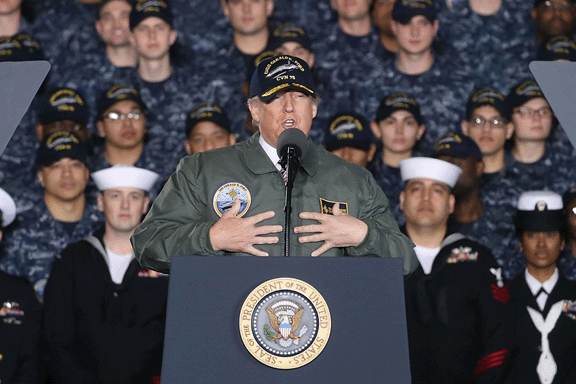
During a speech at the White House, Mr Trump accused the “fanatical regime” in the Iranian capital of spreading “death, destruction and chaos around the globe” as he again called the nuclear pact “one of the worst” agreements the US has ever entered into.
However, he stopped short of scrapping the agreement altogether, saying he wanted his administration to work with Congress and other nations to address the “deal’s many serious flaws”. ……Federica Mogherini, the EU’s foreign policy chief and one of the deal’s chief negotiators, said the agreement will remain valid regardless of Mr Trump’s decision. ……
The move by Mr Trump was part of his “America First” approach to international agreements which has led him to withdraw the United States from the Paris climate accord and the Trans-Pacific Partnership trade talks and renegotiate the North American Free Trade Agreement with Canada and Mexico……
Mr Trump’s more confrontational strategy toward Iran is likely to complicate relations with European allies while strengthening ties with Israel.A vocal opponent of the agreement when it was signed, Israeli Prime Minister Benjamin Netanyahu welcomed Mr Trump’s “courageous” decision.
“I congratulate President Trump for his courageous decision today. He boldly confronted Iran’s terrorist regime,” the prime minister said in a video statement he released in English.
But both UK Prime Minister Theresa May and French President Emmanuel Macron this week had tried to persuade Mr Trump to re-certify the deal. Ms May has called the agreement “vital”, while Mr Macron has said it is “essential for peace”. …….
Russia’s foreign ministry said there was no place in international diplomacy for threatening and aggressive rhetoric such as that displayed by Mr Trump and said such methods were “doomed to fail”, in a statement issued after Mr Trump’s speech……
John McLaughlin, a former acting CIA director under Republican President George W Bush, called the decertification of the Iran deal one of Mr Trump’s “worst decisions”.
By Associated Press 14 October 2017, WASHINGTON (AP) – President Donald Trump offered a questionable reading of Iran’s past economic condition Friday when he blamed the Obama administration for lifting sanctions just as Iran’s government was facing “total collapse.”
A look at some of his points in remarks Friday that denounced Iran’s behavior but stopped short of fulfilling his campaign promise to get the U.S. out of the multinational deal that eased sanctions on Iran in return for a suspension of its nuclear program:
TRUMP: “The previous administration lifted these sanctions, just before what would have been the total collapse of the Iranian regime.”
THE FACTS: An imminent collapse of Iran’s economy was highly unlikely, according to international economists and U.S. officials.
International penalties on Iran in response to its nuclear program did drive its economy into crisis earlier this decade. But even before the nuclear deal, Iran had cut budget expenditures and fixed its balance of payments. It was still exporting oil and importing products from countries such as Japan and China.
The multinational deal froze Iran’s nuclear program in return for an end to a variety of oil, trade and financial sanctions on Tehran. Iran also regained access to frozen assets held abroad. The deal was conceivably an economic lifeline for the state, but international economists as well as U.S. officials did not foresee an imminent economic collapse at the time.
Among those experts, Patrick Clawson at the Washington Institute for Near East Policy said Iran’s leaders worried about the potential for social unrest at the time, but that the economy was sustainable.
TRUMP: “The Iranian regime has committed multiple violations of the agreement. For example, on two separate occasions, they have exceeded the limit of 130 metric tons of heavy water.”
THE FACTS: Iran is meeting all of its obligations under the deal, according to International Atomic Energy Agency investigators, who noted some minor violations that were quickly corrected.
Trump is right that Iran exceeded the limit on heavy water in its possession on two occasions. Both times, international inspectors were able to see that Iran made arrangements to ship the excess out of the country so that it could come back into compliance.
Deal supporters argue this shows the agreement works. Deal opponents say that because Iran sells the surplus on the open market, Iran is therefore being rewarded for violating the deal.
Trump and other critics of the agreement point in particular to Iran’s continuing missile tests, which may or may not defy the U.N. Security Council resolution that enshrined the deal. But those tests do not violate the deal itself.
TRUMP on the deal: “It also gave the regime an immediate financial boost and over $100 billion its government could use to fund terrorism. The regime also received a massive cash settlement of $1.7 billion from the United States, a large portion of which was physically loaded onto an airplane and flown into Iran.”
THE FACTS: The “financial boost” was from money that was Iran’s to begin with. It was not a payout from the U.S. or others but an unfreezing of Iranian assets held abroad.
The $1.7 billion from the U.S. is a separate matter. That dates to the 1970s, when Iran paid the U.S. $400 million for military equipment that was never delivered because the government was overthrown and diplomatic relations ruptured.
The rupture left people, businesses and governments in each country indebted to partners in the other, and these complex claims took decades to sort out in tribunals and arbitration. For its part, Iran paid settlements of more than $2.5 billion to American people and businesses.
The day after the nuclear deal was implemented, the U.S. and Iran announced they had settled the claim over the 1970s military equipment order, with the U.S. agreeing to pay the $400 million principal along with $1.3 billion in interest. Find AP Fact Checks at http://apne.ws/2kbx8bd
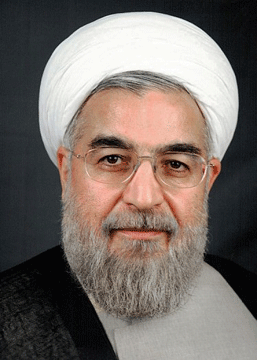
Rouhani says Iran will stay in nuclear deal only if it serves interests – TV, Parisa Hafezi, ANKARA (Reuters) 13 Oct 17, – Iran harshly reacted to President Donald Trump’s decision not to certify its nuclear deal with six major powers, and President Hassan Rouhani said Tehran might walk away if the continuing agreement does not serve the country’s national interests.
Defying Trump, Rouhani said Tehran will double its efforts to expand the country’s defence capabilities, including the country’s ballistic missile programme despite the U.S. pressure to suspend it.
Trump said in an address at the White House that he would not continue to certify the multinational agreement and warned he might ultimately terminate it.
“No president can revoke an international deal … Iran will continue to respect it as long as it serves our interests,” Rouhani said in a live television address, adding that Trump’s speech was full of “insults and fake accusations” against Iranians.
While Trump did not pull the United States out of the agreement, aimed at preventing Iran from developing a nuclear bomb, he gave the U.S. Congress 60 days to decide whether to reimpose economic sanctions on Tehran that were lifted under the pact.
Mr Trump is expected to announce additional economic sanctions against Iran
He has previously called the pact “the worst deal ever negotiated”
The deal saw Iran limit its nuclear program in exchange for fewer economic sanctions
Mr Trump announced the major shift in US policy in a speech that detailed a more confrontational approach to Iran over its nuclear and ballistic missile programs and its support for extremist groups in the Middle East.
Mr Trump said in an address at the White House that his goal was to ensure Iran never obtained a nuclear weapon.
While Mr Trump did not pull the United States out of the agreement, aimed at preventing Iran from developing a nuclear bomb, he gave the US Congress 60 days to decide whether to reimpose economic sanctions on Tehran that were lifted under the pact.
That would increase tension with Iran as well as put Washington at odds with other signatories of the accord such as Britain, France, Germany, Russia, China and the European Union.
Mr Trump warned that if “we are not able to reach a solution working with Congress and our allies, then the agreement will be terminated.”
The US military said it was reviewing the “entire breadth” of its security cooperation activities, force posture and plans to support the new strategy.
“We are identifying new areas where we will work with allies to put pressure on the Iranian regime, neutralise its destabilising influences, and constrain its aggressive power projection, particularly its support for terrorist groups and militants,” Major Adrian Rankine-Galloway, a Pentagon spokesman, told Reuters.
Iran’s President Hassan Rouhani is expected to respond to Mr Trump’s speech on live television in the coming hours.
Mixed responses to policy shift
The European Union’s foreign policy chief Federica Mogherini said the US could not unilaterally cancel the 2015 nuclear deal between Iran and world powers.
Ms Mogherini chaired the final stages of the landmark talks that brought the deal to fruition. She told reporters she spoke to US Secretary of State Rex Tillerson immediately after Mr Trump’s speech.
“We cannot afford, as the international community, to dismantle a nuclear agreement that is working,” she said.
“This deal is not a bilateral agreement … The international community, and the European Union with it, has clearly indicated that the deal is, and will, continue to be in place.”
Mr Trump’s announcement was praised by politicians from countries that have strained relationships with Iran.
Saudi Arabia welcomed the new policy towards Iran and said lifting sanctions had allowed Iran to develop its ballistic missile program and step up its support for militant groups, state news agency SPA reported.
The kingdom said Iran took advantage of additional financial revenues to support for the Lebanese Shi’ite movement Hezbollah and the Houthi group in Yemen.
Israeli Prime Minister Benjamin Netanyahu congratulated Mr Trump for his speech, seeing an opportunity to change the 2015 nuclear deal with Tehran as well as Iranian conduct in the region.
“[Mr Trump] boldly confronted Iran’s terrorist regime [and] created an opportunity to fix this bad deal, to roll back Iran’s aggression and to confront its criminal support of terrorism,” Mr Netanyahu said in a Facebook video.
Israel’s intelligence minister Israel Katz said the speech was “very significant” and could lead to war given threats that preceded it from Tehran.
Israel’s Channel 2 TV asked Mr Katz whether he saw a risk of war after the US leader’s speech.
“Absolutely, yes. I think that the speech was very significant,” he said.
“Iran is the new North Korea. We see where things are goings.” Reuters
Can the Iran deal work without the US? http://thebulletin.org/can-iran-deal-work-without-us11184, 12 OCTOBER 2017 Navid HassibiMedia reports say that President Donald Trump may soon inform Congress that Iran is not complying with its end of the nuclear deal, despite numerous IAEA reports to the contrary and his own two previous certifications. The president is reportedly annoyed by the process, which requires him to certify every 90 days that Iran is in compliance with the terms of the agreement, and he appears to be keen to adopt a more confrontational approach toward Tehran.
While Trump’s refusal to re-certify is not the same as completely withdrawing from the deal—formally known as the Joint Comprehensive Plan of Action (JCPOA)—refusing to certify could have a significant impact, kicking the issue over to Congress, which would then have to decide within 60 days whether to re-impose nuclear-related economic sanctions on Iran. While this action is by no means guaranteed, given thediscord between the White House and mainstream Republicans on Capitol Hill on a number of issues, the re-imposition of sanctions on Iran is still a distinct possibility, given previous opposition to the deal by dedicated congressional Iran hawks.
And from the Iranian point of view, if sanctions are re-imposed by the US Congress, the United States would be in material breach of the deal, which would give a pretext for its unravelling—unless the deal can in some way survive without the United States.
What are the chances of this happening? Can Washington withdraw from the deal without facts on the ground to back up this action? Can the dispute resolution mechanism contained in the deal save it? What about the role of the other five countries that negotiated with Iran alongside the United States: France, Germany, China, Russia, and the United Kingdom? (And the European Union, which coordinates the JCPOA.)
Can the deal survive?
Immediate signals from Iran and Europe. Recent statements by Iran seem to indicate that it wishes to try to keep the deal going, despite a putative US withdrawal from the JCPOA. Iran’s Foreign Minister, Mohammad Javad Zarif, said in some of his strongest public language yet that Iran would remain in the deal if Europe and others did too. And that seems to be a strong possibility; in an interview with Politico, Zarif said: “The Europeans have made it very clear to us and to the United States that they intend to do their utmost to ensure survival of the deal.” This interview also illuminated what a striking gap Trump has opened up between the Americans and their closest allies.
With this in mind, it is clear that a United States withdrawal from the deal would isolate Washington, significantly damage its credibility to negotiate future agreements in good faith, and harm its relationship with allies.
And it might potentially expose it to economic and even legal risks. Can Washington even withdraw from the deal? It is unclear whether the Trump administration can simply withdraw from the deal without cause, or as the deal defines it, an issue of non-performance. The deal does not explicitly describe the procedures involved for a party to leave the agreement—likely by design. The United States may consider the deal to be a non-binding political commitment, but the Europeans believe that the JCPOA is binding because it has been codified through a UN Security Council resolution. When viewed through this lens, US re-imposition of unilateral sanctions (including withdrawal from the agreement) could be interpreted as contravening international law and place Washington in legal jeopardy. This course of action would certainly qualify as non-performance under the deal.
To dance around this problem, the Trump administration has repeatedly accused Iran of violating the spirit of the agreement. For example, administration officials have been making references to the JCPOA’s Preamble and its Article 28, both of which state that the parties commit to implement the deal in good faith and refrain from any action inconsistent with the letter, spirit, and intent of the JCPOA. By interpreting these provisions beyond the scope they were originally intended, the Trump Administrations apparently hopes to prop up its possible withdrawal from the deal.
What about the deal’s dispute resolution mechanism? The JCPOA and the corresponding UN Security Council Resolution detail the necessary steps needed to resolve issues of legitimate non-performance. (And it should be noted that this mechanism was developed with the presumption that no party would deliberately sabotage the deal, which seems to be the intent of the Trump Administration’s words and deeds.)
Under this mechanism, both the United States and Iran could raise the issue of non-performance before the Joint Commission, which is charged with overseeing implementation of the deal. The Joint Commission would then have the opportunity to resolve the problem, at both the foreign minister-level and through a three-member advisory panel, each of which could issue a non-binding opinion. In this situation, the three-member panel would consist of Iran, the United States, and a third JCPOA member. (And remember that the Joint Commission consists of the United States, the United Kingdom, France, Russia, China, Germany and Iran.) Seeing as how all the remaining members of the Joint Commission resolutely back continued implementation of the nuclear deal, it’s safe to assume that their judgment would be in favor of Iran and rule that the US was in non-performance—a decision that Washington would disagree with.
But the decision would be a hollow victory for Iran, because the Joint Commission requires full consensus when it comes to the issue of non-performance—effectively meaning unanimous approval—so just the one dissenting vote from the United States would be enough to stop the dispute resolution mechanism from going into effect, and so leave Iran with few options for redress.
But US non-performance might give Iran grounds to cease performing its own commitments in whole or in part. This would see Iran expand its nuclear program to pre-agreement levels and potentially beyond, and remove the transparency and inspection measures that Iran has found so intrusive but which it had agreed to under the deal. As a result, US non-performance could needlessly re-introduce a crisis that had previously been resolved, and increase the risk of military conflict between Iran and the United States (or Israel). Much of the world would likely blame the Trump administration and this would have far-reaching effects; for example, any credible approach to peacefully resolving the situation on the Korean peninsula would be met with skepticism. Or, as EU foreign policy chief Federica Mogherini put it: “We already have one potential nuclear crisis. We definitely [do] not need to go into another one.”
The United States could go even further, by abusing the terms of the JCPOA to re-impose—or “snap back”—UN Security Council sanctions on Iran. The United States would merely have to notify the Security Council of its assessment that Iran is in non-performance, regardless of the facts. The Security Council would then have to vote on a resolution to continue sanctions relief. The Trump administration would likely veto the resolution and the pre-JCPOA UN sanctions against Iran would be back in place.
Ironically, this mechanism was intended to keep Tehran, and not Washington, in check.
To mitigate against a US threat of snapping UN sanctions back, an arcane and mostly symbolic tactic to bypass a veto could be invoked through the so-called “Uniting for Peace” resolutionof the UN General Assembly, which allows it to vote on a matter that lacks unanimity in the UN Security Council with a simple majority. Although this may seem far-fetched, it could be a legitimate option in countering President Trump’s unpredictability.
Blowback from US withdrawal? Should Washington contravene the nuclear deal, the remaining members of the Joint Commission could work to salvage what is left of the JCPOA, which, along with the UN Security Council Resolution, allows it to “adopt or modify, as necessary, procedures to govern its activities” and “consult and provide guidance on other implementation matters that may arise under the JCPOA.” In this vein, the Joint Commission could adopt an approach that would include accepting US non-performance and withdrawal as a fait accompli, and encourage its members to simply ignore UN sanctions—effectively preventing any snap back, and working against any unilateral US nuclear-related sanctions on Iran.
The EU has already indicated that it is considering employing a “Blocking Statute” which would make it illegal for EU companies to comply with US sanctions done in this manner. (And there is a precedent for this action; the EU had previously used a Blocking Statute in the 1990s in response to the Clinton administration’s sanctions against Iran.) At a recent panel discussion, the EU ambassador to the United States notedthat the “European Union will act to protect the legitimate interests of our companies with all the means at our disposal.”
Seeking remedial action against US secondary sanctions through the World Trade Organization could be another option by the EU. (Secondary sanctions are penalties applied to third-parties, such as foreign banks not directly linked to Iranian entities.) Presumably, Russia, China and others could adopt similar hedges against US measures.
Consequently, it can be seen that maintaining the deal in some form, without the United States, could indeed be a real possibility.
But by far, the best path forward would be for Washington to continue to comply with the JCPOA—which, after all, was a deal laboriously negotiated in good faith over several years to peacefully resolve a longstanding security concern. Simply put, the alternative to the JCPOA would be escalating tensions and inevitable conflict. Other US grievances against Iran—such as addressing Iran’s ballistic missile program, or countering Iranian influence in the region, or dealing with the sunset clauses of the JCPOA (which see time limits of varying lengths, including 10 and 15 years, on restrictions on Iran’s nuclear program)—should be discussed through engagement and diplomacy.
Should the president fail to re-certify Iranian compliance by the October 15 deadline called for by the agreement, it will be up to members of Congress to act in the best interests of the United States, by refraining to re-impose sanctions.
False Assumptions About the Iran Nuclear Deal https://www.nytimes.com/2017/10/08/opinion/false-assumptions-about-the-iran-nuclear-deal.html, By GHOLAMALI KHOSHRO, OOn Oct. 15, the Trump administration will for the third time have to decide whether or not to certify that my country, Iran, is complying with Joint Comprehensive Plan of Action — the nuclear deal that was reached in 2015 between Iran and the five permanent members of the U.N. Security Council plus Germany.
First, some of the agreement’s opponents claim that the J.C.P.O.A. is “the worst agreement the United States has ever entered into with another country.” This ignores an important truth: The nuclear deal is not a bilateral agreement between Tehran and Washington. In fact, it isn’t even a multilateral deal that requires ratification in either Congress or the Iranian Parliament. It is, instead, a United Nations Security Council resolution. (Indeed, this explains why the deal continues to have wide support from the other Security Council members, as well as from Secretary General António Guterres.)
A second false assumption is that the deal is meant to dictate Iran’s policies in matters unrelated to our nuclear program. This has never been the case. It was always clear that the path to reaching a nuclear deal meant setting aside other geopolitical concerns. Anyone involved in the years of talks that led to the J.C.P.O.A. can attest to this. For example, even as Russia and the United States disagreed on many other issues in the Middle East, they were able to work together at the negotiating table.
Reports now indicate the Trump administration wants to tie the nuclear agreement to Iran’s missile program, a move that would go far beyond the J.C.P.O.A.’s intended purpose. Security Council Resolution 2231, which incorporates the nuclear deal, “calls upon” Iran to not work on “ballistic missiles designed to be capable of delivering nuclear weapons.” But my country is not seeking to develop or acquire nuclear weapons and this carefully negotiated language does not restrain us from developing conventional military deterrence technology that so many other countries possess. The fact that Iranian missiles are designed for maximum precision proves that they are not designed for nuclear capability, as such delivery vehicles need not be precise in targeting.
A third false assumption is that there is a “sunset clause” in the deal, suggesting that in a decade Iran will be free of inspections or limits on its nuclear program. While it’s true that some provisions regarding restrictions will expire, crucial aspects of inspections will not. Moreover, the deal establishes that some six years from now — assuming all participants have fulfilled their obligations — Iran should ratify the Additional Protocol on Nuclear Safeguards, part of the Nonproliferation Treaty. This would subject my country to an extensive I.A.E.A. inspection process. Iran will continue its nuclear program for energy and medical purposes as a normal member of the international community and signatory to the Nonproliferation Treaty after the period of years written into the J.C.P.O.A.
We Iranians — like all nations involved in adopting the deal, the international community and nonproliferation experts — recognize that the nuclear agreement was an important diplomatic accomplishment and it remains a credit to the international nonproliferation regime. Among the seven countries that negotiated the nuclear agreement, only America finds the deal’s adoption controversial.
What the president and Congress decide to do about recertification is, ultimately, a domestic matter. But if the United States wants to remain credible in future multilateral negotiations, it cannot go against the international consensus and attempt to scuttle past diplomacy whether as political retaliation against a previous administration, or as part of a constant reassessment of American national interests.
Gholamali Khoshroo is Iran’s ambassador to the United Nations.
First, some of the agreement’s opponents claim that the J.C.P.O.A. is “the worst agreement the United States has ever entered into with another country.” This ignores an important truth: The nuclear deal is not a bilateral agreement between Tehran and Washington. In fact, it isn’t even a multilateral deal that requires ratification in either Congress or the Iranian Parliament. It is, instead, a United Nations Security Council resolution. (Indeed, this explains why the deal continues to have wide support from the other Security Council members, as well as from Secretary General António Guterres.)
A second false assumption is that the deal is meant to dictate Iran’s policies in matters unrelated to our nuclear program. This has never been the case. It was always clear that the path to reaching a nuclear deal meant setting aside other geopolitical concerns. Anyone involved in the years of talks that led to the J.C.P.O.A. can attest to this. For example, even as Russia and the United States disagreed on many other issues in the Middle East, they were able to work together at the negotiating table.
Reports now indicate the Trump administration wants to tie the nuclear agreement to Iran’s missile program, a move that would go far beyond the J.C.P.O.A.’s intended purpose. Security Council Resolution 2231, which incorporates the nuclear deal, “calls upon” Iran to not work on “ballistic missiles designed to be capable of delivering nuclear weapons.” But my country is not seeking to develop or acquire nuclear weapons and this carefully negotiated language does not restrain us from developing conventional military deterrence technology that so many other countries possess. The fact that Iranian missiles are designed for maximum precision proves that they are not designed for nuclear capability, as such delivery vehicles need not be precise in targeting.
A third false assumption is that there is a “sunset clause” in the deal, suggesting that in a decade Iran will be free of inspections or limits on its nuclear program. While it’s true that some provisions regarding restrictions will expire, crucial aspects of inspections will not. Moreover, the deal establishes that some six years from now — assuming all participants have fulfilled their obligations — Iran should ratify the Additional Protocol on Nuclear Safeguards, part of the Nonproliferation Treaty. This would subject my country to an extensive I.A.E.A. inspection process. Iran will continue its nuclear program for energy and medical purposes as a normal member of the international community and signatory to the Nonproliferation Treaty after the period of years written into the J.C.P.O.A.
We Iranians — like all nations involved in adopting the deal, the international community and nonproliferation experts — recognize that the nuclear agreement was an important diplomatic accomplishment and it remains a credit to the international nonproliferation regime. Among the seven countries that negotiated the nuclear agreement, only America finds the deal’s adoption controversial.
What the president and Congress decide to do about recertification is, ultimately, a domestic matter. But if the United States wants to remain credible in future multilateral negotiations, it cannot go against the international consensus and attempt to scuttle past diplomacy whether as political retaliation against a previous administration, or as part of a constant reassessment of American national interests.
Gholamali Khoshroo is Iran’s ambassador to the United Nations.
First, some of the agreement’s opponents claim that the J.C.P.O.A. is “the worst agreement the United States has ever entered into with another country.” This ignores an important truth: The nuclear deal is not a bilateral agreement between Tehran and Washington. In fact, it isn’t even a multilateral deal that requires ratification in either Congress or the Iranian Parliament. It is, instead, a United Nations Security Council resolution. (Indeed, this explains why the deal continues to have wide support from the other Security Council members, as well as from Secretary General António Guterres.)
A second false assumption is that the deal is meant to dictate Iran’s policies in matters unrelated to our nuclear program. This has never been the case. It was always clear that the path to reaching a nuclear deal meant setting aside other geopolitical concerns. Anyone involved in the years of talks that led to the J.C.P.O.A. can attest to this. For example, even as Russia and the United States disagreed on many other issues in the Middle East, they were able to work together at the negotiating table.
Reports now indicate the Trump administration wants to tie the nuclear agreement to Iran’s missile program, a move that would go far beyond the J.C.P.O.A.’s intended purpose. Security Council Resolution 2231, which incorporates the nuclear deal, “calls upon” Iran to not work on “ballistic missiles designed to be capable of delivering nuclear weapons.” But my country is not seeking to develop or acquire nuclear weapons and this carefully negotiated language does not restrain us from developing conventional military deterrence technology that so many other countries possess. The fact that Iranian missiles are designed for maximum precision proves that they are not designed for nuclear capability, as such delivery vehicles need not be precise in targeting.
A third false assumption is that there is a “sunset clause” in the deal, suggesting that in a decade Iran will be free of inspections or limits on its nuclear program. While it’s true that some provisions regarding restrictions will expire, crucial aspects of inspections will not. Moreover, the deal establishes that some six years from now — assuming all participants have fulfilled their obligations — Iran should ratify the Additional Protocol on Nuclear Safeguards, part of the Nonproliferation Treaty. This would subject my country to an extensive I.A.E.A. inspection process. Iran will continue its nuclear program for energy and medical purposes as a normal member of the international community and signatory to the Nonproliferation Treaty after the period of years written into the J.C.P.O.A.
We Iranians — like all nations involved in adopting the deal, the international community and nonproliferation experts — recognize that the nuclear agreement was an important diplomatic accomplishment and it remains a credit to the international nonproliferation regime. Among the seven countries that negotiated the nuclear agreement, only America finds the deal’s adoption controversial.
What the president and Congress decide to do about recertification is, ultimately, a domestic matter. But if the United States wants to remain credible in future multilateral negotiations, it cannot go against the international consensus and attempt to scuttle past diplomacy whether as political retaliation against a previous administration, or as part of a constant reassessment of American national interests.
Gholamali Khoshroo is Iran’s ambassador to the United Nations.
First, some of the agreement’s opponents claim that the J.C.P.O.A. is “the worst agreement the United States has ever entered into with another country.” This ignores an important truth: The nuclear deal is not a bilateral agreement between Tehran and Washington. In fact, it isn’t even a multilateral deal that requires ratification in either Congress or the Iranian Parliament. It is, instead, a United Nations Security Council resolution. (Indeed, this explains why the deal continues to have wide support from the other Security Council members, as well as from Secretary General António Guterres.)
A second false assumption is that the deal is meant to dictate Iran’s policies in matters unrelated to our nuclear program. This has never been the case. It was always clear that the path to reaching a nuclear deal meant setting aside other geopolitical concerns. Anyone involved in the years of talks that led to the J.C.P.O.A. can attest to this. For example, even as Russia and the United States disagreed on many other issues in the Middle East, they were able to work together at the negotiating table.
Reports now indicate the Trump administration wants to tie the nuclear agreement to Iran’s missile program, a move that would go far beyond the J.C.P.O.A.’s intended purpose. Security Council Resolution 2231, which incorporates the nuclear deal, “calls upon” Iran to not work on “ballistic missiles designed to be capable of delivering nuclear weapons.” But my country is not seeking to develop or acquire nuclear weapons and this carefully negotiated language does not restrain us from developing conventional military deterrence technology that so many other countries possess. The fact that Iranian missiles are designed for maximum precision proves that they are not designed for nuclear capability, as such delivery vehicles need not be precise in targeting.
A third false assumption is that there is a “sunset clause” in the deal, suggesting that in a decade Iran will be free of inspections or limits on its nuclear program. While it’s true that some provisions regarding restrictions will expire, crucial aspects of inspections will not. Moreover, the deal establishes that some six years from now — assuming all participants have fulfilled their obligations — Iran should ratify the Additional Protocol on Nuclear Safeguards, part of the Nonproliferation Treaty. This would subject my country to an extensive I.A.E.A. inspection process. Iran will continue its nuclear program for energy and medical purposes as a normal member of the international community and signatory to the Nonproliferation Treaty after the period of years written into the J.C.P.O.A.
We Iranians — like all nations involved in adopting the deal, the international community and nonproliferation experts — recognize that the nuclear agreement was an important diplomatic accomplishment and it remains a credit to the international nonproliferation regime. Among the seven countries that negotiated the nuclear agreement, only America finds the deal’s adoption controversial.
What the president and Congress decide to do about recertification is, ultimately, a domestic matter. But if the United States wants to remain credible in future multilateral negotiations, it cannot go against the international consensus and attempt to scuttle past diplomacy whether as political retaliation against a previous administration, or as part of a constant reassessment of American national interests.
Gholamali Khoshroo is Iran’s ambassador to the United Nations.
Trump plans to declare that Iran nuclear deal is not in the national interest, WP, By Anne GearanOctober 5 President Trump plans to announce next week that he will “decertify” the international nuclear deal with Iran, saying it is not in the national interest of the United States and kicking the issue to a reluctant Congress, people briefed on an emerging White House strategy for Iran said Thursday.
The move would mark the first step in a process that could eventually result in the resumption of U.S. sanctions against Iran, which would blow up a deal limiting Iran’s nuclear activities that the country reached in 2015 with the U.S. and five other nations.
Trump is expected to deliver a speech, tentatively scheduled for Oct. 12, laying out a larger strategy for confronting the nation it blames for terrorism and instability throughout the Middle East.
Under what is described as a tougher and more comprehensive approach, Trump would open the door to modifying the landmark 2015 agreement he has repeatedly bashed as a raw deal for the United States. But for now he would hold off on recommending that Congress reimpose sanctions on Iran that would abrogate the agreement, said four people familiar with aspects of the president’s thinking.
Donald Trump’s demonisation of Iran is dishonest and dangerous, Guardian, Michael Axworthy, 6 Oct 17, The Iran nuclear deal is doing what it was designed to do. It is a force for stability in the unstable Middle East, and to endanger it is irresponsible “…….as we get further into Trumpworld, the more disturbing and dangerous a place it seems to be. And in a strange way, it seems he is not really president at all, but still running for president, still trying to convince people he deserves to be there. He is preoccupied with his predecessor and his policies, and with competing against his record, whether it is the size of the crowd at his inauguration, Obamacare, or now, the Iran nuclear deal that was negotiated while Obama was in office.
With all the difficulties of the world at the moment – a dangerous confrontation with North Korea, the looming threat of trade wars and consequent economic slump, and a Middle East region strewn with failed states, unresolved conflicts and misery, to name just a few – the Iran nuclear deal is a rare example of a recent diplomatic initiative that has actually enhanced stability.
The Joint Comprehensive Plan of Action (the full title of the agreement) is working. The International Atomic Energy Authority (IAEA), responsible for overseeing its verification and inspection provisions, is satisfied that it is working and that Iran is meeting its JCPOA commitments. The other countries that are party to the agreement, the UK, Germany, France China and Russia, agree with the IAEA and are satisfied too. But Donald Trump is not satisfied.
The JCPOA doesn’t do things it was never framed to do, of course. It doesn’t address missile development – its negotiators judged that to attempt that would be too much, and would make an already difficult negotiation (which many pundits around the world said would never be successful), impossible to bring to a successful outcome………
Trump’s demonisation of Iran is dishonest. The instability of the region is not in any significant measure the consequence of Iranian actions. To blame Iran for terrorism in the region is misleading at best – most terrorism there, and most of the Islamist terrorism worldwide, is inspired by extreme versions of Sunni Islam, not by the Shia Islam of Iran and the Iranian regime.
The Republican right in the US, historically, has disliked arms control agreements, largely because they involve compromise by both sides and therefore fall short of what might appear the ideal from a narrow US perspective. But that is the nature of diplomacy too. Treaties have to be negotiated; only in exceptional circumstances can you dictate terms. Some commentators in the US have called the JCPOA a flawed agreement, but it is only flawed agreement from that skewed and immature perspective.
The JCPOA is doing what it was designed to do: limit Iran’s ability to make a bomb. It is a force for stability in the chronically unstable Middle East, and to endanger it is irresponsible. Not just the IAEA and most of the world, but most of Trump’s own military and civilian advisers, all agree on that. From their near silence on the matter, the deal’s previous enemies in Saudi Arabia now seem to agree too.
If Trump decertifies the deal – which seems to be his intention in the next few days – he weakens it, but gives responsibility for reimposing sanctions, which would wreck the agreement, to the US Congress.
To do that would be an abdication of his responsibility as president. It would be the action of a spoilt child who breaks the toys in the kindergarten because the adults won’t agree to do what he wants them to do. And if Trump abdicates responsibility in this way, the logical next step is that he should have the responsibility taken away from him.
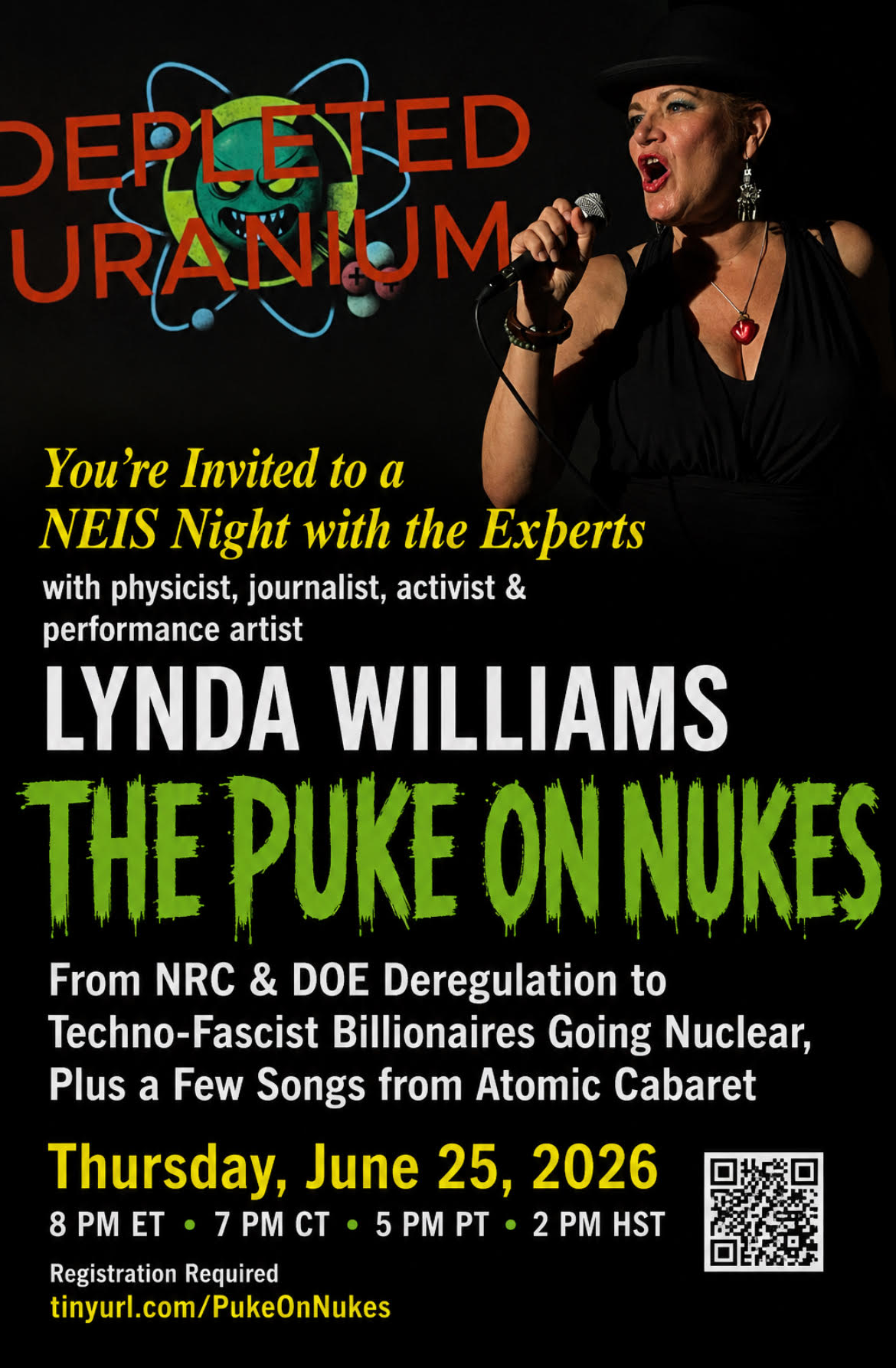
7pm Central Time (8pm ET, 6pm MT, 5pm PT) UTC – 5 From NRC & DOE Deregulation to Techno-Fascist Billionaires Going Nuclear, Plus a Few Songs from Atomic Cabaret REGISTER









 nuclear-news