Iran makes ‘substantial’ nuclear offer in return for US lifting sanctions
|
Plan would allow enhanced, permanent nuclear inspections Iran has offered a deal with the US in which it would formally and permanently accept enhanced inspections of its nuclear programme, in return for the permanent lifting of US sanctions. The offer was made by the Iranian foreign minister, Mohammad Javad Zarif, on a visit to New York. But it is unlikely to be warmly received by the Trump administration, which is currently demanding Iran make a range of sweeping concessions, including cessation of uranium enrichment and support for proxies and allies in the region…… https://www.theguardian.com/world/2019/jul/18/iran-nuclear-deal-trump-mohammad-javad-zarif-sanctions |
|
Iran’s diplomatic offer on nuclear inspections meets with USA scepticism
|
Iran floats offer on nuclear inspections; U.S. skeptical Arshad Mohammed, Steve Holland, WASHINGTON (Reuters) 18 Jul 19- Iran on Thursday signaled a willingness to engage in diplomacy to defuse tensions with the United States with a modest offer on its nuclear program that met immediate skepticism in Washington. Iran’s foreign minister told reporters in New York that Iran could immediately ratify a document prescribing more intrusive inspections of its nuclear program if the United States abandoned its economic sanctions, media organizations reported. The document, known as the Additional Protocol, gives U.N. inspectors from the International Atomic Energy Agency (IAEA) more tools to verify that a nuclear program is peaceful. While U.S. officials suggested they viewed the idea as a non-starter, analysts said it could provide an opening for U.S. President Donald Trump’s administration to pursue diplomacy. …….. ‘A CREATIVE OPENING’? Former U.S. officials saw a diplomatic opening. “If the foreign minister has suggested that the Majlis (the Iranian parliament) would ratify the additional protocol now, that is a serious step,” said Wendy Sherman, a former Obama administration official who negotiated the 2015 nuclear deal. “Of course, Iran will want something serious in return. Nonetheless, a creative opening,” she added. ……… Trump on Thursday said a U.S. Navy ship had “destroyed” an Iranian drone in the Strait of Hormuz after the aircraft threatened the ship. But Zarif told reporters at the United Nations he was not aware of any Iranian drone being downed.https://www.reuters.com/article/us-mideast-iran-usa-zarif/iran-floats-offer-on-nuclear-inspections-us-skeptical-idUSKCN1UD310 |
Iran still committed to the nuclear accord, but will decrease its commitment if other signatories cannot help
 Iran Threatens to Revert to Pre-2015 Nuclear Development Levels, By VOA News, July 15, 2019 Iran threatened Monday to revert its nuclear development program to pre-2015 levels before it agreed to restraints under an international accord if the European countries and the United States that were signatories to the deal fail to help its economy.
Iran says reducing nuclear deal commitments to save it from ‘total collapse
Iran says reducing nuclear deal commitments to save it from ‘total collapse’, Press TV, Jul 5, 2019 Foreign Minister Mohammad Javad Zarif says Tehran’s decision to scale down its commitments under the JCPOA is indeed aimed at protecting the multilateral deal, not killing it.
Back on May 8, Iran notified its remaining partners in the 2015 nuclear deal that it would suspend the implementation of some of its commitments in reaction to the US’ unilateral withdrawal and Europe’s failure to live up to its commitments.
Speaking in an exclusive email interview with The New York Times published on Thursday night, Zarif said Iran made the decision as it “can indeed prevent the deal from total collapse.”
The Joint Comprehensive Plan of Action (JCPOA) “was and remains the best POSSIBLE agreement on the nuclear issue,” Zarif said, adding that its total collapse “will be detrimental to the interests of all, including the US.”
He said Iran “will remain committed to the deal as long as the remaining participants (EU, France, Germany, UK, Russia and China) observe the deal.”
“Survival or collapse of the JCPOA depends on the ability and willingness of all parties to invest in this undertaking. In a nutshell, a multilateral agreement cannot be implemented unilaterally,” Zarif said.
He also said that Iran’s decision to reduce its commitments was taken in line with its legal rights under paragraphs 26 and 36 of the nuclear deal, saying, “Paragraph 36 of JCPOA is a clear example that we negotiated this deal with the full understanding that we could not trust the commitment of the West.
As part of the first phase of scaling down its commitments, Iran exceeded the 300-kilogram limit set by the JCPOA on its low-enriched uranium stockpiles……….
The JCPOA obliges the European partners to prove their commitment to the nuclear deal in action, Zarif said, adding that the Islamic Republic would commit to the agreement in exactly the same way as those countries would.https://www.presstv.com/Detail/2019/07/05/600190/Iran-Zarif-JCPOA-nuclear-deal-commitments
How the Iran nuclear deal actually works
“I think in Iran, we are pretty confident that there is no undeclared plant”
How the Iran nuclear deal works, explained in 3 minutes
Iran is enriching uranium and breaking the limit set by the nuclear deal. Here’s what  that means.
Uranium enrichment is a critical step in making nuclear energy and nuclear weapons. VOX, By Iran has exceeded the uranium enrichment level of 3.67 percent set in the 2015 nuclear deal it made with world powers, a spokesman for Iran’s nuclear agency said, according to reports Monday.
The deal put tight restrictions on Iran’s nuclear program in exchange for the loosening of some international sanctions on the country. The 3.67 percent limitation on uranium enrichment purity was one of many limits in the deal meant to keep Iran from gathering enough material to build an atom bomb in a year if it chose to (Iran has never officially said it wants a nuclear weapon).
On Sunday, Iran’s deputy foreign minister, Abbas Araghchi, said Iran would begin enriching uranium to 4.5 percent for its Bushehr power plant.
“This is to protect the nuclear deal, not to nullify it. … This is an opportunity for talks. And if our partners fail to use this opportunity, they should not doubt our determination to leave the deal,” Araghchi said.
The 4.5 percent enrichment is still well below the 90 percent considered weapons-grade. But the violation of the deal is a move meant “to pressure Europe to reset the terms of the nuclear agreement following a US withdrawal from the pact last year,” according to the Washington Post.
Given the extraordinary destructive power of a nuclear weapon, keeping a close eye on enrichment around the world is critical to global security. But in the decades since the Manhattan Project, the enrichment process has gone from a massive, power-hungry, brute-force operation to a sophisticated and potentially clandestine affair.
Since it’s immensely important in international diplomacy right now, it’s worthwhile to understand what goes into enriching nuclear material, how the nuclear process works, and the strategies for keeping it in check………
Given the extraordinary destructive power of a nuclear weapon, keeping a close eye on enrichment around the world is critical to global security. But in the decades since the Manhattan Project, the enrichment process has gone from a massive, power-hungry, brute-force operation to a sophisticated and potentially clandestine affair.
Since it’s immensely important in international diplomacy right now, it’s worthwhile to understand what goes into enriching nuclear material, how the nuclear process works, and the strategies for keeping it in check.
Under the NPT, countries that don’t currently possess nuclear weapons are prevented from developing or spreading nuclear weapons technologies, but they can pursue nuclear activities for peaceful purposes like research or energy.
In 2003, Iran was found to have violated nuclear activity reporting requirements in the NPT, which spurred the international effort to get Iran to suspend its enrichment work. The US has argued that Iran does not have the right to enrich uranium since it was caught violating some of the safeguards imposed by the NPT, though Iran has not violated the treaty itself.
The goal of the six countries that signed the JCPOA with Iran in 2015 was to limit what is called “breakout time.” That is, how long it would take Iran to enrich enough material for a nuclear weapon if the country suddenly decided to ditch all international agreements and aggressively ramp up enrichment.
Prior to the agreement, Iran’s breakout time was estimated at four to six weeks. The provisions of the deal (Vox’s Zack Beauchamp put together an excellent explainer on this) aimed to extend this to more than a year, which would give international observers time to detect such a shift and enact countermeasures.
In short, the agreement made Iran limit uranium enrichment to 3.67 percent and decommission about 14,000 of its centrifuges, allowing just roughly 5,000 of Iran’s first-generation units to keep spinning. These IR-1 centrifuges produce between 0.75 and 1 SWU per device, whereas the IR-8 centrifuges Iran was developing at the time of the deal could theoretically manage 24 SWU, making them much more efficient.
Iran also gave up much of its low-enriched uranium stockpile, going from 25,000 pounds to 660 pounds. Iranian officials also agreed to pour concrete into their Arak reactor, a potential source of plutonium for nuclear weapons.
In addition, the JCPOA requires round-the-clock monitoring of Iran’s enrichment facilities in Fordow and Natanz, with only the Natanz facility allowed to operate. These are likely the only places where Iran can enrich uranium for a weapon.
“I think in Iran, we are pretty confident that there is no undeclared plant,” said Alex Glaser, director of the Nuclear Futures Laboratory at Princeton University.
International observers are also monitoring Iran’s uranium mining operations.
As it stands, the agreement effectively eliminates Iran’s prospects for enriching enough uranium for a civilian nuclear program and makes it much more tedious to gather the material required for a weapon. What little enrichment Iran is allowed under the deal is effectively a face-saving measure.
But, critics argue, pausing Iran’s entire nuclear enrichment apparatus only extends the breakout time by a few months since the country could just rebuild or reinstall its centrifuges if it decided to leave the agreement. And it looks like that day may be getting closer: a spokesman for Iran’s Atomic Energy Organization said Monday that the agency may increase the enrichment level to 20 percent or reinstall centrifuges.https://www.vox.com/2018/6/11/17369454/iran-uranium-enrichment
Iran’s Revolutionary Guards chief says -The world knows Iran is not pursuing nuclear weapon
Iran threatened on Monday to restart deactivated centrifuges and ramp up enrichment of uranium to 20 percent purity as its next potential big moves away from a 2015 nuclear agreement that Washington abandoned last year.
“Why do they globally sanction us about the nuclear issue when the world knows that we are not pursuing a weapon? In reality they are sanctioning us because of knowledge,” he said. “Nuclear weapons have no place in Islam. Islam never approves of weapons of mass destruction.”
Reporting By Babak Dehghanpisheh, Editing by William Maclean
Iran to breach nuclear deal limits: still far from producing a nuclear weapon
Iran said on Sunday that within hours it would breach the limits on uranium enrichment set four years ago in an accord with the United States and other international powers that was designed to keep Tehran from producing a nuclear weapon……….. The steps Iran has taken are all easily reversible. …..
In violating the limits on uranium enrichment, Tehran still remains far from producing a nuclear weapon. It would take a major production surge, and enrichment to far higher levels, for Iran to develop a bomb’s worth of highly enriched uranium, experts say. It would take even longer to manufacture that material into a nuclear weapon……..
The European strategy for the next few months, one senior diplomat involved in the discussions said, is to buy some time and hope to defuse the crisis. There is no immediate urgency about starting the process for “snapback” sanctions, and European officials, led by the French, hope to begin some kind of negotiation process that would make that unnecessary.
If Iran’s increase in the enrichment level is modest — say, to 5 percent, a level often used for fueling reactors — there would be no political momentum for sanctions, especially because European officials largely view President Trump as the instigator of the nuclear deal’s demise. ……
For a year after Mr. Trump withdrew the United States from what he called a “terrible” deal negotiated by his predecessor, Iran stayed within the accord’s limits. It pressed Britain, France and Germany to make good on their promises to compensate the country for oil revenues and other losses resulting from American sanctions. …….https://www.nytimes.com/2019/07/07/world/middleeast/iran-nuclear-limits-breach.html
Special UN meeting to discuss Iran: Russia, China, France, Britain and Germany try to keep nuclear deal
 UN nuclear watchdog to hold special meeting on Iran at request of US, RTE, 6 July 19 The United States has called an emergency meeting of the UN atomic watchdog’s 35-nation Board of Governors to discuss Iran, according to the US mission to the agency.
It comes after Tehran breached its 2015 nuclear deal with major powers.
Any country on the board can call a meeting, and the International Atomic Energy Agency confirmed in a note to member states that the meeting would be held next Wednesday after the IAEA this week said Iran had exceeded the maximum stock of enriched uranium allowed under the deal……..
The IAEA is in charge of verifying the restrictions on Iran’s nuclear activities imposed by the deal, which also lifted international sanctions against Tehran. The IAEA has repeatedly said it is up to the parties to the deal to decide whether there has been a breach of its terms.
Iran has said it will go over the deal’s nuclear restrictions one by one in retaliation against crippling economic sanctions Washington has imposed on it since the US withdrawal. It has said that as of 7 July it will enrich uranium beyond the 3.67% purity cap imposed by the deal.
Other signatories to the 2015 deal, apart from Iran and the United States, are Russia, China, France, Britain and Germany. Those five countries are trying to keep the deal alive. https://www.rte.ie/news/2019/0706/1060486-un-nuclear-watchdog-iran/
Fiery Imam suggests missile attack on Israel’s Dimona nuclear power plant
Israel’s Nuclear Reactor, Radio Farda, 7July 19, Tehran’s Friday Prayer Imam has suggested that Iran should launch a missile attack on Israel’s Dimona nuclear power plant.
In his Friday July 5 sermon, Ayatollah Mohammad Ali Movahedi Kermani, better known as Movahedi, addressed the United States and Israel, saying: “If Iran decides to confront you, a missile strike on the Dimona reactor would be enough,” threatening that the attack “will plough Israel 200 times.”
Dimona is an Israeli city in the Negev region, South of Beersheba and West of the Dead Sea. The city is nicknamed mini-India for its sizeable Indian Jewish community. The Shimon Peres Negev Nuclear Research Center is located about 13 kilometers to the southeast of the city.
Movahedi warned the United States and Israel about their vulnerability: “You are living in a glass house. You’d better watch out!”
He also warned the United States against a military attack on Iran………
Last year, Iran’s Supreme Leader Ali Khamenei changed his mind about appointing Movahedi as an interim chairman for the Expediency Council after a few weeks, probably fearing his occasional outlandish remarks could cause havoc in Iran’s domestic or international politics.
Some of Friday Prayer Imams in other Iranian cities have also made passing remarks about tensions in the region, but none was observed to make firebrand violent remarks. https://en.radiofarda.com/a/tehran-s-imam-suggests-missile-strike-on-israel-s-nuclear-reactor/30039265.html
Israel lobby in US pushing for war against Iran: Analyst
How Close Is Iran to a Nuclear Bomb, Really?
Experts say Tehran has the capability to build a nuclear weapon within a few years but perhaps not the intent. Foreign Policy.com, BY LARA SELIGMAN, JULY 1, 2019,
Iran confirmed on Monday that it has breached the limit on its stockpile of enriched uranium set by the 2015 nuclear deal, renewing concerns that Tehran could, within months, have enough weapons-grade uranium to build a nuclear bomb.
But experts say the violation is more of a symbolic move than a concrete step toward obtaining a nuclear weapon. Though most agree that Iran has the expertise and capability to eventually build such a device, it is not clear that Tehran has the intent or even sees the necessity of doing so.
“This is not a dash to a nuclear bomb,” said Kelsey Davenport, the director of nonproliferation policy at the Arms Control Association. “It is a calculated move designed to gain leverage in negotiations with the Europeans, Russia, and China on sanctions relief.”
Tehran has recently ratcheted up pressure on the remaining adherents to the nuclear deal to provide some sort of relief to U.S. President Donald Trump’s “maximum pressure” campaign. Iran has allegedly attacked oil tankers in the Gulf of Oman and most recently shot down a U.S. military surveillance drone, nearly provoking a U.S. missile attack that Trump aborted at the last minute. The regime is also threatening to suspend other commitments under the 2015 deal in just days unless European powers provide sanction relief.
The 2015 deal caps Iran’s levels of uranium enriched to 3.67 percent purity—called “low-enriched uranium” and suitable for producing fuel for nuclear power reactors—at 300 kilograms. But there are still a number of steps Iran would have to take in order to build a bomb, Davenport explained……….. https://foreignpolicy.com/2019/07/01/how-close-is-iran-to-a-nuclear-bomb-really/
No solution found to the nuclear issue, after European talks with Iran end
European Talks With Iran End, Leaving Nuclear Issue Unsettled, NYT, By David E. Sanger, June 28, 2019 WASHINGTON — A last-minute effort by European powers to persuade Iran not to breach limits on its stockpile of nuclear fuel ended inconclusively on Friday, with the Iranians saying that Britain, France and Germany had made only modest progress in developing a system to get around tight American sanctions on trade with Tehran.
As he left the talks in Vienna, Abbas Araghchi, the Iranian deputy foreign minister, said he expected Iran would go ahead with its plan to break the ceiling on how much low-enriched uranium it was allowed to possess. That breach could come as early as this weekend, potentially setting off another confrontation with the Trump administration, after a week of recriminations and military threats following the downing of an American drone and attacks on tankers.
“It is still not enough, and it is still not meeting Iran’s expectations,” Mr. Araghchi told reporters, according to news reports from Vienna. …….
Breaking the stockpile limit would not, by itself, give Iran enough fuel to produce a nuclear weapon. But the European participants in the 2015 agreement have been urging the Iranians not to dispense with the accord, for fear that the Trump administration might react with a military or cyberstrike against the Iranians…….
The United States’ special envoy for Iran, Brian H. Hook, said this week that the sanctions have already cost Iran more than $50 billion…….https://www.nytimes.com/2019/06/28/us/politics/europe-iran-nuclear-deal.html
Iran doesn’t want to leave the nuclear agreement, calls on Europe for trade help
No Intention to Quit JCPOA Despite Nuclear Rollbacks Financial Tribune, 29 June 19, Europe should take further measures to ensure that the special trade channel set up to keep trade with Iran afloat satisfies Tehran’s demands, a senior diplomat said on Saturday, while stressing that the country does not intend to leave the nuclear agreement.
“I personally believe that INSTEX, in its current condition, isn’t enough. This mechanism without money is like a beautiful car without fuel,” Iran’s ambassador to the United Nations, Majid Takht-Ravanchi, told the media in New York, IRNA reported.
In early May, a year after US President Donald Trump pulled out of the 2015 Iran nuclear agreement, Tehran announced a decision to abandon some of its commitments under the deal, officially known as the Joint Comprehensive Plan of Action.
Iran would resume higher uranium enrichment in 60 days if the remaining signatories fail to make good on promises to shield its oil and banking sectors from the reimposed and tightened US sanctions.
On Friday, the European Union announced in a statement that the Instrument in Support of Trade Exchanges or INSTEX, the financial mechanism set up by France, Britain and Germany to facilitate some trade with Iran, is now operational and the first transactions are being processed. ….. (subscribers only) https://financialtribune.com/articles/national/98697/no-intention-to-quit-jcpoa-despite-nuclear-rollbacks
Progress in diplomatic talks with Iran, but might not save the nuclear deal
Nuclear talks progress ‘not enough’ for Iran to change course, INSTEX payment system now operational, but Iran says needs to be used for oil purchases to be useful. Aljazeera, 29 June 19
Diplomats meeting in Vienna in a bid to save a 2015 nuclear deal between Iran and world powers made progress but it was “not enough” to stop Tehran scaling back compliance with the accord, according to the Iranian deputy foreign minister.
Officials from the deal’s remaining signatories – China, Russia, the United Kingdom, France, Germany and Iran – as well as the European Union, held talks in the Austrian capital on Friday after Tehran warned that it would soon breach a limit on the amount of enriched uranium set out in the agreement.
“It was a step forward, but it is still not enough and not meeting Iran’s expectations,” Iran’s Deputy Foreign Minister Abbas Araqchi told reporters. “I don’t think the progress made today will be enough to stop our process but the decision will be made in Tehran.”…….https://www.aljazeera.com/news/2019/06/nuclear-talks-progress-iran-change-190628160308104.html
Iran close to exceeding uranium stockpile limits set by the nuclear agreement
Iran Is About To Exceed Uranium Limits. Is The Nuclear Deal Dying? NPR, 26, 2019 , Heard on All Things Considered, GEOFF BRUMFIEL
Iran is on the verge of crossing a key line included in the nuclear deal it reached with the U.S. and other powers in 2015. As soon as Thursday, it’s expected to announce that its uranium stockpiles have exceeded limits set by the deal.
“I think it’s a major bridge for them to go across,” says David Albright, president of the Institute for Science and International Security, which monitors Iran’s nuclear program. Albright and other experts believe that breaching the limit could spell the beginning of the end for the nuclear agreement, which the U.S. exited in May 2018.
The nuclear deal is full of numbers and figures, but its purpose is simple: to slow down Iran’s nuclear program. Before the deal, Iran was within a few weeks of getting enough highly enriched uranium for a nuclear bomb if it chose to. The deal pushed that timeline back from weeks to about a year.
Under the multilateral Joint Comprehensive Plan of Action, Iran was forced to get rid of lots of low-enriched uranium. Low-enriched uranium is kept at levels far below the 90% level considered suitable for building nuclear weapons. But large quantities of low-enriched uranium can be refined to bomb-grade relatively quickly. So the deal capped Iran’s stockpile of low-enriched material to just 300 kilograms, or 661 lbs.
But that was then. Last year, President Trump pulled out of the deal. Without the economic benefits Iran was promised in exchange for limiting its nuclear program, it has begun going back on the agreement. In May, it announced it would begin accumulating more low-enriched uranium. ……..
European companies had hoped to do business with Iran. But in the face of U.S. sanctions, “We’ve seen those companies have to step back and say, ‘We can’t afford to lose the U.S. market,’ ” Hinderstein says.
Iran is now stepping across one line in the deal at a time, in an effort to pressure European nations to provide promised economic relief. European negotiators are racing to complete a package of humanitarian aid by early July, says Aniseh Bassiri Tabrizi with Great Britain’s Royal United Services Institute.
“They are working towards that end goal, to showcase to the Iranians that they are actually working in practical terms to address some of these issues,” Tabrizi says.
If that aid — which includes things like medical supplies — can be delivered without U.S. objection, then it may open the possibility of more economic benefits flowing to Iran. But Tabrizi says it remains to be seen whether it will be enough.
“Iran has made it clear that it needs also to be able to continue to export its oil, to see the incentive of remaining a party of the nuclear deal,” she says.
For now, Hinderstein says, Iran is still about a year away from getting material together for a bomb — should it decide to do so. “We still have some time to work with,” she says.
But with each line that Iran crosses, the timeline shrinks, and the nuclear deal fades further. https://www.npr.org/2019/06/26/736008919/iran-is-about-to-exceed-uranium-limits-is-the-nuclear-deal-dying
1 This Month
22 June – Virtual Event –Climate Change: New Data, New Debate

Monday, June 22, 2026 2:30 p.m. – 3:15 p.m. CT
YouTube. Register here

Protect Sazan Island from the Trump family! https://secure.avaaz.org/campaign/en/protect_sazan_island_from_the_trump_family_loc/?bqFCVab&v=174511&cl=22707147157&_checksum=5e9dde668860e8231c33699735e16a1fbf22ab2cb01da50c999fe8732b9775ef&utm_source=email&utm_medium=blast_email&utm_campaign=174511
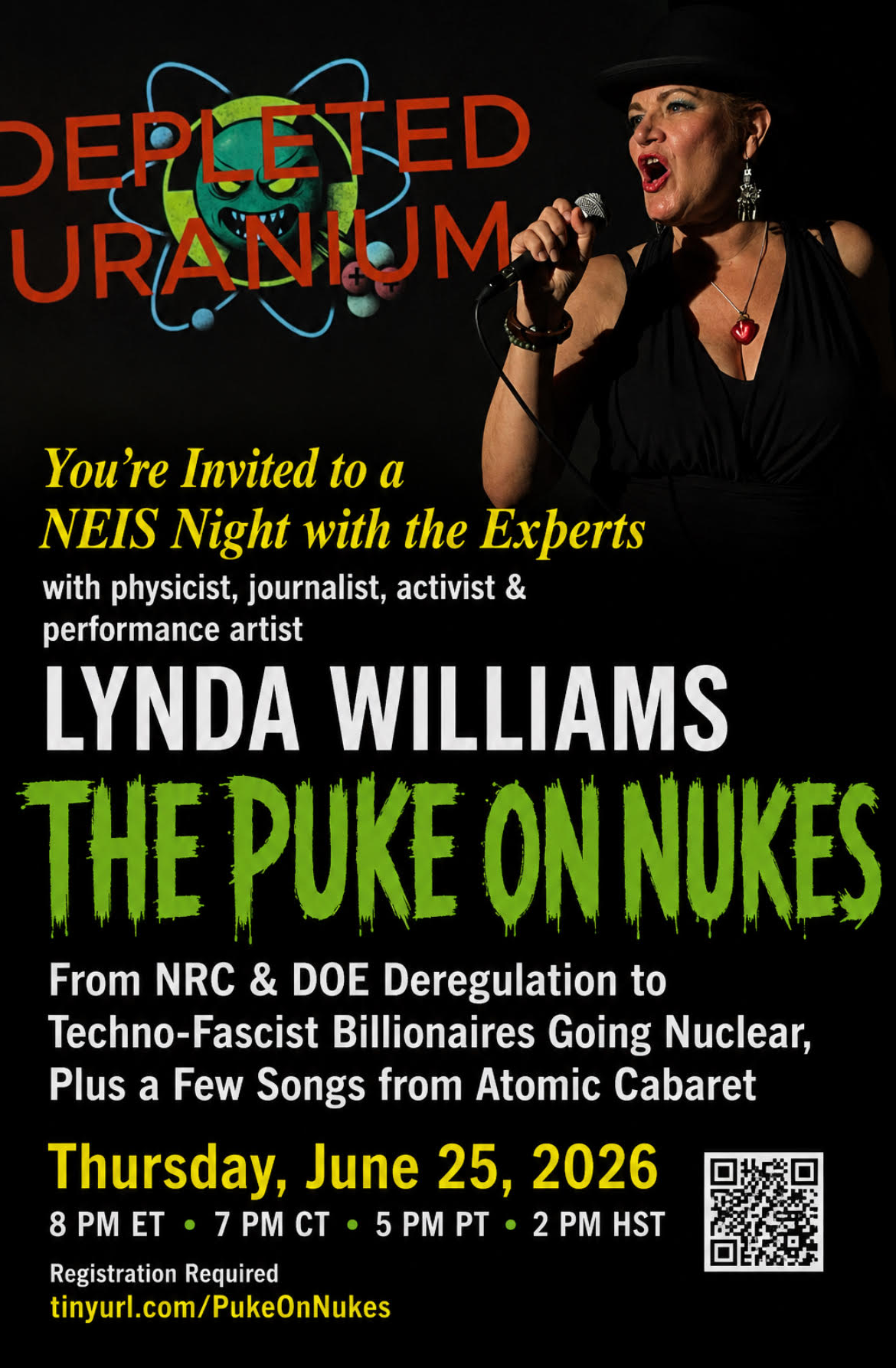
25 June- THE PUKE ON NUKES
Thursday, June 25, 2026
7pm Central Time (8pm ET, 6pm MT, 5pm PT) UTC – 5
From NRC & DOE Deregulation to Techno-Fascist Billionaires Going Nuclear, Plus a Few Songs from Atomic Cabaret REGISTER
26 June – Radiation Trainwreck at the NRC / Join the Protect Better Campaign – https://us02web.zoom.us/meeting/register/4ZlZ5_qLSHGiLSCg8FF6Bg#/registration


Cuba Is Not a Failed State – It Is a Besieged State
PETITION: “Global Appeal to Endorse Palestinian Right of Return of Refugees”
To see nuclear-related stories in greater depth and intensity – go to https://nuclearinformation.wordpress.com
-
Archives
- June 2026 (193)
- May 2026 (306)
- April 2026 (356)
- March 2026 (251)
- February 2026 (268)
- January 2026 (308)
- December 2025 (358)
- November 2025 (359)
- October 2025 (376)
- September 2025 (257)
- August 2025 (319)
- July 2025 (230)
-
Categories
- 1
- 1 NUCLEAR ISSUES
- business and costs
- climate change
- culture and arts
- ENERGY
- environment
- health
- history
- indigenous issues
- Legal
- marketing of nuclear
- media
- opposition to nuclear
- PERSONAL STORIES
- politics
- politics international
- Religion and ethics
- safety
- secrets,lies and civil liberties
- spinbuster
- technology
- Uranium
- wastes
- weapons and war
- Women
- 2 WORLD
- ACTION
- AFRICA
- Atrocities
- AUSTRALIA
- Christina's notes
- Christina's themes
- culture and arts
- Events
- Fuk 2022
- Fuk 2023
- Fukushima 2017
- Fukushima 2018
- fukushima 2019
- Fukushima 2020
- Fukushima 2021
- general
- global warming
- Humour (God we need it)
- Nuclear
- RARE EARTHS
- Reference
- resources – print
- Resources -audiovicual
- Weekly Newsletter
- World
- World Nuclear
- YouTube
-
RSS
Entries RSS
Comments RSS
 nuclear-news