Iran rejects IAEA report alleging increased enriched uranium stockpile

Aljazeera, 31 May 2025
The UN nuclear watchdog warns Tehran could be close to weapons-grade enriched uranium, as negotiations with the US continue.
Iran has rejected a report from the United Nations nuclear watchdog that alleges Tehran has increased its stockpile of highly enriched, near weapons-grade uranium by 50 percent in the last three months.
Iran said on Saturday that the accusation from the International Atomic Energy Agency (IAEA) was “politically motivated and repeates baseless accusations”.
It all comes as nuclear deal negotiations are under way between the United States and Iran, with the Iranian Foreign Minister Abbas Araghchi saying that his country would respond to “elements of a US proposal” his Omani counterpart, Badr Al-Busaidi, had presented during a short visit to Tehran on Saturday.
Araghchi said that the proposal would be “responded to in line with the principles, national interests and rights of the people of Iran”.
Tehran insists that its nuclear programme is for peaceful purposes only.
The IAEA said that as of May 17, Iran had amassed 408.6kg (900.8 pounds) of uranium enriched up to 60 percent – the only non-nuclear weapon state to do so, according to the UN agency – and had increased its stockpile by almost 50 percent to 133.8kg since its last report in February.
The wide-ranging, confidential report seen by several news agencies said Iran carried out secret nuclear activities with material not declared to the IAEA at three locations that have long been under investigation, calling it a “serious concern” and warning Tehran to change its course.
The Iranian Foreign Ministry slammed the report, saying the agency had used “forged documents provided by the Zionist regime [Israel]” and reiterated “previous biased and baseless accusations”.
Iran refutes allegations of undeclared nuclear sites or activities, stressing that it has instead cooperated with the agency in providing all necessary access to the alleged sites, it said.
“The Islamic Republic of Iran, while expressing regret over the publication of this report, which was prepared for political purposes through pressure on the agency, expresses its clear objection to its content,” the statement added.
Araghchi reaffirmed the country’s longstanding position, saying Tehran deems nuclear weapons “unacceptable”.
“If the issue is nuclear weapons, yes, we too consider this type of weapon unacceptable,” Araghchi, Iran’s lead negotiator in the nuclear talks with the US, said in a televised speech. “We agree with them on this issue.”
‘Both sides building leverage’
But the report, which was requested by the IAEA’s 35-nation board of governors in November, will allow for a push by the US, Britain, France and Germany to declare Iran in violation of its non-proliferation obligations.
On Friday, US President Donald Trump said Iran “cannot have a nuclear weapon”………………………………………………………… https://www.aljazeera.com/news/2025/5/31/iran-increases-stockpile-of-enriched-uranium-by-50-percent-iaea-says
Does Tehran want the bomb?
by beyondnuclearinternational, Linda Pentz Gunter
https://beyondnuclearinternational.org/2025/05/25/does-tehran-want-the-bomb/
Is Iran’s nuclear power program a tactical threat or purely commercial, asks Linda Pentz Gunter
“As a party to the Non-Proliferation Treaty (NPT), the Islamic Republic of Iran, based on its religious and ethical principles, has never sought nuclear weapons and remains committed to the principle of non-production and non-use of weapons of mass destruction.”
That was the reassurance given by Iran’s foreign minister, Seyyed Abbas Araghchi, during the Tehran Dialogue Forum hosted earlier this month by the Center for Political and International Studies of Iran’s Foreign Ministry.
It’s a familiar refrain. Iran has consistently argued that it is exercising its “inalienable right” as a signatory to the NPT “to develop research, production and use of nuclear energy for peaceful purposes” as allowed under Article IV of the treaty.
But is it?
Iran has freely admitted that it has enriched uranium-235 up to 60% — considered at least “weapons usable” (higher than 90% is considered weapons-grade.) Why would it choose to — or need to — do this if it has no intention of seeking nuclear weapons production, as Araghchi and others before him have claimed?
The answer to that question seems obvious and one we have repeated ad infinitum when exposing the flaw in the NPT which, in granting the development of civilian nuclear programs to signatories, ensures the pathway to the bomb is left permanently clear.
Even should Iran never actually develop nuclear weapons, it can use its civil program as a threat to do so. It is no idle threat. The possession of a civilian nuclear program affords Iran the materials, equipment, personnel and know-how to transition to nuclear weapons should it so choose.
What might push Iran to make that choice depends a lot on how the current talks go. Keeping Israel at bay — which wanted to start bombing Iran’s nuclear installations immediately — was one of the few sensible decisions the Trump administration has made.
However, in the view of Mohsen Milani, Executive Director of the Center for Strategic & Diplomatic Studies and Professor of Politics at the University of South Florida, developing nuclear weapons has always been on Iran’s agenda. Milani was speaking during a May 20 webinar on the Iran nuclear talks hosted by the Quincy Institute. You can watch the full webinar below.
“I have always believed and I continue to believe that Iran’s nuclear program was based on turning Iran into a potential nuclear power,” Milani said. “That is a power that has the infrastructure, the expertise, to develop a bomb should they decide to develop a bomb.”
How close Iran might be to that achievement is also much debated. In July 2024, then Secretary of State, Antony Blinken, suggested Iran “is now probably one or two weeks” away from producing enough weapons grade material to make a nuclear weapon. Milani thinks Iran “is much closer than it has ever been,” but doubts the timeline is one or two weeks.
But the key is that “Iran’s nuclear program has never been the central part of Iran’s defense posture, nor has the axis of resistance,” Milani said, referring to the informal coalition of Iranian-supported organizations across the region united to counter the influence of Israel and the US. What Iran is doing is ensuring it can keep the nuclear option, “should there be a need for it,” Milani said. The Trump administration’s approach in these negotiations, in Milani’s view, “is they want to make sure that Iran is incapable of doing what it has tried to do for the past twenty years.”
The whole issue of Iran’s nuclear aspirations is squarely in the news again as the Trump administration continues talks with Tehran about its nuclear program. Confusion and uncertainty has been created by the US side, principally Trump’s Special Envoy to the Middle East, real estate developer Steve Witkoff, who has told Iran it can enrich uranium to commercial grade (below 5%), then changed his tune and insisted Iran can have no nuclear program at all.
After four rounds of largely fruitless talks, the Iranians began to lose patience, laying down their red line. “To say that ‘we will not allow Iran to enrich uranium’ is a huge mistake,” warned Ayatollah Khamenei of the American threat. “No one is waiting for permission from anyone. The Islamic Republic has its own policies, its own methods, and it pursues its own agenda,” he added.
Pushing Iran around on this might lead to another negative outcome. Iran could leave the NPT. “As a founding advocate for a nuclear-weapons-free zone in West Asia and a long-time NPT member, Iran has shown good faith by engaging in indirect talks with the United States,” Araghchi said at the conference. “But the Iranian nation cannot forfeit its legitimate right to peaceful nuclear technology, including enrichment, which is enshrined in the NPT.”
The speakers on the Quincy webinar agreed that this public back-and-forth by both sides was a mistake and that Iran should deal directly with the United States instead of through an intermediary, and behind closed doors.
By last Wednesday, the Iranian parliament had also made its views known, declaring it would not be held to any uranium enrichments level caps.
By Friday, a fifth round of talks had taken place, again with the Omanis as intermediaries at least some of the time. It was unclear what, if any, progress had been made, with both sides sounding cautiously optimistic. However, a red line for Iran remains the prospect of shipping its entire stockpile of enriched uranium to Russia, as the Americans have suggested. Iran still insists it is happy to renounce any future nuclear weapons production, but not uranium enrichment. Further talks are planned.
But at the end of the day a larger question looms, which is whether nuclear nations like the US, which claims might and influence due to the possession of its nuclear weapons, has a right to tell another country it cannot have them?
Rather than perpetually wrestling with the nuclear hydra, the US could lead by a very different example and show the world that all of these extreme threats would be eliminated by disarming from nuclear weapons altogether. And given the template of flaws that Iran has laid out for us regarding our current disarmament treaties, that means abolishing nuclear power as well.
Linda Pentz Gunter is the international specialist at Beyond Nuclear and writes for and edits Beyond Nuclear International. Opinions are her own.
Trump warns Netanyahu off Iran strike as nuclear talks continue
28 May,2025 https://www.aljazeera.com/news/2025/5/28/trump-warns-netanyahu-off-iran-strike-as-nuclear-talks-continue
US president says an Israeli strike ‘would be inappropriate to do right now because we’re very close to a solution.’
United States President Donald Trump has said that he told Israeli Prime Minister Benjamin Netanyahu to hold off on any strike against Iran to give his administration more time to push for a new nuclear deal with Tehran, as several rounds of talks have been held in Oman and Italy.
Trump told reporters on Wednesday at the White House that he relayed to Netanyahu a strike “would be inappropriate to do right now because we’re very close to a solution”
The Israeli leader has been threatening a bombardment of Iranian nuclear facilities. Iran has said it would respond with severity if any such attack were launched.
In the meantime, Iran may pause uranium enrichment if the US releases frozen Iranian funds and recognises its right to refine uranium for civilian use under a “political deal” that could lead to a broader nuclear accord, two Iranian official sources told the Reuters news agency.
The sources, close to the negotiating team, said on Wednesday that a “political understanding with the United States could be reached soon” if Washington accepted Tehran’s conditions. The sources told Reuters that under this arrangement, Tehran would halt uranium enrichment for a year.
The latest developments came as the head of the UN’s atomic watchdog group said that “the jury is still out” on negotiations between Iran and the US over Tehran’s rapidly advancing nuclear programme. But Rafael Mariano Grossi described the ongoing negotiations as a good sign.
“I think that is an indication of a willingness to come to an agreement. And I think that… is something possible.”
The 2015 nuclear deal, formally known as the Joint Comprehensive Plan of Action (JCPOA), placed limits on Iran’s nuclear programme in exchange for sanctions relief.
It collapsed after Trump unilaterally withdrew the US from the agreement in 2018, leading to a sharp escalation in tensions and a breakdown in diplomatic relations.
The key sticking point
US officials have repeatedly said that any new deal must include a firm commitment from Iran to halt uranium enrichment, which they view as a potential pathway to building nuclear weapons.
However, Iran has consistently denied seeking nuclear arms, insisting its programme is solely for civilian purposes. It has rejected Washington’s demand to eliminate enrichment capabilities, calling it an infringement on national sovereignty.
It remains the critical sticking point after negotiators for Tehran and Washington met for a fifth round of Oman-mediated talks in Rome.
Instead, Iran has reportedly proposed that the US publicly recognise Tehran’s right to enrich uranium under the Nuclear Non-Proliferation Treaty (NPT), and approve the release of Iranian oil revenues frozen under US sanctions.
Uranium enrichment to 93% is Iran’s right under Nuclear Non Proliferation Treaty, lawmakers tell UN watchdog
Iran International, May 14, 2025,
Iran’s parliament warned on Wednesday that any perceived infringement by the UN’s nuclear watchdog on its nuclear rights, including the right to enrich uranium up to 93%, would be met with backlash.
n a statement by lawmakers addressed to the International Atomic Energy Agency (IAEA), the group said that Iran’s rights under the Nuclear Non-Proliferation Treaty (NPT) — including nuclear research, development, and peaceful use — are non-negotiable and fully verifiable under the IAEA safeguards.
Read by presidium member Ahmad Naderi during a public session, the statement said, “According to Article 4 of the Treaty on the NPT, the great nation of Iran is entitled to three inalienable rights: first, the right to research and development; second, the right to produce; and third, the right to utilize nuclear energy.”
The lawmakers argued that in accordance with this article of the NPT, “the Islamic Republic faces no limitations in nuclear research and development and can proceed with enrichment up to 93% based on its scientific, medical, and industrial needs.”
The lawmakers also criticized the IAEA for what they called four decades of obstructing Iran’s peaceful nuclear development, and for relying on what they called politically motivated intelligence, particularly from Iran’s archenemy, Israel.
Last month, IAEA chief Rafael Grossi said in an interview with Le Monde that Iran was “not far” from being able to produce an atomic bomb, describing the country’s progress as “pieces of a puzzle” that could potentially come together.
Iran maintains that its nuclear program is for peaceful purposes and remains under IAEA monitoring.
Also on Wednesday, Iran’s Parliament Speaker Mohammad Bagher Ghalibaf condemned US President Donald Trump’s recent remarks in Riyadh in which he referenced Iran’s alleged nuclear weapons program and Tehran’s support for military proxies, calling them “delusional” and blaming US policies for instability in West Asia…………………………………………………………………………………..
“Iran is not a warmonger, but we will never surrender. We are brothers with our neighbors and reject US efforts to stir division to boost its arms sales,” he said. https://www.iranintl.com/en/202505143023
Iran proposes partnership with UAE and Saudi Arabia to enrich uranium
A consortium would help Tehran deal with US objections and tie in Gulf states to its enrichment programme
Patrick Wintour, 14 Apr 25, https://www.theguardian.com/world/2025/may/13/iran-proposes-partnership-with-uae-and-saudi-arabia-to-enrich-uranium
Iran has floated the idea of a consortium of Middle Eastern countries – including Iran, Saudi Arabia and the United Arab Emirates (UAE) – to enrich uranium, in a effort to overcome US objections to its continued enrichment programme.
The proposal is seen as a way of locking Gulf states into supporting Iran’s position that it should be allowed to retain enrichment capabilities.
Tehran views the proposal as a concession, since it would be giving neighbouring states access to its technological knowledge and making them stakeholders in the process.
It is not clear if Abbas Araghchi, the Iranian foreign minister, made the proposal in relatively brief three-hour talks with the US in Oman on Sunday, the fourth set of such talks, but the proposal is reportedly circulating in Tehran.
The US has demanded that Iran ends enrichment and dismantles all its nuclear facilities. But amid divisions in Washington, Trump has not made a final decision on the issue and praised Iran’s seriousness in the talks.
The consortium idea was first proposed by former Iranian nuclear negotiator Seyed Hossein Mousavian and Princeton physicist Frank von Hippel long before the current Tehran-Washington talks, in a widely read October 2023 article in the Bulletin of the Atomic Scientists.
Under the consortium, the Saudis and UAE would be shareholders and funders, and would gain access to Iranian technology. The involvement of the Gulf states could be seen as an extra insurance that Iran’s nuclear programme was for entirely civil purposes and not the pathway to building a bomb, as Israel alleges.
If the Saudis and UAE were permitted to send engineers to Iran, an extra form of visibility about the programme would become possible, leaving the international community less reliant solely on the work of the UN nuclear inspectors from the International Atomic Energy Agency.
Iran gradually moved away from the levels of enrichment and stockpile limits set out in the original 2015 deal, blaming Trump for leaving the nuclear deal. Iran’s deputy foreign minister, Majid Takht-Ravanchi, said: “For a limited period of time, we can accept a series of restrictions on the level and volume of enrichment.”
The US originally gave the impression that it needs an agreement with Iran within two months of the talks starting but, as the technicalities of any agreement become more complex, it is possible the talks will be allowed to drag on through the summer.
Iran currently enriches uranium to 60% purity – far above the 3.67% limit set in the 2015 deal, and a short technical step from 90% needed for weapons-grade material. The US secretary of state, Marco Rubio, said these uranium enrichment level are far higher than necessary for civilian uses.
In what may have been a reference to the Iranian proposal Omani foreign minister, Badr Al Busaidi, referred to “useful and original ideas reflecting a shared wish to reach an honourable agreement”.
The UAE operates a civil nuclear power plant named Barakah, located west of Abu Dhabi. It is the first nuclear power plant in the Arab world to be fully operational, with all four reactors now online, and should be capable of producing a quarter of the UAE’s electricity needs.
Iran calls latest nuclear talks with US ‘difficult’ but both sides agree negotiations will continue
By CNN, May 12, https://www.9news.com.au/world/us-iran-nuclear-talks-iran-calls-latest-nuclear-talks-difficult-but-both-sides-agree-negotiations-will-continue/0d7dc1d5-72da-4a91-a356-4676ac116ea8
The latest round of high-stakes nuclear talks between Iran and the US have ended, with Tehran calling them difficult but with both sides agreeing to further negotiations.
Iranian Foreign Ministry spokesman Esmaeil Baqaei confirmed on X on Sunday that the talks had concluded, saying they were “difficult but useful to better understand each other’s positions and to find reasonable & realistic ways to address the differences”.
A senior Trump administration official gave a more positive assessment, telling CNN the discussions “were again both direct and indirect” and lasted over three hours, calling them encouraging.
“Agreement was reached to move forward with the talks to continue working through technical elements,” the official said, adding that the US side was “encouraged by today’s outcome” and looked forward to their next meeting, “which will happen in the near future”.
No date has been agreed for the next round although Baqaei said it would be announced by mediator Oman.
The talks on Sunday were aimed at addressing Tehran’s nuclear program and lifting sanctions
That they are happening at all is something of a breakthrough – the talks are the highest-level in years – but signs of firm progress are slim.
Both countries have expressed a willingness to resolve their disputes through diplomacy. A central issue remains Iran’s demand to continue enriching uranium for its nuclear program, which is insists is peaceful, something the US calls a “red line.”
US President Donald Trump, who is headed to the Middle East next week, has threatened that the US would resort to military strikes against Iranian nuclear sites, with Israel’s help, should Tehran fail to reach a deal with its interlocutors.
The Iranian delegation was led by Foreign Minister Abbas Araghchi, who said before the talks got underway that the US side “holds contradictory positions which is one of the issues in our negotiations”.
“We have been clear about our boundaries,” Araghchi added, according to the Fars news agency.
Iranian officials told CNN on Saturday that recent talks with the US were “not genuine” from the American side. The Iranian source also reiterated that allowing uranium enrichment on Iranian soil is Iran’s “definite red line” in the negotiations.
US special envoy Steve Witkoff, who has been heading the American side, warned that if this session of talks were not productive, “then they won’t continue and we’ll have to take a different route”.
Speaking to Breitbart, Witkoff outlined the US’ expectations for the talks, including on the country’s uranium enrichment program.
“An enrichment program can never exist in the state of Iran ever again. That’s our red line. No enrichment,” he said.
Iran has said it will not surrender its capability to enrich uranium. The country has long insisted it does not want a nuclear weapon and that its program is for energy purposes.
The head of the International Atomic Energy Agency, Rafael Grossi, warned last month that Iran was “not far” from possessing a nuclear bomb.
“It’s like a puzzle. They have the pieces, and one day they could eventually put them together,” Grossi told French newspaper Le Monde.
The Stakes of Donald Trump’s Negotiations with the Islamic Republic of Iran.
First, the United States, faithful to Trump’s Art of the Deal technique, threatened Iran while trying to placate it. International relations are not governed by the same rules as business. Giving in to threats is a sign of weakness that the Iranians could not accept in these negotiations.
by Thierry Meyssan, Voltaire Network | Paris (France) | 29 April 2025
The general public is completely unaware of the real stakes in the negotiations between Washington and Tehran. This article presents a situation in which lies have been piling up over three decades, making any progress particularly difficult. Contrary to popular belief, the nuclear issue in Iran is not whether Tehran will acquire an atomic bomb, but whether it will be able to help Palestine without resorting to weapons.
month and a half ago, I announced that even before concluding peace in Ukraine, President Donald Trump would open negotiations with Iran [1]. As usual, commentators steeped in Joe Biden’s ideology showered me with sarcasm, while my colleagues, specialists in international affairs, noted my observations [2].
The difference between the two lay in their understanding of the negotiations in Ukraine. For the former, it was Donald Trump’s revenge against Volodymyr Zelensky, or a genuflection before Vladimir Putin. For the latter, it was, on the contrary, a desire for peace with Russia in order to devote US resources to its economic recovery.
It follows that the two sides approach the Iranian issue differently. For the former, it is a matter of continuing the chaos that began during the first term with the withdrawal from the nuclear agreement (JCPOA). Conversely, for the latter, it is a desire for peace with Iran, given that it is the only regional power that supports the resistance to Israel.
In early March 2024, President Donald Trump sent a letter to the leader of the Revolution, Ayatollah Ali Khamenei. The existence of this document was mentioned by the author himself during his speech to Congress on March 4, and then debated in the press. According to Sky News Arabia, which read this document, Donald Trump called for negotiations, while specifying: “If you reject the outstretched hand and choose the path of escalation and support for terrorist organizations, I warn you of a swift and determined response […] I am writing this letter with the aim of opening new horizons for our relations, away from the years of conflict, misunderstandings and unnecessary confrontations that we have witnessed in recent decades […] The time has come to leave hostility behind and open a new page of cooperation and mutual respect.” A historic opportunity presents itself to us today […] We will not stand idly by in the face of your regime’s threats against our people or our allies […] If you are willing to negotiate, so are we. But if you continue to ignore the world’s demands, history will testify that you missed a great opportunity.”
Simultaneously, the United States and the United Kingdom launched several attacks against Ansar Allah in Yemen. Unlike previous attacks, these did not target hidden military targets, but rather political targets scattered among the civilian population. They therefore killed leaders of the movement and many other collateral victims, which constitutes war crimes.
It should be recalled that Ansar Allah, pejoratively referred to by Westerners as the “Houthi family gang” or “the Houthis,” attacks Israeli ships in the Red Sea in order to force Tel Aviv to agree to allow humanitarian aid to pass through to Gaza.
Washington and London, believing that this was hampering international trade, and having failed to obtain approval from the Security Council, resumed the war. They initially targeted military objectives and quickly realized that these, buried deep within the country, could not be significantly affected.
Donald Trump’s letter only arrived in Tehran on March 12, and the Iranian response was slow in coming. It is important to understand that while Tehran was flattered by Washington’s secret handwritten approach, it could not accept several aspects of its behavior.
• First, the United States, faithful to Trump’s Art of the Deal technique, threatened Iran while trying to placate it. International relations are not governed by the same rules as business. Giving in to threats is a sign of weakness that the Iranians could not accept in these negotiations. Ayatollah Ali Khamenei commented on March 28: “The enmity of the United States and Israel has always existed. They threaten to attack us, which we believe is not very likely, but if they commit a misdeed, they will certainly receive a strong blow in return.” If the enemies think they can instigate sedition in the country, the Iranian nation itself will respond to them.” President Donald Trump further emphasized this on March 30, telling NBC News: “If they don’t reach an agreement, there will be bombing. It will be bombing like they’ve never seen before.”
According to the United Nations Charter (Article 2, paragraph 4), “members of the Organization shall refrain in their international relations from the threat or use of force against the territorial integrity or political independence of any state.”
The negotiations were therefore compromised before they even began.
• Moreover, massacring the leaders of Ansar Allah was a gratuitous war crime: General Qassem Soleimani, by reorganizing the “Axis of Resistance,” had given Iran’s former proxies their complete freedom. Tehran currently has no influence, other than ideological, over Ansar Allah. Ambassador Amir Saeid Iravani therefore raised these points at the United Nations [3].
• Finally, and most importantly, Donald Trump, by accumulating contradictory signals, did not allow the Iranians to assess his relations with Israel. Does he support the project of a binational state in Palestine (the one promoted by the United Nations)? Or of a Jewish state in Palestine (“Zionism”)? Or that of a “Greater Israel” (“Revisionist Zionism”)? No one knows for sure.
Ultimately, Iran sent a secret response to the secret letter from the United States, and negotiations were able to begin, but only indirectly. That is, the two delegations did not speak directly to each other, but only through a mediator. In this way, Tehran responded to the invitation, but expressed its disapproval of the manner in which it was convened.
ntervening directly, France and the United Kingdom convened a closed-door meeting of the Security Council. Paris and London wished to address several outstanding issues. As nothing has been leaked, it is unclear whether President Emmanuel Macron and Prime Minister Keir Starmer wanted to clarify what had caused all other attempts at negotiations to fail or, on the contrary, to obscure what could have been further obscured…………………………………………………………………………………………………………………………………….. https://www.voltairenet.org/article222165.html
Six in 10 Americans Support US Participation in a Nuclear Agreement with Iran.
Chicago Council on Global Affairs, 30 Apr 25
Majorities of Democrats and Independents support a potential deal similar to the 2015 Joint Comprehensive Plan of Action, but only a minority of Republicans agree.
For the first time since the United States withdrew from the 2015 Joint Comprehensive Plan of Action (JCPOA), American and Iranian officials held direct talks to negotiate a new nuclear deal. These talks come amid reports of Iran’s rapid production of enriched uranium and acceleration of its nuclear weapons program.
A recent Chicago Council on Global Affairs-Ipsos survey, fielded April 18–20, 2025, finds a majority of Americans consider a nuclearized Iran unacceptable and believe the United States should negotiate a deal with Tehran to limit its development. While Democrats and Independents support a deal that would trade sanctions relief for limitations on Iranian nuclear enrichment, Republicans oppose such a tradeoff. However, they may end up following US President Donald Trump’s lead if current negotiations bear fruit.
Key Findings
- Eight in 10 Americans oppose Iran obtaining nuclear weapons (79%) and favor taking diplomatic steps (83%) or tightening economic sanctions (80%) to limit further nuclear enrichment.
- A smaller majority of Americans believe the United States should participate in an agreement that lifts some international economic sanctions against Iran in exchange for strict limits on its nuclear program (61%).
- Partisan differences on a nuclear agreement are striking: 78 percent of Democrats and 62 percent of Independents support US participation in a deal with Iran compared to just 40 percent of Republicans.
- If diplomacy or economic sanctions fail, many Americans are willing to take more forceful approaches: Six in 10 support the United States conducting cyberattacks against Iranian computer systems (59%), and half support conducting airstrikes against Iran’s nuclear facilities (48%).
- A majority oppose sending US troops to destroy Iran’s nuclear facilities (60%).
Americans Favor Diplomatic Approach to Iranian Nuclear Development
The 2015 JCPOA, or the Iran Deal, was a landmark agreement reached between Iran and the P5+1 (China, France, Russia, the United Kingdom, the United States, and Germany) that limited Iranian nuclear enrichment in exchange for sanctions relief and other provisions. While it was initially successful in limiting Iran’s stockpile of enriched uranium, the United States withdrew from the deal in 2018, as the first Trump administration considered it insufficient in curbing Iran’s ballistic missile program and protecting American regional interests. Upon the US withdrawal from the agreement, Iran promptly lifted the cap on its stockpile of uranium and increased its enrichment activities; it has since reached weapons-grade levels of enriched uranium.
…………………………………………………………………………………………………………………………………………………………………… Conclusion
Although US President Donald Trump has not ruled out using military action to stop Iran from obtaining a nuclear weapon, he said he favors a diplomatic agreement to address this issue. Recently, Trump administration officials have given contradictory remarks about current talks, and they have yet to specify how renewed negotiations will produce an agreement more stringent and impactful than its predecessor.
The pressure is on American diplomats to secure a deal that would limit Tehran’s nuclear enrichment without providing the sanctions relief that could potentially fund Iran’s efforts to further destabilize the Middle East or threaten the United States’ regional allies, including Israel. While the outcome of these negotiations remains to be seen, the public continues to express a preference for using diplomatic or economic coercion than direct military action. https://globalaffairs.org/research/public-opinion-survey/six-10-americans-support-us-participation-nuclear-agreement-iran?fbclid=IwY2xjawKA64xleHRuA2FlbQIxMQBicmlkETFISGV5ZEdSZW16a2ZnQzh3AR7iwwVkEnczI_DJHzOGHWvNWeSlg2xdd9YJCsBz0_OiQmJcM48Ujd0ZNX8ZNQ_aem_5kroZ8t3KQ5RgYf4EfYdDA
Trump’s transactional instincts could help forge a new Iran nuclear deal
Mohamad Bazzi, 265 Apr https://www.theguardian.com/commentisfree/2025/apr/25/trump-iran-nuclear-deal
The president has a chance to make good on his reputation as a dealmaker as Iran moves closer to a nuclear weapon.
In May 2018, Donald Trump unilaterally withdrew the US from the Iran nuclear deal and reimposed American sanctions that crippled the Iranian economy. Trump tore up the 2015 agreement, which had taken years for Iran to negotiate with six world powers, under which Tehran limited its nuclear program in exchange for relief from international sanctions. Trump insisted he would be able to negotiate a better pact than the one reached by Barack Obama’s administration.
Today, in his second term as president, Trump is eager to fix the Iran deal he broke nearly seven years ago.
While Trump’s overall foreign policy has been chaotic and has alienated traditional US allies in Europe and elsewhere, he has an opportunity to reach an agreement with Iran that eluded Joe Biden. Since Trump walked away from the original deal, Iran has moved closer to having a nuclear weapon than it has ever been. It has enriched enough uranium close to weapons-grade quality to make six nuclear bombs, according to the International Atomic Energy Agency (IAEA). But analysts believe that even after enriching enough uranium for a bomb, Iran would still need up to a year to develop an actual nuclear warhead that could be deployed on a ballistic missile.
Last month, Trump sent a letter to Iran’s supreme leader, the 86-year-old Ayatollah Ali Khamenei, saying the US wanted to negotiate a new deal. Trump followed up with a public threat, saying if Iran’s leaders did not agree to renewed talks, they would be subjected to “bombing the likes of which they have never seen before”. After Trump’s threats and a buildup of US forces in the Middle East, Iran’s military said it would respond to any attack by targeting US bases in the region, which house thousands of American troops.
But Iranian leaders also agreed to indirect negotiations, rather than the direct talks Trump had proposed. Trump dispatched his special envoy, the real estate developer Steve Witkoff, to lead a team of US negotiators to meet indirectly with top Iranian officials, including the foreign minister, Abbas Araghchi. The two sides held two rounds of productive talks so far this month, under the mediation of Oman. And the US and Iranian teams are due to meet again this weekend in Muscat, the capital of Oman, where they will start talks on technical details of a potential agreement.
While Trump and Iran’s leaders both changed their tones in recent weeks, there are many obstacles before a deal can be reached, including hardliners in Iran and Washington, as well as opposition from Israel’s rightwing government, led by Benjamin Netanyahu, who has spent years working to undermine negotiations between the US and Iran. The main barrier will be whether the Trump administration insists on a total dismantling of Iran’s nuclear program – the so-called “Libya model”, named after the late Libyan dictator Muammar Gaddafi, who decided to eliminate his country’s nuclear weapons program in 2003 under pressure from the US. But that decision deprived Gaddafi of a major lever to stave off western military intervention after the Arab Spring uprisings in 2011, which led to his regime’s fall and his killing by Libyan rebels.
Some foreign policy hawks in Washington, including Trump’s national security adviser, Michael Waltz, and the secretary of state, Marco Rubio, insist on this maximalist strategy, which echoes Netanyahu’s demand that Iran must completely dismantle its nuclear enrichment activity and infrastructure as part of any deal with the US. If Trump takes a similar approach, negotiations would probably break down and Trump could follow through on his threat to carry out military strikes.
Iran has made clear that it will not agree to the total end of its nuclear program, but would accept a verification-based approach, as it did under the 2015 deal negotiated by the Obama administration along with China, France, Russia, the UK and Germany, together with the European Union. That type of agreement would place strict limits on Iran’s ability to enrich uranium and impose an inspections regime involving international monitors. Several of Trump’s advisers, including Witkoff and the vice-president, JD Vance, seem to favor this solution.
“I think he wants to deal with Iran with respect,” Witkoff said of Trump’s outreach to the Iranian regime, in a long interview last month with Tucker Carlson, the rightwing media host who has been highly critical of Republican hawks agitating for war with Iran. “He wants to build trust with them, if it’s possible.”
Iran’s leaders apparently got that message – and have tried to stroke Trump’s ego and convey that they respect him in ways they never respected Biden. In a Washington Post op-ed published on 8 April, Iran’s foreign minister seemed to be speaking to Trump directly when he blamed the failure of earlier negotiations on a “lack of real determination by the Biden administration”. Araghchi also played to Trump’s oft-repeated desire to be a peacemaker who ends America’s legacy of forever wars, writing: “We cannot imagine President Trump wanting to become another US president mired in a catastrophic war in the Middle East.”
And the minister appealed to Trump’s reputation as a deal-maker, citing the “trillion-dollar opportunity” that would benefit US companies if they could gain access to Iran after a diplomatic agreement. Iran’s leaders evidently understand that Trump loves to frame his foreign policy as being guided by his desire to secure economic deals and benefits for American businesses.
In this case, Trump’s transactional instincts and bulldozer style of negotiations could lead to a positive outcome, avoiding war with Iran and undermining the hardliners in Washington, Iran and Israel. Trump has already adopted a significant shift toward Tehran from his first term, when he had insisted that Iran was the world’s leading state sponsor of terrorism and the greatest threat to US interests in the Middle East.
After he took office in 2017, Trump wanted to tear up the Iran deal partly because it was one of Obama’s major foreign policy accomplishments. Trump also surrounded himself with hawkish advisers who reinforced the danger of an Iranian threat, including HR McMaster, who served as national security adviser, and James Mattis, who was defense secretary. Both men commanded US troops during the occupation of Iraq, and they fought Iraqi militias funded by Iran. Trump later appointed John Bolton, another neoconservative and advocate of the 2003 US invasion of Iraq, as his national security adviser.
In his second term, Trump has banished most of the neocons from his administration. Trump also seems to realize that Netanyahu could become one of the biggest obstacles to an Iran deal, as he was during the Obama and Biden administrations. It was no accident that the president announced his plan for renewed talks with Iran while Netanyahu sat beside him at an Oval Office meeting on 7 April. Netanyahu had arranged a hasty visit to Washington to seek an exemption from Trump on new tariffs on Israeli exports. But he left empty-handed and embarrassed by Trump’s Iran announcement. That meeting was a signal to Iran’s leaders: that Trump would not allow Netanyahu to steamroll him, as the Israeli premier had done with other US presidents.
If Trump continues to resist Netanyahu, along with hawkish Republicans and some of his own advisers, he might well be able to negotiate a dramatic deal with Iran – and repair the nuclear crisis he unleashed years ago.
- Mohamad Bazzi is the director of the Hagop Kevorkian Center for Near Eastern studies and a journalism professor at New York University.
Iran opens door to restoring nuclear surveillance, UN watchdog says
Iran has agreed to allow a technical team from the International Atomic
Energy Agency (IAEA) to discuss restoring camera surveillance in Iranian
nuclear facilities, the head of the UN nuclear watchdog said on Wednesday.
IAEA Director General Rafael Grossi confirmed the agency would send a
technical team to Iran following his visit to Tehran this month. Grossi
said his impression is that the Islamic Republic’s leaders are “seriously
engaged in discussions… with a sense of trying to get to an agreement.”
The UN body would be the party responsible for verifying Iran’s compliance
with a deal, Grossi said. “This will have to be verified by the IAEA.”
Iran International 23rd April 2025 https://www.iranintl.com/en/202504237179
Iran-US talks wrap up in Rome with agreement to establish framework for potential nuclear deal
Omani officials stated that the indirect talks are ‘gaining momentum’ after Tehran and Washington agreed to establish technical delegations to draft a potential replacement for the Obama-era JCPOA
The second round of indirect talks between Iranian and US officials concluded in the Italian capital, Rome, on 19 April, with both sides agreeing to establish working groups to draft a “general framework” for a potential new nuclear deal.
“In this round of talks, senior Iranian and US negotiators outlined the general framework for the talks and exchanged views on some important issues in the areas of sanctions relief and the nuclear issue. The two sides agreed to continue the next round of indirect talks next Saturday in Muscat,” the Iranian Foreign Ministry said in a statement.
Tehran also stated that talks to limit the country’s uranium enrichment program in exchange for sanctions relief “require more detailed discussion and examination at the expert level.” As such, the two sides agreed to send technical delegations to the Omani capital next Wednesday for detailed discussions.
Following Saturday’s talks, Iranian Foreign Minister Abbas Araghchi described the atmosphere as “positive” and said that officials “made clear how many in Iran believe that the [2015 Joint Comprehensive Plan of Action] is no longer good enough for us.”
“For now, optimism may be warranted but only with a great deal of caution,” he told reporters.
The Omani Foreign Ministry said the second round of talks “led to the parties agreeing to move to the next phase of targeted negotiations to achieve a fair, permanent, and binding agreement that ensures Iran is free from nuclear weapons and the full lifting of sanctions while preserving the country’s right to develop nuclear energy for peaceful uses and purposes.”
“Dialogue and clear communication are the only way to achieve a credible and reliable understanding that will benefit all parties in the regional and international context,” Omani officials said.
There was no immediate comment from the US side following the talks.
Nevertheless, soon after Saturday’s talks ended, Israeli TV broadcast a pre-recorded address by Prime Minister Benjamin Netanyahu, in which he reiterated his commitment to preventing Iran from developing a nuclear weapon.
“I am committed to preventing Iran from attaining nuclear weapons. I won’t give on this, I won’t let up on this, and I won’t withdraw from this — not a millimeter,” Netanyahu said.
Earlier in the day, Reuters reported that Tel Aviv “has not ruled out” launching an attack on Iran’s nuclear facilities in the near future without US involvement.
Iran to brief China as it accuses Israel of ‘undermining’ US nuclear talks
Tehran official’s Beijing trip comes before third round of talks with the US and follows consultations with Russia.
Iran says it will brief China this week in advance of a third round of talks with the United States on its nuclear programme, as Iranian officials separately accused Israel of seeking to “undermine and disrupt the diplomatic process”.
Iranian Foreign Minister Abbas Araghchi will visit Beijing on Tuesday to discuss the latest talks with the administration of US President Donald Trump on the country’s nuclear programme, spokesman Esmaeil Baqaei said on Monday.
The trip echoes “consultations” Iran held with Russia last week, before the second round of direct US-Iran talks was held over the weekend. A third round of talks between Araghchi and US envoy Steve Witkoff is scheduled to take place in Oman on Saturday.
Araghchi has previously said Tehran always closely consults with its allies, Russia and China, over the nuclear issue.
“It is natural that we will consult and brief China over the latest developments in Iran-US indirect talks,” Baqaei said.
Russia and China, both nuclear-armed powers, were signatories to a now-defunct 2015 deal between Iran, the US and several Western countries intended to defuse tensions around Tehran’s nuclear programme.
The 2015 deal, known as the Joint Comprehensive Plan of Action (JCPOA), from which Trump withdrew in 2018, saw Tehran curtail its nuclear programme in exchange for sanctions relief.
The US and Israel have accused Iran of seeking to use the programme to develop nuclear weapons. Tehran has staunchly denied the claim, saying the programme is for civilian purposes.
On Monday, the Chinese Ministry of Foreign Affairs stressed close ties between Beijing and Tehran, but did not confirm the Iranian minister’s planned visit.
“China and Iran have maintained exchanges and contacts at all levels and in various fields. With regard to the specific visit mentioned, I have no information to offer at the moment,” Guo Jiakun, spokesperson for the ministry, said.
Strengthened alliance
Israel’s war in Gaza has seen Iran pull closer to Russia and China. Recent diplomatic moves surrounding the US-Iran talks have further underscored the strengthened ties.
Araghchi met his Russian counterpart, Sergey Lavrov, last week, just before his second round of negotiations with Witkoff.
On Monday, Russian President Vladimir Putin signed off on a 20-year strategic partnership treaty agreed earlier this year with his Iranian counterpart, Masoud Pezeshkian.
Meanwhile, Iran’s already fraught relations with Israel and its “ironclad” ally, the US, have nosedived amid the war. Since taking office, Trump has reinstated a “maximum pressure” sanctions campaign against Tehran, while repeatedly threatening military action if a new nuclear deal is not reached.
Speaking on Monday, Foreign Ministry spokesman Baqaei accused Israel of trying to disrupt the nascent negotiations to open the way for military action.
In comments carried by the AFP news agency, he declared that Israel is behind efforts from a “kind of coalition” to “undermine and disrupt the diplomatic process”.
“Alongside it are a series of warmongering currents in the United States and figures from different factions,” the spokesman said.
Last week, Prime Minister Benjamin Netanyahu reiterated that Israel would not allow Iran to acquire nuclear weapons.
His statement came a day after The New York Times reported that Trump had dissuaded Israel from striking Iran’s nuclear sites in the short term, saying Washington wanted to prioritise diplomatic talks.
‘Consultations must continue’
Baqaei added that “consultations must continue” with countries that were party to the JCPOA.
Iran has gradually breached the terms of the treaty since Trump abandoned it, most notably by enriching uranium to levels higher than those laid out in the deal.
The International Atomic Energy Agency says Iran has enriched uranium to 60 percent, close to the 90 percent level needed to manufacture weapons. The JCPOA had restricted it to 3.67 percent, the level of enrichment needed for civilian power.
Speaking last week, Witkoff sent mixed messages on what level Washington is seeking. He initially said in an interview that Tehran needed to reduce its uranium enrichment to the 3.67 percent limit, but later clarified that the US wants Iran to end its enrichment programme.
Iranian minister says nuclear deal possible if US does not make ‘unrealistic demands’
Guardian, 19 Apr 25
Iran’s foreign minister, Abbas Araqchi, and US Middle East envoy Steve Witkoff will resume talks in Rome on Saturday
Iran’s top negotiator believes reaching an agreement on its nuclear programme with the US is possible as long as Washington is realistic, as the two sides prepare to resume talks in Rome on Saturday.
Iran’s foreign minister, Abbas Araqchi, and the US Middle East envoy, Steve Witkoff, will begin indirect negotiations through mediators from Oman, after their first round in Muscat, which both sides described as constructive.
“If they demonstrate seriousness of intent and do not make unrealistic demands, reaching agreements is possible,” Araqchi told a news conference in Moscow on Friday after talks with Russia’s foreign minister, Sergei Lavrov.
Tehran has, however, sought to tamp down expectations of a quick deal. The supreme leader, Ayatollah Ali Khamenei, said this week he was “neither overly optimistic nor pessimistic”.
The talks take place under the shadow of Donald Trump’s threat to attack Iran if it does not reach a deal with the US over its nuclear programme.
The US president told reporters on Friday: “I’m for stopping Iran, very simply, from having a nuclear weapon. They can’t have a nuclear weapon. I want Iran to be great and prosperous and terrific.”
Trump, who ditched a 2015 nuclear pact between Iran and six powers during his first term in 2018 and reimposed crippling sanctions on Tehran, has revived his “maximum pressure” campaign on Iran since returning to the White House in January.
Washington wants Iran to halt production of highly enriched uranium, which it believes is aimed at building an atomic bomb.
Tehran, which has always said its nuclear programme is peaceful, says it is willing to negotiate some curbs in return for the lifting of sanctions, but wants watertight guarantees that Washington will not renege again as Trump did in 2018.
Araghchi said Iran’s right to enrich uranium was “non-negotiable”, after Witkoff called for its complete halt…………………………..https://www.theguardian.com/world/2025/apr/19/irans-minister-says-nuclear-deal-possible-if-us-does-not-make-unrealistic-demands
Would military strikes kill Iran’s nuclear programme? Probably not.
Reuters By Francois Murphy and John Irish, April 16, 2025, Editing by William Maclean
- Summary
- Israel, US have threatened to take out nuclear sites
- Most hardened ones require firepower Israel seems to lack
- Can’t destroy enrichment know-how Iran already has
- Attack could drive programme underground, end inspections
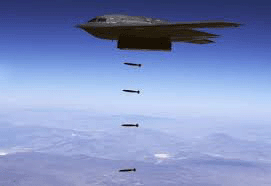
VIENNA, April 15 (Reuters) – The recent U.S. deployment of B-2 bombers, the only planes able to launch the most powerful bunker-busting bombs, to within range of Iran is a potent signal to Tehran of what could happen to its nuclear programme if no deal is reached to rein it in.
But military and nuclear experts say that even with such massive firepower, U.S.-Israeli military action would probably only temporarily set back a programme the West fears is already aimed at producing atom bombs one day, although Iran denies it.
Worse, an attack could prompt Iran to kick out United Nations nuclear inspectors, drive the already partly buried programme fully underground and race towards becoming a nuclear-armed state, both ensuring and hastening that feared outcome.
“Ultimately, short of regime change or occupation, it’s pretty difficult to see how military strikes could destroy Iran’s path to a nuclear weapon,” said Justin Bronk, senior research fellow for airpower and technology at the Royal United Services Institute, a British defence think-tank.
“It would be a case of essentially trying to reimpose a measure of military deterrence, impose cost and push back breakout times back to where we were a few years ago.”
Breakout time refers to how long it would take to produce enough fissile material for a nuclear bomb, currently days or weeks for Iran. Actually making a bomb, should Iran decide to, would take longer.
The landmark 2015 nuclear deal between Iran and major powers placed tough restrictions on Iran’s nuclear activities that increased its breakout time to at least a year. After President Donald Trump pulled the United States out of the deal in 2018 it then unravelled, and Iran pushed far beyond its limits.
Now Trump wants to negotiate new nuclear restrictions in talks that began last weekend. He also said two weeks ago: “If they don’t make a deal, there will be bombing.”
Israel has made similar threats. Its Defence Minister Israel Katz said after taking office in November: “Iran is more exposed than ever to strikes on its nuclear facilities. We have the opportunity to achieve our most important goal – to thwart and eliminate the existential threat to the State of Israel.”
BIG, RISKY
Iran’s nuclear programme is spread over many sites, and an attack would likely have to hit most or all of them. Even the International Atomic Energy Agency, the U.N. nuclear watchdog, does not know where Iran keeps some vital equipment, like parts for centrifuges, the machines that enrich uranium.
Israel could take out most of those sites by itself, military experts say, but it would be a risky operation involving repeated attacks and would have to deal with Russian-supplied anti-aircraft systems – although it managed to do so in far more limited strikes on Iran last year.
Uranium enrichment is at the heart of Iran’s nuclear programme, and its two biggest enrichment sites are the Fuel Enrichment Plant at Natanz, located about three floors underground, apparently to protect it from bombardment, and Fordow, dug far deeper into a mountain………………………………………………………………… https://www.reuters.com/world/middle-east/would-military-strikes-kill-irans-nuclear-programme-probably-not-2025-04-15/
Iran has ‘doubts’ about US intentions ahead of nuclear talks
Iran’s FM expresses concern about US motivations but says second round of negotiations will take place in Rome this weekend.
18 Apr 2025, https://www.aljazeera.com/news/2025/4/18/iran-has-doubts-about-us-intentions-ahead-of-nuclear-talks
Iran’s Foreign Minister Abbas Araghchi has cast doubt over the intentions of the United States a day before a second round of nuclear talks is set to take place with Washington.
The new round will come a week after the two countries held their highest-level negotiations since US President Donald Trump unilaterally abandoned a 2015 landmark nuclear deal three years later. Iran has since abandoned all limits on its nuclear programme, and enriches uranium to up to 60 percent purity – near weapons-grade levels of 90 percent.
“Although we have serious doubts about the intentions and motivations of the American side, in any case, we will participate in tomorrow’s negotiations,” Araghchi said on Friday during a news conference in Moscow with his Russian counterpart, Sergey Lavrov.
Araghchi will set off on Saturday for Rome for a new round of Omani-mediated talks with US Middle East envoy Steve Witkoff.
“We are fully prepared to pursue a peaceful resolution for Iran’s peaceful nuclear programme,” Araghchi said.
Lavrov said Moscow was ready “to play any role that will be useful from Iran’s point of view and that will be acceptable to the United States”.
Russia, which commands the world’s largest confirmed arsenal of nuclear weapons, has deepened its military ties with Iran since it launched its offensive on Ukraine in February 2022, and has played a role in Iran’s nuclear negotiations in the past as a veto-wielding United Nations Security Council member.
Western countries, including the US, have long accused Iran of seeking to acquire nuclear weapons – an allegation Tehran has consistently denied, insisting that its programme is for peaceful civilian purposes.
Al Jazeera’s Tohid Asadi, reporting from Tehran, said there is “a cloud of mistrust in the air” despite statements made by Araghchi.
“With the talks ahead, there is a perception among Iranians that there is this mistrust that exists pertaining to the United States, but going back to the statement that were heard today … we saw a mix of doubt and hope at the same time,” Asadi said.
“Iran is saying it is not interested in putting other issues … [such as] defence capabilities … on the table of negotiations,” he added.
‘Unrealistic demands’
US President Donald Trump has threatened to attack Iran if it does not agree to a deal with the US.
On Tuesday, Iran’s Islamic Revolutionary Guard Corps said the country’s military capabilities were off limits in the discussions.
The official IRNA news agency reported Iran’s regional influence and its missile capabilities, long criticised by Western governments, were among its “red lines” in the talks.
On Wednesday, the Iranian foreign minister said Iran’s enrichment of uranium was not up for discussion, after Witkoff called for it to end.
“If there is similar willingness on the other side, and they refrain from making unreasonable and unrealistic demands, I believe reaching an agreement is likely,” Araghchi said during Friday’s news conference.
Lavrov emphasised that any potential agreement should only pertain to the nuclear issue.
“This is a fundamental point that must be taken into account by those who try to burden the negotiations with non-nuclear issues and thus create a very risky situation,” he said.
Iran told the US during last week’s talks it was ready to accept some limits on its uranium enrichment, but needed watertight guarantees Trump would not again ditch the pact, an Iranian official told the Reuters news agency on Friday, speaking on condition of anonymity.
The official said Tehran’s red lines “mandated by Supreme Leader Ayatollah Ali Khamenei” could not be compromised in the talks, adding that those red lines meant Iran would never agree to dismantle its centrifuges for enriching uranium, halt enrichment altogether, or reduce the amount of enriched uranium it stores to a level below the level it agreed in the 2015 deal.
It would also not negotiate over its missile programme, which Tehran views as outside the scope of any nuclear deal, Reuters reported.
US Secretary of State Marco Rubio said earlier on Friday that the US administration is looking for a peaceful solution with Iran but will never tolerate the country developing a nuclear weapon.
Rubio met with British, French and German officials in Paris and pressed them to maintain sanctions against Iran instead of allowing them to run out.
Israel also reiterated its unwavering commitment to preventing Iran from obtaining nuclear weapons, saying it had a “clear course of action” to prevent this.
“Prime Minister Benjamin Netanyahu and I, along with all relevant bodies, are committed to leading a clear course of action that will prevent Iran from acquiring nuclear weapons,” Defence Minister Israel Katz said on Friday.
1 This Month
Protect Sazan Island from the Trump family! https://secure.avaaz.org/campaign/en/protect_sazan_island_from_the_trump_family_loc/?bqFCVab&v=174511&cl=22707147157&_checksum=5e9dde668860e8231c33699735e16a1fbf22ab2cb01da50c999fe8732b9775ef&utm_source=email&utm_medium=blast_email&utm_campaign=174511


Cuba Is Not a Failed State – It Is a Besieged State
PETITION: “Global Appeal to Endorse Palestinian Right of Return of Refugees”
To see nuclear-related stories in greater depth and intensity – go to https://nuclearinformation.wordpress.com
-
Archives
- June 2026 (129)
- May 2026 (306)
- April 2026 (356)
- March 2026 (251)
- February 2026 (268)
- January 2026 (308)
- December 2025 (358)
- November 2025 (359)
- October 2025 (376)
- September 2025 (257)
- August 2025 (319)
- July 2025 (230)
-
Categories
- 1
- 1 NUCLEAR ISSUES
- business and costs
- climate change
- culture and arts
- ENERGY
- environment
- health
- history
- indigenous issues
- Legal
- marketing of nuclear
- media
- opposition to nuclear
- PERSONAL STORIES
- politics
- politics international
- Religion and ethics
- safety
- secrets,lies and civil liberties
- spinbuster
- technology
- Uranium
- wastes
- weapons and war
- Women
- 2 WORLD
- ACTION
- AFRICA
- Atrocities
- AUSTRALIA
- Christina's notes
- Christina's themes
- culture and arts
- Events
- Fuk 2022
- Fuk 2023
- Fukushima 2017
- Fukushima 2018
- fukushima 2019
- Fukushima 2020
- Fukushima 2021
- general
- global warming
- Humour (God we need it)
- Nuclear
- RARE EARTHS
- Reference
- resources – print
- Resources -audiovicual
- Weekly Newsletter
- World
- World Nuclear
- YouTube
-
RSS
Entries RSS
Comments RSS
 nuclear-news