White House opposes independent oversight of Ukraine aid
https://www.rt.com/news/579510-white-house-opposes-ukraine-aid-oversight/ 12 July 23
President Joe Biden’s administration has urged lawmakers to drop plans for an inspector general to monitor assistance to Kiev
President Joe Biden’s administration has objected to plans by US lawmakers to establish an independent inspector general who would scrutinize Washington’s massive military and economic aid packages for Ukraine.
At issue is a provision added to the $874 billion US defense budget for the government’s next fiscal year, calling for an additional oversight layer on Ukraine aid modeled after the inspector general established for reconstruction in Afghanistan.
Conservative lawmakers, including Representative Matt Gaetz, a Republican from Florida, have argued that the White House lacks adequate controls to prevent fraud and other misuse of the $113 billion in aid approved by Congress to support Ukraine in its conflict with Russia.
However, the administration argued on Monday that the Pentagon inspector general and the Government Accountability Office (GAO) were already working with relevant congressional committees to “ensure accountability” for Ukraine aid. The Pentagon inspector general and the GAO are currently conducting investigations of “every aspect of this assistance,” the White House Office of Management and Budget (OMB) said in a statement.
The White House also opposes an amendment to the defense bill that would expand the authority of the Afghanistan reconstruction inspector general. “This expansion is both unnecessary and unprecedented” because inspectors from both the US State Department and the US Agency for International Development already oversee the aid, the OMB said.
John Sopko, the independent inspector general for Afghanistan reconstruction, warned in February that strong safeguards were needed to prevent corruption from undermining Washington’s aid packages for Ukraine. Failure to learn from the US mistakes in Afghanistan, where much aid was “diverted or stolen,” could lead to a repeat in Ukraine.
You’re bound to get corrupt elements of not only the Ukrainian or host government, but also of US government contractors or other third-party contractors to steal the money,” Sopko told Fox News.
Last year, Congress blocked an initiative spearheaded by Representative Marjorie Taylor Greene, a Republican from Georgia, to audit the aid to Kiev.
Ukraine consistently ranks as one of the most corrupt countries in Europe. Ukrainian President Vladimir Zelensky fired a number of top officials earlier this year for profiteering. An August 2022 report by CBS News indicated that only about 30% of the Western weaponry sent to Kiev was actually making it to the front lines because of waste and corruption.
NATO to keep Ukraine at arm’s length
https://www.rt.com/news/579554-nato-summit-communique/ 12 July 23
NATO Secretary General Jens Stoltenberg further elaborated on the matter at a press conference, stating that the bloc must first ensure that Ukraine achieves a “victory” in its ongoing conflict with Russia. Should Kiev not succeed, its NATO membership will be out of the question, he warned.
Kiev will be permitted to join the US-led bloc “when allies agree and conditions are met”
NATO has reaffirmed its readiness to grant Ukraine membership at some point in the future. A joint statement released during the annual summit of the US-led bloc said Kiev would be invited to join only “when allies agree and conditions are met,” but it will be allowed to bypass the so-called Membership Action Plan that is usually required for candidate members.
We reaffirm the commitment we made at the 2008 summit in Bucharest that Ukraine will become a member of NATO, and today we recognize that Ukraine’s path to full Euro-Atlantic integration has moved beyond the need for the Membership Action Plan,” the statement read.
Ukraine has become “increasingly interoperable and politically integrated with the US-led bloc,” it stated. It also outlined the need for “additional democratic and security sector reforms” in the country.
The alliance will support Ukraine in making these reforms on its path towards future membership. We will be in a position to extend an invitation to Ukraine to join the alliance when allies agree and conditions are met,” the statement concluded.
NATO Secretary General Jens Stoltenberg further elaborated on the matter at a press conference, stating that the bloc must first ensure that Ukraine achieves a “victory” in its ongoing conflict with Russia. Should Kiev not succeed, its NATO membership will be out of the question, he warned.
The pledge falls short of calls by top Ukrainian officials, who have repeatedly urged the US-led alliance to accept the country right away or at least produce an official “invitation” for it at the summit. Ukrainian President Vladimir Zelensky made an apparent last-ditch attempt to influence the bloc’s joint statement hours before it was released, taking to social media to criticize NATO and demand “respect” for Ukraine from the alliance.
“It’s unprecedented and absurd when [a] time frame is not set neither for the invitation nor for Ukraine’s membership. While at the same time vague wording about ‘conditions’ is added even for inviting Ukraine,” Zelensky wrote, referring to a draft of the document that was partially leaked to the media.
The Zaporizhzhia nuclear power plant is a ‘dirty bomb’ waiting to happen – a nuclear expert explains
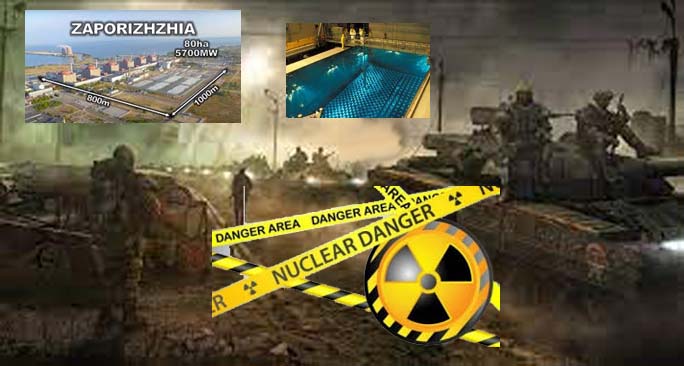
The Conversation, Tilman Ruff July 13, 2023
After the explosion at the Kakhovka Dam in Ukraine last month, many Ukrainians feared the Zaporizhzhia nuclear power plant could be next.
These concerns have been heightened in recent weeks as both Ukraine and Russia have accused each other of planning an attack of the plant, which has been under Russian control since March 2022.
The International Atomic Energy Agency (IAEA) has not found any evidence of explosives in recent inspections, but also said it had yet to be granted access to all parts of the huge plant.
So, how serious are the risks of an attack at the power plant? And how disastrous would this be for Ukraine and the wider world?
Europe’s largest nuclear power plant
Construction of the Zaporizhzhia power plant began in 1981. Five reactors were commissioned between 1984-89, and a sixth in 1995. The reactors are more modern than the graphite-moderated reactors at Chernobyl, and are similar to the pressurised water reactors in widespread use in the United States and Europe.
The plant is Europe’s largest, built on the southern bank of the Kakhovka Reservoir on the Dnipro River, from which it draws its cooling water. Before the Russian invasion, Ukraine generated about half its electricity from 15 nuclear power reactors across four sites, with Zaporizhzhia generating almost half of this.
The plant has cooling ponds for spent nuclear fuel, which require continuous power and water (like the reactors themselves). It also has a dry cask storage facility for spent reactor fuel when it no longer requires continuous water cooling.
In 2017, Ukraine reported there were just over 2,200 tons of highly radioactive spent fuel at Zaporizhzhia, in the spent fuel pools and dry cask storage.
How quickly a meltdown could happen
Barely a week after the invasion began, Russian forces captured Zaporizhzhia. During heavy combat, a fire broke out in a training facility, while other parts of the plant were damaged.
In September 2022, the plant was fully disconnected from the electricity grid. Five reactors were put into cold shutdown. The sixth was maintained in hot shutdown at around 200 degrees Celsius, producing steam for the plant.
The Ukrainian nuclear regulator ordered a cold shutdown of this reactor last month, but this has not happened. Extensive maintenance work on the reactors is overdue.
The fuel inside nuclear reactors needs continuous, active cooling for many months after a reactor shutdown because of the heat that continues to be produced by the decay of hundreds of different fission products. The longer the fuel is inside a nuclear reactor, the more radioactive it becomes. That is why when fuel is removed from a reactor, it still requires continuous, active cooling for years.
The world saw in dramatic fashion in Fukushima, Japan, in 2011 what can happen when continuous, active cooling of nuclear reactors is disrupted.
More than 70% of the total radioactivity at the Fukushima power plant was in the spent fuel ponds, which have none of the carefully engineered containment layers that reactors typically have.
In his classic 1981 book Nuclear Radiation in Warfare, Nobel Peace Prize-winning physicist Joseph Rotblat documented how
in a pressurised water reactor, the meltdown of the core could occur within less than one minute after the loss of coolant.
The radioactivity released from damaged spent fuel ponds could be even greater than from a meltdown at the reactor itself, he wrote.
His study makes clear that a military attack on a reactor or spent fuel pond could release more radioactivity – and longer-lasting radioactivity – than even a large (megaton range) nuclear weapon.
As nuclear physicist Edwin Lyman makes clear, if the Zaporizhzhia reactor cooling was interrupted, there might be a day or two before the spent fuel began to overheat and degrade.
The melting reactor core would then collapse onto the floor inside its steel primary containment vessel and melt through to the floor of the building. Large amounts of radioactive gases and aerosols would be released into the environment, potentially explosively.
The radioactive release could possibly be at Chernobyl-scale or even larger amounts if multiple reactors and spent fuel ponds were involved. This could then spread across borders and continents with the wind, rivers and currents, and come down in hotspots in rain and snow.
A nuclear plant under continuous assault
The Russian invasion of Ukraine is the first time war has engulfed operating nuclear plants and, in a real sense, weaponised them as potential radiological weapons, or “dirty bombs”…………………………………………………………..
The other three nuclear power plants in Ukraine have also experienced interruptions to their electricity supply. In addition, other nuclear facilities have been shelled, struck by missiles or otherwise damaged.
A wake-up call to the dangers of nuclear power
Some nuclear experts have inappropriately downplayed the risk of deliberate or accidental breach of the containment structures at Zaporizhzhia.
However, the IAEA and independent experts have highlighted the very real risk of a catastrophe.
………………………………………………………………………. No other energy technology is associated with such extreme safety and security risks. If Zaporizhzhia were a wind farm or solar array, the risk of a severe accident with global and intergenerational consequences – not to mention weapons proliferation or intractable waste issues – would be precisely zero.
https://theconversation.com/the-zaporizhzhia-nuclear-power-plant-is-a-dirty-bomb-waiting-to-happen-a-nuclear-expert-explains-209236
Ukraine’s chances of victory in 2023 are ‘vanishingly small’
Premiered Jun 24, 2023 Ret. Lieutenant Colonel Daniel Davis elaborates on the current status of the Ukraine war and why a successful counteroffensive looks less likely.
France to supply Ukraine with long-range cruise missiles with the ‘capacity to strike deeply’
By John Irish, July 11, 2023, VILNIUS, July 11 (Reuters) – France will join Britain in supplying Ukraine with long-range cruise missiles, which can travel 250 km (155 miles), a move that allows Ukrainian forces to hit Russian troops and supplies deep behind front lines, French officials said on Tuesday.
Emmanuel Macron said he had decided to boost military aid to Ukraine to help its counteroffensive as the French President arrived at a summit of the 31-member NATO alliance in Lithuania.
“I have decided to increase deliveries of weapons and equipment to enable the Ukrainians to have the capacity to strike deeply,” Macron said, while declining to say how many missiles would be sent.
A French diplomatic source said they were talking about 50 SCALP missiles produced by European manufacturer MBDA.
The missiles would come from existing French military stocks, a French military source told reporters, adding that it would be a “significant number”.
The French version, known as SCALP, has a range of about 250 km, three times as far as Ukraine’s existing missile capacities.
The missiles were being integrated into Ukrainian Russian-made warplanes, the French military source said……………………………….. more https://www.reuters.com/world/europe/france-send-long-range-missiles-ukraine-macron-2023-07-11/
FBI colluded with Ukraine in social media crackdown – lawmakers
https://www.rt.com/news/579523-fbi-ukraine-meta-twitter/ 11 July 23
The bureau failed to properly vet information provided by Kiev, the US House Judiciary Committee says
The FBI cooperated with Ukraine’s Security Service (SBU) to clamp down on social media accounts disseminating alleged “Russian disinformation,” but ended up flagging pages run by the US State Department and American journalists, a report by the House Judiciary Committee has revealed.
Released on Monday, the report accused the FBI of not properly vetting lists of accounts provided to it by the SBU before sending them to the likes of Meta, Google, and Twitter.
As a result, the two agencies “flagged for social media companies the authentic accounts of Americans, including a verified US State Department account and those belonging to American journalists,” and requested that those pages be deleted, the document read.
On some occasions, the FBI followed up to ensure that “these accounts were taken down,” according to the report, which was based on documents subpoenaed from Meta and Alphabet in February.
In one of the SBU’s lists forwarded by the FBI to Meta, the official Russian-language Instagram account of the US State Department was described as “distribut[ing] content that promotes war, inaccurately reflects events in Ukraine, justifies Russian war crimes in Ukraine in violation of international law,” the report stated.
CNN pointed out that Meta, which owns Instagram and Facebook, apparently did not comply with the request to delete the State Department page.
Another moderation request filed to Facebook by the US domestic security agency included a roster of 5,165 accounts, the House Judiciary Committee said.
The report cited an email by a senior Twitter employee who indicated to the FBI that “a few accounts of American and Canadian journalists” were on one of the lists sent to the company by the agency.
Alphabet platforms Google and YouTube were also approached about censoring alleged pro-Russian accounts. A high-ranking member of Google’s cybersecurity team told the authors of the report that the company had been “deluged with various requests” for the removal of content, mainly from “the Ukrainian government, other Eastern European governments, the European Union, and the European Commission.”
The House Judiciary Committee suggested that the FBI had “violated the First Amendment rights of Americans and potentially undermined our national security” through its partnership with the SBU, claiming that the latter had been “infiltrated by Russian-aligned actors.”
The author of the paper noted the purge within the SBU by Ukrainian President Vladimir Zelensky last summer, which saw the agency’s head sacked and hundreds of criminal cases launched against employees on treason charges.
The report was released ahead of FBI Director Christopher Wray’s testimony before the House Judiciary Committee, which is scheduled for Wednesday.
A Judiciary Committee aide told CNN that the Republicans on the panel are planning to question Wray about the content of the paper and use it to claim that the FBI interferes in free speech.
Zelensky slams Biden’s ‘unprecedented and absurd’ stance on NATO membership
New York Post, By Steven Nelson, 11 July 23
VILNIUS, Lithuania — Ukrainian President Volodymyr Zelensky tore into NATO leaders including President Biden on Tuesday for not extending membership to his war-torn country — introducing fresh diplomatic drama into the annual gathering of the military alliance’s leaders.
Zelensky slammed the reticence as “weakness” and “absurd” just moments after Biden referred to the development of new language regarding his country’s potential NATO ascension.
“Now, on the way to Vilnius, we received signals that certain wording is being discussed without Ukraine. And I would like to emphasize that this wordxfing is about the invitation to become NATO member, not about Ukraine’s membership,” Zelensky tweeted.
“It’s unprecedented and absurd when a time frame is not set neither for the invitation nor for Ukraine’s membership. While at the same time vague wording about ‘conditions’ is added even for inviting Ukraine.”
Zelensky added: “It seems there is no readiness neither to invite Ukraine to NATO nor to make it a member of the Alliance. This means that a window of opportunity is being left to bargain Ukraine’s membership in NATO in negotiations with Russia. And for Russia, this means motivation to continue its terror. Uncertainty is weakness. And I will openly discuss this at the summit.”……………
Shortly before Zelensky’s fiery tweet, Biden said during a meeting with NATO Secretary-General Jens Stoltenberg that “we agree on the language that you propose, relative to the future of Ukraine being able to join NATO. And we’re looking for a continued united NATO.”
The wording that Biden alluded to was released later, saying vaguely, “We will be in a position to extend an invitation to Ukraine to join the Alliance when Allies agree and conditions are met.”…………..
Biden said in a CNN interview that aired Sunday that he believes Ukraine is not “ready” for membership.
“I don’t think it’s ready for membership in NATO,” Biden told CNN’s Fareed Zakaria. “I don’t think there is unanimity in NATO about whether or not to bring Ukraine into the NATO family now, at this moment, in the middle of a war.”
……………………… Sen. Dick Durbin (D-Ill.) said that he is particularly concerned about corruption in Ukraine’s government and said that it was an “understandable” cause for concern among fellow NATO countries.
………….. NATO countries including the US have heavily financed and armed Ukraine’s resistance to the more than 16-month-old Russian invasion and Biden has gradually met many of Zelensky’s prior demands, such as agreeing last week to send cluster bombs to aid Kyiv’s flagging offensive, despite a human rights campaign to ban the weapons, which can maim or kill civilians for decades after conflicts end. https://nypost.com/2023/07/11/zelensky-slams-weakness-of-absurd-biden-stance-on-nato/
—
Cluster Bombs for Ukraine? A Warning From Kosovo
SCHEERPOST, by EDITORJuly 10, 2023
With Washington poised to ship cluster bombs to Kyiv, Declassified visits Kosovo to review the grim legacy of NATO firing this banned weapon in the Balkans.
By Phil Miller / Declassified UK
GRACANICA, KOSOVO – “In the village where we lived, there were nine bombs dropped by NATO in the space of two minutes,” Dzafer Buzoli recalls, as we discuss his traumatic childhood in Yugoslavia. A leading member of Kosovo’s Roma, his community went from pillar to post.
Many were dragooned into Slobodan Milosevic’s Serb-dominated Yugoslav army or targeted by Albanian rebels as suspected collaborators, before Bill Clinton and Tony Blair launched their ‘humanitarian intervention’ in 1999.
“When the first bomb fell, we were just confused and wondered what was happening,” he reflects. “But after the second bomb I felt the hot air and fell down from the pressure of the blast.
“Ever since then I’ve had a heightened sense of hearing. When there’s a loud noise or people yelling I have to really back up, because it’s too much for me.”
Buzoli was lucky to survive the airstrike. Two soldiers and a five year old boy were killed in the attack on his village of Laplje Selo, which was hit with controversial cluster munitions.
These scatter a blizzard of ball-shaped bomblets over target areas, like a minefield falling from the sky. Human Rights Watch said NATO killed between 90 and 150 civilians with this weapon across Serbia and Kosovo.
Thousands of bomblets failed to detonate on impact, posing a hazard to children who mistook their little yellow parachutes for toys. In the decade after the war, these remnants claimed another 178 casualties in Kosovo.
While this war might seem like a distant memory for those beyond the Balkans, it offers a cautionary tale to Western states now assisting Ukraine’s fight against Russia.
US officials are said to be seriously considering supplying Kyiv with cluster bombs, possibly as soon as next month.
That’s despite the weapon being banned by more than 120 countries including the UK, following a UN treaty in 2008. ……………………………………………………………………………………………………..
Clearing the remnants of these weapons from Kosovo is not expected to finish until 2024 – a quarter century after the war ended.
That marathon process, coupled with dubious performance on the battlefield, might give Joe Biden pause for thought about sending cluster bombs to Ukraine. https://scheerpost.com/2023/07/10/cluster-bombs-for-ukraine-a-warning-from-kosovo/
US cluster bombs deal is clear signal that war is not going well for Ukraine
America risks losing the moral high ground by supplying Ukraine with a weapon banned by much of the world, so why are they supplying it?
Mark Stone, US correspondent @Stone_SkyNews
The White House is fully aware of the huge controversy surrounding this cluster munitions decision.
Some 123 countries are part of the 2008 International Convention on Cluster Munitions which bans the use or transfer of this particular weapon.
Almost all of America’s allies are signatories to the convention.
Even within US government circles, there has been deep unease about supplying its own stockpile of cluster munitions to Ukraine.
Ukraine war latest: US to send Kyiv controversial weapon banned by more than 100 countries
As recently as last week, within the state department, there was division about the decision to supply the weapon.
The long and grim record of the cluster bomb explains the unease and the controversy.
Globally, civilians represent 97% of cluster munition casualties, according to a report last year by the Landmine and Cluster Munition Monitor – an organisation that seeks to ban them altogether.
Children are overwhelming the victims.
By supplying the weapon, there is a clear risk to civilians, not now necessarily, but in the future. The legacy of unexploded cluster bomblets is evident on former battlefields globally.
America also risks losing the moral high ground against Russia by supplying a weapon banned by much of the world.
So why supply it?
Well, the facts on the ground are not in Ukraine’s favour. The transfer is a clear signal that the war is not going well for Ukraine.
The so-called spring offensive did not materialise in the spring and looks set to falter through the summer too.
Ukraine is fast running out of more conventional artillery with supply stocks in America and elsewhere running low.
A ‘bridge of supply’ is necessary.
………………. The munitions would be used by Ukraine on occupied Ukrainian soil. The risk to civilians would be owned by Ukraine. The onus would be on Ukraine, with a pledge of American help, to clear the unexploded munitions when the war comes to an end.
The announcement is part of a multi-million dollar tranche of new weaponry which is an attempt by the Biden administration to future-proof the conflict; to give Ukraine the weapons it needs now in case domestic political circumstances change in the next 18 months.
American politics is in flux.
There is no guarantee of open-ended support for Ukraine. https://news.sky.com/story/us-cluster-bombs-deal-is-clear-signal-that-war-is-not-going-well-for-ukraine-12917101
Red alert at Zaporizhzhia?
The threatened deadly scenarios could not happen at a wind farm
By Linda Pentz Gunter, 10 july 23 https://beyondnuclearinternational.org/2023/07/09/red-alert-at-zaporizhzhia/
Amidst accusations from both the Russian and Ukrainian sides that the Zaporizhzhia nuclear power plant in southeastern Ukraine has been wired for detonation or could be deliberately attacked during the current war there, one absolute truth remains: nuclear power plants are inherently dangerous.
Whether the rhetorical threats are real or not remains subject for debate. What is incontrovertibly real is the danger a nuclear power plant poses. After all, that is why the two sides are making these threats in the first place: because the outcome would be so deadly. If Zaporizhzhia was a wind farm, it wouldn’t even be mentioned.
Each nuclear reactor contains a lethal radioactive inventory, in the reactor core and also in the fuel pools into which the irradiated fuel is offloaded and, over time, densely packed. Casks also house nuclear waste offloaded from the fuel pools.
Zaporizhzhia is the largest nuclear power plant in Europe with at least 2,204 tons of highly radioactive waste within the reactors and the irradiated fuel pools.
Depending on the severity of what transpires, any or all of this radioactive fuel could be ignited.
Amidst the confusion and unreliability of any pronouncements uttered through the “fog of war”, there remain several unanswered questions that have led to heightened rumor and speculation:
Has the Zaporizhzhia nuclear plant in fact been wired for detonation and whose interests would be served by blowing up the plant?
Why is there an exodus of both Russian and Ukrainian plant personnel?
Will the sabotage of the downstream Kakhovka dam that resulted in catastrophic flooding, also lead to an equally catastrophic loss of available cooling water supplies for the reactors and fuel pools?
Will the backup diesel generators, frequently turned to for powering the essential cooling each time the plant has lost connection to the electricity grid, last through each crisis, given their fuel must also be replenished, potentially not possible under war conditions?
None of these threats would make headlines if Zaporizhzhia was instead home to a wind farm or utility scale solar array. This perhaps explains the rush now to downplay the gravity of the situation, with claims in the press that a major attack on the plant would “not be as bad as Chornobyl” and that radioactive releases would be minimal and barely travel beyond the fence line.
This is an irresponsible dismissal of the real dangers. The measured assessment of Dr. Edwin Lyman at the Union of Concerned Scientists confirms that an attack on Zaporizhzhia could indeed be catastrophic.
The graphite moderator used at Chornobyl undeniably worsened the outcome of that explosion and its aftermath. The graphite fueled the fire and the smoke further suspended what became the radioactive fallout that traveled far and wide across the former Soviet Union and all of Europe.
The part played by the graphite moderator in increasing the severity of the Chornobyl disaster has led to an assumption that major fires and explosions at Zaporizhzhia would result in less serious consequences, given the reactors are not of the same design. All six at Zaporizhzhia are Russian VVERs, similar to the Pressurized Water Reactor used here in the United States. (Chornobyl was the older RBMK.)
However, while Zaporizhzhia may be a less primitive design, it is not harmless. (Absurdly, these 1980s reactors are described in the press as “more modern.”)
If the uranium fuel in the Zaporizhzhia reactors or irradiated fuel storage pools overheats and ignites, it could then heat up the zirconium cladding around it, which would ignite and burn fiercely as a flare at temperatures too hot to extinguish with water.
The resulting chemical reaction would also generate an explosive environment. The heat of the release and any subsequent detonations could breach concrete structures, then loft radioactive gas and fallout into the environment to travel on the weather.
Radioactive fallout could contaminate crucial agricultural land in Ukraine and potentially also in Russia should prevailing winds travel eastward at the time of the disaster. As we have learned from the Chornobyl fallout, this is an enduring harm that enters the food chain and human bodies and remains harmful in the environment indefinitely, as exemplified by the 1,000 square mile Chornobyl Exclusion Zone.
Who then consumes that food is also of critical importance. While Europe allows an already too high 600 becquerels per kilogram (Bq/kg) of radioactive cesium in food, contaminated food supplies from Ukraine that read at higher levels after a nuclear disaster could be exported to countries with even weaker standards, including the US where the limit is an unacceptable 1200 Bq/kg. But will those consuming such foodstuffs be counted among the victims of such a nuclear disaster? Likely not.
The true numbers of those harmed by the Chornobyl disaster will never be known due to institutional suppression and misrepresentation of the numbers and the absence of record-keeping in the former Soviet countries affected. Therefore, to suggest that a major nuclear disaster at Zaporizhzhia would be “not nearly as bad as Chornobyl” is too broad and speculative without looking at the specifics.
Those specifics depend on whether the disaster involves hydrogen explosions such as happened at Fukushima, or fires resulting from a bombing raid or missile attack, which could disperse more radioactivity further. It would also depend on whether all six reactors suffered catastrophic failures, whether all of the fuel pools were drained and caught fire and whether the storage casks were breached.
It would further depend on which way the wind was blowing, and if, when and where it subsequently rained out a radioactive plume, all factors that influenced where the Chornobyl radioactive fallout was deposited.
If Zaporizhzhia comes to harm, each side in the conflict will almost certainly hold the other responsible. But ultimately, the responsibility we all share is to reject the continued use of a technology that has the potential to wreak such disastrous consequences on humanity.
Nuclear power is the most dangerous way to boil water. It is unnecessary, expensive, and an obstacle to renewable energy development. It is intrinsically tied to the desire for — and development of — nuclear weapons, the use of which could be the other lethal outcome in this war.
Zaporizhzhia is in the news almost every day. The propaganda may be deliberately alarmist, but the basis for the alarm is very real or it would not be in the headlines in the first place.
It is time to see sense. Calling for a no-fire zone around Zaporizhzhia is not enough. We must call for no nuclear power at all.
Linda Pentz Gunter is the international specialist at Beyond Nuclear and writes for and curates Beyond Nuclear International.
Ukraine great ‘testing ground’ for Western weapons: Kiev

Thursday, 06 July 2023, https://www.presstv.ir/Detail/2023/07/06/706584/Ukraine-Russia-western-weapons-Reznikov-US-cluster-munitions-
Kiev says Ukraine is a great “testing ground” for the military industry of the West, which is constantly pouring advanced arms and military equipment in the ex-Soviet republic despite repeated warnings by Russia that such a flow of arms will only prolong the war.
In a an interview with Financial Times published on Wednesday, Ukrainian Defense Minister Oleksii Reznikov said his country is an ideal “testing ground” for Western weaponry so that Kiev’s allies can see how their weapons work in real war and to see whether they are efficient or need upgrades.
“For the military industry of the world, you can’t invent a better testing ground,” he said, claiming that American officials became very happy when Ukraine’s military reported that a US Patriot missile system managed to down a Kinzhal, a Russian hypersonic missile.
An American official called the news “fantastic,” Reznikov said.
“The Russians come up with a countermeasure, we inform our partners and they make a new countermeasure against this countermeasure,” the Ukrainian defense minister said.
Reznikov claimed many countries are closely watching the developments in the Ukraine-Russia war, including those that are already armed with Russian weapons.
“Everyone is watching closely. And not only India. China too … Everyone, even those who bought weapons from [Russia], will watch carefully,” he said.
In July 2022, Reznikov made similar comments when he was asking for the United States and NATO to send more weapons to Ukraine.
“We are interested in testing modern systems in the fight against the enemy and we are inviting arms manufacturers to test the new products here,” he said at the time.
The US may reportedly decide later this week to send such internationally-banned cluster munitions to Ukraine.
Cluster bombs are banned under the Convention on Cluster Munitions (CCM), an international treaty that addresses the humanitarian consequences and unacceptable harm caused to civilians by cluster munitions through a categorical prohibition and a framework for action.
The weapons can contain dozens of smaller bomblets, dispersing over vast areas, often killing and maiming civilians. The CCMs are banned because unexploded bomblets can pose a risk to civilians for years after the fighting is over.
Cluster munitions generally eject submunitions that can cover five times as much area as conventional bombs.
The CCM, which took effect in 2010, bans all use, production, transfer and stockpiling of cluster bombs. More than 100 countries have signed the treaty, but the United States, Russia and Ukraine have not.
Russia sees the flooding of Ukraine with weapons from the West as a futile effort to change the outcome of the war. Moscow says supplying Kiev with more weapons will only add to the death and destruction and prolong the conflict.
NATO’s Scorched Earth in Ukraine
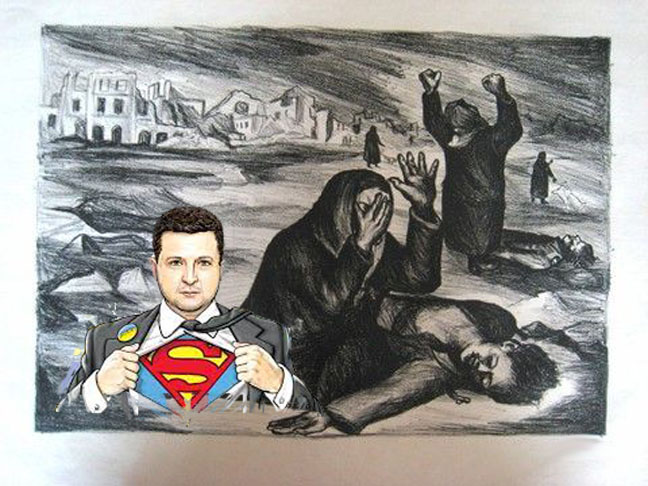
The forthcoming NATO Summit in Vilnius on July 11-12 seems already infected by a strange policy fatalism, writes Tony Kevin.
By Tony Kevin / Consortium News byEDITOR, July 7, 2023
Hope of a policy breakthrough in Vilnius, Lithuania towards peace in Ukraine, spearheaded by the war-weary East Europeans, seems to have drained away.
There is general acceptance in NATO that the Ukrainian summer offensives in Zaporizhie and again now in Bakhmut have failed to dent Russian defences, with horrific mortality in Ukrainian manpower and enormous destruction of Western-supplied equipment.
The West seems content to let Zelensky go on wasting Ukraine’s increasingly scarce military-age men in a process described by writer Raúl Ilargi Meijer as NATO’s assisted suicide of the Ukrainian nation.
The NATO unspoken strategy seems to be: we know Russia is inevitably winning in Ukraine, but we will make sure we and our Kiev proxies destroy as much as possible of Ukraine’s manpower and national wealth before Russia takes control of the country.
The Kakhovka dam is gone, and what is left of Zaporizhie Nuclear Power Plant seems increasingly at risk of West-assisted Ukrainian sabotage. These two huge assets were the pivots of Ukraine’s industrial and agricultural potential and wealth.
When Russia wins political control over the ruined land of Ukraine, and after it repudiates Western carpetbagging claims to asset ownership there, it will face a huge rebuilding job, comparable to the situation the Soviet Union faced in Ukraine after the 1944-45 vengeful scorched-earth actions by the retreating Nazi divisions……………………………….
In the U.S., only the military-industrial-information complex is doing well…………………………….
Russia’s task is to win in Ukraine, as it is doing, but without destroying its reputation with China and the Global Majority……………………………………..
The history of Western diplomatic treachery during the last 32 years since the 1991 end of Soviet Communism has shown Russians that the U.S.-U.K. agenda was always about much more than defeating Communism: it was about expanding American global hegemony and breaking up Russia as a competing world civilisational state.
There is enough evidence now to satisfy the Global Majority that U.S. regime change and controlling operations in Ukraine since 2013 have been above all cynically aimed at weakening and destabilising Russia……………..
The Vilnius NATO meeting will produce no new miracles of salvation for the doomed Kiev regime. There will be a lot of tired rhetoric about continuing to defend democratic Ukraine.
Nobody – speakers or listeners – will believe it. https://scheerpost.com/2023/07/07/natos-scorched-earth-in-ukraine/
An Attack on the Zaporizhzhia Nuclear Plant Could Still be Catastrophic (- nuclear promoters minimise the risk)

Ed Lyman, July 7, 2023 https://blog.ucsusa.org/edwin-lyman/an-attack-on-the-zaporizhzhia-nuclear-plant-could-still-be-catastrophic/
Ukraine has accused Russia of planning to carry out a sabotage attack at the Zaporizhzhia nuclear plant that it has controlled since it seized it by force in March 2022. Although it reports this morning that this current threat is decreasing, the situation is fluid and the plant remains vulnerable to both accidents and attacks. While this ongoing crisis should not lead to panic, there is no cause for complacency either.
Unfortunately, the American Nuclear Society (ANS) and other commenters have been busy attempting to dismiss the risks that either an accident or a deliberate attack could lead to a significant radiological release with far-reaching consequences. Simply put, the ANS is dead wrong here, and by minimizing the potential risk it is endangering Ukrainians and others who may be affected by lulling them into a false sense of security and undermining any motivation to prepare for the worst. Effective emergency preparedness requires a clear-eyed understanding of the actual threat.
As I have pointed out previously, the fact that the six reactors have been in shutdown mode for many months (with one in “hot”, as opposed to “cold,” shutdown) does reduce the risk somewhat compared to a situation where reactors are operating or have only recently shut down. The decay heat in the reactors’ cores decreases significantly over time, although the rate of decrease slows down quite a bit after a few months. However, this does not mean, as ANS misleadingly implies, that there is no risk of a major radiological release that could disperse over a wide area. What it does mean is that if cooling were disrupted to one or more of the reactors, then there would be a longer period of time—days instead of hours—for operators to fix the problem before the cooling water in the reactor cores would start to boil away and drop below the tops of the fuel assemblies, causing the fuel to overheat and degrade.
Timely operator actions are even more critical for reactors that are shut down than for reactors that are operating, since some automatic safety systems are not functional during shutdown. Indeed, in a 1997 report, the International Atomic Energy Agency (IAEA) points out that “acceptable results for most of events during shutdown modes cannot be achieved without operator intervention.” The IAEA report states that both “preventive and mitigatory capabilities are somewhat degraded” in shutdown conditions, and lists a number of shutdown accident initiators for VVER-1000s.
One class of events of particular concern are “boron dilution” accidents, in which the concentration of boron in cooling water necessary to maintain reactors in a subcritical state becomes reduced and nuclear fission inadvertently begins in the core. This would not only increase the reactor temperature and the amount of heat that would have to be removed, but would also generate new quantities of troublesome short-lived fission products, such as iodine isotopes, which have previously decayed away in the months since shutdown. (This is why it remains important that potassium iodide—a drug that can block uptake of radioactive iodine in the thyroid—continue to be available to communities who may be in the path of any plume.)
It is also important to note that it is very unusual for reactors to be maintained for any length of time in either hot or cold shutdown modes with fuel remaining in the core, as is the case at Zaporizhzhia. Whenever nuclear reactors operate in unusual conditions that have not been thoroughly analyzed, risks increase.
Unfortunately, because of the incredible stress that the greatly reduced staff at Zaporizhzhia are under, and the unclear lines of command under Russian occupation, their ability to efficiently execute all the actions necessary to mitigate any accident or sabotage attack is in grave doubt. And if timely operator intervention does not occur, and the fuel assemblies are exposed, then a core melt accident similar to what was experienced in three of the reactors at Fukushima Daiichi is certainly possible.
Once the water level has dropped below the tops of the fuel assemblies, the original decay heat in the reactor core is no longer a relevant factor because when the zirconium cladding surrounding the fuel rods overheats and reacts with steam or air, it produces additional heat through a so-called exothermic reaction. The heat released in this way would soon become far greater than the original decay heat load and would accelerate the heat-up and degradation of the reactor core. At that point, it would be much harder for operators to arrest the progression of the core melt. Eventually, the molten core would drop to the floor of the steel reactor vessel and melt through it onto the floor of the containment building, where it would react with concrete to generate hot gases. Then, there are multiple ways in which the radioactive gases and aerosols generated during the core melt could be released into the environment, including a containment melt-through mode that is possible in VVER-1000 reactors such as Zaporizhzhia.
There is no technical reason why any resulting radioactive releases could not disperse at least as far as occurred at Fukushima, depending on the meteorological conditions. The heat of the radioactive plumes, which determines how high they will rise in the atmosphere and hence how far they can travel, largely come from the heat released by zirconium oxidation. The magnitude and extent of the resulting environmental contamination would depend on the “source term,” or the inventory and characteristics of the radioactive materials released from the site. Since up to six reactors and six spent fuel pools could be involved—especially if the site is deliberately sabotaged—the source term could ultimately be larger than that of Fukushima, where only three reactors were involved and containments remained largely intact.
Thus it is imperative that the international community take Ukraine’s warnings seriously and provide all the assistance it needs for emergency preparedness. Unjustified complacency could lead to a lack of resolve for addressing the danger, only increasing the potential for a long-lasting disaster that will compound the misery of the Ukrainian people.
Despite Zelensky’s claims, there’s no evidence that Russia has rigged Ukraine’s Zaporizhzhya plant with explosives, nuclear watchdog says
Business Insider, Charles R. Davis , Jul 8, 2023
- The IAEA said Friday there’s no sign Russia plans to destroy the Zaporizhzhya nuclear power plant.
- Inspectors “have not seen any mines or explosives,” according to the head of the nuclear watchdog.
- However, the IAEA said its experts have not been provided full access to the facility.
The United Nations’ nuclear watchdog said Friday that it has seen no evidence that Russia intends to blow up the largest nuclear power plant in Europe, a finding that comes after the head of Ukraine’s military intelligence walked back an earlier warning of impending disaster.
In a status report on the Zaporizhzhya nuclear power plant, which Russian forces occupied soon after last year’s full-scale invasion of Ukraine, Rafael Mariano Grossi, head of the International Atomic Energy Agency, said inspectors were recently provided “some additional access” to the facility after Ukraine claimed it had been rigged with bombs……………………………………..
Russia has repeatedly denied it has any intention of causing a nuclear disaster. Kremlin spokesperson Dmitry Peskov this week argued that the real threat is Ukrainian “sabotage.”…. https://www.businessinsider.com/no-sign-russia-has-mined-zaporizhzhya-plant-nuclear-watchdog-says-2023-7
Scenario for a War in Eastern Ukraine
John Stanton, Sri Lanka Guardian•February 05, 2022
The United States Views Russians Just as the Nazi’s Did in World War II
by John Stanton
“There is a sense of open, almost joyful viciousness in all this pro-war, anti-Russian sentiment on opinion pages and television broadcasts. It is certainly racist and demeaning in tone. Such is the first step in convincing the public that the “transgressor” is equivalent to a retrovirus.”John Stanton, Dissident Voice, 2015
Vietnam 2.0 is in the making in Ukraine. The US civil-military establishment, Republicans and Democrats alike, want a shooting war with Russia, even though it was the US that caused the carnage in Ukraine, not the Russians. Yet, that inconvenient reality has been nullified by the US propaganda campaign which, of course, the Russians have responded to with their own.” John Stanton, Counterpunch, 2015
Preparing for War with Russia Since 1992
As President Joe Biden announced the transfer of 2000 US troops to Poland and Germany on February 3, 2022, and the movement of an additional 1000 troops from Western Europe to Romania, I shook my head and looked to the sky thinking, “the United States and its elites really want a war with Russia, both economic and military. US generals want to use tanks, missiles, and aircraft against a near-peer competitor. They can’t beat sandal wearing insurgents in Afghanistan, so they want to mix it up with the A-Team, i.e., Russia.”……………………
The Washington Post and New York Times and the major networks, NBC, CBS, ABC, CNN, FOX, et al, are salivating at the prospect of a Russian invasion of Eastern Ukraine, specifically the Donbass, home to separatist republics in Luhansk and Donetsk. As I wrote in April 2014, “There is a sense of open, almost joyful viciousness in all this pro-war, anti-Russian sentiment on opinion pages and television broadcasts. It is certainly racist and demeaning in tone. Such is the first step in convincing the public that the “transgressor” is equivalent to a retrovirus.” John Stanton, Dissident Voice, 2014
NATO: Causing Trouble since 1949
Presidents Bill Clinton, George W. Bush, Barak Obama, Donald Trump and now Joe Biden have pushed NATO expansion right up to Russia’s border. For example, Estonia and Latvia are NATO members. Estonia is 120 miles from St. Petersburg.NATO is purely a military alliance led by the USA. Its members serve simply military bases (some probably with tactical nuclear weapons) for US military forces and its many military contractors.
Is there any wonder that the President of Russia Vladimir Putin should be concerned?Are NAZI’s in the USA and NATO pushingthe expansion of NATO, the racial hatred of Russians, and seeking a hot war? It is revolting.
NATO: Causing Trouble since 1949
Presidents Bill Clinton, George W. Bush, Barak Obama, Donald Trump and now Joe Biden have pushed NATO expansion right up to Russia’s border. For example, Estonia and Latvia are NATO members. Estonia is 120 miles from St. Petersburg.NATO is purely a military alliance led by the USA. Its members serve simply military bases (some probably with tactical nuclear weapons) for US military forces and its many military contractors.
Is there any wonder that the President of Russia Vladimir Putin should be concerned?Are NAZI’s in the USA and NATO pushing the expansion of NATO, the racial hatred of Russians, and seeking a hot war? It is revolting……………………………….
Attack Scenario, just a Guess: If Russia’s Hand is Forced by USA-NATO
Russian military forces fought in Ukraine during World War II against NAZI Germany. For example, the Battle of Kiev and The Battle of the Dnieper. There is an historical record for Russian military planners to refer to. The Battle of Grozny in Chechnya will weigh heavily on Russian military planners as the decide which communities to take control of………………………………………………..more http://www.srilankaguardian.org/2022/02/scenario-for-war-in-eastern-ukraine.html?m=1
1 This Month

22 June – Virtual Event –Climate Change: New Data, New Debate

Monday, June 22, 2026 2:30 p.m. – 3:15 p.m. CT
YouTube. Register here

Protect Sazan Island from the Trump family! https://secure.avaaz.org/campaign/en/protect_sazan_island_from_the_trump_family_loc/?bqFCVab&v=174511&cl=22707147157&_checksum=5e9dde668860e8231c33699735e16a1fbf22ab2cb01da50c999fe8732b9775ef&utm_source=email&utm_medium=blast_email&utm_campaign=174511
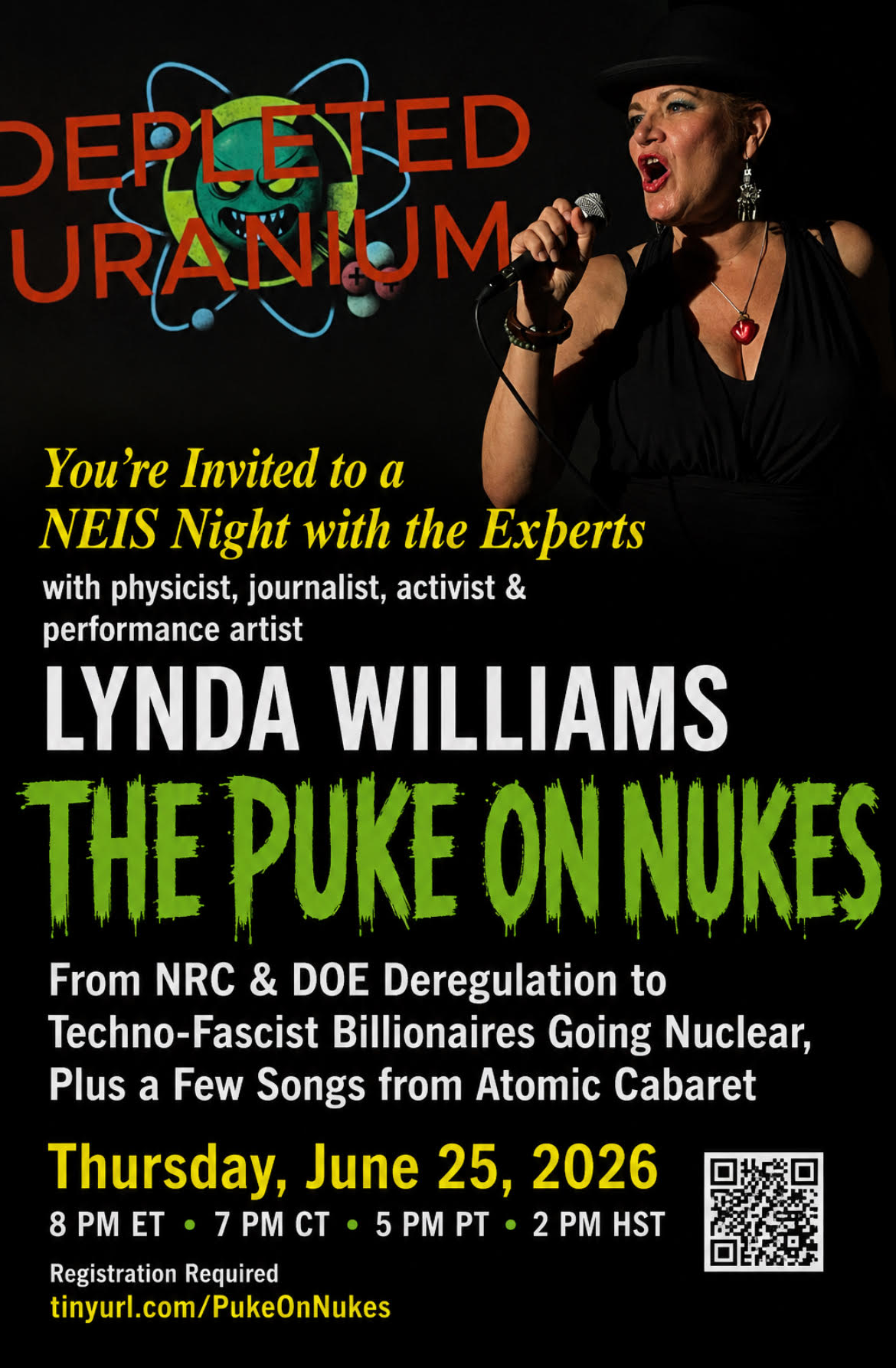
25 June- THE PUKE ON NUKES
Thursday, June 25, 2026
7pm Central Time (8pm ET, 6pm MT, 5pm PT) UTC – 5
From NRC & DOE Deregulation to Techno-Fascist Billionaires Going Nuclear, Plus a Few Songs from Atomic Cabaret REGISTER
26 June – Radiation Trainwreck at the NRC / Join the Protect Better Campaign – https://us02web.zoom.us/meeting/register/4ZlZ5_qLSHGiLSCg8FF6Bg#/registration


Cuba Is Not a Failed State – It Is a Besieged State
PETITION: “Global Appeal to Endorse Palestinian Right of Return of Refugees”
To see nuclear-related stories in greater depth and intensity – go to https://nuclearinformation.wordpress.com
-
Archives
- June 2026 (193)
- May 2026 (306)
- April 2026 (356)
- March 2026 (251)
- February 2026 (268)
- January 2026 (308)
- December 2025 (358)
- November 2025 (359)
- October 2025 (376)
- September 2025 (257)
- August 2025 (319)
- July 2025 (230)
-
Categories
- 1
- 1 NUCLEAR ISSUES
- business and costs
- climate change
- culture and arts
- ENERGY
- environment
- health
- history
- indigenous issues
- Legal
- marketing of nuclear
- media
- opposition to nuclear
- PERSONAL STORIES
- politics
- politics international
- Religion and ethics
- safety
- secrets,lies and civil liberties
- spinbuster
- technology
- Uranium
- wastes
- weapons and war
- Women
- 2 WORLD
- ACTION
- AFRICA
- Atrocities
- AUSTRALIA
- Christina's notes
- Christina's themes
- culture and arts
- Events
- Fuk 2022
- Fuk 2023
- Fukushima 2017
- Fukushima 2018
- fukushima 2019
- Fukushima 2020
- Fukushima 2021
- general
- global warming
- Humour (God we need it)
- Nuclear
- RARE EARTHS
- Reference
- resources – print
- Resources -audiovicual
- Weekly Newsletter
- World
- World Nuclear
- YouTube
-
RSS
Entries RSS
Comments RSS
 nuclear-news
