Ukrainian Minister Warns Zaporizhzhya Nuclear Plant ‘One Step Away’ From Blackout
Ukrainian Energy Minister Herman Halushchenko has appealed to the
International Atomic Energy Agency (IAEA) about the loss of the main power
line supplying electricity to the Zaporizhzhya nuclear power plant in
southern
Ukraine. Halushchenko said on Ukrainian television on August 10
that the nuclear plant is currently being supplied with power from a backup
line. “This is the only external power line left. And such a situation is
one step away from the blackout of the Zaporizhzhya nuclear power plant —
that is, the final loss of external power supply,”
Halushchenko said. In
the event of a blackout, diesel generators would be connected to meet the
needs of the station, but they may be damaged by Russian shelling, which
would stop the cooling of the station and set off a nuclear meltdown,
Halushchenko said. Ukraine’s nuclear authority, Enerhoatom, warned earlier
on August 10 that the Russian-occupied nuclear plant is on the verge of a
blackout because power was cut from the main high-voltage line.
Radio Free Europe 10th Aug 2023
https://www.rferl.org/a/ukraine-zaporizhzhya-nuclear-plant-risk-blackout/32541960.html
Ukraine biggest recipient of US aid since WWII – Washington Post
7 Aug, 2023 https://www.rt.com/news/580960-us-ukraine-military-aid/
Washington has contributed more than $60 billion to Kiev since the beginning of its conflict with Russia, estimates suggest
The United States has committed in excess of $60 billion in aid to Ukraine since the beginning of Moscow’s military operation last year, according to the Washington Post.
A recent analysis has shown that various US aid packages to Kiev have included $43 billion in direct military aid, making it the US’ biggest investment in a country since World War II, according to the paper.
“These are off-the-charts numbers,” Michael O’Hanlon of the think tank Brookings Institution told the WP
He added that Washington’s financial assistance to Ukraine could only be historically compared to the Marshall Plan – a US foreign aid package issued to Western Europe after the end of World War II. Adjusted for inflation, that initiative funded war recovery efforts to the tune of around $150 billion over three years.
The paper notes that Washington’s aid to Ukraine vastly surpasses the financial support issued to some of the US’ more traditional foreign partners, such as Israel, which was sent $8.6 billion in 2022 and 2023, and the $6.2 billion that was sent to Egypt and Jordan combined during the same period. It also significantly eclipses US financial support for Taiwan.
The US Department of Defense has an annual budget of $1.77 trillion, according to government data.
Some signs have shown that public support in the US for continued military assistance is weakening as the conflict enters its 18th month. Research in June found that 44% of Republicans or right-leaning independents believed that Joe Biden’s administration was spending too much on Ukraine aid.
However, O’Hanlon pointed out that the US could continue to fund Ukraine indefinitely. “We could do it forever,” he said. “It’s not economically unsustainable. But it’s probably politically unsustainable.”
Moscow has frequently cited Western support for Ukraine as a primary factor in prolonging the conflict. Anatoly Antonov, Russia’s ambassador to the US, responded to a renewed military package from the US to Ukraine last month by saying it is “beyond morality and common sense.” He claimed that while Washington seeks to portray itself as Kiev’s “selfless benefactor,” in practice it only strives for “more human suffering and deaths.”
Russian officials have repeatedly warned that shipments of heavy weapons and other military aid to Ukraine make NATO members de facto direct participants in Moscow’s conflict with Kiev. Moscow also insisted that Western support would not change the course of the outcome.
Ukrainian counteroffensive ‘highly unlikely’ to succeed, US officials tell CNN
https://www.rt.com/russia/581006-ukraine-counteroffensive-unlikely-success/ 8 Aug 23
Reports from the battlefield have become increasingly “sobering,” one US Congressman has told the network
Kiev’s Western backers are losing faith in the ability of the Ukrainian military to penetrate Russian defenses and turn the tide of the conflict, US and other Western officials told CNN on Tuesday.
“[The Ukrainians are] still going to see, for the next couple of weeks, if there is a chance of making some progress. But for them to really make progress that would change the balance of this conflict, I think, it’s extremely, highly unlikely,” an unnamed “senior Western diplomat” told the American broadcaster.
Illinois Representative Mike Quigley, a Democrat who recently met with US commanders in Europe, described their briefings as “sobering.”
“We’re reminded of the challenges [the Ukrainians] face,” he said, adding that “This is the most difficult time of the war.”
Ukraine launched its long-awaited counteroffensive against Russian forces in early June, assaulting multiple points along the frontline from Zaporozhye to Donetsk regions. However, the Russian military had spent several months preparing a dense and multi-layered network of minefields, trenches, and fortifications, which the Ukrainian side has thus far failed to overcome.
Advancing through minefields without air support, Ukraine’s Western-trained and NATO-equipped units have suffered horrendous casualties, losing 43,000 troops and 4,900 pieces of heavy weaponry in just over two months, according to the most recent figures from the Russian Defense Ministry.
“[The] Russians have a number of defensive lines and [Ukrainian forces] haven’t really gone through the first line,” another anonymous Western diplomat told CNN. “Even if they would keep on fighting for the next several weeks, if they haven’t been able to make more breakthroughs throughout these last seven, eight weeks, what is the likelihood that they will suddenly, with more depleted forces, make them?”
Despite the best efforts of Ukraine’s armed forces chief, Gen. Valery Zaluzhny, to convince the US that “the initiative is on our side,” officials told CNN that Ukrainian President Vladimir Zelensky could soon be pushed to sue for peace if progress remains stalled.
A senior US military official predicted that Kiev would rely more and more on piecemeal strikes within Russia – like the recent drone attacks on Moscow – to compensate for its shortcomings on the battlefield. The Kremlin has drawn similar conclusions from these attacks, with spokesman Dmitry Peskov declaring last week that Kiev was launching “terrorist strikes” as “acts of desperation” to distract from its failing counteroffensive.
Zelensky fears peace pressure from West – NYT
6 Aug 23 https://www.rt.com/news/580879-zelensky-fears-western-pressure-for-peace-talks/—
The Ukrainian president has reportedly told his diplomats that benefactors may push for a negotiated truce with Russia
Ukrainian President Vladimir Zelensky is reportedly worried that Western nations may ramp up pressure to negotiate a peace agreement with Russia, ending a bloody conflict that has killed tens of thousands of Kiev’s troops in just the past two months.
“As furious battles raged across the front lines of Europe’s bloodiest war in decades, Mr. Zelensky told his ambassadors on Wednesday that things would grow even more difficult as pressure was likely to build in the coming months to find a negotiated path to peace,” the New York Times reported on Saturday.
The Ukrainian president described Wednesday’s gathering in Kiev with diplomats as an “emergency strategy session” heading into this weekend’s Ukraine peace summit in Saudi Arabia, the newspaper said. “The meeting is the starting point of what is expected to be a major Ukrainian diplomatic push in the coming months to try to undercut Russia.”
Zelensky told his ambassadors that they must use every available tool – “official and unofficial, institutional and media, cultural diplomacy and the power of ordinary human sincerity” – to convince both allies and neutral nations that “the only road to a lasting peace is complete Russian defeat,” according to the report.
However, many of the nations attending the summit in Saudi Arabia have resisted US pressure to take sides in the crisis, seeing the conflict as a “contest between superpowers” in which they want no part. “This is not only a conflict between Russia and Ukraine,” said Celso Amorim, an adviser to Brazilian President Luiz Inacio Lula da Silva. Speaking remotely on Saturday at the Saudi-hosted summit, he added: “This is also a chapter in the longstanding rivalry between Russia and the West.”
Russian officials have argued that Kiev’s Western backers are only prolonging the bloodshed in Ukraine by continuing to send billions of dollars’ worth of weapons to the former Soviet republic. More than 43,000 Ukrainian troops have been killed since Kiev began a counteroffensive in the Donbass region in early June, the Russian Defense Ministry said on Friday.
Russian and Ukrainian negotiators were reportedly near a peace deal at talks hosted by Türkiyein March 2022, a little more than a month after the conflict began. “After we pulled troops back from Kiev, as we promised,” Ukrainian leaders “threw it all away, into the garbage dump of history,” Russian President Vladimir Putin said at a meeting with African leaders in July.
Ukraine fights narrative battle as counteroffensive stalls – NBC
Rt.com 7 Aug 23
Kiev and its supporters are reportedly worried about perceptions in the West
Faced with a lack of progress on the battlefield, the government in Kiev has taken up a public relations battle in the West, NBC News reported on Friday, citing several US and Ukrainian officials.
As some US officials are “frustrated at the pace” of the Ukrainian counteroffensive, Kiev and some of its backers “worry about losing control of the narrative,” according to NBC.
“If the perception gets out there that the Ukrainians can’t win, then we’re not going to provide them the stuff they need to win,” former US ambassador to Kiev William Taylor told the outlet, warning of a “self-fulfilling prophecy.”
Nikodem Rachon, spokesman for the Polish embassy in Washington, told NBC that Russia “exploits” Ukraine’s lack of battlefield success in propaganda, “aiming to weaken the unity of countries supporting Ukraine.”
President Vladimir Zelensky himself has admitted the “slower pace” of the counteroffensive, blaming the West for delayed deliveries of weapons and ammunition that gave the Russians time to dig in. Deputy Defense Minister Anna Maliar recently claimed gains of “about 241 square kilometers” of territory, which NBC described as “less than 100 square miles.”……………………………………………………………………………..
The Russian Defense Ministry reported on Friday that Ukraine had lost more than 43,000 troops and over 4,900 pieces of heavy weaponry over the course of June and July, including German-made tanks, US-made infantry fighting vehicles, and 747 pieces of artillery.
British intelligence has blamed “weeds and shrubs” growing along the line of contact for slowing down Ukraine’s armor. Kiev officials have latched onto another talking point, however. Leonid Polyakov, a former deputy defense minister of Ukraine who now works for a think tank advising President Vladimir Zelensky, told NBC that Ukraine can’t properly follow US military doctrine without air support.
We have launched a counteroffensive without any kind of air superiority – not in the air force, not in drones, not in helicopters,” Polyakov said. He told a story about two Ukrainian brigades that launched unsupported attacks in June and July and got “shredded” by Russian defenses.
“We wouldn’t do it. We’ve never done it and yet we’re asking them to do it,” agreed ex-ambassador Taylor, who fought in Vietnam as an infantry officer.
The US and its allies are currently training Ukrainian pilots on F-16 fighters, but no country has pledged to actually deliver the jets just yet. https://www.rt.com/russia/580844-ukraine-offensive-narrative-battle/
—
Kiev’s broken record: No matter what advanced weaponry the West sends, there is no magic wand to conjure a Ukrainian victory
Rt.com 6 Aug 23
Zelensky’s team keeps asking for more advanced military hardware as though hoping for a divine intervention that can turn the tide of war.
“………………………………………………………………………Ukrainian presidential adviser Mikhail Podoliak……….. advocated for a political solution to the ongoing conflict between Russia and Ukraine by calling on the West to provide F-16 fighters, ATACMS long-range artillery rockets, and modern missile and air defense systems to Ukraine.
According to Podoliak, these weapons are needed by Ukraine to forcibly evict Russian forces from territory Ukraine claims is illegally occupied by Russia (including Crimea). Anything less than this, he contends, “will result in the collapse of the global security order and the triumph of bloody cannibals around the world.”
…………………..the emphasis placed by the Ukrainian politician on the impact the requested weapons would have on the outcome of the conflict between Russia and Ukraine is telling. On its face, Podoliak’s statement at once reveals the depth of Ukraine’s military difficulties, and the reality that nothing – not even the provision of the requested weapons systems – can reverse the trajectory of strategic defeat that Kiev currently finds itself on.
Back in December 2022, the commander of Ukrainian forces, General Valery Zaluzhny, articulated what material support he wanted from NATO, Western Europe, and the US in order to defeat Russia. “We need tanks,” Zaluzhny said. “We need armored personnel carriers, infantry fighting vehicles. And we need ammo. Please note, I’m not talking about the F-16 now.”
At the end of June 2023, however, Zaluzhny, confronted with the fact that the counteroffensive he had promised if he received the requested weapons (he did) was failing, sang a different tune. “I do not need 120 planes [i.e., F-16’s]. I’m not going to threaten the whole world. A very limited number would be enough. But they are needed. Because there is no other way. Because the enemy is using a different generation of aviation. It’s like we’d go on the offensive with bows and arrows now, and everyone would say, ‘Are you crazy’?”
The US and its NATO allies are currently providing training to Ukrainian pilots on the F-16, and it is expected that Ukraine may receive a small number of the aircraft sometime later this year. But they will not be available in time to have an impact on Ukraine’s faltering counteroffensive, something Zaluzhny believes to be a mistake on the part of his Western partners.
Zaluzhny’s American counterpart, Chairman of the Joint Chiefs of Staff General Mark Milley, disagrees. Following a virtual meeting of the Ukraine Defense Contact Group, which coordinates the supply of weaponry to Ukraine, Milley told the press that the provision of F-16s made no sense from a financial perspective. “If you look at the F-16, 10 F-16s [cost] a billion dollars, the sustainment cost another billion dollars, so you’re talking about $2 billion for 10 aircraft,” Milley said, noting that if the US had provided F-16s earlier, Ukraine would not have gotten much of the equipment Zaluzhny claimed he needed to carry out the Ukrainian counteroffensive. “There are no magic weapons in war,” Milley said. “F-16s are not and neither is anything else.”
Podoliak and the Ukrainians disagree. While hopes for an F-16-powered ‘Divine Wind’ remain quashed for the moment, Kiev is hoping that the US will lift its prohibition on the supply of ATACMS long-range artillery rockets. As things currently stand, however, such a decision is not in the works, with the Biden administration continuing to be worried about any possible escalation in the Ukraine conflict that could lead to a direct military-on-military clash between the US and Russia.
……………………….The problem facing Ukraine is that Russia has responded to the provisions of these weapons by unleashing a massive suppression of enemy air defense (SEAD) campaign designed to neutralize them, and all of Ukraine’s air defense for that matter. This campaign has been successful at stripping away air defense from the front lines and weakening it around critical strategic targets inside Ukraine. Russia today enjoys air superiority throughout Ukraine, able to strike any target it desires at any time. While Ukraine continues to ask for modern air defense systems to replace those destroyed by Russia, the bottom line is these will suffer the same fate as those that preceded them – being destroyed or rendered ineffective.
Podoliak knows the hard truth, yet he and other senior Ukrainian officials continue to call upon the collective West to provide a miracle weapon that will tip the scales in Ukraine’s favor………. https://www.rt.com/russia/580768-ukraine-western-weapons-victory/
UN nuclear watchdog finds no explosives at Zaporizhzhia plant
Experts given access to two units at Russian-held site month after Ukraine claimed there were devices on roofs
The UN nuclear watchdog says it has found no explosives in areas of the Russian-held Zaporizhzhia nuclear power plant in southern Ukraine to which it had requested access a month earlier.
On 4 July, Russia and Ukraine accused each other of planning to stage an attack on Europe’s biggest nuclear power plant, with the latter claiming “operational data” showed “explosive devices” had been placed on the roofs of two units.
The following day the International Atomic Energy Agency, which has repeatedly warned of nearby military clashes potentially causing a nuclear disaster, said access to the roofs of the two units and parts of the turbine halls was essential.
A small IAEA team based at the plant sought to verify the accusations by inspecting areas of the site to which it had already been granted access. It issued updates in the ensuing weeks to say it had found no signs of explosives in those areas, except mines outside the perimeter that appeared to pose no danger to the plant’s safety.
On Friday, it said in a statement: “[IAEA] experts have observed no mines or explosives on the rooftops of unit three and unit four reactor buildings and the turbine halls … after having been given access yesterday afternoon.
“Following repeated requests, the team had unimpeded access to the rooftops of the two reactor units and could also clearly view the rooftops of the turbine halls. The team will continue its requests to visit the roofs of the other four units.”
Western Media Has Falsely Presented the Donbas’ Drive For Autonomy as Being Instigated By Moscow

Covert Action Magazine By Ambrose Sylvan, July 13, 2023 [a long, detailed artice, – I recommend that you read the original]
In Reality It Resulted Largely from Kyiv’s Destruction of Eastern Ukraine’s Economy Under Neo-Liberal Economic Policies Pushed by Washington Since the 1990s
The war in Ukraine is commonly seen through one of two lenses. The vision presented by Western, NATO-aligned powers is one of an astro-turfed Donbas separatism created by Moscow to justify the division of Ukraine.
The view of NATO’s critics is that the Donbas republics rebelled against the Euromaidan revolution and the country’s nationalistic, Euro-centric tilt. The reality is that this conflict started much earlier and was merely frozen until the overthrow of the Ukrainian government in 2013.
Political Economy of the Donbas
Global Security outlines the economic situation in Donbas at the time of the dissolution of the USSR……………………………………………………………………………..
The tension between the central government and the Donbas miners was fueled by the increasing difficulty (and cost) of pulling coal from Donbas mines. Other coal-mining regions of the USSR were less costly but the social unrest in Donbas was placated with increasing state subsidies.
Ukrainian independence ended the Donbas struggle against Moscow but created intractable economic problems. The extensive subsidies for Donbas mines were shifted to the less wealthy government in Kyiv, the economic integration of the Soviet Union’s republics was disrupted, and the shift to a market economy was disastrous.
After the break-up of the Union, the political leaders of the Donbas miners would become known as “red directors,” socialists who put the interconnected economic needs of the Donbas and surrounding regions at the heart of their demands to Kyiv.
One of the earliest separatist organizations in Ukraine was the International Movement of Donbas. The Ukrainian news site DEPO, citing Novosti Donbas, describes the origin of the Intermovement as a project of academics at Donetsk University. The group was created as the “International Front for Donbas” at a meeting held on August 31, 1989.
……………………………………………………………………………………………………………………………………………. The Intermovement for Donbas failed to raise support for a renewed USSR, but the separatist movement would grow larger and stronger with every crisis that shook independent Ukraine.
The Shock Year
The act of independence immediately triggered a years-long economic crisis which was the driving force behind Ukraine’s growing separatist and anti-government movements.
………………………………………………………………………………………………………………….Inflation was accelerated by the spike in oil and gas prices as Ukraine lost the preferential rates it had enjoyed in the Soviet Union. Despite warnings from Moscow and the National Bank of Ukraine that the country would have to pay world prices if it exited the “Ruble Zone,” the government decided to drop the ruble as Ukraine’s currency by year-end.
New national borders interrupted the industrial sector, costs soared, demand fell (especially in state-driven industries like defense and science), and production crashed. For the first time in living memory, Ukrainians experienced the terrors of unemployment, price gouging, and starvation in a time of plenty.
…………………………………………………………………………………………………………………………………………………………. Ukraine dropped the ruble on November 12, 1992, and had no stable legal currency to use at markets. Wages were worthless and some workers were paid directly in consumer goods like soap instead of money. The economic problems of the working masses had become many times worse than they had been at the end of the Soviet era.
Demands of Donbas
Naturally there were outbursts of popular rage against the government as people lost their livelihoods………………………………………………………………………………………..
A government commission headed by the Finance Minister (who had authored the disastrous economic reforms) arrived in Donetsk on June 8. The striking miners made their demands clear: a no-confidence referendum on the President and parliament, and stronger regional self-government for Donbas. On June 18 the government agreed to schedule the referendum for September and to double miners’ wages. However this wage increase did little in the face of hyperinflation and the referendum was eventually canceled in favor of early elections.
Regional autonomy had already been a project of the Donetsk Regional Council before the 1993 general strike……………………………………………………………………………………………………………………………….
A “consultative poll” was held in Donetsk and Luhansk oblasts on the same day as the early elections, March 27, 1994. The central government refused to acknowledge it as a legally binding referendum, but the poll results showed that Donbas had a popular mandate to establish an autonomous government.
The poll had four questions: whether the constitution of Ukraine should change from a unitary state to a federal state; whether the Russian language should be constitutionally equal to the Ukrainian language; whether Russian should be an equal language of government and education in Donbas; and whether Ukraine should be a full participant in the post-Soviet Commonwealth of Independent States.
An overwhelming majority of voters said “YES” to all four questions: The federal system received 84% of all valid ballots in Donetsk, and the other three questions received more than 90% of all valid ballots in both regions…………………………………………
Deindustrialization
Tensions between the Donbas miners and the Ukrainian government continued to intensify over economic and political issues, and major labor actions continued through the decade.
………………………………………………………….The government did not follow through and strike action resumed on February 2, 1996, coordinated across Russia and Ukraine from Siberia to Donbas. As many as one million miners and allied workers went on strike in Ukraine.
…………………………………………………………. The central government’s economic warfare against the Donbas has continued unabated for decades………………………………………………………………………………..
Pushed to the Edge
Kyiv’s systematic destruction of the Donbas economy is a much greater driver of separatism than any Russophile nationalism. Sociological surveys conducted in early 2014 show us the most important issues to eastern Ukrainians on the verge of civil war.
Eight southern and eastern oblasts were surveyed by the Kyiv International Institute of Sociology (KIIS) in April 2014. ……………………………………………………………………………………………
KIIS additionally asked about the state structure of Ukraine. Only 10.6% in Donetsk and 12.4% in Luhansk indicated that they would keep the unitary state with its weak oblasts; 41.1% in Donetsk and 34.2% in Luhansk wanted power to be decentralized with oblasts given greater authority; and 38.4% in Donetsk and 41.9% in Luhansk endorsed a federal system with each region having its own state and the national government becoming a federation of these states. There were clear majorities in Donetsk and Luhansk (79.5% and 76.1%) that desired autonomous local governments.
Another survey was carried out by the Donetsk Institute for Social Research and Political Analysis in April 2014. ………………..In total, 79% of respondents wanted Kyiv to have less power and 48% wanted Donetsk to have its own state formation, whether independent or federated with Ukraine or Russia.
Breakaway
The infamous Donbas independence referendums were held just a few weeks after these surveys had been published. Despite accusations of endemic fraud and fabricated results the outcome was not far from what had been described by scientific opinion polls. The ballots asked not for independence but whether the republics should have “self-rule,” which the Donetsk electoral commissioner said could include autonomous or federal status within Ukraine.
When we consider the souring of public opinion on Kyiv’s “Anti-Terrorist Operation” and its civilian casualties, it is not hard to imagine how the 79% that polled in favor of more self-governance could have become 89% voting in favor of Donetsk self-rule.
………………………………………………………………………………………………………. By 2020 the Donetsk Institute’s follow-up survey had found that 45-50% of respondents favored annexation and only 20-25% supported a return to Ukraine; the remaining 25-30% answered that they wanted any resolution that would end the war.
………………………………………………………………………………………. Shut out of power, the Donbas was subjected to decades of ruthless economic policies which suited northern and western Ukraine’s desires to join the European Union. When President Viktor Yanukovych refused to sign the EU Association Agreement, acting in the interests of the south and east, he was ousted by the Euromaidan protests and riots in the capital. The government which replaced Yanukovych’s Party of Regions immediately signed the agreement, took on colossal debts, and adopted catastrophic austerity measures.
This is how Russian separatists, far-right extremists, and paramilitary bandits were able to find support. Their militant actions burst the tension and made secession a real possibility for the first time. Now a decade of war and blockades has deepened the fissure between Donbas and Ukraine and, with the accession of Donetsk and Luhansk to the Russian Federation, this division may become permanent.
- See David Hoffman, “One Million Miners Go on Strike in Russia, Ukraine,” The Washington Post, February 2, 1996, https://www.washingtonpost.com/archive/politics/1996/02/02/1-million-miners-go-on-strike-in-russia-ukraine/191f1387-b970-4c0a-971a-e7a30edf07b6/ ↑ https://covertactionmagazine.com/2023/07/13/western-media-has-falsely-presented-the-donbas-drive-for-autonomy-as-being-instigated-by-moscow/?mc_cid=f5762ce44c&mc_eid=65917fb94b—
When facts cut through the fog of war
As the Ukraine counteroffensive grinds on, conditions on the ground are now too obvious to ignore. Is it time for talking, yet?
Responsible Statecraft, JULY 28, 2023, Katrina vanden Heuvel and James Carden
The fog of war over much of the last 18 months has skewed press coverage and our understanding of what is happening in Ukraine. Yet media opacity can no longer mask the facts on the ground.
In only the past week, reports have emerged in the Wall Street Journal, CNN, the Financial Times and the New York Times indicating, among other things, that Ukraine’s much awaited spring offensive has ground to a virtual stalemate and munitions from its NATO-allied partners are drying up.
The situation is such that, as the Financial Times columnist Ed Luce noted, “At some point, Volodymyr Zelensky … will need to sit down with Vladimir Putin, or his successor, to reach a deal.”
Perhaps more worrying still was NATO Secretary General Jens Stoltenberg’s admission that “the war in Ukraine is consuming an enormous amount of munitions and depleting allied stockpiles. The current rate of Ukraine’s ammunition expenditure is many times higher than our current rate of production. This puts our defense industries under strain.”
None of this is exactly news. This past April, the so-called “Discord leaks” revealed that Washington officials believed back in February that the war wasn’t going as well as it had been heretofore portrayed. But at the time, the media was more focused on helping authorities hunt down the leaker than reporting the contents of the leak. The unavoidable implication of the leaks, that the Biden administration was presenting two different versions of the war’s progress — one private, the other public — seemed almost willfully deleted from the script.
And so, as the Ukrainian counteroffensive turns into a brutal slog, Kyiv seems to lack the requisite human resources or physical infrastructure to achieve its goals. Isn’t diplomacy now more important than ever? And if not now, when?
There is a growing recognition by a number of experts that conditions do exist for a negotiated settlement to end the war…………………………………………
War casualties (now estimated at well over 350,000 Ukrainian and Russians), the accompanying European economic downturn, the burgeoning food crisis in Africa, the sure-to-be devastating legacy of tens of thousands of unexploded landmines, and the ever-present nuclear risk all tell us one thing: The time has come for talks. https://responsiblestatecraft.org/2023/07/28/when-will-we-concede-that-it-is-time-for-talks/
Overnight drone attack on Moscow injures one and temporarily closes an airport as Russia suffers ‘consequences’
ABC News 31 July 23
Three Ukrainian drones have attacked Moscow in the early hours on Sunday, Russian authorities said, injuring one person and prompting a temporary closure of traffic in and out of one of four airports around the Russian capital.
Key points:
- The Russian Defence Ministry referred to the incident as an “attempted terrorist attack by the Kyiv regime”
- Moscow Mayor Sergei Sobyanin said the attack “insignificantly damaged” the outsides of two buildings in the Moscow city district
- A spokesperson for the Ukrainian air force said the Russian people were seeing the consequences of Russia’s war in Ukraine
Ukrainian President Volodymyr Zelenskyy warned on Sunday that “war” was coming to Russia after the attack.
“Gradually, the war is returning to the territory of Russia — to its symbolic centres and military bases, and this is an inevitable, natural and absolutely fair process,” Mr Zelenskyy said on a visit to the western city of Ivano-Frankivsk.
It was the fourth such attempt at a strike on the capital region this month and the third in a week, fuelling concerns about Moscow’s vulnerability to attacks as Russia’s war in Ukraine drags into its 18th month.
The Russian Defence Ministry referred to the incident as an “attempted terrorist attack by the Kyiv regime” and said three drones targeted the city.
One was shot down in the surrounding Moscow region by air defence systems and two others were jammed. Those two crashed into the Moscow business district…………………………………………………………………
Without directly acknowledging that Ukraine was behind the attack on Moscow, a spokesperson for the Ukrainian air force said that the Russian people were seeing the consequences of Russia’s war in Ukraine………………………………….
Mr Ihnat also referenced a drone attack on Russian-occupied Crimea overnight.
Moscow announced on Sunday that it had shot down 16 Ukrainian drones and neutralised eight more with an electronic jamming system. There were no casualties, officials said.
In Ukraine, the air force reported that it had destroyed four Russian drones above the country’s Kherson and Dnipropetrovsk regions.
Information on the attacks could not be independently verified. https://www.abc.net.au/news/2023-07-30/drone-attack-moscow-injures-one-russia-ukraine/102667050
The Global Crisis at the Zaporizhzhia Nuclear Site Demands Immediate United Nations Intervention
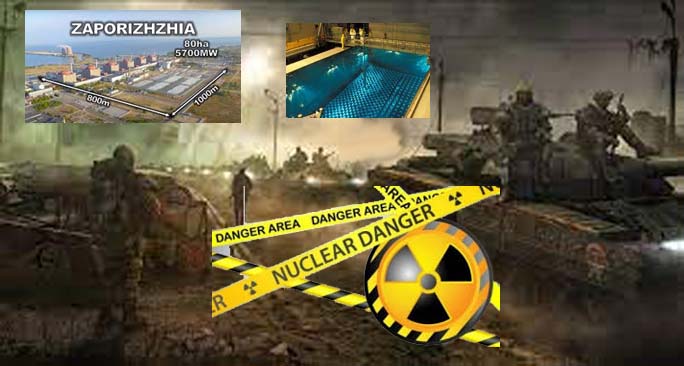
Some interests aligned with commercial reactors may wish to downplay the dangers to avoid tarnishing the industry’s image.
But the apocalyptic scope of a potential catastrophe at Zaporizhzhia is simply too great to let humankind tolerate inaction. There is no biological margin for later regrets.
BY HARVEY WASSERMAN – ET AL. 28 July 23 https://www.counterpunch.org/2023/07/28/the-global-crisis-at-the-zaporizhzhia-nuclear-site-demands-immediate-united-nations-intervention/
The global crisis at six Ukrainian atomic reactors and fuel pools has escalated to an apocalyptic threat that demands immediate action.
Protecting our lives on this planet now demands immediate deployment of a United Nations peacekeeping force to operate and protect this plant.
A petition is now circulating to help make that happen.
This week Russian occupiers threw the Zaporizhzhia site into deepening chaos by firing Unit 4 up to “hot shutdown.” Until July 25, Unit 4 had been in cold shutdown, along with Units 1,2,3 and 6. Unit 5 had been on hot shutdown to help power the plant.
But the Ukrainian nuclear agency Energoatom warns that putting Unit 4 up to hot shutdown is “a gross violation of the requirements of the license to operate this nuclear facility.”
The Russian military has occupied Zaporizhzhia since March, 2022.
It previously assaulted Chernobyl, whose melted Unit 4 core—-which exploded in 1986—-still poses grave dangers. Russian troops terrorized site workers and jeopardized operations that safeguard massive quantities of radiation still on site.
The six reactors and six fuel pools at Zaporizhzhia are burdened with far more potentially apocalyptic radiation than was released at Hiroshima, Nagasaki, Chernobyl or Fukushima. Without sufficient power and a constant supply of cooling water, the site could turn into a radioactive fireball powerful enough to send lethal radiation throughout the Earth’s eco-sphere, threatening all human life.
The Russians and Ukrainians have accused each other of acts that threaten such a catastrophe. Each has blamed the other for apparently random mining and shelling on and around the site. Just one such hit could lead to a meltdown and a series of catastrophic explosions from which our species might never recover.
On June 6, an attack widely attributed to Russia destroyed the Kakhovka hyroelectric dam, threatening vital power and cooling water supplies for Zaporizhzhia. Later that month, Ukrainian President Volodymyr Zelensky charged that the Russians had planted explosives at the site to precede a possible attack.
In 2001, 9/11 terrorists who took down the World Trade Center apparently contemplated attacking the Indian Point Nuclear Plant, 35 miles north of New York City. Such an assault could have blanketed much of New York, New England and the Atlantic Ocean in deadly radiation.
There have been other terrorist threats to atomic reactors and fuel pools. But the six at Zaporizhzhia are the first in history to endure the hostile instability of a hot war zone. on Monday IAEA inspectors spotted anti-personnel mines at the plant’s perimeter and still have not had access to reactor turbine halls or the roofs of reactors 3 and 4 to see what those new objects placed up there are.
The complex also recently lost access to its main power backup line.
With an under-skilled labor force attempting to work in an unpredictable state of terror, with at least two reactors now teetering on hot shutdown, and with six fuel pools vulnerable to loss of power and coolant, the dangers at Zaporizhzhia are on a scale never before experienced by the human race. Though all-out nuclear war might well release more radiation, the instability at these reactors and fuel pools poses as profound a threat to human survival as our species has ever experienced, at least since the Cuban Missile Crisis of 1962.
Such realities cry out for an armed, skilled, stabilizing global force.
The International Atomic Energy Agency, based in Geneva, has been providing vital expertise at the site, and does have the technical and human resources to take operational control. A peacekeeping force, such as the one deployed at Suez in 1956, must create a demilitarized zone capable of protecting the site from shelling and armed attack.
Some interests aligned with commercial reactors may wish to downplay the dangers to avoid tarnishing the industry’s image.
But the apocalyptic scope of a potential catastrophe at Zaporizhzhia is simply too great to let humankind tolerate inaction. There is no biological margin for later regrets.
The General Assembly of the United Nations must send an operational and peacekeeping force to manage and protect the Zaporizhzhia nuclear complex.
IMMEDIATELY!!!
Denys Bondar, Scott Denman, Karl Grossman, Howie Hawkins, Joshua Frank, Myla Reson, Harvey Wasserman and others are among the signees of this article, and of the petition asking the UN to send Peacekeepers to Zaophrizhzhia at https://www.change.org/p/stop-ukrainian-nuclear-disaster-unga-must-establish-dmz-at-zaporizhzhia-plant-now
Kiev strikes ammunition depot in Crimea – official
https://www.rt.com/russia/580106-kiev-strikes-ammunition-depot-crimea/ 23 July 23
Governor Sergey Aksyonov has ordered a mass evacuation from the danger zone
A Ukrainian drone strike has resulted in an explosion at an ammunition depot in the central part of the Crimean peninsula, local Governor Sergey Aksyonov said on Saturday. According to preliminary information, the incident has not resulted in any casualties, he added.
Writing on Telegram, Aksyonov said the detonation had taken place in the Krasnogvardeysky district. “A decision has been made to evacuate the population within a 5km radius from the site of the emergency and place them in temporary accommodation facilities,” he added.
The governor stated that the authorities had also suspended rail traffic in the area in order to “minimize risks,” while expressing hope that the emergency would be dealt with quickly.
The Ukrainian Armed Forces have confirmed the strikes, claiming that they “had destroyed an oil depot and Russian military warehouses” in the area.
Crimea has repeatedly been targeted by Ukrainian drone and missile attacks since Moscow launched its military operation against Kiev over a year ago. On Thursday, Aksyonov said a Ukrainian UAV raid on the peninsula had killed a teenage girl and damaged several administrative buildings.
Earlier this week, a sea drone strike on the Crimean Bridge – which Russia called a Ukrainian terrorist attack – damaged one section of the roadway and claimed the lives of a married couple from Belgorod Region, as well as injuring their 14-year-old daughter.
Kiev stopped short of claiming responsibility, but celebrated the incident, while Ukrainian President Vladimir Zelensky later called the bridge a legitimate military target.
Meanwhile, Russian President Vladimir Putin has condemned the raid as a “terrorist attack” that was pointless from a military standpoint, adding that the bridge has not been used for transporting military materials for a long time. In the aftermath of the incident, Moscow launched several “retaliatory strikes” on targets in Ukrainian port cities.
The Empire Knows It’s Pouring Ukrainian Blood Into An Unwinnable Proxy War

That’s right kids! We’re turning Ukraine into an uninhabitable wasteland of death and dismemberment to save the Ukrainians
Caitlin’s Newsletter CAITLIN JOHNSTONE, JUL 24, 2023
In a new article titled “Ukraine’s Lack of Weaponry and Training Risks Stalemate in Fight With Russia,” The Wall Street Journal’s Daniel Michaels reports that western officials knew Ukrainian forces didn’t have the weapons and training necessary to succeed in their highly touted counteroffensive which was launched last month.
Michaels writes:…………………………………………………
The claim that western officials had sincerely believed Ukrainian forces might be able to overcome their glaring deficits through sheer pluck and ticker is undermined later in the same article by a war pundit who says the US would never attempt such a counteroffensive without first controlling the skies, which Ukraine doesn’t have the ability to do:
“America would never attempt to defeat a prepared defense without air superiority, but they [Ukrainians] don’t have air superiority,” the U.S. Army War College’s John Nagl told WSJ. “It’s impossible to overstate how important air superiority is for fighting a ground fight at a reasonable cost in casualties.”
Antiwar’s Dave DeCamp writes the following on the latest WSJ revelation:
“Leading up to the Ukrainian counteroffensive, which was launched in June, the Discord leaks and media reports revealed that the US did not believe Ukraine could regain much territory from Russia. But the Biden administration pushed for the assault anyway, as it rejected the idea of a pause in fighting.”
So the empire is still knowingly throwing Ukrainian lives into the meat grinder of an unwinnable proxy war, even as western officials tell the public that this war is about saving Ukrainian lives and handing Putin a crushing defeat whenever they’re on camera.
This attitude from the empire is not a new development. Last October The Washington Post reported that “Privately, U.S. officials say neither Russia nor Ukraine is capable of winning the war outright, but they have ruled out the idea of pushing or even nudging Ukraine to the negotiating table.”
Now why might that be? Why would the western empire be so comfortable encouraging Ukrainians to keep fighting when it knows they can’t win?
We find our answer in another Washington Post article titled “The West feels gloomy about Ukraine. Here’s why it shouldn’t.”, authored last week by virulent empire propagandist David Ignatius. In his eagerness to frame the floundering counteroffensive in a positive light for his American audience, Ignatius let slip an inconvenient truth:
“Meanwhile, for the United States and its NATO allies, these 18 months of war have been a strategic windfall, at relatively low cost (other than for the Ukrainians). The West’s most reckless antagonist has been rocked. NATO has grown much stronger with the additions of Sweden and Finland. Germany has weaned itself from dependence on Russian energy and, in many ways, rediscovered its sense of values. NATO squabbles make headlines, but overall, this has been a triumphal summer for the alliance.”
Anyone who believes this proxy war is about helping Ukrainians should be made to read that paragraph over and over again until it sinks in. The admission that the US-centralized power structure benefits immensely from this proxy conflict is revealing enough, but that parenthetical “other than for the Ukrainians” aside really drives it home. It reads as though it was added as an afterthought, like “Oh yeah it’s actually kind of rough on the Ukrainians though — if you consider them to be people.”
The claim that this war is about helping Ukrainians has been further undermined by another new Washington Post report that Ukraine is now more riddled with land mines than any other nation on earth, and that US-supplied cluster munitions are only making the land more deadly.
That’s right kids! We’re turning Ukraine into an uninhabitable wasteland of death and dismemberment to save the Ukrainians.
We should probably talk more about the fact that the US empire is loudly promoting the goal of achieving peace in Ukraine by defeating Russia while quietly acknowledging that this goal is impossible. This is like accelerating toward a brick wall and pretending it’s an open road.
The narrative that Russia can be beaten by ramping up proxy warfare against it makes sense if you believe Russia can be militarily defeated in Ukraine, but the US empire does not believe that Russia can be militarily defeated in Ukraine. It knows that continuing this war is only going to perpetuate the death and devastation.
“Beat Putin’s ass and make him withdraw” sounds cool and is egoically gratifying, and it’s become the mainstream answer to the problem of the war in Ukraine, but nobody promoting that answer can address the fact that the ones driving this proxy war believe it’s impossible. In fact, all evidence we’re seeing suggests that the US is not trying to deliver Putin a crushing defeat in Ukraine and force him to withdraw, but is rather trying to create another long and costly military quagmire for Moscow, as western cold warriors have done repeatedly in instances like Afghanistan and Syria.
Wanting to weaken Russia and wanting to save lives and establish peace in Ukraine are two completely different goals, so different that in practice they wind up being largely contradictory. Drawing Moscow into a bloody quagmire means many more people dying in a war that drags on for years, with all the immense human suffering that that entails.
The US does not want peace in Ukraine, it wants to overextend Russia, shore up military and energy dominance over Europe, expand its war machine and enrich the military-industrial complex. That’s why it knowingly provoked this war. It’s posing as Ukraine’s savior while being clearly invested in Ukraine’s destruction.
It is not legitimate to support this proxy war without squarely addressing this massive contradiction using hard facts and robust argumentation. Nobody ever has. https://www.caitlinjohnst.one/p/the-empire-knows-its-pouring-ukrainian?utm_source=post-email-title&publication_id=82124&post_id=135389526&isFreemail=true&utm_medium=email
Ukraine’s Lack of Weaponry and Training Risks Stalemate in Fight With Russia
U.S. and Kyiv knew of shortfalls but Kyiv still launched offensive
WSJ, By Daniel Michaels, July 22, 2023
BRUSSELS—When Ukraine launched its big counteroffensive this spring, Western military officials knew Kyiv didn’t have all the training or weapons—from shells to warplanes—that it needed to dislodge Russian forces. But they hoped Ukrainian courage and resourcefulness would carry the day.
They haven’t. Deep and deadly minefields, extensive fortifications and Russian air power have combined to largely block significant advances by Ukrainian troops. Instead, the campaign risks descending into a stalemate with the potential to burn through lives and equipment without a major shift in momentum.
As the likelihood of any large-scale breakthrough by the Ukrainians this year dims, it raises the unsettling prospect for Washington and its allies of a longer war—one that would require a huge new infusion of sophisticated armaments and more training to give Kyiv a chance at victory.
The political calculus for the Biden administration is complicated. President Biden is up for re-election in the fall of 2024 and many in Washington believe concerns in the White House about the war’s impact on the campaign are prompting growing caution on the amount of support to offer Kyiv.
The American hesitation contrasts with shifting views in Europe, where more leaders over recent months have come to believe that Ukraine must prevail in the conflict—and Russia must lose—to ensure the continent’s security.
But European militaries lack sufficient resources to supply Ukraine with all it needs to eject Moscow’s armies from the roughly 20% of the country that they control. European leaders are also unlikely to significantly increase support to Kyiv if they sense U.S. reluctance, Western diplomats say.
The shift in trans-Atlantic political winds, evident in tensions between Ukrainian President Volodymyr Zelensky and U.S. officials at the recent North Atlantic Treaty Organization summit in Lithuania, has come as Ukraine’s long-expected offensive appears stalled. Kyiv’s inability to make headway against Russian defenses has persuaded many Western military observers that Ukrainian forces need more training in complex military maneuvers, more-potent air defenses and much more armor.
Moscow’s military, meanwhile, is grappling with low morale because of exhaustion, poor supplies and infighting among Russian leaders, Ukrainian and Western intelligence indicates. Russia appears unable to seize the initiative and attack Ukrainian positions, but its forces remain robust enough to man hundreds of miles of fortifications and large numbers of aircraft, which are keeping Kyiv’s troops at bay……………………………………………………………………………… more https://archive.is/D6CQZ#selection-625.0-634.1
Europe’s black hole: How much of the more than $185 billion given by the West to Ukraine has been stolen?

Rt.com By George Trenin, 20 Jul 23
The fate of huge amounts of aid sent to the country is uncertain amid endemic corruption and a lack of accountability.
As a result of last week’s NATO summit in Vilnius, the US-led military bloc promised Ukraine fresh tranches of financial and military aid. This was despite the fact that by the beginning of the summer, Kiev had already received a total of €165 billion ($185.6 billion) from Western countries. Meanwhile, as the spending increases, the number of US and EU citizens who are willing to sacrifice their own comfort for the sake of Kiev appears to be steadily decreasing.
One of the reasons for this is corruption in Ukraine, which – despite some lofty promises – seems to be as bad now as it was before the Western-backed 2014 ‘Maidan’ coup. If not worse.
Moral compensation
The NATO summit, despite Ukraine’s hopes, did not bring it a long-awaited timeframe for membership. Instead, Western leaders announced new military aid packages for Kiev.
According to the French newspaper Le Monde, French President Emmanuel Macron promised to give Ukraine a “substantial number” of SCALP missiles that can hit targets at a distance of 250 kilometers. According to France24, each costs €850,000.
Berlin announced a package amounting to €700 million. Germany plans to supply Ukraine with launchers for the Patriot missile defense system, Marder-type infantry fighting vehicles, UAVs, Leopard 1 A5 tanks, and artillery shells. However, for Berlin, this is not even close to a record gift value. On May 21, the German Foreign Ministry announced the transfer of military aid to Ukraine worth €2.7 billion.
On July 7, US Under Secretary of Defense for Policy Colin Kahl spoke about a new package of aid from the US which includes cluster munitions – which are banned in 120 countries. The cost was $800 million.
This is the 42nd delivery of aid that Ukraine has received from the US in the past year and a half. Since the beginning of Russia’s offensive, the US Congress has approved military and economic assistance to Ukraine amounting to over $70 billion – and that’s only counting direct expenses.
According to July data from the Kiel Institute (which tracks the volume of aid allocated to Ukraine), total direct subvention provided by the US and its allies in the period from February 24, 2022 to May 31, 2023 topped €165 billion.
The rate at which new tranches are allocated increases every month. For example, at the end of April, the total amount of aid was €15 billion less than it is now – according to NATO Secretary General Jens Stoltenberg, it was then €150 billion. ……………………………………………………………………………..
the risk of corruption exists not only within state borders but that fraud can also occur when concluding contracts in the US. Furthermore, the theft of weapons or other aid may happen as it travels to the war zone through Europe.
Another official involved in criminal investigations at the Pentagon also told Defense One that his department is “concerned about the potential diversion or legal export, or theft for that matter, of the goods.”
Many American businesses do not trust the Ukrainian authorities either and believe that aid is being stolen. According to US Secretary of Commerce Gina Raimondo, private businesses doubt that the funds allocated to Ukraine for reconstruction will be safe from corruption.
nternal games
The corruption issue is acknowledged in Ukraine as well. This spring, the ex-adviser of the office of the president of Ukraine, Aleksey Arestovich, said on his YouTube channel that his old boss, Vladimir Zelensky, has not been able to deal with corruption in Ukraine.
“Ukraine needs only one thing… To have someone come to power who won’t steal. Someone who won’t do it himself and won’t allow others to do so. Unfortunately, so far we haven’t been lucky,” he said.
…………………………………………….. “The Ukrainian president and many in his entourage have been skimming untold millions from the American dollars earmarked for diesel fuel payments. One estimate by analysts from the Central Intelligence Agency put the embezzled funds at $400 million last year, at least,” – American investigative journalist Seymour Hersh stated that Ukrainian President Vladimir Zelensky and his entourage illegally appropriated at least $400 million from funds that were allocated to Kiev for the purchase of diesel fuel.
…………….. Moreover, Hersh says that CIA Director William Burns was displeased with Zelensky because of the possible theft of Western aid, since “he was taking a larger share of the skim money than was going to the generals.” ……………… more https://www.rt.com/russia/579897-europes-black-hole-ukraine/
1 This Month

22 June – Virtual Event –Climate Change: New Data, New Debate

Monday, June 22, 2026 2:30 p.m. – 3:15 p.m. CT
YouTube. Register here

Protect Sazan Island from the Trump family! https://secure.avaaz.org/campaign/en/protect_sazan_island_from_the_trump_family_loc/?bqFCVab&v=174511&cl=22707147157&_checksum=5e9dde668860e8231c33699735e16a1fbf22ab2cb01da50c999fe8732b9775ef&utm_source=email&utm_medium=blast_email&utm_campaign=174511
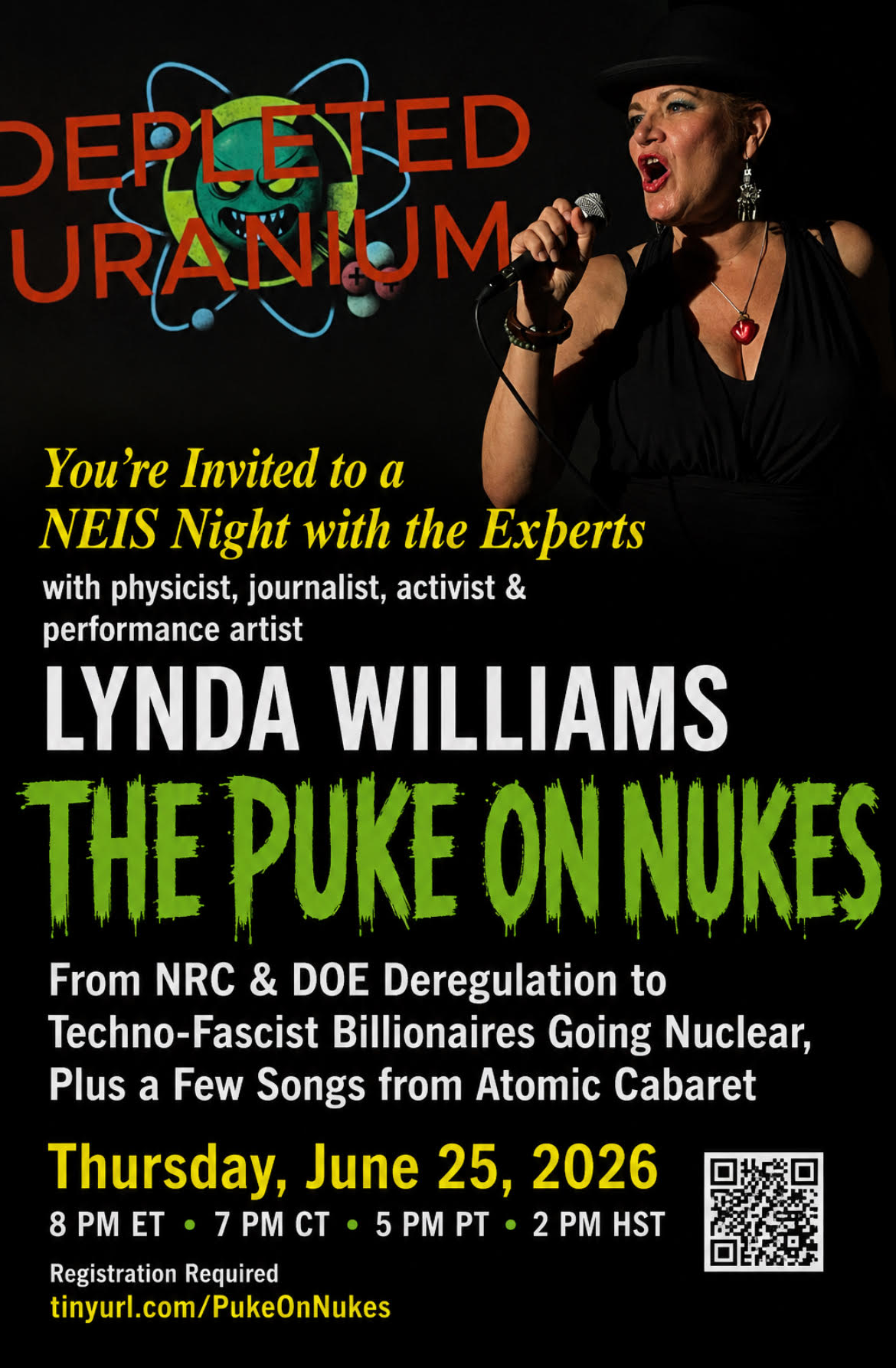
25 June- THE PUKE ON NUKES
Thursday, June 25, 2026
7pm Central Time (8pm ET, 6pm MT, 5pm PT) UTC – 5
From NRC & DOE Deregulation to Techno-Fascist Billionaires Going Nuclear, Plus a Few Songs from Atomic Cabaret REGISTER
26 June – Radiation Trainwreck at the NRC / Join the Protect Better Campaign – https://us02web.zoom.us/meeting/register/4ZlZ5_qLSHGiLSCg8FF6Bg#/registration


Cuba Is Not a Failed State – It Is a Besieged State
PETITION: “Global Appeal to Endorse Palestinian Right of Return of Refugees”
To see nuclear-related stories in greater depth and intensity – go to https://nuclearinformation.wordpress.com
-
Archives
- June 2026 (193)
- May 2026 (306)
- April 2026 (356)
- March 2026 (251)
- February 2026 (268)
- January 2026 (308)
- December 2025 (358)
- November 2025 (359)
- October 2025 (376)
- September 2025 (257)
- August 2025 (319)
- July 2025 (230)
-
Categories
- 1
- 1 NUCLEAR ISSUES
- business and costs
- climate change
- culture and arts
- ENERGY
- environment
- health
- history
- indigenous issues
- Legal
- marketing of nuclear
- media
- opposition to nuclear
- PERSONAL STORIES
- politics
- politics international
- Religion and ethics
- safety
- secrets,lies and civil liberties
- spinbuster
- technology
- Uranium
- wastes
- weapons and war
- Women
- 2 WORLD
- ACTION
- AFRICA
- Atrocities
- AUSTRALIA
- Christina's notes
- Christina's themes
- culture and arts
- Events
- Fuk 2022
- Fuk 2023
- Fukushima 2017
- Fukushima 2018
- fukushima 2019
- Fukushima 2020
- Fukushima 2021
- general
- global warming
- Humour (God we need it)
- Nuclear
- RARE EARTHS
- Reference
- resources – print
- Resources -audiovicual
- Weekly Newsletter
- World
- World Nuclear
- YouTube
-
RSS
Entries RSS
Comments RSS
 nuclear-news