Is Ukraine’s new long-range missile technology bringing us closer to WW3? Experts say Putin ‘might try something desperate’ amid US fears it will convince Vladimir to use nuclear weapons
- Kyiv last month blew up Russian air defence system with modified cruise missile
- The new missile gives Ukraine the capacity to strike deep into Russian territory
- Experts told MailOnline what the missiles mean for war and potential retaliation
Daily Mail By DAVID AVERRE and RACHAEL BUNYAN 10 September 2023
Ukraine’s development of a newly modified cruise missile that could strike targets hundreds of miles across the Russian border has sparked fears that Vladimir Putin could resort to the nuclear option if he becomes ‘desperate’.
Dr. Alan Mendoza, executive director at the Henry Jackson Society think tank, said that although the nuclear threat is unlikely, it remains on the table should the Kremlin chief feel backed into a corner amid attacks on Russian cities.
‘It is not likely Russia would strike Ukraine or NATO allies with nuclear weapons simply in response to Neptune missiles being used – to do so would mean a response from the West that would surely hasten the demise of the Putin regime.
‘That said, if Putin felt that his grip on power was loosening beyond his control he might try something desperate. At that point, it would be hoped that saner forces within the Russian hierarchy would step in to relieve him of command,’ he said.
Meanwhile, former US Defense Attaché to Moscow and retired US Army Brigadier General Kevin Ryan said Washington was alarmed by Ukraine’s new strike capability.
‘The US administration is concerned that successful attacks by Ukraine into Russia could give Putin justification to expand his war to the West or even use nuclear weapons.
‘Deploying the Neptune in attacks against Russian infrastructure will escalate the war and force Putin and his military leadership to also escalate their attacks against Ukrainian cities.’
t comes after Ukraine last month destroyed a state-of-the-art Russian air defence system nestled in the occupied Crimean peninsula, scoring a direct hit on the S-400 ‘Triumf’ and blasting it sky-high in an impressive strike.
Putin‘s state-media mouthpieces and war-bloggers railed against the attack, labelling it the result of a British-supplied Storm Shadow missile and threatening retaliation against the West for its support of Kyiv.
But it was later revealed that the weapon behind the destruction of the S-400 was not a British projectile, but instead a modified version of a Neptune cruise missile – the kind that sunk the Moskva, pride of Russia‘s Black Sea Fleet last year.
By converting the Neptune anti-ship missile to be fired from land positions on land targets, Ukraine’s engineers have provided Zelensky‘s army with the capability to strike deep within Russian territory – something they’ve shown they can do already with drones – with devastating effect.
Senior Research Leader in Defence and Security at RAND Europe Bryden Spurling told MailOnline that the newly modified missile could enable Ukraine to destroy targets more than 200 miles inside Russian territory with near pin-point accuracy.
‘The earlier anti-ship version sank the Russian cruiser Moskva, so it is a precision weapon with a large warhead. The suggested range for this new land attack version seems to be somewhere between 170 and 190 miles – and could possibly grow to be as much as 225 miles according to some sources,’ Spurling said.
He added that the modified Neptune missiles unlock a new capability for Ukraine’s armed forces, whose access to Western weapon systems like Storm Shadow missiles is contingent on them being used exclusively to defend Ukrainian territory – not to strike across the border………………………………………………………………………………….. https://www.dailymail.co.uk/news/article-12479123/Is-Ukraines-new-long-range-missile-technology-bringing-closer-WW3-Experts-say-Putin-try-desperate-amid-fears-convince-Vladimir-use-nuclear-weapons.html
NATO isn’t able to help Ukraine win
Russia has the upper hand on the front lines as the bloc is no longer able to meet Kiev’s needs
Rt.com By Ilya Kramnik, military analyst, expert at the Russian International Affairs Council and researcher at the Russian Academy of Sciences 10 Sept 23
More than 18 months into the conflict between Russia and Ukraine, NATO military aid to Kiev remains a constituent part of the war. This factor seeps into public consciousness, influences the political perception of the conflict, and affects the situation on the battlefield, whichever side of the hostilities people find themselves on. All these aspects are important in their own right, and each will influence the course of the conflict and its eventual outcome. But how long will NATO be able to provide military assistance to Ukraine?
Gloomy prospects for Ukraine
NATO began providing assistance to Kiev as soon as the conflict started in 2022, and the volume of aid increased throughout the course of last year. This assistance largely influenced the attitude of ordinary Ukrainians toward the hostilities and reinforced the myth of a speedy and inevitable “victory” for Kiev, certain to happen because “the whole world supports us.”
The same attitude prevailed in the area of public policy – the aid provided by a particular country indicated whose side it was on: Ukraine’s “allies” in NATO (primarily the US) provided direct military assistance, while “neutral” countries offered only financial and organizational assistance, or no help at all.
On the battlefield, NATO aid is fully responsible for the combat capabilities of the Armed Forces of Ukraine (UAF). If this aid is discontinued, the Ukrainian army will lose its combat capability within a few weeks, or as soon as the current ammunition stocks run out.
How likely is it that NATO assistance will continue? To answer this question, we need to understand the stocks of weapons and military equipment among members of the bloc – and it is important to note that many are lacking in this regard.
The US stands out for its available resources, and its weapons arsenal is larger than that of all other NATO countries. However, even though Washington has provided Kiev with large quantities of weapons and ammunition, it is still only supplying a relatively small share of what it has. Other countries with large weapons arsenals are Greece and Turkey. However, these stocks exist because of age-old tensions between the two countries, which limits their possible transfer to Ukraine.
In most other NATO countries, military stocks are relatively small and are intended mainly for export, particularly when the buyer is interested in used equipment which can be put to use in its existing condition or modernized.
These factors impose a limit on the volume of aid allocated to Ukraine, and are why military assistance to Kiev, which started in 2022 and peaked in early 2023, has begun to decline. It also means that unless the US starts handing over reserve military equipment, or, together with other allies, finds alternative suppliers, assistance will be cut further.
…………………………………………………………………………………… the Ukrainian counteroffensive was launched with a clear lack of artillery, tanks, and particularly engineering equipment, despite the fact that NATO Supreme Allied Commander General Christopher Cavoli declared that Ukrainian troops were fully equipped.
On the other hand, NATO made a number of decisions and signed contracts to equip Ukrainian troops on a long-term basis. This included the transfer of missile defense systems and other weapons which, due to insufficient production capacities, will not be available for several years. Like the decision to transfer fighter jets – which hasn’t yet been publicly finalized in terms of volume and timing – these contracts were assessed by numerous experts as “post-war,” i.e. intended to compensate after the conflict for the losses sustained.
However, the unsuccessful course of the Ukrainian counteroffensive launched in July makes the full-scale implementation of these contracts and intentions uncertain. Their prospects will be even more doubtful in the event of a successful Russian offensive in the coming fall or winter……………………………………
Will NATO be able to significantly increase aid to Ukraine in the near future? No. Military production is an inertial industry, and even if the decision to considerably increase the production of weapons were made tomorrow, it would take up to two years to yield any results. Considering the unfavorable public image of Ukraine’s unsuccessful counteroffensive, it may take even longer.
……….. It is quite likely that the initiative to transfer Western fighter jets to Ukraine will be quietly abandoned, since the AFU will no longer be able to use them. Russia knows full well that this is the case. In theory, this state of affairs should increase the willingness of the US to negotiate, although the upcoming election season will greatly complicate any potential talks.
So, unless something extraordinary happens, the West will most likely continue to support the Ukrainian armed forces to the extent necessary to continue resistance. This means Ukraine will not have enough equipment and weapons to launch a large-scale new counteroffensive unless the US decides to share its weapons arsenals.
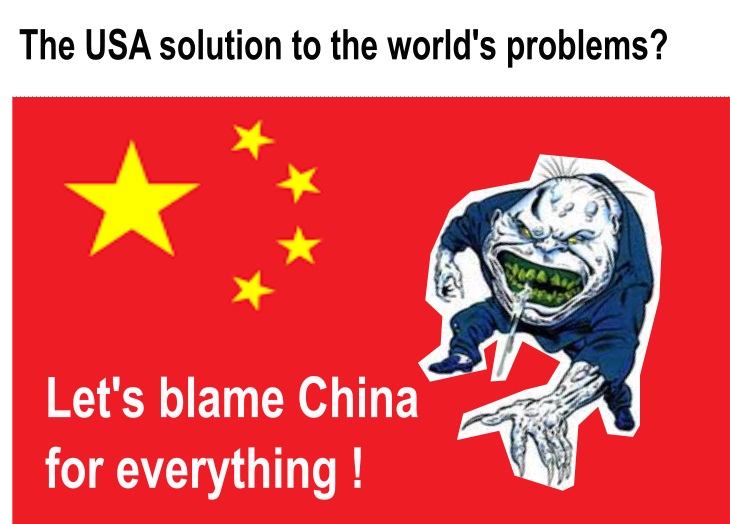
Such a decision, however, would go against US practice in recent years as well as its strategic planning, which sees China as the main rival on which to focus its financial, military, and technological resources. https://www.rt.com/russia/582368-nato-ukraine-russia-front-lines/
Counter-offensive threatened by slow Western aid – Zelensky
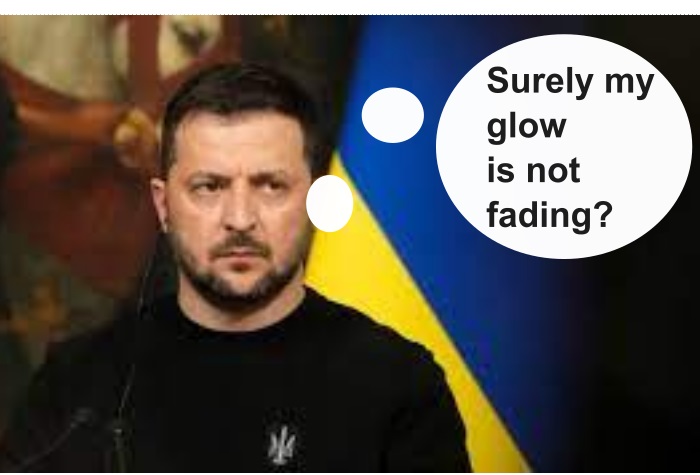
Ukrainian president Volodymyr Zelenskyy has said that Russia was slowing down the Ukrainian counter-offensive, blaming the “slowness” of Western arms deliveries. The leader also renewed calls for long-range weapons as well as new sanctions against Moscow.
Speaking on Friday, Zelenskyy also stressed that time was against Ukraine, with Russia banking on a Republican victory in the 2024 presidential election to weaken American support for Kyiv.
According to him, “the processes are becoming more complicated and slower when it comes to economic sanctions against Moscow or the supply of weapons” from the West.
Ukraine has complained in particular for months about the slowness of negotiations on the delivery of F-16 fighters. Several dozen of these American aircraft will ultimately be delivered by European countries, but the crews must now be trained for months in order to use them effectively.
The Ukrainian counter-offensive, launched in June, came up against powerful defence lines built by the Russians, including minefields and anti-tank traps…………………

American Secretary of State Antony Blinken, who was in Kyiv on Wednesday and Thursday, judged the “significant progress” of the offensive “very, very encouraging”.
He promised $1 billion (approximately €933m) in new aid. Washington also confirmed the supply of depleted uranium shells to give “momentum” to the offensive……………………….. more https://www.euronews.com/2023/09/09/ukraine-war-ukrainian-armed-forces-advance-as-zelenskyy-renews-calls-for-foreign-aid
Ukraine – health care women compulsory military service.
This article was originally in German
link in German: https://exxpress.at/neue-fluchtwelle-droht-selenskyj-befiehlt-wehrpflicht-fuer-pflegerinnen-aerztinnen/
Hundreds of thousands of women will no longer be allowed to leave Ukraine from October 1st, thus Austria is also threatened by a new wave of refugees in the next 22 days: The government in Kiev is by law ordering all women with medical training to be conscripted.
According to the Interior Ministry, 67,370 women from Ukraine are already registered as displaced persons in Austria, and now there could be another massive wave of entry: The Ukrainian media is already reporting that from October 1st compulsory military service is introduced for all Ukrainian women with medical training – i.e. for all nurses , pharmacists and doctors.
The Podrobnosti news portal writes: “Women with medical or pharmaceutical training must register for military service from October 1, 2023. They get the status of conscripts for whom travelling abroad is restricted.” This was stated by Fedir Venislavskyi, member of the Verkhovna Rada’s Committee (Supreme Council of Ukraine) for National Security, Defense and Intelligence, and also the president’s representative in parliament.
Female deserters face up to 12 years in prison
Ukrainian women with medical training can then only leave the country in 22 days with a special permit. Since this Kiev order most likely affects hundreds of thousands of women throughout the country, which still has around 32 million non-refugee residents, another large wave of refugees is now likely to hit Western nations: Many, also young women, should now be aware of the fact that they as conscripts are no longer allowed to leave Ukraine before the end of the war – and of how deserters are treated if they are caught trying to escape.
Desertion in Ukraine can result in a prison sentence of up to 12 years. Since February, the courts can no longer impose a suspended sentence or a lower sentence than that provided for in the new law, as was previously the case.
The new order to force hundreds of thousands of women in nursing professions to do military service allows us to draw conclusions about the actual military situation in Ukraine. As also the current recruitment measure that tuberculosis sufferers and AIDS patients can also be called up to serve in the army.
A Slow mindless grind towards nuclear Armageddon?
Strategic Culture, Fri, 01 Sep 2023
This week saw widespread air strikes on the Russian Federation involving mass aerial drone attacks. Six regions were attacked including the capital, Moscow. Among the targets was the Kursk region where a nuclear plant is located. Several international airports across Russia were temporarily shut down. This is an incredible situation in which Russian territory is being targeted by a military assault not seen since the Great Patriotic War against Nazi Germany.
The U.S. media could barely contain its glee at the surge in air strikes on Russia. The New York Times hailed them as a “morale booster” for Ukraine, while CNN noted cryptically that the Kiev regime was “emboldened” to hit strategic targets inside Russia. The telling question of course not asked by CNN is: emboldened by whom?
Most of the incoming drones were shot down or disabled by Russian air defenses. But that is beside the point that Russian territory is now being targeted by mass attacks. And there can be no doubt that this “emboldened” military campaign is being enabled and directed by the United States and its NATO allies who are arming the Nazi regime in Kiev to the teeth.
The air strike, this week at Pskov airport is particularly revealing. Several Russian military cargo planes were reportedly destroyed. The location is only some 30 kilometers from Russia’s northwestern border with Estonia and over 600 km from Ukraine. It is almost certain that NATO members Estonia and possibly Latvia enabled that attack on Pskov. Russian foreign ministry spokeswoman Maria Zakharova has openly accused NATO of participating in the air assaults on Russian territory. The British publication, The Economist, also reported that NATO hardware, satellite and navigational logistics were vital for the drone campaign.
Dmitry Medvedev, the Deputy Chairman of Russia’s National Security Council, this week stated that Russia now has legal justification for going to war with NATO members directly. He warned that the world is on the brink of a nuclear conflagration.
We need to step back here and see the process of the proverbial boiling-frog scenario.

[CORRECTION: It’s a myth that frogs will stay in water that slowly heats, until they die. In reality, they will try to get out, as soon as the temperature becomes uncomfortable.]
This describes an insidious creeping situation which would otherwise not be tolerated. A frog apparently will jump back from a pot of boiling water but if the frog is placed in the pot of water which is then slowly brought to the boil it will succumb passively to its ill fate.
The process seems apt as a metaphor for the conflict in Ukraine between the U.S.-led NATO bloc and Russia. The Kiev regime was installed in 2014 through a CIA-backed coup against a democratically elected president; it was armed and trained by NATO, despite its vile Nazi battalions, to attack ethnic Russians in Ukraine; when Russia intervened militarily in February 2022 after diplomatic offers were rejected by the U.S. and NATO, the conflict has steadily escalated over the past 18 months to the point where pre-war Russian territory is now coming under mass air strikes.
This mass assault on Russian territory by NATO forces would have been unthinkable only a few months ago. And yet here we are at that astounding point.
There seems little doubt that the air strikes on Russia are a sort of Plan B to compensate for the abject failure of the NATO-backed regime on the battlefields in Ukraine. The much-vaunted “counteroffensive” that started in June has become a debacle for the NATO sponsors. The turn towards drone strikes on Russia appears to be a change in tactic as a way of terrorizing the Russian population and destabilizing the authority of Russian President Vladimir Putin, as well as distracting from NATO’s military incompetence.
Russia’s defense doctrine mandates the use of nuclear weapons if the state’s existential security is threatened. So far, the NATO-backed drone attacks on Russia have not reached that threshold. But the incremental process is dangerously heading in that dreadful direction.
If we were to turn the tables on the situation, the audacity would become even more apparent. Can anyone imagine for a second how the United States would react if a foreign adversary was enabling the launch of air strikes on Washington DC and other strategic centers, whereby airports were shut down and military infrastructure was being destroyed?………………………………………………………………. more https://strategic-culture.su/news/2023/09/01/boiling-frogs-towards-nuclear-armageddon/
Scott Ritter: A comprehensive Ukrainian defeat is the only possible outcome of its conflict with Russia

Rt.com 8 Sept 23
Kiev was offered a peace deal long ago, but chose war instead, egged on by its Western backers. Now its fate is sealed
September 2 marked the 78th anniversary of the World War Two surrender ceremony onboard the USS Missouri in Tokyo Bay. This moment formalized Japan’s unconditional capitulation to the United States, and its allies, and marked the end of the conflict. From the Japanese perspective, it had been ongoing since the Marco Polo bridge incident of July 7, 1937, which started the Sino-Japanese War.
There was no negotiation, only a simple surrender ceremony in which Japanese officials signed documents, without conditions.
Because that is what defeat looks like.
History is meant to be studied in a manner that seeks to draw out lessons from the past that might have relevance in the present. As George Santayana, the American philosopher, noted, “Those who cannot remember the past are condemned to repeat it.” The Ukrainian government in Kiev would do well to reflect on both the historical precedent set by Japan’s unconditional surrender, and Santayana’s advice, when considering its current conflict with Russia
First and foremost, Ukraine must reflect honestly about the causes of this conflict, and which side bears the burden of responsibility for the fighting. ‘Denazification’ is a term that the Russian government has used in describing one of its stated goals and objectives. President Vladimir Putin has made numerous references to the odious legacy of Stepan Bandera, the notorious mass murderer and associate of Nazi Germany who is feted by modern-day Ukrainian nationalists as a hero and all but a founding father of their nation.
That present-day Ukraine would see fit to elevate a man such as Bandera to such a level speaks volumes about the rotten foundation of Kiev’s cause, and the dearth of moral fiber in the nation today. The role played by the modern-day adherents of the Nazi collaborator’s hateful nationalist ideology in promulgating the key events that led to the initiation of the military operation by Russia can neither be ignored nor minimized. It was the Banderists, with their long relationship with the CIA and other foreign intelligence services hostile to Moscow, who used violence to oust the former president of Ukraine, Viktor Yanukovich, from office in February 2014.
From the act of illicit politicized violence came the mainstreaming of the forces of ethnic and cultural genocide, manifested in the form of the present-day Banderists, who initiated acts of violence and oppression in eastern Ukraine. This, in turn, triggered the Russian response in Crimea and the actions of the citizens of Donbass, who organized to resist the rampage of the Bandera-affiliated Ukrainian nationalists. The Minsk Accords, and the subsequent betrayal by Kiev and its Western partners of the potential path for peace that these represented, followed.
Ukraine cannot disassociate itself from the role played by the modern-day Banderists in shaping the present reality. In this, Kiev mirrors the militarists of Imperial Japan, whose blind allegiance to the precepts of Bushido, the traditional ‘way of the warrior’ dating back to the Samurai of 17th century Japan, helped push the country into global conflict. Part of Japan’s obligations upon surrender was to purge its society of the influence of the militarists, and to enact a constitution that deplatformed them by making wars of aggression – and the military forces needed to wage them – unconstitutional.
Banderism, in all its manifestations, must be eradicated from Ukrainian society in the same manner that Bushido-inspired militarism was removed from Japan, to include the creation of a new constitution that enshrines this purge as law. Any failure to do so only allows the cancer of Banderism to survive, festering inside the defeated body of post-conflict Ukraine until some future time when it can metastasize once again to bring harm……………………….
As the Western establishment media begins to come to grips with the scope and scale of Ukraine’s eventual military defeat (and, by extension, the reality of a decisive Russian military victory), their political overseers in the US, NATO, and the European Union struggle to define what the endgame will be. Having articulated the Russian-Ukrainian conflict as an existential struggle where the very survival of NATO is on the line, these Western politicians now have the task of shaping public perception in a manner that mitigates any meaningful, sustained political blowback from constituents who have been deceived into tolerating the transfer of billions of dollars from their respective national treasuries, and billions more dollars’ worth of weapons from their respective arsenals, into a lost and disgraced cause.
………………………………….. Russia has been undertaking the successful demilitarization of Ukraine’s armed forces since the initiation of partial mobilization. The equipment Ukraine is provided by the West is similarly being destroyed by Russia at a rate that makes replacement unsustainable. Meanwhile, Russia’s own defense industry has kicked into full gear, supplying a range of modern weapons and ammunition that is more than sufficient.
The harsh reality is that neither Ukraine nor its Western allies can sustain the operational losses in manpower and equipment that the conflict with Russia is inflicting……….. if Kiev persists in extending this conflict until it is physically unable to defend itself, it runs the risk of losing even more territory, including Odessa and Kharkov.
Russia did not enter the conflict with the intent of seizing Ukrainian territory. But in March 2022, Kiev rejected a draft peace agreement (which it had preliminarily approved at first), and this decision to eschew peace in favor of war led to Russia absorbing Donbass, Zaporozhye, and Kherson.
As one of its conditions to even begin negotiating for peace with Moscow, Kiev demanded the return of all former Ukrainian territories currently under Russian control – including Crimea. To achieve such an outcome, however, Ukraine would have to be able to compel compliance by defeating Russia militarily and/or politically. As things stand, this is an impossibility.
What Ukraine and its Western partners do not yet seem to have come to grips with is the fact that Russia’s leadership is in no mood for negotiations for negotiations’ sake. Putin has listed its goals and objectives when it comes to the conflict – denazification, demilitarization, and no NATO membership for Ukraine.
……….The longer Kiev – and its Western partners – drag out this conflict, the greater the harm that will accrue for Ukraine……….. https://www.rt.com/russia/582259-ukraine-unconditional-surrender-nato/
Russia says US supplying depleted-uranium shells to Ukraine could lead to war between nuclear powers

The US will have to answer for the ‘very sad consequences’ of its decision to provide depleted uranium munitions to Ukraine, the Kremlin said
i news, By Jessie Williams, Foreign news reporter, September 7, 2023
Russia has condemned a US decision to send controversial depleted uranium tank shells to Ukraine as “a criminal act”, that would increase the chance of “direct armed conflict between nuclear powers”.
The Kremlin said on Thursday that the US would have to answer for the “very sad consequences” of its decision to provide depleted uranium munitions to Ukraine.
The controversial weapons – included in a $175m (£140m) package of military equipment for Ukraine announced by the US on Wednesday – have armour-piercing capabilities, which mean they could help to destroy Russian tanks.
The shells are intended for 31 American M1 Abrams tanks due to be delivered to Ukraine later this year.
Sergei Ryabkov, Russia’s deputy foreign minister, accused the US of a “criminal act” beyond reasonable escalation. “Now this pressure is dangerously balancing on the brink of direct armed conflict between nuclear powers,” he said.
“It is a reflection of Washington’s outrageous disregard for the environmental consequences of using this kind of ammunition in a combat zone. This is, in fact, a criminal act, I cannot give any other assessment.”
In March, Putin warned that Moscow would “respond accordingly, given that the collective West is starting to use weapons with a ‘nuclear component.’” Foreign Minister Sergei Lavrov called the move “a step toward accelerating escalation”.
Depleted uranium is a byproduct of the uranium enrichment process needed to create nuclear weapons. The rounds retain some radioactive properties, but they cannot generate a nuclear reaction as a nuclear weapon would, Edward Geist, a nuclear expert and policy researcher at the US-based Rand non-profit research institution, told The Associated Press.
The shells sharpen on impact, which further increases their ability to tear through tank armour. “It’s so dense and it’s got so much momentum that it just keeps going through the armour – and it heats it up so much that it catches fire,” he added.
“The administration’s decision to supply weapons with depleted uranium is an indicator of inhumanity,” Russia’s embassy in Washington said on Telegram. “Clearly, with its idea of inflicting a ‘strategic defeat’, Washington is prepared to fight not only to the last Ukrainian but also to do away with entire generations.”
on Friday the Kremlin spokesman Dmitry Peskov said Nato’s heavy use of such ammunition in the bombing of Yugoslavia in 1999 had caused a jump in cases of cancer and other diseases.
“These consequences are also felt by subsequent generations of those who somehow came into contact or were in areas where these weapons were used,” he told reporters, saying the same would now happen in Ukraine……………………………………….
The International Coalition to Ban Uranium Weapons said there were dangerous health risks from ingesting depleted uranium dust, including cancer.
A Defence Department official told Politico the weapons are considered the most effective way of arming their Abrams tanks. The UK has already sent the same type of ammunition to Ukraine to arm its Challenger 2 tanks, but this is the first time the US is sending the rounds.
Earlier this year the Pentagon said it would not be sending the depleted uranium munitions to Ukraine, but made a U-turn in their announcement on Wednesday during the US Secretary of State Antony Blinken’s visit to Kyiv……………………………..
The decision comes after the White House announced it will be sending another controversial weapon to Ukraine -cluster munitions – which are banned by more than 100 countries. https://inews.co.uk/news/world/russia-us-supplying-depleted-uranium-shells-ukraine-war-2599291
Ukraine used cluster munitions against civilians – Human Rights Watch

https://www.rt.com/russia/582435-hrw-ukraine-cluster-civilians/ 8 Sept 23
Kiev targeted the population of Russian-held Izyum with the controversial projectiles.
The Ukrainian military used cluster munitions to shell the city of Izyum and caused civilian deaths, Human Rights Watch said on Tuesday. The attack happened months before the US provided Kiev with additional cluster shells, overruling the objections of many NATO members.
“We figured this out after the Russians left and our investigators went there to look into the war crimes and atrocities that were committed – and they saw remnants of cluster munitions everywhere,” HRW’s Mary Wareham told RIA Novosti. “After finding out the direction from which the fire came, they established that they had been used by Ukrainian forces.”
The 110-page Cluster Munition Monitor 2022 report, published by HRW this week, lists deployments of such weapons by both sides in the conflict. It notes that the group had first reported on the attack on Izyum in July, but that the Ukrainian Defense Ministry officially denied ever using such munitions in or around the settlement.
Wareham pointed out that HRW had detailed testimonies about civilians who were killed or wounded by cluster bombs.
A HRW report from January also included information about the Ukrainian use of cluster munitions, as well as the targeting of Izyum by ‘Butterfly’anti-personnel mines, which killed 11 civilians and wounded around 50, including five children. HRW said that the Russian military informed the civilians about the danger of the mines, citing testimonials from around 100 local residents.
Wareham pointed out that HRW had detailed testimonies about civilians who were killed or wounded by cluster bombs.
A HRW report from January also included information about the Ukrainian use of cluster munitions, as well as the targeting of Izyum by ‘Butterfly’anti-personnel mines, which killed 11 civilians and wounded around 50, including five children. HRW said that the Russian military informed the civilians about the danger of the mines, citing testimonials from around 100 local residents.
Cluster munitions are abhorrent weapons that are globally banned because they cause both immediate and long-term civilian harm and suffering,” Wareham said while announcing the annual report. “It’s unconscionable that civilians are still dying from cluster munition attacks 15 years after these weapons were outlawed.”
Over the years, the HRW has released a number of reports about the use of cluster munitions in the Ukrainian conflict, stating that both sides were using them. The organization noted, however, that its ability to gather evidence of Ukrainian attacks is hampered because it cannot safely access Russian-controlled territories.
Ukraine, Russia, and the US are not party to the Convention on Cluster Munitions (CCM), which has sought to ban this type of ordnance, citing its toll on civilians. Earlier this year, Washington rejected objections from several NATO allies who are party to the CMM and sent Kiev 155mm artillery shells loaded with dual-purpose improved conventional munitions (DPICM).
Some US outlets have reported that the Pentagon receives detailed reports from Ukraine about when and where its DPICM ordnance is used. Russia has documented multiple instances of their use against civilians in Donetsk.
US Intelligence Official: Media Misleading Americans About Ukraine’s Battlefield Success

The massive push by Ukraine resulted in nearly no territorial gains.
Still, Washington has pushed Kyiv to continue the counteroffensive. The White House acknowledges that for Ukraine to have a possibility of success, Kyiv will have to be willing to sustain high casualties.
By Kyle Anzalone / Antiwar.com 8 Sept 23
In an interview with renowned reporter Seymour Hersh, a US intelligence official scolded the media for misleading the American public about Ukraine’s battlefield failures during the Spring counteroffensive. ………..
Responding to reports in recent weeks that Ukrainian forces were gaining momentum and recapturing territory, the official remarked, “Where are the reporters getting this stuff?” he asked. “There are stories talking about drunk Russian commanders while the Ukrainians are penetrating the three lines of Russian defense and will be able to work back to Mariupol.”
He continued, “The goal of Russia’s first line of defense was not to stop the Ukrainian offense, but to slow it down so if there was a Ukrainian advance, Russian commanders could bring in reserves to fortify the line.” The official added, “There is no evidence that Ukrainian forces have gotten past the first line. The American press is doing anything but honest reporting on the failure thus far of the offense.”
Secretary of State Antony Blinken delivered a similarly optimistic message during his trip to Kyiv on Wednesday. “In the ongoing counteroffensive, progress has accelerated in the past few weeks. This new assistance will help sustain it and build further momentum,” he said at a press conference.
The official says that message is being delivered from military intelligence to the White House, while the CIA has drawn other conclusions. “This kind of reporting from the military intelligence community is going to the White House. There are other views,” he said, referring to the CIA. The official explained those views do not reach President Joe Biden.
For over three months, Kyiv has ordered its forces to advance on entrench Russian defensive lines in southern Ukraine. Russian minefields caused Ukraine to lose a significant portion of its Western-trained soldiers and equipment in the opening weeks of the offensive. The massive push by Ukraine resulted in nearly no territorial gains.
Still, Washington has pushed Kyiv to continue the counteroffensive. The White House acknowledges that for Ukraine to have a possibility of success, Kyiv will have to be willing to sustain high casualties.
The official told Hersh no matter how committed Kyiv is to the war effort, President Zelensky’s goals are unattainable. “Zelensky will never get his land back,” he said……………. https://scheerpost.com/2023/09/08/us-intelligence-official-media-misleading-americans-about-ukraines-battlefield-success/
NATO Chief Openly Admits Russia Invaded Ukraine Because Of NATO Expansion
Stoltenberg’s remarks would probably have been classified as Russian propaganda by plutocrat-funded “disinformation experts” and imperial “fact checkers” if it had been said online by someone like you or me, but because it came from the head of NATO as part of a screed against the Russian president it’s been allowed to pass through without objection.
In reality Stoltenberg is just stating a well-established fact: contrary to the official western narrative, Putin invaded Ukraine not because he is evil and hates freedom but because no great power ever allows foreign military threats to amass on its borders — including the United States.
CAITLIN JOHNSTONE, SEP 9, 2023 https://www.caitlinjohnst.one/p/nato-chief-openly-admits-russia-invaded?utm_source=post-email-title&publication_id=82124&post_id=136866482&utm_campaign=email-post-title&isFreemail=true&r=1ise1&utm_medium=email
During a speech at the EU Parliament’s foreign affairs committee on Thursday, NATO Secretary General Jens Stoltenberg clearly and repeatedly acknowledged that Putin made the decision to invade Ukraine because of fears of NATO expansionism.
His comments, initially flagged by journalist Thomas Frazi, read as follows:
The background was that President Putin declared in the autumn of 2021, and actually sent a draft treaty that they wanted NATO to sign, to promise no more NATO enlargement. That was what he sent us. And was a pre-condition for not invade Ukraine. Of course we didn’t sign that.
The opposite happened. He wanted us to sign that promise, never to enlarge NATO. He wanted us to remove our military infrastructure in all Allies that have joined NATO since 1997, meaning half of NATO, all the Central and Eastern Europe, we should remove NATO from that part of our Alliance, introducing some kind of B, or second class membership. We rejected that.
So he went to war to prevent NATO, more NATO, close to his borders.
Stoltenberg made these remarks as part of a general gloat about the fact that Putin invaded Ukraine to prevent NATO expansion and yet the invasion has resulted in Sweden and Finland applying to join the alliance, saying it “demonstrates that when President Putin invaded a European country to prevent more NATO, he’s getting the exact opposite.”
Stoltenberg’s remarks would probably have been classified as Russian propaganda by plutocrat-funded “disinformation experts” and imperial “fact checkers” if it had been said online by someone like you or me, but because it came from the head of NATO as part of a screed against the Russian president it’s been allowed to pass through without objection.
In reality Stoltenberg is just stating a well-established fact: contrary to the official western narrative, Putin invaded Ukraine not because he is evil and hates freedom but because no great power ever allows foreign military threats to amass on its borders — including the United States. That’s why so many western analysts and officials spent years warning that NATO’s actions were going to provoke a war, and yet when war broke out we were slammed with a tsunami of mass media propaganda repeating over and over and over again that this was an “unprovoked invasion”.
It would have been so very, very easy to prevent this horrific war. Off-ramp after off-ramp after off-ramp was passed to get us to where we’re at now. Chance after chance after chance to avoid all this pointless death and misery was passed up, both before 2014 and every year since. The US-centralized power structure knowingly chose this war, and it did so to advance its own interests. If people really, deeply understood this, the entire western empire would collapse.
It’s the damnedest thing how you’ll get called a Kremlin agent for saying that this war was provoked by NATO expansionism and that it serves US interests, even when NATO openly says this war was provoked by NATO expansionism and US officials keep openly saying that this war serves US interests.
The latest entry in the latter category came in the form of a Thursday tweet by Senate Minority Leader Mitch McConnell, which reads, “Standing with our allies against Russian aggression isn’t charity. In fact — it’s a direct investment in replenishing America’s arsenal with American weapons built by American workers. Expanding our defense industrial base puts America in a stronger position to out-compete China.”
When official authorized narrative-makers acknowledge these things it’s okay, but when normal human beings do it it’s Kremlin disinformation. This is because when the authorized narrative-makers do it they’re doing it to advance the information interests of the US empire — to explain to war-weary Americans how this war benefits their country, or to mock Putin’s failure to stop the enlargement of NATO — whereas when normal people do it it’s to establish what’s true and factual.
This all happens as a study sponsored by the EU with a group funded by US oligarch Pierre Omidyar is being circulated by mass media outlets like The Washington Post finding that Twitter under Elon Musk has not been doing enough to censor “Russian propaganda” on the platform. This would put Musk in violation of the European Union’s Digital Services Act, which requires platforms to restrict such materials.
As Glenn Greenwald has noted, the Digital Services Act defines “Russian propaganda” so extremely broadly that it includes “ideological alignment with the Russian state” in the category of materials that must be censored, which includes people who “parrot the Kremlin’s narratives through originally produced content or by spreading Kremlin aligned narratives to different target audiences and languages.”
Anyone who speaks out against US foreign policy relating to Russia online is always immediately accused of “parroting Kremlin narratives” by empire apologists mindlessly regurgitating what they’ve been told to believe by outlets like The Washington Post, whether they have anything to do with the Russian government or not. I myself have no affiliation or interaction with the Russian state whatsoever, yet I receive many of these accusations every single day online just for criticizing US foreign policy.
If I were the NATO Secretary General publicly gloating about how Putin’s efforts to stop the expansion of NATO have failed, it would be fine for me to acknowledge that NATO expansion provoked this war after our refusal to prevent a needless conflict. But because I am harming the information interests of the western empire instead of helping them, that makes me a Russian propagandist.
This isn’t because the definition of “Russian propaganda” is flawed, but because it is working exactly as intended. The push to marginalize and eliminate “Russian propaganda” has never had anything to do with fighting the actual materials put out by the Russian state (which have essentially zero meaningful existence in the western world); the push has always been about stomping out opposition to US foreign policy.
Like so much else in this world when examining the behavior of power, it’s ultimately all about narrative control. The powerful understand that whoever controls the dominant narrative about world events actually controls the world, because real power isn’t just controlling what happens but controlling what people think about what happens. That’s the real glue holding the US-centralized empire together, and the world will never have a chance at knowing peace until people start bringing consciousness to it.
Ukraine wasted $17 million on faulty drones – media
Rt.com 8 Sept 23
A company managed to supply only one airworthy drone out of a batch of 55 ordered by Kiev, investigative outlet reports
A drone-manufacturing company has failed to deliver on a lucrative contract with the country’s military, Ukrainian investigative outlet Bihus.info reported on Tuesday. Ukrainian Aviation Systems (UAS) failed to meet a deadline to provide the military with 55 HAWK reconnaissance drones in mid-August, delivering just four units, of which just one was deemed airworthy.
The HAWK drone is a small winged reconnaissance UAV capable of reaching speeds of up to 55 kilometers per hour (34mph), according to UAS. Each unit costs more than 14.5 million hryvnias (nearly $400,000), while the whole contract is worth 807 million hryvnias or almost $22 million, with at least $17.6 million paid to the company in advance, according to Bihus.info.
Reporters with the outlet attended ill-fated trials of the drones, during which only one unit managed to show decent performance and was accepted by the military. One of the drones repeatedly lost connection to ground control mid-flight, while another lost its wings and crashed. A third unit failed to take off at all, the outlet reported.
UAS is linked to Borislav Rosenblat, a former MP and close associate of former Ukrainian President Pyotr Poroshenko. Rosenblat has repeatedly been involved in various corruption scandals, ending up being stripped of his mandate in 2017 amid an investigation into illegal amber mining and trade……………………………………………………………………………….. more https://www.rt.com/russia/582430-ukraine-faulty-drones-contract/
Fyodor Lukyanov: Why the ‘world majority’ sees the Ukraine conflict as an example of declining European and North American power
Most believe ethnic Europeans are colonialists and hope to end their stranglehold on power
By Fyodor Lukyanov, the editor-in-chief of Russia in Global Affairs, chairman of the Presidium of the Council on Foreign and Defense Policy, and research director of the Valdai International Discussion Club.
It’s now the fall of 2023, and the Ukraine conflict has become an integral part of the international political and economic landscape. A cessation of hostilities is not expected.Meanwhile, neither a decisive victory for one side nor a compromise peace agreement seems likely in the foreseeable future.
The situation remains the most important factor influencing the global balance of power.
When the fighting started, it was immediately clear that relations between Russia and the West were entering an acute phase. But the severity and persistence of the conflict have exceeded expectations. In February 2022, few could have imagined the current level of NATO’s military-technical support of Ukraine and such a thorough dismantling of all ties between Russia and the Western countries.
The predictions of the first phase did not work out for anyone. Moscow misjudged the military-political and public mood in Ukraine and the willingness of the United States and its allies to go so far in supporting Kiev. The West made the mistake of assuming that the Russian economic system could not withstand an external blockade, but that the global economy could do without Moscow relatively painlessly. Both parties’ perception of their own ability to force their adversaries to change course and make concessions did not match reality.
The mistakes made in the early stages were the result of stereotypes formed earlier. If we strip away the nuances, the opponents exaggerated each other’s vulnerability and mistook their rivals as “paper tigers.” This is still partly an element, but more as a figure of speech in propaganda. The game has turned into a protracted process in which each side tries to mobilize its advantages and accumulate decisive superiority in order to escape the stalemate. The intensity of the confrontation between Russia and the West is increasing, but not its quality.
The most significant changes have taken place in the part of the world that is not involved in the conflict, although it is affected by it. The currently fashionable Russian notion of a “world majority,” which applies to the non-Western part of humanity, is somewhat confusing because it suggests a consolidated community. However, the essence of this majority is its heterogeneity – in contrast to the universal cohesion of values that the West offers. However, the term does outline the contours – a set of countries that are unwilling to be drawn into processes that follow the tradition of Western politics. The Ukraine crisis is a product of Western political culture, to which all the immediate participants belong. Russia, which has adopted an extremely anti-Western stance, is also acting (or let’s say is forced to act) within the Western military-political paradigm.
There is a growing opinion among the world’s majority that the influence of those who have long dictated the rules in the international arena is waning. ………………………………………………………………………….more https://www.rt.com/russia/582455-declining-europe-america-power/
US to Arm Ukraine With Toxic Depleted Uranium Ammunition
The munitions will be used with US-made Abrams tanks
by Dave DeCamp https://news.antiwar.com/2023/09/03/us-to-arm-ukraine-with-toxic-depleted-uranium-ammunition/
The US is set to arm Ukraine with controversial depleted uranium (DU) ammunition as part of an upcoming arms package for use with US-made Abrams tanks, Reuters reported on Friday.
DU is a heavy metal that’s a byproduct of enriched uranium and is extremely dense, making it a good material for armor-piercing rounds. But DU ammunition is toxic and is linked to cancer and birth defects in places it has been used, including Iraq, where the US used an enormous amount of DU in the Gulf War and the 2003 invasion.
The UK has already provided Ukraine with DU ammunition for use with British-made Challenger 2 tanks, but the US has yet to take the step. Earlier this year, when Russian President Vladimir Putin announced he was deploying nuclear weapons to Belarus, he said it was a response to the UK arming Ukraine with DU.
According to Reuters, the arms package for Ukraine that will include DU ammunition is expected to be announced this week. The first Abrams tanks are due to arrive in Ukraine in the coming weeks.
The Wall Street Journal reported in June that the Biden administration was expected to arm Ukraine with DU. The report said some officials were concerned the move would open up the US to criticism for providing weapons that could cause health and environmental damage.
But at this point in the war, the administration has shown it’s not concerned about damaging Ukraine’s environment. In July, the US started arming Ukraine with cluster bombs, which spread small submunitions over large areas. Unexploded submunitions, or bomblets, can be found by civilians years or decades after use. Because of their history of killing civilians, cluster munitions have been banned by over 100 countries.
Nation-States as “Business Models”: Ukraine as Another Neoliberal Privatization Exercise
By Dr. T. P. Wilkinson, Global Research, August 31, 2023 https://www.globalresearch.ca/states-business-models-ukraine-another-neo-liberal-privatization-exercise/5830818
Introduction
Perhaps the leading two veteran critics of US policy in Ukraine, Colonel Douglas MacGregor USA and Major Scott Ritter USMC, have said loud and clear that at least from a military standpoint the Ukrainian armed forces have lost the war against Russia.
There have been numerous voices calling for an end to the conflict, not least because the more than USD 46 billion and counting in military aid alone, has yet to produce any of the results announced as aims of what has finally been admitted is a war against Russia.[i]
If Mr Zelenskyy, the president of the Ukraine’s government in Kiev, is to be taken at face value, then the hostilities can only end when Crimea and the Donbass regions are fully under Kiev’s control and Vladimir Putin has been removed from office as president of the Russian Federation. To date no commentator has adequately explained how those war aims are to be attained. This applies especially after the conservatively estimated 400,000 deaths and uncounted casualties in the ranks of Kiev’s forces since the beginning of the Special Military Operation in February 2022.
Before considering the political and economic issues it is important to reiterate a few military facts, especially for those armchair soldiers who derive their military acumen from TV and Hollywood films.
As MacGregor and Ritter, both of whom have intimate practical knowledge of warfare, have said. Armies on the ground need supplies, i.e. food, weapons, ammunition, medical care for wounded, etc.
These supplies have to be delivered from somewhere.
In ancient times, armies could live off the land. Essentially this was through looting and plunder—stealing their food from the local population as they marched. To prevent the local population from becoming the enemy in the rear and avoid early exhaustion of local supply, generals started paying for what was requisitioned.
To prevent this defending forces would often withdraw the civilian population and destroy what could not be taken. In fact this kind of rough warfare against civilians still occurs although it has been forbidden under the Law of Land Warfare.[ii]
Naturally the soldier in the field can no longer make weaponry and even less plundered from the local inhabitants—unless one comes across some tribe the US has armed with Stingers perhaps.
All the weapons the Ukrainian armed forces deploy have to be imported from countries with factory capacity.
As the two officers among others have said, the capacity is unavailable for the Ukraine.
Obviously it would also be unavailable to NATO forces were they able to deploy in Ukraine in any numbers.
It is illusory to believe that a NATO army can do what the Wehrmacht could not some eighty years ago with three million men under arms and the most modern army of its day.
This was so obvious from the beginning that one has to wonder why this war ever started.
Is it possible that wars are started without any intention of winning them?
If winning the war is not the objective, then what is?
1 This Month
22 June – Virtual Event –Climate Change: New Data, New Debate

Monday, June 22, 2026 2:30 p.m. – 3:15 p.m. CT
YouTube. Register here

Protect Sazan Island from the Trump family! https://secure.avaaz.org/campaign/en/protect_sazan_island_from_the_trump_family_loc/?bqFCVab&v=174511&cl=22707147157&_checksum=5e9dde668860e8231c33699735e16a1fbf22ab2cb01da50c999fe8732b9775ef&utm_source=email&utm_medium=blast_email&utm_campaign=174511
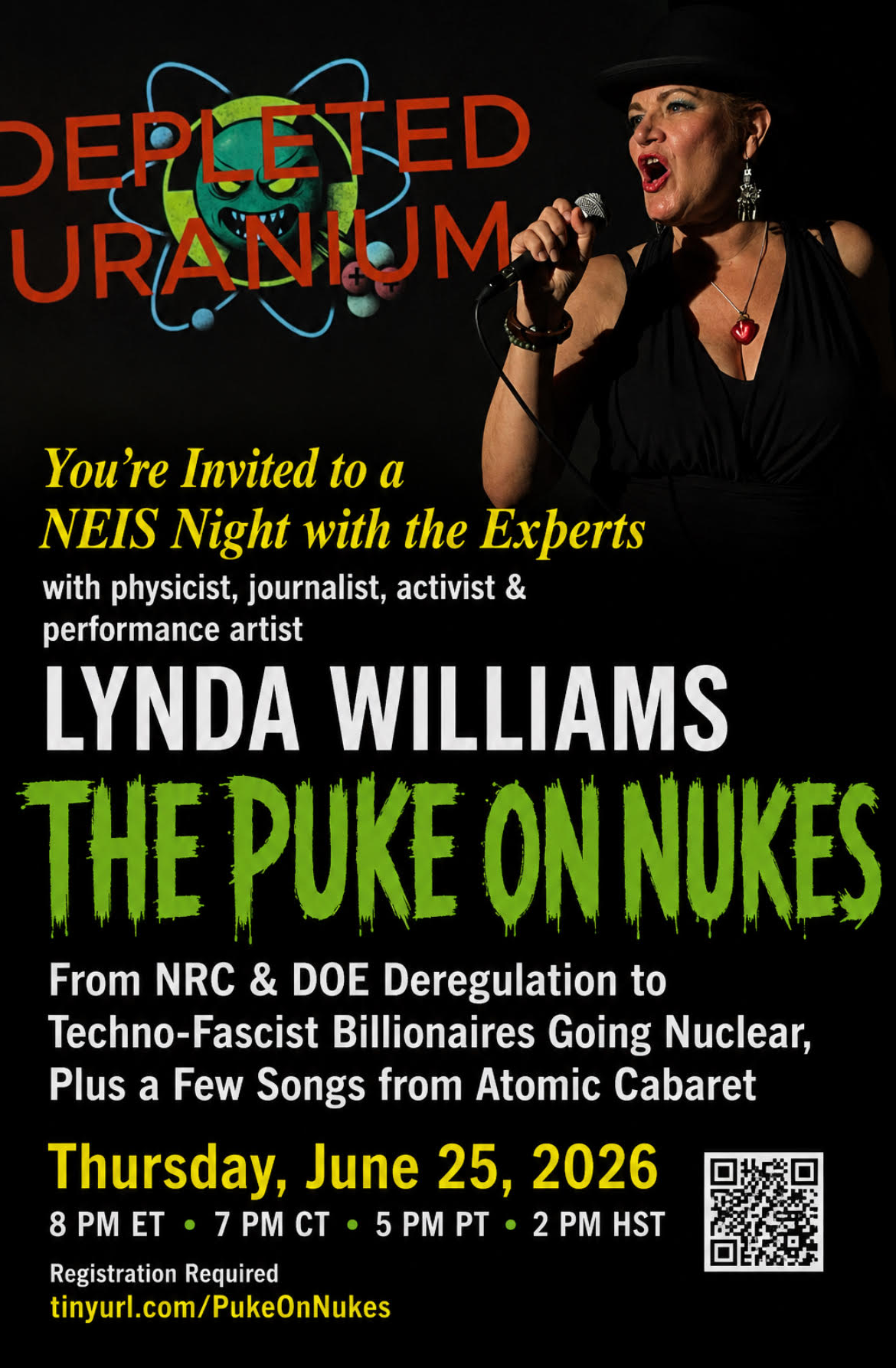
25 June- THE PUKE ON NUKES
Thursday, June 25, 2026
7pm Central Time (8pm ET, 6pm MT, 5pm PT) UTC – 5
From NRC & DOE Deregulation to Techno-Fascist Billionaires Going Nuclear, Plus a Few Songs from Atomic Cabaret REGISTER
26 June – Radiation Trainwreck at the NRC / Join the Protect Better Campaign – https://us02web.zoom.us/meeting/register/4ZlZ5_qLSHGiLSCg8FF6Bg#/registration


Cuba Is Not a Failed State – It Is a Besieged State
PETITION: “Global Appeal to Endorse Palestinian Right of Return of Refugees”
To see nuclear-related stories in greater depth and intensity – go to https://nuclearinformation.wordpress.com
-
Archives
- June 2026 (193)
- May 2026 (306)
- April 2026 (356)
- March 2026 (251)
- February 2026 (268)
- January 2026 (308)
- December 2025 (358)
- November 2025 (359)
- October 2025 (376)
- September 2025 (257)
- August 2025 (319)
- July 2025 (230)
-
Categories
- 1
- 1 NUCLEAR ISSUES
- business and costs
- climate change
- culture and arts
- ENERGY
- environment
- health
- history
- indigenous issues
- Legal
- marketing of nuclear
- media
- opposition to nuclear
- PERSONAL STORIES
- politics
- politics international
- Religion and ethics
- safety
- secrets,lies and civil liberties
- spinbuster
- technology
- Uranium
- wastes
- weapons and war
- Women
- 2 WORLD
- ACTION
- AFRICA
- Atrocities
- AUSTRALIA
- Christina's notes
- Christina's themes
- culture and arts
- Events
- Fuk 2022
- Fuk 2023
- Fukushima 2017
- Fukushima 2018
- fukushima 2019
- Fukushima 2020
- Fukushima 2021
- general
- global warming
- Humour (God we need it)
- Nuclear
- RARE EARTHS
- Reference
- resources – print
- Resources -audiovicual
- Weekly Newsletter
- World
- World Nuclear
- YouTube
-
RSS
Entries RSS
Comments RSS
 nuclear-news