Ukrainians joining Americans in supporting negotiated end to Russo Ukraine war
Walt Zlotow, West Suburban Peace Coalition , Glen Ellyn IL – 11 Oct 23
Ukrainians are increasingly opposing the Kyiv government’s war goals of retaking Crimea and Donbas. Support for those goals has dropped from 70% to 60% according to a Gallop poll. Ukrainians seeking a diplomatic settlement has risen from 25% to 31% as well. This in spite of tight Kyiv control over media and targeting war dissenters.
This mirrors dwindling support for more war weapons and no negotiations among American voters. The US also exercises tight, tho subtle control over its media. It doesn’t target war dissenters; just ignores them.
Most distressing about dwindling support for a lost cause, squandering American treasure while hundreds of thousands in Ukraine die is this: The people are starting to get it; their leaders apparently, never will.
Zelensky pledged not to directly attack nuclear plant in Zaporizhzhia, says IAEA chief

“a number of fragile points apart from the reactors themselves”, including “the spent fuel area which is not fortified” as well as other storage areas holding fresh nuclear fuel.
Rafael Grossi says president personally assured him Ukraine ‘will not directly bomb or shell’ plant in counteroffensive
Dan Sabbagh, Guardian, 11 Oct 23
Rafael Grossi, the head of the International Atomic Energy Agency, says Volodymyr Zelenskiy has promised him that Ukraine will not attack Europe’s biggest nuclear plant as part of its counteroffensive against Russia.
In an interview with the Guardian, the nuclear watchdog chief said he was most concerned about the Zaporizhzhia nuclear plant becoming engulfed in fighting between the two sides, but insisted he had obtained a commitment from the Ukrainian president.
“President Zelenskiy has personally assured me that they will not directly bomb or shell it,” Grossi said, although he added that Zelenskiy had told him “all other options are on the table” in terms of taking it back.
That means Ukraine would comply with the first of the five new nuclear safety principles – “do not attack a nuclear power plant” – initially outlined by Grossi at the UN security council at the end of May to avert “a catastrophic accident”.
The Zaporizhzhia nuclear power station was captured by Russia in March 2022, the first time any reactor has been captured in war, prompting fears of a fresh incident in the same country where an explosion at Chornobyl spread radioactivity across Europe in 1986.
Grossi said the danger was that “anything can happen at any time” given the prevailing military situation. “I’m often asked, is [the power station] safe now? No. It’s in the middle of a war zone with a counteroffensive,” he said.
He said he believed there “were two main problems”, the most significant of which was “a direct attack, hit” on one of the less secure areas of the plant, while the secondary concern was the maintenance of water cooling, necessary even as the six reactors are in shutdown……….
Grossi said he was particularly concerned by “a number of fragile points apart from the reactors themselves”, including “the spent fuel area which is not fortified” as well as other storage areas holding fresh nuclear fuel.
“The fresh fuel halls, let me remind you, were hit in August 2022,” he added, describing the aftermath of an attack that left holes visible to satellite imagery on the roof of the power station’s key facility.
A few days later, Grossi crossed the frontlines to pay one of three personal visits since the start of the war to the nuclear plant, where he said he saw the damage caused by the attack where “a few metres down, you have the racks containing the fresh fuel”.
Though the damage was likely to have come after a Ukrainian attack, Grossi said he would not say who was responsible. “I don’t have a forensic capacity [to determine who was responsible],” he said. “The Russians would certainly say that [the Ukrainians did it].”
IAEA monitors are permanently based at the nuclear power plant, although last week Greenpeace said their number – at four – was too small and they were unable to provide effective assurances about safety because they had to give a week’s notice of their inspection requests…………..
Russia’s Rosatom nuclear agency has taken over the management of the plant, but has had to rely on a fraction of the prewar Ukrainian staff to keep it operational. Staffing levels plunged from 12,000 before the war to, Grossi said, about 2,000 today, although he added it was “growing again” with more native Russians coming onsite.
Concerns about maintaining water cooling increased sharply after the Nova Kakhovka dam downstream was blown in June, draining the Dnipro reservoir around the plant and leaving its reserve cooling water pond exposed…………………….
Grossi said he regretted how the plant had been used in military brinkmanship between the two sides. “We were not expecting a war with these kind of characteristics,” he said………… https://www.theguardian.com/world/2023/oct/10/zelenskiy-promises-not-to-attack-zaporizhzhia-nuclear-plant-says-iaea-chief #nuclear #antinuclear #NuclearFree #NoNukes #NuclearPlants
Ukraine admits to conducting 3 commando raids against the city that hosts Zaporozhye Nuclear Power Plant

Ukraine’s nuclear admission a ‘wake-up call’ to the world – Moscow
https://www.rt.com/russia/584418-zakharova-budanov-energodar-raids/ 11 Oct 23
Kiev’s top military spy Kirill Budanov confirms launch of three botched assaults to retake Europe’s largest nuclear power plant.
The acknowledgement by Ukraine’s military intelligence chief Kirill Budanov, that three amphibious commando raids had been launched against the city that hosts Zaporozhye Nuclear Power Plant, must not go unnoticed by the UN or by citizens of NATO states, Russia’s foreign ministry has said.
In an interview with Ukrainian media last week, Budanov and some subordinates described how the country’s military intelligence agency GUR had conducted commando raids on the city of Energodar and that each of these had failed.
The confession should bring people in NATO states “out of their hypnotic trance” in which they were “led to believe [by their governments] that Russia creates nuclear threats,” ministry spokeswoman Maria Zakharova stated on Monday.
Zakharova also called for a reaction from the UN, which she said “has been claiming for all these months” that they couldn’t determine the direction from which the nuclear facility was being threatened.
None of Kiev’s three commando operations managed to establish a Ukrainian foothold in Energodar but officials claimed the expeditions gave them valuable experience and contributed to a larger goal of preventing Russia from using the plant to provide electricity to the region. The Zaporozhye station is in a state of partial shutdown, with a single reactor providing power for its own consumption.
The site was the focus of a protracted diplomatic spat between Moscow and Kiev last year. Ukraine claimed that Russia kept heavy weapons at the plant and was attacking Ukrainian forces from it. Moscow denied the accusation and said Kiev’s forces regularly targeted the facility with shelling and drone strikes.
The mutual accusations turned down a notch after UN watchdog the International Atomic Energy Agency (IAEA) deployed a permanent on-site monitoring mission in September 2022. The organization repeatedly declined to assess who was responsible for sporadic incidents involving the facility.
IAEA Director General Rafael Grossi attempted to mediate a Russian-Ukrainian deal to declare the vicinity of the Zaporozhye plant off-limits for hostilities, but did not succeed.
In July, Ukrainian President Vladimir Zelensky claimed that Russia had rigged the site with explosives and could blow it up at any moment, possibly in a false-flag operation. Kiev described the purported plot as part of Moscow’s alleged “nuclear blackmail” of Ukraine and its Western backers.
Russia dismissed the allegations. IAEA monitors reported that territory outside the perimeter of the plant was mined but otherwise could not confirm Zelensky’s claims. The Ukrainian leader cited reports by his intelligence services. #Ukraine
Zelensky fears Israel will distract from Western aid to Kiev
Rt.com 11 Oct 23
The Ukrainian president has visited NATO headquarters, concerned that the flow of Western help could be imperiled
Ukrainian President Vladimir Zelensky has voiced concerns that the security crisis in the Middle East could draw international attention away from his country. He blamed Russia for the Hamas incursion into southern Israel last week.
“If international attention shifts away from Ukraine, one way or another, it will have consequences,” the Ukrainian leader warned in an interview with France 2 on Tuesday.
“The fate of Ukraine depends on the unity of the rest of the world,” he added, expressing hope that Washington would ensure continued assistance…………………………….
On Wednesday, Zelensky made an unannounced visit to NATO headquarters in Brussels, where he reportedly sought reassurances that the Hamas raid and Israel’s retaliation would not distract from attention to Ukraine…………..
Last month, the US Congress declined to allocate money for Ukraine aid in a 45-day stopgap spending bill. The White House reportedly wants to include it in a package meant for Israel to overcome resistance from some lawmakers………
The Pentagon announced its latest $200 million package of assistance to Ukraine on Wednesday.
The Zelensky government has rejected the idea of peace talks with Russia and seeks a military victory with Western help instead. Moscow has argued that the US and its allies are using Ukrainians as “cannon fodder” in a proxy war against Russia. https://www.rt.com/russia/584640-zelensky-aid-israel-nato/
Was the massacre in a Ukrainian village in fact a false-flag provocation by the Kiev regime?
More proof of a false-flag massacre at village funeral by Kiev regime
Strategic Culture Foundation, Tue, 10 Oct 2023 https://www.sott.net/article/485035-More-proof-of-a-false-flag-massacre-at-village-funeral-by-Kiev-regime
A massacre in a Ukrainian village last week that was roundly blamed on the Russian military in Western media reports has taken a new twist that further shows the incident was actually a false-flag provocation by the Kiev regime.
Western media last week reported that 52 people were killed when a cafe was allegedly hit by a Russian precision missile on Thursday, October 5. All Western media reports cited Ukrainian officials as their source for attributing blame on the Russian military firing an Iskander missile.
The cafe was crowded with families who had attended a funeral for a Ukrainian soldier.
Ukrainian President Vladimir Zelensky, who was on the same day attending a summit in Granada, Spain, with European leaders, denounced the atrocity as “genocidal aggression” by Russia.
After widely reporting the slaughter in the village of Hroza in eastern Ukraine amid a torrent of condemnations of Russia, as usual, Western media have quickly shifted their focus onto other world events, primarily the eruption in violence between Israelis and Palestinians over the weekend.
However, a follow-up report by AP on the horror at Hroza inadvertently sheds more light on who actually fired the missile. There is good reason to suspect that the Kiev regime orchestrated the air strike as a false-flag propaganda stunt. In other words, the regime deliberately killed civilians in its own territory in a cynical effort to smear Russia.
The new twist is that the families of the victims are reportedly at a loss as to how Russian forces knew of the gathering of people for the dead soldier’s funeral. The village has no military bases or tactical value. It is situated nearly 30 kilometers from the frontline between Ukrainian and Russian troops in eastern Ukraine.
The follow-up AP report claims that local people suspect that an informer in the village might have given the coordinates of the funeral to the Russian military. But rather than making that deduction, a more plausible explanation for the deadly attack can be found in the acutely felt political needs of the Kiev regime.
The timing of the massacre on the same day that Zelensky was making a big pitch for more military aid from European NATO members strongly suggests that Kiev regime forces carried out the strike on Hroza village to give its president more emotive power in his set-piece appeal to European leaders.
There is precedent for such a vile act. As noted earlier, when U.S. Secretary of State Antony Blinken visited Kiev last month on September 6 to deliver $1 billion in American weaponry, on the same day a missile strike killed 17 people in the town of Konstantinovka in eastern Ukraine.The town is under the control of the Ukrainian military. That atrocity was immediately blamed on Russia which Zelensky and Blinken vociferously condemned at the time. It turned out later, though, that the Armed Forces of Ukraine carried out the air strike in a seeming error, according to the New York Times.
It is argued by this author that the strike on Konstantinovka was not an error, but rather a deliberate act of killing Ukrainian civilians to smear Russia and to garner support for more American military aid.
The same modus operandi is believed to explain the massacre at the village of Hroza last week.
Bear in mind that the summit in Granada addressed by Zelensky where he cited the carnage at Hroza and suitably accused Russia of depraved terrorism was held at a crucial political moment concerning American and European financial support for the Kiev regime. The U.S. Congress has temporarily suspended billions of dollars for Ukraine and the pressure is on Europe to maintain the flow of money.
The highly emotive appeal by Zelensky in Granada appeared to bolster European military support with reports that same day of Spain pledging to supply more air-defense systems to Ukraine.
Returning to the latest AP report, it was said:
“Locals say it [Hroza village] is strictly a civilian area. There has never been any military base, whether Russian or Ukrainian. They said only civilians or family came to the funeral and wake, and residents were the only people who would have known where and when it was taking place.
“Dmytro Chubenko, spokesman for the regional prosecutor, said investigators are looking into whether someone from the area transmitted the cafe’s coordinates to the Russians — a betrayal to everyone now grieving in Hroza… Many share that suspicion, describing a strike timed to kill the maximum number of people. The date of the funeral was set a few weeks ago, and the time was shared throughout the village late last week.”
This version of events stretches credulity. Would a local village inhabitant go out of their way to tell the Russian military about a family funeral gathering? Would the Russian military go to the trouble of firing an Iskander precision missile at a civilian gathering 30 kms from its front line and also knowing that Western media would predictably vilify Russia for “barbarity”?
That explanation of an alleged informer and Russian depravity does not add up.
What does add up, rather, is the Kiev regime authorities knew that a funeral for one of their own soldiers was taking place on the same day that their president was making a big appeal for more weapons at a summit in Spain.
Zelensky needed a propaganda punch for his appeal and Western media obliged as usual to paint Russia as evil barbarians. #Ukraine
Depleted Ukrainium: What Comes After Failure?

public support for the war—and here and here official support—ever more visibly wobbles and wanes……… And those running the war in Ukraine are slowly but surely losing on this side of the conflict.
October 5, 2023, By Patrick Lawrence / Original to ScheerPost #Ukraine
ou cannot name the last time you read anything about a parliamentary election in Slovakia, so I won’t bother asking. But you are reading about one this week, assuming you still follow mainstream media—if only to understand what you are supposed to think about one or another event, as against what has actually occurred.
In results announced in Bratislava Sunday, a leftist party whose primary platform plank is opposition to the war in Ukraine won 23 percent of the vote. On Monday the Slovakian president, Zuzana Čaputová, formally asked Robert Fico, who leads the SMER party, to form a government. It looks like he will do so in a coalition with either Voice, a social-democratic party that took 15 percent of the vote, or with Progressive Slovakia, a liberal-centrist party that finished with 18 percent of the vote.
Fico is an interesting figure. He has served as prime minister twice over the course of a decade, during which time he proved sufficiently European to bring Slovakia into the euro. To one or another extent, his likely coalition partners favor keeping Slovakia as a card-carrying member of the Western coalition supporting Ukraine. But they did not win the election: Fico did.
And Fico is all business in his opposition to Slovakia’s support for the U.S. proxy war tearing Ukraine and its people to pieces.
SMER’s platform assigns the West and Ukraine equal responsibility for the war—a purposeful rip into the “unprovoked” charade—and promises an immediate end to all Slovakian arms shipments to the war effort. Speaking after the election results were announced, Fico pointedly pledged to press Kiev and its backers to begin peace talks with Moscow. “More killing is not going to help anyone,” he declared.
There are two things to say about Robert Fico’s return to the top of Slovakian politics. One, we find once again that the U.S. is a victim of its old, Manichean habit of dividing the whole of humanity into good guys and bad guys. The headline on CNN’s report on the elections reads, “Pro–Russian politician wins Slovakia’s parliamentary election.” The New York Times head is, “Unease in the West as Slovakia Appears Set to Join the Putin Sympathizers.”
Tell me, which of these is more pathetic? “Pro–Russian?” “Putin sympathizers?” This is infantile—apart from being false, I mean. Fico simply articulates an independent, perfectly sound position on the war. CNN and The Times are infantilizing their viewers and readers as they reduce this position to the simplistic binary of a Saturday-morning cartoon. The insidious thing here, and let us be ever vigilant on this point, is that these media are inserting into our brains the thought that any deviation from the Russophobic orthodoxy amounts to support for the Kremlin’s demonized occupant.
Two, “unease” is too mild a word for the reigning sentiment among the war-mongering elites in Washington and the European capitals. An incipient panic is closer to the reality as public support for the war—and here and here official support—ever more visibly wobbles and wanes. The first front in any war is the home front, where it is imperative the battle is won. And those running the war in Ukraine are slowly but surely losing on this side of the conflict.
They are losing it on the ground in Ukraine, too, it is now more or less obvious. Our question becomes: Where will the powers that instigated this war and invested heavily in it turn next? As I argued soon after the Russian intervention began in February 2022, this conflict was probably conceived as the Washington neoconservatives’ shoot-the-moon moment, its all-out play to take down the Russian Federation. What happens now, as the neocons lose this round of Hearts and the game as they have played it is over?
To my great relief, the blue-and-yellow flags that disfigured the American landscape in the early months of the war are now mostly gone. More than half of Americans polled agree with Robert Fico: No more military aid and weapons to Ukraine. This percentage is headed in only one direction from here on out.
Volodymyr Zelensky’s swing through North America beginning with his attendance at this year’s General Assembly last month, went pretty badly. At the GA, he did not make any headway persuading the global majority opposed to the war to come over to his side. His reception in Washington was… what is the best word?… muted? House Republicans, many of whom oppose more military aid, refused to meet him. When, over the weekend, Speaker Kevin McCarthy finally pushed through a bill to keep the government funded, he had to strip out a provision authorizing another tranche of weapons funding.
The mood elsewhere appears to be no brighter. That astonishing debacle in the Canadian Parliament—presenting an old SS man as a hero because he fought the Soviets?—cannot have done Zelensky’s constituency in Canada any good. Across the pond there are signs of impatience as roughly eight million Ukrainian refugees settle in Europe, displaying little interest—and who can blame them?—in going home when the war is over. War or no, solidarity or no, the Poles have blocked imports of cheap Ukrainian wheat. There are signs of buyer’s remorse among the Finns a matter of months after their impulsive decision to join NATO. And now the Slovakians and their new leader’s alarming display of political and intellectual independence.
However these matters may stand as you read this commentary, the trends here outlined are destined to accelerate in coming months. The Ukrainians’ long-touted counteroffensive, a major prop in the campaign to maintain public support for the war, is touted no more. It is well on the way to taking its place next to the 2007 “surge” in Iraq. Remember that? Of course you don’t. And you won’t remember the counteroffensive any more distinctly in, I would say, a year’s time.
Not even The New York Times pretends any longer that the front line in eastern Ukraine has budged more than a matter of meters the whole of this year. And this is before the harsh winter weather begins. At that point, stasis will be the best the Ukrainians can hope for. All this autumn and all winter, the Russians are likely to continue their rolling volleys of rockets, missiles, and artillery shells to the point most of Ukraine east of Kiev resembles Ypres or the Somme in 1918.
Let us look ahead to next spring, then. The Ukrainian front will have sustained another winter’s deterioration, and popular discontent among Europeans is likely to have sharpened. It will be considerably harder to pretend that the Kiev regime can win the war or, indeed, that it makes any sense to continue it. And Joe Biden will be looking at an election in seven or so months.
At that point, what? ………………………………………………………………………………………………………………………………. more https://scheerpost.com/2023/10/05/patrick-lawrence-depleted-ukrainium/
Ukrainians who helped elderly neighbours in Russian occupation are being convicted of collaboration.
In Occupation, They Cared for the Vulnerable. Now They’re in Jail for It
Ukrainians who ensured elderly neighbours survived when Russia took their town are being convicted of collaboration.
SCHEERPOST, By Oleksiy Arunyan / openDemocracy October 6, 2023 #Ukraine
When the eastern Ukrainian city of Lyman was occupied for five months last year, Valentyna Tkach and Tetiana Potapenko stayed behind. They volunteered to help their vulnerable neighbours. They cared for elderly residents, contacted the Russian occupation administration to ask for food and coal for them, and even buried dead bodies.
Now, both women are in detention, having been accused by Ukraine’s Secret Service of collaboration with Russia – a crime punishable by up to 10 years in prison.
Tkach and Potapenko were volunteers long before the occupation. Since Soviet times, Lyman’s population has self-organised to better coordinate with local authorities. Residents of each of the city’s ‘microdistricts’ nominate individuals, who are usually women and are known as street attendants (vulychni), to maintain order and liaise with the mayor’s office on their behalf.
This work is coordinated by a head of the neighbourhood, who is elected by residents. When Russia captured Lyman, the local leaders in Tkach and Potapenko’s microdistricts fled, and the women stepped up to take on their roles.
Today, they believe they are being punished for helping others. As part of a series of stories on collaboration trials in the Donetsk region, Ukrainian news outlet Graty met both women in April, while they were in pre-trial detention. Below, [on original] openDemocracy publishes an abridged translation of Graty’s feature…………………………………………………………………………………………………………….. more https://scheerpost.com/2023/10/06/in-occupation-they-cared-for-the-vulnerable-now-theyre-in-jail-for-it/
Jeffrey Sachs: Beyond the Neocon Debacle in #Ukraine
October 4, 2023 https://consortiumnews.com/2023/10/04/jeffrey-sachs-beyond-the-neocon-debacle-in-ukraine/
Four events have shattered NATO’s drive for enlargement eastward. Now, decisions by the U.S. and Russia will matter enormously for the entire world’s peace, security and wellbeing.
By Jeffrey D. Sachs, Common Dreams
We are entering the end stage of the 30-year U.S. neoconservative debacle in Ukraine. The neocon plan to surround Russia in the Black Sea region by NATO has failed. Decisions now by the U.S. and Russia will matter enormously for peace, security, and wellbeing for the entire world.
Four events have shattered the neocon hopes for NATO enlargement eastward, to Ukraine, Georgia, and onward.
The first is straightforward. Ukraine has been devastated on the battlefield, with tragic and appalling losses. Russia is winning the war of attrition, an outcome that was predictable from the start but which the neocons and mainstream media continue to deny.
The second is the collapsing support in Europe for the U.S. neocon strategy. Poland no longer speaks with Ukraine. Hungary has long opposed the neocons. Slovakia has elected an anti-neocon government. E.U. leaders — including French President Emmanuel Macron, Italian Prime Minister Giorgia Meloni, Spain’s Acting Prime Minister Pedro Sanchez, German Chancellor Olaf Scholz, U.K. Prime Minister Rishi Sunak, and others — have disapproval ratings far higher than approvals.
The third is the cut in U.S. financial support for Ukraine. The grassroots of the Republican Party, several GOP presidential candidates and a growing number of Republican members of Congress oppose more spending on Ukraine. In the stop-gap bill to keep the government running, Republicans stripped away new financial support for Ukraine. The White House has called for new aid legislation, but this will be an uphill fight.
The fourth, and most urgent from Ukraine’s point of view, is the likelihood of a Russian offensive. Ukraine’s casualties are in the hundreds of thousands, and Ukraine has burned through its artillery, air defenses, tanks and other heavy weapons. Russia is likely to follow with a massive offensive.
The neocons have created utter disasters in Afghanistan, Iraq, Syria, Libya and now Ukraine. The U.S. political system has not yet held the neocons to account, since foreign policy is carried out with little public or congressional scrutiny to date. Mainstream media have sided with the slogans of the neocons.
Ukraine is at risk of economic, demographic and military collapse. What should the U.S. government do to face this potential disaster?
Urgently, it should change course. Britain advises the U.S. to escalate, as Britain is stuck with 19th-century imperial reveries. U.S. neocons are stuck with imperial bravado. Cooler heads urgently need to prevail.
President Joe Biden should immediately inform President Vladimir Putin that the U.S. will end NATO enlargement eastward if the U.S. and Russia reach a new agreement on security arrangements. By ending NATO expansion, the U.S. can still save Ukraine from the policy debacles of the past 30 years.
Biden should agree to negotiate a security arrangement of the kind, though not precise details, of Putin’s proposals of Dec. 17, 2021. Biden foolishly refused to negotiate with Putin in December 2021. It’s time to negotiate now.
There are four keys to an agreement. First, as part of an overall deal, Biden should agree that NATO will not enlarge eastward, but not reverse the past NATO enlargement. NATO would of course not tolerate Russian encroachments in existing NATO states. Both Russia and the U.S. would pledge to avoid provocations near Russia’s borders, including provocative missile placement, military exercises and the like.
Second, the new U.S.-Russia security agreement should cover nuclear weapons. The U.S. unilateral withdrawal from the Anti-Ballistic Missile Treaty in 2002, followed by the placement of Aegis missiles in Poland and Romania, gravely inflamed tensions, which were further exacerbated by the U.S. withdrawal from the Intermediate Nuclear Force Agreement in 2019 and Russia’s suspension of the New Start Treaty in 2023.
Russian leaders have repeatedly pointed to U.S. missiles near Russia, unconstrained by the abandoned ABM Treaty, as a dire threat to Russia’s national security.
Third, Russia and Ukraine would agree on new borders, in which the overwhelmingly ethnic Russian Crimea and heavily ethnic Russian districts of eastern Ukraine would remain part of Russia. The border changes would be accompanied by security guarantees for Ukraine backed unanimously by the U.N. Security Council and other states such as Germany, Turkey and India.
Fourth, as part of a settlement, the U.S., Russia, and the E.U. would re-establish trade, finance, cultural exchange and tourist relations. It’s certainly time once again to hear Rachmaninoff and Tchaikovsky in U.S. and European concert halls.
Border changes are a last resort and should be made under the auspices of the U.N. Security Council. They must never be an invitation to further territorial demands, such as by Russia regarding ethnic Russians in other countries. Yet borders change, and the U.S. has recently backed two border changes.
NATO bombed Serbia for 47 days until it relinquished the Albanian-majority region of Kosovo. In 2008, the U.S. recognized Kosovo as a sovereign nation. The U.S. government similarly backed South Sudan’s insurgency to break away from Sudan.
If Russia, Ukraine, or the U.S. subsequently violated the new agreement, they would be challenging the rest of the world. As President John F. Kennedy once observed, “even the most hostile nations can be relied upon to accept and keep those treaty obligations, and only those treaty obligations, which are in their own interest.”
The U.S. neocons carry much blame for undermining Ukraine’s 1991 borders. Russia did not claim Crimea until after the U.S.-backed overthrow of Ukraine’s President Viktor Yanukovych in 2014. Nor did Russia annex the Donbass after 2014, instead calling on Ukraine to honor the U.N.-backed Minsk II agreement, based on autonomy for the Donbass. The neocons preferred to arm Ukraine to retake the Donbass by force rather than grant the Donbass autonomy.
The long-term key to peace in Europe is collective security as called for by the Organization for Security and Co-operation in Europe (OSCE).
According to OSCE agreements, OSCE member states “will not strengthen their security at the expense of the security of other States.”
Neocon unilateralism undermined Europe’s collective security by pushing NATO enlargement without regard to third parties, notably Russia. Europe — including the E.U., Russia and Ukraine — needs more OSCE and less neocon unilateralism as key to lasting peace in Europe.
Jeffrey D. Sachs is a university professor and director of the Center for Sustainable Development at Columbia University, where he directed The Earth Institute from 2002 until 2016. He is also president of the U.N. Sustainable Development Solutions Network and a commissioner of the U.N. Broadband Commission for Development. He has been adviser to three United Nations secretaries-general, and currently serves as an SDG Advocate under Secretary-General Antonio Guterres. Sachs is the author, most recently, of A New Foreign Policy: Beyond American Exceptionalism (2020). Other books include: Building the New American Economy: Smart, Fair, and Sustainable (2017) and The Age of Sustainable Development, (2015) with Ban Ki-moon.
Zelensky names battalion after 1930s fascist sympathizer
the Organization of Ukrainian Nationalists (OUN)…….. Konovalets served as its first leader….. The OUN allied itself with Nazi Germany during World War II in the hope of creating a Berlin-backed Ukrainian state.
https://www.rt.com/russia/583894-konovalets-battalion-ukraine-army/ 4 Oct 23
A Ukrainian unit was bestowed with the title ‘Evgeny Konovalets’ to mark a national military holiday.
Kiev has renamed a military unit in honor of Evgeny Konovalets, the fascist sympathizer who led the Ukrainian nationalist insurgency in Poland during the 1920s. The ‘honorary title’ was bestowed by President Vladimir Zelensky last week.
According to a presidential decree published by Zelensky’s office, the 131st reconnaissance battalion of the army was given its new name as part of events connected with the Day of Defenders of Ukraine, which was marked on Sunday.
Konovalets is one of numerous historical figures who have been lionized in modern Ukraine for their roles in fighting for an independent nation state. A Galician-born veteran on the Austro-Hungarian side in World War I, he was peripherally involved in the short-lived secessionist Ukrainian People’s Republic in the late 1910s.
In 1920, Konovalets moved to Czechoslovakia, where he and other Ukrainian nationalists with combat experience founded the Ukrainian Military Organization (UVO), a paramilitary organization that was involved in the armed fight in what is now Western Ukraine.
The insurgency conducted assassination attacks against Polish officials, as well as supposed Ukrainian collaborators who supported Warsaw’s sovereignty over Galicia. The UVO existed until 1929, when it merged with other radical nationalist and fascist groups into the Organization of Ukrainian Nationalists (OUN). Then based in Switzerland, Konovalets served as its first leader.
The UVO’s terrorist activities against Poland were partially financed by Germany’s Abwehr military intelligence. Konovalets maintained contact with various fascist organizations in Europe and personally met Adolf Hitler in the early 1930s. According to papers published later, Konovalets expressed skepticism about the German Nazi leader in private communications with fellow nationalists.
Konovalets was assassinated in Rotterdam in 1938 by a Soviet intelligence agent. The OUN allied itself with Nazi Germany during World War II in the hope of creating a Berlin-backed Ukrainian state.
Kiev’s elevation of controversial figures was further highlighted last month, when Zelensky joined the Canadian parliament in giving a standing ovation to Yaroslav Hunka, a 98-year-old veteran of a Nazi Waffen-SS unit. Parliament Speaker Anthony Rota, who had invited the Ukrainian-Canadian Hunka to the chamber, stepped down from his position last week after taking full responsibility for the incident.
The Zelensky lie is coming to an end

Voltaire Network, by Thierry Meyssan, Translation by Roger Lagassé 1 Oct 23
President Volodymyr Zelensky’s trip to the United States cleared up any remaining ambiguities. Everyone wondered about his strategy. He doesn’t seem to be trying to defend his own people, as he mobilizes all his men and sends them to die on the front line with no hope of victory. From now on, he appears to have no qualms about lying and cheating, and uses every means at his disposal to expel certain states from intergovernmental organizations.
How can we not draw a parallel with Stepan Bandera, who massacred thousands of his own compatriots in the final days of the Second World War, when the defeat of the Reich was in no doubt?

Ukrainian President Volodymyr Zelensky attended the 78th General Assembly of the United Nations to deliver his customary speech on Russian terrorism. It was his first speech from this rostrum.
This year, four of the five permanent members of the Security Council did not send their heads of state or government: China, France, the UK and Russia. Clearly, despite the rhetoric, something has gone wrong in this institution.
Let’s summarize President Zelensky’s speech:
“Russia uses food as a weapon against the rest of the world and the “game”, in its favor, of certain European countries. It also uses civilian nuclear reactors as weapons, as it is doing at Zaporijha. It has abducted “hundreds of thousands” of Ukrainian children, who are being re-educated at home in hatred of Ukraine, which constitutes “genocide”. Russia provokes a war every decade. Today, it threatens Kazakhstan and the Baltic states. Many seats in this hemicycle would be empty if Russia were to achieve its objectives through its acts of treachery. Thank God nobody has yet imagined how to use the climate as a weapon. Natural disasters kill. They happen while Moscow has decided to kill tens of thousands of people. We must unite against these challenges. We can breathe new life into the “Rules-Based World Order” by building on the Ukrainian peace formula that I will be presenting to the Security Council shortly. I invite you all to the Peace Summit we are organizing. We can’t rely on Russia’s word: ask Prigozhin if he keeps his promises! Slava Ukraini!”
All the delegations allied with the United States applauded the speech loud and clear, while the others kept a low profile.
This speech calls for several comments:
– The argument of using food as a weapon refers to sieges to starve populations, as in North Korea yesterday or Yemen today. This is not at all what the Russians are doing in Ukraine, where they are attacking the profits of the major US corporations (Cargill, Dupont and Monsanto) which own a third of Ukrainian crops. The use of civilian nuclear power plants as a weapon of war must be understood as having an effect only at close range. The Russians occupy the Zaporijha plant and would lose their soldiers in the event of radiation. On the contrary, it is the Ukrainian forces who are threatening them with radiation in order to expel them. Finally, Russia has never abducted Ukrainian children, but has protected them from the combat zones by moving them within its territory. The International Criminal Court’s condemnation is based exclusively on the refusal to consider the accession of Crimea, Donbass and part of Novorossia to the Russian Federation as legal.
– The argument of Russian expansionism may frighten the Kazakhs and Balts, but it’s nothing more than a trial of intent. Returning to the possible use of climate as a weapon shows an ignorance of history. The USA already used it in their war against Viet Nam, making rain for months on the Ho Chi Min trail, the Vietcong’s supply route through the Laotian jungle (Operation “Popeye”). Eventually, they signed the Convention on the Prohibition of Military or Any Other Hostile Use of Environmental Modification Techniques
– To claim, without naming them, that Poland, Hungary and Slovakia are playing into the Russians’ hands by banning the import of Ukrainian grain at knock-down prices is an insult to these countries. Poland, which, forgetting the massacre of over 100,000 Poles by Ukrainian integral nationalists during the Second World War, has nevertheless welcomed 1.5 million Ukrainian refugees since the start of the current war, will appreciate this.
– The call to defend the “rules-based World Order” can only be taken as a challenge to the majority of UN members who are fighting, on the contrary, for a return to International Law. The Ukrainian peace plan therefore concerns only the Western camp and aims to extend the war.
– President Zelenski’s conclusion refers to a poem by Taras Shevchenko (1814-1861). The expression “Slava Ukraini!” had become the cry of recognition of the Ukrainian integral nationalists of Dmitry Dontsov and Simon Petlioura during the war against the Soviet revolution, when they massacred the Jews and anarchists of Novorussia. Then it became the victory cry of the Ukrainian integral nationalists of Dmitry Dontsov and Stepan Bandera when they massacred Jews, Gypsies and Resistance fighters. Finally, in 1941, it became the equivalent of “Heil Hitler! Its use today, especially at the United Nations, refers back to the post-war resolutions against Nazi propaganda, which Ukraine now opposes……………………………………………………………………………………………………………………………………………………..
The debate continued with a speech by Secretary General António Guterres. He began by pointing out that some multilateral meetings, such as the one on the plan to safeguard the Sustainable Development Goals, are held efficiently. He then described Russia’s invasion of Ukraine as a flagrant violation of the UN Charter and international law. On the judicial front, he reported that investigative teams were continuing to gather evidence of shocking and widespread human rights violations “mainly perpetrated by the Russian Federation”, including the forced transfer of children. Finally, he welcomed the agreement on cereals and regretted that Russia had not renewed it.
The Secretary General’s position expresses only his personal opinion. In this case, it is not based on any judicial decision and does not take into account the Russian position. The trial currently underway before the International Court of Justice, i.e. the UN’s internal tribunal, will hear both sides. It will be for the Court alone to judge whether there has been a violation of the Charter, as Russia claims to have launched a special military operation to comply with Security Council Resolution 2202 (“Minsk agreements”). In any case, the Court will only rule on one question: whether or not Ukraine was massacring its own citizens before the Russian special military operation. We are talking about 20,000 citizens.
Ukrainian President Volodymyr Zelensky then intervened. He began his speech by asking how a state that violates the UN Charter can sit on the Security Council? He noted that the General Assembly had recognized that Russia, not Ukraine, was responsible for the war. He then presented his 10-point peace plan. This plan, which had already been presented to the G20 in Bali, does not take Russia’s demands into account. So, strictly speaking, it’s not a peace plan, but rather Ukraine’s demands. In passing, he asked the General Assembly to adopt, by a two-thirds majority, a modification of its statutes and deprive Russia of its right of veto. Finally, he called on all States present to participate in the “peace” conference that his country was organizing.
The session chairman, Edi Rama, wondered about the current situation: a member of the Security Council is violating the UN Charter! Fortunately, despite the abusive use of its veto power, the majority of Council members ensure that its values are respected. He then gave the floor to Council members in the order of their registration.
Their speeches added nothing new. None of them dared to take up Ukraine’s call for Russia to be stripped of its veto power.
A little backtracking is in order here: when the United Nations was created, Franklin D. Roosevelt of the United States and Winston Churchill of Great Britain were at odds with Joseph Stalin of the Soviet Union. The USA and the UK wanted to create an organization that would govern the world according to their own conceptions, while the USSR wanted it to uphold international law and prevent war. It was the Soviet conception that triumphed. The right of veto takes into account the military reality of the time. There is no such thing as a legitimate or abusive veto. Quite simply, international law cannot be respected by all if it runs counter to the interests of one of its most powerful members.
The idea of depriving Russia of its veto power had never been expressed in public. Last year, however, the US State Department tested the matter with all UN member states, and it proved impossible to achieve a two-thirds majority.
After his speech, President Zelensky left the room, having no time to waste listening to the other delegations. He rushed off to Washington to address Congress, as he had already done in December 2022. However, when he arrived on Capitol Hill, House Speaker Kevin McCarthy told him straight out that it was out of the question. Parliamentarians have too busy an agenda,” he said. Dejected, the Ukrainian president had to content himself with a meeting with the presidents of the two chambers and a few Democratic senators.
The time for unconditional support is over. Like all their Western counterparts, US parliamentarians have realized that: – ammunition is in short supply, and the Western arms industry cannot compete with Russia’s in either the short or medium term; – the rebellion of Wagner Group owner Yevgeny Prigozhin against the Kremlin has failed; – the Ukrainian counter-offensive has been extremely deadly, with over a thousand people killed every day for the past two weeks, without achieving any significant successes.
Many would therefore like to negotiate a way out of the crisis or, at the very least, stop spending astronomical sums of money for nothing. Some Republicans have written to the Biden administration asking for a precise account of how the funds already disbursed have been used. Pending a response, they will not vote for another dollar. The Pentagon is therefore devising ways to divert equipment and continue the US commitment to Ukraine. It is hiding behind the possibility of blocking the federal budget in the event of a substantive disagreement between Capitol Hill and the White House.
To make up for the parliamentary affront, both the Secretary of Defense and President Joe Biden granted the Ukrainian president an interview. He also visited a university, the Clinton Foundation and the Atlantic Council, and chatted with the heads of financial companies. But the fact remains: everyone has observed President Zelensky’s outrages and his inability to win this war. Everyone has now been able to verify that Volodomyr Zelensky is not trying to defend his country. On the contrary, he is sending his men to die for nothing in front of the Russian defense line. He’s acting just as hard-line nationalists and Nazis always did: he doesn’t hesitate to lie to his own people, to cheat, and to use every means at his disposal to provoke a general confrontation at the cost of sacrificing his own people. https://www.voltairenet.org/article219739.html?fbclid=IwAR1_Hi_V0hQJPPSffJRKWhlqmnLKJYYprcKu1qeNRoRlUfGpX4-IVSD3nsQ
Monuments to Ukrainian Nazis in Canada

W.O. Munce, https://www.thepostil.com/monuments-to-ukrainian-nazis-in-canada/
Given the fact that Ukraine and Nazis are again making news, it is important to point out that there are indeed commemorative monuments to Ukrainian Nazis in Canada, located where the Ukrainian populations are the greatest. The reasons for such monuments are known to the Ukrainian community alone, but so it is essential to make a record of them here, along with a hint at what those being commemorated did back in the days of World War Two.
“Ukrainian partisans and their allies burned homes, shot or forced back inside those who tried to flee, and used sickles and pitchforks to kill those they captured outside. Churches full of worshipers were burned to the ground. Partisans displayed beheaded, crucified, dismembered, or disemboweled bodies, to encourage remaining Poles to flee… It was this maimed OUN-Bandera, led by Mykola Lebed’ and then Roman Shukhevych, that cleansed the Polish population from Volhynia in 1943” (The Reconstruction of Nations).
The 14th Division of the Ukrainian SS surrounded the village Huta Pieniacka from three sides… The people were gathered in the church or shot in the houses. Those gathered in the church—men, women and children—were taken outside in groups, children killed in front of their parents. Some men and women were shot in the cemetery, others were gathered in barns where they were shot” (British archives).
“One of their major tasks as UPA partisans was the cleansing of the Polish presence from Volhynia. Poles tend to credit the UPA’s success in this operation to natural Ukrainian brutality; it was rather a result of recent experience. People learn to do what they are trained to do, and are good at doing what they have done many times. Ukrainian partisans who mass-murdered Poles in 1943 followed the tactics they learned as collaborators in the Holocaust in 1942: detailed advance planning and site selection; persuasive assurances to local populations prior to actions; sudden encirclements of settlements; and then physical elimination of human beings. Ukrainians learned the techniques of mass murder from Germans. This is why UPA ethnic cleansing was striking in its efficiency, and why Volhynian Poles in 1943 were nearly as helpless as Volhynian Jews in 1942. It is one reason why the campaign against Poles began in Volhynia rather than Galicia, since in Volhynia the Ukrainian police played a greater role in the Final Solution” (The Reconstruction of Nations).
“On that day, early in the morning, soldiers of this division, dressed in white, masking outfits, surrounded the village. The village was cross-fired by artillery. SS-men of the 14th Division of the SS ‘Galizien’ entered the village, shooting the civilians rounded up at a church. The civilians, mostly women and children, were divided and locked in barns that were set on fire. Those who tried to run away were killed. Witnesses interrogated by the prosecutors of the Head Commission described the morbid details of the act. The crime was committed against women, children, and newborn babies” (The Institute of National Remembrance. Commission for the Prosecution of Crimes against the Polish Nation).
Related Articles:
People Are Dying For Inches In Ukraine, The “World’s Largest Arms Fair”

CAITLIN JOHNSTONE, SEP 29, 2023 https://www.caitlinjohnst.one/p/people-are-dying-for-inches-in-ukraine?utm_source=post-email-title&publication_id=82124&post_id=137502350&utm_campaign=email-post-title&isFreemail=true&r=1ise1&utm_medium=email
There’s a heartbreaking graphic going around right now showing the almost microscopic changes that have occurred to the frontline of the war in Ukraine this year despite nonstop death and destruction of unfathomable horror the entire time.
The graphic comes from a New York Times article titled “Who’s Gaining Ground in Ukraine? This Year, No One.”, which eventually gets around to acknowledging that Russia has actually gained more ground than Ukraine in 2023 despite Kyiv’s much-hyped counteroffensive which began in June.
“When both sides’ gains are added up, Russia now controls nearly 200 square miles more territory in Ukraine compared with the start of the year,” the Times reports.
As Left I on the News noted on Twitter, this contradicts the titular claim in another New York Times article published last week under the headline “Ukraine Has Gained Ground. But It Has Much Further To Go.”
The reason the map of gains and losses is so heartbreaking is because so much has been given up for so very, very little. At least tens of thousands have died in this war with hundreds of thousands wounded, all for those teeny, tiny little blips on the map. Ukraine is now freckled with more landmines than anywhere else on earth, which experts say will take decades to clear. This giant deathtrap is exacerbated by the cluster munitions that are covering the land with greater and greater frequency, which will go on to detonate and kill civilians (mostly children) for years to come. The mines and artillery fire on the frontline of this war are reportedly creating tens of thousands of amputees, numbers comparable to what was seen in World War I.
And all for what? Essentially nothing. A few inches gained here, a few inches lost there. The meaninglessness of it all is probably one of the reasons why military-aged Ukrainian men have been fleeing and attempting to flee the nation in droves to avoid conscription.
War is the worst thing in the world. The suffering, trauma and loss of mass military violence is too much to comprehend, even for people who are right there experiencing it. And the only thing worse than a war where one side gets completely steamrolled by the other is one in which people keep killing each other and killing each other over tiny gains and losses on the battlefield without an end to the nightmare anywhere on the horizon.
And now we see western officials and media outlets telling us all to prepare for this war to drag on for years, potentially into the 2030s. This nonsensical violence, which even the head of NATO now admits could have been avoided by simply ceasing to amass a western military threat on Russia’s doorstep, is scheduled to drag on as long as possible for no grander reason than the advancement of US strategic interests.
This news from The New York Times comes out at the same time as a Wall Street Journal article titled “The War in Ukraine Is Also a Giant Arms Fair,” subtitled “Arms makers are getting orders for weapons being put to the test on the battlefield.”
“The Panzerhaubitze howitzer is part of an arsenal of weapons being put to the test in Ukraine in what has become the world’s largest arms fair,” writes WSJ’s Alistair MacDonald. “Companies that make the weapons being used in Ukraine have won orders and resurrected production lines. The deployment of billions of dollars worth of equipment in a major land war has also given manufacturers and militaries a unique opportunity to analyze the battlefield performance of weapons, and learn how best to use them.”
This is one of those things that just sounds a bit uncomfortable at first, but if you really sit with the words and deeply contemplate what’s being said here it will show up as so deeply evil it will give you nightmares. The fact that weapons systems are being tested on human bodies to the immense benefit of war profiteers over a completely avoidable and deliberately provoked war is one of the most depraved things you can possibly imagine, and is a clear sign that we are living in a profoundly sick society.
This is so, so ugly, and it’s slated to get even uglier — these freaks haven’t even gotten started on China yet. The sooner this monstrous power structure can be brought to its knees, the better it will be for everyone.
Fresh concerns over Zaporizhzhia nuclear power plant: Emerging Europe this week
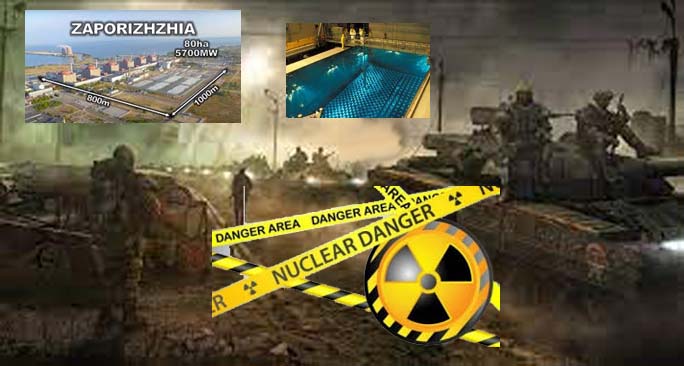
Emerging Europe 29th Sept 2023 #nuclear #antinuclear #nuclear-free #NoNukes
International regulators are incapable of properly monitoring safety at the Russian-occupied Zaporizhzhia nuclear power station, according to a critical dossier compiled by Greenpeace that is being sent to western governments on Thursday.
The environmental campaign group concludes the International Atomic Energy Agency has too few inspectors at Europe’s biggest nuclear plant—four—and that there are too many restrictions placed on their access.
It argues that the IAEA is “unable to meet its mandate requirements” but it is not prepared to admit as much in public, and as a result what it describes as Russian violations of safety principles are not being called out.
Shaun Burnie and Jan Vande Putte, nuclear specialists at Greenpeace, conclude: “The IAEA risks normalising what remains a dangerous nuclear crisis, unprecedented in the history of nuclear power, while exaggerating its actual influence on events on the ground.”
The vast Zaporizhzhia nuclear power plant, with six reactors on site, was captured by Russia in early March 2022 and has been on the frontline of the war ever since. It is sited on the Dnipro River in central Ukraine and Ukrainian forces occupy the riverbank opposite, leaving the plant in the sights of both sides’ militaries. https://emerging-europe.com/news/fresh-concerns-over-zaporizhzhia-nuclear-power-plant-emerging-europe-this-week/
US and UK involved in attack on Crimea – Russia
https://www.rt.com/russia/583634-us-uk-crimea-strike/ 29 Sept 23
Moscow has “no doubt” about Western complicity in the attack on Sevastopol last Friday, the Foreign Ministry has said
Maria Zakharova, the spokeswoman for the Russian Foreign Ministry, has asserted that US and British intelligence agencies supported Kiev during an attack on Sevastopol last Friday. The Ukrainian assault targeted the headquarters of the Russian Black Sea Fleet.
Speaking at a weekly briefing on Wednesday, she said there was “no doubt that this attack was planned with the use of Western surveillance assets, NATO satellite equipment, and spy planes and conducted at the direction of and in close coordination with American and British special services.”
The Defense Ministry has reported that the missile strike on the fleet headquarters involved several Ukrainian missiles, with Russian air defenses successfully intercepting some of them. British media outlets have also disclosed that Kiev employed Storm Shadow missiles supplied by the UK in the attack, resulting in significant damage to the building.
Zakharova described the incident as one of many in which Kiev “targets Russian regions, using missiles and shells supplied by NATO states,” citing several other recent examples. The goals of the Ukrainian government, she said, are “to draw attention away from the Ukrainian military’s failed attempts at conducting a counteroffensive” and to destabilize Russian society.
The US and its allies have supplied tens of billions of dollars worth of military hardware to Ukraine to boost its summer charge against Russian defensive lines. The operation, however, has so far produced insignificant territorial gains at the cost of heavy losses in manpower and equipment.
Russian Defense Minister Sergey Shoigu estimated on Tuesday that over 17,000 Ukrainian troops were killed in September alone. Western officials and media have acknowledged that the counteroffensive has not turned out as Kiev and its sponsors had hoped.
The administration of US President Joe Biden, however, has urged Congress to keep financing Ukraine for the foreseeable future. An appropriation request for over $24 billion in aid is currently floating in the legislature but is opposed by some Republican lawmakers.
Senators have proposed a compromise stopgap spending bill to avoid a possible government shutdown next month. The plan involves reducing spending on Ukraine to $6.2 billion. The GOP-controlled House of Representatives would need to approve the draft before it could be voted on and sent to Biden’s desk to be signed into law.
‘Unprecedented nuclear crisis’ at Russian-controlled power plant with 148 attacks
An alarming dossier compiled by Greenpeace is being sent to
Western governments warning international regulators are currently
incapable of properly monitoring safety at the Zaporizhzhia plant in
Ukraine.
Mirror 28th Sept 2023
https://www.mirror.co.uk/news/world-news/unprecedented-nuclear-crisis-russian-controlled-31050468
1 This Month
22 June – Virtual Event –Climate Change: New Data, New Debate

Monday, June 22, 2026 2:30 p.m. – 3:15 p.m. CT
YouTube. Register here

Protect Sazan Island from the Trump family! https://secure.avaaz.org/campaign/en/protect_sazan_island_from_the_trump_family_loc/?bqFCVab&v=174511&cl=22707147157&_checksum=5e9dde668860e8231c33699735e16a1fbf22ab2cb01da50c999fe8732b9775ef&utm_source=email&utm_medium=blast_email&utm_campaign=174511
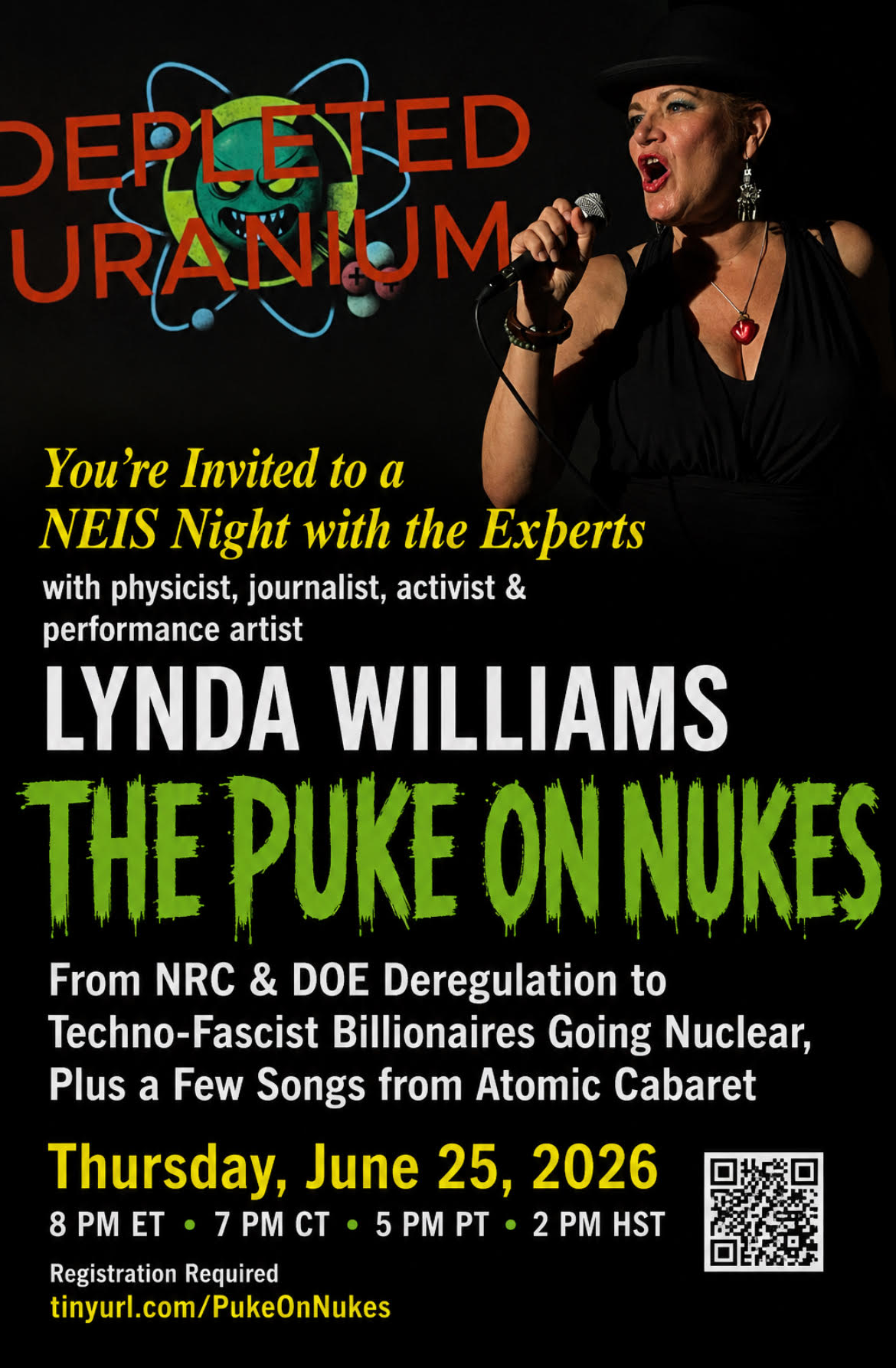
25 June- THE PUKE ON NUKES
Thursday, June 25, 2026
7pm Central Time (8pm ET, 6pm MT, 5pm PT) UTC – 5
From NRC & DOE Deregulation to Techno-Fascist Billionaires Going Nuclear, Plus a Few Songs from Atomic Cabaret REGISTER
26 June – Radiation Trainwreck at the NRC / Join the Protect Better Campaign – https://us02web.zoom.us/meeting/register/4ZlZ5_qLSHGiLSCg8FF6Bg#/registration


Cuba Is Not a Failed State – It Is a Besieged State
PETITION: “Global Appeal to Endorse Palestinian Right of Return of Refugees”
To see nuclear-related stories in greater depth and intensity – go to https://nuclearinformation.wordpress.com
-
Archives
- June 2026 (193)
- May 2026 (306)
- April 2026 (356)
- March 2026 (251)
- February 2026 (268)
- January 2026 (308)
- December 2025 (358)
- November 2025 (359)
- October 2025 (376)
- September 2025 (257)
- August 2025 (319)
- July 2025 (230)
-
Categories
- 1
- 1 NUCLEAR ISSUES
- business and costs
- climate change
- culture and arts
- ENERGY
- environment
- health
- history
- indigenous issues
- Legal
- marketing of nuclear
- media
- opposition to nuclear
- PERSONAL STORIES
- politics
- politics international
- Religion and ethics
- safety
- secrets,lies and civil liberties
- spinbuster
- technology
- Uranium
- wastes
- weapons and war
- Women
- 2 WORLD
- ACTION
- AFRICA
- Atrocities
- AUSTRALIA
- Christina's notes
- Christina's themes
- culture and arts
- Events
- Fuk 2022
- Fuk 2023
- Fukushima 2017
- Fukushima 2018
- fukushima 2019
- Fukushima 2020
- Fukushima 2021
- general
- global warming
- Humour (God we need it)
- Nuclear
- RARE EARTHS
- Reference
- resources – print
- Resources -audiovicual
- Weekly Newsletter
- World
- World Nuclear
- YouTube
-
RSS
Entries RSS
Comments RSS
 nuclear-news
