Assange’s Very Life Is at Stake
Julian Assange will soon find out whether he will be granted a final appeal in the U.K. in his fight against extradition, or will soon face the cruel vengeance of the U.S.
By Mary Kostakidis, 4 Feb 24, https://consortiumnews.com/2024/02/04/mary-kostakidis-assanges-very-life-at-stake/
In Julian Assange’s extradition case, Magistrate Judge Venessa Baraitser determined he would not survive imprisonment in a U.S. Supermax facility – that he is very likely to commit suicide.
One of the final witnesses in the 4 week extradition trial in 2020 was an American lawyer whose client Abu Hamza was held in ADX Colorado where Julian is likely to be sent. Abu Hamza has no hands. He was extradited from the U.K. following assurances by the U.S. that the prison system was able to deal with the special requirements of such a prisoner.
His lawyer testified that despite assurances he would not be placed in total isolation, that is indeed where he was kept, under Special Administrative Measures, and the U.S. had also failed to delivered on other undertakings to protect his human rights – he did not have a toilet in his cell he could operate – he was stripped of all dignity, contrary to guarantees.
In the case of David Mendoza Herrera, the Spanish government successfully pursued the return of their citizen who was extradited to the U.S. following assurances the U.S. reneged on – a process that took many years while the prisoner attempted first to seek redress in the U.S. but ultimately only succeeded after suing the Spanish government for failing to protect his rights. It was forced to act after the Spanish Supreme Court virtually threatened to suspend the Spain-U.S. Extradition Treaty.
The assurances provided by the U.S. in their 2021 High Court Appeal of the District Court’s decision in Assange’s case were not tested in Court. They were automatically accepted, a judge expressing complete confidence in the reliability of a guarantee from the United States Government, and differentiating between the guarantee of a State and that provided by a Diplomat.
(Whilst a Diplomat’s assurance may involve a different signature at the bottom of the page, surely it appears there only after the boss’s approval, but evidently this makes a difference).
Significantly however, the assurances were also conditional — they could be revoked at any time, so not worth the paper they were written on, no matter who signed them.
Since that decision was handed down though, the U.K. Supreme Court has delivered a landmark ruling in a case where the U.K. government had accepted assurances provided by a foreign government (Rwanda). It determined that such assurances cannot be automatically accepted – that there is a requirement for ‘meaningful, independent, evidence- based judicial review focusing on the protection of human rights on the ground in that country’.
In Julian’s case, it is the human rights of national security prisoners in the U.S., their treatment and the conditions in which they are kept.
The U.N. considers solitary confinement beyond 2 weeks as torture – special rapporteurs have been arguing this for decades. In condemning the treatment of Chelsea Manning in a U.S. prison, then Special Rapporteur on Torture Juan Mendez said:
“Prolonged solitary confinement raises special concerns, because the risk of grave and irreparable harm to the detained person increases with the length of isolation and the uncertainty regarding its duration… I have defined prolonged solitary confinement as any period in excess of 15 days. This definition reflects the fact that most of the scientific literature shows that, after 15 days, certain changes in brain functions occur and the harmful psychological effects of isolation can become irreversible.” [Emphasis added.]
Abu Hamza has been in solitary confinement for nine years. His lawyer testified walking was too painful for him because his toe nails were so long, and his pleas for them to be cut were ignored.
Significant Recent Changes in Assange’s Health
The automatic acceptance and reliability of the assurances were not the only problem at that time.
A serious problem that arose during that hearing was its failure to note or take into account the change in Julian’s medical condition. It is a critical failure because the decision delivered was based on assurances the U.S. prison system could mitigate against his known risk factors – the risk he would commit suicide. But he had developed another serious physical risk factor.
After the four-week Extradition hearing in the lower court where Assange appeared boxed in a glass booth at the back of the court where he was prevented from communicating with his lawyers, he was permitted to appear via videolink from Belmarsh at subsequent substantive hearings.
At the start of the U.S. Appeal there was a brief pre-hearing chat between Assange’s lawyer and the judge to the effect that the defendant has elected not to appear due to an increase in medication.
It was extraordinary and inconceivable he would choose not to observe the hearing via videolink. Indeed I was later informed by his wife Stella he had wanted to appear but had not been permitted to by the prison.
Both his absence and the explanation flagged a problem.
Assange had not missed a single hearing. He had shown great determination in his struggle to engage with the drama unfolding in court despite enormous challenges such as not being able to attract his lawyers’ attention (after being denied the tools and time to prepare for his own defence), and in spite of medication and a dramatic deterioration in his health as was so throughly documented by former U.N. Rapporteur on Torture Nils Melzer in his book The Trial of Julian Assange: A Story of Persecution.
Why was he so heavily medicated so as not to be able to sit in the video-link room at Belmarsh? What had necessitated this increase in medication? This question was directly pertinent to the decision the court had to make, but I heard no question from the judge about it and the hearing proceeded.
Then, remarkably, some time into the hearing, Julian appeared.
We journalists observing via a link could see him in a window on our screens. He would have been able to see and hear the judge, and those in the courtroom would be able to see him on a monitor as we could.
He looked mighty unwell, not only drugged. He had to use his arm to prop up his head but one side of his face was noticeably drooping and one eye was shut.
During these hearings we were given very occasional, brief glimpses of the defendant – time enough to note he is still observing his own legal proceeding, be it in a depersoned way. I asked the video link host on the chat facility to show us more of the defendant – we needed a better and more frequent look at him as he looked unwell.
Journalists are warned when we join the video-link that using the chat facility for anything other than communicating about technical issues and only with the host (hearings were frequently hamstrung by audio problems) could result in access being withdrawn. But many of the other 30 or so journalists on the link were sending Me Too messages on the Chat. Remarkably and to my relief the host obliged & we were shown Julian more often and for longer than in any previous hearings.
So after the bizarre news Julian was not going to attend his own hearing, the second thing I could not understand is that given his condition when he did appear, there were no questions or adjournment. Those deciding his fate were not perturbed by his state, or had failed to notice what was immediately evident to us.
Julian persisted in his attempt to focus, but he was clearly severely hampered. He eventually gave up, stood up & moved away from the monitor camera. It was as if he could no longer abide the humiliation of being scrutinised by people unknown, witnesses to a feeble, failed attempt to command his body and mind, a mind that has been razor sharp and never before let him down.
The public learnt some nine weeks later, and days after the judgement came down clearing the way for Julian’s extradition, that he in fact had had a TIA – a Transient Ischemic Attack or minor stroke – often a precursor to a major, catastrophic one when prompt access to an MRI machine would be vital if his life was to be saved.
I don’t know whether it is known, exactly when Julian had the stroke. The monitoring of prisoners is not exactly tailored to pick up and quickly respond to such silent stealthy symptoms. Did the stroke occur before the hearing? Was that why he was so heavily medicated? Or did it occur at the time of the hearing?
One thing is clear – he has had a stroke, so his condition has changed, and the assurances accepted took no account of this, though the Court’s decision was handed down long after he had the stroke and a fewsdays before it was finally made public.
One of the two Justices presiding over the U.S. Appeal, Ian Duncan Burnett, was the Chief Justice of the High Court at the time. His decision in the case of U.K. citizen Lauri Love set a precedent where extradition to the U.S. was denied on the basis of a medical condition.
This engendered a little hope that he may not reverse the District Court’s decision in Julian’s case. But as Law Professor Nils Melzer remarked, you don’t need the Chief Justice on a case where he has already set a precedent that can be followed. However you do need him if his precedent is to be overturned.
Throughout the hearing, the Love decision loomed large in our minds and Love was present in Court, but we realised this potential pathway was a dead end when it was finally raised by Julian’s lawyers.
The Chief Justice responded swiftly, dismissively and categorically: ‘Oh but that was an entirely different case. He had eczema.’ (Verbatim to my memory)
So the difference between being extradited or not, was eczema, and there would be no joy for Julian in this court despite the marked deterioration in his physical and psychological health.
Julian sought leave to appeal the decision of the High Court, in the Supreme Court, but that Supreme Court’s determination was that there were no arguable points of law to form a basis for an Appeal.
The Upcoming Hearing
Over two days on Feb. 20-21, a panel of two High Court judges will rule on whether Julian can appeal both the Secretary of State’s decision to extradite him and Judge Baraitser’s decision on the basis of all the grounds he argued which she knocked back, such as the political nature of the prosecution and the impossibility of a fair trial for him in the U.S..
The reliability and adequacy of the U.S. assurances that he will not be held in a super max prison, nor under S.A.M.s, that his suicide can be prevented, that he would be returned to Australia to serve out a sentence at some point, have not been tested in court, and now the medical condition for which they were furnished has changed. And in the meantime there has been a landmark ruling by the [U.K.] Supreme Court in another case, regarding the necessity for judicial review of foreign govt assurances.
A letter very early this year to the U.K. home secretary from a cross party group of our Parliamentarians is an important and timely one, requesting he “undertake an urgent, thorough and independent assessment of the risks to Mr. Assange’s health and welfare in the event he is extradited to the United States.”
Assange has made an application to attend this month’s hearing in person so he can communicate with his legal team.
The judges may make an immediate decision at the conclusion of the two-day hearing or reserve their judgement.
If Assange wins this case, a date will be set for a full Appeal hearing.
If he is denied the right to appeal there are no further appeal avenues at the domestic level.
He can then apply to the European Court of Human Rights, which has the power to order a stay on his extradition – a Rule 39 Instruction, which is only given in “exceptional circumstances”. It may however be a race to lodge the Appeal before he is bundled off on a plane to the U.S.
If Julian Assange is extradited and the U.S. is successful in prosecuting him he will not receive a fair trial there and unlikely to receive the constitutional protection afforded to its own citizens, the U.S. will have redefined in law, investigative journalism as ‘espionage’.
It will demonstrate that U.S. domestic laws, but not protections, apply internationally to non-U.S. citizens.
It will have cost Assange his freedom & likely his life – an example to anyone who attempts to discredit the state sanctioned narrative. A narrative that has been shattered by independent and citizen journalists in Gaza – explosively, daily, globally, and irrevocably.
This is the text of a speech delivered by Mary Kostakidis to a conference on Julian Assange held in Sydney, Australia on Jan. 29.
Journalist Mary Kostakidis presented SBS World News for two decades as Australia’s first national primetime news anchorwoman. Previous articles include “Watching the Eyes” for Declassified Australia. She covers Julian Assanges’s extradition court proceedings live on Twitter.
Strong opposition on plans to store nuclear waste in East Yorkshire
A consultation event took place in Patrington yesterday
Andy Marsh, 2nd Feb 2024
There appears to be very strong opposition to plans to store nuclear waste in East Yorkshire
A series of public pop-in centres will give people in the area more information about the proposals for Holderness.
We were at the first consultation event in Patrington yesterday.
Another is being held in Withernsea later.
There are some who were convinced by the plans but many weren’t.
I would oppose it 100 per cent
Beverley and Holderness MP Graham Stuart has called for a referendum.
Here are some of the views of people we spoke to:
“They don’t know exactly where the site is going to be.”
“Somebody has to have it – to be honest I’ll be dead before all the this takes place anyway.
“I would oppose it – 100 per cent – on behalf of my children, my grandchildren and my future great grandchildren.”
We feel like guinea pigs
“This is bad for this community.”
“The whole of Holderness – everybody involved in it – it can only lead to bad things.”
“I think it’ll be a positive thing for the area if it happens here.”
“There are terms such as may and could – that’s not absolute certainty.”
“It feels like we’re just guinea pigs.”……………………………………………… https://planetradio.co.uk/greatest-hits/east-yorkshire-north-lincolnshire/news/strong-opposition-on-plans-to-store-nuclear-waste-east-yorkshire/
‘Odd’ Hinkley Point C salt marsh plan has Somerset locals up in arms
Anger at EDF proposals to flood wildlife-rich farmland as ‘compensation’ for killing millions of fish at nuclear site
Steven Morris, Guardian, 3 Feb 24
tanding in a field close to the Somerset coast surrounded by her flock of sheep, Juliet Pankhurst shook her head. “It doesn’t make any sense,” she said. “They want to flood this land that has been farmed for generations. We’ve got great crested newts in the pond over there, water voles in the ditches, hares all over the place. They’ll be lost.”
Her partner, Mark Halliwell, shrugged. “But they’ll get their way – they always do. No matter what scheme they come up with.”
The “they” in question is EDF, the French company building the Hinkley Point C nuclear power station a few miles down the coast from the farm. The scheme is to create a salt marsh on the land as – its word – “compensation” for dropping an innovative plan to stop millions of fish from swimming into the plant’s cooling system and being killed.
“The whole thing sounds a bit odd,” said Pankhurst.
Usually, creating salt marshes – excellent wildlife habitats and carbon stores – is a positive story. This one has been greeted with anger and scepticism in the local area and farther afield.
It takes a bit of unravelling. As part of the Hinkley Point C project, EDF had said it would save millions of fish by installing an “acoustic fish deterrent” (AFD) system. The Bristol Channel and Severn estuary are hugely important habitats for species including salmon and eel.
Under the system, almost 300 underwater “sound projectors” would have boomed noise louder than a jumbo jet into the sea to deter fish from entering the plant’s water intakes, nearly two miles offshore.
But EDF has changed its mind, arguing that installing and maintaining the system would risk the lives of divers working in the fast-flowing, murky water and expressing concerns about the impact of the noise on porpoises, seals, whales.
According to the UK government’s Centre for Environment, Fisheries and Aquaculture Science, between 18 and 46 tonnes of fish will be lost a year if the AFD plan is abandoned.
So as “compensation”, EDF has proposed to create or enhance native oyster beds, kelp forest and seagrass habitat, and, contentiously, create about 313 hectares (773 acres) of new salt marsh along the River Parrett at Pawlett Hams, an area of wildlife-rich grassland managed by about 30 landowners, who face having to sell up and move on.
Scores of people, under the watchful eye of a police community support officer, turned up for a meeting at Pawlett village hall this week as part of EDF’s consultation on the proposal.
Scores of people, under the watchful eye of a police community support officer, turned up for a meeting at Pawlett village hall this week as part of EDF’s consultation on the proposal.
The proposal includes diverting a stretch of the King Charles III England coast path inland. One villager, Rachel Fitton, who walks at Pawlett Hams, was in tears at the prospect of the land being flooded. “It’s so sad for people who love that area,” she said. Her husband, Jason Fitton, said: “It’s insanity, disgraceful. Think of all the hedgerows and wildlife that will be lost.”
The Hampshire company Fish Guidance Systems, which had expected to provide the AFD system, is also unimpressed at EDF’s change of direction, saying it was like building wind turbines that would kill millions of birds and offering to build a nature reserve next door.
FGS says elver migration from the Atlantic is expected to be particularly hard, hit with eels “likely to be sucked into the Hinkley intakes” and only a few making it to the Somerset Levels and other habitats……………………….https://www.theguardian.com/uk-news/2024/feb/02/odd-hinkley-point-c-salt-marsh-plan-has-somerset-locals-up-in-arms—
Hinkley C – don’t say I didn’t warn you!
In 2016, I called for Hinkley C to be scrapped. Now its commissioning has been pushed back to the end of the decade and its costs have ballooned to as much as £48 billion in 2024 money. I was right.

MICHAEL LIEBREICH, JAN 25, 2024
“The case for Hinkley Point C has collapsed: It’s time to scrap it.” This was the title of an article I wrote for City AM in July 2016.
The story so far
For those who have forgotten those heady days, a quick recap. July 2016 was one month after the UK voted for Brexit. Prime Minister David Cameron and Chancellor George Osborne (whose pet project was Hinkley C, aided by energy minister in the previous Coalition government and currently LibDem leader, Ed Davey) had resigned. Theresa May had just taken over as Prime Minister.
The project already had a ghastly history. In the early 2000s, the nuclear industry, with French champion Areva in the lead (later driven into bankruptcy by cost overruns at Flamanville and Olkiluoto and rescued by EDF in 2017), announced a “Nuclear Renaissance” and was lobbying for a new build programme in the UK to replace aging plants set for retirement. In the absence of evidence, they claimed new plants would produce power for £24 per MWh (£39/MWh in 2024 money, or $50/MWh).
The Labour Party, long dead set against nuclear power, were convinced. In January 2008, Prime Minister Gordon Brown declared, in the preface to a White Paper on nuclear power entitled “Meeting the Energy Challenge” that “nuclear should have a role to play in the generation of electricity, alongside other low carbon technologies.” The White Paper estimated the total cost of building a 1.6GW nuclear plant at £2.8 billion – which would translate into £5.6 billion for Hinkley C’s 3.2GW (£9.0 billion or $11.5 billion in 2024 money).
EDF’s UK CEO Vincent de Rivaz was cock-a-hoop, predicting that Brits would be cooking their turkeys with power from Hinkley C by Christmas 2017. But remember that figure – £9.0 billion for 3.2GW.
By October 2013, Osborne and Davey had agreed a Contract for Difference with EDF for electricity production at a strike price of £92.50/MWh in 2012 money (£132/MWh in today’s money or $169/MWh) – rising with inflation for 35 years, but dropping to £87.50 (£125/MWh in today’s money or $173/MWh) if a second EPR were to be built. That EPR is Sizewell C – of which more later.
At that point, Hinkley C was expected to cost £16 billion in 2015 money (£22 billion in 2024 money or $28 billion). It was due to come online in 2023 and continue cooking Christmas turkeys for 60 years.
Since then, on five separate occasions EDF has announced that costs have increased, and the commissioning date pushed back. The only delay which was not fully in the control of EDF and it suppliers in the nuclear and construction industries was Covid – which can be blamed for around a year of delay and a couple of billion of cost increase, but not more.
Last week – yet another delay and cost increase
……………………. Now, I know that supporters of the project and hard-core nuclear fans will be bursting blood vessels at this point, desperate to jump in an explain that most of the difference between £9 billion and nearly £50 billion is down to financing cost resulting from the use of the CfD mechanism, regulatory cost, delay in government decision-making and so on. But I’m going to say it: I don’t care……………………………
How big things (don’t) get done
It is not like cost over-runs in nuclear projects are a big secret. The world’s leading academic expert on project management is Danish Professor Bent Flyvbjerg, author of How Big Things Get Done, who joined me on Cleaning Up last year. Having build a huge database of projects of different sources, he can definitively show that nuclear plants are worse only than Olympic Games in terms of cost over-runs. On average they go 120% over the budget, with 58% of them going a whopping 204% over budget.
The common trope among nuclear fans is that it is only in the western world that nuclear new build is either problematic or exorbitantly expensive, and this is driven by excessive regulation.
While excessive delays in emerging nuclear powers are certainly less common, there is no transparency over how this is achieved. There are ample examples of problems: the use of fake certification documents, the sealing of deals for reactor sales by military inducements, cutting corners on safety, failure to maintain control of the fuel supply chain, failure to disclose problems and accidents; unexplained accidents on aging plants.
There is also no transparency over the real cost of their plants. Put simply, these are are whatever their leaders say they are: it is they who decide the cost of capital, state guarantees, whether safety standards meet or exceed international standards, whether safety standards are enforced, the environmental standards applied to the supply chain, the speed projects proceed through licencing, the need or not to provision for decommissioning costs, the diversion of costs to military, energy or industrial budgets, and so on.
Back to 2016
Now let’s get back to Hinkley C, and 2016. One of the first things Theresa May did when she took over from David Cameron was to ask her security advisors to review the wisdom of allowing state-owned China General Nuclear to invest £6 billion in the project. In the end May backed down and allowed the investment to go ahead, but that is the background to my piece: the project’s future was in doubt, and it was the last realistic chance to kill it before tens of billions of pounds had been invested. And this is what I wrote: The case for Hinkley Point C has collapsed: It’s time to scrap it.
………………………………………………………………. It is worth remembering that while construction costs are in the £42 to £48 billion range, the 35 years of electricity at £87.50 or £92.50/MW in 2012 money, adjusted for inflation will cost UK energy users a gargantuan £111 or £116 billion over the next 35 years. Could we use that money better? You bet.
Summary
So there you have it. 2016 was a missed opportunity, most likely the last opportunity to scrap the benighted project, one of the worst blunders in the history of public procurement and of the UK’s energy industry.
Does that mean we should scrap it now? It’s almost certainly too late. EDF has probably spent so much on the project, that the net present value of its revenues exceeds the remaining cost to bring the project to completion
What I do know is that the UK must resist the French government demands that it put its hand in the public pocket for yet more money to support the project. The whole point of the structure put in place, with its super-generous and inflation-protected CfD strike price, was that EDF was to bear the risk of cost over-runs. These will come back to bite UK energy users in the form of higher power costs from Sizewell C, should that project go ahead. If the UK taxpayers have to bear the cost of cost over-runs, let’s just nationalise and be done with any pretence that the market bears any risk from nuclear power projects.
I know many will say I am just being anti-nuclear.
No, I’m pro-nuclear……..
………………… to paraphrase Oscar Wilde, “if Hinkley C, Flamanville, Olkiluoto and Vogtle are the way the nuclear industry treats its projects, it does not deserve to have any”. https://mliebreich.substack.com/p/hinkley-c-dont-say-i-didnt-warn-you
French firm EDF shows its power over the UK govt – no judicial review now required over fish protection from Hinkley nuclear cooling system.
In 2021, EDF was formally told it must fit an acoustic fish deterrent
(AFD) system to the massive seawater intakes of the cooling system. It was
considered necessary to “protect the marine life of the Severn Estuary
catchment area and its nine great rivers: Parrett, Avon, Severn, Wye, Usk,
Ebbw, Rhymney, Taff, Ely and their tributaries where many fish species go
to breed”.
Without AFD it is estimated that 22 billion fish would be
ingested over the planned 60-year life of the plant, of which half would be
killed in the process.
Not so final. EDF appealed against this but in 2022
the then environment secretary, George Eustice, refused the appeal in
definitive terms: “The decision on this appeal is final [and] can only be
challenged in the courts by judicial review.”
Final? EDF, which has been
running rings around the government and bullying ministers (Eyes passim)
since it bought the British nuclear fleet in 2008, simply went
regulator-shopping on the basis that energy ministers are more likely to be
sympathetic. And so it proves: the Department for Environment, Food & Rural
Affairs (Defra) has been reduced to the role of consultee on the “final
final” decision, which will now be taken elsewhere – with no judicial
review required.
Private Eye 2nd Feb 2024
https://www.private-eye.co.uk/sections.php?issue=1616§ion_link=columnists
How not to go nuclear: Hinkley and Sizewell

by DAVID HOWELL
David Howell: This is not just a matter of finding the cash to meet the
enormous budget overrun. The Chinese payments halt at Hinkley leaves a
growing gap. Love or hate them nowadays, they have already been edged out
of the Sizewell plan (they were actually paid £100m to leave), so the very
large Chinese contribution there will also have to be found from elsewhere.
But EDF has no more money, and the French think the British Government
should open its chequebook. HM Treasury thinks no such thing. So, to
repeat, who is going to fill the gap?
Copying Hinkley, and certainly copying its financial story, looks less attractive by the day. The British hope is that at Sizewell a new financial model, requiring consumers and
customers to pay extra for years in advance for their electricity, will
entice in investors, to replace the Chinese. One allegedly interested
“private investor” is said to be the not-so-private United Arab
Emirates government. But is that the kind of swap — the very non-aligned
UAE in place of the Chinese — that we need?
The Article 29th Jan 2024
https://www.thearticle.com/how-not-to-go-nuclear-hinckley-and-sizewell
Hinkley Point shambles shows why UK must scrap disastrous nuclear strategy.

Energy spokesperson Mark Ruskell is accusing Tories and Labour of wasting billions of pounds on nuclear technology
The UK government must scrap its disastrous nuclear strategy in light of the shambolic saga of the Hinkley Point power station, says the Scottish Greens climate spokesperson, Mark Ruskell MSP.
The call follows revelations that the Hinkley Point project has been hit by yet another delay of up to four more years, and that it could cost an eye watering £46 billion.
This month the UK government announced plans for the biggest expansion on nuclear energy for 70 years.
Mr Ruskell said: “Hinkley Point C has been a shambolic money pit. It’s been hit by delay after delay and the costs are escalating at an alarming rate. Nobody can say with any confidence when it will go live or how much money will have been wasted on it.
“Yet, the UK government wants to throw even more time and money into an unsafe, unreliable and eye-wateringly expensive energy source that will leave a terrible legacy for future generations.
“The climate crisis is happening all around us. We don’t have time to waste on a disastrous nuclear strategy. Renewable energy is the cleanest, greenest and cheapest energy available, that is what all governments should be focusing on.
“That is what we are doing with Scottish Greens in government in Scotland. Yet the Tories and Labour are committed to wasting billions of pounds on nuclear technology.”
Sellafield nuclear plant: Cancer fears raised by Scottish MP.

By Hamish Morrison The National, 1st Feb 2024
CANCER fears have been raised amid fresh concerns about the level of nuclear waste found in Scottish waters.
As delays and costs mount on Britain’s new flagship nuclear project, SNP MP Allan Dorans has unearthed research showing the environmental impact of atomic energy – and has
raised fears it could cause cancer. Dorans has previously raised concerns
about the Sellafield nuclear waste processing plant in Cumbria, which pumps
waste out into the sea, reaching as far as the Ayrshire coast in his
constituency. While the levels of radiation remain within what the UK
authorities consider safe, Dorans has repeatedly raised fears these
assessments may be underplaying the health risks of exposure to
radioactivity.
Now he has highlighted research from Manchester University
which examined how the sea bed conditions around the Sellafield site
effectively contain radioactive waste which is then distributed around the
coast to Scotland and disturbed by fish, including haddock. Dorans said:
“While most Government advisors insist that this radioactivity only
inches down is safe from transmission into the food chain, the activity of
bottom-feeding species and the disturbance that storms and flooding must
cause in the sediment suggests to me complacency.”
The National 1st Feb 2024
https://www.thenational.scot/news/24091797.sellafield-nuclear-plant-cancer-fears-raised-scottish-mp
Britain plans ‘robocop’ force to protect nuclear sites with paint bombs
AI-powered drones are being designed to cut labour costs and boost
security at Sellafield. Britain’s nuclear sites could soon be protected
by a “robocop” style police force made up of AI-powered drones equipped
with paint bombs and smoke guns.
The Nuclear Decommissioning Authority
(NDA), which runs high-security nuclear sites such as Sellafield and
Dounreay, wants to build a robotic police force to cut costs and boost
security across sites containing radioactive waste. It has offered £1.5m
to security and defence companies for initial designs of a robotic defence
system, with a view to commissioning a fully-fledged version in the future.
The NDA’s document for the project says that a key aim is to cut labour
costs by reducing the number of armed police. Currently, the Civil Nuclear
Constabulary employs nearly 1,600 people, with its cost bill rising to
£130m in 2022/23 – up from £110m in 2018.
The procurement document
said: “The NDA covers 17 nuclear sites, 1,000 hectares of land and over
800 buildings. We are interested in innovative ways to ensure our sites
remain safe and secure in a resource-constrained environment.” A
spokesman for the NDA confirmed the “roboforce” plans, claiming that
police officers will be able to control the technology without being
exposed to danger. “They will be able to override the system, or
investigate and deal with intruders from a control room,” the spokesman
said.
Telegraph 1st Feb 2024
Blackwater Against New Nuclear Group (BANNG) firmly contradicts Therese Coffey, MP on Bradwell as a nuclear site.

Therese Coffey MP suggests Bradwell is a large brownfield site. In fact,
the site is occupied by the long closed Bradwell A power station now in the
process of decommissioning before being returned to greenfield land use.
Perhaps her most preposterous assertion is that ‘Bradwell has hosted
nuclear power and hopes to do so again in the future’. In fact, the
communities and Councils around the Blackwater estuary in Essex are
overwhelmingly against new nuclear development at Bradwell.
Many years ago, BANNG gathered 10,000 signatures face-to-face for a petition against new
nuclear development at Bradwell which was taken to Whitehall. Since then,
the Chinese developer, CGN, has withdrawn its proposals for a massive new
nuclear power station in the face of implacable hostility from the local
community.
‘Therese Coffey would do well to check her facts and look to
her own backyard and devote her campaigning against the destruction of the
Suffolk coast by the giant Sizewell C nuclear power station project, with
its long-term stores of radioactive wastes, rather than seek to impose
unwanted infrastructure on the precious marshlands of Essex.’
BANNG 31st Jan 2023
Britain will test fire Trident nuclear missile for the first time since 2016 as fears of World War Three grow
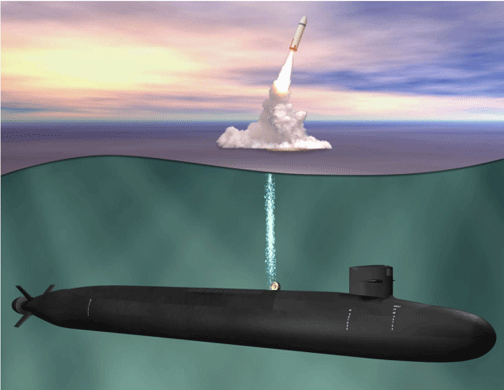
- HMS Vanguard is reported to have sailed into the Atlantic earlier this week
- It is expected to test-fire a Trident missile 3,500 miles from the US
Daily Mail, By CHRIS JEWERS, 2 February 2024
Britain is primed to test a Trident nuclear missile for the first time since 2016 amid growing fears of a global conflict, according to reports.
Officials are said to have issued a warning to shipping in the region of the test as nuclear submarine HMS Vanguard sailed into the Atlantic earlier this week.
The test will be the first time the UK has test fired a Trident missile since a botched launch in 2016 on sister sub HMS Vengeance which left the navy red-faced.
HMS Vanguard has undergone a seven-year refit in Plymouth since then, and is now set to fire an unnamed missile, The Sun reports.
The tests are understood to be the final hurdle the £4 billion submarine must clear in order to re-enter service as part of the UK’s nuclear deterrent force. ……..
HMS Vanguard has been hailed as a 491-foot ‘colossus’ that can patrol under the surface of the seas for months at a time.
On board, she can carry up to 16 Trident 2 D5 missiles, a submarine-launched ballistic missile (SLBM), built by American firm Lockheed Martin.
They also share the name with the UK’s nuclear programme (the Trident nuclear programme) the purpose of which is to ‘deter the most extreme threats to our national security and way of life, which cannot be done by other means,’ according to the mission statement by the Ministry of Defence.
Each missile is armed with British-made thermonuclear warheads that are 20 times more powerful than the Oppenheimer-developed weapons dropped during the Second World War on the Japanese cities of Hiroshima and Nagasaki.
The warheads are delivered by multiple independently targetable re-entry vehicles (MIRVs), or – in other words – exoatmospheric ballistic missiles.
Citing a Royal Navy source, The Sun said Britain’s nuclear submarines can carry more explosive power than was dropped in the entirety of the Second World War.
In the coming test, HMS Vanguard is expected to launch a single missile that will not be armed with nuclear warheads, about 55 miles off the US coast……………………
The missiles are designed to blast to the edge of space and track their position against the stars, before re-entering the atmosphere (hence exoatmospheric), plummeting to earth and raining warheads down on its target.
The maximum range of the missile is 12,000km (7,400 miles), which is roughly the distance from London to Indonesia one way, or Hawaii the other.
A warning was issued by the US National Geospatial Intelligence Agency to shipping that could cross the missile’s expected course, The Sun said.
The ‘hazardous operations’ warning also plots areas closer to the launch site where debris is expected to fall into the ocean…………………………….
Reports of the test come amid rising fears that Britain and her allies could be pulled into a conflict in the coming years.……………………………………………………………………
The test also comes after it was reported last year that a Royal Navy nuclear submarine and its crew were mere moments from being crushed after its depth gauge suddenly failed.
Reports said the Vanguard class sub, which had been carrying 140 crew and Trident 2 missiles, suffered the huge malfunction while on a mission in the Atlantic.
It caused a frantic scrabble with engineers managing to stop the submarine and its nuclear reactor from plunging further and being crushed by underwater pressure just minutes before disaster struck. …………………………………………………… more https://www.dailymail.co.uk/news/article-13034029/Britain-test-fire-Trident-missile.html
Campaigners Warn Return of US Nukes to UK Would ‘Make Britain a Guaranteed Target’

The U.S. is reportedly planning to deploy nukes “three times the strength of the Hiroshima bomb” to an air base in Suffolk.
JAKE JOHNSON, Feb 02, 2024, Common Dreams
Nuclear weapon abolitionists sounded alarm Friday in response to fresh evidence that the United States is planning to station nukes in the United Kingdom for the first time in more than 15 years, a move that opponents said would only heighten the risk of an atomic war.
The U.S. removed more than 100 nuclear bombs from Royal Air Force Lakenheath, a base in Suffolk, in 2008 following sustained protests from the U.K.-based Campaign for Nuclear Disarmament (CND) and other nonproliferation advocates.
CND warned in a statement Friday that the redeployment of nukes to Lakenheath would “make Britain a guaranteed target in the event of any war between NATO and Russia.”
Nuclear weapon abolitionists sounded alarm Friday in response to fresh evidence that the United States is planning to station nukes in the United Kingdom for the first time in more than 15 years, a move that opponents said would only heighten the risk of an atomic war.
The U.S. removed more than 100 nuclear bombs from Royal Air Force Lakenheath, a base in Suffolk, in 2008 following sustained protests from the U.K.-based Campaign for Nuclear Disarmament (CND) and other nonproliferation advocates.
CND warned in a statement Friday that the redeployment of nukes to Lakenheath would “make Britain a guaranteed target in the event of any war between NATO and Russia.”
“We encourage both the media and the public to increase pressure on the British government to be honest about this deployment,” said Kate Hudson, CND’s general secretary.
The Telegraphreported last week that “procurement contracts for a new facility at RAF Lakenheath in Suffolk confirm that the U.S. intends to place nuclear warheads three times the strength of the Hiroshima bomb at the air base.”………………………………………. more https://www.commondreams.org/news/us-nuclear-weapons-uk
It’s not a done deal and you are not alone’: anti-GDF campaigners pledge solidarity with South Holderness over nuclear waste dump plan,
Last week’s surprise news that South Holderness is being considered as another
potential site for a Geological Disposal Facility, or in layperson’s
language a nuclear waste dump, will have been a great shock to many local
people. But residents can take heart because this is the fifth such
announcement by Nuclear Waste Services and residents in West Cumbria and
East Lincolnshire faced with similar news in previous years have mobilised
successful campaigns to fight similar plans in their areas.
NFLA 30th Jan 2024
1
Cracks appear in Labour-Green alliance over claims that Heysham power stations letter was ‘reckless’
Cracks have appeared in an alliance between Labour and the Greens after a
letter calling for the lives of Heysham Power Stations to be extended was
branded “reckless”. Lancaster City Council leader Phillip Black was also
accused of “operating outside the terms of a collaboration agreement”
between Labour and the Greens, who between them form the majority of the
council’s coalition cabinet.
Councillor Jack Lenox of the Greens also said
it was “completely inappropriate for Councillor Black to suggest that
pressure on the council’s budget should be a factor in extending the lives
of these nuclear power stations”. Councillor Black, from Labour, has
responded by accusing the Greens of “Machievellian nonsense” and making
“baseless accusations”.
Beyond Radio 30th Jan 2024
Is this the World’s Most Expensive and Most Delayed Power Project?
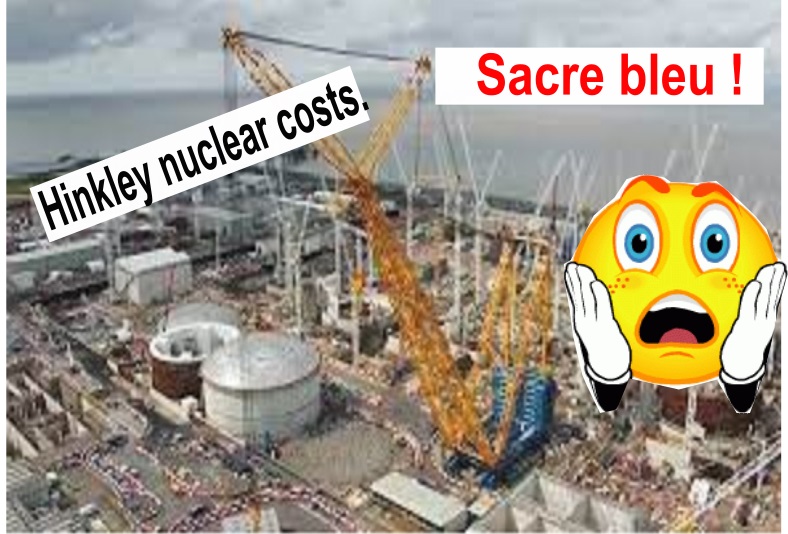
By Leonard Hyman & William Tilles – Jan 31, 2024,
Yes, they are still building the Hinckley Point C nuclear power station in the United Kingdom, and yes the latest estimated cost is more than the previously estimated cost and the completion date has receded another two years into the future.
This nuclear project received its license for construction in 2012, with an estimated cost of £18 billion and completion date in 2025. The last estimate calls for 2029-2031 completion at a cost of £46 billion. To the extent that these estimates can be trusted, the plant would end up costing double the original estimate in real terms. In the same time period, solar and wind costs will decline by at least one half. We are not sure yet whether Hinckley Point will set an all-time record as the most expensive and most delayed power-related project in history, but it certainly will be a contender.
As is the case for so many climate- or security-related projects, the UK government offered significant subsidies to the builder. But in a different way. Most governments, nowadays, offer start-up subsidies in order to bring production levels up to a point where economies of scale kick in, after which costs drop rapidly and consumers get real benefits. The cost curves for wind, solar, and energy storage show how well this strategy works. Give the industry a kickstart and watch the action take place.
Not so with nuclear, where costs seem to rise with encouragement rather than fall. Opting for nuclear, then, seems more like an ideological rather than a technological or economic choice, especially for British Conservative politicians. “Nuclear has to be part of the package”, they seem to say. Even if the nuclear cost per kW installed is five-eight times higher than non-fossil alternatives. But, fortunately, the UK government is not directly on the hook for the added costs, the Chinese co-investor in the project has declared that it will not contribute more, and it looks as if French utility EDF will bear the increased costs if it does not get a new power contract. But if the UK decides to stick EDF with the bill, what will that decision do to discourage further nuclear construction? Given the perilous nature of that construction (namely the danger of cost inflation), who could take the risk of initiating new projects other than a government agency?………………………………………….
Oil Price 31st Jan 2024
1 This Month
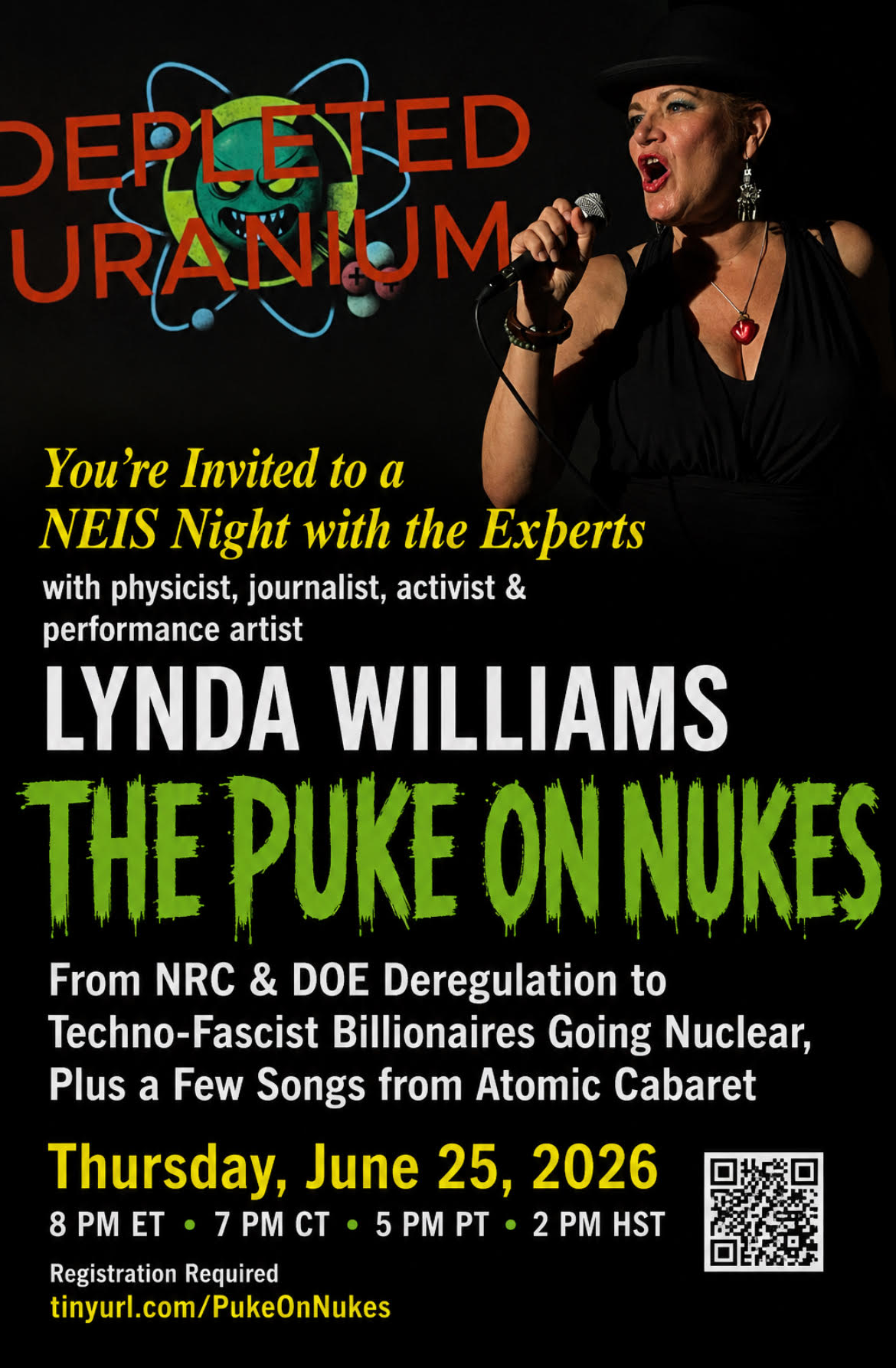
25 June- THE PUKE ON NUKES
Thursday, June 25, 2026
7pm Central Time (8pm ET, 6pm MT, 5pm PT) UTC – 5
From NRC & DOE Deregulation to Techno-Fascist Billionaires Going Nuclear, Plus a Few Songs from Atomic Cabaret REGISTER
26 June – Radiation Trainwreck at the NRC / Join the Protect Better Campaign – https://us02web.zoom.us/meeting/register/4ZlZ5_qLSHGiLSCg8FF6Bg#/registration

1st July – Webinar Waste of Space: The Environmental Harm of Military and Civil Space Activity st July, 7 pm

Report Launch Online: We are seeing an increasing exploitation of space for military and commercial purposes. This must change.

Protect Sazan Island from the Trump family! https://secure.avaaz.org/campaign/en/protect_sazan_island_from_the_trump_family_loc/?bqFCVab&v=174511&cl=22707147157&_checksum=5e9dde668860e8231c33699735e16a1fbf22ab2cb01da50c999fe8732b9775ef&utm_source=email&utm_medium=blast_email&utm_campaign=174511


Cuba Is Not a Failed State – It Is a Besieged State
PETITION: “Global Appeal to Endorse Palestinian Right of Return of Refugees”
To see nuclear-related stories in greater depth and intensity – go to https://nuclearinformation.wordpress.com
-
Archives
- June 2026 (241)
- May 2026 (306)
- April 2026 (356)
- March 2026 (251)
- February 2026 (268)
- January 2026 (308)
- December 2025 (358)
- November 2025 (359)
- October 2025 (376)
- September 2025 (257)
- August 2025 (319)
- July 2025 (230)
-
Categories
- 1
- 1 NUCLEAR ISSUES
- business and costs
- climate change
- culture and arts
- ENERGY
- environment
- health
- history
- indigenous issues
- Legal
- marketing of nuclear
- media
- opposition to nuclear
- PERSONAL STORIES
- politics
- politics international
- Religion and ethics
- safety
- secrets,lies and civil liberties
- spinbuster
- technology
- Uranium
- wastes
- weapons and war
- Women
- 2 WORLD
- ACTION
- AFRICA
- Atrocities
- AUSTRALIA
- Christina's notes
- Christina's themes
- culture and arts
- Events
- Fuk 2022
- Fuk 2023
- Fukushima 2017
- Fukushima 2018
- fukushima 2019
- Fukushima 2020
- Fukushima 2021
- general
- global warming
- Humour (God we need it)
- Nuclear
- RARE EARTHS
- Reference
- resources – print
- Resources -audiovicual
- Weekly Newsletter
- World
- World Nuclear
- YouTube
-
RSS
Entries RSS
Comments RSS
 nuclear-news