Keir Starmer doesn’t speak for Labour members on nuclear weapons
, https://labouroutlook.org/2024/04/14/starmer-doesnt-speak-for-labour-members-on-nuclear-weapons/
‘I am opposed to the use of nuclear weapons. I am opposed to the holding of nuclear weapons. I want to see a nuclear-free world. I believe it is possible.’Keir Starmer, 2015
Labour CND has issued the following statement in response to Keir Starmer’s visit to Barrow, Friday 12 April
Keir Starmer used a visit to Barrow-in-Furness on 12 April to announce Labour’s ‘unshakeable absolute total’ commitment to Trident, Britain’s nuclear weapons system, and Labour’s plan to raise military spending to 2.5% of gross domestic product under a Labour government which means billions of pounds more public funds allocated to the military budget.1
Starmer should be under no illusions. He does not speak for the majority of Labour Party members, however, or even the public on these issues. Nor does this allay Tory voter fears that Labour is a safe pair of hands when it comes to defence.2
Trident is the ‘bedrock of Labour’s plan to keep Britain safe’, he said. The UK’s ‘nuclear deterrent’ was ‘maintained on behalf of NATO’. This was ‘a generational, multi-decade commitment’ from a Starmer government.
International tensions are growing, and with them the risk of nuclear confrontation. Politicians may believe Trident guarantees us a place at the top table. But the assurance of Labour and Tories alike that it brings safety for people in Britain is a cruel illusion. Meanwhile UK domestic politics continues to ignore the true international situation which is that Britain has not signed the UN Treaty on the Prohibition of Nuclear Weapons which came into force in 2021.
Politicians may believe Trident guarantees us a place at the top table. But the assurance of Labour and Tories alike that it brings safety for people in Britain is a cruel illusion.

Starmer doesn’t speak for Labour members on nuclear weapons
Barrow, CND, International, Labour CND, nuclear weapons, starmer, TridentLeave a Commenton Starmer doesn’t speak for Labour members on nuclear weapons
Share
‘I am opposed to the use of nuclear weapons. I am opposed to the holding of nuclear weapons. I want to see a nuclear-free world. I believe it is possible.’Keir Starmer, 2015
Labour CND has issued the following statement in response to Keir Starmer’s visit to Barrow, Friday 12 April
Keir Starmer used a visit to Barrow-in-Furness on 12 April to announce Labour’s ‘unshakeable absolute total’ commitment to Trident, Britain’s nuclear weapons system, and Labour’s plan to raise military spending to 2.5% of gross domestic product under a Labour government which means billions of pounds more public funds allocated to the military budget.1
Starmer should be under no illusions. He does not speak for the majority of Labour Party members, however, or even the public on these issues. Nor does this allay Tory voter fears that Labour is a safe pair of hands when it comes to defence.2
Trident is the ‘bedrock of Labour’s plan to keep Britain safe’, he said. The UK’s ‘nuclear deterrent’ was ‘maintained on behalf of NATO’. This was ‘a generational, multi-decade commitment’ from a Starmer government.
International tensions are growing, and with them the risk of nuclear confrontation. Politicians may believe Trident guarantees us a place at the top table. But the assurance of Labour and Tories alike that it brings safety for people in Britain is a cruel illusion. Meanwhile UK domestic politics continues to ignore the true international situation which is that Britain has not signed the UN Treaty on the Prohibition of Nuclear Weapons which came into force in 2021.
Politicians may believe Trident guarantees us a place at the top table. But the assurance of Labour and Tories alike that it brings safety for people in Britain is a cruel illusion.
The possession of a nuclear weapons system makes the UK a target. The decision to site United States nuclear weapons on British soil – taken without public or even parliamentary debate – puts us on the front line of any nuclear attack.
Britain’s nuclear weapons system is not independent as Starmer claims. Trident is dependent on US technology and know-how.
Even sections of the military recognise that the money spent on Trident would be better deployed elsewhere, arguing for increases in areas of conventional defence.
Disregarding these and many other arguments against nuclear weapons, in a statement shot through with jingoism, Starmer
has made three commitments which he argues will defend the UK economy and prioritise British jobs and skills:
- to build all four new Dreadnought nuclear submarines in the UK, at Barrow-in-Furness;
- to maintain Britain’s continuous at sea nuclear deterrent; and
- to deliver all future upgrades needed to properly equip Trident.
A commitment to increase the military budget means cuts elsewhere in government investment and public spending. Figures released by the Treasury as part of the Spring Budget showed that Core Military Spending was £54.2 billion pounds for the year ending March 2024, around 2.3% of GDP.3 How else will a Labour government, committed to fiscal responsibility as well as lowering taxes, find the extra resources to fund Starmer’s commitment to increase the military budget? It will come at the expense of the NHS, education, and the ability to address child poverty or to abolish the two-child cap on child benefits. It will also come at the expense of dealing with the human security threat of climate change.Labour CND says the next Labour government should not allow its priorities to be dictated by the Conservative Party and their establishment friends. We need is a radical rethink about spending priorities and about British foreign policy.The incoming Labour government will face a range of challenges. None of them will be solved by nuclear weapons or spending ever more money on the military.
Notes
- Keir Starmer, My commitment to the UK’s nuclear deterrent is Unshakeable Absolute Total, Daily Mail exclusive, 11 April 2024 athttps://www.dailymail.co.uk/news/article-13298999/Keir-Starmer-vows-Britains-nuclear-deterrent-safe-hands-promises-unshakeable-commitment- Trident-new-generation-nuclear-submarines-built-UK.htm ↩︎
- See for example the hundreds of reader comments in response to the above, which have appeared within hours of the article being posted online. ↩︎
- Dr Stuart Parkinson, Co-Chair GCOMS-UK (UK branch of the Global Campaign on Military Spending) and Executive Director of Scientists for Global Responsibility, Spring Budget 24: Military Spending Continues to Grow at the Expense of Climate Funds and Overseas Aid, at https://demilitarize.org.uk/spring-budget-24-military-spending-continues-to-grow-at-the-expense-of-climate-funds-and-overseas-aid/ ↩︎
Government could still replace Fujitsu in key nuclear contract
Fujitsu’s first government contract of the year could be just a stay of execution as department says that all replacement options are still being considered.
Karl Flinders, Chief reporter and senior editor EME, 12 Apr 24 https://www.computerweekly.com/news/366580657/Government-could-still-replace-Fujitsu-in-key-nuclear-contract
Fujitsu’s controversial contract with the National Nuclear Laboratory (NNL) was renewed because there were no other suppliers that could meet the regulatory duties required, but the service could be taken in-house next year.
Following the announcement of Fujitsu’s first government contract of the year and a subsequent public backlash, the government has been quick to stress that all options to replace the supplier’s £155,000 software support contract with the NNL, including moving the service in-house, are being considered.
Reacting to criticism for awarding the contract to Fujitsu, which is under intense scrutiny over its role in the Post Office scandal, the Department for Energy Security & Net Zero outlined the reason for Fujitsu’s new deal. “NNL requires bespoke software to ensure its work remains compliant with operationally critical regulations. There are currently no other suitable suppliers and without re-awarding this contract, the NNL would be unable to fulfil its regulatory duties,” said a spokesperson.
But the department added that, “The NNL will consider all options once the contract comes to an end in March 2025, including exploring in-house solutions.
Fujitsu’s huge UK government business is under pressure following public anger at the IT giant’s role as supplier of the Horizon system at the heart of the Post Office scandal. The company has already seen a reduction in public sector contracts this year.
By April 2023, Fujitsu had signed a £25m deal with Bristol City Council, a £16m contract with the Post Office, a deal worth £13m with Northern Ireland Water, an £8m deal with the Ministry of Defence, two deals with the Department for Education totalling £3m, and a contract with Leeds City Council worth up to £100,000. This year the NNL is its sole government contract announced so far.
In another sign of possible reputational damage, earlier this month the Department for Environment, Food and Rural Affairs ended Fujitsu’s role in providing a flood warning system for the UK, two months after signing an extension of up to 12 months.
Read more about Fujitsu’s ‘hollow’ bidding pause
- Leaked comms reveal Fujitsu eyeing huge UK government bounty.
- Fujitsu staff instructed how to bid for government contracts during self-imposed ban.
- Fujitsu should stop bending rules, stop bidding and pay up, says MP.
Fujitsu’s head of Europe, Paul Patterson, promised to pause bidding for government work until after the completion of the statutory public inquiry into the Post Office scandal, following the broadcast of the ITV drama, Mr Bates vs the Post Office, at the beginning of the year.
During questioning by MPs at a business and trade select committee hearing in January, Patterson acknowledged Fujitsu’s part in the scandal, telling MPs and victims: “We were involved from the start; we did have bugs and errors in the system, and we did help the Post Office in their prosecutions of subpostmasters. For that, we are truly sorry.”
But the bidding pause, described as “hollow” by MP Kevan Jones, does not include deals with existing customers in the public sector, of which there are many. Last month, Computer Weekly revealed leaked internal communications that showed Fujitsu is still targeting about £1.3bn worth of UK government contracts over the next 12 months. Further leaked documents revealed that Fujitsu created a spreadsheet instructing staff how to get around its self-imposed ban.
Internal communications seen by Computer Weekly also revealed that Fujitsu is spending heavily on managing the current scandal fallout. It has sought external support in a project known as Holly, where it has engaged PR, ethical business experts and lawyers, at a cost of £27m so far.
The Post Office scandal was first exposed by Computer Weekly in 2009, revealing the stories of seven subpostmasters and the problems they suffered due to the accounting software (see timeline of Computer Weekly articles about the scandal below).
Fresh blow for UK nuclear as the City snubs Sizewell C

By FRANCESCA WASHTELL , 14 April 20 24, https://www.thisismoney.co.uk/money/markets/article-13304269/Fresh-blow-UK-nuclear-City-snubs-Sizewell-C.html
Britain’s flagship nuclear plant could face greater dependence on foreign cash after a string of big-name City firms snubbed a chance to fund the project.
Phoenix, Abrdn and Aviva had said they would consider supporting new nuclear plants and were thought to be in the running to back Sizewell C in Suffolk.
But all have now said they are not in negotiations to take an equity stake in the power station, according to emails sent to campaign group Stop Sizewell C and seen by The Mail on Sunday.
This is a bitter blow for Ministers, who spent years changing the funding model for giant infrastructure works to entice City investors such as Phoenix and Aviva. The model, known as the regulated asset base, enables investors to receive dividends on projects still being built.
Sizewell C has been dogged by delays for years, and the Government has still to finally decide whether it will go ahead.
A series of pension funds, including BT, NatWest, and Nest, have ruled out backing the plant, which will cost at least £20billion.
Alison Downes of Stop Sizewell C said: ‘The Government has spent years planning and legislating to allow the funding model for Sizewell C, with the objective of attracting UK pension funds. The strategy has not succeeded, which is hardly a surprise considering the many uncertainties, including what the project will actually cost.’
In January, the Government committed a further £1.3billion of funding to Sizewell C, which will go on early building work.
Six groups are in talks with the Government over funding the project, with at least one understood to be from the Emirates.
British Gas owner Centrica is also thought to be in the frame.
Pressure is mounting after EDF this year began pressing the Government to help fund cost overruns on Hinkley Point C in Somerset. The French utility group said the price tag for that plant – which is the same type planned for Sizewell C – could hit £46billion from an initial estimate of £18billion. The Suffolk plant could power six million homes for 60 years, but would take nine to 12 years to build.
Ministers have also backed programmes to set up small nuclear reactors, especially a Rolls-Royce-led firm designing these easy-to-assemble plants.
Industry sources say these are likely to be more attractive to investors as they are quicker and cheaper to build.
Sizewell C Nuclear : too destructive, too costly, too late

The Article, by IAN LINDEN, 14 Apr 24
Joan Girling grew up near the Suffolk coast, with its little terns, barn owls, harebells, ladies bedstraw, sedums, blue butterflies and acid grassland. There was no nuclear power station. “It was perfect, a nature lover’s paradise,” she told me.
In 1959, Joan’s father, faced with compulsory purchase, was forced to sell off a corner of their front garden, with its large pond full of water lilies and wildlife. It was to make way for workers’ traffic to the site of Sizewell A, a nuclear power station. Sizewell A is today a great, ugly, Stalinist-looking excrescence looming above the seashore. Her grandmother, who lived next door, watched as they filled in the pond. “The worst part was to hear my Grandma crying. I remember it as if it was yesterday.”
In the late 1980s it all happened again: Sizewell B. This time Joan moved house with her family to escape construction traffic. From 1993-2005 she served on Suffolk County Council. Fifteen years ago, Joan Girling became a founding and deeply dedicated member of Community against Nuclear Expansion, later renamed Together Against Sizewell C (TASC).
The human and environmental costs ought not be underestimated. The disruption and destruction accompanying years of building accounts for the level and persistence of local protest. Stop Sizewell C, originally a parish of Theberton and Eastbridge action group, alongside the local Friends of the Earth, joined TASC in a long-running legal campaign. Crowdfunding helped finance three rounds of court action seeking judicial review of the Sizewell C project. The last one challenged the Business Secretary (then Kwasi Kwarteng) over his 2022 Development Consent Order giving the green light to start construction. Kwateng rejected the Planning Inspectorate’s conclusion (part of the process required by the 2008 Planning Act) that in the absence of an assessed, permanent, potable water supply for the project, “the case for the grant of development consent is not yet made”. Sizewell C will be forced to use a desalination plant during construction. The Court of Appeal found for the Government in December 2023.
The construction of Sizewell C means heavy truck traffic. New roads, a large park and ride facility, as well as a railway branch line, will have a major impact over a large area. Much of it is designated by Natural England — sponsored, incidentally, by the Department of Environment, Food and Rural Affairs (DEFRA) — as a Suffolk Coast and Heaths National Landscape (formerly Area of Outstanding Natural Beauty). A small bite comes out of reed beds and marsh land, designated a Site of Special Scientific Interest. The new reactors will lie right next to Minsmere, a popular RSPB reserve where the drain-pipe boom of the bittern can be heard. Building Sizewell C will blight tourism for two decades, though it will boost other aspects of the local economy. But before dismissing protest as Nimbyism, it is as well to evaluate what lies in the backyard………………………………………………………………………….. more https://www.thearticle.com/sizewell-c-too-destructive-too-costly-too-late
Sizewell C Fiasco Part 4. Much more expensive than renewables- Unknown cost or period for Investors
Sizewell C Fiasco Part 4 Much more expensive than renewables- Unknown cost or period for Investors
Sizewell C was given the go ahead against the advice of the Planning
Inspectorate by politicians who have since mainly been discredited. They do
not have the finance in place yet – a staggering £30 billion plus?
Yet the Government have been chucking hard pressed taxpayers’ money at the project
and Sizewell C Project have started massive pre-construction works. If they
can cause this much Eco/ Landscape devastation even now, what will they do
if they get the go ahead on construction?
Sizewell C would be a disaster
for the Environment and the Landscape. Taxpayers and Investors will be
financing a bottomless pit. Locked in for decades to paying much more than
the cost of wind or solar energy. Even if finished on time – which is very
unlikely – it would be far too late for any energy crisis. Which would be
caused by the current bad or lack of – planning and management for energy
production and a hopeless so-called National Grid (run for shareholders not
UK Taxpayers).
If built Sizewell C would be too late to contribute to net
zero and its construction would produce vast amounts of carbon and other
pollution for well over a decade at least. Not to mention the much more
radioactive waste from this unproven EPR type of reactor which is too hot
to move until the next century – so has to be stored on site on an eroding
coastline! The whole thing is bonkers!
Stop Sizewell C 8th April 2024 https://www.youtube.com/watch?v=o4ICw23iYY0
Civil and military nuclear mutuality

‘The UK government is pursuing an uneconomic nuclear programme in large part so as to maintain & renew military nuclear capabilities’.
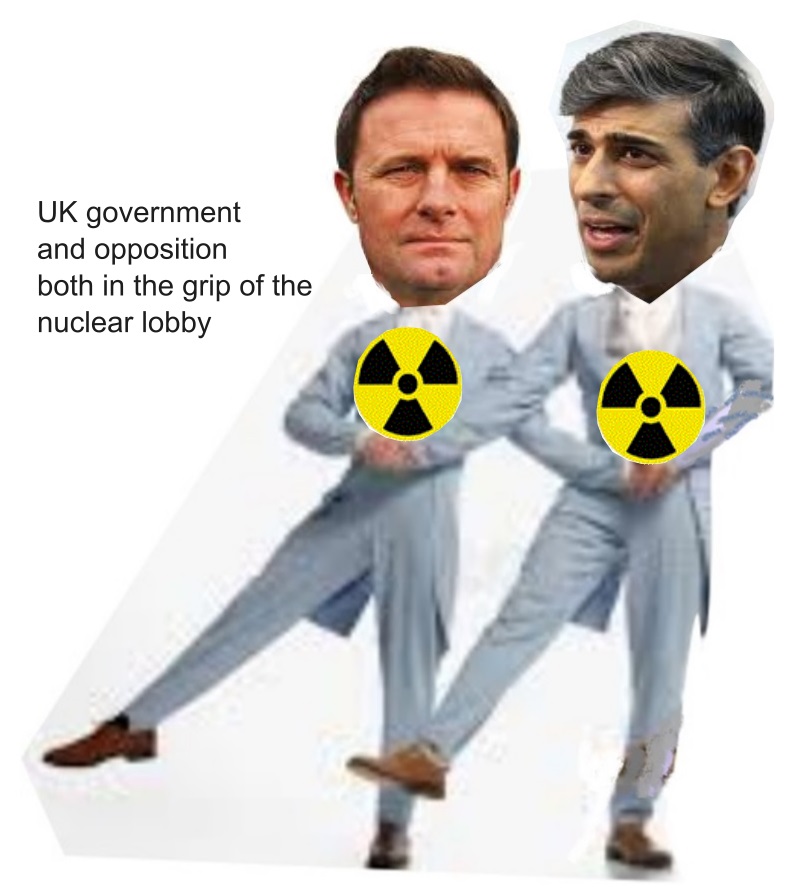
Rishi Sunak backs both civil and military nuclear: ‘Safeguarding the future of our nuclear deterrent and nuclear energy industry is a critical national endeavour’. French president Emmanuel Macron is even more upfront about it all: ‘Without civil nuclear power, no military nuclear power, without military nuclear, no civil nuclear.’ With the USA, China and Russia also evidently locked into similar paths, the global future doesn’t look too good.
‘The UK government is pursuing an uneconomic nuclear programme in large part so as to maintain & renew military nuclear capabilities’.
backs both civil and military nuclear: ‘Safeguarding the future of our nuclear deterrent and nuclear energy industry is a critical national endeavour’. French president Emmanuel Macron is even more upfront about it all: ‘Without civil nuclear power, no military nuclear power, without military nuclear, no civil nuclear.’ With the USA, China and Russia also evidently locked into similar paths, the global future doesn’t look too good.
Renew Extra Weekly, 13 Apr 24
Until recently, the UK government has always said that civil and military nuclear technologies were separate things, for example in response to claims that expansion of civil nuclear power capacity could lead to proliferation of nuclear weapons making capacity. But, as researchers at the University of Sussex have relentlessly catalogued, there seems to have been a change of view underway, culminating formally in March in a new policy document from No. 10 Downing Street. Entitled ‘Building the Nuclear Workforce of Tomorrow’ it claims that ‘domestic [civil] nuclear capability is vital to our national defence and energy security, underpinning our nuclear deterrent and securing cheaper, more reliable energy for UK consumers’. So they are intertwined and mutually beneficial- we need both!
UK Prime Minister Sunak says that ‘in a more dangerous and contested world, the UK’s continuous at-sea nuclear deterrent is more vital than ever’ and that civil nuclear power is the ‘perfect antidote to the energy challenges facing Britain- it’s green, cheaper in the long term and will ensure the UK’s energy security for the long term’.
There are many issues raised by these claims. Leaving aside all the major moral and political issues associated with nuclear weapons, it is not at all clear that new nuclear reactors will be as costs effective as renewables. Indeed, the cost of renewables has fallen dramatically in recent years while the cost of nuclear projects has continued to escalate. It could be that, recognising this imbalance in cost, what we are now seeing is the government trying to provide a compensating justification for new civil nuclear- it will aid defence. Even if, arguably, it makes little economic sense as Business Green argued: ‘The UK government is pursuing an uneconomic nuclear programme in large part so as to maintain & renew military nuclear capabilities’.
Basically, as the Sussex University researchers have argued, it does seem that the government is just responding to military pressures. More specifically though, it’s a matter of rapidly expanding skill requirements- and shortages. Matthew Lay, Head of EDF Nuclear Skills Alliance, says that ‘the UK Government’s commitment to nuclear power must be seen in the context of a steady increase of nuclear capacity worldwide as well as growth in defence expenditure,’ and especially the growth in the ‘defence industry’s demand for nuclear skills, to deliver established and new nuclear submarine programmes’. So it’s about expanding nuclear skills for building nuclear sub power plants and civil reactors, including possibly Small Modular Reactors (SMRs), which have some similarities. Presumably also about making fuels for them both too.
Some may be happy about civil-military skill sharing, but it’s a long way from the old rhetoric about ‘atoms for peace’. In 1953 President Eisenhower called for nuclear bomb technology to be turned to peaceful ends around the world, with US help e.g. in transferring nuclear plant technology to developing countries. That had floundered due, in part, to the high cost of nuclear plants. According to a review by Drogan, a State Department Intelligence Report, circulated in January 1954, ‘Economic Implications of Nuclear Power in Foreign Countries’, noted that ‘nuclear power plants may cost twice as much to operate and as much as 50 percent more to build and equip than conventional thermal plants’. So it warned that the introduction of nuclear power would ‘not usher in a new era of plenty and rapid economic development as is commonly believed’. You could say that we are still waiting!
There were also potential conflicts between the ‘atoms for peace’ idea and proliferation issues. Indeed that is now even more of a problem, with some newly developing countries, following the UAE’s lead, looking to have nuclear plants, which, in theory, could give them the ability to make bombs. And (the Nuclear Proliferation Treaty apart!) why not, if nuclear weapons states like the UK are seen as no longer maintaining a clear separation between civil and military nuclear technology? Except of course the high cost of civil nuclear may make renewables a much better deal- especially solar, of which many countries (in the Middle East and Africa for example) have plenty. ……………………………………………………………………………..
Clearly UK Prime Minister Sunak doesn’t see it this way- he backs both civil and military nuclear: ‘Safeguarding the future of our nuclear deterrent and nuclear energy industry is a critical national endeavour’. French president Emmanuel Macron is even more upfront about it all: ‘Without civil nuclear power, no military nuclear power, without military nuclear, no civil nuclear.’ With the USA, China and Russia also evidently locked into similar paths, the global future doesn’t look too good.
Do we really have to continue with all this? In 1995, Sir Michael Atiyah, then retiring as President of the Royal Society, said ‘I believe history will show that insistence on a UK nuclear capability [weapons and energy] was fundamentally misguided, a total waste of resources and a significant factor in our relative economic decline over the past 50 years’. He may have been right. https://renewextraweekly.blogspot.com/2024/04/civil-and-military-nuclear-mutuality.html
The Scottish National Party support signing an international treaty banning nuclear weapons, post independence

THE SNP support signing an international treaty banning nuclear weapons
after independence – despite External Affairs Secretary Angus Robertson
refusing to say as much, The Sunday National understands. The news comes
after Robertson repeatedly declined to commit an independent Scotland to
signing the UN Treaty on the Prohibition of Nuclear Weapons (TPNW) at the
launch of a government white paper on Scotland’s place in the world in
March. The SNP have been clear that the UK’s nuclear weaponry, which is
based on the River Clyde, would have to leave the country after a Yes vote.
Former first minister Nicola Sturgeon had said in 2021 that an independent
Scotland “would be a keen signatory” to the TPNW.
The National 14th April 2024
‘Unprecedented infestation’ of rats at Dounreay site
‘Unprecedented infestation’ of rats at Dounreay site. Dounreay has had to
bring in a pest control company to deal with an “unprecedented infestation
of rats over the past few months,” according to a safety rep at the site.
Workers, too, have expressed their concerns about the situation with one
saying hundreds were reportedly seen “scurrying away” when pampas
grass-like plants were removed from around the buildings where they were
nesting.
There have been reports of the rats being seen in vehicles, a
kitchen area and near bins, while concerns have been raised about health
implications.
John O’Groat Journal 11th April 2024
https://www.johnogroat-journal.co.uk/news/unprecedented-infestation-of-rats-at-dounreay-site-347661
Keir Starmer slammed over staunch defence of nuclear weapons

“it’s increasingly clear that Starmer’s offer is just more of the same: billions of pounds wasted on nuclear weapons and nuclear power, and a belligerent foreign policy that includes support for the Aukus pact, Nato, and continuing arms sales to Israel, used to kill Palestinians.
“Putting billions of pounds into the pockets of arms companies and their investors will not reinvigorate the economy in any meaningful way.”
The National By Hamish Morrison @HMorrison97 Political Reporter, 10 Apr 24
KEIR Starmer has said Trident is the “bedrock” of Labour’s defence policy – despite growing concern over the state of the ageing nuclear fleet critics say is a “grotesque” waste of money.
The Labour leader launched a full-throated defence of Britain’s nuclear weapons in an attempt to stress the distance he has taken the party since its leadership under Jeremy Corbyn – who voted against the renewal of Trident while in charge.
During a visit to Barrow today, where nuclear submarines are being built, Starmer is expected to focus on increasing jobs and skills in defence.
Starmer said: “The changed Labour Party I lead knows that our nation’s defence must always come first. Labour’s commitment to our nuclear deterrent is total.
“In the face of rising global threats and growing Russian aggression, the UK’s nuclear deterrent is the bedrock of Labour’s plan to keep Britain safe.
“It will ensure vital protection for the UK and our Nato allies in the years ahead, as well as supporting thousands of high paying jobs across the UK………………………..
Labour will ensure that new UK leadership within Aukus helps make this national endeavour a success for Britain.”
The Aukus pact unites Australia, the UK and the USA in a military pact in the South Pacific, which critics say escalates tensions with the Chinese.
China’s government has described Aukus – which will see Australia provided with nuclear-powered submarines – as indicative of an “obsolete Cold War zero sum mentality”.
The SNP have said Labour’s commitment to Trident was “grotesque”.
Martin Docherty-Hughes (below), the party’s defence spokesperson, said: “Westminster has already wasted billions of pounds of taxpayer’s money on nuclear weapons and expensive nuclear energy.
“It is therefore grotesque that Sir Keir Starmer is prepared to throw billions more down the drain when his party claim there is no money to improve our NHS, help families with the cost of living or to properly invest in our green energy future.
“This money would be better spent on a raft of other things – not least investing in the green energy gold rush, which would ensure Scotland, with all its renewal energy potential, could be a green energy powerhouse of the 21st century.”
He blasted the “misfiring Trident missiles”, drawing attention to a high-profile blunder which saw a test missile dramatically fail to launch, landing just yards from the submarine carrying it.
Docherty-Hughes said the Government should provide more money for “underpaid and under-resourced” armed forces staff and conventional defence systems.
Alba general secretary Chris McEleny, who worked at HM Naval Base Clyde, where nukes are stored, said: “When one in four children in Scotland live in poverty it is obscene that resources are wasted to ensure that we have the best defended foodbanks in the world.”
He added that the “war-mongering Labour Party have now made it clear that independence is the only way to free Scotland of nuclear weapons”.
Healey, Labour’s shadow defence minister, said a “strong defence industrial strategy” would be “hardwired” in the party’s quest to promote economic growth if it gains power at the election.
He added: “We will make it fundamental to direct defence investment first to British jobs and British industry.”……………………………..
Kate Hudson, general secretary of the Campaign for Nuclear Disarmament, said voters were “desperately looking for hope from the Labour Party”.
She added: “However, it’s increasingly clear that Starmer’s offer is just more of the same: billions of pounds wasted on nuclear weapons and nuclear power, and a belligerent foreign policy that includes support for the Aukus pact, Nato, and continuing arms sales to Israel, used to kill Palestinians.
“Putting billions of pounds into the pockets of arms companies and their investors will not reinvigorate the economy in any meaningful way.” https://www.thenational.scot/news/24248069.keir-starmer-slammed-staunch-defence-nuclear-weapons/
UK Government decision to withhold nuclear power plant information unlawful
Government decision to withhold nuclear power plant information unlawful.
A ruling by the Information Commissioner (IC) requiring the Secretary of
State for Energy Security and Net Zero requesting the disclosure of
information in respect of a proposed nuclear power plant on Anglesey was
upheld by the General Regulatory Chamber (GRC) which concluded that the
public interest supported its disclosure.
Planning Resource 11th April 2024
Nuclear energy ‘now an obstacle to delivering net zero’ – Greenpeace.
Nuclear energy has been touted as key to the global transition,
but concerns around costs and timescales have generated scepticism.
According to Greenpeace director of policy Doug Parr: “Nuclear power
can’t bridge the gap between anything and anything. It is too slow. It is
too expensive. It is a massive distraction.”
Speaking about the role of
nuclear energy in the UK’s transition, Parr tells Energy Monitor: “It
doesn’t help with the kind of grid system that we need, which is going to
be renewables heavy. I think the UK focus on nuclear power is now an
obstacle to delivering net zero because it is sucking up time, energy and
political bandwidth, which can be spent on more useful things.”
Parr argues that governments should be investing in more immediate solutions. He
points to investment in Sizewell C – the 3.2GW power station set to be
built in the English county of Suffolk – where construction is set to
commence this year. It is likely to take between nine and 12 years to
complete, but delays at Hinkley C (of which Sizewell C will be a close
copy) have stirred doubt.
“We will be putting a lot of money into
something like Sizewell C, when actually we will find that it is a white
elephant by the time it has opened,” he contends. “We will have spent
all that time, energy and effort, which could have been put into improving
our housing stock, improving our grid or improving the ability of electric
vehicles to meet the needs of people through a proper charging network –
things that would actually would deliver this decade, not in 15 years time.
So, we would cut a lot more carbon, we would get something done that is
useful and we wouldn’t have piles of messy radioactive waste that we
still don’t know what to do with.”
Energy Monitor 10th April 2024, https://www.energymonitor.ai/features/nuclear-energy-now-an-obstacle-to-delivering-net-zero-greenpeace/
Why you probably shouldn’t become a Community Interest Company
by preorg, https://preorg.org/why-you-probably-shouldnt-become-a-community-interest-company/
Imagine you have sacrificed hundreds of hours of your volunteering time to a non-profit organisation doing good work. After years of effort, often exhaustion, you discover that the directors don’t care that much about whether you succeeded in helping those people you intended to help. They care mostly about how much time they can spend at the swimming pool at their second home in Spain. Your volunteer hours have helped fund that lifestyle.
How could such a situation arise? Aren’t charities supposed to have boards of governors that keep the organisation on track? But wait, it wasn’t a charity! It was a Community Interest Company. Now, I should say that I don’t currently know of any such dramatic betrayals of people’s goodwill. But what I will argue here is that this situation arising in some CICs is bordering on inevitable, given the operating parameters of CICs. Given the weakness of regulation of the companies, almost boasted about by the CIC Regulator, it’s only a matter of time.
Why would I think that? Most people seem happy with CICs; Community Interest Companies are a success story, we are told. There are now many thousands of CICs in the UK, all having appeared within the space of ten years. This rapid rise in fact means that many people have chosen a form the long-term resilience of which has yet to be tested. It would be exciting to write an article about all the horribly failed CICs littering the social economy landscape. But I don’t know of any; I can only do a much less exciting job: pointing out what’s wrong with CICs before they start to fail. My contention is that, with the help of an FOI request to the CIC Regulator, we can see that certain types of failure are predictable. As for why we haven’t seen the failures yet, it is largely because CICs are young and in most of them the founders are still in charge.
The CIC was designed for organisations with social goals. It must operate in the ‘community interest’, which is defined in the articles of the organisation. It is also chosen over charities as an organisation that can more easily buy and sell commercially. But among the people I have asked, the main reason for opting for a CIC has been that it is easy. It is a lightweight structure, it is unencumbered by bureaucracy. It can be set up in a couple of days and can adapt quickly to changing conditions since it doesn’t have long lists of rules in its constitution. More like a standard profit-making company then, but with social objectives built in. Supposedly. More on that later.
By comparison both charities and co-operatives or community benefit societies (BenComs) have a lot more rules. Rules! How annoying! How limiting! But hang on a moment, why, if rules are so tedious, do those other organisations bother with them? The answer is that most of the rules are about accountability. In the case of a charity, the board of trustees, who must be consulted on significant matters, exist to keep the charity in line with its social aims. In co-ops and BenComs it is the membership who must constantly be consulted, and who choose who leads the organisation. Democracy certainly can be quite annoying.
By comparison a standard CIC is at the mercy of its directors, who needn’t even be many in number. That’s fine, I hear some say, I am the director, and I trust myself to make good decisions. Perhaps, but do you intend to lead the organisation forever? Even if you plan to live forever, what happens if you get ill, or leave through some other reason beyond your control? The purpose behind many accountability mechanisms is that they transcend the ideals of one particular person. They embed the ethics and goals into the DNA of the organisation, whoever may be running it at a given time. So how long do you want your organisation to last?
There is one supposed accountability mechanism in CICs: the government regulator. In theory the Office of the Regulator of Community Interest Companies has a lot of power to force CICs to stick to their aims. In practice it appears to do very little, priding itself on being a ‘light touch’ regulator. When I contacted the Regulator, they explained that in the last year they received 57 complaints, only 3 of which resulted in an intervention by the regulator. None of these 3 were related to the community benefit requirements. The Regulator has so far never wound up a CIC or stripped one of its CIC status. The Regulator has no records of intervening in a CIC on the basis of the standard paperwork submitted each year, which in part reports on the organisation’s performance under its community benefit requirement. That is to say, there appears to be no pro-active monitoring of whether CICs are operating for community benefit.
Even Social Enterprise UK, a fan of the CIC form, has raised questions over the strength of the Regulator. This accountability mechanism begins to look weak, to say the least. I’m not sure it will ever improve either. I doubt the regulator will ever be well enough funded to investigate what is going on in tens of thousands of organisations. We should not look for accountability in the CIC regulator.
Let’s move on to another question, a special case of the accountability problem: what profits can be made from a CIC, often presented as a non-profit structure? There is a CIC limited by shares that is allowed to make a profit. Previously there was a dividend cap of 20% of share value in any given year. This was considered by the government to be ‘inhibiting investment’ so in 2014 they removed the cap. Say that again? Annual 20% profits inhibiting investment?
Let’s leave that aside. In fact the majority of CICs are limited by guarantee and are more genuinely non-profit in form. There are, however, a couple of massive catches. The directors of a CIC can pay themselves whatever they can argue could reasonably be seen as necessary, as long as they are still fulfilling their social objectives. As determined by the aforementioned ‘light touch’ regulator. A CIC with a turnover of some millions a year could in theory pay the directors a million a year, if they could argue that without the salary they couldn’t retain the talent they need. Is it still a non-profit? This raises the aforementioned scenario of people putting in hundreds of volunteer hours for a supposed non-profit while the directors are buying holiday homes in the Mediterranean.
The second problem is that nobody is paying any attention to who CICs contract out work to. If a CIC pays huge ‘management fees’ or overpays on a cleaning contract to a company that happens to be owned by, say, the partner of a director, any money in the organisation can very easily be siphoned out to profit-making enterprises. In a charity the board and regulator would keep a sharp eye on this type of activity; the CIC regulator barely seems to glance at the paperwork.
You, the current director, might not abuse your position so, but can you be so sure of your successors? We only need to look at Housing Associations for a case study in organisational mission drift, in part driven by the high salaries CEOs have been able to pay themselves.
A word too on putting an informal democratic structure on top of an undemocratic CIC: I’m told that the Centre for Alternative Technology in Wales acted for years like a co-operative, and those involved assumed that’s what it was. But it never took a co-operative legal form, so when it ran into trouble, new leadership bulldozed aside the democracy people had assumed was one of the core values of the organisation. CAT is at least a charity, but the lesson is that informal structures can be dispensed with any time the CIC directors get tired of them.
But surely there must be a right situation for a CIC? Perhaps. A CIC could be right for an organisation that is mostly a trading organisation and is for a short-term project which won’t exist for long. If the project is intended to run long-term, I don’t believe the CIC is a reliable form. It is at the mercy of the leadership that follows you, if not your own leadership. The CIC Regulator is not the safety net you need. For most people it would be worth choosing an organisational type that seems more ‘difficult’ in the short term, but will almost certainly be more sustainable and accountable in the long run.
For existing successful CICs, why would they bother to change if they are doing well as they are? Let’s remember they are still young organisations. Do we want to wait twenty years to see the emergence of accountability and mission-drift problems that are, I am suggesting, rather predictable? Mission-drift that the Regulator will never pick up on unless someone reports it?
There are a few ways to mitigate the risks here. The best option for many would be to convert into a co-operative CIC. Co-ops UK offers one set of model rules for this, and the Somerset Rules can also convert a CIC into a multi-stakeholder co-op. It will cost time and money, it is true, to change the rules, but it will surely not be as painful as the organisation going off track in a few years’ time after the founders have retired.
The second best option is to add democratic rules to the CIC. It is a benefit of CICs that they are very flexible. The CIC Regulator offers model rules of a participatory organisation of large membership, though it is still very much director-controlled. It is theoretically possible to set up a more democratic membership structure without being a co-operative. While this method may miss out on embedding some of the checks and balances that co-ops have developed over the years, it could make the organisation more accountable. But remember, rules that can be added can be taken away. Only co-ops and their cousins, community benefit societies, lock democracy in permamently.
Finally, if actual democracy seems too great a task, it is at least possible to simply install more directors onto the CIC board, preferably those affected by what the organisation does, and so establish a strong democratic culture among the CIC directors. It’s not a perfect fix, but increased collective decision-making will mitigate the problems of a top-down culture reliant on the goodwill of two or three people.
For those who haven’t started their organisation yet, this is a plea to consider that a sustainable organisation is an accountable one, and democracy is one of the best ways to ensure accountability. Thankfully others, in the form of the co-operative movement, have already paved the way for us.
Five Years At Belmarsh: A Chronicle Of Julian Assange’s Imprisonment.

Kevin Gosztola, Apr 11, 2024, https://scheerpost.com/2024/04/12/five-years-at-belmarsh-a-chronicle-of-julian-assanges-imprisonment/
Calls for Assange’s freedom are renewed as the WikiLeaks founder marks five years in Belmarsh prison.
At the behest of the United States government, the British government has detained WikiLeaks founder Julian Assange in His Majesty’s Prison Belmarsh for five years.
Assange is one of the only journalists to be jailed by a Western country, making the treatment that he has endured extraordinary. He has spent more time in prison than most individuals charged with similar acts.
Since December 2010, Assange has lived under some form of arbitrary detention.
He was expelled from Ecuador’s London embassy on April 11, 2019, and British police immediately arrested him. Police transported Assange to Belmarsh, a maximum-security facility often referred to as “Britain’s Guantanamo.”
Around the same time, the U.S. Justice Department unsealed an indictment that alleged that Assange had conspired with U.S. Army whistleblower Chelsea Manning to commit a “computer intrusion.” The following month the DOJ issued another indictment with 17 additional Espionage Act charges.
2019
On May 1, Assange was sentenced by a British court to 50 weeks in prison as punishment for seeking political asylum from Ecuador while Sweden was attempting to extradite him. His sentence was longer than the six-month sentence that Jack Shepherd, the “speedboat killer” received for “breaching bail.”
Continue readingBUSINESS AS USUAL FOR BRITAIN’S WEAPONS EXPORTS
WEAPONS MADE ON MY DOORSTEP ARE HELPING TO KILL PEOPLE IN GAZA
British voters want to stop arming Israel, so why are spineless politicians ignoring them, asks Amy Hall.
This week, Foreign Secretary David Cameron confirmed that the UK government will not join the handful of Western countries that have stopped sending arms to Israel. Weapons exports from the UK will continue. The majority of voters are in favour of a ban and three British aid workers were among the seven killed by an Israeli air strike last week. But for Cameron and his cronies, it’s business as usual.
Britain has a long-standing commitment to arming the violence of the Israeli state and its occupation of Palestine. According to the Campaign Against the Arms Trade, Britain licensed around $556 million worth of arms to Israel between 2015 and 2022.
Those of us in Britain who are devastated and incensed by the endless death and destruction in Gaza are apparently to take reassurance from Cameron’s insistence that government ministers have ‘grave concerns around the humanitarian access issue’ there.
But these concerns appear not to be grave enough to challenge Britain’s own arms industry and its role in Israel’s ongoing genocidal campaign on Gaza. The weapons manufacturing taking place in my city assures me of that.
NO BOMBS FROM BRIGHTON’
Just a few kilometres from where I live in Brighton & Hove, on the South Coast of England, locals have set up a protest camp near to a factory that has been oiling the global war machine for many years. L3Harris makes bomb release mechanisms for F35 and F16 fighter jets, used by government armies including the Israeli Defence Forces.
Since 15 March, Brighton Peace Camp has been welcoming visitors, hosting everything from storytelling for kids to workshops on topics ranging from local antifascist history to Dabke, a Palestinian folk dance. The camp has also hosted an Iftar/Shabbat meal organized by Brighton and Hove Jews Against the Occupation.
‘We need to take every action in our power to stop the genocide in Gaza,’ said Sarah, from the group Brighton Against the Arms Trade. ‘We need to look at where the weapons are produced and disrupt the production and supply chain. L3Harris in Brighton is a critical part of that.
‘We demand a just transition towards the development of renewables, which must and can start now. Production at the factory must stop immediately and all components must be decommissioned.’
Local people have been campaigning against L3 Harris (formerly EDO MBM Technology Ltd) for decades. The company is now seeking to further solidify its mark on the city by making permanent an extension to its factory that was built in 2018. But thanks to intense opposition from local people, including some members of Parliament and city councillors, Brighton & Hove City Council (BHCC) has been under pressure not to grant planning permission. Nearly 650 objections were submitted to the application.
The local campaign against the arms factory, StopL3Harris, is asking people to call on their political representatives to join the calls to refuse the planning request. It was due before BHCC’s planning committee in March but was delayed as the Council seeks legal advice. Two out three of the city’s MPs: the Green Party’s Caroline Lucas and Labour’s Lloyd Russell-Moyle have submitted objections. The third MP, Labour representative Peter Kyle, has not.
Brighton is not the only British city where this kind of manufacturing is taking place. CAAT estimates that British industry makes 15 per cent of every F35 combat aircraft that Israel uses in its assault on Gaza. The campaign has mapped UK companies involved in manufacturing components for the F35 and estimates that the value of Britain’s supplies to be worth at least $422 million since 2016.
EXPORTS TO ISRAEL CAN BE STOPPED
In response to growing pressure, a number of countries have already stopped sending arms to Israel. ‘Denmark and Canada have both recently ruled to halt arms sales to Israel – so why not the UK?’ said Marnie, a Brighton & Hove resident who is taking part in the Peace Camp.
In February, a court of appeal in the Netherlands ordered the Dutch government to stop arms exports to Israel within the F35 programme, stating that it would violate the EU Common Rules for Arms Exports and the UN Arms Trade Treaty.
The UN welcomed the decision and called for arms exports to Israel to ‘stop immediately’, as any transfer of weapons or ammunition that would be used in Gaza is likely to violate international humanitarian law.
More than 600 lawyers have also warned the British government that arms exports to Israel risk legal violations. A senior MP for the leading Conservative party has said that the government has kept under wraps advice from its own lawyers that Israel has broken international law.
Too many of our elected representatives seem to be living in a parallel universe, dismissive of international law and apparently unperturbed by the suffering of the Palestinian people. Yet those of us who support a weapons ban, continue to watch in horror the endless stream of videos of crying children carrying their dead siblings, images of skeletal children starved to death, and the massacres of civilians and aid workers in the simple act of delivering food.
Cameron should be more than ‘concerned’ about the six children killed each day during the current offensive in Gaza. If our politicians were serious about the humanitarian situation, our politicians would be pushing for an immediate and permanent ceasefire, an end to the blockade of the Gaza strip, and an end to Israel’s occupation of Palestine.
Until then, as the money keeps flowing and the bombs keep dropping, we will continue to march, boycott, protest, donate, camp and cry until Palestine is free.
Hunterston: Scottish National Party see no nuclear future due to terrorism risk.
Largs and Millport, 11th April, By Calum Corral @CalumCorral, Senior Reporter
The SNP has warned of a possible terrorism risk in North Ayrshire if Scotland were to return to nuclear power.
The warning came after one of the party’s North Ayrshire Council opponents raised a motion asking the authority to back calls to consider Hunterston and Ardeer as sites for
‘small modular nuclear reactors’ (SMRs). Todd Ferguson (Conservative, North
Coast) lodged a motion asking that the council’s chief executive write to
the UK Government asking them to consider the two North Ayrshire sites for
SMR developments, “thereby protecting our excellent nuclear workforce and
providing vital employment for generations to come.”
During the debate in the council chamber, Councillor Eleanor Collier (SNP, North Coast) praised the contribution of Hunterston A and B nuclear power stations to the
Scottish electricity supply since 1964 and 1976 respectively.
But she said it was “time to move to a safer more acceptable zero carbon alternatives to
meet our energy requirements and look at renewable employment
opportunities”. Cllr Collier added: “The Scottish Government is clear that
nuclear power is not wanted nor needed. “The objective of energy policy is
to progressively increase the generation of renewables and clean energy and
renewables to migrate away from dependency on nuclear power.
“I think we all know that nuclear power generation is more expensive than renewables,
and it leaves the problem of nuclear waste and how to deal with the
redundant facilities afterwards. There are inherent risks with the
process.
“It is important to note that Sellafield [in Cumbria] has shut its
doors to taking in spent nuclear fuel rods, so if we did have nuclear rods
to deal with they would have to be disposed of locally, not to mention the
risk of theft and misuse by terrorists of uranium products.
“There are many questions around the cost effectiveness and safety of these new SMR
designs. “SMRs are smaller, but because of that they lose the economy of
scale, and the unit price rises.” Cllr Collier also cited scientific
studies which stated that SMRs generate more radioactive waste than
conventional nuclear power stations, and use more plutonium.
She said that zero carbon and renewables were the way ahead for Hunterston and pointed to the £1.4bn XLCC cable manufacturing project, which is projected to bring
900 jobs to the area over the coming years. Conservative councillor Tom
Marshall said; “We are talking about a climate change emergency. “The
Scottish Government is missing its targets, but nuclear power could help
meet those targets.
Largs & Millport Weekly News 11th April 2024
**CoRWM**
CoRWM Minutes of Meeting 12th Sept 2023.
CoRWM 11th April 2024
CoRWM Minutes of Meeting 28th November 2023 CoRWM 11th April 2024
1 This Month

25 June- THE PUKE ON NUKES
Thursday, June 25, 2026
7pm Central Time (8pm ET, 6pm MT, 5pm PT) UTC – 5
From NRC & DOE Deregulation to Techno-Fascist Billionaires Going Nuclear, Plus a Few Songs from Atomic Cabaret REGISTER
26 June – Radiation Trainwreck at the NRC / Join the Protect Better Campaign – https://us02web.zoom.us/meeting/register/4ZlZ5_qLSHGiLSCg8FF6Bg#/registration

1st July – Webinar Waste of Space: The Environmental Harm of Military and Civil Space Activity st July, 7 pm

Report Launch Online: We are seeing an increasing exploitation of space for military and commercial purposes. This must change.

Protect Sazan Island from the Trump family! https://secure.avaaz.org/campaign/en/protect_sazan_island_from_the_trump_family_loc/?bqFCVab&v=174511&cl=22707147157&_checksum=5e9dde668860e8231c33699735e16a1fbf22ab2cb01da50c999fe8732b9775ef&utm_source=email&utm_medium=blast_email&utm_campaign=174511


Cuba Is Not a Failed State – It Is a Besieged State
PETITION: “Global Appeal to Endorse Palestinian Right of Return of Refugees”
To see nuclear-related stories in greater depth and intensity – go to https://nuclearinformation.wordpress.com
-
Archives
- June 2026 (230)
- May 2026 (306)
- April 2026 (356)
- March 2026 (251)
- February 2026 (268)
- January 2026 (308)
- December 2025 (358)
- November 2025 (359)
- October 2025 (376)
- September 2025 (257)
- August 2025 (319)
- July 2025 (230)
-
Categories
- 1
- 1 NUCLEAR ISSUES
- business and costs
- climate change
- culture and arts
- ENERGY
- environment
- health
- history
- indigenous issues
- Legal
- marketing of nuclear
- media
- opposition to nuclear
- PERSONAL STORIES
- politics
- politics international
- Religion and ethics
- safety
- secrets,lies and civil liberties
- spinbuster
- technology
- Uranium
- wastes
- weapons and war
- Women
- 2 WORLD
- ACTION
- AFRICA
- Atrocities
- AUSTRALIA
- Christina's notes
- Christina's themes
- culture and arts
- Events
- Fuk 2022
- Fuk 2023
- Fukushima 2017
- Fukushima 2018
- fukushima 2019
- Fukushima 2020
- Fukushima 2021
- general
- global warming
- Humour (God we need it)
- Nuclear
- RARE EARTHS
- Reference
- resources – print
- Resources -audiovicual
- Weekly Newsletter
- World
- World Nuclear
- YouTube
-
RSS
Entries RSS
Comments RSS
 nuclear-news