UK Sees Privatization ‘Opportunities’ in Ukraine War

A recent project update from the Foreign Office is explicit about the goals. It states these should see “the invasion not only as a crisis, but also as an opportunity”
privatisation ……..can create private monopolies, reduce accountability to government and overcharge the public.
British aid is being used to open up Ukraine’s wrecked economy to foreign investors and enhance trade with the UK.
DECLASSIFIED UK, MARK CURTIS, November 21, 2024
Amid the devastating war in Ukraine, British economic aid to the country is focused on promoting pro-private sector reforms and on pressing the government to open up its economy to foreign investors.
Recently-published Foreign Office documents on its flagship aid project in Ukraine, which supports privatisation, note that the war provides “opportunities” for Ukraine delivering on “some hugely important reforms”.
The government in Kyiv has in recent months been responding positively to these calls. Last month, president Volodymyr Zelensky signed a new law expanding the privatisation of state-owned banks in the country.
It follows the Ukrainian government’s announcement in July of its ‘Large-Scale Privatisation 2024’ programme that is intended to drive foreign investment into the country and raise money for Ukraine’s struggling national budget, not least to fight Russia.
Large assets slated for privatisation currently include the country’s biggest producer of titanium ore, a leading producer of concrete products and a mining and processing plant.
Ukraine envisaged privatising the country’s roughly 3,500 state-owned enterprises in a law of 2018, which said foreign citizens and companies could become owners.
The process stalled as a result of coronavirus and then Russia’s invasion in February 2022. But hundreds of smaller-scale enterprises are now being privatised, bringing in revenues of UAH 9.6bn (£181m) in the past two years.
“The resumption of privatisation amid the full-scale war is an important step, which is already yielding results,” Ukraine’s economy minister Yulia Svyrydenko said last month.
Another law enacted in June 2023 allows large-scale assets to be sold to foreigners or Ukrainians during the current martial law regime.
‘Good governance’
Britain’s main economic aid project in Ukraine runs from 2022-25 and is called the Good Governance Fund. One of its aims is to ensure that “Ukraine adopts and implements economic reforms that create a more inclusive economy, enhancing trade opportunities with the UK”.
A recent project update from the Foreign Office is explicit about the goals. It states these should see “the invasion not only as a crisis, but also as an opportunity”…………………………………………………………………
Advancing privatisation
One key strand of the Good Governance Fund project is direct support to privatisation in Ukraine.
This involves a seven-year sub-programme called SOERA (State-owned enterprises reform activity in Ukraine), which is funded by USAID with the UK Foreign Office as a junior partner.
SOERA works to “advance privatization of selected SOEs [state-owned enterprises], and develop a strategic management model for SOEs remaining in state ownership.”
UK documents note the programme has already “prepared the groundwork” for privatisation, a key plank of which is to change Ukraine’s legislation. ………………………………………………………………
Declassified made a freedom of information request asking the Foreign Office to provide the briefing notes for then foreign secretary James Cleverly for the conference. It replied saying the request was “too broad”.
“The UK is hoping to reap benefits for UK firms from Ukraine’s reconstruction”, observes a report on British aid to Ukraine earlier this year by the aid watchdog, ICAI.
Conditionality
Britain’s privatisation agenda in Ukraine is part of a wider push by the World Bank and the International Monetary Fund (IMF), which routinely promote privatisation in low income countries, often as a condition of providing aid.
Zelensky’s recent announcement on state-owned banks is based on World Bank recommendations and gives international donors a role in selecting financial advisers for the sales.
……………………………………….Rustem Umyerov, the head of the State Property Fund, which presides over Ukraine’s privatisation strategy, said in July that “international partners support the start of large-scale privatization and are ready to facilitate pitches to the business communities in their countries.”
……Foreign investment in rebuilding Ukraine’s economy is being coordinated by the world’s largest asset manager, Blackrock.
…………………privatisation ……..can create private monopolies, reduce accountability to government and overcharge the public.
The key goal for Western states supposedly ‘aiding’ Ukraine’s privatisation process is to find access to new markets, and to bring Ukraine into their commercial orbit, fully detaching it from their rival, Russia.
A sign that the Ukrainian public needs persuading about this Western-backed privatisation is that the US/UK’s SOERA project includes a public relations dimension. One of its goals is to “assist the government in strategic communications to enhance reforms”. https://www.declassifieduk.org/uk-sees-privatisation-opportunities-in-ukraine-war/
UK Defence secretary to seek ‘missing’ nuclear test records
Dominic Casciani, BBC, 16 Nov 24
Defence Secretary John Healey has launched an investigation into whether there are long lost or hidden documents that reveal military chiefs secretly monitored the health of men who witnessed nuclear bomb tests in the 1950s.
John Healey told MPs that while “nothing is being withheld”, officials would carry out a “detailed dig” amid concerns from the surviving veterans.
The pledge comes after the BBC screened a special documentary on Wednesday into allegations that there has been a decades-long cover-up of how the nuclear testing programme harmed personnel.
Alan Owen, one of the leaders of the men’s campaign said the decision was a “brilliant” step forward after years of battles for answers.
Survivors in their 80s say many of them and their children have suffered cancers, genetic defects and other illnesses that must be linked to radioactive fall-out.
Similar claims have been made by indigenous communities in Australia where many of the tests were conducted.
For decades, successive governments have denied there was a secret monitoring programme – but the veterans say recently declassified files support their memories of medical staff taking blood and urine samples.
Speaking to Parliament’s Defence Committee, Mr Healey said the investigation would not be straight-forward and records may have been lost…………………………………………………………………………………… https://www.bbc.co.uk/news/articles/cg7g4z0jxneo
Norfolk MP criticised for ‘anti-nuclear’ stance for Bacton
Steff Aquarone, North Norfolk MP, has been criticised for his “negative”
stance on plans to create a nuclear reactor in Bacton. Norfolk MP
criticised for ‘anti-nuclear’ stance for Bacton. An MP has been attacked
for not being “more open-minded” over his staunch anti-nuclear stance after
plans emerged that could see a reactor built in a coastal village.
Eastern Daily Press 22nd Nov 2024, https://www.edp24.co.uk/news/24741752.norfolk-mp-criticised-anti-nuclear-stance-bacton/
NFLA submarine champion raises concerns over Clyde Tritium contamination
The Nuclear Free Local Authorities have written to the Defence Secretary and the Head of the Scottish Environment Protection Agency over recent revelations that radioactive tritium discharges from nuclear subs operating in the Clyde are on the increase.
Investigative journalist Rob Edwards recently published the damning findings in award-winning paper The Ferret[i]. The latest data from the Scottish Environment Protection Agency’s Scottish Pollution Release Inventory[ii] shows that emissions of the radioactive gas, tritium, from military nuclear operations on the Clyde into the air and sea have more than doubled over the last six years.
His Majesty’s Naval Base Clyde in Scotland is home to the Royal Navy’s Submarine Service. When not at sea on patrol, the navy’s four Vanguard and five Astute nuclear powered submarines are berthed at Faslane. Whilst Astute are conventionally armed submarines, the Vanguards are each equipped with Trident missiles with nuclear warheads deployed on a rotational basis as a so-called ‘continuous-at-sea deterrent’.
Eight miles from Faslane across the Gare Loch at Coulport is the shore facility where the missiles and warheads are stored. These are fitted or removed from the submarines at an explosive handling jetty, with warheads being periodically and controversially taken by road convoys to and from Aldermaston for maintenance.
21st November 2024
NFLA sub champion raises concerns over Clyde Tritium contamination
The Nuclear Free Local Authorities have written to the Defence Secretary and the Head of the Scottish Environment Protection Agency over recent revelations that radioactive tritium discharges from nuclear subs operating in the Clyde are on the increase.
Investigative journalist Rob Edwards recently published the damning findings in award-winning paper The Ferret[i]. The latest data from the Scottish Environment Protection Agency’s Scottish Pollution Release Inventory[ii] shows that emissions of the radioactive gas, tritium, from military nuclear operations on the Clyde into the air and sea have more than doubled over the last six years.
His Majesty’s Naval Base Clyde in Scotland is home to the Royal Navy’s Submarine Service. When not at sea on patrol, the navy’s four Vanguard and five Astute nuclear powered submarines are berthed at Faslane. Whilst Astute are conventionally armed submarines, the Vanguards are each equipped with Trident missiles with nuclear warheads deployed on a rotational basis as a so-called ‘continuous-at-sea deterrent’.
Eight miles from Faslane across the Gare Loch at Coulport is the shore facility where the missiles and warheads are stored. These are fitted or removed from the submarines at an explosive handling jetty, with warheads being periodically and controversially taken by road convoys to and from Aldermaston for maintenance.
Emissions of radioactive tritium from the associated Royal Naval Armaments Depot on Loch Long into the air have risen steadily from 1,770 megabequerels (MBq) in 2018 to 4,224 MBq in 2023, whilst the Faslane base discharged over 50,000 MBq of tritium contaminated effluents into the Clyde between 2018 and 2023; this peaked at 16,609 MBq in 2020.
The NFLAs have always been concerned about the long-term impact on human and marine animal health of exposure to radioactive contamination, and have repeatedly challenged the practice by military and civil nuclear authorities of discharges into the air, land and watercourses.
Discharges of tritium are an especial concern. Tritium has been found in sewage, waste and ballast water expelled by the submarines. It is also found in reactors and is an essential component of nuclear warheads. The Vanguard submarines are very old and their crews are being stretched by testing patrols which are getting longer. Old boats are more likely to leak and tired crews are more likely to make mistakes.
Dr Ian Fairlie, an expert on radioactivity in the environment, who has previously advised the UK government, told The Ferret that he found the emissions “worrying”. Dr Fairlie explained why: “First, they are large, more than four billion becquerels per year; second, they are steadily increasing; and third, they are of tritium – which is very hazardous when it’s inhaled or ingested” .
Whilst much of our recent attention has been focused on pushing back against the practices of discharges at Dounreay, Sellafield and Trawsfynydd, the NFLAs’ Spokesperson on Nuclear Submarine issues, Councillor Brian Goodall has used Rob’s revelations to write to Labour’s Defence Secretary, John Healey, and the Chief Executive of the Scottish Environmental Protection Agency, Nicole Paterson with his questions and concerns.
Most specifically, Councillor Goodall is seeking clarification of the reasons for the increase in tritium discharges and also the steps being taken by the Ministry of Defence to reduce them and – given our previous criticism of the agency’s oversight at Dounreay – by the SEPA to monitor them.
Hunterston B decommissioning approved
The UK Office for Nuclear Regulation (ONR) has granted consent to EDF
Energy’s application to start decommissioning the Hunterston B nuclear
power station. This follows a public consultation and a detailed assessment
by ONR specialist inspectors of EDF’s environmental statement.
The
statement included a detailed environmental impact assessment (EIA) for the
proposed decommissioning project at the North Ayrshire site in Scotland,
along with mitigation measures designed to prevent or reduce any
significant adverse environmental impacts.
The EIA identified two
significant impacts during decommissioning: temporary adverse visual impact
of dismantling activities of the power station for local residents and the
socioeconomic effects on the regional employment market and workers at
Hunterston B released from their roles during phases of the project. ONR
said it is satisfied that the environmental statement proposes adequate
mitigation measures to address these factors and considers the statement to
be complete, of the right quality, and in line with relevant good
practices.
Nuclear Engineering International 19th Nov 2024 https://www.neimagazine.com/news/hunterston-b-decommissioning-approved/
Somerset church would ‘become’ island if ‘ham-fisted’ Hinkley saltmarsh plans go-ahead
Sunday 17th November
Somerset church would ‘become’ island if ‘ham-fisted’ Hinkley saltmarsh
plans go-ahead. Steve Bridger (Yatton, Independent), a local councillor for
the village on North Somerset Council, told a full meeting of the council
on November 12 that the plan was “ham-fisted.”
He said: “Landowners
who would be directly impacted by the proposals were sent letters in
September, completely out of the blue, with a rather threatening tone
talking about compulsory purchase of their land.” When Somerset’s new
nuclear power station was granted planning permission, it was told to
install speakers to scare off fish from getting sucked into its cooling
systems.
But EDF now says this would be “dangerous to install,” and
wants to compensate for the 44 tonnes of fish expected to die each year by
creating 340 hectares of saltmarsh along the Severn. Peter Burden
(Portishead South, Conservative) told the council chamber: “It is crazy,
chairman, to destroy habitat to mitigate for killing fish.”
West Somerset Free Press 17th Nov 2024, https://www.wsfp.co.uk/news/somerset-church-would-become-island-if-ham-fisted-hinkley-saltmarsh-plans-go-ahead-739509
Great British Nuclear to put £1.8bn worth of mini-nuke contracts up for grabs

Successful bidders will work with winners of delayed SMR design
competition. Nearly £2bn worth of construction contracts for Britain’s
first mini-nuclear power plants will be up for grabs next year as officials
prepare sites for the pioneering energy projects.
Great British Nuclear(GBN), the government body tasked with spearheading the development of small modular reactors (SMRs), expects to put the work out for tender
between February and July 2025, according to official documents.
The biggest jobs available will be at least two £800m “delivery partner”
contracts to manage the construction of the SMRs over a period of 10 years.
Smaller contracts for an “owner’s engineer”, “foundation project
management” and “foundation engineering” will also be open to
bidding.
They will work with technology companies designing the reactors
which will be selected in GBN’s ongoing SMR design competition, which has
been delayed multiple times.
Telegraph 18th Nov 2024 https://www.telegraph.co.uk/business/2024/11/18/great-british-nuclear-to-put-18bn-worth-mini-nuke-contracts/
Why EDF’s Hinkley C nuclear power plant will probably not be running before 2035

David Toke. Nov 20, 2024, https://davidtoke.substack.com/p/why-edfs-hinkley-c-nuclear-power
There is a broad relationship between the time it takes to build nuclear power stations and their cost. That is apparent from looking at what has happened in the past, with nuclear costs escalating as construction times have increased. A study of this relationship leads to the conclusion that the commercial operation of Hinkley Point C (HPC) will almost certainly not happen before 2035.
The model being built at Hinkley C is the European Pressurised Reactor (EPR). The only two EPRs to have been (more or less) completed in the West have involved major cost overruns. They have taken much longer to build than expected. In Finland, the plant at Olkiluoto took nearly 17 years to come into commercial operation from its construction start in 2005. The EPR at Flamanville in France has so far taken 17 years to (not quite as yet) come into commercial operation since the concrete for the reactor was first poured in 2007.
When I was writing a book about nuclear power, safety, and costs I did an (anonymised) interview with a British-based nuclear industry consultant who commented:
‘the point at which you do the first concrete pour, the organisation starts hemorrhaging money. That is when you have to build as rapidly as possible with minimum delays and commission as quickly as you can’. (anonymous interview with nuclear consultant, 01/06/2018) (page 133 see book link HERE ). It’s a simple relationship really. The longer the construction period is, then the longer you have to employ staff to do the job. Hence costs increase almost as night follows day.
You can see the relationship between costs and construction time in Figure 1 below [on original]. Please note these are so-called ‘overnight’ costs and do not include interest payments to debtors or equity holders. This, in reality, pushes up costs greatly, which is why these ‘overnight’ costs greatly understate nuclear costs. However, I use the overnight costs for comparison purposes, and also because their interpretation is much more transparent and unarguable compared to making assumptions about the cost of capital.
In a post earlier this year I explained how Flamanville 3’s construction time had been part of a trend towards increasing nuclear construction times in France. This is shown in Figure 2 below [on original]. The bar on the right represents Flamanville 3 whose construction began in 2007.
Both the power plant compared in Figure 1 (Flamanville 3 and Olkiluoto 3) cost much more than expected. However the alarming thing about the British nuclear programme is that they are still only about half as expensive as the projected costs of Hinkley C. Whereas Olkiluoto 3 and Flamanville 3 have overnight costs of around 8.7 to 8.1 billion euros per GW, Hinkley C has projected costs, according to EDF, of around double this amount (ie over 16 billion euros per GW) when EDF’s median projected costs are translated into 2024 euro prices. (See HERE for costs in 2015 £s, as reported by ‘World Nuclear News’).
This does imply that Hinkley C is going to take even longer to come online than these power plants in Finland and France did. Hinkley C’s reactor construction began at the end of 2018, and the cost estimates made then were broadly in line with the sort of costs we have seen in the cases of Fimamanville and Olkiluoto. However, projections of cost overruns for HPC have escalated since then.
Even if EDF ‘only’ took as long to build as Flamanaville and Olkiluoto, HPC will not be online until 2035. But the costs of HPC are much higher, around double, compared to either of these other EPRs. Of course, we cannot say, for definite, now how long for sure completion of HPC will take. But we can do an estimate by working backward from the cost. That is if there is a simple linear relationship between construction time and cost then we could say that if HPC is going to cost twice as much as Flamanville 3 or Olkiluoto 3 then HPC will take twice as long as these plants – that is well over 30 years. On that basis, HPC would not be finished until around 2050. You can see this calculation in Figure 3. [on original] HPC is in the third set of columns.
Maybe it will not take quite as long as 2050 to finish HPC – I cannot say – but what these simple calculations do suggest that EDF’s (most recently) projected completion dates of 2029-2031 look hopelessly optimistic. Even if HPC ‘only’ takes as long as Flamanville 3, we shall still be looking at a start no earlier than 2035. The CEO of EDF is famously quoted as saying that people would be cooking their turkeys by the xmas of 2017. We could be lucky to be cooking our turkeys using HPC power by 2037!
The prospect of HPC not being online in 2029 automatically triggers penalty clauses in the contract that was agreed between the UK Government and EDF in 2013. If EDF does not meet this deadline then it loses a year of its premium price guarantee for every year that it fails to start generating. The premium price of £92.50 per MWh in 2012 prices which equates to £129 per MWh in 2024 prices. No doubt pressure will grow on the UK Government to relax the penalty clause.
All of this does not bode well for Sizewell C. This is a carbon copy of the design of HPC, we are told. Except that it is not, It is on a different site with its own, different, challenges. There can be no confidence that the costs will be much less than HPC – as Amory Lovins puts it, nuclear power seems to have an ‘unlearning curve’ – ie it gets more expensive over time in a given country. It is unlikely that EDF will have much capacity to do much on Sizewell C until HPC is more or less completed, and as Sizewell C is likely to take at least 15 years to build (based on experience with EPRs) it seems unlikely that Sizewell C will be generating this side of 2050. I have one good reason to hope to see the day when Sizewell C is generating. It means that I shall live a very long time and be very old indeed!
Otherwise, it would not be wise to persevere with Sizewell C. Sizewell C is likely to come online when it is even more technologically uncompetitive than it is now with other green energy sources and techniques. Indeed the approach of the Government has altered dramatically since the Hinkley Point C contract was signed. Then there were penalty clauses imposed on EDF to encourage good performance. Now, with Sizewell C, EDF will be able to rely on the consumer to pay the tens of billions of pounds of cost overruns that will inevitably occur. A sort of reverse logic has been applied. It has been realized that nuclear power is too uneconomic to be built by offering a long-term contract to buy electricity. But instead of walking away from the technology, we will now take on a massive uncapped financial obligation for the next project.
Reading road sees suspected nuclear warhead convoy
A military convoy believed to be carrying nuclear warheads has been
spotted moving along a road in Reading. The convoy was made up a large
police presence and umarked trucks – typical of nuclear material
transportation operations – moving along the Bath Road towards the Atomic
Weapons Establishment in Burghfield.
Reading Chronicle 18th Nov 2024 https://www.readingchronicle.co.uk/news/24731286.reading-road-sees-suspected-nuclear-warhead-convoy/
Regulators update guidance on contamination of ground and water on nuclear licensed sites
by Practical Law Environment 18 Nov 24
The Office for Nuclear Regulation (ONR), Environment Agency (EA), Natural
Resources Wales (NRW) and Scottish Environment Protection Agency (SEPA)
published updated guidance on expectations on the prevention and management
of radioactive and non-radioactive contamination of the ground and water on
nuclear licensed sites, on 14 November 2024.
Practical Law 18th Nov 2024
https://uk.practicallaw.thomsonreuters.com/Document/I8b889a97a5a011efb5eab7c3554138a0/View/FullText.html
‘Starmer – meet us before it’s too late,’ nuclear test veterans say

Dominic Casciani, 18 Nov 24, https://www.bbc.com/news/articles/cy4ng2873jro
When 18-year-old John Morris stood for the first time on the Pacific’s Christmas Island in 1956, he had no idea that the destructive forces of nature he would witness, harnessed for military power, would hang like a mushroom cloud over his life forever.
Now 86, Mr Morris is one of the last few of 22,000 personnel who witnessed the UK’s nuclear bomb tests – and those that are able to are still fighting to find out what it did their bodies.
A BBC film, to be broadcast this Wednesday, details their battles for what the dwindling band of men believe is a hidden truth: that the UK’s military knew at the time it was subjecting them to radiation that would damage them and their descendants forever.
Thousands of the men have suffered cancers and other conditions that other nuclear states have recognised as probably linked to the now-banned testing.
But not the UK. It has paid no compensation at all.
In Mr Morris’s case, as the film reveals, he believes the death of his first child, Steven, in 1962, was the result of the radiation damage he suffered during Operation Grapple – the name given to a series of British nuclear weapons tests.
Steven was four months old when he died in his cot. The coroner suspected the baby’s lung had not properly formed. Why? Nobody knows…………………………..
“I blame the Ministry of Defence and the experiments they did on us for Steven’s death – and I always will.”
John Morris’s story is one of many testimonies in the film, which also covers what happened to Indigenous communities who lived in the nuclear bomb test areas in Australia.
All of them believe they were lab rats, subjected to live human experimentation as the British raced to join the USA and Russia as a nuclear power.
And they are appealing to Sir Keir Starmer to meet them – to make good on what they believe was a pledge made by the Labour party.
The campaign for disclosure and damages for ill health began decades ago as the veterans linked health conditions, cancers and birth defects in children to the nuclear testing that began in 1952.
But in 2012, the Supreme Court ended the campaign for damages, saying the men could not prove the link – and they had also long run out of time.
The campaign, however, was relaunched last year thanks to potentially crucial new evidence discovered in what is known as the “Gledhill memo”.
The 1958 report from Christmas Island to the nuclear programme’s secret UK headquarters says that there were blood tests for Squadron Leader Terry Gledhill showing “gross irregularity”.
The memo, says the campaign, is proof that blood tests were being taken from personnel – and that there was a continuing but secret plan to monitor them.
The circumstantial evidence has grown since. This year, 4,000 pages of documents from the Atomic Weapons Establishment were declassified after a long Freedom of Information fight.
Those documents are still being analysed but the campaign says they show there were standing orders for repeated blood and urine tests of military personnel and Indigenous communities at the test sites.
The language in some of the documents is unambiguous. One, from 1957, says that “all personnel selected for duty at Maralinga [the Australian test site] may be exposed to radiation”.
Many of the men have obtained their personnel and medical files – but say they have gaps that correspond to when they were stationed on the operations.
John Morris’s military medical file, for instance, is missing regular blood tests from Christmas Island that he says were part of the regime.
Then the campaign discovered, again by chance, what could be an official order to destroy medical records.
The widow of one veteran who had died of multiple cancers obtained her late husband’s personnel records, hoping the medical records would help with her claim for a war pension.
The bundle she received included a slip of paper, dated 1959, which marks where officials had removed pages. That was when her husband had been part of the testing programme.
And the slip says the material had been removed under a “special directive regarding prompt disposal”, on the then orders of the ministerial office for the Royal Air Force.
What was that “special directive”? Nobody knows.
So was there a cover-up decades ago?
A 2008 government filing, in one part of the then legal battle, shows officials assured their in-house lawyers that “no individual monitoring of servicemen” had taken place during the tests.
But that does not make sense given the Gledhill memo shows personnel were being tested – and men remember it, too.
Another government document, from the 1990s, shows officials discussing their “concerns” that judges at the European Court of Human Rights had been told that there were no classified records concerning the monitoring of personnel.
The men say something stinks, and they have relaunched their legal fight, but time – and age – is against them.
The men’s lawyers believe they have a case for a failure to disclose medical records and, at worst, may have had glimpses of a cover-up locked in the bowels of military archives.
If they sue, the case could take years that the men do not have. So they have proposed an alternative time-limited one-off tribunal to find answers.
And that is why the men now want to meet Sir Keir Starmer – to get it done.
In 2019, the Labour Party, then led by Jeremy Corbyn, pledged £50,000 for each surviving British nuclear-test veteran.
Sir Keir met the veterans in 2021 but made no promises – and the 2019 offer was not in the 2024 manifesto.
But the prime minister has pledged to introduce the so-called “Hillsborough law” that places a duty on public officials to come completely clean when faced with an allegation of cover-up or misconduct.
That law could be in force within a year and it could help the men get answers, assuming they are there to be found.
“Keir Starmer, meet us,” says John Morris. “All I want is to meet him and get a pathway forward. They have let me down for 70 years.”
Ministers ‘looking hard’ at veterans concerns
A Ministry of Defence spokesperson said it recognised the “huge contribution” of the veterans and the government was committed to working with them and “listening to their concerns”.
“Ministers are looking hard at the issue – including the question of records,” said the spokesperson.
“They will continue to engage with the individuals and families affected and as part of this engagement, the Minister of Veterans Alistair Carns has already met with parliamentarians and a Nuclear Test Veteran campaign group to discuss their concerns further.”
Both Labour and Conservatives governments have maintained no records have been withheld from the veterans, including from the court cases.
The MoD says research has found no link between the nuclear tests, ill health and genetic defects in children. That’s contradicted by a respected study from New Zealand that showed its personnel suffered genetic damage from attending the British tests.
Whatever the government chooses to do, the impact of what the men witnessed will be with them forever.
When John Folkes was 19 years old, he was on board a plane ordered to fly through four atomic bomb mushroom clouds.
It was like being “microwaved”, he tells the BBC film, as his body was exposed to the raw power of a nuclear weapon. And he has suffered ever since from PTSD and a permanent tremble.
Some 14 months of his medical records are missing, despite him remembering radiation tests.
“It’s weighed heavily on my conscience,” the 89-year-old tells the BBC’s film.
“I’m a part of something that should never have happened.
“There exists within our society some dark forces that suppress the truth. I firmly believe that we’ve been betrayed. Shamefully betrayed.”
Britain’s Nuclear Bomb Scandal: Our Story airs on Wednesday 20 November at 21:00 on BBC Two and on iPlayer
Let’s be honest about nuclear waste, please

Elly Foster, 19th October 2024, https://www.cambrian-news.co.uk/opinion/elly-foster-lets-be-honest-about-nuclear-waste-please-728497?fbclid=IwY2xjawGjYhhleHRuA2FlbQIxMQABHR3h-H6mNK0lqJo0YWuLUygtj2lAJfQ4D4REpSwouKSrpGR8MIhGn3-udg_aem_3qvtVo9K841CI82s0PxUkA
Climate campaigners have welcomed Angela Rayner’s decision to stop a new deep coal mine being opened in Whitehaven, Cumbria. There’s more to this story. The Chief Executive Officer of West Cumbria Mining Ltd is Mark Kirkbride. His second job is on the Radioactive Waste Management Committee advising the Government how to deal with the massive stockpile of radioactive waste from our nuclear power stations.
Mark’s answer: dig a huge hole, 25 square km, under the Irish Sea, and bury it.In the industry’s parlance this is called a Geological Disposal Facility (GDF). Mark would’ve liked the coal pit next to the nuclear waste dump.
North Somerset Council says no to ‘crazy’ EDF salt marsh plan
Chard and Ilminster News, By John Wimperis, 15 Nov 24
NORTH Somerset Council is set to urge the government to block “crazy” plans to flood hundreds of acres of farmland near Kingston Seymour.
Power company EDF wants to turn a huge swath of farmland by the village into a salt marsh to make up for fish killed at Hinkley Point C.
But councillors are calling for EDF to drop the plan and instead invest in biodiversity in ways the area wants and needs.
“It is crazy, chairman, to destroy habitat to mitigate for killing fish,” Peter Burden, Conservative Portishead South, told a full council meeting November 12.
Burden tabled a motion, amended by Annemieke Waite (Winford, Green), for the council to urge the government to insist that EDF obey the original planning conditions.
Councillors voted to pass the resolution unanimously.
Steve Bridger (Yatton, Independent), a local councillor for the village on North Somerset Council, described the EDF plan as “ham-fisted.”
Farmers and businesses dismayed
Farmers and local businesses have expressed dismay at the plans. Third generation young farmer Sophie Cole, whose entire farm could be affected, said in September: “No amount of money can compensate me for the loss of my livelihood and exciting plans for the future.”
When Somerset’s new nuclear power station was granted planning permission, it was told to install speakers to scare off fish from getting sucked into its cooling systems.
But EDF now says this would be “dangerous to install,” and wants to compensate for the 44 tonnes of fish expected to die each year by creating 340 hectares of saltmarsh along the Severn……………………..
Mr Burden said any changes to sea defences should be dealt with in the same way as other shoreline changes.
“I think we should ask for serious amounts of cash to be put into proper nature conservation and environment improvements in the wider area, not set up a completely new scheme by an organisation that’s interested in making power,” he said.
Involving central government
The council resolution sees it commit to continue working with the Environment Agency and local communities to develop a strategy to protect residents and the natural habitat, and to write to Angela Rayner and Ed Miliband, as the secretaries of state responsible for local government and energy, to urge them to enforce the original planning conditions on EDF, and not let them swap them for creating salt marshes……….. https://www.chardandilminsternews.co.uk/news/24725089.north-somerset-council-says-no-crazy-edf-salt-marsh-plan/
Secrecy ramping up as problems mount in the UK nuclear programme

David Cullen NIS 12th Nov 2024
The UK’s nuclear weapons programme is at a critical stage with mounting problems, and secrecy is being increased when transparency and accountability are more vital than ever. Routine public disclosures of information are now months overdue, nearly a year in one case. At the same time, the increasingly draconian approach to secrecy from the Ministry of Defence (MOD) is limiting the information that they will disclose through Freedom of Information (FOI) requests, or in response to Parliamentary Questions.
The current level of public disclosure about the programme is lower than any time since at least the early 1990s. Without proper scrutiny there is no meaningful way for the public to understand what is happening, or for elected representatives to challenge it, and the likely result will be greater mismanagement, increased safety risks and a waste of huge sums of public funds.
At Nuclear Information Service (NIS) we prefer to focus on the content of our work, rather than drawing attention to ourselves and what we do, but these levels of secrecy are unprecedented during the 24 years we have been operating and we have decided to speak out. Whatever your position on nuclear weapons, the current information black hole is antithetical to good governance, and fundamentally unacceptable in a democracy.
Missing updates to Parliament
From 2011 to 2023, the MOD published an annual update to Parliament on the progress of its nuclear weapon upgrade programmes. The first of these was the ‘Initial Gate’ report on what is now known as the Dreadnought Programme, summarising the first few years of scoping work undertaken by the MOD and the plans for the new submarine class. From 2012 to 2021 these were routinely published shortly before Christmas (with the exception of 2015, when the Strategic Security and Defence Review published that November was deemed to have included enough information that there was no separate update).
The 2022 update was not published that year. NIS submitted an FOI request in January 2023 asking for a publication date and we were told in early February the update was “expected to be released in the coming weeks”. In response to a Parliamentary Question in late February from John Healy, who has since become Minister for Defence, the MOD said the update was “undergoing final clearance procedures”. No reason was given for the delay, despite this being explicitly asked by Healy and in a subsequent question submitted by Baroness Blower. The update was finally published on 8th March. The end of the update stated that the MOD planned “to next report progress to Parliament in late 2023”.
The 2023 update has not been published at all. NIS contacted the MOD in early December 2023 to ask what the planned publication date was and were told the annual update was “an enduring commitment by the MOD to Parliament…[but] there is no prescribed timeframe for its release” and the MOD was “unable to provide a date for its publication”. It is now early November 2024, nearly two years after the time period covered by the last update. In what sense can the MOD credibly describe these updates as annual?
Major Projects data not yet released
The other annual release of information about the progress of the MOD’s nuclear upgrades is the government’s Major Projects Data releases. These are coordinated by the Infrastructure and Projects Authority (IPA), a quasi-independent branch of government which sits under the Cabinet Office and is supposed to help ensure the government’s large projects are well managed and provide value for money. Projects are given a traffic-light colour rating, with many of the projects relating to the nuclear weapons programme being given ‘Amber’ or ‘Red’ rating, indicating respectively that they face serious problems, or appear unachievable.
Alongside the report published by the IPA which summarises the ratings for each programme and makes some general observations about programme management, data is published by each government department on their respective programmes. This includes predicted end dates, costs and a brief explanation of progress and/or problems. Since 2016 these have been published each July. Although the election this year may have interfered with the publication timetable, the data is typically assembled in March of each year, two months before the election was called. As it is now four months since the election, it is difficult to understand why the data has not been published.
Resistance to information disclosure
These missing information releases come at a time when the MOD is significantly more resistant to disclosing information to the public and parliamentarians than it has been in the past. In recent years key pieces of information have even been withheld in the MOD Major Projects releases. The 2022 release had redactions relating to the Astute, Dreadnought, Core Production Capability, Mensa, Pegasus and Teutates projects.
When NIS challenged these redactions we were told that that some were the consequence of an “anomaly” which caused them to be “withheld erroneously”. However, the planned end dates for the Astute and Dreadnought programmes were still withheld, as was the MOD narrative on the timetable for those two projects. The MOD took eight months to complete an internal review of this decision, instead of the maximum expected time of forty working days, and upheld the decision.
The FOI requests we submitted for our recent briefing on the US-UK Mutual Defence Agreement were treated similarly, although the delays were shorter. No information has been disclosed to us on the transfer of nuclear materials under the MDA between 2014 and 2024, and only three years of data on the transfer of non-nuclear components of nuclear weapons has been released, with the excuse that extracting the information would take too much time……………………………………………………………………………………….
This antipathy to disclosure is reflected in the recent changes to the government’s stance on official figures relating to its nuclear stockpile. These came in the 2021 Integrated Review, alongside the announcement of an increase to the UK’s warhead stockpile cap, breaking with a decades-long trend of reductions. Figures for the numbers of operational warheads that the UK owns, for deployed warheads, or deployed missiles are no longer published. These changes are a breach of commitments made by the UK and other nuclear-weapon states at the 2000 and 2010 Non-Proliferation Treaty (NPT) review conferences to increased transparency about their capabilities.
Foreclosed FOI avenues
The questionable role of the ICO, which is responsible for regulating FOI matters in the UK, is sadly not limited to the dubious interpretation of the rule on ‘similar’ requests. Our appeals to the ICO over the missing data from the 2022 Major Projects release and on the transfer of nuclear material under the MDA have both been recently rejected………………………………..
Under the FOI Act, we technically have the right to appeal to the Information Tribunal, but in this case there is no prospect of us being meaningfully able to exercise that right. In previous Information Tribunal cases, such the 2019 case over the government’s withholding of reports from its internal nuclear safety regulator, the MOD can refrain from making its key arguments in open court, and will instead make them in a closed session which we would not be able to attend.
If we wished to make a meaningful case at tribunal with any realistic hope of success, we would face the kafkaesque prospect of needing to employ a barrister who we could not even properly instruct, as we do not know what arguments are being made by the MOD. The position of the ICO suggests that most of the case would be heard in closed session and we would have little chance of winning. As rulings of the tribunal create FOI case law, it would actually be irresponsible for us to bring a case under these circumstances.
State of the programme
It is not hard to think of reasons why the MOD wishes to minimise information in the public domain about the weapons programme, considering what we do know about the state of the programme and its upgrade projects. The reliability issues in the Vanguard fleet, and extended patrols they have caused, are the most visible issues, but there are many more.
HMS Vanguard has rejoined the fleet after its extended seven year deep maintenance and refuelling, but appears not to have been sent out on patrol for many months after rejoining the fleet. We saw a failed missile test-firing earlier this year and the fire on HMS Victorious in 2022. The entire Astute-class fleet was unable to put to to sea for five months this year, and it’s possible that the problems that caused this may surface in the incoming Dreadnought fleet. It seems likely that US submarines had to help during the recent change in Vanguard patrols. There may be additional delays to the Dreadnought programme, particularly after the recent fire at Barrow, which would put additional strain on the Vanguard fleet.
There may be additional details of, or implications from, any of these problems, or undisclosed connections between them, which could prove highly embarrassing to the MOD. There may also be additional issues beyond those we currently know about or suspect.
From the responses that we have had to our FOI requests, it seems the MOD’s argument in favour of its recourse to secrecy is fairly consistent in general terms. It claims that disclosing any information relating to the UK’s nuclear programme could allow ‘adversary’ states, particularly Russia, to draw conclusions about the capabilities and vulnerabilities of the programme. The so-called ‘mosaic effect’, where multiple pieces of individually inconsequential information can be drawn together to form a wider picture, is frequently invoked. These conclusions could then be leveraged by Russia or others to disrupt the weapons programme and degrade the UK’s ability to keep one nuclear-armed submarine at sea at all times.
It is not possible to know to what extent this hypothetical risk would remain credible when subjected to detailed critique and analysis. We only know that the MOD has been able to successfully convince the ICO and Information Tribunal of its veracity in closed forums with no external scrutiny. However, it stands to reason that this convoluted scenario would appear more credible if the UK is already struggling to maintain patrols. To what extent are the vulnerabilities the MOD cites to justify its secrecy a function of its own mismanagement? It is not possible to say, but a clear inference can be drawn from the conspicuous absence of the 2023 Update to Parliament: the MOD has chosen to say nothing rather than provide a basic overview of how its upgrade programmes are progressing.
Is the spectre of Russian interference being used as an excuse to hide MOD mismanagement and emerging problems in the programme from the public? How close is the programme to being unable to field its nuclear armed-submarines safely? What is the MOD trying to hide? The public deserve answers to these questions, and there is no reason that they cannot be given in a form that poses no risk to the security of the UK and its population. At NIS we will continue to seek what information we can to highlight these issues, but regular detailed parliamentary scrutiny is long overdue.
Members of the public have the right under the FOI Act to be provided with information on request, and ministers are expected to be candid and transparent towards Parliament under the ministerial code. When the approach of the government is to frustrate that right and avoid those obligations, and the ICO does not challenge them, this is a serious threat to democratic oversight and accountability. We welcome the recent calls from the House of Lords following the changes to the Mutual Defence Agreement, but as the Public Accounts Committee stated earlier in the year, there is also gap in the parliamentary scrutiny of government nuclear spending. We believe the gap is actually much wider, and it is time for regular and detailed scrutiny by Parliament of the whole UK nuclear weapons programme. https://www.nuclearinfo.org/comment/2024/11/secrecy-ramping-up-as-problems-mount-in-the-uk-nuclear-programme/
Nuclear site holds emergency exercise
BBC 12th Nov 2024
A safety exercise which simulates an emergency at a nuclear site is taking place.
People who live close to the Sellafield nuclear reprocessing plant in Cumbria may hear the site siren and receive text, email and telephone warnings if they have signed up for them.
If the siren sounds, the gates will be shut and the site placed into lockdown.
Full-scale safety tests have to take place at Sellafield at least once a year and are observed by the Office for Nuclear Regulation (ONR).
This is a “daylight exercise”, but details of timings or the scenario are not revealed in advance.
A Sellafield spokesperson said everyone on site is expected to “respond appropriately and follow instructions”.
ONS inspectors will provide feedback and learning points following the exercise. https://www.bbc.co.uk/news/articles/cgj7dezyed2o
1 This Month

22 June – Virtual Event –Climate Change: New Data, New Debate

Monday, June 22, 2026 2:30 p.m. – 3:15 p.m. CT
YouTube. Register here
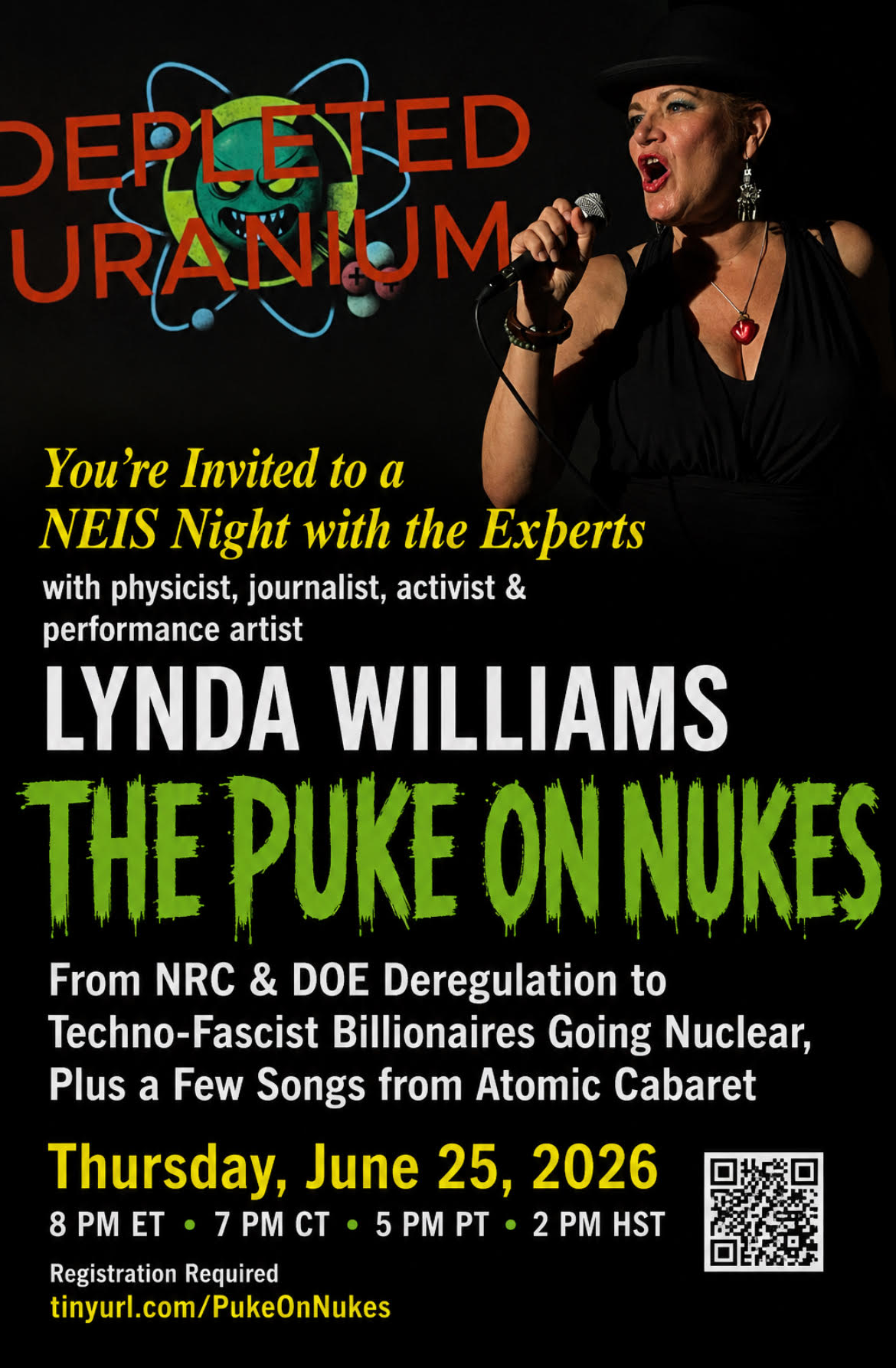
25 June- THE PUKE ON NUKES
Thursday, June 25, 2026
7pm Central Time (8pm ET, 6pm MT, 5pm PT) UTC – 5
From NRC & DOE Deregulation to Techno-Fascist Billionaires Going Nuclear, Plus a Few Songs from Atomic Cabaret REGISTER
26 June – Radiation Trainwreck at the NRC / Join the Protect Better Campaign – https://us02web.zoom.us/meeting/register/4ZlZ5_qLSHGiLSCg8FF6Bg#/registration
1st July – Webinar Waste of Space: The Environmental Harm of Military and Civil Space Activity st July, 7 pm

Report Launch Online: We are seeing an increasing exploitation of space for military and commercial purposes. This must change.

Protect Sazan Island from the Trump family! https://secure.avaaz.org/campaign/en/protect_sazan_island_from_the_trump_family_loc/?bqFCVab&v=174511&cl=22707147157&_checksum=5e9dde668860e8231c33699735e16a1fbf22ab2cb01da50c999fe8732b9775ef&utm_source=email&utm_medium=blast_email&utm_campaign=174511


Cuba Is Not a Failed State – It Is a Besieged State
PETITION: “Global Appeal to Endorse Palestinian Right of Return of Refugees”
To see nuclear-related stories in greater depth and intensity – go to https://nuclearinformation.wordpress.com
-
Archives
- June 2026 (221)
- May 2026 (306)
- April 2026 (356)
- March 2026 (251)
- February 2026 (268)
- January 2026 (308)
- December 2025 (358)
- November 2025 (359)
- October 2025 (376)
- September 2025 (257)
- August 2025 (319)
- July 2025 (230)
-
Categories
- 1
- 1 NUCLEAR ISSUES
- business and costs
- climate change
- culture and arts
- ENERGY
- environment
- health
- history
- indigenous issues
- Legal
- marketing of nuclear
- media
- opposition to nuclear
- PERSONAL STORIES
- politics
- politics international
- Religion and ethics
- safety
- secrets,lies and civil liberties
- spinbuster
- technology
- Uranium
- wastes
- weapons and war
- Women
- 2 WORLD
- ACTION
- AFRICA
- Atrocities
- AUSTRALIA
- Christina's notes
- Christina's themes
- culture and arts
- Events
- Fuk 2022
- Fuk 2023
- Fukushima 2017
- Fukushima 2018
- fukushima 2019
- Fukushima 2020
- Fukushima 2021
- general
- global warming
- Humour (God we need it)
- Nuclear
- RARE EARTHS
- Reference
- resources – print
- Resources -audiovicual
- Weekly Newsletter
- World
- World Nuclear
- YouTube
-
RSS
Entries RSS
Comments RSS
 nuclear-news