Starmer’s latest con job
The government’s nuclear power expansion plan is a hollow betrayal of working people that panders to wealthy corporations and will rip off consumers, writes LINDA PENTZ GUNTER

No nuclear reactor, small or otherwise, will ever be built in time, affordably or in enough quantities to address the climate crisis that is already upon us.
February 15, 2025,
https://morningstaronline.co.uk/article/starmer%E2%80%99s-latest-con-job
IS KEIR STARMER really so desperate to bask in the orange glow of omnipotence radiating from the monomaniacal US president that he feels compelled to parrot Donald Trump’s catchphrases?
Apparently yes. Starmer really did say “build, baby build.”
The context for this abhorrent utterance was his announcement that mini-nuclear power plants — known as small modular reactors — would proliferate across Britain until they are “commonplace.”
According to Starmer, they would be smaller and cheaper than current nuclear power plants. Those living near nuclear construction sites could be compensated for this inconvenience with lowered electricity rates. New reactors would be in place by 2032.
All of this is completely unsubstantiated by any shred of empirical evidence, but more on that in a moment.
Starmer’s “fast forward on nuclear” would, he claims, deliver a supply of good jobs as well as “homegrown power.” (If you are searching a UK map for the “homegrown” uranium mines that would supply the fuel for these reactors, keep looking.)
The restriction on building new reactors on existing nuclear sites is to be lifted so they could be built anywhere and everywhere and people who “hadn’t thought there’s going to be anything nuclear near me” will simply “get used to the idea of it,” Starmer said.
Oddly, the first new site doesn’t appear to be adjacent to Number 10 Downing Street.
The whole thing is of course a massive con that would, if such a plan ever materialised, dramatically raise electricity rates, further fleece taxpayers, impede real progress on climate by diverting money away from already available renewable energy solutions, and put countless communities in danger.

And of course, what will become of the radioactive waste these “small” reactors would still produce? A recent Stanford study found that small modular reactors will actually generate more radioactive waste than conventional nuclear power plants.
Unions should not be fooled. Promising jobs that will likely never materialise and would be better created immediately in industries such as renewable energy that are here now and have a long-term future, isn’t a boon to working people, it’s yet another betrayal.
Further, nuclear power, as the industry has itself demonstrated over and over, is the slowest and most expensive energy choice among the so-called low-carbon options.
No nuclear reactor, small or otherwise, will ever be built in time, affordably or in enough quantities to address the climate crisis that is already upon us.
Study after study shows that greater carbon emissions can be achieved far faster by investing the same amount in renewable energy instead of nuclear power.
The Starmer government is deliberately ignoring that to pander to big corporations rather than invest in the public good.
Nuclear power is in any case not low-carbon, and certainly not carbon-zero as the industry often brags.
The Hinkley Point C two-reactor site on the Somerset coast will have used between 200,000 to one million tons of steel by the time the two reactors are complete, according to various estimates, and will consume the equivalent electrical power of a small country.
Further, nuclear power, unlike the renewable energy industry, has demonstrated negative learning by actually becoming slower to build and more expensive over time.
In October 2021, Lazard, one of the world’s leading financial advisory and asset management firms, calculated that the average construction cost of a utility-scale photovoltaic plant in the US was £695 per kilowatt of generation capacity. A nuclear plant, it said, would cost around £8,185 per kilowatt — almost 12 times as much.
A Sussex University study looking at 180 nuclear construction projects around the world found that 175 of them took, on average, 64 per cent more time than anticipated with final costs 177 per cent higher than originally predicted.
Small modular reactor projects will be more expensive than conventional nuclear plants because, being so small, they have poor economies of scale, requiring massive upfront orders to make a factory producing them financially viable.
Small reactors also require an equally massive deployment in order to generate the equivalent amount of energy currently produced by large-sized reactors. It’s why the industry has rejected small modular reactors for decades.
Wealthy corporations such as Rolls-Royce, one of the companies eager to build small modular reactors in Britain, are not willing to shoulder any of this risk. But, under Starmer’s scheme, the high costs of new reactor development and construction will be passed on to consumers and taxpayers.
In fact, this is already in place. A new Regulated Asset Base (RAB) funding model came into force in the UK in May 2022. RAB incentivises private investment in new nuclear projects by charging consumers through their electricity bills — with no guarantee that the nuclear plant will ever be completed.
This is precisely the fate that befell ratepayers in South Carolina in the US, where a similar law is in place and where two planned reactors were abandoned in 2017, by which time ratepayers had paid £1,6 billion for reactors that would never deliver a watt of electricity.
The extent to which the nuclear choice is a bad deal for Britain was made plain back in 2020, when the UK Department for Business, Energy and Industrial Strategy estimated that a large-scale solar project targeted to become operational in the UK in 2025 would produce electricity with a levelised cost of £44 per megawatt hour. Its estimate for nuclear power was £102 per megawatt hour. (Levelising takes into account all variable costs from licensing, construction, operation and eventual decommissioning and waste management.)
No nuclear corporations — not even multibillionaire Bill Gates’s nuclear reactor company Terrapower — will build new nuclear plants without charging both consumers and taxpayers to do it. Gates has asked the US government — ie US taxpayers — to foot half of his project’s likely underestimated £3.2 billion cost.
As physicist MV Ramana points out in his new book Nuclear Is Not The Solution, corporations only embark on new nuclear projects “when the public can be made to bear a large fraction of the high costs of building nuclear plants and operating them, either in the form of higher power bills or in the form of taxes.”
Starmer’s aspirations of empire that would make little Britain “one of the world’s leaders on nuclear” are no more than a craven capitulation to Rolls-Royce and other corporations, which have been complaining for years that the process in place is too arduous and slow, with too many regulatory hurdles. (Let’s not forget that Rolls Royce is an integral part of Britain’s nuclear weapons complex. Late last month the company got a new £9bn eight-year deal to support Britain’s nuclear submarine programme, the most lethal destructive force on Earth. This is not a coincidence.)
Cue Starmer’s Nuclear Regulatory Taskforce announced with a brazen headline on the government’s own website: “Government rips up rules to fire-up nuclear power.”
The taskforce mandate is ostensibly to fast-track and streamline approval of new reactor design and development. But despite Starmer’s protestations that there would be “no compromise on safety,” the phrases “fast-track” and “streamline” are code for precisely that; safety shortcuts.
Ripping up the rules is exactly what this is about — the rules concerning safety. They were there for a reason, given nuclear power is the most lethal method yet discovered by which to boil water. And reducing safety oversight is a particularly dangerous drift given that none of the current small modular reactors — still effectively just drawings on paper — have proven safety records.
Indeed, quite the opposite. Whether they are based on miniature versions of the traditional pressurised water reactor, such as those being built at Hinkley Point C, or “fast reactors,” none are new designs and all have significant known safety flaws.
Even the US Nuclear Regulatory Commission, a willing industry lapdog, declined the design submitted by Oklo for its 15-50 megawatt Aurora micro reactor because the company could not answer fundamental safety questions.
“Oklo’s application continues to contain significant information gaps in its description of Aurora’s potential accidents as well as its classification of safety systems and components,” the NRC wrote.
That should be a warning for the British public who are not being asked but told by the Starmer government that they must accept a nuclear reactor in their community for the good of the country’s “energy security.”
This threat is perhaps the most sinister part of the entire new nuclear announcement. There will be no dissent. The Starmer government will “push past nimbyism,” “take on the blockers” and “break through” any line of resistance from MPs minded to prevent a mini-Chernobyl happening in their constituents’ backyards.
While his autocratic idol in Washington DC continues to fling out a daily stream of fascistic executive orders like a hippopotamus with diarrhoea, Starmer is seemingly striving to match him at every turn.
Whether it’s stripping pensioners of life-saving winter fuel allowances, keeping children in poverty by refusing to lift the two-child benefit cap, autocratically arresting peaceful protesters on climate or Palestine, or misleading the British public with false promises about nuclear power, Starmer is consistent in at least one regard: making one bad decision after another.
The new nuclear plan is a “great opportunity” for Rolls-Royce, a company so deserving it ranks as “among the best in the world,” crowed Starmer. Maybe he’s just looking for a shiny new car to go with those free designer suits and A-level crash pads?
Linda Pentz Gunter is a writer based in Takoma Park, Maryland, and the founder of Beyond Nuclear, a non-governmental anti-nuclear advocacy group.
Trouble at t’mill: local Councils rebel over nuke dump plan

The NFLAs have welcomed today’s statement made by the Leader of East Lindsey District Council that he shall recommend to his Executive that they ‘unanimously withdraw’ the council from the Theddlethorpe Community Partnership and the GDF process at their next meeting.
Coupled with the withdrawal of Millom Town Council from the South Copeland GDF Community Partnership and condemnation by Seascale Parish Council of the imposition of an Area of Focus for Mid-Copeland east of the village, this demonstrates that there is increasing disaffection amongst politicians with the process.
In his statement, ELDC Council Leader Craig Leyland cited the change of prospective site for a possible GDF surface facility from the former Theddlethorpe Conoco gas terminal to a 4km square parcel of farmland between the inland villages of Gayton le Marsh and Great Carlton. This he describes as prime agricultural land that has not had any previous industrial use and that is ‘nestling close to the Lincolnshire Wolds Area of Outstanding Natural Beauty’…………….
NFLA 12th Feb 2025,
https://www.nuclearpolicy.info/news/trouble-at-tmill-local-councils-rebel-over-nuke-dump-plan/
Nuclear waste plan ‘would scar Lincolnshire Wolds’
BBC UK Sharon Edwards, Political reporter, Lincolnshire, 12th Feb 2025
A council is set to withdraw from talks to bury nuclear waste in the countryside.
Nuclear Waste Services (NWS), a government body, has earmarked an area near Louth, Lincolnshire, to build a disposal facility.
However, East Lindsey District Council (ELDC) leader Craig Leyland said the scheme would “scar” agricultural land, and a consultation process had served only to “antagonise and distress” residents.
NWS thanked the district council for taking part in the talks and said it would continue working with Lincolnshire County Council.
In 2021, the district council joined a community partnership group with NWS to examine a previous proposal to bury waste at a former gas terminal in Theddlethorpe, near Mablethorpe.
Last month, NWS announced it had moved the proposed location of the facility to land between Gayton le Marsh and Great Carlton.
But Leyland said the new proposal would “scar several kilometres of Lincolnshire farmland on the margins of the Lincolnshire Wolds”.
He also said the consultation process had “not been effective” and the council had not been given all the information it needed from NWS.
East Lindsey councillors will be asked to formally vote to withdraw from the consultation.
‘A key role’
The move will not automatically kill the plan, which requires “community consent” to go ahead, as NWS is still working with the county council……………………………
Lincolnshire County Council (LCC) remains in the process, but leader Councillor Martin Hill said the authority shared some of ELDC’s concerns about the new location…………………………….
https://www.bbc.co.uk/news/articles/cnvqljq77p0o
Safety Issues and Impact on Marine Environment of Extension of British Nuclear Plant Lifespan Queried by NGO

The Celtic League has noted that there was a previous review of a decision to extend Torness’s lifespan, after the discovery of cracks in the graphite bricks, which make up the reactor cores of some advanced gas-cooled power stations.
Afloat 12th February 2025, https://afloat.ie/resources/news-update/item/66295-safety-issues-and-impact-on-marine-environment-of-extension-of-british-nuclear-plant-lifespan-queried-by-ngo
The Celtic League NGO has queried the impact on the marine environment of the British government’s decision to extend the life of four old nuclear power plants.
It has also said that the decision is one that both the Irish and Manx governments should be concerned about, given the potential environmental impact.
Last month, French state-owned company EDF Energy said that the lifespan of Scotland’s last remaining nuclear power station and three other plants in England would be extended.
The company said that Torness, in East Lothian, and its sister site Heysham 2, in Lancashire, would continue generating for an extra two years until 2030.
Two other sites – Hartlepool and Heysham 1 – will continue for an extra year until 2027, it said, and it planned to invest £1.3bn (sterling) across its operational nuclear estate over the next three years.
The Celtic League has noted that there was a previous review of a decision to extend Torness’s lifespan, after the discovery of cracks in the graphite bricks, which make up the reactor cores of some advanced gas-cooled power stations.
Bernard Moffatt of the Celtic League has submitted a number of questions relating to safety to British Chief Nuclear Inspector Mark Foy at the Office of Nuclear Regulation, and says it will publish any response it receives.
Anas Sarwar’s insistences on nuclear energy serves wrong people.

Last week, Anas Sarwar challenged John Swinney over his
determination to continue SNP policy that uses planning to veto new nuclear
power plants in Scotland. Sarwar announced at FMQs that 29% of the energy
mix that morning came from nuclear.
John Swinney pointed out 70% came from
renewables and suggested Labour would only muddy the water for investors in
Scotland if they focused unduly on the “junior partner” in the energy
mix.
Sarwar then pointed out China has built 29 nuclear power plants. Fine
– China has also built two-thirds of the world’s wind and solar
resource, yet its use of coal also makes it the world’s largest emitter.
Which tells us what precisely? Forget China – focus on Scotland. Scotland
backing nuclear is like geothermal and hydro-powered Iceland backing gas.
It makes no sense at all. Our destiny is to develop clean, green baseload
energy sources for ourselves and the rest of the world.
What’s so wrong with nuclear?
Jings, where to start? Nuclear costs more to produce, plants
take far longer to construct, leave behind radioactive waste and depend
largely on highly enriched uranium derived from Russia and workers forced
to risk radiation and exploitation.
Wind critics complain that
intermittency means baseload (flick of a switch) energy like gas must be
ready for wind-free days. But nuclear isn’t flick of a switch either –
it takes too long to power up and down so stays permanently on (apart from
planned maintenance) even when wind is high.
Last year, six international
academics were so worried about Labour’s new stance, they issued a joint
statement. Maybe it didn’t reach the new Prime Minister, but it was
published in The National. Professor Steve Thomas, Dr Paul Dorfman,
Professor MV Ramana, Professor Amory Lovins and Tetsunari Iida stated that
after 60 years of commercial history, “nuclear power is further from, not
nearer to, survival without massive public subsidies”, and contributes as
much electricity in one year as renewables add in three days.
Nuclear isn’t cheaper – anywhere. The German Institute for Economic Research
examined 674 nuclear power plants built across the world since 1951 and
found the average plant made a loss of €4.8 billion. It also isn’t
greener – the International Panel on Climate Change says renewables are
now 10 times more efficient than nuclear at CO2 mitigation.
And it certainly isn’t quicker. Professor Naomi Oreskes from Harvard University
wrote in Scientific American: “The most recent US nuclear power reactors
were started in 2013 and are still not finished. That’s the problem with
imagined ‘breakthrough’ technologies. The breakthrough can be sudden,
but implementation is slow.” [Sarwar] wrote a column for the Daily Record
which insisted: “John Swinney could end the SNP’s ideological
opposition to nuclear power, with the stroke of a pen.” Ah, Anas. The
boot’s on the other foot.
Opposition to nuclear in Scotland isn’t
ideological. But Labour’s deep attachment certainly is. Anas Sarwar also
contended that if Swinney backed nuclear, “he could unlock billions of
pounds of investment in Scotland and create spates of new quality jobs”.
Mmm. Spates. Maybe this was written in a hurry. Like the billions not
invested by the City of London in Sizewell or Hinkley C over the past
decade? Come on.
So, what’s Labour’s nuclear love-in really about? Some
think Starmer inherited “an absolute monster” after the Tories’ bad
decision to put billions of public cash into Sizewell. But others like
Professor Andrew Stirling and senior research fellow Philip Johnstone
advanced a different theory in the latest edition of the European:
“Nuclear affections are a military romance. Powerful defence interests
– with characteristic secrecy and highly active PR – are mostly driving
the dogged persistence.”
The National 13th Feb 2025, https://www.thenational.scot/politics/24931561.anas-sarwars-insistences-nuclear-energy-serves-wrong-people/
Great British Nuclear competition winners announcement still ‘around Spending Review’

13 Feb, 2025 By Tom Pashby
Great British Nuclear (GBN) has confirmed that the winners of its small modular reactor (SMR) competition will still be announced around the time of the Spending Review on 11 June 2025, despite reports that it would take place on 26 March at the Spring Statement.
GE-Hitachi, Holtec Britain, Rolls-Royce SMR and Westinghouse Electric Co. were announced as the final four companies in contention following the conclusion of the initial tender
stage at the end of September. NuScale dropped out at this point, while EDF
exited the competition in July when it failed to submit documents before
the deadline.
GBN completed two rounds of assessment with the four
shortlisted companies and is now entering negotiations ahead of the
submission of final tenders. The nuclear body said in November 2024 it had
started “detailed negotiations” with the four small modular reactor
(SMR) developers remaining in its competition for deployment in the UK. GBN
debunks financial news site report. Financial news site The Motley Fool
reported on 11 February that the announcement was “expected to be
announced by Great British Nuclear on or around the time of the Spring
Budget Statement, scheduled for 26 March”.
New Civil Engineer 13th Feb 2025, https://www.newcivilengineer.com/latest/great-british-nuclear-competition-winners-announcement-still-around-spending-review-13-02-2025/
Warning sent about need for strategic policing reform to address security of SMRs
New Civil Engineer, 2 Feb, 2025 By Tom Pashby
Security concerns have been raised following the publication of the draft National Policy Statement for nuclear energy which would change where small modular reactors (SMRs) could be situated.
National Policy Statement for nuclear energy generation (EN-7) was published in draft form on 6 February following an announcement by the prime minister about the slashing of legislation aroudn the development of nuclear energy generation projects………………………………….
Limited details about security in EN-7 raises policing questions
Despite EN-7 being 64 pages, just two lines are dedicated to specifically addressing the security of SMRs.
The proposed proliferation of SMRs in the UK presents a novel nuclear security risk because of there potentially being many more smaller nuclear-licensed sites which are closer to people and property than gigawatt-scale reactors which tend to be in remote coastal locations.
King’s College London Centre for Science & Security Studies research fellow Ross Peel previously told NCE that security planning for SMRs in the UK is “not where it should be”.
In a section titled “Security of Site”, EN-7 says “Ensuring that the proposed nuclear infrastructure will be secure is vital. The Security Considerations section of EN-1 addresses security considerations in detail.
“The applicant should engage with the Office for Nuclear Regulation (ONR) as part of early engagement on securing a Nuclear Site Licence to understand what steps will be required to comply with relevant site security requirements.”
Recent analysis by the Alan Turing Institute’s Centre for Emerging Technology and Security said that policing capability was not up to scratch to protect SMRs.
Policing SMRs would require a significant uplift in funding and workforce at the Civil Nuclear Constabulary (CNC) which is run by the Civil Nuclear Police Authority (CNPA). The CNPA is an executive non-departmental public body, sponsored by the Department for Energy Security and Net Zero (DESNZ).
Local police forces, overseen by the Home Office, could also be required to increase their capacity to respond to CBRN (chemical, biological, radiological and nuclear) incidents.
It is currently unclear how any resource uplift would be funded, and which bodies would provide that funding. As things stand, gigawatt-scale nuclear power sites’ security is funded by the developers themselves.
The business model for SMRs is not yet settled, with different developers proposing different management mechanisms.
Existing policing model does not accommodate complex demands of SMRs
Former police investigations and review commissioner Scotland and co-author of the Centre for Emerging Technology and Security analysis on SMR policing John McNeill said: “The ONR can specify security standards for SMRs, but they cannot require policing bodies to comply with their requirements.
“ONR can specify, approve, or reject, security arrangements, and vary these in response to changes in the threat assessments. But they cannot require any Police and Crime Commissioner (PCC) or Chief Constable (CC) to assign resources to meet their defined standards. Not even [the government] can direct them.
“Policing of airports and football grounds, even schools and educational campuses, shows how hard this will be to fund fairly…………………………………………………………….
“The existing policing model does not readily accommodate the complex demands of responding to the protection of the critical national infrastructure, nor a spread of SMRs.
It’s an outdated model that is not fit for this purpose. Since 2012 the 43 local (directly elected) policing bodies have set the priorities and assigned the budgets, for their police areas.
“We have already highlighted the complexities of policing a proliferation of SMRs in new areas of the country. Policing will need to extend their capability and capacity to respond. And meet the associated costs. It will not be enough to promise a reduction in their electricity bills sometime in the future!
“In short, the deafening silence from the Home Office and policing bodies is not reassuring to apprehensive communities who may have an SMR (or more) in their back yard.
“Finally, who pays the piper? Contractors will baulk at paying for local security. Site security may be less problematic.”
Sheffield Hallam University hosts the Centre of Excellence in Terrorism, Resilience, Intelligence and Organised Crime Research (Centric).
Centric professor in governance and national security Fraser Sampson co-authored the policing reform analysis with McNeill.
Sampson said: “The introduction of SMRs (and now associated data centres) is being presented as wholly different from whatever has gone before. That means the policing and security arrangements will need to be wholly different as they are the solution to the wrong problem.
“The engineering, environmental and economic noises are deafening but so is the silence on the extraordinary challenges that this will bring for community-level policing and resilience.
Policing and security are a network of systems. Turbocharging one part of a system will only pay off if the rest of the system can keep up – otherwise, the fast bit has to wait for the rest. No one wants to be responsible for the weakest link in the security chain.
“Workforce vetting has proved challenging enough for policing; an exponential increase in both volume and speed of reliable vetting must have a significant resource impact but add in risks from supply chain integrity, cyber-attacks and insider threats.”
Sampson said that the International Atomic Energy Agency (IAEA) “states more than half of radioactive [materials] thefts/losses since 1993 occurred during authorised transit.
“Where is the reassurance coming from that proliferation will improve these figures? We’re not dealing with Swampy anymore.”
Concerns about security of SMRs raised in parliament
In a debate about SMRs in the House of Lords, backbench Labour peer Lord Harris of Haringey asked about the potential increased demand on nuclear policing. The debate took place on 22 January 2025, before the publication of EN-7.
Outside of parliament, Harris is chair of the National Preparedness Commission (NPC), which works “to promote policies and actions to help the UK be significantly better prepared to avoid, mitigate, respond to, and recover from major shocks, threats and challenges”.
In the Lords debate, Harris asked: “What consideration has been given to who will protect and police modular nuclear reactors?
“Will it be the Civil Nuclear Constabulary, which would mean covering far more sites than it currently does, or will it be the other police forces?
“What discussions has the Minister had with his colleagues at the Home Office?”……………………………………………………………………..
https://www.newcivilengineer.com/latest/warning-sent-about-need-for-strategic-policing-reform-to-address-security-of-smrs-12-02-2025/
Nuclear waste site plans in Midlands face major setback as council withdraws
Proposals for a massive underground hazardous nuclear waste site in the
Midlands have hit a setback after a council withdrew from a major
partnership, ignited because the agency behind the scheme are now looking
at putting the entrance close to a national beauty spot rather than a
disused gasworks.
Yesterday (wed) the leader of East Lindsey District
Council announced it was leaving a community partnership with Nuclear Waste
Services (NWS), the government agency which is behind the project to
dispose of Britain’s radioactive waste in a Ground Disposal Facility (GDF).
Insider Media 13th Feb 2025, https://www.insidermedia.com/news/midlands/nuclear-waste-site-plans-in-midlands-face-major-setback-as-council-withdraws
Why Welsh speakers oppose Wylfa nuclear plant
Letter David Thomas: I was dismayed to see your article (Report, February
8), blithely dismissing the impact of the planned Wylfa Newydd nuclear
power station on Welsh-speaking communities. You parrot the view of the
nuclear industry that nothing should stand in the way of the bulldozers,
with little regard for the wider picture here in Wales.
The valid concerns
of Welsh-speaking communities are deemed illegitimate by the nuclear
industry, and Welsh speakers’ interests are portrayed as akin to those of
bats and newts — as unnecessary “blockers” to progress.
The ongoing survival of the Welsh language is nothing short of a miracle in the face of
the linguistic, economic and political hegemony of our English neighbour.
To dismiss linguistic and cultural concerns that the Wylfa Newydd plan
might entail is to dismiss the very existence of Wales as a linguistic and
cultural entity.
The Welsh government has committed to a target of having
1mn Welsh speakers by 2050. This plan has been ratified on repeated
occasions by the Welsh electorate, and surveys show that an overwhelming
majority of the Welsh population are well disposed to the language, even
among groups of non Welsh speakers.
We might also question why Ynys Môn
(Anglesey) is perceived as a suitable site for a new nuclear power plant.
Wales is already a net exporter of energy, yet Welsh consumers pay more for
electricity than the vast majority of their English counterparts.
Possibilities for renewables in the form of onshore and offshore wind and
tidal energy appear promising, yet attempts to pioneer tidal power in Wales
have been blocked by successive UK governments.
FT 12th Feb 2025
https://www.ft.com/content/3c9045c5-8cb4-4db3-bdf1-734b7cd789bf
NUCLEAR BRIBERY: Nuclear Waste Services funds Cumbrian community projects

More than 260 projects across Cumbria and Lincolnshire have received
financial support from Nuclear Waste Services (NWS). The community projects
have received millions of pounds worth of funding from NWS in the last
three years. The communities in which NWS operates have been supported by
funding that aims to benefit people and projects. Over the last three
years, more than £10 million has been awarded to over 260 initiatives
across Cumbria and Lincolnshire ranging from youth schemes, mental health
initiatives, and mountain rescue.
Carlisle News & Star 13th Feb 2025, https://www.newsandstar.co.uk/news/24931120.nuclear-waste-services-funds-cumbrian-community-projects/
The Coventry experiment: why were Indian women in Britain given radioactive food without their consent?
When details about a scientific study in the 1960s became public, there was shock, outrage and anxiety. But exactly what happened?
By Samira Shackle, Guardian, 11 Feb 25
In 2019, Shahnaz Akhter, a postdoctoral researcher at Warwick University, was chatting to her sister, who mentioned a documentary that had aired on Channel 4 in the mid-1990s. It was about human radiation experiments, including one that had taken place in 1969 in Coventry. As part of an experiment on iron absorption, 21 Indian women had been fed chapatis baked with radioactive isotopes, apparently without their consent.
Having grown up in Coventry’s tight-knit South Asian community, Akhter was shocked that she had never heard of the experiment. When she looked into it, she found an inquiry by the Coventry Health Authority in 1995 conducted soon after the documentary aired. The inquiry examined whether the experiment put the subjects’ health at risk and whether informed consent was obtained. But the only mention of the women’s perspectives was a single sentence: “At the public meeting, it was stated that two of the participants who had come forward had no recollection of giving informed consent.”
…………………………………… rather than putting out a public call for information, Akhter quietly asked around within her community for people who might know families that had been affected.
By chance, at about the same time, a historian and broadcaster, Dr Louise Raw, came across some old reporting about the radioactive chapatis – specifically, a 1995 story in India Today following up on the documentary, which jogged her memory of watching the film when it aired. Raw is interested in hidden histories and was immediately intrigued.
……………………………………………………….The story provoked major anxiety in Coventry. Though the study only involved 21 women, Owatemi was contacted by scores of people terrified that their mothers or grandmothers had been affected.
………………………………………Desperate for information, Kalbir – an articulate, assertive woman who sees herself as a fighter – tried to get access to her mother’s medical records, only to hit dead ends: the doctor’s surgery no longer existed and medical confidentiality still applied after death. Meanwhile, Akhter and Owatemi’s efforts were stalling too. The Medical Research Council (MRC), the public body that funds and coordinates research into human health in the UK, says it does not have any documentation relating to the study, not even a list of who was experimented on………………………………
The study took place more than 50 years ago, yet it still stirs up strong emotions, tapping into a host of broader anxieties about racial health inequalities and abuses by the medical establishment. After so many years have elapsed, sorting truth from panic is a complex task. What really happened in Coventry in 1969?
……………………………………………………..In the postwar period, doctors used radiation to treat everything from arthritis to ringworm. By the mid-1950s, it had become clear that exposure increases the chance of developing certain cancers and can cause infertility. The use of radiation was pared back, but medical researchers remained excited about the quick, precise experimentation it offered.
……………………………………..a new set of principles for ethical research on humans, known as the Nuremberg Code, had been introduced. The first of its 10 points is: “The voluntary consent of the human subject is absolutely essential.” The code also sets out other principles: experiments should be for the good of society and carried out by qualified researchers, and the risk should never exceed the potential benefit. But at first the code didn’t have much effect on researchers in the UK and the US, who saw it as something that applied to evil war criminals, not high-minded doctors who wanted to further scientific knowledge. In 1964, the medical researcher Paul Beeson, who had been a professor of medicine at both Yale and Oxford, wrote that the Nuremberg Code was “a wonderful document to say why the war crimes were atrocities, but it’s not a very good guide to clinical investigation which is done with high motives”.
……………………………..There are countless other examples from the US, UK and Canada. A number of these involved radiation exposure: in the 1950s, pregnant women in London and Aberdeen were injected with radioactive iodine to test their thyroid function despite the fact that radiation exposure of any sort poses a risk to a foetus. In Massachusetts in the 1940s and 1950s, boys with learning difficulties at a residential school were fed radioactive oatmeal as part of an experiment to see how Quaker Oats were digested.
………………………………………………………………………………………………………. in Cardiff Elwood hired an Indian housewife to teach a group of Welsh women to make traditional chapatis. Using flour fortified with radioactive iron, they made 200 chapatis to freeze until needed. Meanwhile, Elwood looked for participants. He needed South Asian women who still ate a traditional diet. Eventually he settled on Coventry, where there was a community of migrants from the Punjab region of India. Elwood’s team enlisted a doctor’s surgery in Foleshill, the centre of Coventry’s South Asian community, to identify women who could take part.
………………………………………………………….Despite translation difficulties, and the possibility that the women did not understand what was happening, the study got under way. Every morning for four days, the women were asked to eat one of the irradiated chapatis, which were delivered on dry ice each morning. A few hours later, Tom Benjamin, a field worker on Elwood’s team, would return, visiting all 21 houses to check the women had eaten it and record what foods they’d had with it. Seventeen days later, the women were picked up and driven an hour and a half to Harwell Laboratory for testing,
…………………………………Kalbir finds it upsetting to imagine her mother there. “The terror these women must have gone through,” she said. “They were already struggling in England. Our homes were being attacked by racists, we would get abused on the street, and then the system does this to them.”
The study, published in 1970, found that iron was not absorbed any more effectively from chapatis and the fermented flour they use than from bread. No one informed the women about the results, and no one followed up to check whether the radiation exposure had impacted their health.
………………………………………………In the 1990s, MRC officials insisted that it would be a poor use of public money to do a follow-up study on the women since the level of radiation exposure was so low. But to people who already feel misled, such reassurances can feel like a repetition of the “doctor knows best” mentality. “I feel anger, frustration and massive anxiety,” Kalbir told me. “I’m desperate to get answers and justice.” As it has surfaced and resurfaced, the story of the radioactive chapatis has come to represent something more than itself. “These women had a hard time in England,” said Kalbir. “They didn’t understand the way research and the medical professions worked. They had a great deal of trust. This shouldn’t have happened.” https://www.theguardian.com/news/2025/feb/11/the-coventry-experiment-why-were-indian-women-in-britain-given-radioactive-food-without-consent
‘Nothing prepared us for Sizewell C devastation’
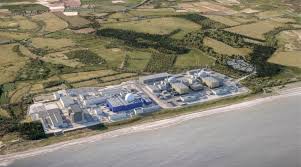
Richard Daniel, Environment reporter, BBC East of England, 10 Feb 25
Groundwork for a new nuclear power station on the Suffolk coast is well under way, but the funding needed to build it has still not been agreed.
Sizewell C said it was confident a final investment decision on the station would be made this summer.
Meanwhile, the cost of its sister project, Hinkley Point C in Somerset, has risen to as high as £46bn.
Opponents have likened Sizewell C to the beleaguered HS2 rail project and said the government should pull out before it is too late.
So what is the state of play?
In east Suffolk, signs of development are hard to miss.
Thousands of trees have been felled, and a huge swathe of land stretching from the outskirts of Leiston to the coast have been cleared for a new construction compound and access road to the Sizewell C site.
Elsewhere, land is being dug up for a new link road off the A12, a new bypass around the villages of Stratford St Andrew and Farnham, and two park-and-ride sites at Wickham Market and Darsham.
The groundwork started a year ago.
The twin reactors would generate 3.2 GW of electricity, sufficient to power six million homes.
So far the UK government, which has an 85% stake in the project, has pledged £5.5bn towards development work.
Last month, EDF denied reports that the total cost of the project had risen to over £40bn, up from an estimated £20bn in 2018.
It is seeking investors and the government said a final investment decision would be made in June.
‘It’s all gone’
David Grant’s farm at Middleton, near Leiston, has been cut in two by the new Sizewell link road and an access road to the B1122.
He said he had lost 38 acres (15 hectares) of arable land.
Opponents of Sizewell C still argue the project should be scrapped before it is too late.
Alison Downes, from Stop Sizewell C, said: “The taxpayer is being forced to pay for what is basically a bet that this project is a good idea and should go ahead.
“The possibility that Sizewell C could go ahead at whatever price is just completely inconceivable.
“Every penny they spend on Sizewell C is a penny lost to cheaper, quicker renewable energy projects that could get us to net zero more quickly and address our climate crisis.”
“Nothing prepared us for the devastation caused,” he said.
“It’s all gone, dug out with machines completely ruthlessly and without any sympathy.
“I think this is HS2, but bigger, frankly.
“I’ve got friends who were involved in the HS2 cancellation and they haven’t even been able to repurchase their land. Luckily we have the option to repurchase if this doesn’t go ahead.”
‘Every penny they spend is a penny lost’
Opponents of Sizewell C still argue the project should be scrapped before it is too late.
Alison Downes, from Stop Sizewell C, said: “The taxpayer is being forced to pay for what is basically a bet that this project is a good idea and should go ahead.
“The possibility that Sizewell C could go ahead at whatever price is just completely inconceivable.
“Every penny they spend on Sizewell C is a penny lost to cheaper, quicker renewable energy projects that could get us to net zero more quickly and address our climate crisis.”…………………. https://www.bbc.co.uk/news/articles/cd9qwygd5j4o
Engineer who worked on Hinkley Point C nuclear project quizzed on suspicion of being a Russian spy
By LETTICE BROMOVSKY, 4 February 2025 , https://www.dailymail.co.uk/news/article-14355483/Nuclear-power-worker-suspicion-Russian-spy.html?openWebLoggedIn=true&login
An engineer who worked on a UK nuclear project was quizzed on suspicion of being a spy after he returned to the UK from Russia.
Mario Zadra, a 67-year-old Italian national, who worked as an engineer on the Hinkley Point C project from 2020 to 2023 from their headquarters in Bristol, was questioned by counter-terrorism police after he flew into Heathrow airport on April 12, 2023.
It was reported that potentially sensitive documents were found in his possession and were seized by the authorities to prevent them being ‘used to carry out a hostile attack’.
Zadra was arrested under Schedule Three, which gives police the power to search, question, and detain a person to determine whether they are engaged in hostile activity, Burnham & Highbridge Weekly News first reported.
Hinkley Point C is currently constructing two new nuclear reactors, which will provide zero-carbon electricity for around six million homes, and is expected to cost a massive £46billion.
Zadra was later dismissed by his employer, Alten Ltd, a supplier for EDF’s Hinkley Point C – settling for more than £37,000 in an employment tribunal, local media reported.
Counter terrorism police retained Mr Zadra’s hard drives for national security reasons. He was not charged with any offence.
A spokesperson for Hinkley Point C said: ‘Hinkley Point C takes information security very seriously and there are rigorous measures in place to protect sensitive data.
‘This individual did not have access to sensitive nuclear information. The information he removed was outdated.
‘Allegations made by this person were thoroughly investigated and independently reviewed. His contract with Alten Ltd ended as a result of increasingly inappropriate and disruptive behaviour.’
The Met police and the Home Office have been approached for comment.
Octopus Energy launches renewables investment platform for consumers
Octopus Energy, the UK’s largest energy supplier, has launched an
investment platform allowing consumers to buy shares of a renewable energy
project. Octopus has launched ‘the Collective’ which it says is a
first-of-its-kind initiative that enables customers to invest in renewables
themselves. There is a minimum investment requirement of £25 but, since
there are no fees and the Collective is free to join, all returns go to the
investor. A YouGov survey revealed that 33% of Brits want to invest in
green power; Octopus says that by becoming the first energy company in the
UK with a retail investment platform regulated by the Financial Conduct
Authority (FCA), it will meet this demand.
Current 10th Feb 2025 https://www.current-news.co.uk/octopus-energy-launches-renewables-investment-platform-for-consumers/
The £40bn nuclear project at risk of becoming another British white elephant.

Telegraph 9th Feb 2025, Matt Oliver. Industry Editor,
On the Suffolk coast, an army of yellow diggers and dump
trucks are levelling fields and preparing the ground for one of Britain’s
biggest infrastructure projects. It is here that thousands of workers plan
to raise Sizewell C, a multibillion-pound nuclear power station, in the
late 2030s, eventually providing power for some 6m homes. If approved in
the coming months, the scheme would replace capacity lost elsewhere over
the next decade as other nuclear plants from the 1970s and 80s gradually
shut down.
Yet that is still a big “if”, with Labour ministers
currently weighing up whether the benefits of Sizewell C are worth the
gargantuan costs, which will reportedly exceed £40bn (the original budget
given to HS2). On one hand, it is a shovel-ready project that promises to
boost energy security and economic growth – something Rachel Reeves, the
Chancellor, is in desperate need of.
Hanging over the project, however, is
the shadow of its sister scheme: Hinkley Point C in Somerset, which is
running years behind schedule and has gone dramatically over-budget.
Should Sizewell C spiral into disaster, like Hinkley, it could easily become a
white elephant that kills off the prospects of any future successors. And
unlike its sister scheme, which was funded entirely by EDF and other
investors, British taxpayers will be on the hook if things go wrong, with
the Government playing the role of anchor investor.
“There is no transparency around Sizewell C,” says spokesman Alison Downes, who lives
nearby. “Why, despite government support, does its likely eye-watering
cost and impact on households remain shrouded in secrecy? Hinkley has
morphed into the most expensive nuclear power station ever built, by some
distance. Originally budgeted at £18bn, it is now estimated to cost
£46bn. Miliband quietly initiated a review of the nuclear programme last
year and there is speculation he could soon axe the Wylfa proposal in
favour of focusing on mini nuclear plants known as small modular reactors
(SMR) instead.
https://www.telegraph.co.uk/business/2025/02/09/sizewell-c-becoming-another-british-white-elephant/
1 This Month
22 June – Virtual Event –Climate Change: New Data, New Debate

Monday, June 22, 2026 2:30 p.m. – 3:15 p.m. CT
YouTube. Register here

Protect Sazan Island from the Trump family! https://secure.avaaz.org/campaign/en/protect_sazan_island_from_the_trump_family_loc/?bqFCVab&v=174511&cl=22707147157&_checksum=5e9dde668860e8231c33699735e16a1fbf22ab2cb01da50c999fe8732b9775ef&utm_source=email&utm_medium=blast_email&utm_campaign=174511
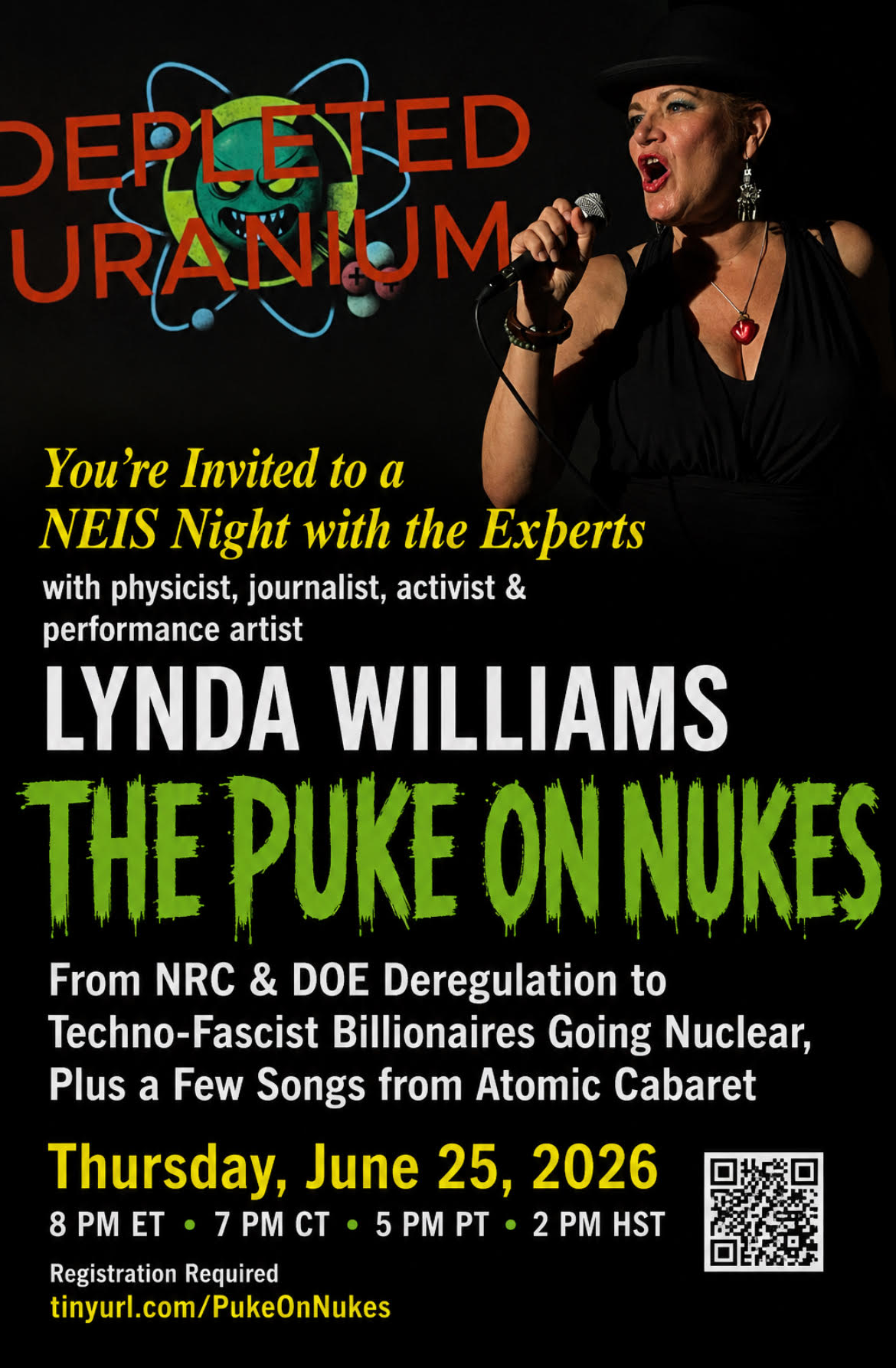
25 June- THE PUKE ON NUKES
Thursday, June 25, 2026
7pm Central Time (8pm ET, 6pm MT, 5pm PT) UTC – 5
From NRC & DOE Deregulation to Techno-Fascist Billionaires Going Nuclear, Plus a Few Songs from Atomic Cabaret REGISTER
26 June – Radiation Trainwreck at the NRC / Join the Protect Better Campaign – https://us02web.zoom.us/meeting/register/4ZlZ5_qLSHGiLSCg8FF6Bg#/registration

Cuba Is Not a Failed State – It Is a Besieged State
PETITION: “Global Appeal to Endorse Palestinian Right of Return of Refugees”
To see nuclear-related stories in greater depth and intensity – go to https://nuclearinformation.wordpress.com
-
Archives
- June 2026 (193)
- May 2026 (306)
- April 2026 (356)
- March 2026 (251)
- February 2026 (268)
- January 2026 (308)
- December 2025 (358)
- November 2025 (359)
- October 2025 (376)
- September 2025 (257)
- August 2025 (319)
- July 2025 (230)
-
Categories
- 1
- 1 NUCLEAR ISSUES
- business and costs
- climate change
- culture and arts
- ENERGY
- environment
- health
- history
- indigenous issues
- Legal
- marketing of nuclear
- media
- opposition to nuclear
- PERSONAL STORIES
- politics
- politics international
- Religion and ethics
- safety
- secrets,lies and civil liberties
- spinbuster
- technology
- Uranium
- wastes
- weapons and war
- Women
- 2 WORLD
- ACTION
- AFRICA
- Atrocities
- AUSTRALIA
- Christina's notes
- Christina's themes
- culture and arts
- Events
- Fuk 2022
- Fuk 2023
- Fukushima 2017
- Fukushima 2018
- fukushima 2019
- Fukushima 2020
- Fukushima 2021
- general
- global warming
- Humour (God we need it)
- Nuclear
- RARE EARTHS
- Reference
- resources – print
- Resources -audiovicual
- Weekly Newsletter
- World
- World Nuclear
- YouTube
-
RSS
Entries RSS
Comments RSS
 nuclear-news